

ICD-10-CM M25.511 is the code for pain in the right shoulder. Use the code that matches documented laterality.
| ICD-10-CM Code | Description |
| M25.511 | Pain in right shoulder |
| M25.512 | Pain in left shoulder |
| M25.519 | Pain in unspecified shoulder |
The ICD-10 coding system plays an important role in documentation of medical disorders, the diagnosis and billing in contemporary healthcare. It facilitates insurance claims in order to ensure accurate medical records and documentation. Precise ICD-10 code matters for effective treatment and reimbursement when it concerns musculoskeletal diseases.
Right Shoulder Pain ICD-10 Code M25.511 is the standardized medical classification used to document and bill for pain located specifically in the right shoulder joint. The code can help in distinguishing between bilateral or left shoulder pain and right shoulder pain. This promotes clinical clarity and reduces claim denials. Furthermore, the code M25.511 enables physicians to precisely and consistently document right shoulder pain. This blog provides guidelines for an accurate diagnosis of the right shoulder pain ICD Code M25.511 which is mostly used by a medical coding company in USA.
Why ICD-10 Coding Matters in Right Shoulder Pain
An accurate ICD-10 classification is significant for right shoulder pain for an effective treatment. The ICD-10 code M25.511 is a specific code which helps physicians to accurately identify and treat right shoulder pain. Standardized coding increases uniformity across EHRs and healthcare systems in order to improve care coordination and lower documentation mistakes. Proper coding is helpful to providers, coders, patients, and researchers. Code support in correct diagnosis, compliance, reimbursement, and data validity to study treatment outcomes.
For healthcare providers aiming to maintain consistency in coding accuracy and reimbursement processes, reliable medical billing services in USA can further support compliant documentation and efficient claims management without altering clinical workflows.
Understanding ICD-10 Code M25.511
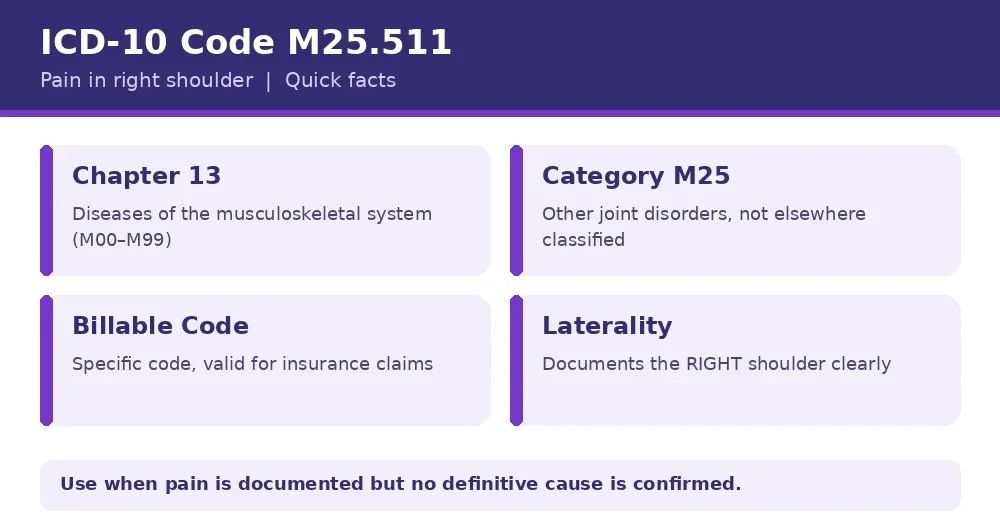
ICD-10 code M25.511 is the code which exactly detects pain in the right shoulder. This provides clear documentation of laterality for clinical and billing purposes. It is a billable code under the M25 category and falls under Chapter 13, which covers diseases of the musculoskeletal system and connective tissue (M00–M99). According to ICD 10 cmtool, external cause codes may be reported alongside M25.511 when identifying the underlying cause of the musculoskeletal condition:
Official ICD-10 Description
The official diagnostic code for right shoulder pain is ICD-10 code M25.511. It is useful when a patient reports pain in the right shoulder without possessing a more precise primary health problem recorded at the time of the consultation.
Code Category
The code M25.511 falls under the broader M25 category including other joint disorders and not elsewhere classified. This category is usually used for symptoms related to joints such as pain, stiffness, and instability when no final structural diagnosis has been established.
Billable Status and Coding Complexity
M25.511 is a billable and specific ICD-10 code which means that it can be used for insurance claims for reimbursement. It is preferred over icd 10 right shoulder pain unspecified options when documentation supports laterality because it specifies the right shoulder. Proper use of the icd 10 code right shoulder pain improves coding accuracy and reduces claim rejections across healthcare systems.
When M25.511 Should Be Assigned
The ICD-10 code for pain in the right shoulder should be allocated when right shoulder pain is the primary complaint and no more precise diagnosis. These diagnoses are right shoulder bursitis M75.51 or right clavicle pain such as ICD 10 code for right clavicle pain. M25.511 appropriately captures the symptom while further evaluation is ongoing if the cause of pain is unclear.
When to Use M25.511 vs. Other Shoulder ICD-10 Codes
When there is no specific condition identified at the time of consultation, ICD-10 code M25.511 is applied for common icd right shoulder pain. Laterality, clinical results, and the detection of a more accurate diagnosis all influence the right code to use.
General Shoulder Pain vs. Diagnosed Conditions
The code M25.511 is implemented when a patient presents icd 10 code right shoulder pain without a confirmed core condition. The general ICD-10 pain in the right shoulder code should be altered with a more specific code to reflect an actual clinical finding once that specific diagnosis is proved, such as right shoulder bursitis M75.51 or another confirmed shoulder condition.
Primary vs. Secondary Diagnosis Use
When right shoulder pain is the primary cause for the consultation, M25.511 can be reported as a primary diagnosis. When pain is associated with another illness or operation, it can additionally be designated as a secondary diagnosis. Accurate medical records along with appropriate compensation are ensured when the diagnosis code for shoulder pain is assigned correctly.
Pro Tip: Use ICD-10 code M25.511 when right shoulder pain is evidently documented but no conclusive root cause diagnosis is confirmed to ensure accurate laterality and cleaner insurance claims. Once a specific condition such as bursitis or clavicle involvement is recognized, replace M25.511 with the more precise ICD-10 code for best coding accuracy and reimbursement.
Documentation Requirements for Proper Selection
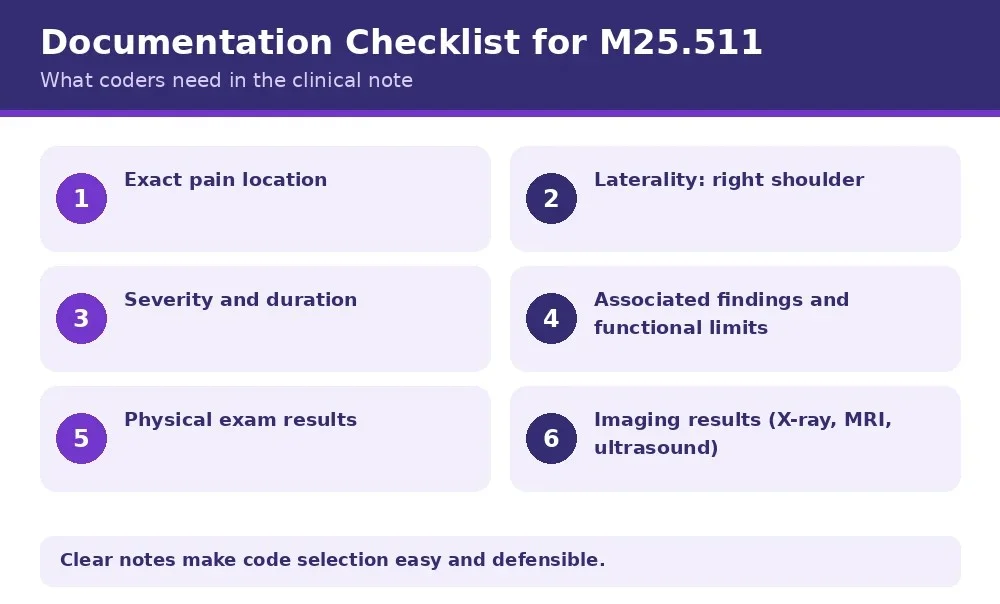
Proper code selection depends on thorough documentation, including pain location, laterality, duration, and associated findings. Clear notes allow coders to choose the correct ICD-10 code for pain in the right shoulder or transition to a more definitive diagnosis code when available. This same documentation-driven approach applies when reporting related conditions, such as ICD-10 Code for Abnormal Weight Gain, helping improve overall coding accuracy, compliance, and claim acceptance.
Getting Denials on This Code?
Accurate documentation and choosing the right ICD-10 code can go a long way in preventing unnecessary claim denials. Talk to a billing specialist who can help you find coding and documentation issues that may be slowing down reimbursement.
Clinical Presentation of ICD Right Shoulder Pain M25.511
Right shoulder pain icd 10 code usually and normally appears with stiffness, severe discomfort, aching, or a restricted range of motion. This frequently worsens with reaching, lifting, or overhead activities. Functional restrictions may include trouble in dressing, sleeping on the affected side, or performing daily tasks. Whereas many cases are coded using M25.511 right shoulder pain ICD-10 code for general symptoms and red flags such as numbness, trauma, severe weakness, fever, or persistent pain. This may designate a more serious structural injury requiring a more specific diagnosis of icd right shoulder pain, such as clavicular or bursitis involvement, rather than a general icd 10 pain right shoulder code.
Differential Diagnosis: Selecting the Correct ICD-10 Code M25.511
Differentiating between some shoulder conditions that come with their own ICD-10 codes and right shoulder pain, M25.511 is essential for precise coding. The general right shoulder pain ICD-10 code should be substituted with a more particular code when an accurate diagnosis is recorded. The following is the comparison of related ICD-10 Codes:
General Right Shoulder Pain
- M25.511 is for pain in the right shoulder.
- This is used when no definitive structural cause is identified.
- This is appropriate for initial or nonspecific presentations.
Rotator Cuff Disorders
- M75.101 is an unspecified rotator cuff tear or rupture of the right shoulder and not specified as traumatic.
- This is selected when imaging or clinical findings confirm a tear.
Bursitis
- M75.51 is used for the right shoulder bursitis.
- This is used when inflammation of the shoulder bursa is clearly documented.
- This is more specific than ICD 10 pain in the right shoulder.
Osteoarthritis
- M19.011 is the primary osteoarthritis and right shoulder.
- This is applied when degenerative joint disease is the confirmed cause of pain.
Shoulder Sprain or Strain
- S43.401A is the sprain of unspecified parts of the right shoulder girdle and initial encounter.
- This is used for acute injury related pain rather than chronic or nonspecific symptoms.
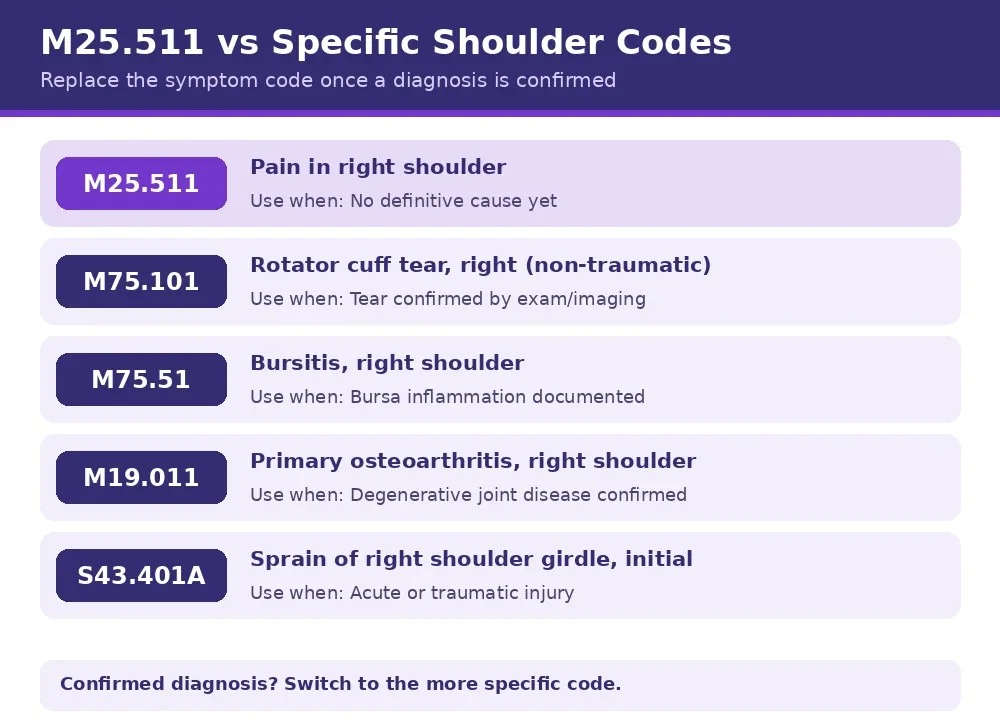
Pro Tip: Begin with M25.511 for right shoulder pain icd 10 code when no specific condition is confirmed, but always switch to a more precise ICD-10 code such as bursitis, rotator cuff tear, osteoarthritis, or sprain once clinical or imaging results establish a final diagnosis to ensure accurate coding and reimbursement.
Comparison of ICD-10 Codes for Right Shoulder Pain
| ICD-10 Code | / Description | Common Causes and Symptoms | Key Coding and Clinical Details |
| M25.511 | Pain in right shoulder | Nonspecific pain, aching, stiffness, limited range of motion, discomfort with lifting or overhead activity. | Billable symptom code; use when no definitive diagnosis is established; specifies laterality; appropriate for initial evaluation. |
| M75.101 | Unspecified rotator cuff tear or rupture of right shoulder, not traumatic. | Weakness, pain with arm elevation, night pain, reduced shoulder strength. | Use only when rotator cuff tear is clinically or radiologically confirmed; more specific than pain codes. |
| M75.51 | Bursitis of the right shoulder. | Inflammation, swelling, tenderness, pain during movement or pressure. | Use when shoulder bursa inflammation is documented; replaces M25.511 when diagnosis is confirmed. |
| M19.011 | Primary osteoarthritis, right shoulder. | Chronic pain, stiffness, reduced joint mobility, crepitus. | Degenerative joint disease; requires imaging or clinical confirmation; not appropriate for nonspecific pain. |
| S43.401A | Sprain of unspecified parts of right shoulder girdle, initial encounter. | Acute pain after trauma, swelling, limited motion. | Injury-specific code; use for acute or traumatic cases; not for chronic shoulder pain. |
| M62.81 | Muscle weakness | Reduced strength, difficulty lifting or holding objects. | Use when weakness is the primary finding; may be used alongside pain codes if documented. |
| Z48.81 | Encounter for surgical aftercare following surgery on the musculoskeletal system. | Post-operative pain, healing phase symptoms. | Not for active pathology; use for post-surgical follow-up care only. |
| ICD-10 code for right clavicle pain | Pain localized to the right clavicle. | Pain near the collarbone, tenderness after trauma or overuse. | Use a clavicle-specific diagnosis when the pain source is clavicular rather than shoulder joint. |
Causes and Risk Factors of Right Shoulder Pain
Several musculoskeletal disorders, such as muscle inflammation, bursitis, or joint degeneration can lead to right shoulder pain ICD-10 code M25.511. ICD-10 manifestations of right shoulder pain tend to be caused by trauma, ongoing usage, and incorrect positioning, whereas continual shoulder pain can be worsened by chronic conditions including diabetes or osteoarthritis. Unless a more accurate diagnosis code for right shoulder pain is identified, the appropriate use of the ICD-10 code for right shoulder pain will be essential because several drugs can cause musculoskeletal pain. You can minimize coding errors through outsource medical coding services.
Diagnostic Approach for M25.511
A comprehensive patient history and physical examination are the fundamental steps in determining the cause for right shoulder pain M25.511 in order to determine the level of discomfort, location, and functional implications of the pain. Although imaging procedures such as MRI, X-ray, or ultrasound can identify anatomical injuries.
Movement and implications for regular daily tasks are further assessed by functional and motion range tests. When results show a particular condition, such as clavicle damage, the rotator cuff tear, or right shoulder bursitis M75.51. The code should be updated from M25.511 to the relevant ICD-10 code for right shoulder pain or the particular diagnosis for proper documentation and billing. Related guidance on ICD-10 coding for left leg pain explains how accurate code selection supports consistent clinical documentation and billing processes.
Use of M25.511 Across Medical Specialties
Many medical specialties use the right shoulder pain ICD-10 code M25.511 to record nonspecific shoulder pain. It improves referral coordination and patient complaint tracking in primary care settings. M25.511 is applied in physical therapy to assess functional improvement and direct rehabilitation. Geriatrics applies it to evaluate aged-related musculoskeletal limitations, whereas neurology can apply it to assess shoulder pain due to nerve damage. M25.511 is commonly used in oncology as well to ensure consistent documentation. This also encourages provider contact when shoulder pain develops as a symptom or related to treatment side effects.
ICD-10 Coding M25.511: Management, Practices and Strategies
Proper documentation and appropriate strategies for treatment are essential for accurate classification as well as effective management of right shoulder pain M25.511. Accurate coding and the best possible treatment for patients are made possible by identifying laterality, precisely determining severity, duration, and associated findings, and updating to more specific ICD-10 codes when clinically validated. When necessary, specialized or surgical treatments are increased from a conservative first approach to treatment. Proper coding and documentation direct appropriate clinical management in addition to supporting compliance and reimbursement.
The following important practices and strategies can guide:
- Always document the exact location, severity, and duration of right shoulder pain.
- Specify laterality using the right shoulder code rather than unspecified alternatives.
- Update to more specific ICD-10 codes such as M75.51 for right shoulder bursitis when confirmed.
- Begin management with activity modification, rest, and pain relief without a prescription.
- Physical therapy can help to improve strength, flexibility, and range or level of motion.
- Corticosteroid injections can be considered if there is persistent pain.
- Recommend to orthopedic or pain specialists for unresolved symptoms or structural injuries.
Pro Tip: Precisely document laterality, severity, and duration when using M25.511, start with traditional management, and promptly update to a more specific ICD-10 code once an established diagnosis is recognized to support effective care, compliance, and proper reimbursement.
Comorbidities and Additional Coding Considerations
The right shoulder pain ICD-10 code M25.511 can be considered as a secondary diagnosis. When pain in the shoulder coexists with another primary condition. These conditions might be osteoarthritis, rotator cuff tear, or systemic musculoskeletal disorder. Several comorbid conditions can require further ICD-10 codes. There are a few manifestations of these conditions such as rheumatoid arthritis, diabetes, and cervical spine problems. Accurate and comprehensive coding can be helpful for adequate reimbursement and clinical accuracy.
When M25.511 Should Not be Applied
Conditions having a clear root cause should not be classified under the right shoulder pain ICD-10 code M25.511. Use codes such as M19.011 primary osteoarthritis and right shoulder for degenerative joint condition. Rather than using M25.511, neurological pain or radiculopathy can be classified using specific to nerves ICD-10 codes. Codes such as M62.81 for weakness in muscles are required in situations involving weak muscles or paralysis. Procedure follow-up codes or injury-focused such as S43.401A for sprains or Z48.81 for after surgical treatment should be applied to post-surgical or post-traumatic pain in the shoulder. Choosing the appropriate ICD-10 code ensures correct documentation, billing, and clinical clarity for icd 10 right shoulder pain.
Common Coding Errors and Insurance Denials
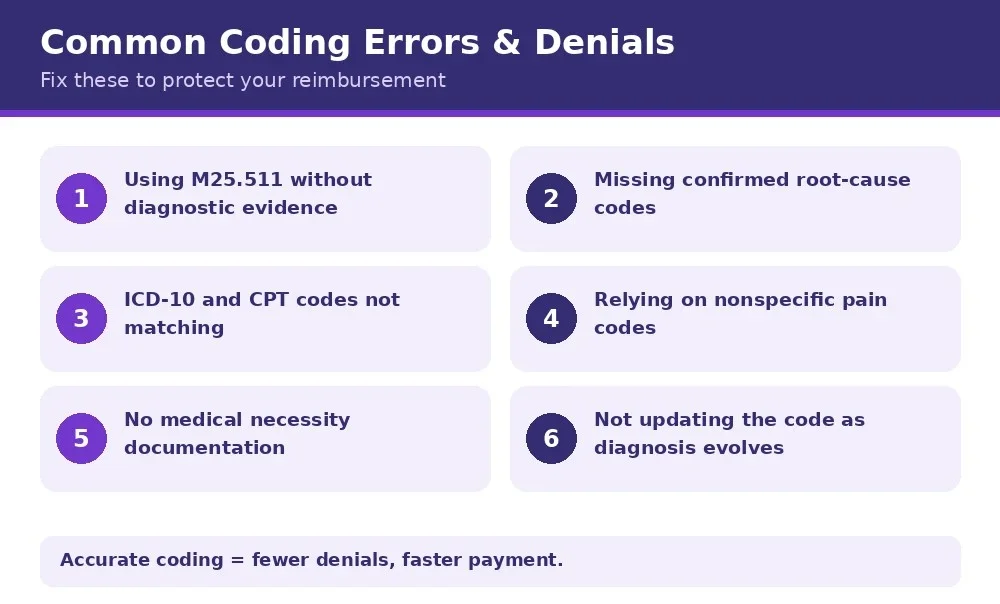
Insurance denials for right shoulder pain icd 10 code frequently result from incomplete documentation, incorrect code selection, or poor placement between diagnosis and services billed. Denial management services can help you with common coding errors and denials. Following are coding errors that need corrections:
- Applying M25.511 in absence of sufficient diagnostic evidence, such as findings from a physical exam or image data.
- Neglecting to code root causes or verified conditions such osteoarthritis (M19.011), rotator cuff tear (M75.101), or bursitis (M75.51).
- Mismatching ICD-10 diagnosis codes with disconnected or irrelevant CPT procedure codes.
- Relying on nonspecific pain codes when a definitive diagnosis is clinically recognized.
- Missing documentation of medical necessity for procedures or treatments.
- Inadequate notes on functional limitations, symptoms, and treatment rationale.
- Lack of continuation updates when the diagnosis evolves over time.
Compliance, Reimbursement, and Legal Considerations: ICD-10 Code M25.511
The M25.511 right shoulder pain ICD-10 code needs to be precisely used for quick reimbursement and claim acceptance. Medicare and HIPAA compliance gets additional backing through appropriate documentation. This reduces the possibility of penalties, audits, and legal issues. Additional information on lower back pain ICD-10 coding, from unspecified to chronic conditions, outlines proper classification for reporting and reimbursement purposes.
Following are important legal and compliance concerns include:
- Ensures correct processing and quick reimbursement of claims.
- Complies with payer regulations such as with HIPAA and Medicare.
- Reduces denials that are caused by incorrect, vague, or unsupported codes.
- Prevents miscoding or upcoding that can boost penalties.
- Protects providers from legal and financial liability or audits.
- Strengthens medical necessity documentation for shoulder pain services.
- Improves overall coding accuracy through regular audits and reviews.
Patient Impact and Future Outlook for Shoulder Pain Coding
ICD-10 codes M25.511 for right shoulder pain, which can influence daily activities, mental wellness, and financial security. As a result, prompt treatment and suitable documentation are essential. When providers are properly prepared, deeper and standardized shoulder pain coding can improve clinical clarity, documentation accuracy, and prospective patient care as healthcare moves towards ICD-11. The following are important impacts and future outlook for shoulder pain coding:
- Right shoulder pain can restrict everyday activities such as dressing, lifting, and overhead reaching.
- Chronic discomfort can worsen stress, irritability,frustration and problems with sleep.
- Patients can encounter financial burden as visits to the doctor and treatments.
- Personal care for patients can improve healing and manage symptoms.
- Improving posture, daily activities, and conducting gentle exercises are all that contribute to ease discomfort.
- Secure and effective pain management is contingent upon the use of medications.
- ICD-11 will introduce more detailed and standardized shoulder pain coding.
- Updated code structures will improve specificity for pain type, cause, and laterality.
- Early preparation, staff training, and EHR updates will support a smooth ICD-11 transition.
How iSolve RCM Supports Accurate Right Shoulder Pain Coding
For clinical clarity, adequate reimbursement, and compliance, right shoulder pain (M25.511) needs to be accurately documented and recorded. By guaranteeing accurate ICD-10 coding, verifying laterality and related conditions, and speeding the submission of claims, iSolve RCM can help medical professionals. Practitioners can effectively manage the administrative aspects of right shoulder pain ICD-10 code reporting while concentrating on patient treatment because of iSolve RCM’s experience in reducing denials, improving reimbursements, and preserving comprehensive compliance records.
FAQs
What is the difference between M25.511 and a rotator cuff tear?
M25.511 is for nonspecific right shoulder pain, whereas rotator cuff tears have their own codes such as M75.101 when a structural injury is confirmed.
Is M25.511 covered by Medicare?
Yes, M25.511 is billable for Medicare when correctly documented as the primary or secondary diagnosis for shoulder pain.
Should M25.511 be used for acute injuries?
No, post-traumatic pain or acute injuries should use ICD-10 codes specific injury rather than M25.511.
Can M25.511 be used alongside other shoulder diagnoses?
Yes, it can serve as a secondary code when shoulder pain coexists with conditions such as bursitis M75.51 or osteoarthritis M19.011.
What documentation is required for M25.511?
Comprehensive history, pain location, physical exam, and imaging results are required to support accurate billing and coding.