
Every medical claim tells a story, and every detail matters. Each line item represents a service, a department and a cost that the payer has to understand. Many claims are denied or delayed because of small mistakes, and confusion around revenue codes is one of the most common causes. Knowing what a revenue code is in medical billing is essential to submitting claims correctly and getting paid on time.
Revenue codes translate hospital services into a standard billing language that every payer accepts. They connect each service, from a routine lab test to a complex surgery, to the department where the care was delivered. That system brings consistency, clarity and precision to facility billing.
This guide explains what a revenue code is, how it is used on hospital and Medicare claims and why payers review it closely. It also includes a complete revenue codes list, the codes for inpatient care and surgery and the practical steps that reduce denials, whether billing is handled in-house or through outsourced medical billing services.
What is a Revenue Code in Medical Billing?
A revenue code is a four-digit code, established by the National Uniform Billing Committee (NUBC), that identifies the department, accommodation or type of service behind each charge on a hospital claim. Each line item in the hospital chargemaster carries a revenue code, and the code is reported in form locator 42 of the UB-04 claim form.
Revenue codes do not describe the specific procedure. Instead, they classify the charge as room and board, laboratory, radiology, pharmacy, operating room or another service area, which tells the payer where in the facility the service was provided.
Revenue codes are reported on institutional claims, the UB-04 or its electronic version the 837I, and they matter on both inpatient and outpatient hospital claims. They work alongside CPT and HCPCS procedure codes so that each charge is grouped, billed and paid according to payer rules. In short, revenue codes keep revenue cycle management accurate on the facility side.
Pro Tip: Always cross-check the revenue code against the hospital chargemaster and the matching CPT or HCPCS code. Using the correct code makes reimbursement much smoother and prevents avoidable denials.
Importance of Revenue Codes in Medical Billing
Revenue codes tie each medical service to the hospital department and cost center that provided it. They let payers see quickly where a service was delivered and which facility resources it used. Used correctly, a revenue code supports accurate charge reporting, reduces confusion during claim review and keeps services grouped in a standard way.
Revenue codes also affect how fast claims are approved and paid. A wrong or missing revenue code can lead to denials, delays or underpayment, especially on institutional and inpatient claims. With the right revenue codes and accurate medical coding, healthcare organizations improve compliance, raise billing accuracy and keep the revenue cycle running smoothly.
The Role of Revenue Codes in Healthcare Finance
Revenue codes are maintained by the NUBC, which standardizes them for institutional claims across the United States, and they are central to tracking the finances of healthcare services. In healthcare finance, revenue codes group services by department, such as laboratory, radiology, pharmacy or inpatient care.
That grouping lets hospitals track how services are used, allocate costs and measure department performance. Without revenue codes, connecting clinical services to financial data would be inconsistent.
Beyond internal tracking, revenue codes support reimbursement and financial reporting. Payers use them to validate charges, apply payment rules and estimate reimbursement on facility claims. Accurate use of revenue codes improves financial transparency, supports budgeting and forecasting and helps organizations keep a steady cash flow while staying within payer and regulatory rules.
Structure of a Revenue Code
A revenue code has four digits, and most begin with a leading zero. The first three digits identify the general category of service, and the fourth digit identifies the subcategory. Billing guides write a category with an X in place of the last digit, so 030X means the whole laboratory category and 0305 means hematology within it.
Two conventions run through the whole list. A fourth digit of 0 is the general classification for the category, such as 0300 for general laboratory. A fourth digit of 9 usually means “other” services in that category, such as 0309 for other laboratory services. A few categories use codes above 0999, such as 1000 for behavioral health accommodations and 2100 for alternative therapy. Code 0001 is reserved for the total charge line at the bottom of the claim.
Where Revenue Codes Appear on the UB-04
On the UB-04, each charge line uses form locators 42 to 47. The 837I carries the same information electronically.
| Form Locator | What It Holds |
|---|---|
| 42 | Revenue code |
| 43 | Revenue code description |
| 44 | CPT or HCPCS code and modifiers, when required |
| 45 | Date of service (outpatient lines) |
| 46 | Units of service |
| 47 | Total charges for the line |
The claim ends with revenue code 0001, which carries the total of all charges. The type of bill, such as 0111 for an inpatient claim or 0131 for hospital outpatient, tells the payer what kind of claim it is, while the revenue codes describe each line within it.
Revenue Codes List: Major Categories
The table below lists the revenue code categories with short descriptions. For the full descriptions, refer to the NUBC’s UB-04 Data Specifications Manual or your Medicare contractor’s list, such as the Noridian revenue code table, which notes that codes it does not list are not in use by CMS.
| Code Range | Category |
|---|---|
| 0001 | Total charge |
| 010X | All-inclusive rate |
| 011X to 015X | Room and board: private, semi-private, 3 and 4 beds, deluxe private and ward |
| 016X | Other room and board |
| 017X | Nursery |
| 018X | Leave of absence |
| 019X | Subacute care |
| 020X | Intensive care unit |
| 021X | Coronary care unit |
| 022X | Special charges |
| 023X | Incremental nursing charge |
| 024X | All-inclusive ancillary |
| 025X | Pharmacy (extended by 063X and 089X) |
| 026X | IV therapy |
| 027X | Medical and surgical supplies and devices (extended by 062X) |
| 028X | Oncology |
| 029X | Durable medical equipment, other than renal |
| 030X | Laboratory |
| 031X | Laboratory pathology |
| 032X | Radiology, diagnostic |
| 033X | Radiology, therapeutic and chemotherapy administration |
| 034X | Nuclear medicine |
| 035X | CT scan |
| 036X | Operating room services |
| 037X | Anesthesia |
| 038X | Blood and blood products |
| 039X | Blood administration, processing and storage |
| 040X | Other imaging services, including ultrasound, mammography and PET |
| 041X | Respiratory services |
| 042X | Physical therapy |
| 043X | Occupational therapy |
| 044X | Speech-language pathology |
| 045X | Emergency room |
| 046X | Pulmonary function |
| 047X | Audiology |
| 048X | Cardiology |
| 049X | Ambulatory surgical care |
| 050X | Outpatient services |
| 051X | Clinic |
| 052X | Freestanding clinic, including RHC and FQHC visits |
| 053X | Osteopathic services |
| 054X | Ambulance |
| 055X to 060X | Home health services: skilled nursing, social services, aide, other visits, units of service and oxygen |
| 061X | Magnetic resonance technology (MRI and MRA) |
| 064X | Home IV therapy |
| 065X | Hospice |
| 066X | Respite care |
| 068X | Trauma response |
| 069X | Pre-hospice and palliative care |
| 070X | Cast room |
| 071X | Recovery room |
| 072X | Labor room and delivery |
| 073X | EKG and ECG |
| 074X | EEG |
| 075X | Gastrointestinal services |
| 076X | Specialty services, including treatment room and observation hours |
| 077X | Preventive services, including vaccine administration |
| 078X | Telemedicine |
| 079X | Extracorporeal shock wave therapy |
| 080X | Inpatient renal dialysis |
| 081X | Acquisition of body components |
| 082X to 085X | Outpatient and home dialysis |
| 087X | Cell and gene therapy |
| 090X and 091X | Behavioral health treatments and services |
| 092X | Other diagnostic services |
| 094X and 095X | Other therapeutic services, including cardiac and pulmonary rehabilitation |
| 096X to 098X | Professional fees |
| 099X | Patient convenience items |
| 100X | Behavioral health accommodations |
| 210X | Alternative therapy services |
| 310X | Adult care |
Revenue Code Applications in Various Medical Facilities
Revenue codes classify services by the type of care and the department that delivered it. Hospitals, clinics and outpatient facilities each rely on the codes that match their services.
1. Revenue Codes for Inpatient Services
Inpatient claims use revenue codes to capture the cost of the hospital stay, including the room, nursery care and intensive care.
| Revenue Code | Description |
|---|---|
| 0100 to 0169 | Room and board, by accommodation type: all-inclusive (010X), private (011X), semi-private (012X), 3 and 4 beds (013X), deluxe private (014X), ward (015X) and other (016X) |
| 0110 | Private room, general classification |
| 0120 | Semi-private room (two beds), general classification |
| 0121 | Semi-private room, medical, surgical or gynecology |
| 0170 to 0179 | Nursery, including newborn levels I to IV |
| 0200 to 0209 | Intensive care unit |
| 0210 to 0219 | Coronary care unit |
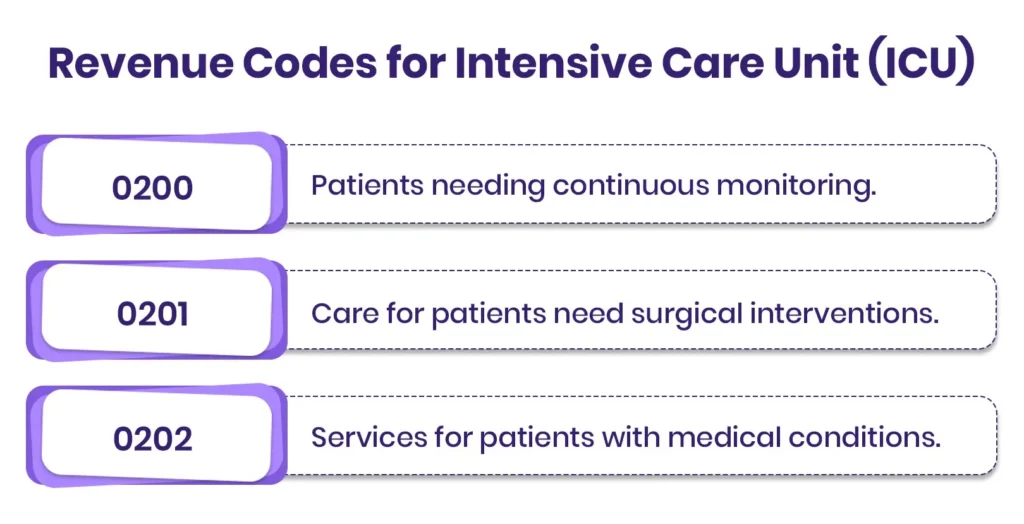
2. Revenue Codes for Intensive Care Unit (ICU)
ICU revenue codes apply to patients who need continuous monitoring and a high level of care.
| Revenue Code | Description |
|---|---|
| 0200 | ICU, general classification |
| 0201 | Surgical ICU |
| 0202 | Medical ICU |
| 0203 | Pediatric ICU |
| 0204 | Psychiatric ICU |
| 0206 | Intermediate ICU, the level of care between a full ICU and a regular floor, often called step-down |
| 0207 | Burn care ICU |
| 0208 | Trauma ICU |
| 0209 | Other ICU services |
Coronary care has its own category:
| Revenue Code | Description |
|---|---|
| 0210 | Coronary care unit, general classification |
| 0211 | Myocardial infarction |
| 0212 | Pulmonary care |
| 0213 | Heart transplant |
| 0214 | Intermediate coronary care unit |
| 0219 | Other coronary care |
3. Revenue Codes for Pharmacy
Pharmacy revenue codes identify the drugs and pharmacy services a facility provides.
| Revenue Code | Description |
|---|---|
| 0250 | Pharmacy, general classification |
| 0251 | Generic drugs |
| 0252 | Non-generic (brand-name) drugs |
| 0254 | Drugs incident to other diagnostic services |
| 0255 | Drugs incident to radiology |
| 0257 | Non-prescription (over-the-counter) drugs |
| 0258 | IV solutions |
| 0259 | Other pharmacy services |
Two more pharmacy codes complete the 025X category: 0253 for take-home drugs and 0256 for experimental drugs. Drugs that must be reported with a HCPCS code, such as most injectable drugs on outpatient claims, are usually billed under 0636, Drugs requiring detailed coding. IV therapy services, such as infusion pumps and pharmacy IV services, use the 026X category, starting with 0260 for the general classification.
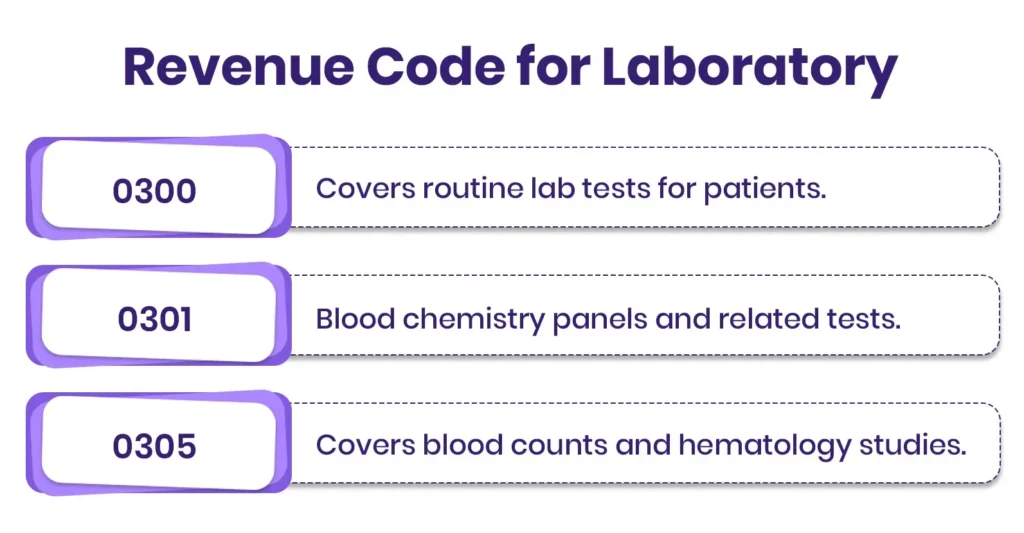
4. Revenue Codes for Laboratory
Laboratory revenue codes cover clinical diagnostic tests and specimen processing. They should be billed according to complete laboratory billing guidelines so each test is classified correctly, stays compliant and is paid in full.
| Revenue Code | Description |
|---|---|
| 0300 | Laboratory, general classification |
| 0301 | Chemistry, such as blood chemistry panels |
| 0302 | Immunology |
| 0304 | Non-routine dialysis |
| 0305 | Hematology, including blood counts |
| 0306 | Bacteriology and microbiology |
| 0307 | Urology |
| 0309 | Other laboratory services |
The lab category also includes 0303 for renal patient (home) lab services. Anatomic pathology has its own category, 031X: 0310 general, 0311 cytology, 0312 histology, 0314 biopsy and 0319 other.
5. Revenue Codes for Radiology
Diagnostic radiology revenue codes in the 032X category classify X-ray and related diagnostic imaging. CT scans, MRI, ultrasound and nuclear medicine have their own categories, listed below, and each must be paired with the right CPT code for correct reimbursement through accurate radiology billing and coding.
| Revenue Code | Description |
|---|---|
| 0320 | Diagnostic radiology, general classification |
| 0321 | Angiocardiography |
| 0322 | Arthrography |
| 0323 | Arteriography |
| 0324 | Chest X-ray |
| 0329 | Other diagnostic radiology |
| Revenue Code | Description |
|---|---|
| 0330 to 0339 | Therapeutic radiology and chemotherapy administration |
| 0340 to 0349 | Nuclear medicine |
| 0350 | CT scan, general classification |
| 0351 | CT head scan |
| 0352 | CT body scan |
| 0400 | Other imaging services, general classification |
| 0401 | Diagnostic mammography |
| 0402 | Ultrasound |
| 0403 | Screening mammography |
| 0404 | Positron emission tomography (PET) |
| 0610 to 0619 | MRI and MRA, by body area |
6. Revenue Codes for Operating Room
Operating room revenue codes report charges for the use of surgical facilities. For a full breakdown of the general OR code, see our guide to revenue code 0360.
| Revenue Code | Description |
|---|---|
| 0360 | Operating room services, general classification |
| 0361 | Minor surgery |
| 0362 | Organ transplant, other than kidney |
| 0367 | Kidney transplant |
| 0369 | Other operating room services |
Surgical claims usually carry related lines as well: 0370 for anesthesia, 0710 for the recovery room and 0490 for ambulatory surgical care in same-day surgery settings.
7. Revenue Codes for Physical Therapy
Physical therapy revenue codes cover rehabilitative and therapeutic services. When billing physical therapy services such as Neuromuscular Reeducation CPT Code 97112, the correct revenue code is important for accurate classification and timely payment.
| Revenue Code | Description |
|---|---|
| 0420 | Physical therapy, general classification |
| 0421 | Visit charge |
| 0422 | Hourly charge |
| 0423 | Group rate |
| 0424 | Evaluation or re-evaluation |
| 0429 | Other physical therapy services |
Occupational therapy and speech-language pathology follow the same pattern in their own categories: 043X for occupational therapy and 044X for speech-language pathology, each with a general code ending in 0, visit and hourly charges, a group rate, an evaluation code and an “other” code ending in 9.
8. Revenue Codes for Clinics
Clinics, whether general or specialty outpatient facilities, use revenue codes to categorize their services. In a clinic setting, the revenue code shows the type of clinic and the level of care, which matters for both payment and facility reporting.
| Revenue Code | Description |
|---|---|
| 0510 | Clinic, general classification, typically used for routine outpatient clinic visits |
| 0511 | Chronic pain center |
| 0512 | Dental clinic |
| 0513 | Psychiatric clinic |
| 0514 | OB/GYN clinic |
| 0515 | Pediatric clinic |
| 0516 | Urgent care clinic |
| 0517 | Family practice clinic |
| 0519 | Other clinic services |
Rural health clinics and federally qualified health centers do not use 0511. Their visits are billed under the freestanding clinic category, 052X, such as 0521 for a clinic visit by a member to an RHC or FQHC.
9. Revenue Codes for Emergency Room Visits
Emergency room revenue codes capture services provided during emergency visits.
| Revenue Code | Description |
|---|---|
| 0450 | Emergency room, general classification |
| 0451 | EMTALA emergency medical screening services |
| 0452 | ER services beyond EMTALA screening |
| 0456 | Urgent care |
| 0459 | Other emergency room services |
10. Revenue Codes for Outpatient Services
Outpatient services cover visits where patients receive treatment or diagnostics without being admitted.
| Revenue Code | Description |
|---|---|
| 0500 | Outpatient services, general classification |
| 0509 | Other outpatient services |
| 0510 to 0519 | Clinic services, including dental, psychiatric, OB/GYN, pediatric and other specialty clinics |
Two more outpatient codes come up often: 0762 for observation hours, used when a patient is kept under observation without being admitted, and 0761 for treatment room services.
11. Other Frequently Billed Revenue Codes
| Revenue Code | Description |
|---|---|
| 0410 | Respiratory services, general classification |
| 0481 | Cardiac catheterization lab |
| 0483 | Echocardiology |
| 0730 | EKG and ECG, general classification |
| 0750 | Gastrointestinal services |
| 0900 | Behavioral health treatments, general classification |
| 0943 | Cardiac rehabilitation |
| 0960 | Professional fees, general classification |
Pro Tip: Always check the revenue code against the location of service and the type of care delivered. Cross-checking with the hospital charge master and each payer’s guidelines helps prevent denials and makes sure each department is paid correctly for the services it delivers.
Revenue Codes vs Medical Codes: What Is the Difference?
Revenue codes show where in the facility a service was provided and are essential for hospital billing and cost tracking. Medical codes describe the service itself, whether a procedure, a supply or a diagnosis. The two work together to get the service paid.
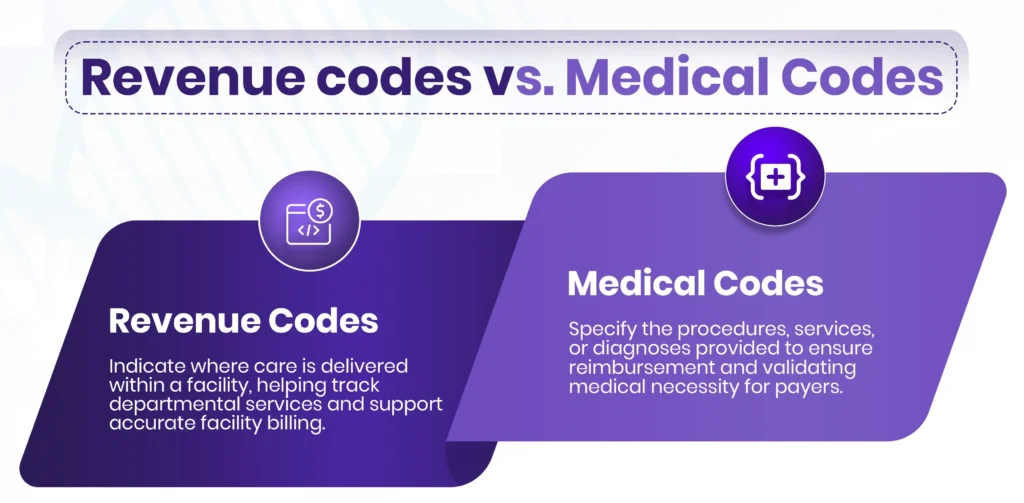
| Aspect | Revenue Codes | Medical Codes |
|---|---|---|
| Purpose | Identify department or service location. | Describe the procedure, service, or diagnosis. |
| Focus | Where care is delivered. | What care is delivered. |
| Examples | 0120 covers the general medical/surgical floor. | 99213 cover office or outpatient visits. |
| Used By | Hospitals, facility-based billing. | Physicians, clinics, and hospitals. |
| Forms | UB-04 for institutional claims. | CMS-1500, electronic claims. |
| Level of Detail | Broad classification such as department or service type. | Specific service, procedure, or diagnosis. |
| Function in Billing | Supports facility cost tracking and reimbursement | Supports payer approval based on medical necessity |
| Standardization | Maintained by CMS and hospital guidelines | Maintained by AMA (CPT), WHO (ICD-10), CMS (HCPCS). |
| Time Sensitivity | Usually per patient stay, visit, or department use. | Usually per procedure, encounter, or treatment session |
| Impact on Payment | Determines facility reimbursement rates. | Determines service coverage and payment accuracy. |
| Audit or Reconciliation Use | Used in revenue cycle management and departmental accounting | Used in compliance audits, clinical review, and claim validation. |
| Coding Complexity | Relatively simple numeric system | More complex; includes alphanumeric codes with modifiers and detailed descriptions |
| Examples by Category | 0360 cover operating room and 0300 cover Lab services | 81002 – Urinalysis, 70450 – CT scan without contrast. |
| Interdependency | Works with medical codes to validate claims | Requires revenue codes to ensure the correct facility charge classification |
Revenue Codes Vs. CPT Codes/HCPCS Codes
Key Differences Between Revenue Codes and CPT Codes
Revenue codes are four-digit numeric codes used in facility billing to identify the department, type of service or location of care, such as ICU, radiology or pharmacy. They answer the question “Where was the service provided?”
CPT (Current Procedural Terminology) codes are five-character codes that describe the specific procedure or service performed. They answer the question “What service was performed?” Category I CPT codes are numeric, while Category II and III codes end in a letter.
Revenue codes classify facility resources, while CPT codes describe clinical procedures. Revenue codes appear only on institutional claims such as the UB-04. CPT codes appear on professional claims (CMS-1500) and on most outpatient lines of the UB-04, next to the revenue code. Revenue codes support accurate facility billing, while CPT codes carry the medical necessity and service detail.
Revenue Codes vs HCPCS Codes
HCPCS Level II codes extend CPT to items and services CPT does not cover, such as durable medical equipment, ambulance services and many drugs and supplies. On institutional claims, the revenue code still shows where the service occurred, while the HCPCS code identifies the specific item. For example, an injection of ceftriaxone reported with HCPCS J0696 is usually billed on an outpatient claim under revenue code 0636, Drugs requiring detailed coding, rather than general pharmacy code 0250.
Why Both Are Required on Facility Claims
Outpatient facility claims usually need both a revenue code and a CPT or HCPCS code on each line. The revenue code shows which department or cost center provided the service, and the CPT or HCPCS code shows exactly what was done. Together they let the payer understand and price the claim, and leaving either one out can lead to a denial. For example, a CT scan of the head without contrast is reported with revenue code 0351, CT head scan, and CPT 70450.
Professional (CPT/HCPCS) vs Institutional (Revenue Codes) Billing
Professional billing covers the work a provider performs and is paid based on CPT or HCPCS codes. Institutional billing covers the facility resources used and is classified by revenue codes, alongside CPT or HCPCS codes on outpatient lines.
Professional (CPT/HCPCS) Vs. Institutional (Revenue Codes)
Professional billing covers the work a provider performs and is paid based on CPT or HCPCS codes. Institutional billing covers the facility resources used and is classified by revenue codes, alongside CPT or HCPCS codes on outpatient lines.
| Aspect | Professional Billing (CPT/HCPCS) | Institutional Billing (Revenue Codes) |
|---|---|---|
| Form used | CMS-1500 | UB-04 |
| Coding focus | Procedure or service provided by the clinician | Department or location where the service was delivered |
| Examples of codes | 99213 office visit, 81002 urinalysis | 0300 laboratory, 0360 operating room |
| Primary users | Physicians and other clinicians | Hospitals and outpatient facilities |
| Payment determination | Based on the procedure and the provider’s work | Based on facility charges, grouped by revenue code and priced by payer rules |
| Payer requirement | Validates medical necessity | Classifies facility charges |
How to Find the Right Revenue Code
Choosing the right revenue code is essential for clean claims and prompt payment. Coders can rely on several sources.
Hospital Chargemaster
The hospital chargemaster is the internal database of every billable service, supply and procedure, each mapped to its revenue code. It is usually the first reference for coders, and using it keeps claims consistent across the facility.
NUBC and Medicare Revenue Code Lists
The NUBC maintains the official revenue codes in its UB-04 Data Specifications Manual. Medicare Administrative Contractors publish the codes Medicare accepts, such as the Noridian revenue code list. Coders use these lists when billing Medicare to stay within federal requirements and avoid denials for codes that are not in use.
Payer-Specific Billing Guidelines
Payers can set their own rules on revenue code use, including which codes need a HCPCS code. Following each payer’s guidelines makes sure the revenue code matches what that payer expects.
Billing Software and Coding Tools
Modern billing software often includes coding tools and search features that help coders select the right revenue code quickly. These tools cross-reference CPT and HCPCS codes, department data and payer rules, which is how an experienced medical billing company in the USA keeps claims accurate. Combining all of these sources leads to correct revenue coding and a smoother revenue cycle.
Pro Tip: Cross-check every revenue code against the hospital chargemaster, the Medicare list and payer guidelines. Billing software with built-in coding checks speeds up the process and reduces the chance of denials.
Common Revenue Code Errors That Cause Claim Denials
Revenue code errors are among the most common reasons hospital and facility claims are denied or delayed. Even a small mistake, such as the wrong department code or a missing digit, can cause the payer to reject the claim. These are the errors that come up most often:
Using a revenue code from the wrong department, such as a lab code for a radiology service. Leaving the revenue code off a line. Choosing a code that does not fit the patient’s setting, such as an inpatient room and board code on an outpatient claim. Using an outdated or invalid code, including codes Medicare does not recognize. Pairing the revenue code with a CPT or HCPCS code that does not belong to that department. Leaving out the HCPCS code on a line where the payer requires one. Reporting the same service under more than one revenue code. Using a general code where the payer expects a more specific one.
Avoiding these mistakes improves claim acceptance, speeds up payment and keeps billing within payer and regulatory rules. When errors have already turned into denials, denial management traces each one back to its source.
Best Practices in the Assignment of Accurate Revenue Code
Accurate revenue code assignment keeps services classified correctly, gets claims processed promptly and cuts denials caused by coding mistakes. These practices help facilities stay compliant and improve financial performance.
Verify the Service and Patient Setting
Before assigning a revenue code, confirm the type of service and whether the patient is inpatient, outpatient or in the emergency department. Many denials come from a mismatch between the service and the setting.
Reference the Hospital Chargemaster
The chargemaster lists every billable service with its revenue code. Reconcile services to the chargemaster so every claim stays consistent.
Check Official Revenue Code Lists
Confirm the code against the current NUBC and Medicare lists and each payer’s guidance. Up-to-date lists prevent errors from retired or unused codes.
Match Revenue Codes With CPT and HCPCS Codes
The revenue code should match the procedure or service code on the same line. A CT head scan, for example, belongs under revenue code 0351 with its CPT code. Proper alignment prevents denials caused by mismatched codes.
Use Billing Software and Coding Tools
Billing software with automated suggestions, cross-references and validation checks helps coders pick the right code quickly and reduces manual errors.
Train and Audit Regularly
Ongoing coder training and internal audits keep staff current on revenue codes, payer requirements and common pitfalls. A regular medical billing audit catches errors before claims go out.
How iSolve RCM Help with Revenue Code in Medical Billing
Revenue code assignment is a process that requires the combination of knowledge, resources and technology and the adherence to these best practices will guarantee submission of claims in the right format and receive payment in a timely manner. Proper selection of revenue codes is essential to effective medical billing and prompt reimbursement, yet it may be quite tricky to manage it when using multiple services, departments, and payers since iSolve RCM offers an integrated platform that automates the process of revenue code selection, cross-refers CPT/HCPS codes, and maintains adherence to payer-specific guidelines.
iSolve RCM allows healthcare facilities to minimize mistakes, avoid claim reimbursement, and simplify the revenue cycle, making the revenue coding process more precise, efficient, and reliable with the help of such features as real-time validation, billing dashboards, and reporting tools.
Frequently Asked Questions (FAQ’s)
What is a revenue code in billing?
A revenue code is a four digit code used on hospital and facility claims to show the department or type of service behind each charge, such as radiology, pharmacy or surgery. It helps the payer classify the charge and process the claim correctly.
What is the difference between a procedure code and a revenue code?
A procedure code, such as a CPT or HCPCS code, describes the service or treatment performed. A revenue code identifies the department or type of service within the facility. The revenue code shows where the service happened, and the procedure code shows what was done.
Can you bill a revenue code without a CPT code?
Yes, in some cases. Room and board and other routine inpatient charges are billed with a revenue code and no CPT code. Most outpatient procedure and ancillary lines, however, need a CPT or HCPCS code next to the revenue code to be paid.
What are the sources of revenue codes?
Revenue codes come from the NUBC, which publishes them in the UB-04 Data Specifications Manual. Hospitals map them to each service in their chargemaster, and Medicare contractors publish lists of the codes they accept.
Who maintains revenue codes?
The National Uniform Billing Committee (NUBC) maintains revenue codes in the United States. Medicare and other payers publish the codes they accept and any reporting rules that go with them.
What are the three main types of medical codes?
The three main types are diagnosis codes (ICD-10), which identify the patient’s condition; procedure codes (CPT and HCPCS), which describe the services provided; and revenue codes, which classify the department or type of service on facility claims.
What is a four-digit code that categorizes a line item in the chargemaster?
It is a revenue code. A revenue code is a four-digit code established by the NUBC that classifies each line item in the hospital chargemaster and is reported in form locator 42 of the UB-04.
What is revenue code 0300?
Revenue code 0300 is Laboratory, general classification. It is used for lab services that do not fall under a more specific lab code such as 0301 for chemistry or 0305 for hematology.
What is revenue code 0320?
Revenue code 0320 is Diagnostic radiology, general classification. It covers X-ray and related diagnostic imaging. CT scans use 035X, MRI uses 061X and ultrasound uses 0402.
What is revenue code 0206?
Revenue code 0206 is Intermediate ICU, the level of care between a full intensive care unit and a regular medical floor, often called step-down care.
What is revenue code 0510?
Revenue code 0510 is Clinic, general classification. It is used for hospital outpatient clinic visits that do not fit a more specific clinic code, such as 0514 for OB/GYN or 0516 for urgent care.
What is revenue code 0250?
Revenue code 0250 is Pharmacy, general classification. It is used for drugs and pharmacy services that do not need a separate HCPCS code. Drugs that must be reported with a HCPCS code usually go under 0636.
Is a revenue code the same as a CPT or procedure code?
No. A revenue code such as 0300 is not a CPT or procedure code. Revenue codes have four digits and identify the department, while CPT codes have five characters and identify the procedure. Both often appear on the same outpatient claim line.