

Current Procedural Terminology (CPT) 99203 designates a low-to-moderate complexity office or other outpatient evaluation and management (E/M) facility for new patients. It is extensively applied in clinical documentation and medical billing to confirm appropriate reimbursement while reflecting provider work, supports clinical decision-making and patient evaluation with appropriate documentation and coding accuracy in practice.
Precise reporting of CPT code 99203 is significant for revenue integrity, compliance, and outpatient documentation and coding readiness. Inappropriate coding can result in claim denials, minimized reimbursement, or underpayment if documentation and coding are inaccurate. This blog summarizes documentation requirements, selection criteria, and best practices to support accurate E/M code assignment for providers effectively, offered by an affordable medical billing company.
What Is CPT Code 99203?
The CPT code 99203 specifies an office visit with the patient being a new one with E/M criteria. This usually involves 30 to 44 minutes of time spent by the physician. This is considered to be of moderate complexity services for medical billing purposes with the codes from 99202 through 99205.
Description of CPT code 99203 explains the documentation requirements for initial patient visits that have moderate complexity. This information is helpful in selecting the right codes based on a patient’s history, physical exam, and medical decision making according to CMS E/M rules to facilitate payment by insurers.
According to the research carried out by the American Medical Association (AMA), an office or any other outpatient service that evaluates and manages a new patient will have a medically appropriate history and/or examination together with low medical decision-making. When coding is done based on the time used, the total time taken on the date of the service will be 30 to 44 minutes.
Key Features of CPT 99203
Medical code 99203 frameworks moderate complexity new patient visits supporting compliant E/M billing documentation requirements.
New Patient Requirement (3-Year Rule)
CPT 99203 is used if the patient has not received any professional services by the same physician or specialty group in the last three years. This provision guarantees that the correct coding is made for new patients, which is central in medical billing and documentation.
Low-Level Medical Decision-Making
For CPT code 99203, the MDM is of lower to moderate complexity and includes assessment of problems, risks, and information. The provider should include clear clinical rationale in the documentation for proper coding, appropriate billing, and compliance with E/M documentation guidelines standards.
Face-To-Face Evaluation and Management
The CPT code 99203 necessitates face-to-face contact between the provider and the patient that entails comprehensive assessment, evaluation, and diagnosis. The accurate recording of time-based or medical decision making-based criteria is important to determine the level of service and facilitate appropriate coding and billing practices.
Expert Insight: When billing CPT code 99203, make sure to provide adequate documentation of the patient’s medical history, examination results, and decisions made for treatment. Check whether the new patient criteria for three years still apply.
Services Covered Under CPT 99203
Medical billing code 99203 covers important outpatient services for new patient evaluation and management care.
Comprehensive History
A comprehensive history performed with CPT 99203 necessitates full documentation regarding the chief complaint, present illness, past medical, family, and social history. Physicians get pertinent information on the clinical background necessary to reach the correct diagnosis and treatment plan, following evaluation and management service guidelines accurately and consistently.
Physical Examination
In CPT 99203, the physical exam comprises a detailed inspection of all systems that could have a bearing on the patient’s chief complaints. The provider will examine the patient’s vital signs and other body systems to ensure proper diagnosis and subsequent treatment planning and to comply with documentation requirements for accurate E/M coding.
Evaluation and Management
Services provided under the Evaluation and Management Service category CPT code 99203 include the evaluation of test results and the formulation of the management plan. The physician evaluates the patient’s history and test results to decide whether the patient requires such services, which is essential for correct coding and payment.
Patient Education
Education of patients under CPT code 99203 concentrates on counseling patients about their diagnosis, treatment methods, use of medications, and preventive measures. The role of the physician in this case is to make sure that the patient understands the whole treatment plan as well as the risks involved in it.
When to Use CPT Code 99203
CPT 99203 is used for moderate new patient visits involving routine or low-risk conditions.
Acute Uncomplicated Conditions
CPT code 99203 is utilized when evaluating the patient who is suffering from acute illness, for example, infection or injury, in order to conduct an extensive evaluation of his/her condition. The physician will collect the medical history of the patient as well as perform physical examination without taking any risks.
Stable Chronic Illness
The CPT code 99203 will be used in dealing with individuals who have chronic diseases without complications such as hypertension and diabetes. The healthcare practitioner determines the stability of the condition and explains to the patient how the medications work. There should be adequate documentation to support the complicated decisions made.
Multiple Minor Problems
Procedure code 99203 is applied when there are multiple complaints of low severity which require evaluation together. The physician performs a thorough evaluation to ensure that any associated problems are excluded. Documentation of all problems helps in meeting the criteria for medical necessity, choosing the appropriate E/M code, and efficient billing. Medical coding services play a key role to ensure accurate documentation and improved reimbursement outcomes.
Time Requirements for 99203
Medical billing code 99203 requires 30–44 minutes encounter time or moderate MDM documentation compliance standards.
30–44 Minutes Total Encounter Time
CPT code 99203 coding is allowed according to total time spent by the provider when there is spending of 30-44 minutes in face-to-face and non-face-to-face services in a new patient visit. This time involves reviewing charts, documentation, counseling, and coordinating care services for proper billing and guideline requirements.
What Counts Toward Time
Activities that qualify for time spent under CPT code 99203 include review of the patient’s medical records, documentation, patient counseling, test ordering, and care coordination. All the clinical and administrative work conducted on the same day is counted when choosing time as the basis of billing.
When To Use Time Vs MDM
The decision on whether to use time-based or MDM coding for CPT 99203 depends on the type of documentation that supports the code selection. If the encounter duration in minutes is recorded, then time-based coding is selected, but if the clinical complexity determines the code, then MDM coding is selected.
Best Practices for Using CPT 99203
Medical billing code 99203 ensures accurate new patient evaluation documentation supporting compliant E/M coding practices.
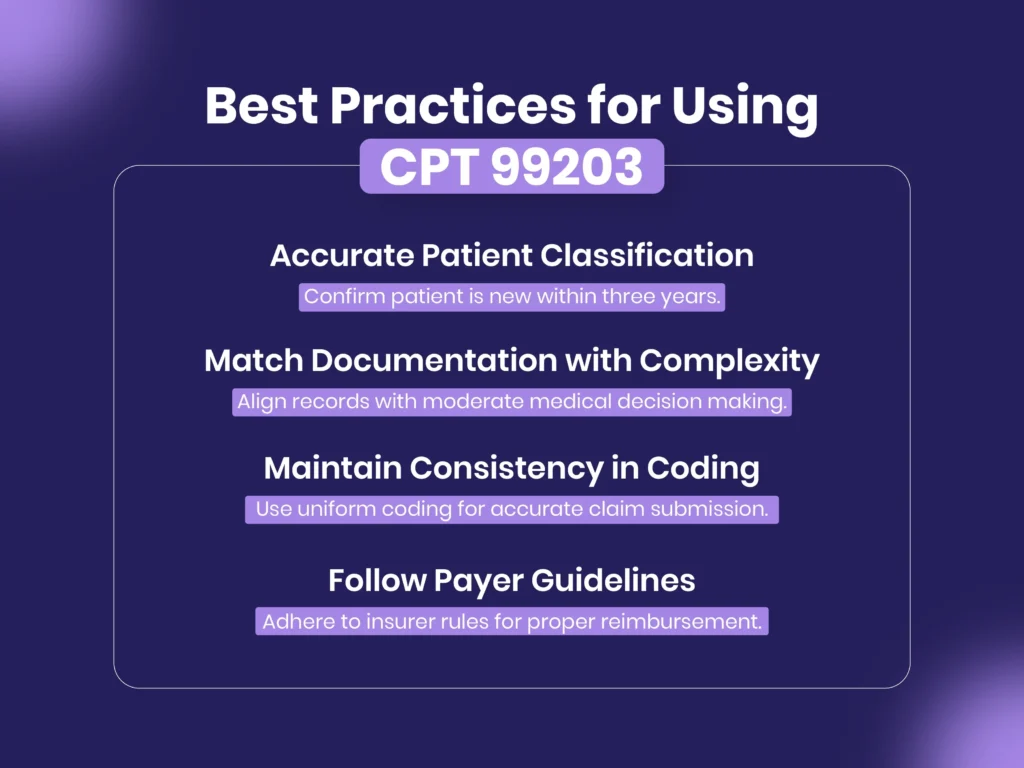
Accurate Patient Classification
The 99203 CPT code is used when patient identification accurately determines that the patient is indeed a new patient according to the “three-year” regulation. Patient identification avoids medical coding mistakes, helps choose the appropriate level of E/M codes, and abides by payers’ guidelines.
Match Documentation with Complexity
CPT code 99203 description necessitates the use of proper documentation for an appropriate level of Medical Decision Making. The documentation should show proper correlation of patient history, physical exam, and Medical Decision Making to allow for accurate Coding for a moderate level E/M Code.
Maintain Consistency in Coding
Uniformity provided by CPT 99203 code promotes consistency and reliability, ensuring that there are no problems during claims filing. Proper coding promotes proper documentation and helps meet the requirements set forth by insurance payers. Proper coding also ensures accuracy through alignment with E/M guidelines and medical billing procedures.
Follow Payer Guidelines
The application of procedure code 99203 should conform with guidelines delivered by each respective payer to guarantee proper payment and avoid claim rejections. Providers are encouraged to confirm the necessary documentation and coding rules that apply, and to guarantee appropriate coding and level selection for E/M services.
Expert Advice: Remember to confirm that your patient is indeed a new patient, match the level of documentation to the MDM complexity, and consider payer requirements for accurate coding of CPT 99203.
Modifiers Used with CPT 99203
CPT code 99203 defines moderate complexity new patient visit requiring accurate E/M documentation compliance standards
Why Modifiers Are Used
The 99203 CPT code has modifier usage to signify specific circumstances that would be encountered that could affect the level of reimbursement for that particular service rendered. It is used to ensure compliance with insurance company policies when filing out claims forms and provides clarity in record keeping and auditing.
Modifier 25: Separate E/M Service with Procedure
Definition of modifier 25 with 99203 CPT code description: The use of modifier 25 in the CPT code description is done when a critical and separately identifiable E/M service is done on the same day of the procedure. This modifier ensures proper payment, differentiation, and compliance with payers’ documentation policies.
Modifier 24: Unrelated Visit During Post-Op Period
Modifier 24 along with CPT code 99203 is applied to unrelated E/M services performed during the post-operative phase of a previous surgery. This modifier will help avoid global period claims denial and make sure that appropriate documentation of the medical necessity of the procedure is done.
Modifier 57: Decision For Surgery
Modifier 57 when applied with CPT code 99203 indicates that the decision for major surgery was made following the evaluation and management service provided. It permits a separate claim to be made for preoperative care decisions to ensure that proper documentation is used in justifying medical necessity and proper coding practices.
Modifier 53: Discontinued Procedure
Use of modifier 53 occurs when there is an interruption during a surgical procedure because of the patient’s safety reasons, unforeseen circumstances, or physical constraints that necessitate the provider to terminate the process. The modifier guarantees that partial payments are made for the procedures performed and promotes proper billing practices.
Reimbursement Overview
99203 CPT code reimbursement varies by payer policies, documentation quality, and medical necessity compliance standards.
Medicare, Medicaid, Private Payer Variation
The coding for 99203 is reimbursed differently under Medicare, Medicaid, and insurance companies based on the payment scales, rules for reimbursement, and documentation guidelines. Medicare uses the rigorous E/M guidelines by CMS, whereas the other two may change their rules of payment and audits that influence approval of claims and reimbursement rates.
Factors Affecting Payment
Several determinants affect the reimbursement for billing code 99203 including documentation, need for the procedure, level of care, modifier used, and contract terms between the provider and payer. Others include geographic adjustments and the possibility of audits and coding inconsistencies. Matching of clinical documentation to E/M requirements avoids denials of claims.
Importance Of Payer-Specific Checks
The CPT code 99203 description needs to be verified against the policies of specific insurance companies before claims can be filed in order to meet their requirements and avoid underpayment or denial. It is essential that practitioners continually monitor any changes and updates to the proper documentation of procedures and coding.
Pro Tip: Always verify payer-specific reimbursement policies for CPT 99203, ensure complete and accurate documentation, and confirm medical necessity to avoid underpayments, claim denials, and delays in reimbursement across Medicare, Medicaid, and private insurers.
CPT 99203 vs Other Codes
CPT code 99203 is a moderate new patient visit, higher complexity than 99202 E/M level.
99202 Vs 99203 (Time + Complexity)
Description of CPT code 99203 varies significantly from 99202 both in terms of time and medical decision-making level. While 99202 covers the service provided for 15-29 minutes involving simple medical decision making, 99203 entails services provided for 30-44 minutes of moderate to low medical decision making.
99204 Overview
Code 99203 is less complex than CPT 99204, which includes more complicated medical decisions and a total duration of 45 to 59 minutes. CPT 99204 is utilized for complicated patient visits where a thorough examination is conducted with a higher risk of management and documentation is provided for advanced E/M codes.
Common Mistakes to Avoid Errors in Code 99023
Medical billing code 99203 errors include misclassification, documentation gaps, and incorrect E/M coding selection practices. Denial management services help minimize claim rejections and support a more well-organized revenue cycle process.
Wrong Patient Classification
The mistakes with 99203 CPT code generally happen when healthcare providers wrongfully classify the established patients as new ones. The three-year requirement should be adhered to strictly to prevent misrepresentation of E/M codes, denials, and violations. Properly identifying a patient is key to ensuring the accuracy of the medical coding process.
Under/Over Documentation
Description for CPT code 99203 entails proper documentation that represents true clinical complexity of the encounter. Lack of proper documentation will result in undercoding while too much documentation may attract auditing. Healthcare professionals should make sure that medical decision-making and documentation of history and physical examination support selected E/M code.
Upcoding/Downcoding
Mistakes that are associated with procedure code 99203 are upcoding at a higher level when the coding cannot be justified through documentation or downcoding at a lower level than can be supported by documentation. Upcoding is likely to cause more auditing problems, whereas downcoding results in less payment.
Ignoring Time Requirements
The CPT code 99203 is applicable only if a minimum of 30–44 minutes total time is observed while coding based on the time basis. Failure to document the total time taken will result in improper coding. It is mandatory for the physician to document all activities undertaken for the process.
How iSolve RCM help with CPT Code 99203
The iSolve RCM service can help maximize the 99203 CPT code billing process by providing proper patient classification, documentations, and choosing the right level of evaluation and management services. By minimizing coding errors for the CPT code 99203 billing process, they can help increase reimbursements and adhere to the CMS standards for documentation, which will help you maximize your revenue cycle management process.
FAQs
What is CPT code 99203 used for?
The CPT code 99203 is applied when there are new patient office visits that require low to moderate levels of medical decision making. There must be extensive documentation of history, physical exam, and medical reasoning for correct E/M coding.
What documentation is required for CPT 99203?
Code 99203 documentation will consist of a chief complaint, history of present illness, review of systems, physical exam, and medical decision making. Doctors are required to document their clinical findings and reasoning behind their conclusions to justify medical necessity.
How is MDM determined in CPT 99203?
MDM in cpt code 99203 is assessed by assessing the problems involved, the information gathered, and the degree of risk. The MDM must be indicative of a low to moderately complex situation. Good documentation of clinical judgement will ensure appropriate coding.
Can time be used for CPT 99203 coding?
Yes, cpt code 99203 can be chosen based on total time spent by the provider between 30-44 minutes. This consists of face-to-face treatment, documenting, and coordinating services. Time-based coding needs to be documented and can override MDM with appropriate justification.
What are common mistakes in CPT 99203 billing?
Some common mistakes that occur are the lack of documentation, inaccurate MDM evaluation, inappropriate modifiers, and over-coding. Such errors may result in denial or audit. Proper documentation and strict compliance with payer requirements are key to achieving correct reimbursement results.
How does CPT 99203 differ from 99202?
CPT Code 99203 consists of lower to moderate level MDM and more time (30–44 minutes), whereas CPT Code 99202 has simple MDM and takes 15–29 minutes. The difference is based on complexity, level of documentation, and clinical decision-making.