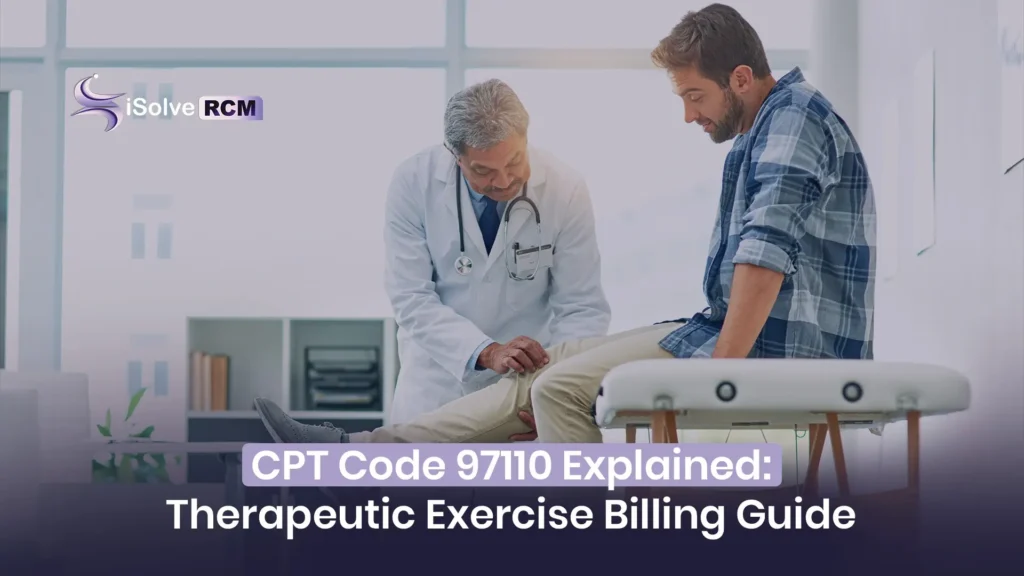
You already know CPT codes are what keep your claims consistent, compliant, and reimbursable across payers, if you are working in physical therapy billing or managing a clinic. In this space, precision is not optional because it directly impacts your revenue cycle and audit risk.
The 97110 CPT code is applied for therapeutic exercise services that require expert intervention, and getting it right is crucial for showing medical necessity to ensure clean claim approval. In this blog we will explore what CPT 97110 actually means, how to bill it correctly, what documentation payers assume, and the common mistakes that frequently lead to denials, so you can line up your coding with compliance and defend your reimbursement.
In addition to that, we will also be discussing the way in which a medical billing firm in the United States such as iSolve RCM can help healthcare practitioners via coding accuracy, enhanced documentation process, fewer denied claims, and quick reimbursement, among other aspects.
What CPT Code 97110 Means for Your Practice
CPT Code 97110 is one that you probably interact with frequently, especially if you deal with physical therapy claims management or run your own practice. This code refers to therapeutic exercise procedures conducted on an individual basis with patients, which involve treatment by an authorized practitioner with a functional goal in mind.
Therapeutic exercise CPT codes are used by you in your daily practice when your primary concern is to help patients regain their muscle strength, endurance, flexibility, and range of motion. It is important to note that these exercise therapies are personalized according to the health conditions of patients and are therefore not general in nature.
The procedure code 97110 may normally be billed by licensed physical therapists, occupational therapists, or other qualified professionals based on each payor’s policies. The key point here is to adequately document the skilled services provided, comply with supervision requirements, and establish a clear link between therapy and functional improvement in order to avoid problems in payment processing.
The CPT 97110 code is a 15-minute therapeutic exercise code utilized for enhancing strength, endurance, ROM, and flexibility. The code indicates clinically oriented one-on-one treatment as per the AMA guidelines.
What Falls Under CPT Code 97110
If your organization offers therapeutic exercise billing services, the CPT code 97110 description is basically what you use to determine how therapeutic exercise is supposed to be provided. It can be considered a timed service that must have face-to-face contact between the patient and therapist. The therapist will provide direct supervision and assist in performing exercises according to the patient’s functional capabilities.
The billing for 97110 is done on a basis of 15 minutes. As such, proper timekeeping will be essential in your practice on a daily basis. With regard to billing, all minutes of skilled service provided should be properly accounted for and the payer guidelines regarding units must strictly be followed.
When referring to CPT for therapeutic exercises, we need to remember that this involves exercise programs prescribed by clinicians such as resistance exercise, stretching programs, range of motion procedures, and strength training. From this perspective, it should be pointed out that each session requires personalization as well as thorough documentation, coupled with appropriate assistance from medical billing services in terms of proper coding, meeting payer requirements, and obtaining payment in time.
Bill Skilled Work, Not Just Exercise
Avoid documenting routine exercise. Demonstrate the clinical reasoning, skilled intervention, and individualized goals to ensure that CPT 97110 services warrant coverage by payers.
Core Drivers Behind Effective Therapeutic Exercise (97110)
As far as the 97110 CPT code is concerned, there are certain clinical factors which define the delivery of treatment, documentation, and justification of therapy provided. These factors are supposed to be well-defined in the patient’s records since they provide a direct link between therapy services and improved functioning.
Building Functional Strength in Clinical Care
Improvement in strength according to 97110 CPT code definitions is based on systematic and progressively increasing resistance training to restore muscle function. The process is designed to build up patients’ ability to function normally by building their strength, preventing deconditioning, and restoring their strength safely from a practical perspective. The most important aspect for insurance billing is that there is evidence of progression.
Restoring Movement Through Flexibility and Mobility Work
The treatment for flexibility and mobility improvement through CPT coding of therapeutic exercises will involve improving stiffness in joints and muscles. This involves stretches and mobility exercises aimed at loosening stiff muscles and ensuring proper joint movements. For documentation purposes, you need to relate this treatment to functional deficits that affect your patients’ ability to perform activities of daily living independently.
Improving Stamina and Activity Tolerance
The type of therapy where endurance training under the CPT for therapeutic exercise is administered to patients who require assistance in increasing their endurance levels and tolerance to physical activities. The exercises are repetitive and systematic and help increase cardiovascular endurance and muscle endurance. From a clinical point of view, this helps patients increase their resistance to fatigue and cope with physical activities.
Turning Therapy into Practical Function
Goals for functional outcomes when it comes to 97110 procedure code include only one point: Can the individual really perform better in their day-to-day activities? Your intervention must always have some specific tasks that can measure the progress in your patient’s performance, such as walking, lifting, and self-care. Compliance wise, this is how you prove the effectiveness of your treatments.
What You Need to Document for CPT 97110 to Stay Compliant
In dealing with the CPT code 97110 description, documentation becomes vital since without it, it means nothing. There should be proof that the intervention was indeed skilled, it was medically necessary, and there were indications of progress made. If there was not adequate documentation, the intervention never really happened.
Tracking Time the Right Way
The time involved in the treatment under 97110 procedure code should be noted accurately in minutes. The start time or end time or the skilled time used in the course of therapy should be written down accurately. It is essential in order to ensure proper compliance with time-based billing criteria and to prevent unnecessary denials or deductions from claims.
Be Specific About What You Actually Did in Treatment
It is important to note that one needs to indicate the specific exercises that were done, such as strength training or stretching; as opposed to simply saying “therapy rendered regarding the CPT code for therapeutic exercises. By doing so, payers will be able to comprehend the foundation behind the treatment.
Always Link Treatment to the Body Region
Therapeutic exercise CPT coding involves identifying the particular part of the body for which the treatment will be done, whether the upper extremity, the lower extremity, the trunk or any combination of these. The significance of this is that it helps demonstrate clinical judgment and enhances medical necessity.
Show How the Patient Responded, Not Just What You Did
According to the 97110 CPT code definitions, it is necessary that the patient’s response to the treatment be documented. The response can be in terms of tolerance, improvement, fatigue, and other limitations. Documentation must be able to show progression on a functional level so that skilled services continue.
Medical Necessity Is What Holds the Claim Together
Reimbursement for CPT code therapeutic exercise depends on medical necessity. Your documentation must state the reason for skilled therapy and the impact impairments are having on patient functioning. It is important to document this information since you will be aligning with what the payers expect from their providers.
Match Time, Units, and Documentation Exactly
Always align documented minutes with billed units. Even small mismatches in 8-minute rule application can trigger denials, audits, and reimbursement delays.
How to Bill CPT 97110 Correctly Without Denials
When using CPT code 97110 description, you need to ensure that the billing process is equally as accurate as the actual treatment process. Since this is a time-based code, the accuracy of your timing, unit calculation, and documentation of skilled services will determine whether your claims are paid or not. You can also learn detailed billing, uses, and documentation tips for 72141 CPT Code to confirm accurate claims and improved reimbursement success.
Understanding the 15-Minute Rule in Real Practice
Procedure code 97110 has a timing of 15 minutes which means the billing is to be done according to the actual time used for the therapy. This shows that there should be documentation on the actual amount of time the therapy took, and whether the intervention was active for the entire duration.
Getting Units Right Using the 8-Minute Rule
CPT code for therapeutic exercises follows the 8-minute rule. You get to charge one unit as soon as you achieve at least 8 minutes of skilled treatment, then subsequent minutes will add more units. Remember to ensure accuracy when documenting your minutes and billing your units.
Why One-on-One Supervision Is Non-Negotiable
CPT Code for Therapeutic Exercise is performed under constant and direct supervision. It does not mean that you will simply supervise the procedure. You will need to supervise, assist, and control the patient during the course of therapy. From the standpoint of billing, it plays an important role.
Using 97110 Alongside Other Therapy Codes the Right Way
The CPT code definitions for 97110 should always be utilized in a prudent manner in conjunction with other therapeutic treatments. The individual codes should each indicate different types of treatment interventions, and this should be clearly reflected in the documentation. Failure to do so may result in claim review by insurance companies.
What Determines Your Reimbursement for CPT 97110
As far as the 97110 CPT code reimbursement is concerned, one should not forget that there is no guarantee when it comes to getting paid. It depends on how well you manage to document the provided service, report the time, and follow the requirements set by a particular payer.
Why Insurance Policies Change Your Payment Outcome
The reimbursement guidelines for the CPT code 97110 description are highly dependent on the payer’s individual policy. Every payer determines their criteria for coverage, level of documentation, and allowable units. As far as billing is concerned, it indicates that you must ensure compliance with each requirement prior to filing your claim.
How Location Affects What You Get Paid
For the procedure code 97110, there will be differences in the payment amount based on the location of where the patient is located. This means that the payment amount could vary when comparing a city setting to a rural one, so one should keep in mind the payment methods of their area.
Why Credentials Impact Claim Approval
As far as the CPT codes for therapeutic exercises are concerned, it should be noted that reimbursement will depend on provider credentials. In most cases, licensed physical and occupational therapists are usually eligible to use this code. However, it should be taken into account that there can be some variances in payer policies.
What “Typical Reimbursement” Actually Means
There is a certain payment received for the CPT code for therapeutic exercises; however, it is not at a set rate. This will depend on various factors like the agreement between the provider and the payer, the schedule provided by Medicare, and also geographical differences.
How to Improve Your Reimbursement Consistently
You need to concentrate on clean documentation, proper units, and medical necessity in order to get the maximum return on your procedure code 97110. You will be able to avoid many denied claims and have good cash flow by performing internal audits on a regular basis.
Where Clinics Commonly Go Wrong with CPT 97110 Billing
Upon reflection on the issues associated with the CPT code 97110 description, one finds that the majority of claims denials arise not because of the therapy itself, but rather as a result of errors made in billing and documentation that could have easily been avoided.
Where Unit Calculation Errors Lead to Billing Issues
One of the common problems associated with the 97110 procedure code is related to the error in the unit count process. In the actual billing process, the mistake typically occurs in the incorrect application of the 8-minute rule or due to inaccurate recording of the time required for the therapy.
When Documentation Doesn’t Tell the Full Clinical Story
Incomplete documentation plays an important role in denials when using CPT for therapeutic exercise. Information that cannot be specified includes what type of exercise was done, how long the therapy lasted, or patient progress. If it is not well documented, then it is not billable, as a payer.
When Medical Necessity Is Assumed Instead of Documented
Medical necessity is an essential requirement for the therapeutic exercise CPT code service. The biggest problem that people have is not indicating that the medical intervention was necessary to address certain impairments or rehabilitation objectives.
Where CPT 97110 Is Confused with Other Therapy Codes
One problem that comes up regarding the 97110 CPT code definitions is the confusion between 97110 and other types of therapy that include gait training or neuromuscular re-education. Each code corresponds to a certain clinical service, hence choosing the wrong code may result in claim denials and noncompliance.
Specific Documentation Wins Claims
Avoid vague phrases like “exercise done.” Include type, intensity, response, and functional impact. Detailed notes meaningfully improve claim approval rates and payer confidence.
When CPT 97110 Should Be Used in Your Practice
As for the CPT code therapeutic exercise, the bottom line is rather simple; therapeutic exercise is to be used only when an exercise procedure involving skill and planning is needed to help a patient regain his physical abilities. When it comes to application of this code, there should always be a clear medical necessity behind it.
Choosing the Right Clinical Situation for 97110
The CPT codes 97110 will only be applicable if the patient needs to engage in supervised therapeutic exercises to recover their physical functioning. This implies that the person cannot be engaged in physical activities on his or her own, but rather needs some assistance from the therapist to enhance his or her fitness levels.
Using 97110 in Post-Surgical Recovery Plans
When it comes to the rehabilitation phase following surgery, procedure code 97110 is frequently employed to facilitate the progressive improvement of strength, range of motion, and functionality. This is achieved through exercises which are slowly introduced in order to prevent injury, minimize stiffness, and enable safe self-reliance post-operatively.
Applying 97110 for Musculoskeletal Conditions
Therapeutic exercises are also relevant to cases involving injuries to the musculoskeletal system, like sprains, strains, or tendonitis. This can be explained by the fact that these kinds of exercises allow the reduction of pain levels and improvement in the movement of injured joints and muscles.
Using 97110 in Long-Term Chronic Pain Management
Whereas in the case of chronic pain patients, the procedure code 97110 encourages gradual functional improvement by means of exercise. In this case, the objective is to achieve improvement in terms of tolerance and desensitization, as well as enhanced functionality during everyday tasks.
How to Stay Compliant When Billing CPT 97110
As you consider the CPT code 97110 definition, you cannot afford to overlook the issue of compliance as that is how you ensure that your claims do not get denied or audited. From a practical point of view, this entails adhering strictly to payer guidelines while documenting all services accordingly.
Working Within Each Payer’s Rules Without Exceptions
According to the 97110 CPT code definitions, there can be unique standards set by each insurance payer in terms of documentation standards, units of service, and medical necessity. From a billing perspective, this implies that there is no set standard you can follow. You will be required to meet the unique standards set by Medicare, Medicaid, and commercial payers.
Keeping Documentation Clean, Complete, and Defensible
Maintaining precise documentation regarding CPT for therapeutic exercise is the best way to avoid any claims denials. You must provide an accurate account of the procedures that you have carried out, the amount of time taken, the exercises conducted, and the patient’s reaction. This will help prove the need for treatment during audit processes.
Staying Updated So Your Claims Don’t Fall Behind
Procedure code 97110 is vulnerable to changes in CPT code guidelines and any changes to policies by the payers involved. This makes your daily activities very susceptible to change in coding guidelines without prior notification from you. It is therefore important that you always stay abreast with new coding policies, with support from medical coding services of iSolve RCM to ensure accurate code selection, compliance with updated guidelines, and reduced risk of claim denials.
Preparing Your Clinic for Audit Situations Before They Happen
Preparation for an audit with regard to the therapeutic exercise CPT code is all about having consistency. The more consistently you document, calculate, and justify your medical necessity, the easier it becomes to manage an audit rather than be scared by it.
How iSolve RCM help with 97110 CPT code
As we deal with the 97110 CPT code, there can be no compromise on anything but perfection. We need to ensure that all our bills are filed and settled accurately. This is where iSolve RCM fits into the picture – we ensure proper coordination between your clinical documentation and the payers’ criteria.
When looking at a day-to-day basis, we help the provider in making sure there is proper documentation, correct calculation for units, and proper support for the CPT code 97110 description. This will prevent the usual mistakes that cause claims to be denied.
We ensure that your processes adhere to specific payer guidelines regarding the definitions of 97110 CPT codes. This removes confusion regarding what is required by Medicare, Medicaid, or private insurance companies. Eventually, this ensures easier reimbursement processes which make the submission of claims less unpredictable. We help physical therapy centers to prepare for audits, enhance claim cleanliness, and improve revenue integrity.
FAQs
Can CPT Code 97110 be billed with telehealth services?
Yes, CPT Code 97110 can be claimed for telehealth if the payer allows therapeutic exercises to be done under remote supervision. It is important that there is direct communication between the healthcare professional and patient and that there is appropriate documentation of the procedure.
Is CPT Code 97110 time transferable between therapists?
Time charged according to CPT Code 97110 cannot be split or transferred among different therapists. The time spent directly working with the patient must be documented individually by each therapist. This will allow for the proper computation of units and adherence to payment guidelines.
What modifiers are commonly used with CPT Code 97110?
Common modifiers that can be used for CPT code 97110 are GP, GO, or 59. The modifiers serve to explain what type of therapy it is, avoid any problems related to bundling services, and make the process of processing claims easier.
Does CPT Code 97110 require physician referral?
Yes, usually, CPT Code 97110 will require a referral or plan of care from a doctor or other qualified health care provider. This will help ensure that there is medical necessity for the procedure.
How often can CPT Code 97110 be billed per week?
Billing for CPT code 97110 will vary depending on patients’ requirements, payer regulations, and treatment plans. There are no set limitations per week, but justifications for skilled services must be provided. Without justification for progression, it can lead to denied claims or audits.
What is the difference between CPT Code 97110 and home exercise programs?
The CPT code 97110 pertains to therapeutic exercises done under supervision and guidance from a health practitioner, whereas home exercises are unsupervised activities of the patients. Only 97110 can be billed since it is guided, requires clinical judgement, and includes treatment by a therapist.