Medical billing errors are costing U.S. healthcare providers billions every year. Research shows the average physician practice loses between 5% and 15% of collectible revenue because of billing errors, denied claims, and aging accounts receivable. For most practices, that loss is not the result of bad clinical work. It happens because managing a full billing operation in-house requires infrastructure, staffing, and payer intelligence that most practices simply do not have.
The U.S. medical billing outsourcing market is now valued above $13 billion in 2026 and growing at 10.1% annually, with projections reaching $24.7 billion by 2032, according to IMARC Group. That growth reflects a measurable outcome: practices that work with the right 3rd party billing companies collect more, reduce denials, and carry less administrative burden. But the right partner matters. A generalist biller misses specialty-specific coding nuances. A non-compliant vendor creates HIPAA risk. A company that only resubmits denials without fixing the root cause is just expensive rework.
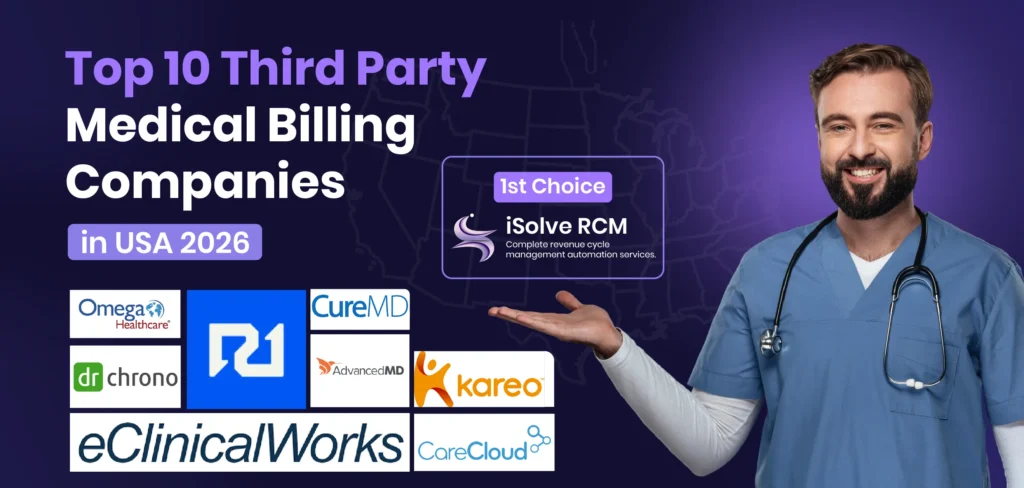
We evaluated the top 10 third-party medical billing companies on eight criteria: clean claim rate, first-pass resolution rate, AR days, denial management depth, EHR integration, HIPAA compliance, specialty coverage, and pricing transparency. Every entry includes honest limitations. iSolve RCM leads this list, and the reasons are specific.
What Is Third Party Billing and How Does It Work?
Third party billing in healthcare means a provider submits a claim to an insurance company or government payer instead of collecting payment directly from the patient at the time of service. The “third party” is the payer, which could be Medicare, Medicaid, or a commercial insurer like Blue Cross Blue Shield, UnitedHealthcare, Aetna, or Cigna. These payers stand between the provider and the patient and are responsible for reimbursing covered services based on the patient’s insurance plan.
In practice, a third party biller codes each patient visit using ICD-10-CM diagnosis codes and CPT or HCPCS Level II procedure codes. They prepare a claim form, either a CMS-1500 for physician billing or a UB-04 for facility billing, and send it through a healthcare clearinghouse like Change Healthcare, Availity, or Waystar using the EDI 837 electronic format. After submission, the biller manages the full payment cycle through Electronic Remittance Advice (ERA) posting, Electronic Funds Transfer (EFT) reconciliation, denial management, and AR follow-up until every claim is resolved.
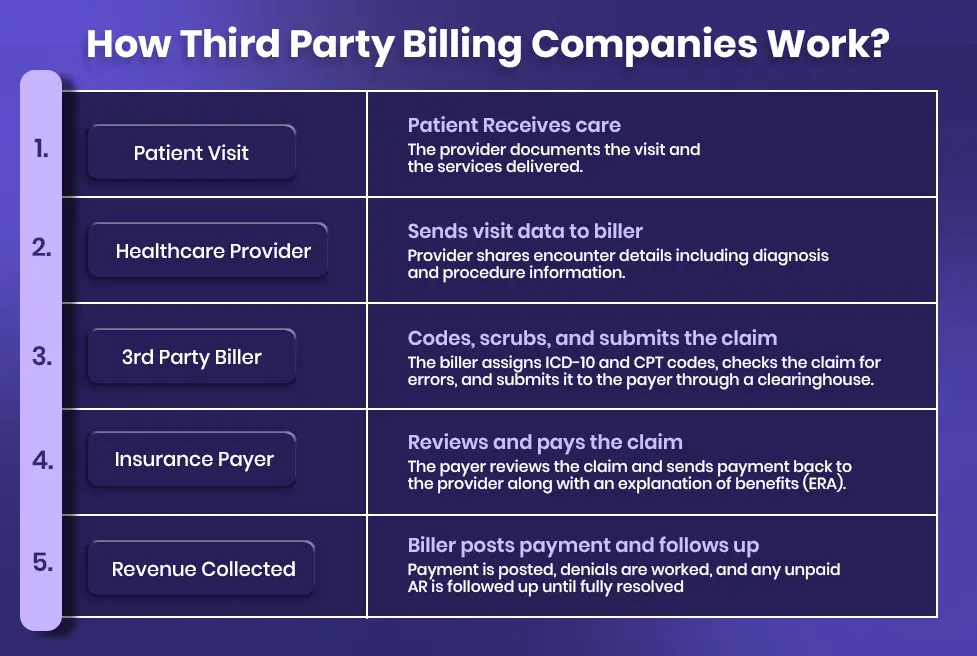
When a practice outsources to third party billing companies, they hand that entire workflow to a specialized external team. The practice focuses on patient care. The billing partner takes ownership of the revenue cycle.
5 Signs Your Practice Is Ready for a Third Party Billing Company
Many practices reading this are not yet in the “which company” phase. They are still asking whether outside help is actually needed. These five signs answer that question.
Your AR has been aging for the past 45 days.
For commercial players, 30 days is the standard ceiling. If claims are sitting beyond that, especially past 60 days, your follow-up process is behind and unpaid revenue is building up month after month.
Your clean claim rate is below 92%
According to HFMA benchmarks, the best-practice target is 97 to 98%. A rate below 92% means more than one in twelve claims goes out with an error, which leads to denials, rework, and delayed cash flow that most in-house teams are too stretched to fully recover.
Your denial rate is above 7%
The CMS benchmark for high-performing billing operations is a denial rate under 5%. Above 7% points to systematic problems in eligibility verification, prior authorization, or medical coding accuracy.
Your staff is handling billing and clinical tasks at the same time
Pulling clinical staff into billing work costs you in two ways. You are paying clinical wages for administrative tasks, and patient care gets less attention as a result.
Revenue is growing but collections are flat
More patient volume with the same collections means revenue is leaking out somewhere. The most common causes are undercoded claims, missed charges, uncollected patient balances, and aging secondary claims with no one actively following up. A good 3rd party medical billing company in USA finds and closes those gaps.
How We Ranked These 10 Companies
Every company on this list was measured against the same eight criteria. Each entry also includes a clear “Not ideal for” note, because a list where every company looks equally strong is a list you cannot actually use to make a decision.
- Clean claim rate: Industry benchmark is 95%. Top 3rd party billing companies reach 97 to 98%.
- First-pass resolution rate: How often claims are paid on the first submission, with no rework.
- AR days: Best-in-class third-party medical billing companies hold this under 30 days.
- Denial management depth: Resubmission alone is not denial management. Root-cause prevention is.
- EHR integration: Does it work inside your existing system, or move your data into an external platform?
- HIPAA compliance: Mandatory for every vendor. ISO 27001 certification is the additional security standard.
- Specialty coverage: Specialty-specific coding expertise is a different standard from generalist billing.
- Pricing transparency: Percentage of collections (3 to 8%), flat fee per claim ($3 to $5), or hybrid, and what is actually included in that rate.

Top 10 Best Third Party Medical Billing Companies in USA 2026
Top third-party companies in the USA provide healthcare solutions, outsourced medical billing services, and revenue cycle management to help clinics improve claim accuracy, reduce denials, and increase overall revenue performance.
1. iSolve RCM: Best Overall Third Party Medical Billing Company
Best for: Solo practices, small clinics, and multi-specialty groups that want stronger billing results without hiring a bigger in-house team.
iSolve RCM handles your full revenue cycle from start to finish. Before any claim goes out, their team checks insurance eligibility, confirms prior authorization, and runs each claim through an AI-powered scrubbing tool. This catches errors like wrong diagnosis codes, missing modifiers, and incorrect billing codes before they reach the payer. According to HFMA, the average denial rate in the industry is 8 to 10%. iSolve clients stay under 5% because every denial is tracked by root cause and used to fix the process, not just the individual claim.
They cover 12 or more specialties including Cardiology, Orthopedics, Neurology, Behavioral Health, Physical Therapy, Internal Medicine, Dermatology, Oncology, OB/GYN, and Radiology. Each practice is assigned a coder who knows that specialty, not a generalist working across all fields.
Key services:
- Insurance eligibility verification and prior authorization
- Medical coding using ICD-10-CM, CPT, and HCPCS Level II
- AI claim scrubbing and clean claim submission
- Denial management and AR follow-up
- Patient billing, credentialing, and MIPS/MACRA support
Performance benchmarks:
| Metric | iSolve RCM | Industry Average |
| Clean Claim Rate | 97 to 98% | Around 85% |
| First-Pass Resolution Rate | 97% or above | 75 to 80% |
| AR Days | Under 30 days | 40 to 50 days |
| Denial Rate | Under 5% | 8 to 10% |
| Collection Ratio | 96% or above | 80 to 85% |
Pricing: Percentage of collections with no hidden fees for denial management or credentialing.
2. Athenahealth
Best for: Large practices, federally qualified health centers, behavioral health organizations, and ambulatory surgery centers that want EHR, billing, telehealth, and practice management inside one cloud-based platform.
Athenahealth processes over 400 million claim checks each year and applies more than 23,000 proprietary validation rules before submission. That volume produces a first-pass resolution rate of around 94%. The integrated platform connects EHR, revenue cycle management, patient engagement, and telehealth in a single environment, which is a real advantage for large organizations that want fewer vendor relationships and a unified view of their data.
Key services: Medical claim processing, denial management, insurance verification, RCM, patient billing, EHR integration, telehealth.
Not ideal for: Solo practices and small clinics. Athenahealth’s pricing is enterprise-level and the platform complexity is built for organizations with substantial administrative infrastructure already in place. Smaller practices typically pay for capabilities they will never use.
3. R1 RCM
Best for: Hospitals, large health systems, and hospital-owned physician groups that need enterprise-scale revenue cycle management with Robotic Process Automation (RPA) and AI-driven analytics.
R1 RCM’s platform uses automation and machine learning to manage charge capture, claim submission, denial management, and patient financial services at high volume. They serve some of the largest health systems in the country and have deep experience in complex payer-mix environments where manual billing processes simply cannot keep pace with daily claim volume.
Key services: End-to-end RCM, charge capture, claims management, patient financial services, performance analytics.
Not ideal for: Independent practices, small groups, or specialty clinics. R1’s model is calibrated for health-system scale. Smaller providers will not get the pricing structure or account-level attention that makes this partnership work.
4. AdvancedMD
Best for: Independent practices and multi-specialty groups that want billing, EHR, scheduling, and financial reporting inside one unified system.
AdvancedMD removes the data handoff problem that generates billing errors in separate systems. Clinical documentation flows directly into the billing workflow with no manual transfer in between. Their RCM services cover claim submission, payment posting, denial follow-up, and detailed analytics, all inside a platform that also handles scheduling and electronic health records.
Key services: RCM, claim submission, payment posting, denial management, EHR integration, practice management, financial analytics.
Not ideal for: Practices that want to keep their existing EHR and only need a billing partner. AdvancedMD is designed for full platform adoption. If you want standalone third party billing services, this is not the right fit.
5. CareCloud
Best for: Mid-size practices and hospital-employed physician groups that want cloud-based RCM paired with strong real-time financial visibility and analytics.
CareCloud’s Concierge RCM service covers the full cycle from appointment scheduling through claim reimbursement. Their real-time dashboards give leadership clear visibility into AR performance and revenue gaps. They report a 30% reduction in AR days and a 90% collection rate for their client base, which reflects strong performance in mid-market practice environments.
Key services: RCM, medical coding services, insurance verification, patient billing, real-time analytics, denial management, practice management.
Not ideal for: Practices that want to preserve their current EHR and billing stack. CareCloud delivers its best results when adopted as an end-to-end platform rather than added on top of existing tools.
6. DrChrono
Best for: Tech-forward practices, telemedicine providers, and small to mid-size clinics where having EHR and billing in the same system is the top operational priority.
DrChrono’s billing is built natively inside its EHR. Patient encounters move directly from clinical documentation into the billing workflow without any manual data transfer, which eliminates a common source of coding errors in separate-system setups. The platform also supports telehealth billing with the correct place-of-service codes and CPT modifiers for virtual care visits.
Key services: Insurance verification, claim processing, patient billing, CPT and ICD-10 coding, denial management, telehealth billing, reporting.
Not ideal for: Practices that are not on the DrChrono EHR. The billing value is almost entirely tied to that native integration. Without it, you are using a general billing tool with no particular advantage over other options.
7. Kareo (Now Tebra)
Best for: Solo physicians and small independent practices that want fast, simple billing matched with a specialty-trained billing partner from an established network.
Tebra connects independent practices with billing partners from a network of more than 1,600 specialized billers. You are matched with someone who already knows your specialty’s CPT patterns and payer requirements, not a generalist who is learning your practice on your time. The platform keeps daily billing tasks and KPI tracking clear and simple for practices without a dedicated billing team.
Key services: Practice management, insurance eligibility, claims management, patient payment solutions, outsourced billing partner network.
Not ideal for: Large groups, multi-location practices, or hospital-affiliated organizations. Tebra is designed for an independent practice scale and does not handle the volume or complexity of larger organizations comfortably.
8. eClinicalWorks
Best for: Practices already on the eClinicalWorks EHR that want AI-powered RCM added to their existing clinical workflow without switching platforms.
eClinicalWorks’ RCM layer adds automated charge capture, claim scrubbing, and denial risk prediction directly inside the EHR environment their users already know. The machine learning component flags high-risk claims before submission, which helps practices that have historically struggled with specific payer-coding combinations. For existing eClinicalWorks users, adding the RCM layer is the lowest-friction path to improving clean claim performance.
Key services: AI claim scrubbing, denial management, charge capture, EHR-native integration, compliance reporting.
Not ideal for: Any practice not currently on the eClinicalWorks platform. The RCM capability depends almost entirely on native integration and delivers limited value as a standalone billing solution.
9. CureMD
Best for: Multi-specialty practices and niche specialty clinics that need certified coding depth across 32 or more specialties, with MIPS/MACRA compliance support built in.
CureMD’s strongest feature is specialty breadth. With billing expertise across more than 32 specialties, their coders understand the specific payer rules, CPT patterns, and prior authorization requirements of fields like orthopedics, neurology, oncology, and behavioral health. According to their published outcomes data, clients see up to 35% faster payments and approximately 6% lower denial rates. Their MIPS consulting is among the most developed of any 3rd party medical billing company in this segment.
Key services: Specialty billing across 32 or more specialties, AI claim scrubbing, denial management, MIPS/MACRA consulting, patient engagement, EHR integration.
Not ideal for: Practices looking for a straightforward, lower-cost billing solution. CureMD’s depth comes with platform complexity and cost that smaller or single-specialty practices often find more than they need.
10. Omega Healthcare
Best for: Large healthcare organizations and hospital systems where reducing per-claim cost at scale, through a global delivery model, is the primary operational goal.
Omega Healthcare runs large RCM teams across the U.S. and India, managing end-to-end revenue cycles for hospitals, large physician groups, and ambulatory networks. Their global delivery model reduces per-claim processing costs significantly at volume, which makes them a practical option for organizations processing tens of thousands of claims every month.
Key services: End-to-end RCM, medical coding, AR follow-up, denial management, patient financial services, analytics.
Not ideal for: Small or mid-size practices. The global delivery model and enterprise contracting structure is built for volumes that most independent practices and small groups do not generate.
In-House Billing vs. Third Party Billing: The Cost Reality
Most practices that stay in-house do not do so because in-house billing performs better. They stay because switching feels uncertain. According to MGMA cost benchmarking data, here is what the numbers actually show for a practice collecting $1.5 million annually:
| Factor | In-House Billing | Third Party Billing |
| Annual staffing cost | $55,000 to $75,000 or more per biller | 3 to 8% of collections |
| Clean claim rate | 82 to 87% average | 95 to 98% with top companies |
| Denial rate | 10 to 15% average | 4 to 8% with strong vendors |
| AR days | 45 to 60 days average | 25 to 35 days |
| Technology access | Limited by practice budget | Enterprise-grade tools included |
| Scalability | Requires hiring and retraining | Scales without adding headcount |
A 10% improvement in collection rate from switching to a high-performing 3rd party medical billing company on a $1.5 million book of collections adds $150,000 in recovered annual revenue, which is often more than the total cost of the outsourcing service itself.
How to Choose the Right Third Party Medical Billing Company
The best 10 medical billing companies in USA for healthcare practices in 2026 play an important role in the billing process. Choosing the right third party medical billing company requires evaluating accuracy, compliance, experience, and technology.
Does their expertise match your specialty?
Third party billing for cardiology is not the same as for behavioral health or physical therapy. CPT codes, modifier requirements, payer documentation rules, and prior authorization thresholds are different by specialty. Ask directly: how many current clients do you serve in my specialty, and which coder is assigned to my account?
What is their clean claim rate, and can they prove it?
Ask for a documented, data-backed figure, not a marketing headline. According to HFMA, the industry average clean claim rate is around 85%. A qualified third-party medical billing company should be consistently above 95%. If they cannot back the number with client data, that is a meaningful answer on its own.
How do they handle denied claims beyond resubmission?
Resubmitting a denial is rework, not management. Real denial management services means categorizing each denial by root cause, tracking patterns by payer and code, and feeding that intelligence back into front-end prevention. Ask specifically how their denial data improves your claim accuracy on the next billing cycle.
Do they work inside your EHR or move your data out?
Third party billing services that pull your claim data into their own external system take your AR visibility with them. If you cannot see your claims in real time inside your own platform, you are relying on their reports instead of your own data. That is a dependency you want to avoid from the start.
What does the contract actually include?
Before signing, confirm whether you are in a long-term lock-in or month-to-month, whether your data is portable if you leave, what the SLA is for denial follow-up response times, and whether denial management, credentialing, and patient statements are included in the base rate or billed separately.
What does the transition look like?
This is the question most practices skip and later wish they had asked. A well-managed transition runs legacy AR follow-up in parallel with new claim submission so that collections do not stop during the switch. Ask for a documented onboarding timeline. If they cannot provide one, treat that as a warning sign.
Frequently Asked Questions
What is the best third party medical billing company in the USA?
Based on clean claim rate, denial management performance, EHR integration depth, and specialty coverage, iSolve RCM ranks as the top third party medical billing company for healthcare providers in 2026. They consistently benchmark a clean claim rate of ≥97–98%, AR days under 30, and a denial rate under 5%.
How much do third party medical billing companies charge?
Most medical billing outsourcing companies charge between 3% and 8% of collections, depending on your specialty, volume, and the scope of services included. Some charge a flat fee per claim ($3 – $5). Always confirm whether denial management, credentialing, and patient statements are included in the base rate or billed separately.
Is outsourcing medical billing actually worth it?
For most practices, yes, significantly. Outsourcing to a high-performing third party billing company typically increases collections by 10 to 15%, reduces AR days from 40 to 50 days down to under 30, and cuts denial rates from the industry average of 8 – 10% toward 4 – 5%. The cost of outsourcing is almost always lower than the revenue you’re currently losing to billing errors and uncollected claims.
What is the difference between medical billing and revenue cycle management (RCM)?
Medical billing is one part of the revenue cycle, specifically the claim submission and payment collection process. Revenue cycle management (RCM) is the full end-to-end financial workflow, starting from patient scheduling and insurance eligibility verification, through coding, claim submission, denial management, payment posting, AR follow-up, and patient collections. The best third party medical billing companies offer full RCM, not just billing.
How do I switch from my current billing company to a new one?
Start by getting your complete AR data and claims history exported from your current vendor before giving notice. Execute a BAA with your new partner early. Run parallel billing for 2 – 3 weeks if possible. A well-structured onboarding process like iSolve RCM’s dedicated transition management should get your claims flowing cleanly within 30 days of kickoff.
What percentage of medical bills contain errors?
Industry data consistently shows that approximately 80% of U.S. medical bills contain some form of billing error ranging from incorrect CPT codes and missing ICD-10 modifiers to wrong patient demographics and duplicate charges. This is the core reason outsourced medical billing services that use certified coders and automated claim scrubbing deliver materially better financial outcomes than most in-house billing departments.