

Finding the right ICD-10 code for knee pain is a daily challenge, because pain in the knee joint is one of the most prevalent musculoskeletal problems seen at a primary health care clinic, an orthopedic office, an emergency department, and even a physiotherapy practice. Knee pain can occur from traumatic sports-related injuries to joint degeneration due to aging; the list is long for different conditions that cause this problem and the corresponding coding complexity involved in doing it properly. Choosing the appropriate ICD-10 code for knee pain is no small task.
This is an important decision as far as both clinical and financial results are concerned. This decision affects the payment, authorization, and compliance of the procedure involved. If a wrong or ambiguous code is selected for the medical procedure, it may lead to denials and prior authorizations being delayed, putting the practice at risk of undergoing an audit process.
This complete blog is intended to be an all-inclusive source for all who seek information about ICD-10 codes for knee pain diagnoses. If you need information on ICD-10 codes for right knee pain, the difference between M25.561 and M25.562, bilateral knee pain ICD-10 coding, or guidance from a medical billing company in USA on how to bill knee pain properly, this blog will provide that information in great detail.
Understanding Knee Pain as a Diagnosis in ICD-10
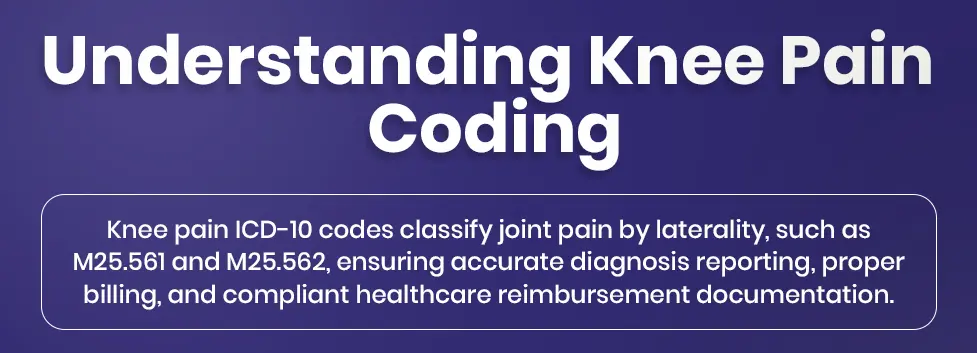
Before moving to details about the coding, it is necessary to know about ICD-10 coding with regards to the problem of knee pain and whether it refers to the other laterality code to determine its side. The reason for the development of ICD-10-CM is that ICD-10 collects more data about patients than ICD-9 did before. A substantial improvement to the new classification is the obligatory use of laterality in musculoskeletal disorders coding. Where the previous ICD version allowed the coder to indicate only that a patient experiences “knee pain” without the need to clarify the side, ICD-10 requires such clarification.
The rule is not an abuse of the system – it is a core aspect of clinical practice. It must be noted that the left knee and right knee are distinctly different body parts, each with unique pathologies, treatment records, and medical necessity. A patient who has had a total knee arthroplasty on his or her left knee, followed by knee pain on the right side, is a distinct case from a bilateral knee pain patient. Treating them similarly in coding can create inaccurate information about the patient’s status to payers, and jeopardize treatment of the affected side.
The knee pain code in ICD-10 falls under M25.5 – Pain in joint, which belongs to Chapter 13, Diseases of the musculoskeletal system and connective tissue (M00–M99). In M25.5, the fifth character “6” denotes the knee joint. The sixth character indicates laterality: “1” for the right knee, “2” for the left knee, and “9” for an unspecified knee. ICD-10-CM does not provide a single bilateral code for knee pain, so bilateral knee pain is reported with both M25.561 and M25.562.
ICD-10 Knee Pain Codes at a Glance
| ICD-10-CM Code | Description |
|---|---|
| M25.561 | Pain in right knee |
| M25.562 | Pain in left knee |
| M25.569 | Pain in unspecified knee |
| M25.561 + M25.562 | Bilateral knee pain (report both codes together) |
The Core ICD-10 Knee Pain Codes Explained
The core ICD-10 knee pain codes classify right, left, and bilateral knee pain conditions which help providers to ensure accurate diagnosis documentation, compliant billing, and reimbursement accuracy.
M25.561 — Pain in Right Knee
M25.561 is the ICD-10 code for right knee pain. The code is widely used and it is applied by default when the patient reports right knee pain without a specific underlying diagnosis such as osteoarthritis, meniscal tear, or ligament injury having been confirmed.
This diagnosis code can be applied under certain circumstances. For instance, if the patient complains about pain in the right knee without an underlying diagnosis being established, then M25.561 should be reported. In addition, it applies to those cases where the doctor notes pain in the knee without mentioning any particular pathology in the report, if the patient seeks medical attention because of pain even if there is no specific cause for that, or when right knee pain is treated as the problem per se using various therapies such as painkillers, physical therapy, and injections.
What really sets the M25.561 right knee pain code apart in regard to billing is the fact that it helps support many different codes related to procedures. CPT codes for intra-articular corticosteroid injection (20610), CPT codes for viscosupplementation injections along with appropriate J-codes, CPT codes for diagnostic arthroscopy (29870), and CPT codes for imaging services (73721 – MRI of the knee without contrast) all require a code to support medical necessity. The M25.561 code would be an acceptable code to help support these procedure codes.
In regard to documentation, it should be noted that pain is specifically in the right knee joint, how severe it is, how it feels (sharp, dull, constant, intermittent). It is important to know what triggers pain (and alleviates it). Any treatments that were previously tried can also be helpful.
M25.562 — Pain in Left Knee
M25.562 is the ICD-10 code for left knee pain, which performs all the same purposes in the clinical documentation and medical coding as M25.561, with the only exception that the affected side is left rather than right. The ICD-10 code for left knee pain uses the same requirements as those described above for its counterparts — except the laterality.
ICD-10 left knee pain code is common in the practices of family medicine, sports medicine, orthopedics, and physical therapy billing. Just like the ICD-10 code for right knee pain, M25.562 can be used whenever left knee pain is the principal complaint; before making a diagnosis based on a clear structure of the condition; and when the doctor opts to code the symptoms rather than their cause at the current visit. The list of services that can be performed in patients with pain in the left knee is identical to that for M25.561 — injections, diagnostic imaging, physical therapy visits, and surgery.
One of the most frequent mistakes in coding pain in the left knee area is that of laterality — especially in clinics where their forms automatically populate with one side or in cases where dictation errors remain uncorrected. When a patient comes to the office with left knee pain and he/she is mistakenly assigned a code of M25.561 (right knee), there will be problems with claims in situations where the procedure, such as a left knee injection, does not correspond with the assigned code.
M25.561 Deep Dive — Why This Code Matters Most
Out of all the codes associated with knee pain, M25.561 – pain in the right knee is one which needs to be analyzed in detail because it is, statistically speaking, the most frequently queried and billed knee pain code out of all of them. Having a full understanding of the use of this code, its limitations, and its relation to other more specific codes is a requirement for any coder in a practice focused heavily on the musculoskeletal system.
M25.561 is an ICD-10 code for a symptom, which means that pain in itself is what this code represents, not the cause of that pain. This is what makes it so broadly applicable – it can be assigned every time there is a mention of right knee pain as a problem, but it must be replaced with another code if the underlying cause has been established.
For instance, when a patient comes in with pain in the right knee (M25.561) and an MRI is done which shows a tear in the medial meniscus, the correct code to use will be M23.201 (derangement of unspecified medial meniscus due to old tear or injury, right knee) or other codes related to meniscus tear and not M25.561. The use of M25.561 once the actual diagnosis is confirmed becomes a coding mistake irrespective of the continuing symptoms.
It is essential for coders to know how to make this shift in musculoskeletal coding. Instead of using M25.561 on subsequent visits, the coder should check prior encounters and other relevant diagnostic reports. Where there is a confirmed diagnosis, the code should reflect it. When there is no clear diagnosis, then M25.561 is justified.
Code the Cause When a Specific Diagnosis Is Established
M25.561 and M25.562 are symptom codes and should not replace a more specific diagnosis when the underlying cause of knee pain has been established.
For example, when knee osteoarthritis is documented, use the appropriate M17. osteoarthritis code based on the documented type and laterality rather than relying only on a knee pain code.
- M25.561 / M25.562: Use for right or left knee pain when no more specific diagnosis has been established.
- M17. : Use the appropriate osteoarthritis code when knee osteoarthritis is confirmed and documented.
- Other specific diagnosis codes: Use the condition-specific ICD-10-CM code when a meniscal tear, ligament injury, bursitis, chondromalacia, or another underlying condition is established.
Coding rule: Code the documented cause when known; use the knee pain symptom code when the underlying diagnosis has not yet been established.
M25.569 — Pain in Unspecified Knee
The ICD-10 code that describes pain in an unspecified knee is M25.569. It is applicable when there is no information about the affected knee or if the information provided by the doctor is unclear. It must be noted that M25.569 code should be avoided at any cost. Coding principles require that laterality must be mentioned whenever the medical practitioner has knowledge of the affected limb, and using M25.569 in such cases would indicate a coding mistake. It is well known that payers understand that unspecified codes denote lack of documentation in patients’ records and tend to investigate claims having these codes.
Whenever coders face the situation of an unspecified code, they should definitely contact the treating physician and inquire about the affected knee. Most of the time, the physician knows which knee hurts but just does not mention it in his notes.
Expert Advice: Ensure that laterality is verified, prior diagnostic results are reviewed, and symptoms are coded using confirmed conditions codes whenever possible in order to increase accuracy and avoid denials.
Quick Reference — ICD-10 Knee Pain Code Cheat Sheet
| Code | Description |
| M25.561 | Pain in right knee |
| M25.562 | Pain in left knee |
| M25.569 | Pain in unspecified knee |
| M17.11 | Primary osteoarthritis, right knee |
| M17.12 | Primary osteoarthritis, left knee |
| M17.31 | Post-traumatic osteoarthritis, right knee |
| M17.32 | Post-traumatic osteoarthritis, left knee |
| M22.41 | Chondromalacia patellae, right knee |
| M22.42 | Chondromalacia patellae, left knee |
| M70.41 | Prepatellar bursitis, right knee |
| M70.42 | Prepatellar bursitis, left knee |
| M76.31 | Iliotibial band syndrome, right leg |
| M76.32 | Iliotibial band syndrome, left leg |
| S83.501A | Sprain of ACL, right knee, initial encounter |
| S83.502A | Sprain of ACL, left knee, initial encounter |
Bilateral Knee Pain ICD-10 Coding
The situation where a patient is having pain in both knees is a unique case in coding which is usually done wrongly. In cases where the patient comes with pain in both knees, the right thing to do according to ICD-10 is to code using the bilateral code that would be M25.561 and M25.562 or a bilateral identifier when it comes to a particular code category, where medical coding services help ensure coding accuracy and compliance.
In the case of M25.5 knee pain category in ICD-10-CM, there is no code for bilateral knee pain. The way to do bilateral knee pain coding in ICD-10 would be to assign M25.561 for the right knee pain and M25.562 for left knee pain. The coding is used at once when coding and this enables proper coding of procedures involving both knees such as bilateral knee injection.
This is another situation where coding errors occur rather frequently. Some coders apply a single code for knee pain even in cases where the physician notes bilateral pathology, either as a matter of routine or due to the fact that their coding software does not allow multiple codes per encounter. As a result, a mismatch between diagnosis and procedure is established, resulting in partial or total denial of the claim. Another mistake involves using M25.569 (knee unspecified) to imply bilateral pathology – a misinterpretation of this code, as it actually means that laterality is not known.
For accurate coding in situations where the encounter involved patients with bilateral knee pain, the physician should state explicitly that there is bilateral pathology, provide separate details about each knee in terms of the characteristics of pain and, if possible, mention physical exam findings in relation to any potential asymmetries.
When to Use Knee Pain Codes vs. More Specific Diagnosis Codes
Among the analytical questions to ask about knee pain coding is: when is the proper time to use the codes M25.561 or M25.562, and when would a diagnostic code suffice? The solution involves knowledge on the correlation between symptom codes and diagnostic codes under ICD-10 coding rules.
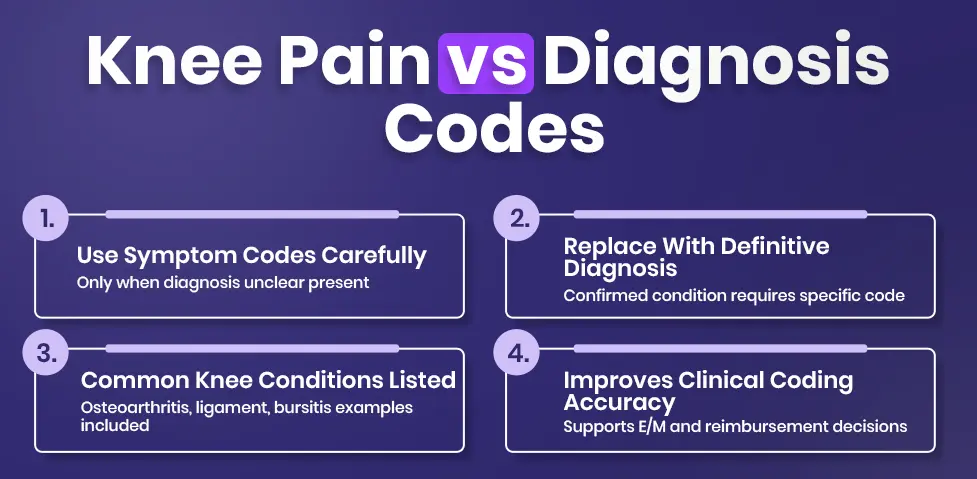
According to ICD-10 Official Guidelines, symptom codes like M25.561 (right knee pain) shall not be assigned when the condition is diagnosed and has been stated in the documentation provided by the doctor who is taking care of the patient. Under such circumstances, only the disease code should be used as the primary code, and symptom code can only be used as an additional code depending on what it contributes to the medical documentation.
These are some common conditions associated with the knee, each having a different ICD-10 code that replaces M25.561 or M25.562 when the diagnosis is made. For osteoarthritis of the right knee, either M17.11 (primary) or M17.31 (post-traumatic) can be used. A medial collateral ligament strain of the right knee has the code S83.411A (initial encounter). For anterior cruciate ligament tear of the right knee, S83.501A is the applicable code. Chondromalacia of the right knee is assigned to M22.41. Prepatellar bursitis of the right knee is designated by the code M70.41. Finally, iliotibial band syndrome of the right knee can be referred to using M76.31.
Every one of these specific codes contains much more clinically relevant information than a generic knee pain code does, making decisions at higher levels of medical decision-making possible in E/M coding. However, the ICD-10 code used for knee pain — M25.561 or M25.562 — still holds great value and relevance in its own right when applied as a stand-alone code during the diagnostic process.
Professional Insight: Apply symptom codes related to knee pain only where a diagnosis hasn’t been made; after a proper diagnosis is made, stop using the symptom code and use the ICD-10 code for that condition.
ICD-10 Knee Pain Coding for Different Clinical Settings
Primary Care
M25.561 or M25.562 ICD-10 codes of knee pain may be first used by the physician during evaluation for knee pain in primary care. The physician will order X-ray examinations (codes 73560-73564) and prescribe NSAIDs and analgesic medications. Knee pain referral will be made for orthopedics or physical therapy. Documentation would include details about the onset and duration of knee pain and how the condition developed.
Orthopedic Practice
Orthopedic coders code from general M25.561 through detailed post-op and structural diagnosis codes that pertain to knees. In orthopedic coding, there is no significant delay in coding changes from symptom codes to definitive codes; this process can occur in one or two visits. Coders should be aware of new diagnoses made after performing imaging or arthroscopy on the patient, updating the codes when necessary. Billing for M25.561 for a patient who has a history of meniscal tear three visits prior to the present encounter may be an issue identified in payer audits.
Physical Therapy
There are many records kept of knee pains among patients by physical therapists, and these records depend on the ICD-10 codes from the referring physician. For billing of physical therapy, the ICD-10 code for the left knee pain (M25.562) and right knee pain (M25.561) has to be included on the claim form as well as being consistent with the diagnosis of the physician. Physical therapists are not allowed to create ICD-10 codes outside their professional scope of practice.
Emergency Department
Knee pain codes in the ED are used to code evaluation and management of cases with acute knee injuries, acute/chronic pain flares, and cases with post-procedure complications. In the case where there is clear documentation about the cause of the injury, and where there is also evidence of a particular structure that has been injured, such as fractures, tears of the ligaments, and dislocations, specific trauma codes are utilized in place of the pain codes M25.56x.
Documentation Best Practices for Knee Pain Coding
Accurate coding requires proper documentation. In most cases, the most common cause of selecting a general or less-specific code is not lack of coding expertise, but insufficient physician documentation. If proper documentation is provided by physicians every time, coders have all the information required to make sure the coding process is performed accurately in the very first attempt, while outsource medical billing services help improve coding accuracy, compliance, and reimbursement efficiency.
The physician must provide the side affected during each consultation in which there is knee pain. There must be a description of the pain in clinical terms such as “sharp” or “dull” or “aching”. There must be information regarding the factors that aggravate the pain and those that relieve the pain. Any previous occurrence of knee pain should also be documented, along with the duration of pain, relationship to activity and any other relevant information. Physical exam findings should detail ROM, swelling, point of tenderness, ligamentous stability, and specific orthopedic tests such as McMurray, Lachman, and patellar grind tests.
Any findings from diagnostic studies such as x-rays, MRIs, and arthroscopy need to be included in the note and discussed with regard to how they affect the working diagnosis. If a certain structural diagnosis is made, then it needs to be mentioned. If the patient’s workup is incomplete, and pain alone can be determined, then this needs to be documented as well. Any treatment plans such as medication, injections, referrals, therapy, and even surgery need to be documented in relation to the diagnosis and include medical necessity language.
An EHR template used for knee pain visits can remind the provider to document laterality, chronicity, and whether or not the diagnosis is known. The CDI specialist reviewing these cases will be able to catch any missing laterality documentation, changes in diagnosis, and lack of documentation regarding intractability before claims get denied.
Knee Pain Medical Billing and Avoiding Denials
The financial implications associated with precise coding of knee pain cases are quite high. Outpatient orthopedic/musculoskeletal cases represent one of the largest coding categories in outpatient practice, and millions of knee pain diagnosis codes are utilized per year in claims processing. Coding errors, even slight ones, represent a huge dollar loss in terms of revenue for providers when applied across a broad spectrum of patients, where denial management services help identify coding issues, reduce claim rejections, and recover lost reimbursements efficiently.
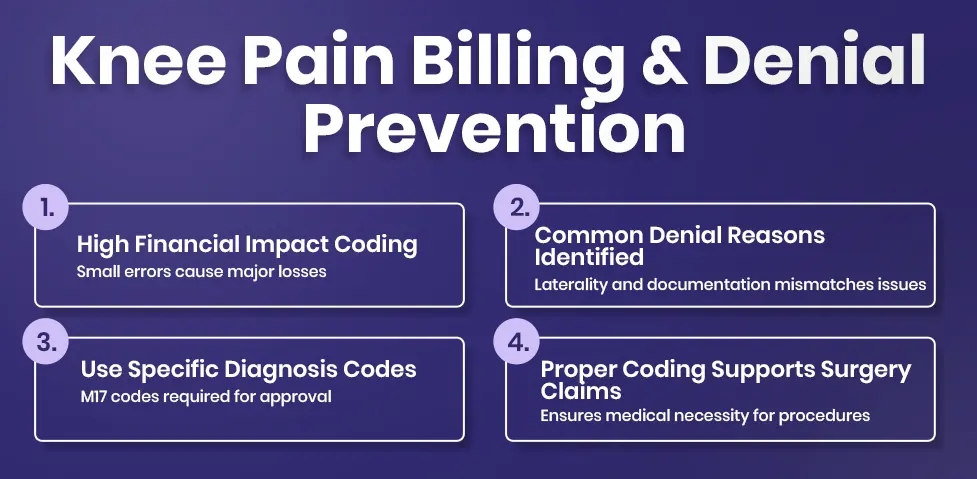
The most frequent causes of denials in knee pain insurance billing cases are mismatched laterality between diagnosis and procedure codes, the inappropriate use of unspecified codes rather than more exact codes where applicable, failure to move to definitive diagnosis codes once an initial diagnosis has been determined, lack of adequate medical necessity documentation for diagnostic images and injections, and bilateral procedures without dual knee diagnosis codes.
For viscosupplementation injections, which are a high-ticket item in orthopedic offices, many insurance companies insist on proof of failure in conservative management, a definite diagnosis of knee osteoarthritis, and particular ICD-10 codes – either M17.11 for osteoarthritis of right knee or M17.12 for osteoarthritis of left knee. The use of M25.561 alone will most likely lead to denial for the aforementioned procedures. In order to be aware of the insurance company guidelines for documentation for knee pain and knee pathology coding, it is vital for an office with large numbers of joint injections to know them.
In case of surgery, be it a partial meniscectomy (CPT 29881), total knee arthroplasty (CPT 27447), or anterior cruciate ligament (ACL) reconstruction (CPT 27407), a diagnosis code should represent the pathology seen on imaging studies or during a physical exam. The coding of the above-listed surgeries using M25.561 alone is quite risky, and the claim will probably face an inquiry because of its inability to show the pathology in question.
Expert Tip: Make sure that diagnosis laterality matches procedures; when there is confirmation of definitive ICD-10 diagnoses, use them; also, be sure to properly document medical necessity in order to avoid denials.
How iSolve RCM Supports Your Practice with ICD-10 Knee Pain Coding
Coding for knee pain properly, ranging from right knee pain to codes for bilateral knee pain in ICD-10, will not only require a good code finder resource. Proper coding for knee pain will require not only an understanding of the codes but also an understanding of how payers work, the ability to document well, and a partner that knows billing for musculoskeletal injuries and conditions inside and out. This partner is iSolve RCM. We are a complete service revenue cycle management firm that specializes in orthopedics, sports medicine, primary care, and physical therapy billing. Our professional certified coders have a complete understanding of all levels of musculoskeletal billing in ICD-10, including knee pain diagnosis codes.
FAQs
What is the ICD-10 code for right knee pain?
The ICD-10 code for right knee pain is M25.561 — Pain in right knee. This is one of the most commonly billed musculoskeletal diagnosis codes in outpatient medicine.
What does M25.561 mean?
M25.561 is the ICD-10-CM diagnosis code for pain in the right knee. The “M” identifies the musculoskeletal chapter, “25” identifies joint disorders, “.5” identifies pain in the joint, “6” identifies the knee, and “1” specifies the right side.
How do I code bilateral knee pain in ICD-10?
Bilateral knee pain ICD-10 coding requires assigning both M25.561 and M25.562 together on the claim, as ICD-10 does not provide a single bilateral code within the M25.56x series.
When should I use M25.561 instead of a more specific knee code?
Use M25.561 when knee pain is the primary documented complaint and a definitive underlying diagnosis has not yet been established. Once a specific diagnosis — such as osteoarthritis, meniscal tear, or ligament injury — is confirmed and documented, transition to the appropriate specific code.
Can M25.561 be used for chronic knee pain?
Yes. M25.561 can be used for both acute and chronic right knee pain when pain is the primary documented complaint. However, if a chronic condition such as osteoarthritis has been diagnosed, the osteoarthritis code should be the primary diagnosis.
What is the ICD-10 code for left knee joint pain?
Left knee joint pain is coded as M25.562 in ICD-10-CM. The term “joint pain” aligns directly with the M25.5 category, which specifically classifies pain in joints by anatomical location.