
Anemia is a common clinical condition in which the number of red blood cells or hemoglobin become minimum which leads to less oxygen delivery to tissues. This condition is caused because of multiple factors including nutritional deficiencies, chronic diseases, blood loss, or genetic disorders and is normally met in medical practice.
Proper documentation, clinical communication, and reimbursement depend purely on the precise use of the ICD-10 coding for anemia. This blog will try to explain key ICD-10 codes, different types of anemia, and essential billing guidelines to help healthcare professionals and medical billing companies in USA ensure precise coding, improve documentation accuracy, and avoid costly claim errors.
Overview of Anemia in Clinical Practice
According to research by the National Center for Biotechnology Information, Anemia is a medical condition in which the level of hemoglobin or red blood cells start to decrease in your blood. Because of this condition, delivery of oxygen to your body tissues becomes slow or decreased. Low delivery or delay of oxygen in your body causes exhaustion, fatigue, weakness, and shortness of breath which can range from mild to severe.
Iron deficiency, chronic diseases, kidney disease, and acute blood loss due to injury or surgery are some common reasons which develop anemia symptoms in your body. There is a dire need of appropriate classification of ICD-10 coding because it guarantees suitable treatment planning, accurate diagnosis reporting, and correct medical billing for healthcare services.
Expert Tip: Always recognize and document the fundamental cause of anemia whenever possible. Precise clinical documentation supports exact ICD-10 code selection, advances claim acceptance rates, and supports prevent reimbursement delays or coding-related compliance issues.
General ICD-10 Code for Anemia
The code D64.9, Anemia, unspecified is a general ICD-10 code for anemia which is used when the specific or precise type or underlying cause of anemia is not evidently documented. Anemia is one of the most usually used coding entries in routine clinical and medical billing set-ups.
The code D64.9 is a category which should be useful only when there is inadequate or insufficient clinical information and need to recognize a more specific form of anemia. This is not a lasting or permanent code but it acts as a default or temporary code up until further diagnostic assessment or physician documentation elucidates the exact type of anemia present.
Proper documentation is important in this context and is also necessary while using an unidentified or unknown anemia code. It is important for healthcare professionals to document all the available lab results, physical evidence, and potential causes so that the process of code modification can be easier in the future. Organizations that employ the expertise of medical coding services will benefit by better documentation and coding practices.
ICD-10 Codes for Different Types of Anemia
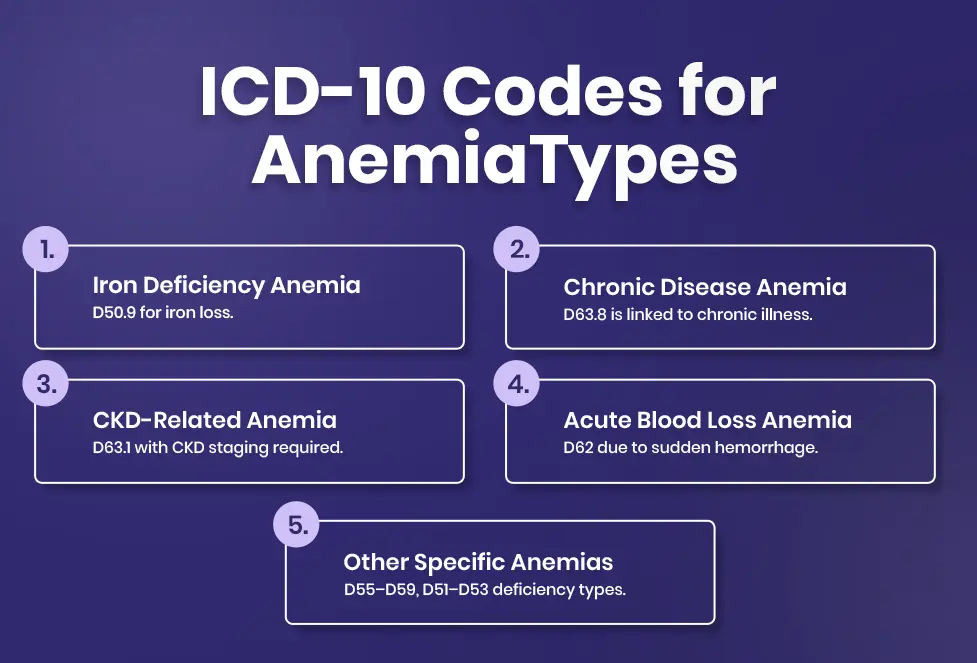
ICD-10 anemia codes fluctuate by type which include iron deficiency, chronic disease, CKD-related anemia, acute blood loss, and other specific categories.
Iron Deficiency Anemia
The anemia code D50.9 is mainly applied for iron deficiency and when as unspecified. Iron deficiency happens due to the inadequate factors that include iron intake, chronic blood loss or absorption issues. Gastrointestinal bleeding or dietary deficiency are some identifying and primary causes which can provide a chance to recognize accurate coding for ICD-10 classification and enhanced clinical documentation.
Chronic Disease Anemia
The code D63.8 is normally used for anemia of chronic disease. This is classified and occurs secondary to lasting illnesses such as infections, malignancies or inflammatory disorders. This results from fundamental chronic pathology because it is not a primary condition. Appropriate coding involves connecting anemia with the interrelated disease or diagnosis to ensure precise ICD-10 reporting.
Anemia in Chronic Kidney Disease (CKD)
Anemia in chronic kidney disease is coded as D63.1 and must be applied with an additional or accompanying CKD stage code such as N18. This condition is specifically fallouts from low or reduced erythropoietin production in kidney impairment. Both anemia and CKD stage require and play an important role in correct coding and documentation to ensure clinical accuracy and proper reimbursement.
Acute Blood Loss Anemia
Acute blood loss anemia is coded as D62 and it normally happens due to surgery, sudden hemorrhage from trauma or gastrointestinal bleeding. This condition of anemia signifies a quick drop in hemoglobin levels. You need to find the main reason for bleeding and document it alongside the anemia diagnosis for correct coding.
Other Specific Anemias
Other anemia types that include hemolytic anemias with D55–D59 codes and vitamin deficiency anemias along with D51–D53 codes. These conditions arise from nutritional deficiencies or red blood cell destruction such as folate or vitamin B12 deficiency. Suitable classification depends on recognizing the exact fundamental cause for precise ICD-10 coding. You also need to know about how to use ICD-10 codes for Rheumatoid Arthritis.
Expert Insight: Always code the most specific type of anemia maintained by clinical documentation. Avoid depending on unspecified codes when the primary cause is known, as accurate code selection advances claim acceptance, reimbursement precision, and compliance with ICD-10 guidelines.
ICD-10 Coding Guidelines for Anemia
Anemia ICD-10 Coding Guidelines advise coders on picking the more detailed diagnosis instead of relying on unspecified codes in the process. The guidelines about the use of unspecified and specific codes recommend that the former only be applied where the specific cause of anemia cannot be determined from clinical records.
In anemia cases, it is essential to consider proper sequencing when choosing a code depending on whether it results from other conditions like chronic kidney diseases or infections. Sequencing is important in connecting anemia with its underlying causes through proper linking, along with the importance of physician documentation.
Coding Anemia with Chronic Conditions
Anemia often occurs alongside other illnesses, requiring proper combination coding that will accurately capture the presence of the chronic illness along with its impact on the blood part. Practices who outsource medical billing services will be able to do better at proper coding, diagnosis sequencing, and documentation pertaining to both the condition and the anemia accompanying the illness.
CKD + anemia coding rules
Anemia in chronic kidney disease necessitates the use of both codes. The correct codes are D63.1 and N18., and this is due to the decreased erythropoietin formation leading to anemia in the CKD patients. Appropriate coding allows proper medical care provision and enhances reimbursements from health insurance organizations.
Cancer-related anemia
Cancer anemia is caused by cancer itself, chemotherapy, and/or bone marrow suppression. In coding, the malignancy and the anemia must both be noted when they are both significant. The anemia would be secondary and should be coded accordingly. Proper documentation allows for appropriate ICD-10 coding, justifies treatment, and avoids claim denial.
Diabetes and chronic disease associations
Diabetes may be indirectly involved in the development of anemia if the kidneys have been damaged by diabetes or if there is any sort of chronic inflammation. The coding process will depend on whether the patient’s anemia is because of diabetic complications or something else entirely.
Examples of correct code pairing
Proper coding combinations should be made based on the combination of anemia with the underlying conditions; for example, D63.1 and N18.- for CKD and D63.8 and chronic inflammation diseases. This should always be done with regard to clinical indications. Proper coding combinations will enhance coding accuracy and ensure adherence to ICD-10 guidelines.
Common Coding Errors to Avoid
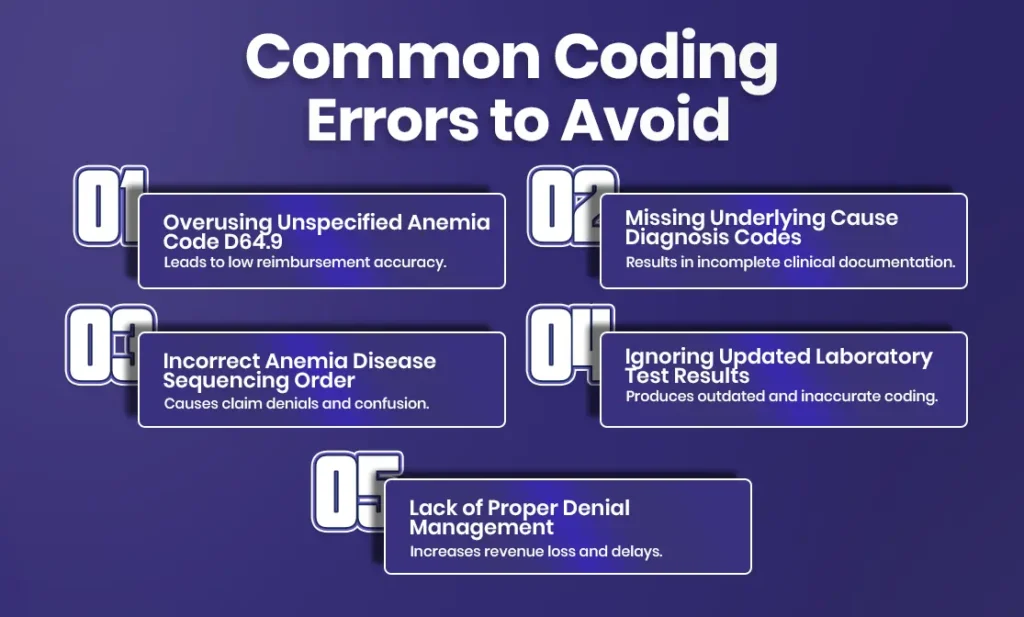
Inadequate coding in relation to anemia can lead to claims denial, wrong data, and underpayment. Those providers who employ denial management services can detect coding problems early on and resolve claims quickly and effectively. By following the guidelines for proper coding using ICD-10 codes, one can ensure the right use of codes for anemia related to the condition.
Overusing D64.9 when specific diagnosis exists
The improper use of D64.9 (anemia, unspecified) is the result of coders’ inability to determine more specific types of anemias, which could be either iron deficiency or chronic kidney disease anemias. Inaccurate coding decreases reimbursement; hence, it should be avoided. The best way to do this is to analyze patient records thoroughly.
Missing underlying cause codes
Another common mistake is not mentioning the underlying cause of anemia that can be attributed to other diseases like chronic kidney problems, malignancy, or even poor nutrition. It must be noted that anemia is mostly considered secondary, hence, forgetting to include its primary cause results in inadequate medical documentation.
Incorrect sequencing of anemia with chronic diseases
Incorrect coding results from the incorrect sequencing where anemia becomes the principal diagnosis while it should be the chronic condition that leads to the anemia. The sequencing rules for ICD-10 indicate how the principal diagnosis must be determined. Proper sequencing is essential for compliance purposes and claim acceptance.
Not updating codes based on lab findings
The other typical error is that anemia codes are not properly updated based on laboratory reports. Since there are additional diagnostic results, proper coding needs to be done. Failure to do so could mean that outdated coding could become a problem and may even lead to incorrect billing.Bottom of Form
Professional Tip: Normally review physician documentation, laboratory findings, and primary diagnoses before finalizing anemia codes. Precise sequencing and specific code selection can meaningfully minimize claim denials, advance reimbursement rates, and strengthen complete coding compliance.
Billing and Reimbursement Implications
Coding for anemia is extremely important in medical billing because it affects the payment process and helps to comply with insurance company requirements. The use of ICD-10 codes makes it possible to properly document the treatment provided and prove its need.
Why accurate ICD-10 coding affects claim approval
Correct coding of ICD-10 is critical in ensuring that the diagnosis of the patient is well captured and reduces the chances of rejection of the claims. Correctly coding anemia using specific causes will help the insurer to determine the medical necessity of the services provided.
Impact on insurance reimbursement
The insurance reimbursement process is greatly influenced by the use of specific ICD-10 codes. Codes related to anemia that specify the cause behind it tend to have better insurance acceptance rates than nonspecific anemia codes. Accurate coding helps ensure accurate payment for the services rendered.
Medical necessity documentation tips
Good evidence for the necessity of care must include clinical documentation, lab results, and information provided by the doctor concerning the presence of anemia. The presence of anemia associated with some other condition provides grounds for treatment. Good documentation will allow coders to assign the right ICD-10 codes.
Role in audits and compliance
Precise anemia coding is vital for auditing purposes in terms of compliance checks carried out by payers and regulatory agencies. Correct use of codes will help avoid any fines and claim denials. Proper coding will show that the right rules have been followed.
ICD-10 Anemia Code Reference Table
| ICD-10 Code | Diagnosis | Brief Explanation |
| D64.9 | Unspecified anemia | Used when the type or cause of anemia is not clearly documented in clinical records. |
| D50.9 | Iron deficiency anemia | Indicates anemia due to lack of iron from diet, absorption issues, or chronic blood loss. |
| D63.1 | Anemia in CKD | Used for anemia caused by chronic kidney disease and must be coded with N18.- stage. |
| D63.8 | Anemia in other chronic diseases | Applied when anemia is secondary to long-term chronic conditions like infections or inflammation. |
| D62 | Acute posthemorrhagic anemia | Used for anemia resulting from sudden blood loss due to trauma, surgery, or internal bleeding. |
How iSolve RCM Support ICD-10 Code for Anemia
The support offered by iSolve RCM Support to healthcare providers will include help in assigning appropriate codes for anemia in ICD-10 through reviewing relevant documentation and achieving proper coding. The assistance will aid in minimizing errors, such as overuse of codes that are not specific, such as code D64.9. The professionals will assist in choosing codes from ICD-10 that correspond to the actual cause of the diagnosis, for example, anemia from chronic kidney disease, iron deficiency, and chronic diseases.
FAQs
What is the ICD-10 code for anemia?
The ICD-10 code for anemia relies on its type and cause. The most normally applied code is D64.9 for unspecified anemia, but specific codes such as D50.9, D63.1, and D63.8 are utilized when the exact reason is documented in clinical records.
When should D64.9 be used for anemia?
D64.9 should only be used when the type or fundamental cause of anemia is not evidently specified or precisely mentioned in the medical documentation. If lab results or physician notes designate a specific type, a more precise ICD-10 code should always be nominated.
What is the ICD-10 code for anemia in chronic kidney disease?
The ICD-10 code for anemia in chronic kidney disease is D63.1. It must always be used along with the additional suitable CKD stage code such as N18. to confirm precise documentation, appropriate sequencing, and correct reimbursement in medical billing systems.
What is the ICD-10 code for iron deficiency anemia?
Iron deficiency anemia is coded as D50.9 when unspecified. It happens due to low iron levels which is caused by poor diet, malabsorption, or chronic blood loss. Precise documentation helps certify correct ICD-10 coding and appropriate clinical management.
What is anemia of chronic disease ICD-10 code?
Anemia of chronic disease is coded as D63.8, and is applied when anemia is secondary to lasting conditions such as infections, inflammatory disorders, or malignancies. Correct coding requires linking anemia with the primary chronic disease for exact reporting.
Why is accurate ICD-10 coding for anemia important?
Precise ICD-10 coding confirms correct diagnosis reporting, minimizes claim denials, and advances reimbursement. It also cares for clinical documentation integrity, supports audits, and guarantees proper communication between healthcare providers, coders, and insurance companies for conditions related to anemia.