
Prior authorization has long served as a resource management platform within healthcare which helps insurers to assess certain treatments, medications, and services before coverage is approved. Whereas intended to support suitable care decisions, the process has gradually influenced how providers coordinate patient services and accomplish administrative responsibilities.
Recent industry-led and federal reforms are accelerating efforts to renovate this system across the United States. The Centers for Medicare & Medicaid Services (CMS) and U.S. Department of Health and Human Services (HHS) along with major health plans, have committed to update workflows through digitization and interoperability. Early results display measurable impact, including an estimated 11% reduction in prior authorizations, equating to roughly 6.5 million fewer requests which highlight progress toward reducing organizational load.
As healthcare systems continue growing, 2026 marks an important period for modernization efforts aimed at improving authorization workflows. CMS is also introducing stricter standards, that include 72-hour response times for accelerated requests and 7-day timelines for standard decisions which start in 2026, with electronic prior authorization interfaces expected by 2027. Industry stakeholders, including providers, payers, and every major medical billing company in USA, are seeking greater efficiency and consistency to promote significant procedural updates that will restructure daily operations and lasting planning for medical practices. This blog will try to explore prior authorization changes, impacts, challenges and preparation tips.
An Overview of Prior Authorization in Today’s Healthcare System
Prior authorization is a financial resource management and medical necessity review process used by health insurers to regulate whether a prescribed service, procedure, medication, or medical device meets coverage requirements before it is delivered. The objective is to confirm that care decisions remain medically essential, clinically suitable, and associated with payer guidelines. Providers are required to submit clinical documentation for evaluation before approval is granted, although increasing coordination efforts across payers, providers, and health IT stakeholders are supporting a more linked authorization ecosystem.
The requirements of changing contemporary prior authorization are most normally applied to high-cost services and specialized treatments such as elective surgical procedures, advanced imaging, specialty medications, durable medical equipment, outpatient interventions and behavioral health services. Since requirements fluctuate across insurance plans, medical practices must uninterruptedly monitor payer-specific policies. Industry alignment is gradually moving toward standardized workflows through interoperability frameworks such as National Council for Prescription Drug Programs recognized as NCPDP standards for pharmacy transactions and Fast HealthCare Interoperability Resources stand as FHIR standards for medical services which improve consistency in digital data exchange across systems.
Despite being intended to support appropriate care utilization, prior authorization remains to present operational challenges for healthcare providers. Repetitive or recurrent submissions, administrative burden, and payer-specific rules normally increase workload for clinical and billing teams. These inadequacies are the source of delays in treatment access and disruptions in reimbursement cycles. Healthcare systems are progressively adopting electronic prior authorization within integrated EHR environments to improve efficiency, minimize manual processes and advance coordination across the broader healthcare technology ecosystem.
Expert Insight: Update prior authorization by integrating electronic workflows within EHR systems, aligning with payer-specific requirements, and apply interoperability standards like FHIR and NCPDP to minimize managerial burden, advance data consistency, and accelerate timely access to care decisions.
Key Prior Authorization Changes Expected in 2026
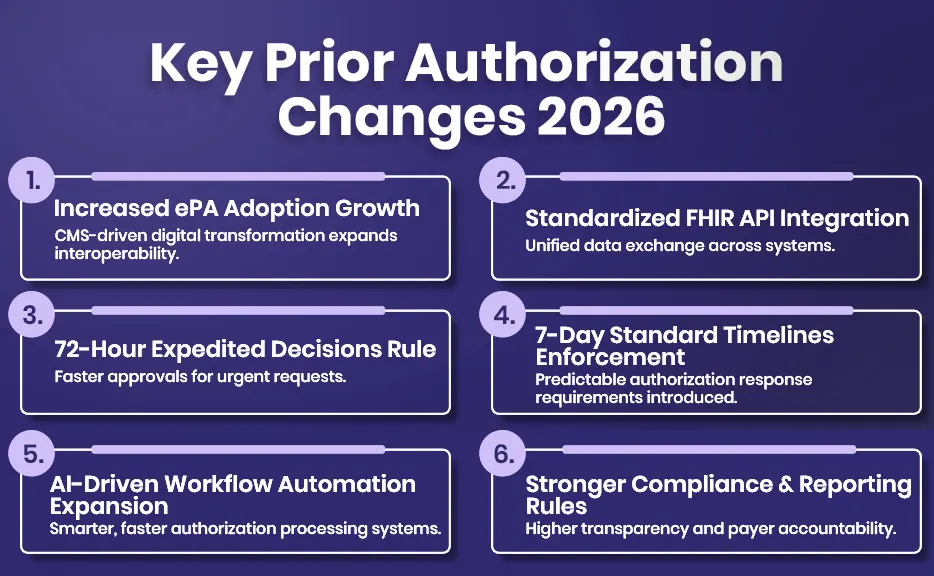
The healthcare industry is preparing to make major reforms that will redesign prior authorization 2026 which emphasize efficiency, transparency, compliance, and technology.
Increased Electronic Prior Authorization (ePA) Adoption
A major shift in electronic prior authorization (ePA) is being advanced through CMS-led coordination mechanisms through the Health Tech Ecosystem which focus on system-wide interoperability rather than isolated digital upgrades. The Electronic Prior Authorization Acceleration initiative consists of 29 early adopters across hospitals, EHR vendors, physician groups, and digital health organizations, with participation from entities such as Epic, Oracle, Cleveland Clinic, and UnitedHealthcare-linked networks. This collaboration targets practical workflow gaps between payers and providers, mainly issues caused by fragmented communication channels and inconsistent submission processes.
The initiative stresses standardized, API-enabled connectivity using FHIR-based data exchange to support structured and consistent authorization transactions, instead of relying on disconnected manual workflows. It also strengthens alignment on defined decision-making timeframes and transparency requirements which ensure easier coordination across systems. The focus is on building an integrated infrastructure where authorization data can move easily across clinical and administrative platforms without recurrent manual intervention, with organized implementation milestones leading up to the 2027 interoperability deadline.
Enhanced Transparency Requirements
CMS-led reforms are delivering measurable improvements in transparency across the prior authorization process through interoperability and regulatory reporting standards. Under the CMS Interoperability and Prior Authorization Final Rule, affected payers are required to enable API-based interoperability to authorization data using FHIR-based standards which improve instantaneous visibility into requests, decisions, and update the status. In addition, payers are required to widely report prior authorization metrics which support providers better understand approval criteria, minimize uncertainty, and advance coordination across clinical workflows.
Faster Decision Timelines
Modernized CMS policies are introducing stricter performance standards to advance prior authorization turnaround time across Medicare Advantage, Medicaid, CHIP, and Marketplace strategies. Beginning in 2026, payers must deliver their decisions within 72 hours for expedited requests and 7 calendar days for standard requests which ensure faster access to care. These defined timelines are designed to minimize administrative delays, advance patient flow, and support more foreseeable scheduling and treatment initiation across healthcare practices.
Expanded Automation and AI Utilization
Automation will be a key component in streamlining the process of prior authorization workflow, with the CMS advocating for API-enabled solutions that are integrated directly within the EHR systems. Automated prior authorizations are being achieved through electronic prior authorization interfaces as well as data exchange. The CMS program highlights the reduction of manual processes such as submitting requests via fax, among others.
Greater Regulatory Oversight
Prior authorization requirements 2026 regulatory focus is increasing as CMS Implements interoperability, transparency, and accountability for health plans. The Interoperability and Prior Authorization Final Rule require the usage of standardized API, compliance with the time frames for decisions, and performance reporting. All these measures have been put in place to promote uniform payer behavior, increase regulation, and speed up industry adoption of electronic prior authorization ahead of the 2027 implementation date.
How Prior Authorization Changes Will Impact Medical Practices
Healthcare providers will experience both challenges and opportunities that influence operations, staffing, and revenue, as authorization transformations take effect. As a result, many medical practices may increasingly depend on outsource medical billing services to handle evolving administrative requirements, preserve operational efficiency, and support steady revenue cycle performance during the transition.
Positive Impacts
The authorization system modernization can meaningfully minimize administrative burdens and support earlier care delivery. Faster approvals, modernized communication, and less manual tasks let staff to focus on patient care rather than paperwork. Improvements in prior authorization in healthcare can also improve patient fulfilment while growing complete operational proficiency across medical practices.
Potential Operational Challenges
Despite the benefits, many organizations may face transitional hurdles as they familiarize themselves with new requirements. Workflow reshape; employee training, software advancements, and payer-specific protocols can produce temporary disruptions. Subsequent prior authorization best practices will be essential for maintaining productivity and to ensure staff can successfully deal with updated authorization procedures.
Revenue Cycle Implications
Good authorization management has the potential to improve financial performance through preventing avoidable claim denials and fast tracking the claims process cycle. Good documentation and approval will ensure that there is no delay in reimbursement, thus ensuring regular cash flow. Prior authorization in medical billing has the ability to ensure proper revenue capture. Prior authorization is only one constituent of a healthy revenue cycle. You need to understand about medical billing KPI benchmarks for small practices for a deeper understanding of performance measurement which reviews the metrics commonly applied to assess billing accuracy, reimbursement efficiency, and financial stability.
Common Challenges Practices May Face During the Transition
Although upcoming transformations offer lasting benefits, medical practices may come across several operational and obstacles related to compliance during implementation.
Technology Integration Issues
Integrating new authorization technologies with prevailing healthcare systems can be complicated. Practices may face EHR compatibility issues, software upgrade expenditures, and data migration apprehensions that disturb workflow continuity. Practices exploring solutions such as a prior authorization API must confirm continuous interoperability to avoid disruptions and maintain precise information exchange.
Staff Adaptation and Training
Positive implementation depends deeply on staff readiness and education. Employees must learn new platforms, know revised payer requirements, and familiarize themselves with changing procedures without compromising productivity. Applying a prior authorization checklist for providers can help standardize training efforts and guarantee teams consistently follow updated authorization protocols.
Variations Among Payers
Some insurers may not implement the changes in the same manner or at the same pace. Transformations in approval criteria, technology adoption, and operational timelines can produce confusion for providers. It is important and essential to understand evolving prior authorization guidelines across multiple payers to maintain efficiency and minimize administrative complications.
Compliance Risks
Compliance risks are increasing as authorization procedures shift toward an organized digital exchange and standardized submission plans across payers and health systems. Medical practices must confirm and verify that clinical information is exactly captured, consistently transmitted, and aligned with evolving interoperability requirements. Correct documentation and medical coding services play an important role to support data integrity and ensure that submitted information meets payer requirements. Any inconsistencies or irregularities in data managing, coding accuracy, or submission processes can lead to authentication failures, delayed responses, or increased review scrutiny within connected authorization systems.
Professional Advice: Start preparing early by auditing current prior authorization workflows, strengthening documentation precision, and aligning clinical and billing teams with modernized digital submission requirements. Practices that actively adopt standardized procedures and technology-supported workflows are better positioned to minimize delays, curtail compliance risks, and keep smoother revenue cycle performance during the transition period.
Prior Authorization Preparation Tips for Medical Practices
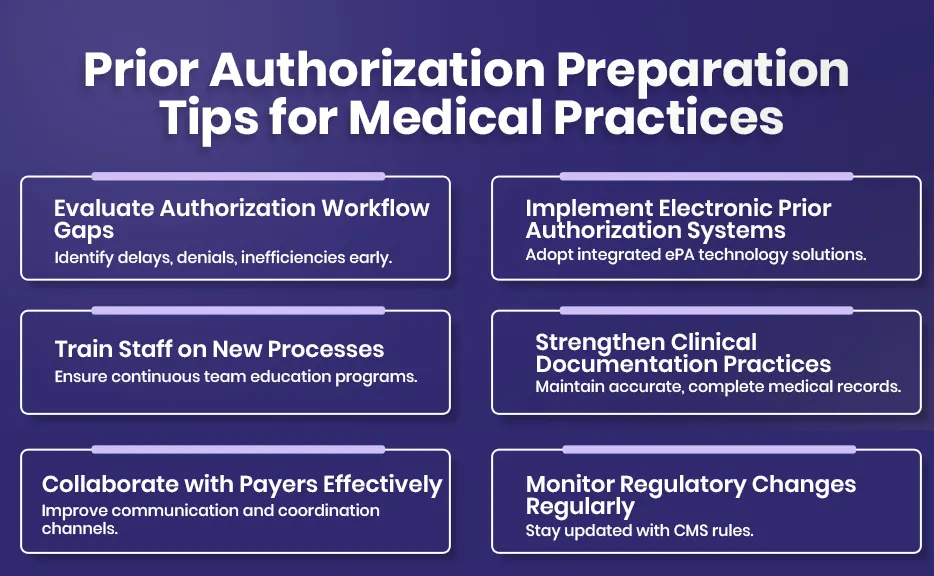
Proactive planning can support medical practices familiarize easily with authorization reforms while minimizing disruptions to patient care and operations.
Evaluate Current Prior Authorization Workflows
Before implementing new procedures, practices should evaluate their existing authorization procedures to find inadequacies. Reviewing obstructions, tracking approval delays, and analyzing denial trends can disclose opportunities for improvement. Measuring the prior authorization time frame for requests also supports establishing benchmarks and assessing future performance gains.
Invest in Electronic Prior Authorization Solutions
Modern ePA platforms can modernize request submissions, minimize manual work, and advance communication with payers. Organizations should consider interoperability, reporting capabilities, automation features, and EHR compatibility when assessing solutions. Investing in electronic prior authorization technology can boost efficiency while supporting compliance with growing industry requirements.
Train Staff on Upcoming Changes
Continuous education is vital to ensure successful adoption of new authorization standards. Practices should develop planned training programs, cross-train administrative and clinical personnel, and establish dependable procedures. The knowledge about how prior authorization works under modernized regulations can support staff to deal with changes confidently while maintaining operational productivity.
Strengthen Documentation Practices
Precise and complete clinical documentation remains indispensable for successful authorization outcomes. Providers should maintain comprehensive patient records, follow payer-specific requirements, and practice standardized checklists whenever possible. Strong documentation can minimize prior authorization denial reasons, support medical requirement determinations, and advance approval and appeal success rates.
Collaborate with Payers and Vendors
Maintaining open communication with insurers and technology partners can update the transition process. Practices should stay informed about implementation schedules, attend educational sessions, and seek clarification when policies change. Understanding the prior authorization approval process across payer networks can assist organizations to prepare more successfully and avoid unnecessary delays.
Monitor Regulatory Developments
Healthcare regulations remain to evolve which make ongoing monitoring important for compliance. Practices should normally evaluate payer updates, follow federal and state policy changes, and track industry developments. Staying up-to-date about the CMS prior authorization rule 2026 can benefit organizations to align procedures with new requirements and avoid compliance challenges.
Transforming Prior Authorization Through Intelligent Technologies
Advancing digital infrastructure is transforming prior authorization in healthcare, with a strong focus on standardized data exchange, interoperability, and actual connectivity across payers and providers. Current developments are centered on CMS-led modernization efforts rather than isolated automation tools. Because this integrates payer platforms, clinical systems, and health IT vendors into a united ecosystem designed to support continuous authorization workflows.
Benefits of Automation
Automation within prior authorization is gradually driven by CMS’s Health Tech Ecosystem expansion, which is shifting methods from manual, fragmented workflows toward structured, API-enabled systems. Medical practices are working to replace fax and portal-based submissions with standardized digital exchange models through initiatives involving 29 early adopters. This transition is supported by FHIR and NCPDP standards which enable more consistent communication between clinical and payer systems while improving operational alignment across the authorization process.
AI and Machine Learning Opportunities
Replacing standalone AI applications with integrated solutions, existing advancements are being entrenched into wider interoperable frameworks that support smarter authorization routing and decision support at scale. Machine learning capabilities are progressively applied to update data exchange and advance prioritization of requests across integrated platforms. This supports more well-organized management of authorization workloads while ensuring consistency with standardized submission and evaluating requirements across participating health systems.
The Future of Actual Authorizations
The industry is moving toward an organized shift from manual approvals to actual, API-driven authorization systems which is maintained by CMS interoperability requirements. A key long-standing objective of these initiatives is to empower 80% of electronic prior authorization approvals to be handled in real time by 2027, as long as complete clinical documentation is available. This development reflects a wider transition toward decision support integrated into care delivery workflows, where authorization outcomes are gradually integrated directly into clinical workflows through connected digital infrastructure.
Expert Guidance: Focus on accepting interoperable, API-based prior authorization systems early, as CMS-driven reforms prioritize actual data exchange. Early readiness supports to minimize manual delays, advance accuracy, and align easily with evolving industry-wide digital authorization standards.
Best Practices for Maintaining Efficiency and Compliance
Preserving strong operational control over prior authorization workflow involves structured and standardized procedures across the organization. Medical practices should confirm consistent documentation, produce clear authorization protocols, and persistently review internal procedures to minimize inconsistency. Conducting workflow audits and tracking key performance indicators (KPIs) supports identifying inefficiencies early and cares for continuous improvement to submit precision and approval rates.
Correspondingly important is developing a practical approach to denial management services and interdepartmental coordination. Practices that analyze trends connected to prior authorization denial reasons can improve submission quality and minimize recurrence of errors. Strengthening communication between clinical and administrative teams approves alignment on documentation requirements, advances response times, and supports more well-organized handling of authorization requests across all service lines.
Looking Beyond 2026: The Future of Prior Authorization
The evolution of prior authorization in healthcare is anticipated to endure shifting toward greater interoperability across systems and stakeholders. As data exchange standards improve, medical practices and payers will gradually depend on connected platforms that empower easier communication and faster decision-making. Continued automation and digitization will further minimize manual intervention which allow more standardized and well-organized authorization processes across the industry.
Over the next five years, the focus will probably expand models toward more patient-centered ones that prioritize timely access to care and minimize administrative resistance. Emerging trends in how prior authorization works recommend a future where approvals are ever more automated, transparent, and integrated into clinical workflows. These fluctuations are expected to redesign operational expectations and redefine proficiency standards for medical practices to deal with evolving healthcare systems.
Commitments and Industry-Wide Prior Authorization Reform 2026
The year 2026 marks a major phase in prior authorization 2026 reforms as health plans that include AHIP, Blue Cross Blue Shield Association (BCBSA), CMS, and HHS will keep implementing voluntary commitments to modernize processes across commercial insurance, Medicaid managed care and Medicare advantage. Covering approximately 270 million Americans, these initiatives focus on minimizing the scope of services which require authorization. Improve continuity of care during insurance transitions through a 90-day protection period, and strengthen communication with clear, patient-friendly determination clarifications. All clinically denied requests will linger to undergo medical professional evaluation to ensure safeguards remain in place while improving transparency and efficiency.
Looking ahead, the initiative sets the foundation for transformational changes in prior authorization workflows, particularly by 2027. It is anticipated that 80 percent of electronic authorizations having proper documentation will take place in factual time owing to increased use of FHIR API and a common standard for the submission process. These reforms are geared towards enabling approval at the point of care and reducing the need for faxes and manual submission processes. Despite the need to adopt electronic submission processes by the providers, the overarching idea is the reduction of administrative burden and facilitation of better care coordination.
How iSolve RCM Supports Prior Authorization
The iSolve RCM system streamlines the prior authorization procedure for medical practices by minimizing administrative efforts and maximizing approval effectiveness. The whole process of authorization will be managed by the company’s experts, which will guarantee that all necessary documents are submitted correctly and efficiently. For organizations dealing with medical devices, maintaining accurate and accessible documentation is also essential, including IFU Translation For Medical Devices to ensure device instructions and safety information are clearly communicated across different languages and markets. In addition, providers will have an opportunity to concentrate their efforts on the treatment process while complying with the latest guidelines regarding prior authorizations. As a result, the company increases the speed of the process through proactive management of the communication with payers and minimization of the most typical errors made during prior authorization procedures.
FAQs
What is changing in prior authorization in 2026?
A number of industry initiatives have been launched intended at reshuffling authorization processes, facilitating more electronic submissions, increasing interoperability and fostering greater transparency. These developments are planned to modernize processes in healthcare organizations and decrease complexities for providers, payers and patients.
What is electronic prior authorization (ePA)?
Electronic prior authorization is the electronic approach to the submission, evaluation, and monitoring of the authorization request via the network of healthcare organizations. The approach replaces many traditional approaches due to its capability to facilitate information exchanges between providers and payers.
How will prior authorization changes affect medical practices?
Workflow changes could be experienced in medical practice through the adoption of new technology and standardization of the process. Although the process is expected to be prepared for, these changes could aid in ensuring coordination in operations and management of authorization processes.
Why are interoperability standards important for prior authorization?
The standards for interoperability allow the exchange of information between the health systems, the payers, and the technology platforms through a standardized approach. It increases consistency in the data and eliminates communication issues and helps to authorize transactions more easily.
What challenges should providers prepare for during the transition?
Healthcare entities might experience difficulties in technology integration, training needs, process redesign requirements, and diverse payer expectations. Early preparation through process assessment, educational programs, and technology evaluation would assist practices in handling these hurdles while continuing with their regular activities without interruption.
How can medical practices prepare for future prior authorization requirements?
Preparations can be made through evaluation of existing processes, improving documentation procedures, acquiring technology tools that support such initiatives, staying abreast of industry trends, and promoting cooperation between administration and clinical staff. It is vital for organizations to be prepared for changes in authorization standards.