
The Medicare billing rules for skin substitute grafts and Cellular and Tissue-Based Products (CTPs) are changing considerably in 2026 as the Centers for Medicare & Medicaid Services (CMS) introduces new billing policies and procedures designed to tackle high Medicare costs and ensure greater compliance within the wound care field.
There has been increasing scrutiny into skin substitutes due to the fast growth of use, increasing cost of reimbursement, and issues that regulatory bodies have about medical necessity and billing practices. This may influence the bottom line, product choice, and efficiency of operations for wound care facilities.
The purpose of this blog is to explore the most significant updates to CMS skin substitutes and CTP payments, which will be introduced starting from 2026, such as the reimbursement process, coverage policies, MA prior authorization policy, documentation needs, codes, risk of audits, and practical tips for ensuring compliance, for a leading medical billing company in USA, and practical tips for ensuring compliance.
What Are Skin Substitutes and CTPs in Wound Care?
Skin substitutes or Cellular and Tissue Based Products (CTPs) are classified as wound care devices designed to aid in the repair of tissues. The skin substitutes provide scaffolding that allows new tissue to form. These are usually indicated for wounds that do not heal with regular wound care therapies. This is normally documented using wound care cpt codes (15271-15278), based on wound size and anatomy of the wound.
CTP is often utilized for treating patients with diabetic foot ulcers, venous leg ulcers, pressure ulcers, and other types of complicated wounds. CTPs have become more widely used because of the necessity to implement evidence-based practices that can optimize the healing process and avoid any adverse effects.
Skin substitutes are different from autografts in that autografts need skin to be harvested from the patient’s own body, while skin substitutes are biological materials that are produced or processed and directly used on the wound. This method avoids complications at the donor site.
Expert Guide: Always document wound measurements in exact cm², confirm 4+ weeks of failed conservative care, and ensure CPT 15271–15278 matches HCPCS Q-code usage to avoid denials and support Medicare compliance during audits and prior authorization reviews.
Why CMS Changed the Payment Model
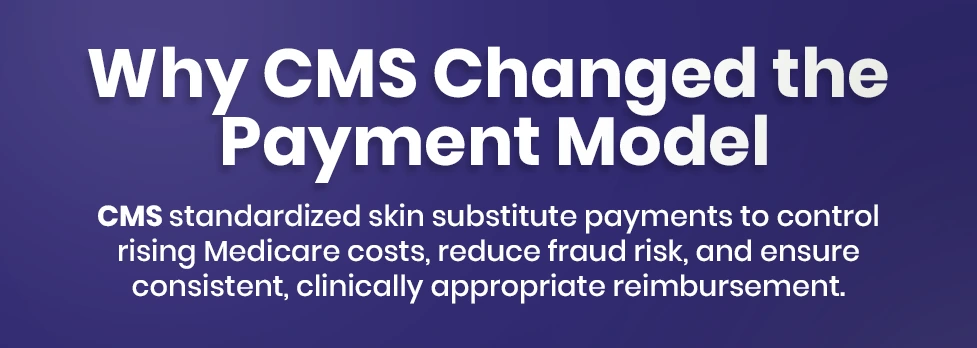
Skin substitutes saw major changes in the way CMS covered their cost because of the huge increase in Medicare spending on such items over the past few years. According to federal statistics, the amount of spending rose from around $250 million in 2019 to more than $10 billion in 2024.
Federal regulating bodies such as the OIG noted some possible weaknesses in the current payment system. They noted the possibility of inconsistencies in pricing information, large payment discrepancies, and even a risk of fraud, waste, and abuse. The enforcement of medically unnecessary wound grafts made the regulatory scrutiny more intense.
CMS implemented a more standardized method of reimbursement for several skin substitutes from 2026 onwards in order to solve such problems. The goals that CMS has included improved payment consistency, decreased spending variability, increased integrity in the program, and making sure that the payment is made according to the clinical need.
Major CMS Changes Effective January 1, 2026
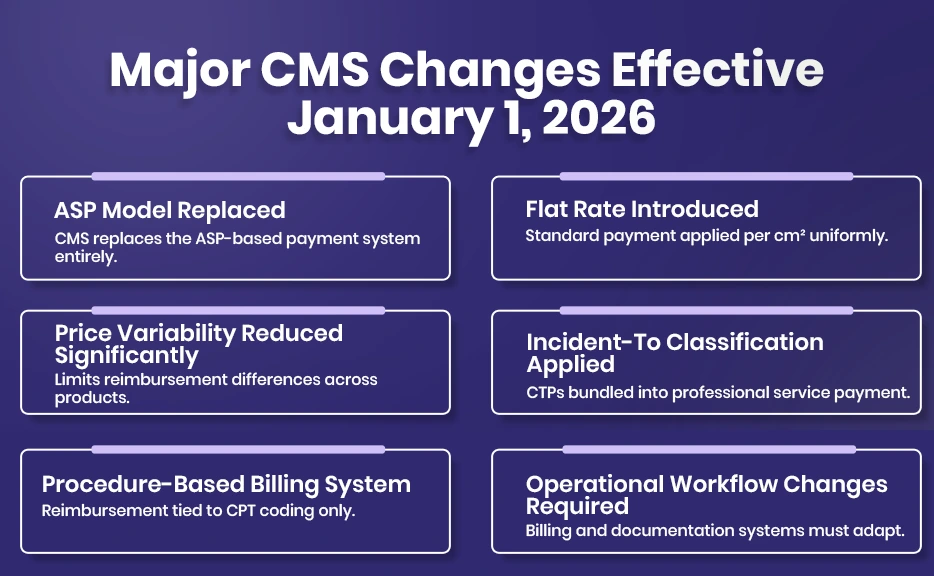
CMS is instituting an important change in skin substitutes reimbursement, whereby ASP-based pricing will be replaced by a fixed fee for almost all CTP products.
Transition from ASP-Based Payments
Prior to the changes implemented by CMS in 2026, most skin substitutes were paid for using the Average Sales Price (ASP) method, meaning that their payment was dependent on the manufacturer’s prices and on the market situation. The new changes introduce a flat-rate payment, making it less dependent on the price.
Standardized Payment Rate
A standard payment of around $127.28 per cm2 has been set by CMS for the majority of skin substitutes used. The objective of this approach is to manage increasing Medicare costs and price differences among the different products. Nevertheless, it could affect the decision-making process of physicians with regard to purchasing CTPs.
Incident-To Supply Classification
According to the new policy, the majority of skin substitutes will be considered an “incident-to” supply in physicians’ services instead of a separately billable biological material. In other words, the payment for the procedure will be made based on professional service coding. In practice, providers need to keep in mind several operational issues.
CMS Skin Substitute Graft & CTP Payment Changes (2026)
| Category | What is Changing in 2026 | Key Facts & Figures | Impact on Providers |
| Medicare Spending Trend | Rapid increase in skin substitute utilization triggered CMS reform | Spending increased from ~$250M (2019) to >$10B (2024) | Higher scrutiny on utilization and reimbursement justification |
| Payment Model Shift | Move from ASP-based pricing to standardized flat-rate model | Most products paid under fixed rate methodology | Reduced variability in reimbursement across products |
| Standardized Rate | CMS introduces uniform reimbursement for CTP applications | Approx. $127.28 per cm² (2026) | May reduce margins for high-cost products |
| Regulatory Oversight | Increased enforcement by CMS, OIG, DOJ | Multiple fraud/waste/abuse investigations in wound care sector | Higher audit and compliance risk |
| Coverage Rules (LCDs) | Continued LCD enforcement for DFU & VLU only | Requires ≥4 weeks conservative care failure | Stricter medical necessity documentation required |
| Product Classification | Shift toward “incident-to” supply treatment for many products | CTPs bundled into professional service payment | Changes billing structure and revenue capture |
| Medicare Advantage (MA) | Expanded prior authorization requirements | Product-specific approvals required | Increased administrative burden and delays |
| Documentation Standards | Stronger clinical documentation requirements | Wound size (cm²), progression, product usage, waste tracking | Higher risk of denial if incomplete |
| Coding Requirements | Strict CPT–HCPCS alignment required | CPT 15271–15278 + Q4101–Q4199 pairing required | Coding errors lead to denials or audits |
| Audit Risk | Increased RAC/OIG/DOJ enforcement focus | Claims reviewed for medical necessity & overutilization patterns | Greater need for compliance systems |
| Billing Compliance Focus | Emphasis on accurate wound measurement and utilization tracking | Exact cm² measurement required (no rounding) | Prevents upcoding/underbilling errors |
Coverage and LCD Updates
The CMS is maintaining the stringent LCD requirements for skin substitute grafts, especially those involving diabetic foot ulcers and venous leg ulcers, even as it revises its proposals for 2026.
Current LCD Requirements
Coverage under Medicare for skin substitute grafting is mostly confined to cases of chronic, difficult to heal DFUs and VLUs where there has been inadequate response to the conservative treatment approach. At least four weeks of wound management needs to be demonstrated, which should include off-loading, infection control, and appropriate vascular management. Documentation of wound size, history, and evolution will be necessary to prove medical necessity.
Withdrawal of Proposed 2026 LCDs
CMS has since withdrawn any previous proposals to unify the LCD changes regarding skin substitutes set for implementation in 2026 in response to feedback and manufacturer input. This means that the current LCD process remains effective for all Medicare Administrative Contractors (MACs). However, it is important to note that CMS still has an interest in unification in the future.
Prior Authorization Changes for Medicare Advantage Plans
The Medicare Advantage (MA) plans have made prior authorization requirements stringent for skin substitute grafts and applications of the CTP. While such coverage policy guidelines are often consistent with those of the CMS, they can sometimes result in added administrative procedures, which may include prior authorization for both the procedure and the CTP used.
With respect to these new guidelines, it is necessary for practitioners to document all information concerning the medical necessity of the procedure, such as measurements and duration of the wounds and previous conservative treatments. The prior authorization can be product-specific; thus, if prior authorization was provided for one product, it does not necessarily cover other products.
Documentation Requirements for Compliance
CMS requires strict, detailed clinical documentation for skin substitute grafts, ensuring medical necessity, proper utilization tracking, and audit-ready records for every application.
Wound Assessment Documentation
Documentation of wound assessment requires proper measurement in square centimeters of length, width, and depth, the kind of wound, time frame since it occurred, and its cause. Wound progress or non-progress must be clearly evident as per the CMS guidelines. Updates on wound assessment must be done in order to provide continued medical necessity of CTP usage.
Conservative Care Documentation
There needs to be evidence of at least 4 weeks of standard wound care prior to the introduction of skin substitutes. This would involve off-loading in cases of DFUs, compression in cases of VLUs, infection management, and vascular evaluation if needed. The documentation should include dates of treatment and modalities utilized with no improvement.
Product Utilization Tracking
Documentation of each utilization of skin substitutes is important and should contain information like the name of the product, Q-code from the HCPCS list, lot number, and the amount utilized. There is a need for reconciliation of the size of the wound against the billed units by CMS.
Waste Documentation Requirements
It is important that any leftover from the skin substitute product is well recorded in the medical record. CMS stipulates the recording of the quantity of skin substitute that was utilized, quantity that was wasted, the rationale behind the wastage, and any identification number associated with the skin substitute.
Professional Tip: Always keep track of all your CTP applications with well-formulated documentation consisting of accurate measurement of the wounds in cm2, 4-week conservative treatment evidence, Q-codes, and waste management details in order to avoid any claim denials.
Billing and Coding Considerations
Billing skin substitute grafts accurately involves proper selection of CPT codes, HCPCS code for the products, and modifiers to ensure Medicare reimbursement criteria are met. In addition, many providers choose to benefit from outsource medical billing services to improve coding accuracy, reduce claim denials, streamline prior authorization workflows, and ensure full compliance with evolving CMS documentation and reimbursement requirements.
CPT Codes for Skin Substitute Applications
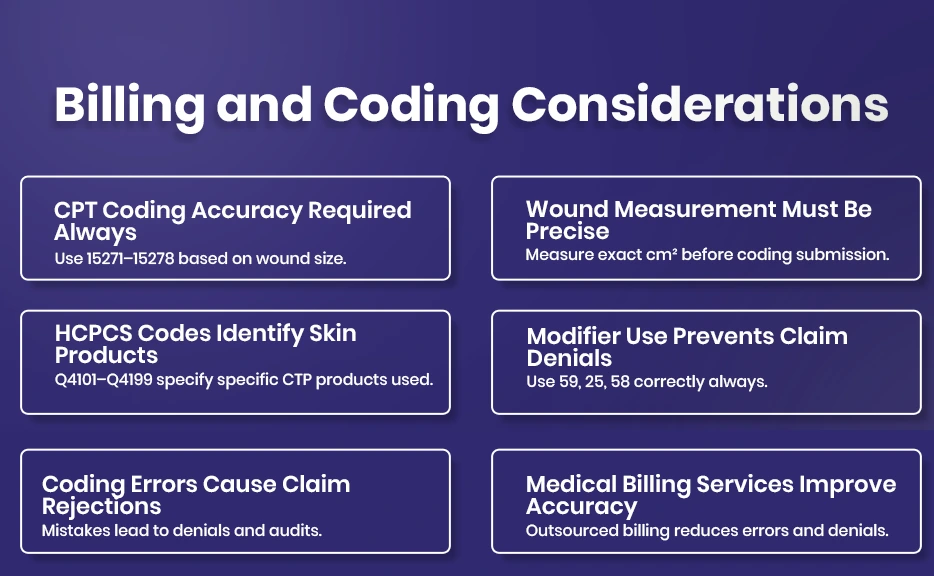
Skin graft substitutes are coded using codes 15271-15278 based on the size of the wound and the body part involved. Small wounds generally get coded based on 25 cm² while large wounds get coded based on 100 cm². The right code needs to be selected through accurate measuring of the wound.
HCPCS Q-Codes
HCPCS Q-codes (Q4101-Q4199) denote the type of skin substitute utilized. Such HCPCS Q-codes play an important role in the separate coding of biological supplies. The requirement of reporting the correct Q-code along with the CPT codes of application by CMS must be adhered to in order to prevent claim rejection or compliance problems.
Modifier Usage
Modifying codes are used to denote any exceptional circumstance like wound at more than one site or repeated procedure performed. Typical examples of modifiers are: 59/XS – for different services rendered; 25 – for E/M service performed separately; and 58 – for staged procedure. Proper use of modifiers will avoid improper bundling of claims.
Common Coding Errors
Some of the frequent coding errors include the inappropriate usage of CPT and HCPCS codes, wrong calculation of wound measurements, lack of product code, and improper use of modifiers. Such coding errors often lead to claims denial, claim underpayment, and claim audit. The CMS emphasizes the need for proper documentation and coding of skin substitutes. Professional medical coding services are widely used by most healthcare providers in order to avoid such coding errors and make their claims clean.
Audit and Enforcement Risks
There is growing regulatory oversight of CMS skin substitutes, with the increase in enforcement activities by federal government agencies in relation to prevention of frauds, necessity of treatment, and proper billing.
DOJ Enforcement Trends
There have been numerous investigations by the DOJ regarding the issue of wound care billing including instances of unnecessary use of skin substitutes and questionable financial dealings. Recent prosecutions bring to light the problems of overutilization, kickback schemes, and false reimbursement claims that are associated with such situations.
RAC Audits
The Recovery Audit Contractors (RACs) audit skin substitutes claims, seeking any overpayments. The documentation requirement, repetition, and proof of medical necessity form some of the areas that the auditors scrutinize. High usage rates and insufficient documentation for the wound healing process are among the reasons that cause a claim to be selected for audit.
OIG Focus Areas
Pricing anomalies, utilization trends, and possible risk of fraud with regard to skin substitute products remain an ongoing investigation area of the Office of Inspector General (OIG). Among the key issues of concern are improper selection of the products, absence of documentation on conservative care and incongruence of billing units with the wound size.
Strategies to Reduce Denials
Prevention of skin substitute claim denials can be achieved through proactive compliance processes, structured documentation workflows, and audit readiness in accordance with CMS and Medicare Advantage regulations. Providers can further strengthen outcomes by utilizing denial management services, which help identify root causes of claim rejections, correct documentation gaps, appeal denied claims effectively, and improve overall reimbursement performance through continuous revenue cycle optimization.
Coverage Verification Checklist
The process of coverage verification in an organized manner makes sure that the individual is eligible before receiving the service. The provider needs to verify the LCD criteria like DFU/VLU diagnosis, lack of success with conservative treatment, and time period for healing. This will help to prevent any non-coverage services.
Prior Authorization Workflow
The effective prior authorization process involves providing all of the necessary clinical information, such as wound measurements, treatment history, and choice of products, prior to starting treatment. Because Medicare Advantage authorizations are usually tied to the products, workflows need to include checking for authorization of CTPs, as well as reauthorization after the authorization period ends.
Documentation Best Practices
Proper documentation includes documenting the wound dimensions in real-time, documenting the progress of wound healing, and documenting the products used and wasted. Physicians need to document that all information supports the medical necessity for the product use and the failure of conservative treatment. Proper documentation prevents audit and facilitates CPT/HCPCS code correlation.
Internal Audit Recommendations
Regular internal audit helps spot coding mistakes, lack of documentation, and any discrepancies in billing procedures prior to external auditing. The internal audit should concentrate on proper measurements of the wounds, application of modifiers, and correlation between CPT and HCPCS codes. High risk and denied claims review allows addressing system-related problems and improving CMS compliance.
Expert Advice: Establish a denial avoidance process incorporating real-time eligibility verification, prior authorization confirmation, and proper wound documentation to guarantee CPT/HCPCS coding is accurate and help prevent delays in Medicare Advantage reimbursement and increase audit preparedness for skin substitutes.
Preparing Your Practice for 2026
Adjusting to CMS changes in how it pays for skin substitutes involves changes in operations involving training of clinical staff, revenue cycles and the choice of products.
Staff Education
Training for the staff is extremely important in order to get a good understanding of new CMS guidelines, such as proper documentation requirements, LCD guidelines, and CPT-HCPCS coding. Training must be focused on measuring wounds correctly, proper conservative care documentation, and use of modifiers. The knowledgeable staff is less likely to have compliance problems.
Revenue Cycle Adjustments
Revenue cycle management services need to be upgraded to account for changes in the new reimbursement system that has become standardized and requires more prior authorization. This involves improved pre-billing processes and scrubbing for better mapping of CPT codes and HCPCS. Good workflow is needed to avoid denials and speed up reimbursements within the 2026 CMS framework.
Product Evaluation Strategy
In light of CMS introducing the flat-rate payment method, selection of products ought to consider their clinical efficacy, compliance to standards, and cost-effectiveness. It is necessary for providers to assess the products that qualify for the program, have sufficient supporting evidence, and reimbursement. Proper product selection ensures financial sustainability and compliance.
How iSolve RCM Supports Skin Substitute Graft Billing
Skin substitute graft billing can be facilitated by iSolve RCM through the process of revenue cycle management which includes documentation verification, matching of CPT-HCPCS codes, and management of pre-authorizations for Medicare Advantage plans. This enables providers to meet CMS 2026 regulations by lowering the risks of denials, proper documentation of wound care, accurate modifiers, and proper billing of DFU and VLU cases.
FAQs
What are skin substitute grafts in wound care?
CTPs, an abbreviation for skin substitutes, are advanced biological or synthetic substances used in the treatment of chronic wounds, like those resulting from diabetic foot ulcers and venous leg ulcers. These act as platforms for tissue regeneration when standard wound treatments fail.
Does Medicare cover skin substitute grafts in 2026?
Yes, the skin substitute grafts are still covered by Medicare under LCDs when medical necessity is met. Coverage of the skin substitute grafts is applicable for the treatment of DFUs and VLUs only when the conservative treatments have been proven ineffective.
What changed in CMS reimbursement for skin substitutes in 2026?
The CMS has also made a significant change where payments for skin substitutes were shifted from being based on ASP prices to fixed flat price amounts. This is done at a price rate of about $127.28 per square centimeter.
What CPT codes are used for skin substitute applications?
Skin substitute codes fall under CPT codes 15271 through 15278 based on the wound dimensions and anatomical site. This should always be accompanied by Q-codes in HCPCS that correspond to the skin substitute product used.
Why are skin substitute claims often denied?
Common bases for denials include failure to provide documentation of conservative care, improper use of CPT-HCPCS codes, wrong measurement of the wound size, and failure to get prior authorization. CMS and Medicare Advantage policies have stringent requirements for medical necessity and documentation for such services.
How can providers reduce skin substitute billing errors?
Errors can be reduced through proper documentation, proper verification of the LCDs, proper use of the code combinations, product tracking, and having an effective process of prior authorization. Internal audit and training of employees also contribute to avoiding denials of claims.