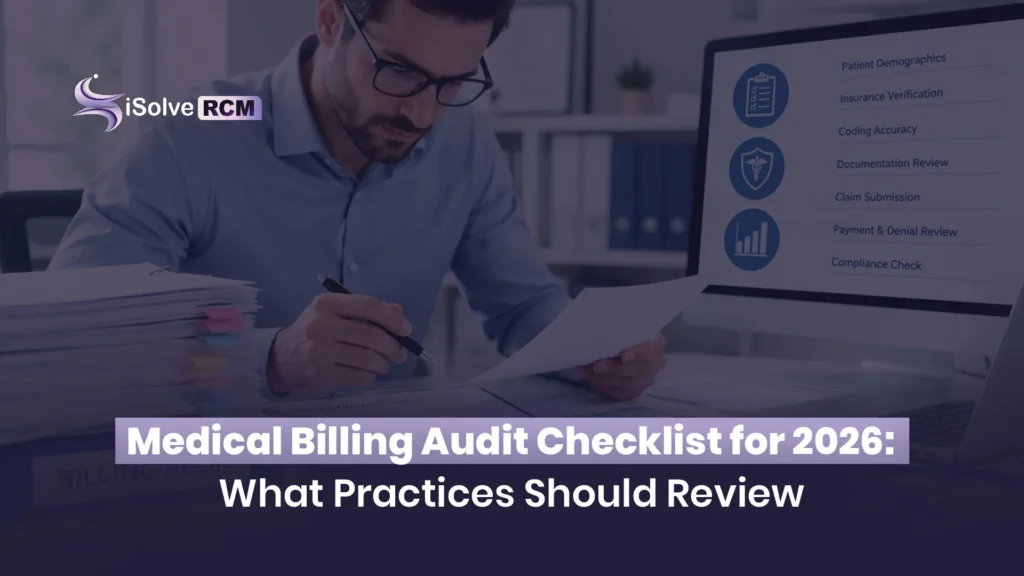

The process of auditing medical bills has been seen as a key strategy by healthcare practices in 2026 due to increased claims scrutiny by payers, changes in regulations, and more complicated revenue cycle problems. According to the American Medical Association, administrative expenses comprise around 15–30% of the health care budget of the United States, and the majority of this money goes to billing and insurance processes. Medical billing audits allow practices to detect any inaccuracies in their billing, documentation, coding, or workflow before they cause problems.
The need for pro-active auditing has greatly risen in 2026 because of greater payer and regulatory scrutiny. CMS has raised awareness in regards to Medicare Advantage RADV (risk adjustment validation) audits by paying great attention to the proper support for diagnosis codes that should be documented properly. OIG pays much attention to potential billing errors such as incorrect modifier use, E/M coding practice, and documentation irregularities. In addition, commercial payers use complex algorithms of claim reviews based on AI to identify any deviations in payment patterns, therefore, proper coding and documentation become crucial.
A structured medical billing audit checklist ensures that every important part of the billing process is reviewed, including patient registration, insurance verification, clinical documentation, coding, claim submission, payment posting, denial management, and accounts receivable performance. Regular audits help a medical billing company identify workflow gaps, improve coding quality, reduce denials, and support more accurate reimbursement. This article explains the medical billing audit process, essential checklist items, common audit challenges, and best practices for 2026.
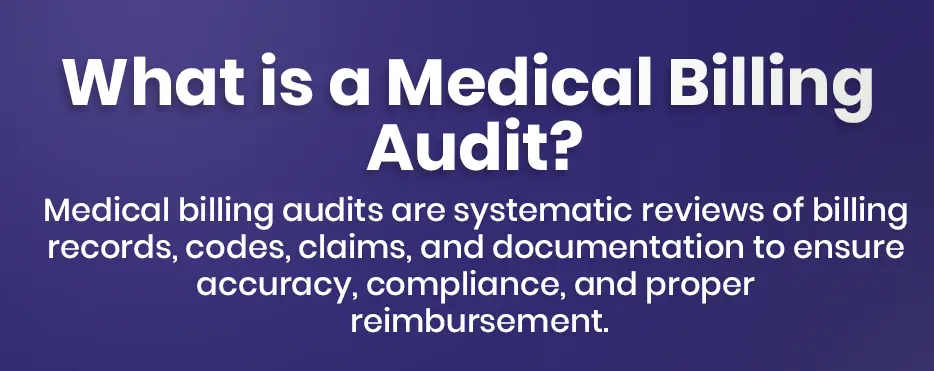
What Is a Medical Billing Audit?
Medical billing audit can be defined as an analysis of the billing history of a health care facility to ensure that the billing procedures, codes, claims, and documents are accurate and in line with the healthcare laws. When considering what is medical billing audit, one can define it as a process through which the clinical documents, medical codes, claims and billing are checked for errors that may lead to non-payment.
A healthcare billing audit is an audit of the entire process involved in the revenue cycle, such as patient registration, insurance verification, capturing the charges, claiming process, payment posting, managing denials, and follow up in accounts receivable. Medical coding audit is a more focused audit that looks into the accuracy of ICD-10, CPT, HCPCS codes, and their modifiers used for documenting the services. The two audits serve complementary roles in ensuring accurate billing and reimbursement while minimizing the risks arising out of incorrect coding, unsupported services, and claims. These audits are very important in 2026 when CMS RADV audits and payer analytics are becoming stricter in documenting the accuracy of services.
Medical billing audit procedures for an organization’s billing process are very important not only in ensuring better organizational performance but also in compliance. Common billing errors that may include inaccuracies in the patient’s demographic details, lack of authorization, duplicate billing, lack of adequate diagnosis coding, wrong use of modifiers, or insufficient documentation from the healthcare provider may lead to claim rejection, payment shortages, delayed payments, or refunds. Regular medical billing audit services are essential in helping healthcare organizations uncover areas of inefficiency in their billing process.
Expert Advice: Performing routine medical billing audits can help healthcare institutions identify mistakes, ensure compliance, increase documentation accuracy, and improve billing and collection efficiency. Employing audit insights to refine processes will substantially minimize claim denials and financial losses.
Benefits of Conducting Regular Medical Billing Audits
An audit would be very helpful in improving your billing accuracy, finance, and compliance. If you understand the major benefits of conducting an audit in terms of medical billing, then it would become easier for you to avoid mistakes, secure higher payments, and have a good revenue cycle. It is important to note that by 2026, an audit is not just about compliance but also about revenue.
Reduced Claim Denials
Routine audits help discover problems like lack of documentation, coding errors, eligibility problems, authorization issues, and claim filing errors before they are sent to payers. Making use of a quality check list for medical billing can assist in getting clean claims filed, resulting in fewer denials, less work, and faster payment.
Some front-end errors such as inactive insurance policy, wrong subscriber details, referrals not done, or prior authorization lapses may lead to denials. These kinds of denials happen weeks after the patient’s visit. Routine checks on registration, eligibility checks, and authorization issues can prevent denials.
Improved Cash Flow
Good billing practices and quick submission of claims lead to better cash flow. A comprehensive revenue cycle assessment identifies the presence of delayed payments, unprocessed claims, underpaid amounts, and problems within the follow-up process. According to industry analysis, many healthcare practices lose considerable portions of their collectible revenue because of errors in their billing practices. For instance, a medical practice that generates $2 million in annual revenue is likely to miss out on hundreds of thousands of dollars because of revenue leakage.
Better Coding Accuracy
Routine audits help confirm the accuracy of ICD-10, CPT, and HCPCS codes used in relation to documented procedures. Better accuracy in coding will help prevent issues like undercoding, overcoding, misuse of modifiers, and problems related to medical necessity. Coding audits have become increasingly significant in 2026 since payers are looking into patterns of coding via automatic means. There are certain high-risk areas that include E/M level selection, the use of Modifier 25, Modifier 59 use, and high-use procedure codes.
Stronger Compliance
Audits in medical billing ensure that the practice complies with the policies of the payers, Medicare and Medicaid guidelines, HIPAA regulations, OIG guidelines, and the organization’s internal process. Compliance audits enable an organization to assess areas needing improvements, get prepared for any audit from outside, and avoid any penalty or request for repayment. Given the current increase in CMS RADV activities and focus by the OIG on certain billing practices, compliance audits prove necessary.
Increased Revenue Recovery
These audits detect lost charges, inaccuracies in the payment adjustment process, underbilling problems, reimbursement omissions, and open claim balances that could be easily overlooked. Fixing these problems is crucial for collecting revenue that is due to the medical practice, as well as reducing revenue leakage. Payment reconciliation checks can be performed by comparing payments with payer information such as payment advice and contractual rate sheets.
Better Patient Billing Accuracy
Review of the billing statements ensures that patients get billed properly with right charges and adjustments. Reduced billing errors ensure increased transparency and reduce disputes. It helps build up trust between the patient and the hospital.
Enhanced Operational Efficiency
A properly designed auditing process will make the billing process better because it will enable the detection of repeated mistakes and inefficient processes. Auditing helps in standardizing the process, making the process easier for employees and less complex, resulting in consistency in the billing process. Many health care facilities work with medical billing audit companies in USA.
Lower Audit Risks
Routine internal auditing enables firms to spot compliance problems early on before they become serious problems for payers or regulators to find. Proper documentation, billings, and standardization prevent unnecessary financial risk and aid in firm stability.
Medical Billing Audit Checklist for 2026
An extensive audit checklist enables the health care practices to perform an audit of all the stages in the process from patient registration to payment collection. Regular auditing of all the areas ensures that there are no mistakes made during the billing process.
1. Patient Registration & Insurance Verification
Correct registration of patients is crucial for a proper billing process. Checking patient demographics, active insurance coverages, referrals, preauthorization, consent forms, and patient’s qualification need to be done prior to providing any service to a patient. The completion of an insurance verification audit checklist will minimize registration mistakes, and prevent unnecessary denial of claims.
2. Medical Documentation Review
The documentation must be able to justify all services that have been billed. It is necessary to look into the notes, documentation, signatures, medical necessity, and complete records to find out any missing information. The use of a checklist for documentation can aid in the process.
3. Medical Coding Audit
Coding accuracy impacts payment and compliance. Check coding of diagnoses in accordance with the ICD-10 classification system and coding of procedures in accordance with CPT and HCPCS rules, including any possible upcoding, downcoding, and misuse of modifiers. A medical coding audit checklist can help find out problems with coding early in the process, and companies using expert medical coding services can benefit from medical coding audits.
4. Charge Capture Audit
All services rendered must be accurately identified and charged for. Determine under-charges, overcharges, correct fee schedules, and charge lag from the time the service was performed until the claim was created. Performing charge capture audits on a routine basis is important to avoid revenue leakage and maximize billing efficiency.
5. Claims Submission Audit
Ensure that claims are complete, correct, and meet the payer’s standards before submitting them. Evaluate the deadlines for submitting claims, the attachments that should be included, electronic claim editing and payer guidelines. An extensive claims audit checklist improves the claims submission audit process, while an efficient medical claims audit checklist increases the chances of first-pass claim acceptance.
6. Claim Denial Analysis
Denial Management services are supposed to identify any recurring denial patterns rather than just fixing a single claim. Denial trends are analyzed, appeals success rates are tracked, root causes are determined, and preventive measures are taken. An effective Claim Denial Audit Checklist along with Denial Management Audit Checklist contributes to the reduction of further denials.
7. Payment Posting Review
Proper payment posting guarantees that the payment is consistent with the terms of the contract and the remittance advice from the payer. The areas that should be reviewed include Electronic Remittance Advice, payment reconciliation, contractual adjustment and underpayment. A standard payment posting audit checklist will enhance proper financial reporting.
8. Accounts Receivable Audit
Accounts Receivable Aging is crucial to ensure proper cash flow. The accounts receivable aging statement must be considered in combination with the overdue invoices, follow-up actions, and collection efforts in order to reveal any lags in the process of collecting payments. Accounts Receivable Audit Checklist can be helpful in efficient auditing of medical billings and aging of accounts receivable management.
9. Compliance & Revenue Cycle Review
An audit that is complete in nature needs to assess both the compliance as well as the performance factors. The areas of concern include HIPPA compliance, Medicare/Medicaid billing compliance, OIG recommendations, revenue leakages and KPIs. With the help of medical billing compliance checklist, physician billing audit checklist, revenue cycle audit checklist, revenue cycle management audit checklist and RCM audit checklist, healthcare organizations can improve their compliance and performance levels.
Professional Tip: A comprehensive medical billing audit checklist helps healthcare organizations identify errors, improve compliance, reduce claim denials, and optimize revenue cycle performance through continuous process improvement.
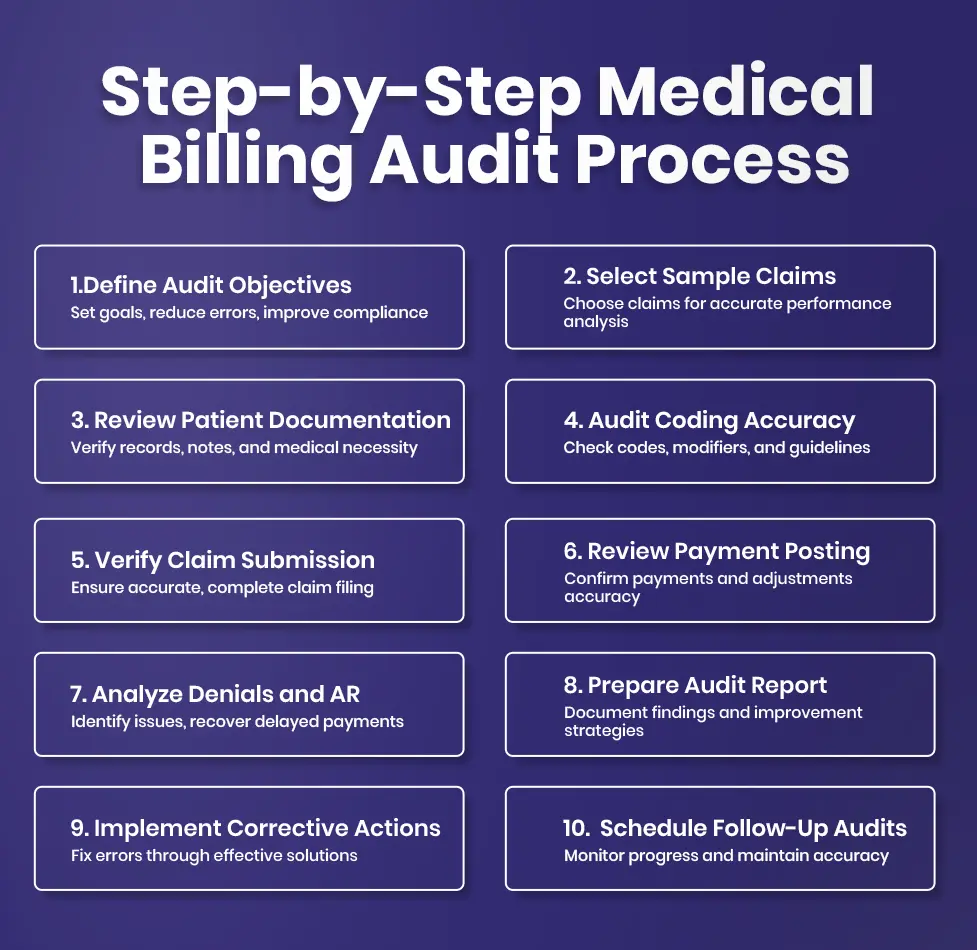
Step-by-Step Medical Billing Audit Process
Using a proper auditing process, hospitals can identify errors, ensure compliance, and maximize their profitability. Using a process-oriented approach, all the steps in the medical billing process can be evaluated, hence making it easy for clinics to learn about the process of conducting a medical billing audit. Companies who outsource medical billing services can also use auditing to evaluate the performance of their service providers.
Step 1: Define Audit Objectives
Start with setting some practical objectives that need to be accomplished by means of the audit, for instance, decreasing denials, correct coding, compliance check, or identifying revenue leakage. Goal setting will facilitate focusing on certain areas for the auditor and measuring progress made following the audit.
Step 2: Select Sample Claims
Pick the claims that represent your sample according to certain criteria like type of service, payer, billing volume, claim denials, and even reimbursement amounts. The chosen sample will give you the correct information regarding the performance of your billing process.
Step 3: Review Patient Documentation
Review patient files, doctor’s notes, details on medical necessity, signatures, and other pertinent documentation to ensure that the claimed services are correctly documented. This is an important step to make sure that claims have proper documentation.
Step 4: Audit Coding Accuracy
Review diagnosis and procedure codes, modifiers, and coding guidelines to help assure that your coding is done accurately. Accurate coding helps avoid errors and compliance problems, as well as consistent reimbursement.
Step 5: Verify Claim Submission
Review submissions for completeness, timeliness of filing, required attachments, and payer requirements. This process identifies any submission errors that could cause unwarranted denials and payment delays.
Step 6: Review Payment Posting
Analyze payment records, remittance advice, adjustments, and reimbursement details to confirm payments are posted correctly. This helps identify missing payments, incorrect adjustments, and underpayment issues.
Step 7: Analyze Denials and AR
Analyze denial patterns, aging accounts receivable, and collections processes. Recognizing the underlying reasons helps practices in developing solutions that will eliminate denials and increase payment recovery.
Step 8: Prepare Audit Report
The audit findings, errors, financial impact, compliance, and recommendations for improvement must be recorded. The report helps in taking actions in the future.
Step 9: Implement Corrective Actions
Tackle any existing problems through training, streamlining processes, implementing policies, and making changes where necessary. This would ensure that there is no repeat of similar billing errors.
Step 10: Schedule Follow-Up Audits
Conducting regular reviews will guarantee that the changes put in place are effective and sustained for a long time. The knowledge of how to conduct the medical billing audit correctly necessitates constant monitoring, evaluating and adjusting of the billing process. Conducting these medical billing audit processes can help practices develop their audit process consistently and maximize their revenue cycle.
Medical Billing Audit Best Practices for 2026
Adhering to good audit practices enables the health care providers to keep their operations accurate and compliant. Adopting good medical billing audit practices will enable the organizations to identify any mistakes that may be committed and establish better revenue cycle management techniques by 2026.
Conduct Quarterly Internal Audits
Periodic internal auditing allows for identifying billing errors before they turn out to be something more serious. Quarterly assessment of the process of claims, documentation, coding, and payments will allow maintaining accuracy and compliance, as well as spotting any flaws in the workflow.
Standardize Audit Procedures
Standardization of audit procedures is necessary in order to ensure that each audit conducted follows the same procedure and standard of evaluation. This will increase the consistency of the audits, increase ease of comparisons of the findings, and also make it clear what is expected from the employees.
Use AI-Powered Audit Tools
The sophisticated AI-enabled audit tools can quickly process huge volumes of claim data and spot any irregularities in the billing procedures that could lead to possible mistakes. Such solutions assist auditors in making the process more efficient, as well as identifying areas that require additional attention.
Track Billing KPIs
The measurement of key performance indicators including denials ratio, accounts receivable turnover ratio, clean claims rate, and reimbursement pattern give important insights. The monitoring of key performance indicators allows clinics to understand audit results, detect areas for improvement, and make the right decision.
Monitor Denial Trends
Understanding trends in denials assists organizations in learning from the reasons behind claims being denied and avoiding them in the future. Examination of the payer’s feedback along with coding, documentation, and submission issues allows for developing appropriate solutions aimed at improving claims acceptance rate.
Train Coding and Billing Staff
Continuous training is key to keeping billing professionals aware of the latest codes and policies related to billing and coding. Professionals who are educated on billing will be able to avoid mistakes while adhering to the guidelines of the process.
Keep Documentation Current
Documentation that is both accurate and up-to-date will ensure appropriate coding, claim approval, and compliance with health care laws and regulations. It is important for clinics to routinely check their documentation process and have all notes from physicians available.
Stay Updated with Payer Policy Changes
Payer policies and reimbursement techniques change continuously, which is why it is serious to have updated information at hand. Being aware of the latest updates will allow one to comply with current requirements and optimize their billing process.
Perform Regular Self-Audits
Self-audits of the practice’s medical billing process enable them to evaluate themselves, find areas that need improvement, and fix problems on their own. This way, they will be able to spot errors ahead of time and ensure their compliance before anyone else does.
Common Medical Billing Audit Red Flags
Early identification of any warning signals or red flags allows healthcare practices to prevent revenue loss, compliance challenges, and billing inefficiencies. Recognizing common red flags in medical billing audits helps organizations identify potential issues, address challenges promptly, and implement effective solutions to improve billing accuracy and overall revenue cycle performance.
High Denial Rates
High rates of denials generally suggest an issue with the accuracy of claims, documentation, coding or payer guidelines. It is important for practices to periodically review their reasons for denials to find out why the problem exists and address them.
Repeated Coding Errors
Repetitive errors in ICD-10, CPT or HCPCS codes, or any other modifier, could indicate that there are shortcomings in terms of understanding and reviewing the coding process. Audits will assist in recognizing repetitive errors and enhancing the coding process.
Missing Documentation
Inadequate medical records, missing provider signatures, and inadequate documentation can result in delayed payments and compliance issues. Employing a medical billing mistake checklist can assist practices in ensuring that the documentation requirements have been met.
Duplicate Billing and Incorrect Modifiers
When there are duplicate claims, wrong modifiers, or wrong reporting of services, there is bound to be an investigation by the payers. Claim review is one way of preventing any form of billing inaccuracy.
Excessive Write-Offs and Long AR Days
Abnormal write-offs, high days in accounts receivable, and frequent payer denials are some examples that can be used to determine whether there is any loss of revenue or inefficiencies in the follow-up process.
Inconsistent Charge Capture
The failure to capture or inconsistent charge capture will cause loss of revenue and improper financial reporting. The periodic reviews guarantee that all services rendered are captured and charged.
Expert Insight: Early identification of medical billing audit red flags helps healthcare organizations avoid revenue losses, comply with regulations, fix billing mistakes, enhance documentation, streamline claims processes, and achieve better performance of their entire revenue cycle process.
How iSolve RCM Supports Your Medical Billing Audit Checklist
iSolve RCM makes it easier for healthcare practices to enhance and streamline the medical billing audit process through our suite of revenue cycle management services which will be geared towards finding errors and improving the financial performance of the practice. We perform an assessment of critical areas within the medical billing process such as documentation accuracy, coding validation, claim submission, denial management, payment posting and accounts receivable management. Through the use of a medical billing audit checklist, iSolve RCM will help healthcare practices discover revenue leakage, minimize claim denials and stay compliant with the rules and regulations set by payers and the industry at large.
FAQs
What is a medical billing audit?
A medical billing audit is a structured process of evaluating the billing documentation, claims, coding, and other related issues with the aim of ensuring that all information and procedures comply with regulations and requirements in order to secure correct payment from payers.
How often should a medical billing audit be performed?
A majority of healthcare organizations need to perform billing audits once every quarter, but the audit frequency can depend on a number of factors. Audits will be important in ensuring that issues can be identified, improvement tracked, accuracy of the billing process maintained, and problems resolved.
What is included in a medical billing audit checklist?
Those areas that should be covered when there is an audit checklist for medical billing include patient registration, insurance verification, documentation, coding, claim submission, payments, denials, and accounts receivables. The points mentioned below will help in analyzing the whole process of medical billing.
Who should perform a medical billing audit?
The audit process in medical billing needs to be done by professional billing specialists, coders who are certified, compliance personnel, or revenue cycle auditors. The internal team can do the audit while the external audit professionals can offer the unbiased opinion of the expert in the field.
What is the difference between a coding audit and a billing audit?
Coding audit is concerned with the process of checking the correctness of the codes assigned to the procedures performed. Billing audit involves auditing of the entire billing process. The process of coding and billing goes hand-in-hand in order to ensure accuracy.
Can small practices perform internal billing audits?
Certainly, smaller clinics can conduct their own internal audits of billing through the examination of claims, documentation, coding, payments, and denials. Utilizing a checklist will enable smaller entities to detect problems, comply with rules and regulations, prevent losses, and manage their billing processes effectively without conducting complicated audits.