
Recertification is a vital procedure for compliance in the field of healthcare through which payers can determine whether the providers have continued to meet the mandatory criteria in terms of their qualifications, licensing, competency, and safety of the patients. By conducting the reviews periodically, payers make sure that the doctors and other healthcare practitioners have active credentials, updated contact and practice information, certifications, and compliance with the regulations. The majority of the health plans mandate Recredentialing by the providers every 2-3 years, although the time period may vary according to the payers, specialties, and programs.
An effective Recredentialing checklist will make it easy for providers to keep track of time, have all necessary documents organized, have accurate CAQH data, and facilitate easy communication with payers. As incomplete applications, outdated data, and documentation gaps tend to be some of the major reasons why credentialing takes long, credential management should be proactive in order to protect your revenue and network access. This blog will help you understand the process of Recredentialing in the healthcare field and avoid payer termination. Partnering with an experienced medical billing company in USA can help healthcare providers streamline Recredentialing, maintain accurate documentation, meet payer deadlines, and minimize the risk of reimbursement delays or payer termination.
What Is Recredentialing in Healthcare?
Recredentialing of providers is an evaluation by payers on a regular basis of the qualifications, credentials, licensing, and certification of a provider and other information relating to a provider in order to check whether the provider still qualifies to be part of the payer’s network. Unlike initial credentialing that takes place when the provider applies for inclusion in the payer’s network, recredentialing confirms the qualifications of an approved provider.
It is necessary for insurance carriers to periodically review the provider in order to keep accurate provider directories, minimize fraud potential, and make sure the patient safety standards are maintained. As part of the process of recredentialing, the carrier will check new credentials, malpractice insurance, sanctions history, and other related documents.
Purpose of the Recredentialing Process
The main aim of recredentialing is to make sure that healthcare professionals still hold all the necessary credentials to join the insurance networks. It entails the examination of active licenses, board certifications, malpractice insurance, privileges at hospitals, employment history, and many other credentials in order to make sure that the professional still meets the criteria for offering the health care services.
Recredentialing will further demonstrate continuous adherence to the insurance provider’s policies and regulatory requirements as well as help in minimizing issues such as fraud, administrative risk, and quality problems. By finding out any lapsed license or any other issues regarding sanctions or lack of documentation, the insurer is able to safeguard patients and uphold high standards of practice.
Credentialing vs. Recredentialing Process
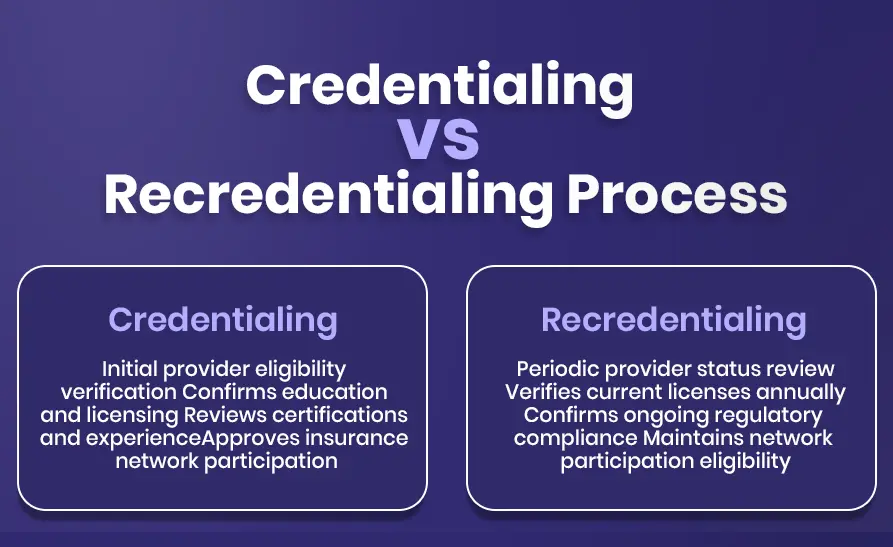
Credentialing is the first assessment that a health care provider undertakes prior to entering into the network or organization of an insurance payer. In this regard, the payer will confirm credentials such as education background, training, licensing by state, certification, malpractice insurance, experience, and professional referrals. After this process, the provider is then enrolled by the payer and becomes qualified for reimbursement for their services.
Recredentialing, in contrast, is a periodic process that takes place after the initial authorization process in order to determine whether the providers continue to meet the standards of the payers and regulators. Rather than gathering all of the information again, the payers confirm that the license, the certification, the place of practice, and the malpractice insurance have not changed since the initial authorization process. A structured provider credentialing program establishes accurate provider records from the beginning, making future recredentialing faster, easier, and more compliant.
How Often Is Provider Recredentialing Required?
Credential revalidation is normally conducted at regular intervals in order to make sure that all the healthcare professionals are meeting the standards set out by the payers, regulators, and other parties involved in their practice. Although there is a normal period during which the process should be done for each institution, this depends on the type of insurance company or hospital in question.
Standard Recredentialing Frequency
Most insurance carriers will require recredentialing for providers to occur every two to three years, while there may be individual differences with the policies of each insurance carrier. Different insurance programs such as Medicare Advantage, Medicaid managed care, and hospital credentialing committees may use different timeframes depending on regulatory guidelines and accreditation criteria. The provider needs to check the policy of each insurance carrier.
Factors That May Require Earlier Review
There can be some instances that might lead to recredentialing prior to the normal cycle of review. Such instances are those involving change of a physician’s medical license, filing of a lawsuit, disciplinary actions, location of practice, and expiration of certifications. Any considerable change in the ownership or hospital privileges of a physician is subject to updated documentation.
Importance of Tracking Recredentialing Deadlines
It is imperative to monitor the deadline for recredentialing in order to be able to remain in the network of the insurer consistently. Not adhering to the deadline may result in either being suspended from receiving payments, having the process of claim submission delayed, or even termination of the contract. Medicare providers are required to periodically revalidate their enrollment information to confirm continued eligibility, and healthcare organizations can review official requirements through the CMS Medicare Provider Enrollment Revalidation resources.
Healthcare Recredentialing Process: Step-by-Step Guide
The recredentialing process in healthcare guarantees that the providers remain in compliance with the standards required by the insurers and the health care organizations. This is through the evaluation of qualifications of the provider, updating the records, verification of credentials, and ensuring compliance with regulatory requirements. Each step needs to be followed keenly to avoid delays.
Step 1: Receive Re-credentialing Request
It starts off with the payer/healthcare organization sending out a recredentialing notice to the provider prior to expiration of the existing approval period. This notice will contain information about deadlines, paperwork and documentation that is to be completed by the provider. Providers need to read the payer’s requirements carefully and make a schedule.
Step 2: Verify Provider Information
It is necessary that all the personal and professional data must be revised and updated before the submission of their application. Some of the information to be verified includes: legal name, NPI number, location of practices, specialization, contact numbers, hospital affiliation, and employment history. Accurate information will help avoid verification delays.
Step 3: Complete Credentialing Applications
Once provider information is verified, providers will need to fill out all credentialing application forms that are required by the insurer. Most insurers have online portal services and use CAQH for collecting provider information. It is necessary for the provider to update his or her CAQH profile and complete all sections.
Step 4: Submit Required Documentation
At the time of completion of the process, all documents are supposed to be uploaded by the healthcare provider, including updated copies of the medical license, board certification, malpractice insurance, DEA, and other documents required by the application form. All documents should be verified before being uploaded to make sure that they are updated, legible, and correct according to the application form.
Step 5: Payer Review and Verification
Once the application is received, the process of verification commences. The process encompasses verification of active licensure, board certification, education, experience, malpractice insurance, sanction screening, and background checks. In some cases, a quality assessment of the provider’s performance may be required prior to credentialing.
During the recredentialing process, providers must guarantee that enrollment details, practice information, and professional credentials remain precise and modernized according to payer and regulatory requirements outlined by Centers for Medicare & Medicaid Services (CMS) Provider Enrollment Guidelines.
Step 6: Approval and Continued Participation
Once the process is completed successfully, the payer approves the provider as being active within the network. The provider needs to keep all the notifications from the payer regarding approval and also needs to update their own credentialing information and set a deadline for the next recredentialing cycle.
Complete Recredentialing Checklist for Healthcare Providers
The use of a comprehensive checklist for the credentialing process will ensure that health care providers have all the important information and documentation organized prior to filing the application for recredentialing. Having their documents in order will avoid delays in the process, as well as prevent application denial. Below are checklists which include most of the required information.
Provider Information Checklist
Provider information must be accurate in all applications for recredentialing. The information provided by the payers is used to check the accuracy and consistency of the provider information in their system. Ensure that all identifying information is correct when compared to the payer’s records.
- Full legal name
- National Provider Identifier (NPI)
- Tax Identification Number (TIN)
- Practice locations
- Contact information
- Specialty and credentials
License and Certification Checklist
Insurance companies check licenses and certifications of the professionals in order to verify that the provider still has legal rights to provide the service. The expired or incomplete information on licensing and certification will lead to further delays in processing or more information being required.
- Current medical license
- DEA registration (if applicable)
- Board certification documents
- State controlled substance license
- Professional certifications
Education and Training Documents
Credentials in education show that providers have successfully undergone the necessary medical training and maintain their competence as professionals. Payors can ask for information regarding medical education, postgraduate education, and continuing medical education in connection with recredentialing evaluation.
- Medical school information
- Residency or fellowship details
- Training certificates
- Continuing medical education (CME) records
Professional Liability Documentation
Professional liability documents will aid the payer in determining the risk involved and checking that there is appropriate malpractice insurance in place. The provider must make sure that his or her insurance certificate is up-to-date and shows accurate coverage.
- Current malpractice insurance certificate
- Claims history
- Liability coverage details
Employment and Practice History
Providers’ employment history and their professional affiliations will be reviewed to ensure that the providers have had adequate experience and are currently practicing. Keeping up-to-date records regarding employment and professional affiliations will help make the verification process easier.
- Work history
- Current affiliations
- Hospital privileges
- Professional references
Provider Credentialing Documents: Complete Documentation Checklist
Documentation is one of the key steps in the recredentialing process for providers. Insurance payers ask providers to provide documentation that proves their qualifications, standing in the industry, and compliance with regulatory guidelines. Having an organized document file will facilitate the review process and will reduce the chances of receiving requests for additional documentation.
Common Documents Needed for Recredentialing
Typically, most payers demand that you produce a set of documents that establish who you are, where you studied, whether you are licensed, and all relevant professional qualifications. Ensure that you check each document before sending in your application for recredentialing to make sure that it is updated and does not contain any inconsistencies.
- Provider application forms
- Government-issued identification
- Medical license copies
- National Provider Identifier (NPI) documentation
- W-9 forms
- CAQH profile information
- Malpractice insurance documents
- Board certification proof
- Hospital privileges documentation
- Updated work history or curriculum vitae (CV)
- Continuing medical education (CME) records
Tips for Managing Credentialing Documents
Organizing the credentialing documents in an efficient manner can help greatly minimize delays when processing the recredentialing process. The organization needs to organize all the digital copies of important documents like licenses, certificates, malpractice insurance, and IDs in one place for easy access. Keeping your documents in separate credentialing files will also make future updates easier.
The provider needs to keep track of all the expiring dates of the licenses, certification, DEA, and insurance policies to prevent any surprises when renewing them. This way you will be able to catch all missing or inaccurate information during the internal audit and prepare everything in advance before sending it to the payer.
CAQH Re-attestation Process: What Providers Need to Know
What Is CAQH?
The CAQH re-attestation process starts with the recognition of the function of the Council for Affordable Quality Healthcare (CAQH). CAQH ProView is the name of the central repository where healthcare providers keep their professional data in a secure environment that participating payers of insurance will use during the credentialing and recredentialing process. Rather than filling out applications to every single insurer, providers can keep only one profile.
CAQH Re-attestation Requirements
CAQH profile re-attestation forms an integral part of the recredentialing cycle of healthcare providers. Healthcare providers are supposed to regularly check the accuracy and timeliness of the information contained within their CAQH profiles. This means that CAQH should be updated with the latest information regarding medical licenses, locations of practices, training and education, malpractice insurance, affiliations with hospitals, and other professional information.
CAQH Recredentialing Checklist
Adhering to the CAQH recredentialing checklist will ensure proper and timely re-attestation for providers. Providers should check whether all documents are updated and all sections of their profile have been looked into before submission.
- Log into your CAQH profile
- Review all profile sections
- Upload updated supporting documents
- Verify license and certification expiration dates
- Complete the re-attestation process
- Save confirmation records for future reference
Medical Credentialing Checklist: Common Compliance Requirements
Regulatory and Compliance Checks
A complete checklist for provider credentialing consists of regulatory checks that ensure that the provider continues to comply with all necessary regulations. Insurance carriers usually check whether the medical license is valid, carry out sanctions screening, verify Medicare/Medicaid qualifications, and do background checks. Such procedures enable ensuring that the provider is still qualified to become a part of healthcare networks. Accurate medical coding services complement provider compliance by ensuring claims are coded correctly and meet payer documentation requirements.
Quality and Performance Review
The assessment of the provider’s quality and professional performance is another task that payers accomplish when performing the credentialing compliance check. Payers review patient safety data, complaints, malpractice cases, peer review data, and other quality measures. The examination of such aspects ensures that healthcare organizations and insurance companies maintain quality standards, mitigate risks, and provide good services to their patients.
Credentialing Compliance Checklist
A structured credentialing compliance checklist would allow providers to organize themselves better for regular reviews. It will reduce errors in the process and facilitate timely recredentialing.
- Verify provider information annually
- Track license and certification expiration dates
- Maintain accurate and updated records
- Document all credentialing submissions
- Follow payer-specific deadlines and requirements
Common Reasons Providers Fail Recredentialing
Sometimes even the best trained healthcare professionals can end up having delays and denials regarding recredentialing process owing to some preventable mistakes in administration. Failure to meet deadlines, poor documentation, old CAQH records, and non-compliance are the main causes for rejection or denial of recredentialing process by payers. This information is very useful in helping to take necessary action. Professional denial management services help healthcare organizations resolve claim denials that may occur because of credentialing or enrollment-related issues.
Missing Deadlines
Among the many reasons for failing to credential or recredential is that of submitting past deadline dates. Ineffective application processes or notifications received by the payers may cause problems in processing. It is imperative to keep track of expiration dates, respond to payers’ notifications, and set up reminders to comply with all the requirements before the deadline.
Incomplete Documentation
Incomplete or inaccurate documents will result in a delayed recredentialing process. If the documents have expired medical license, expired board certification, expired malpractice insurance or any erroneous information about the provider, the payer will ask for further verification to verify the documents. It is always recommended to go through the entire set of documents before submission.
CAQH Profile Issues
Another common issue that arises when providers face challenges with recredentialing is that of an out-of-date or incomplete CAQH profile. Forgoing any action toward the attestation process, updating documentation, or any modifications made to license, address, and insurer data will hinder the ability of the payers to go ahead with their review process.
Compliance Problems
The provider might run into problems regarding compliance when he faces issues with licenses, disciplinary measures, undisclosed changes in practice, and any discrepancy between documentation presented and that on file. Such matters will be carefully looked at by insurance companies during the recredentialing process, to make sure that the provider remains in compliance.
How to Avoid Payer Termination During Recredentialing
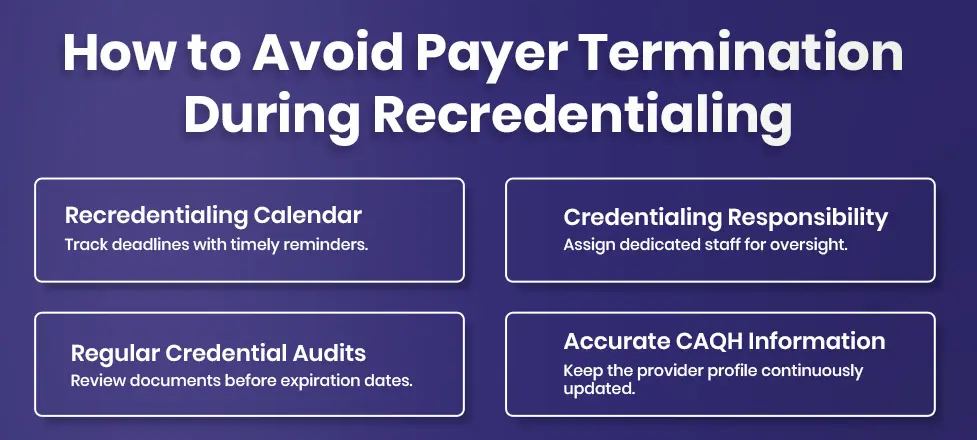
Failure to be terminated by the payer necessitates managing the provider’s documentation, timeframes, and compliance issues. Having a proper recredentialing process will enable healthcare facilities to avoid making documentation mistakes, non-deliveries, and disruption of the credentialing process. Maintaining proper information, delegating accountability, and regular review of providers’ information is necessary for organizations. Many healthcare organizations choose to outsource medical billing services to minimize payment disruptions and maintain revenue continuity during the recredentialing process.
Create a Recredentialing Calendar
The use of a recredentialing calendar ensures that payers’ important deadlines are anticipated. Through this schedule, a healthcare provider will be able to plan the completion of tasks before any of the deadlines come knocking at their door. Automating reminders and conducting regular reviews of future tasks ensure that nothing gets overlooked.
Assign Credentialing Responsibility
Establishment of credentialing assignments is key to ensuring that key processes are conducted with efficiency and consistency. It is imperative for healthcare organizations to have some key individuals who will be responsible for processing applications, gathering information, communicating with the payers, and tracking approvals. There is also software for credentialing management which makes the process easier.
Perform Regular Credential Audits
Credentialing audits are an important part of ensuring that provider credentials are current and accurate before becoming a problem. By performing periodic reviews of providers’ files, companies can ensure that all the required documentation is up to date. This helps to prevent last minute complications during the recredentialing process.
Maintain Accurate CAQH Information
The CAQH data needs to be up-to-date since this facilitates the process of verifying the payer and the recredentialing process. The provider needs to review the CAQH profile periodically to ensure that the licensure, practice location, educational background, and insurance data is updated. This helps the payers access the necessary data without delay.
How Long Does Medical Credentialing Take?
The medical credentialing time frame differs, as it depends on the payers, type of the provider, required documents and verification procedure. Usually, initial medical credentialing takes several weeks or even months because the payers have to verify the education, licenses, work experience, malpractice insurance and other credentials. Recredentialing is done faster since the documents already exist and need only updating but not collecting from scratch. The delay in the credentialing process may appear due to the missing information and slow reactions to the payer’s requests.
It is possible for providers to avoid credentialing delays by completing applications properly, reacting promptly to payer’s requests and keeping all necessary records up-to-date during the year. Up-to-date licenses, certifications, CAQH profile and insurance certificates help payers to do the verification quickly. Comprehensive underpayment recovery in medical billing services help providers recover lost revenue from payer underpayments that may occur during credentialing transitions.
Provider Recredentialing Best Practices for Healthcare Organizations
Proper recredentialing procedures assist healthcare organizations to maintain compliance and administrative risk reduction and uninterrupted payer participation. The process can be improved through structuring to enhance accuracy and efficiency. Healthcare organizations can strengthen their revenue cycle performance by combining effective recredentialing practices with professional AR Management Services to track unpaid claims and improve collection outcomes.
Standardize Credentialing Workflows
Standardizing the process of credentialing workflows guarantees that each and every provider goes through the same process of gathering the documents, verifying them, submitting them and following up on them. The standardization of processes will help to ensure that there are no discrepancies, there is no omission of any step and that there is good coordination between the two parties.
Maintain Centralized Provider Records
Having centralized files for providers makes it easier for health care institutions to keep all credentialing information in one place. A good database will have all the required information such as the license, certification, medical malpractice, CAQH information, and payers’ enrollment. This makes it easy for the team to search for the necessary information for re-credentialing, audit, and payers’ verification.
Automate Expiration Tracking
Automation in expiry tracking assists organizations in keeping track of crucial credentialing dates such as licenses, certifications, insurance policies, and registration renewals. Alerts are automatically issued by automation systems to ensure that there is enough time to renew the documents and submit them. This approach ensures minimal chances of suspending providers due to out-of-date documentation.
Conduct Compliance Reviews
Compliance assessments conducted on a regular basis can help healthcare facilities pinpoint the weaknesses in the process of credentialing and make sure that the provider files comply with the payers’ requirements. This can be done by conducting license verifications, assessing the accuracy of documentation, sanctions information review, and workflow assessment.
Train Administrative Teams
Well-educated administrative teams are crucial for the successful management of provider recredentialing processes. The staff must be aware of all the demands that payers place on recredentialing, of documentation rules, CAQH modifications, and all the internal credentialing procedures. Training is important to achieve accuracy in the process, avoid mistakes, and effectively control the provider applications process.
Monitor Payer Requirements
Payer requirements may vary with time, thus requiring continuous monitoring by healthcare organizations. The credentialing team has to continuously monitor information provided by insurance firms, government agencies, and regulators regarding any changes that need to be implemented in order to maintain compliance. It is important to stay up-to-date to make necessary adjustments and ensure good payer relations.
How iSolve RCM Helps with Recredentialing
The iSolve RCM service streamlines the credentialing process for healthcare organizations through the documentation process, deadline management, and compliance with payers’ standards. The iSolve RCM team provides assistance in the gathering and verification of credentials documentation, maintaining accurate provider information, monitoring CAQH information, and paying bills to payers. Through the iSolve RCM approach, it becomes easier to streamline the credentialing process without delays and administrative burdens.
FAQs
What is provider recredentialing?
Recertification refers to the periodic evaluation carried out by the payers of insurance on the qualifications, license, and certification of the health care providers. The reason behind the recertification of health care providers is to ensure that they are eligible to be part of the networks.
How often is provider recredentialing required?
Providers recredentialed qualifications are typically mandatory every two to three years; however, this period varies from payer to payer. It is important for providers to track their own credentialing needs, renewals, and deadlines to ensure smooth continuity of their involvement in a network.
What documents are needed for recredentialing?
Examples of recredentialing documents include provider application, medical license, NPI documentation, W-9 form, malpractice insurance certificate, board certification, CAQH document, hospital privileges, employment history, and continuing education document. The requirement of recredentialing documents can differ according to payers and specialty of providers.
How long does medical credentialing take?
Timelines for medical credentialing will vary depending on payer expectations, verification timeframes, and the level of documentation available. First-time credentialing could take several weeks to months, whereas recredentialing takes less time. Delays in the process often result from missing documentation or incomplete applications.
What happens if a provider fails recredentialing?
Non-compliance with the recredentialing process can result in delayed payment, exclusion from a payer’s network, and termination of a physician as well. Possible corrective measures can be submission of the documents, record updates, responding to the payer’s inquiries, and additional review.
Is CAQH required for recredentialing?
CAQH is used extensively in healthcare credentialing due to the centralized nature of CAQH and provider profile management. There are a number of commercial payers who depend on CAQH data when conducting recredentialing. This ensures that the providers have up-to-date and attested profiles.