
Most administrators equate claim submission with revenue capture. A claim goes out the door, and the assumption is that payment, in full, will eventually follow. The belief in the claim submission process is arguably the most expensive fallacy in medical billing today. All the claim submission does is to state that an attempt has been made at seeking for remuneration; it does not provide any information regarding accuracy, completeness, or whether the payment request was honored by the payee at all. There are several places from the time the services are rendered until the time payment is actually posted where earnings can disappear.
This is the reality behind revenue leakage in healthcare: income that a practice has legitimately earned through patient care but never actually collects. Leakage does not announce itself. It does not appear as a rejected claim sitting in a work queue demanding attention. Instead, it hides inside missed charges that were never billed.
All of these include coding practices that silently reduce payment levels, lack of documentation that makes a claim less defensible, and underpayments of payment that do not compare to the contracted rate. Even when a practice submits 100 percent of claims on time, it may be losing a sizable portion of earned income monthly.
Understanding where these gaps live, and building a revenue cycle that actively hunts for them, is no longer optional for practices trying to protect their margins in an increasingly complex payer environment. This piece walks through what revenue leakage actually looks like, where it originates inside the billing process, and what a practice can do to close the gap between what it earns and what it collects. Partnering with experienced medical billing agencies can help medical practices identify hidden revenue gaps, improve claim accuracy, and build a more efficient billing workflow that prevents revenue leakage.
What Is Revenue Leakage in Healthcare?
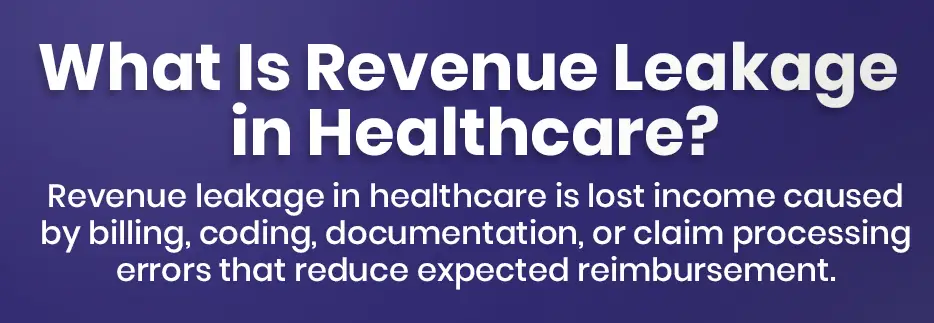
Revenue leakage in healthcare refers to earned income that a practice never actually collects, despite having delivered the service and, in most cases, documented it. A patient is seen, a procedure is performed, a claim is filed, yet somewhere in that chain, dollars the practice was owed simply never arrive. This is distinct from bad debt caused by a patient’s inability to pay; leakage originates almost entirely from internal process failures rather than external financial hardship.
The clearest way to understand leakage is to separate expected revenue from actual collected revenue. Expected revenue is what a practice should receive based on the services rendered and the rates contracted with each payer. Actual revenue is what lands in the account after claims processing, adjustments, denials, and patient collections are all accounted for. The distance between those two numbers, month after month, is the leakage figure, and in many practices, it is far larger than leadership assumes.
There are a few typical locations where leakage usually occurs. The first location is the missed charge where a service is done but never coded for in a claim. The next area is coding errors which lower or deny payments. Denial of claims either delays or prevents payment depending upon whether there is an appeal process successful. Underpayment occurs when the payer pays less than contracted. Documentation gaps weaken the medical necessity argument behind a claim. And inefficient billing workflows allow claims to sit unresolved until timely filing deadlines pass, converting a recoverable claim into a permanent loss.
Expert Insight: Perform revenue leak audits at regular intervals and see how much your expected reimbursement differs from the actual amount. Checking out the charge capture process, coding, denials, and payer adjustments will reveal hidden revenue leaks.
Why Revenue Leakage Is a Major Problem for Medical Practices
The financial implications of leakage escalate in a subtle manner. In itself, a single case of missed charge or slight underpayment may be of no consequence, but when accumulated, after hundreds of transactions monthly, those amounts become quite a big chunk of the total collectible income. Most practices learn of the magnitude of the issue in the course of a financial assessment at the end of the year, and at that time, most of those claims are not even amendable anymore.
In addition to direct loss of money, leakage increases the load of administration of such. Time spent on cleaning up messy and non-current claims could otherwise be used for the more constructive work of processing clean and timely claims. It distracts employees from their main tasks which contribute to the development of the business.
Most crucially, outstanding leaks prevent the practice from investing in its further development. The issue is directly related to the hiring, equipment acquisition or service expansion. In the absence of a clear financial picture, due to an unknown share of earnings, the leadership is forced to make decisions on an incomplete picture, and the development process becomes slower as a result.
How Does Medical Billing Work? Understanding the Revenue Cycle
Medical billing does not happen once but is rather a series of interconnected activities, any failure of which may lead to losses that will not be accounted for in their true cause. This is why it is important to comprehend the entire process so as to pinpoint the exact point of leakage, and not assume that losses happen solely at the point of denial.
Overview of the Medical Billing Process
The cycle starts even before the patient comes in, where the registration process and insurance verification ensure that the coverage is active and relevant to the visit. Next is the recording of the entire clinical encounter done in detail, indicating all the procedures conducted by the health practitioner. This information is transformed into billable amounts which are further converted into medical codes, taking into consideration the diagnosis made. These codes are used to submit the claim for payment by the payers, where the latter evaluates the claim for eligibility according to medical necessity and contracts before making the payment. After the payment is made, the payment has to be correctly posted against the respective claim and account of the patient.
Where Revenue Can Be Lost in the Billing Process
Every one of these stages carries its own risk. An error at registration, such as an outdated insurance record, can invalidate an otherwise perfect claim before it is ever submitted. A documentation gap during the clinical encounter can undercut coding accuracy two steps later. A missed follow-up on an unpaid claim can allow a recoverable balance to age past the point of practical collection. This is why monitoring only the final payment total is insufficient; a practice needs visibility into performance at each individual stage to understand where its specific leakage is actually occurring, rather than treating the whole revenue cycle as a single, undifferentiated process.
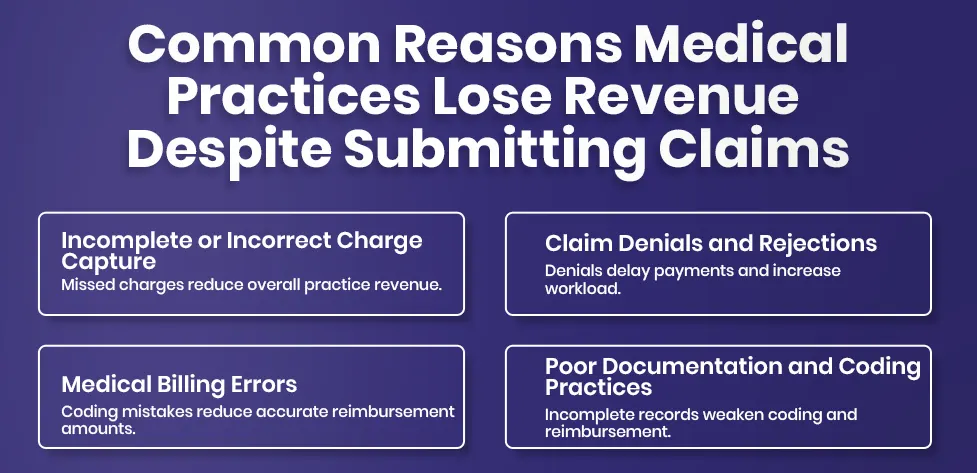
Common Reasons Medical Practices Lose Revenue Despite Submitting Claims
The presentation of a claim does not ensure anything more than the act of making a request. There are four major types of reasons for which practices end up losing money, and all have unique factors related to them. Many practices choose to outsource medical billing services to reduce administrative challenges, improve claim processing accuracy, and ensure that billing specialists actively monitor revenue opportunities throughout the revenue cycle.
Incomplete or Incorrect Charge Capture
The concept of charge capture is defined as the recording of all services performed during an encounter in order to ensure that any services rendered are billed for. If charge capture is done properly, there will be an accurate link established between the performance of a certain service and the billing of such services. Typical errors encountered include services that were performed but are not captured by the billing system, supplies that are forgotten to be included during the busy course of the encounter, and improper coding of services.
The most destructive thing about inadequate charge capture is that it causes problems with absolutely no point of failure. At least a denied claim allows one to see that something has gone wrong, and an appeal can be filed. When the charge has not been captured at all, there is nothing on the records, which means that there is no claim to appeal because there is no charge recorded in the system. It happens because of the difference between documentation and billing aspects of the practice, and providers think that the charge will appear on its own due to the documentation, while billers know nothing about the service provided.
Claim Denials and Rejections
Denials almost never occur because of one sole reason. Inaccuracies with patient data such as misspellings of names and incorrect date of births will often result in automatic denials. Eligibility denials, which occur when coverage expires and changes unknown to the provider, continue to be some of the most frequent, yet most preventable, denial reasons. Other reasons for denials include coding errors, lack of documentation, prior authorizations that have not been met, and arguments regarding medical necessity. Because each type of denial needs to be handled differently, the general approach of resubmit and hope does not work.
A denied claim brings along a lag time, and it comes at a financial cost, even if the claim gets sorted out in the end, since the lag time is the gap between the delivery of the service and the receiving of payment for it. A process of reworking a denied claim takes up staff hours, which costs money independently of the amount of the claim in question. Perhaps most worrying of all, quite a lot of denied claims do not get pursued at all. Industry studies have proven on many occasions that a considerable number of denied claims do not get reworked due to insufficient staffing, and therefore they turn into permanently lost money.
Denial prevention begins with enhancing patient eligibility verification prior to the appointment process, not after the denial of a claim. Better documentation will ensure that medical necessity is supported when it is needed. Reviewing coding with regard to payer specific guidelines helps prevent mistakes. Analyzing denials based on payer and denial reason codes, as opposed to handling each denial in isolation, will help the practice find the root cause of the problem.
Medical Billing Errors
Billing mistakes come in different types. Billing mistakes related to the selection of the wrong CPT or ICD-10 codes is one of the most common, usually resulting from poor documentation. Billing for a service more than once, referred to as duplicate billing, leads to denial of claim and compliance review. Mismatched or missing modifiers may result in an incorrectly billed claim being reduced or even denied in its entirety. Billing mistakes relating to incorrect information regarding payers and plans, as well as inaccurate billing claim information, are among the other common mistakes.
The most direct result of a billing mistake is typically underpayment as opposed to outright rejection. This poses an additional threat because, when a claim is underpaid, this may go undetected since the claim could still get paid despite having been miscoded; only the amount would have been reduced, and unless this is being compared to what the patient is supposed to be paid, this gets written off as routine income. The cumulative effect of making the same mistake repeatedly results in increased scrutiny by the payer.
Poor Documentation and Coding Practices
Clinical documentation forms the basis on which each coder builds his/her choice of the appropriate code. In cases where clinical documentation is lacking or is not in line with the care rendered, coders tend to make judgment calls that might result in coding that is lower than the actual level of service rendered, only for fear of overcoding. This is revenue leakage, although it is quite understandable because it is motivated by issues of compliance. Effective education for physicians along with periodic coding audits eliminates this problem. The use of professional medical coding services ensures proper translation of clinical documents into appropriate billing codes, thus minimizing coding errors, denying claims, and ensuring proper reimbursement.
Professional Guidance: Periodic assessments of charge capture, denial patterns, billing accuracy, and documentation quality are necessary to discover potential revenue leaks before it’s too late. The collaboration of regular audits and billing/coding skills will do the job.
Revenue Leakage Examples in Medical Practices
Abstract explanations of leakage are useful, but real scenarios make the pattern easier to recognize in day-to-day operations.
Missed Charge Capture
A provider performs a billable in-office procedure during what was scheduled as a routine visit. The procedure is clearly documented in the clinical note, but the billing team never receives a separate charge for it, because the visit was coded and closed as a standard office visit. The claim goes out complete and clean by every measure the practice tracks, yet the reimbursement for the procedure itself is permanently lost, with no denial or rejection to alert anyone that something was missing.
Coding Errors
A claim is submitted using a procedure code that does not accurately reflect the documented complexity of the service. The payer either denies the claim for a mismatch between the code and the supporting documentation, or reimburses it at the lower rate associated with the incorrect code. Without a routine coding audit comparing submitted codes against documentation, this kind of discrepancy can persist across dozens of claims before anyone notices the pattern.
Insurance Verification Failure
A patient’s coverage lapsed in the window between scheduling and the actual appointment date, but eligibility was never rechecked immediately before service. The claim is submitted to a policy that is no longer active, resulting in denial, and the balance shifts to patient responsibility. Patient-responsibility balances are historically collected at a far lower rate than payer-responsibility balances, meaning this single verification gap can convert a nearly guaranteed payment into a highly uncertain one.
Underpayment Detection Failure
An insurance company processes a claim and issues payment, but the amount reimbursed falls below the rate specified in the practice’s contract, whether due to a processing error on the payer’s side or a misapplied fee schedule. Without a routine process of comparing each remittance against the contracted rate, the practice accepts the payment as final. The underpayment becomes permanent, unrecovered revenue, and because it happened silently, it is never flagged for dispute within the payer’s contractual timeframe for correction.
Studies have been done using HCFA surveys conducted on 5,000 family practitioners and found that there is a well-defined fee structure where physicians usual fees are higher and Medicare/Medicaid allowable are lower. This study has looked at the issues relating to fee reduction in terms of reimbursement and financial implications.
What Is Revenue Integrity in Healthcare?
The topic of revenue integrity involves the practice of bringing together clinical documentation, accurate coding, compliance with regulations, and proper billing in one cohesive and accountable process. Unlike other models, which view documentation, coding, and billing as distinct processes to be managed by different people with different objectives, revenue integrity requires that what is documented, what is coded, and what is billed should align. The point at which most of the leakages occur happens to be at the point where these processes intersect.
The structured revenue integrity initiative will guarantee that a health care organization receives full reimbursement that is deserved for it by virtue of its contracts with payers, not what a claim will earn it after going through an unreliable process. Besides the revenue advantage, a structured revenue integrity initiative will shield a health care organization from any compliance risk because erroneous coding and/or billing is not only costly but risky due to regulatory issues that may arise. The end result is more financial visibility at every stage of the revenue cycle process within all departments involved.
It is easier to understand them as complementary rather than as interchangeable terms. The revenue cycle management is responsible for overseeing the whole process operation, from registration through the process until the final posting is made essentially, the question it raises is whether the process runs smoothly from point to point. Meanwhile, revenue integrity stands beside the operation process as its quality control, raising the question of whether each of the points in the process is done correctly. The revenue cycle of a business might be very quick yet leak revenue without proper revenue integrity.
Revenue Leakage Analysis: Finding Hidden Revenue Loss
Revenue leak analysis is an organized review process whereby one tries to pinpoint specifically at what point and why there is revenue leakage. Unlike in other approaches that involve responding to a feeling of low revenue, this process involves a systematic tracing of the revenue cycle back from its end up to the point where revenue is actually leaking.
Key Areas Reviewed During Revenue Leakage Analysis
The complete analysis always includes the investigation of the trends in claim denials, segregated by the payers and by reason codes, because sometimes certain payers or reasons cause a large part of the total amount of leakage. The coding accuracy is tested through the clinical documentation for the purpose of detecting the systematic undercoding or overcoding. The charge capture accuracy is verified with the help of the clinical schedule in order to detect services rendered without any billing. The payment accuracy is verified by comparing payments with the contracted fee schedule in search of the underpayments.
Benefits of Conducting a Revenue Leakage Audit
Well-conducted leakage audits uncover financial discrepancies that will never come out through monthly financial reports, as the latter usually focus on what has been gathered and not what should have been gathered. The process of conducting a leakage audit also helps to make billing more accurate in the future, as any patterns of errors that become apparent through auditing can be fixed at their source. In many instances, leakage audits bring back revenue that is still within an appeal or dispute period.
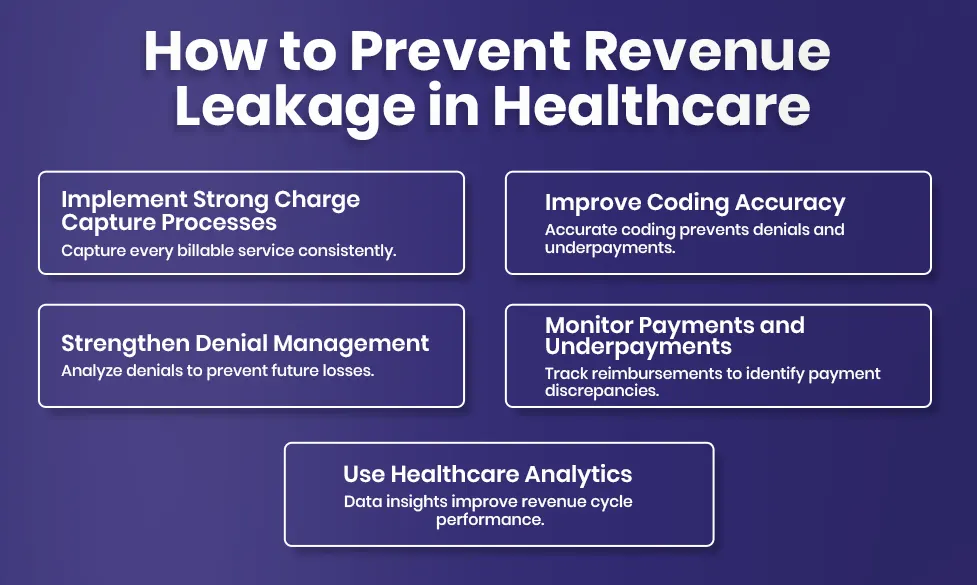
How to Prevent Revenue Leakage in Healthcare
Proactive strategies assist health care organizations in recognizing potential issues related to billing and ensure financial precision in addition to avoiding losses from missed billing opportunities.
Implement Strong Charge Capture Processes
Standardizing documentation templates across providers ensures that every billable service has a clear, consistent record at the point of care, reducing reliance on individual memory or habit. Reviewing missed charge reports on a regular, scheduled basis, rather than only during periodic audits, catches gaps while they can still be corrected and billed within the payer’s timely filing window.
Improve Coding Accuracy
Routine code reviews where the submitted codes are compared against the documentation prevent any errors prior to filing the claim. Continuous staff education ensures that coders are always up to date with payer guidelines, which change often and therefore even an experienced coder should receive education occasionally. Staying abreast of the latest coding guidelines on an annual basis helps in avoiding the use of outdated codes, which can lead to denials and underpayments.
Strengthen Denial Management
An analysis of the denial reasons based on categories instead of addressing each denial case in isolation helps to identify the consistent root cause behind the revenue losses. Developing prevention approaches based on the root causes of denials, along with monitoring the performance of different payers in terms of denials, helps to make denial management a proactive process.
Monitor Payments and Underpayments
Comparing every payer remittance against the contracted fee schedule catches underpayments that would otherwise be absorbed without notice. Identifying reimbursement discrepancies quickly matters a great deal, since most payer contracts set strict windows for disputing incorrect payment, and missing that window converts a recoverable underpayment into a permanent one.
Use Healthcare Analytics
Consistently tracking core revenue cycle metrics gives practice leadership early visibility into performance shifts before they compound into significant losses. Reviewing this data on a regular cadence helps identify specific workflow problems, whether tied to a particular provider’s documentation habits or a particular payer’s evolving denial pattern, while the corrective action required is still relatively simple.
Guidance for Practices: Revenue leakage prevention involves constant surveillance rather than periodic assessments. Employing automated analytics, audits, and tracking of denied claims will help you detect billing problems, optimize processes, and secure your revenue prior to experiencing any actual loss.
Revenue Leakage Management Strategies for Medical Practices
Leakage prevention is not a one-time activity; it is an ongoing management activity that needs to become part of the routine operation of the practice. Implementing constant monitoring of the revenue cycle, instead of just doing annual assessments, enables any potential problems to be found when they are still small enough to fix. Regularly performing leakage audits allows for any new leakage opportunities to be found due to changes in clinical and administrative operations. Enhancing communication between clinical and billing departments helps resolve any issues regarding documentation prior to sending the claims out, instead of after receiving a denial. Automating redundant billing activities helps minimize the errors caused by manual processes that occur during busy times. For practices that do not have the means to perform such monitoring, having an outside billing department help can be a solution. The incorporation of denial management services in the revenue cycle assists organizations in solving unpaid claims faster, avoiding future mistakes, and improving collection efficiency.
How to Improve Revenue Cycle Management (RCM)
Optimizing revenue cycle management requires efficient workflows, accurate documentation, proactive claim management, and continuous monitoring to reduce delays, prevent denials, improve collections, and maximize healthcare revenue performance. Comprehensive revenue cycle management services include billing, coding, claims processing, denial management, payment tracking, and financial reporting for the entire process to enhance performance of the medical practice.
Best Practices for Better RCM Performance
Ensuring insurance eligibility prior to each appointment, not just during the first registration process, eliminates the primary reason for unnecessary denials. More accurate documentation, done in real time, ensures that all subsequent processes, including coding and payment review, will benefit. Efficiently filing a claim on the first try will minimize any processing delays or additional costs associated with correcting a claim. Minimizing denial rates, following up on unpaid claims immediately and not allowing them to get older, and conducting financial assessments regularly serve as the basis of an effective revenue cycle.
Key RCM Metrics to Monitor
There are a few key performance indicators that help one understand the status of the revenue cycle better than the overall collections figure alone. The clean claims rate indicates the percentage of claims that are accepted by the payer without needing correction on initial submission. Claim denial rate keeps track of the portion of submitted claims that are being denied in entirety. The days in accounts receivable metric indicates the typical period required to receive payments after service, with extended periods indicating some form of hindrance in the process. The net collection rate reveals the actual amount of collectable revenue being collected by taking into consideration the contractual adjustments. Payment turnaround time indicates how quickly the payers are settling claims and an extended trend is indicative of a problem that must be addressed beforehand. Practices that seek reliable billing companies can use the list of the top 10 medical billing companies in Florida to compare their expertise, services, and solutions for improving revenue cycle performance.
How iSolve RCM Helps Close These Gaps
Revenue leakage, however, is approached at iSolve RCM differently from other organizations as we consider it to be a process issue, not a claims issue. Billing and coding staff at our organization conduct their reviews of the charge capture, documentation and payer remittance directly comparing everything against the contracted rate, thus identifying any underpayments or missing charges before they become revenue leakage and not afterwards. Denial patterns per payer and root cause are tracked, all unresolved claims are taken up to the appeal level, and practices are provided with clear insight into where their revenues go every step of the way. The point here is that the income generated through patient care must end up in practice accounts as it was earned, without any additional efforts to identify the problem months later.