
Every healthcare practice eventually runs into the same wall; the clinical side of medicine is getting harder to separate from the financial side. A denied claim does not just cost a few dollars in rework; according to the Healthcare Financial Management Association, reworking a single denied claim costs between $25 and $117 once staff time, resubmission, and appeals are factored in. Multiply that across a mid-sized practice submitting a few thousand claims a month, and billing stops being a back-office task. It becomes a determinant of whether the practice stays profitable.
That is making many practices face a tough choice whether they should handle their billing in-house vs outsourced medical billing to a professional medical billing partner. This is not a new dilemma; however, it is becoming more relevant with each passing day. According to the Medical Group Management Association’s data of 2025, nearly 60 percent of practices with less than 10 doctors are now seriously considering the option of outsourcing a part of their billing, and 90 percent of all medical groups have reported that their operating costs for the first six months of 2025 were higher than 2024.
This comparison walks through the five areas that actually decide the outcome of that decision:
- Cost is what in-house billing really costs versus what outsourced medical billing services charge.
- Control and transparency are who sees what, and how fast.
- Revenue cycle efficiency is how claims move from submission to payment.
- Collections performance is how much of what’s owed actually gets collected.
- Scalability is what happens when patient volume changes.
Getting this decision right affects more than the bottom line. It affects how much time providers spend on patient care versus paperwork, and how predictable a practice’s cash flow is from month to month.
In addition to these changes, there are several underlying drivers worth calling out as well. Denial risks are dynamic, and cannot be planned for once and then forgotten by a medical practice, because they are on the rise. The third annual survey conducted by Experian Health and entitled “State of Claims” was published late in 2025, based on the answers provided by 250 healthcare revenue cycle executives, with the results demonstrating that 41% of providers currently have denial rates above 10%, up from 30% just three years before. This means that an increasingly high percentage of practices are having trouble getting paid, due to the reworked claim submissions, appeals or unprocessed claims altogether. In light of these facts, it becomes clear that whether to work in-house or outsource is no longer a question of preference. Practices looking for end-to-end best medical billing companies can simplify claims processing, payment posting, and payer follow-up while reducing the administrative burden on internal staff.
How an In-House Billing Team Works
In-house medical billing is where the billing process takes place within the practice itself, which would employ its own billing personnel, who would be medical billers, coders, billing managers, or revenue cycle specialists depending on the size of the organization. The entire claims process involves verifying the patient’s eligibility, coding each patient encounter using the appropriate CPT/ICD-10 code, claims processing, denial management, payment posting, and accounts receivable management.
Since the staff works within the practice, the process can be designed in such a way as to work well for that particular practice; its schedule, physician specialty, payer arrangements. A typical day for in-house billing would begin with sorting through the previous day’s encounters, verifying proper documentation for each of the codes submitted, and preparing claims for submission. Denials that come back from payers get routed to whichever biller has capacity, appeals get drafted against payer-specific timelines, and payment postings get reconciled against expected reimbursement; all while patient statements and collections calls run in parallel. It is a full-time operational discipline in its own right, distinct from clinical care, which is exactly why it tends to either get fully resourced or fully outsourced rather than handled as a side responsibility.
Advantages of In-House Medical Billing
- Practice leadership can walk over to the billing office and ask a question, rather than waiting on a scheduled call or email thread.
- Coders and providers can clarify documentation issues in real time, which matters when a chart note needs a quick correction before a claim goes out.
- Nothing about the billing process is a black box; leadership sees exactly what’s happening, claim by claim.
- Internal teams can adapt processes to unusual scheduling, multiple locations, or specialty-specific documentation needs without negotiating scope with an outside vendor.
Challenges of Managing Billing Internally
The advantages come with real costs. In accordance with cost analyses in the industry from 2025, each individual billing full-time staff member will incur annual expenses of anywhere between $76,000 and $132,000, which includes not only the salary but also all payroll taxes and benefits as well as software licensing costs, training, and even the cost of turnover, excluding denial loss.
Other recurring challenges include:
- Medical billing is a specialized skill set, and turnover means retraining, temporary coverage gaps, and claims sitting untouched.
- Coding sets, payer policies, and documentation requirements shift throughout the year, and an in-house team has to absorb that education on top of its daily workload.
- Clearinghouse fees, claim-scrubbing tools, and eligibility-verification systems all require licensing and upkeep.
- Adding providers or opening a second location usually means hiring and training new billing staff months in advance of the actual growth.
There is also a compounding effect that’s easy to underestimate: prior authorization work. The study by the American Medical Association’s 2024 physician survey revealed that practices have to allocate 14.5 hours of work per week per physician just for the prior authorization process; a requirement which is bound to take its toll on other areas of operations, especially when it comes to the in-house setting where billing time is used for it.
How Medical Billing Outsourcing Works
Outsourced medical billing means a practice contracts with a third-party billing partner to manage some or all of its revenue cycle. Depending on the scope agreed upon, that can include coding review, claims submission, insurance verification, denial management, patient statements, and full revenue cycle management.
Benefits of Outsourcing Medical Billing
The reason is that it is all about specialization and economies of scale. The dedicated billing partner is handling claim submissions to various practices at once, and therefore their people get exposure to more denial scenarios and payer peculiarities than any in-house team would normally see. Choosing to outsource medical billing services permits healthcare providers to access experienced billing specialists without the ongoing costs of hiring, training, and maintaining a full in-house team.
- Billing partners typically staff certified coders and billers whose full-time job is claims accuracy.
- Practice staff spend less time on collections calls and appeals paperwork.
- Data cited by RevCycle Intelligence shows in-house billing teams average denial rates between 5% and 10%, while dedicated billing companies often bring that down to 2–3% through specialization and volume experience.
- Claims that are coded correctly the first time move through the payer adjudication process without the delay of rework.
- A dedicated partner tracks denial reasons across the whole book of business, not just one practice’s history, which sharpens prevention over time.
Potential Drawbacks of Outsourced Billing
Outsourcing is not without trade-offs:
- Practice leadership is not managing the billers directly.
- Response time and reporting quality vary widely across vendors.
- Not every billing company specializes in every specialty, and a poor fit can undo the benefits.
- The practice needs assurance that its partner meets HIPAA security and privacy standards, since protected health information now flows through a third party.
- Percentage-of-collections pricing aligns incentives well, but a poorly scoped contract can leave gaps; for instance, unclear ownership of patient collections or ambiguous handling of underpayments; that only surface after the relationship is underway.
None of these drawbacks are reasons to avoid outsourcing outright. They are reasons to vet a partner carefully before signing, the same way a practice would veto any vendor handling a core financial function. Healthcare practices can also refer to the U.S. Department of Health and Human Services (HHS) HIPAA guidance to better understand their privacy, security, and compliance responsibilities.
That last point carries real financial weight. Under the 2026 HIPAA penalty structure, civil monetary penalties range from roughly $145 to more than $2.19 million annually per violation category, and the Office for Civil Rights closed 21 major enforcement actions in 2025; its second-highest annual total on record. Separately, the healthcare sector recorded the highest average data breach cost of any industry for the fourteenth consecutive year, according to IBM’s Cost of a Data Breach Report. Whoever handles claims data; internal staff or an outside partner has to be held to that standard.
That standard applies just as much to in-house teams, which is worth stating plainly. Keeping billing internal doesn’t remove the compliance obligation; it just means the practice carries it alone, without a partner’s dedicated compliance infrastructure to lean on. The most commonly cited failure in recent OCR enforcement actions has been a missing or inadequate security risk analysis; a gap that shows up in practices of every size, not just large health systems. Whether billing stays internal or moves to a partner, the questions are the same: who has access to patient billing data, how is that access logged, and is there a signed agreement establishing exactly how the data can be used. Accurate medical coding services help ensure claims are submitted with the correct CPT and ICD-10 codes, reducing preventable denials and improving reimbursement accuracy.
In-House vs Outsourced Medical Billing: Cost Comparison
Cost of Running an In-House Billing Department
The visible costs; salary and benefits; are only part of the picture. A full accounting includes:
- Salaries and payroll taxes for billers, coders, and a billing manager.
- Employee benefits (health insurance, retirement contributions, paid time off).
- Initial certification and ongoing continuing-education costs.
- Billing platform licensing and clearinghouse fees.
- Office space, workstations, and equipment.
- Compliance training and periodic risk assessments.
- Recruiting and onboarding costs every time a biller leaves.
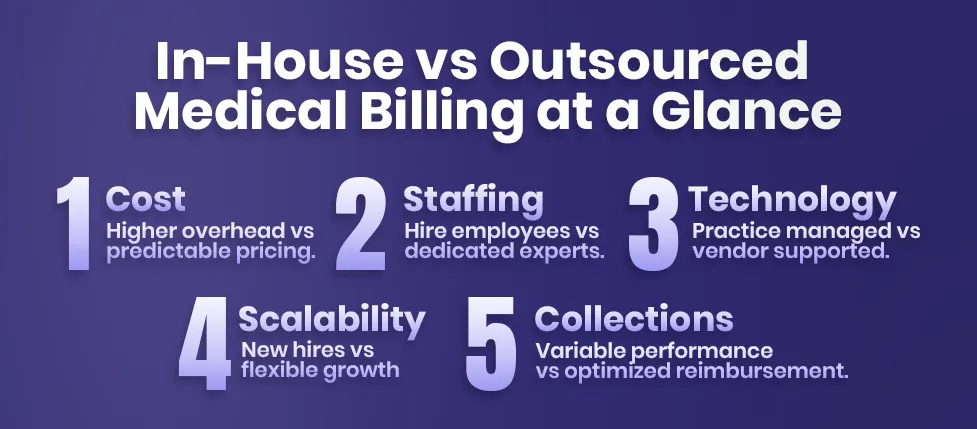
MGMA’s cost survey data puts the average in-house cost per claim between $20 and $30 once these line items are combined; a figure that holds up across multiple independent billing-cost studies published through 2025 and 2026.
Expert Tip: Before making any comparisons between the cost of your billing done in house or outsource, be sure to factor in your real cost per claim by considering salary, benefits, technology, training, turnover, denials, and administrative expenses. You will be surprised how high your true billing cost can be!
Medical Billing Outsourcing Cost Explained
Outsourced pricing generally follows one of three structures:
- Percentage-Of-Collections is the most common model, typically running 4% to 10% of what’s actually collected. Because the fee is tied to collections, the billing partner has a direct financial incentive to chase down every dollar owed.
- Flat Or Per-Claim Pricing is a fixed rate per claim submitted, generally $4 to $10, or a flat monthly fee ranging roughly $1,000 to $5,000 depending on volume.
- Per-FTE Staffing is a monthly rate, typically $2,000 to $4,000 per dedicated staff member, most common among larger practices or hospital systems that want dedicated headcount without the overhead of direct employment.
What a practice actually pays depends on its size, specialty, monthly claim volume, and how much of the revenue cycle is handed off versus retained internally.
Which Option Is More Cost-Effective?
For a practice collecting roughly $200,000 a month, cost analyses published in 2025 suggest in-house billing can run close to double the cost of outsourcing once denials, rework, and staffing gaps are priced in; while typically delivering weaker collection results. That gap tends to be widest for:
- Small practices, where one or two billing staff can’t absorb sick days, vacations, or turnover without claims backing up.
- Growing clinics, where hiring ahead of patient volume is expensive and hiring behind it creates a claims backlog.
- Specialty providers, where coding complexity (multiple modifiers, prior authorization requirements, bundled procedures) rewards deep, repeated experience with that exact specialty.
In-house billing tends to make the most financial sense for large, established groups with stable claim volume, strong existing infrastructure, and the scale to justify a full internal revenue cycle department; the same conditions under which per-FTE outsourcing models also become viable alternatives.
A simple work comparison illustrates why math tends to favor outsourcing at a smaller scale. A practice with two billing FTEs is looking at roughly $150,000–$260,000 in fully loaded annual staffing cost, before accounting for the 10–20% of revenue that industry cost studies estimate is typically lost to avoidable denials and slow follow-up. If this method was utilized on the basis of 6 percent of collections fee for $2.4 million annual collections, the payment would be approximately $144,000 annually, with the billing partner having incentive to keep the collection ratio high because it will be earning from it. The change in ratio is seen when more claims and more complexities in specialties occur, which is why the bigger and more experienced the group is, the more they have incentive to employ internal staffing.
Control and Transparency: In-House Billing vs Outsourcing
Level of Control with In-House Billing
Nothing beats direct, in-person management for immediacy. Leadership has same-day access to claim status, can redirect staff priorities instantly, and never has to wait on a third party’s reporting schedule.
Maintaining Control with Outsourced Medical Billing Services
The right billing partner replaces hands-on management with structured accountability instead:
- Reporting dashboards that show claim status, denial trends, and days in accounts receivable
- Regular performance reviews; often monthly or quarterly business reviews comparing actual results against benchmarks
- Transparent communication protocols; defined points of contact and response-time expectations
- Service-level agreements that spell out turnaround times, clean-claim rate targets, and escalation procedures in writing
A billing partner without these mechanisms in place effectively asks a practice to hand over its cash flow on faith; which is exactly the scenario that erodes trust in outsourcing.
Expert Advice: The key to control does not lie in where billing takes place; the key to control lies in visibility. Select a billing partner who offers real-time reporting, response times, performance reviews, and service level agreements.
How to Choose the Right Balance Between Control and Efficiency
The right answer depends on what the practice actually values day to day:
- If hands-on oversight and same-day adjustments matter most, weight the decision toward in-house or a hybrid model.
- If freeing up clinical and administrative time matters more than daily involvement, a billing partner with strong reporting can deliver comparable visibility with far less internal effort.
- Either way, internal resources; staff bandwidth, existing billing expertise, and growth plans; should shape the decision more than either option’s reputation in the abstract.
Impact on Revenue Cycle Management and Collections
It is true that internal oversight has its positive aspects when it comes to spotting issues early, yet it also comes with its limitations as a technique. Among these, one could point out issues such as claim denial due to coding errors or lack of eligibility of the patient, delays in payment due to poor follow-up, or missing information which is realized only when the claim is denied. Even timely claim submission doesn’t guarantee full reimbursement, as coding errors, denials, underpayments, and delayed follow-up can still lead to revenue loss, a topic covered in why medical practices lose revenue even when claims are being submitted.
The denial issue is quite a big one in the industry, according to the Experian Health State of Claims survey conducted in 2025 and based on 250 participants in the healthcare revenue cycle management area. It has been found that 41% of providers experience a denial rate exceeding 10%, compared to 38% in the previous year and 30% in 2022. On another note, hospital-level statistics gathered from more than 2,300 hospitals in 2025 shows the denial rate at 11.6%, with more than $48.4 billion worth of denied claims industry-wide.
How an Outsourced Revenue Cycle Management Improves Collections
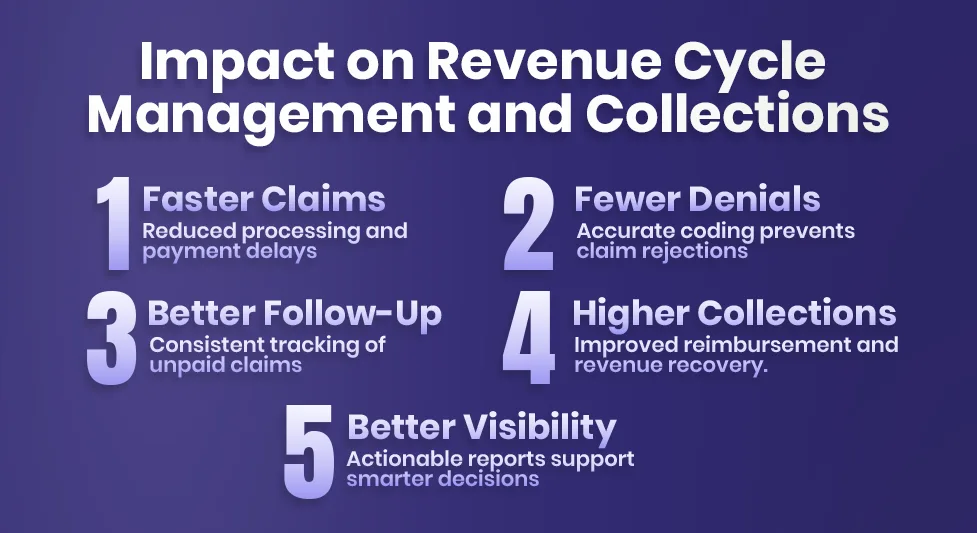
Dedicated denial management services identify the root causes or reasons of rejected claims, recover lost reimbursements, and help prevent recurring denial patterns. Dedicated revenue cycle management services address these gaps through:
- Faster claims processing, since clean claims move through payer systems without the delay of correction cycles.
- Higher clean-claim rates, achieved through experience-driven code accuracy before submission.
- Denial prevention, informed by pattern recognition across a much larger claims volume than any single practice generates.
- Stronger accounts receivable management, with defined follow-up cadences on aging claims rather than ad hoc attention.
- Recovered reimbursement on claims that would otherwise have been written off after an initial denial.
Professional Guide: Avoid concentrating on just the denials ratio. Keep an eye on important revenue cycle statistics including the clean claim ratio, first pass acceptance ratio, number of days in accounts receivable, and underpayments. These factors together give you a more accurate representation of your billing.
Why Many Healthcare Providers Outsource RCM Services
The consistent theme across practices that outsource is access to specialized coding expertise, to reporting depth that would be expensive to build internally, and to financial visibility that turns billing from a black box into a measurable, benchmarked function of the practice.
The financial stakes of getting this wrong are larger than most practices assume. Denial-related waste has been estimated at $265 billion annually across the U.S. healthcare system in recent industry analyses; a figure that has grown steadily over the past decade even as claims processing has become more electronic. At the payer-audit level, 2025 data from a network of 1.2 million providers showed the average dollar amount tied to a single medical-necessity denial rose 70% year over year to $450, with telehealth-related denials climbing 84% over the same period. Those numbers point to the same underlying pattern: denial management isn’t a one-time fix; it’s an ongoing discipline that rewards whoever has the staffing depth and pattern recognition to keep up with it; which is precisely the resource gap outsourcing is built to close. Inclusive revenue cycle management services provide visibility across the entire reimbursement process, from patient registration through final payment collection.
Reducing Reliance on Billing Systems Alone
Using Billing Systems In-House
Claim management systems and clearinghouse links perform a substantial function, such as detecting missing fields prior to the submission, automating the process of verifying the patient’s eligibility and electronic submission of claims as opposed to manual processing. This results in a considerable reduction in errors for an organized clinic.
Limitations of Relying Only on Systems
But no platform substitutes for billing expertise. A claims-scrubbing tool can catch a missing modifier; it can’t judge whether a payer’s specific medical-necessity policy will accept a given code combination, or negotiate an appeal when a claim is denied on a technicality. That judgment still requires trained coders and billers who stay current on payer rules; and someone still has to monitor compliance obligations around how patient data moves through those systems.
Combining Structured Processes with Outsourced Expertise
It is the combination of claims workflow discipline with outsourcing the knowledge of billing, through such methods as electronic preauthorization, document review by knowledgeable coders prior to claim filing, clearinghouse connections to speed up claims routing, and robust collections reporting, which produces the best results. This is all possible without building or maintaining the required infrastructure in-house, since the billing company has all of the necessary infrastructure set up for every single client.
Outsourced Medical Billing for Different Healthcare Practices
Medical Billing for Small Practices
Small clinics feel staffing gaps the hardest; one employee out sick can stall claims for days. Outsourcing gives small practices access to a full billing team’s worth of expertise without the overhead of hiring one, which is a large part of why MGMA’s 2025 data show outsourcing consideration concentrated most heavily among practices under 10 physicians.
Physician Medical Billing Services
Specialty-focused billing support matters because coding complexity varies enormously by specialty. A partner experienced in a specific specialty brings pattern recognition that translates directly into fewer denials and faster, more complete physician reimbursement.
Hospital Medical Billing Services
Hospitals face a different scale of complexity entirely; multiple departments, far higher claim volumes, and coordination across inpatient, outpatient, and specialty billing simultaneously. At that scale, even small percentage-point improvements in clean-claim rates translate into substantial dollar amounts, which is why hospital systems are often the heaviest users of dedicated revenue cycle management services. Hospital-level denial data aggregated across more than 2,300 facilities put the 2025 industry-wide denial rate at 11.6%, tied to an estimated $48.4 billion in denied claims; a scale of exposure that makes structured, specialty-aware billing support less of a convenience and more of a financial necessity.
Is a Hybrid Billing Model Worth Considering?
Every organization does not have to go for any one of the two models only. In fact, a rising number is keeping a tiny in-house staff for patient collections, front office eligibility verification, and billing inquiries, while outsourcing coding assessment, claims processing, and denial management to an external firm. The mixed model could be quite effective for practices which would like to keep control on some operations but without the burden of setting up an entire internal department.
The trade-off is coordination. A hybrid model only works if both sides; internal staff and the outsourced partner have clearly defined responsibilities and shared visibility into claim status, so that no claim falls into a gap between the two teams. Practices considering this route should treat the division of labor as seriously as they’d treat a full outsourcing contract, with the same attention to reporting and accountability described earlier in this guide.
How to Choose Between In-House and Outsourced Medical Billing
Questions Healthcare Providers Should Ask
- What does our billing actually cost today, once every line item is counted?
- Are claim denials rising, and do we know why?
- Do we have experienced, currently certified billing staff on hand?
- Can our team keep pace with regulatory and payer policy changes?
- Would stronger collections performance meaningfully change our financial position?
When to Consider Outsourcing Medical Billing
Certain signs consistently point toward outsourcing:
- Administrative costs climbing faster than patient volume
- Reimbursements arriving slower than they used to
- Claim denials increasing without a clear internal fix
- Difficulty hiring or retaining skilled billing staff
- No internal expertise in structured revenue cycle management
What to Look for in Medical Billing Companies
Not every billing partner is the right fit. Evaluate:
- Industry experience is how long the company has operated and at what scale
- Specialty expertise is a direct experience with the practice’s exact specialty and coding requirements
- Claims infrastructure is a clearinghouse connections and eligibility-verification capability
- Compliance standards are documented HIPAA safeguards and a signed business associate agreement
- Reporting depth is clear, regular visibility into claim status and denial trends
- Client support is a defined point of contact and realistic response-time commitments
In-House vs Outsourced Medical Billing
| Factor | In-House Billing | Outsourced Billing |
| Cost | $20–$30 per claim; $76K–$132K per billing FTE annually | 4–10% of collections, or $4–$10 per claim |
| Control | Direct, same-day oversight | Managed through reporting and SLAs |
| Denial rate | Industry average 5–10% | Often reduced to 2–3% with specialized billing partners |
| Expertise | Limited to internal staff knowledge | Access to specialists across many claim types |
| Scalability | Requires hiring ahead of growth | Expands with claim volume, no new hires needed |
| Technology overhead | Practice pays for and manages licenses | Vendor-supported and maintained |
| Compliance | Full internal responsibility | Shared, with vendor safeguards and agreements |
| Collections | Tied to internal team’s consistency | Typically optimized through dedicated denial management |
How iSolve RCM Helps with Outsourced Medical Billing
Choosing between in-house and outsourced billing ultimately comes down to whether a practice wants to build this expertise internally or bring it in already built. iSolve RCM works with practices weighing exactly that trade-off; reviewing current claim denial rates, cost-per-claim, and days in accounts receivable against what a dedicated billing partnership could realistically change. For practices already feeling the strain of rising denial rates and staffing gaps, that side-by-side comparison is often the clearest way to see where outsourcing would actually move the numbers, and where an in-house or hybrid approach still makes sense. The right starting point is a direct look at a practice’s own claims data; not an industry average.
FAQs
What is the distinction between in-house medical billing and outsourced medical billing?
In-house medical billing entails a healthcare practice using its own coders and billers who handle claims in-house, whereas outsourced medical billing is where claims management duties are contracted out to an experienced partner. In-house billing provides you with more control, while outsourcing medical billing provides expert experience, reporting structure, and lower denial rates with no increased staffing costs.
How much does outsourced medical billing cost?
The cost of outsourcing your medical billing is around 4% to 10% of the total amount of money you collect each month. Others may bill a fixed cost per claim that could range from $4 to $10 per claim. This pricing varies depending on the billing performance of a particular practice.
Is outsourcing medical billing less expensive than in-house billing?
In most cases, outsourcing medical billing is cheaper compared to in-house billing since when one takes into account the cost of salaries, employee benefits, training expenses, IT fees, and denied payments, in-house billing ends up being almost twice as expensive as outsourcing billing for the same claim volume.
Does outsourcing medical billing minimize claim denials?
Yes. It is noted that in-house billing teams normally have denial rates ranging from 5% to 10%, whereas outsourced billing teams usually keep their denial rates around 2% to 3%. The difference generally arises due to the extensive coding knowledge and skills gained in many practices and claim types.
Is there any risk of data security for the outsourced medical billing company?
No. This should not happen if the partner company enters into a business associate agreement and ensures that it complies with the HIPAA regulations regarding safety. The practices need to check how the company encrypts data and trains its employees on handling sensitive data before engaging with them, as medical information data breaches are the most expensive ones to manage.
What practices can best benefit from the outsourced billing service?
Those practices, which have smaller staff, expanding clinics hiring doctors faster than they can hire billers, and those dealing with some specialty practices having complicated coding requirements. They would gain from immediately acquiring billing expertise without additional investments.