

Denial claims have become one of the most costly and persistent challenges in the revenue cycle of the healthcare industry. The industry benchmarks have demonstrated that the rate of initial denial claims reached 11.8% in 2026 as compared to 10.2% a few years ago, while the share of those health care facilities, which reported the level of denial claims over 10%, reached 41%. This level of denial claims has been viewed as a red flag by the Healthcare Financial Management Association (HFMA). For the medical practices, hospitals, and specialty groups, these figures have practical meaning rather than merely statistical information.
Any denial claim is the revenue, which was earned but not received in one way or another. Reworking a claim denial can cost from $25 to $181 for any medical practice. On average, the losses of a hospital from denial claims reach $5 million per year, and some of these claims are never reimbursed. For smaller physician practices, which do not have denial teams, the percentage impact may be even higher.
This guide explains what denial management services really entails, the reasons behind the increasing trend of denials, the signals which denote that the in-house system is no longer working, and when does outsourcing denial management turn into a must rather than an option for a practice. Be it the case that there is only a trickle of denials coming into the billing office, or the AR days continue to increase monthly, the idea is to offer an evidence-based approach for decision-making to administrators, CFOs and practice managers. Many healthcare organizations partner with experienced medical billing companies to handle multifaceted denial workflows, advance claim accuracy, and maintain a healthier revenue cycle without increasing internal workload.
Understanding the Role of Denial Management in Healthcare
Denial management is the systematic handling of claims for which there has been a denial of reimbursement by a payer through the analysis, correction, appeal, and learning that can be brought back to the billing side of the process in order to prevent future denials. It is both a revenue recovery activity and a prevention activity.
Revenue recovery from a denied claim is just half of the problem. Denial management that simply involves resubmission and hoping will continue to cost you those same dollars in each cycle. Denial management, in its true sense, is where every denial is a data point to minimize the risk of further denials in the future.
It should be noted how denying management differs from claims follow-up in general. Claims follow-up relates to regular following up on the unpaid or pending claims that have yet to get a payer decision. Denying management starts specifically when the payer makes a negative decision on the claim, no matter whether it is a hard deny (further billing impossible) or a soft deny (fixable and re-submittable). The main reason why organizations underinvest in denying management is that they do not see the difference between claims follow-up and denying management, assuming that the same team can deal with both of them. In reality, denials need a different skill set: decoding the remittance advice code, being aware of appeal deadlines, etc.
Clean Claims vs. Denied Claims: Why Prevention Matters
A clean claim is a claim that is adjudicated by the payer on the first attempt without any need for additional information or corrections. On the other hand, a denied claim is either rejected by the payer or requires resubmission due to corrections.
First-pass clean claim acceptance rate or the percentage of the claim that is paid on the first attempt is one of the biggest indicators of a good revenue cycle. Organizations that are performing well have first pass acceptance rate in the mid to high 90s while organizations that have a first-pass acceptance rate lower than mid-80s are definitely struggling. In addition to extra costs, a denied claim delays payment and also increases the possibility of abandonment because aged claims have very low chances of collection once they pass the 90 days mark.
Expert Guidance: Monitor the rate at which claims are approved on your first pass each month, and address any denial patterns right away. Enhancing the front-end process, including eligibility, accurate coding, and thorough documentation, can help prevent denials, expedite payments, and improve revenue cycle management.
The Denial Management Lifecycle
A mature denial management program typically moves through six stages:
- Claim submission and monitoring — Tracking claims from submission through payer response.
- Denial identification — Flagging claims that come back with a denial code (CARC/RARC) rather than payment.
- Denial analysis — Reviewing the specific reason code, payer policy, and supporting documentation.
- Root cause analysis — Determining whether the denial stems from registration, eligibility, coding, authorization, or documentation.
- Appeal and resolution — Filing a timely, well-supported appeal or correcting and resubmitting the claim.
- Prevention and continuous improvement — Feeding findings back into front-end verification, coding review, and staff training so the same denial pattern does not recur.
Common Medical Claim Denial Reasons
Investing in denial management services becomes essential when increasing denial volumes, rising AR days, and limited internal resources begin affecting revenue recovery. Denials are rarely caused by a single issue. The most frequent categories reported across 2026 industry data include:
- Incorrect or incomplete patient demographic information.
- Eligibility and coverage verification failures.
- Coding and billing errors, including mismatched CPT and ICD-10 codes.
- Missing or insufficient clinical documentation to support medical necessity.
- Prior authorization failures or missing approvals.
- Duplicate claim submissions.
- Timely filing violations.
- Medical necessity disputes.
However, it is also worth noting that the recent statistics collected by the industry concerning denial rates related to the Affordable Care Act marketplaces revealed that about three out of four denials occurred due to administrative errors, such as mistakes made in paperwork or plan design and not because of disagreements about medical necessity, which means that most denials in theory could be avoided by ensuring better front-end processes. It has also been observed that payers have become more stringent regarding documentation.
The Impact of Rising Denials on AR
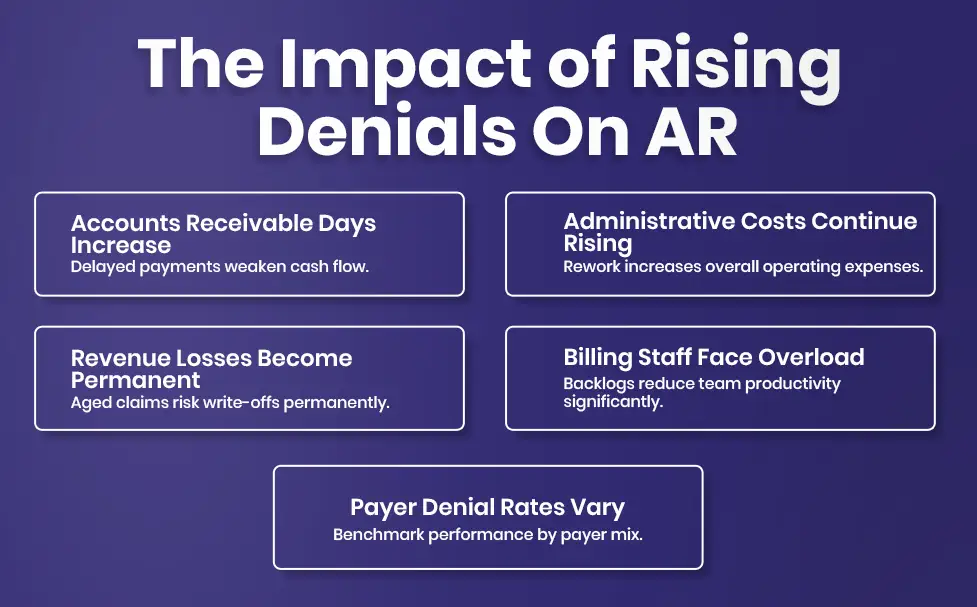
Understanding why medical practices lose revenue often begins with identifying preventable issues such as claim denials, coding errors, authorization failures, and inefficient follow-up processes. Uncontrolled denial growth shows up in accounts receivable long before it shows up on a profit-and-loss statement. Practices typically see:
- Increased days in accounts receivable (AR days climbing past 45–60 days).
- Delayed payments that disrupt cash flow projections.
- Higher administrative costs tied to rework, appeals, and resubmissions.
- Permanently lost revenue on claims that age out or are written off.
- Mounting workload for billing staff who are forced to spend more time chasing old claims than processing new ones.
There is also a great variation in the rate of denials across different types of payers, and this is important when comparing practices’ performances. According to recent information from the industry, Medicaid inpatient denials are at about 44 percent, denials by commercial payers are at almost 20 percent, Medicare Advantage plans are denying initial denials at about 16 percent, while traditional Medicare continues to be the most reliable payer at about 5 percent. A practice with more Medicaid and commercial patients will have to deal with more denials than a practice with primarily Medicare patients.
Denial Rates by Payer Type: A Quick Benchmark
Because payer mix varies so widely between specialties, it helps to see denial behavior broken out by payer category rather than relying on a single blended average:
| Payer Type | Approximate Denial Rate (2026) |
| Traditional Medicare | ~5% |
| Medicare Advantage (initial claims) | ~15–16% |
| Commercial payers | ~20–21% |
| Medicaid (marketplace/ACA) | ~19% |
| Medicaid inpatient claims | up to ~44% |
A practice with high Medicaid inpatient utilization can expect that denial management will take many more hours per dollar recovered than a practice with a predominantly traditional Medicare patient population. Using the right payer category for benchmarking instead of the national average makes it possible to see if your denial rate is an issue or just part of your payer mix.
Key Steps in the Claim Denial Management Process
An organized denial management process generally follows these steps:
- Tracking and categorizing every denial by reason code and payer.
- Verifying the accuracy of the stated denial reason against the original claim.
- Prioritizing high-dollar and time-sensitive claims first.
- Filing appeals within payer-specific deadlines.
- Correcting the underlying billing or coding error.
- Feeding findings back into prevention efforts to stop recurrence.
Denial Management Workflow Explained
Efficient workflow requires close cooperation among coders, billers, clinicians, and administrative staff. Coders require access to the information about the reasons for the rejection of a claim in order to fix the code set; billers should be aware of the proper format for appeals from payers; and clinicians may have to be included in the process in cases when lack of documentation is the reason behind the claim’s rejection. The standardization of workflow, when the procedure of the denial’s resolution takes place in the same manner each time, results in higher recovery rates compared to non-standardized processes.
Denial Management Team Responsibilities
A functioning denial team typically divides responsibility as follows:
- Denial analysts review incoming denials, categorize them, and route them to the right specialist.
- Medical coders correct coding-related denials and flag documentation gaps.
- Billing specialists manage resubmission, appeal drafting, and payer correspondence.
- Leadership oversees reporting, tracks recovery rates, and identifies systemic issues requiring process change.
Signs Your Organization Needs Denial Management Services
Early warning signs of growing denials can help the healthcare industry preserve its revenue stream. AR growth, delayed payments, increasing denials, and overworked billing departments all are signals that denial management service is needed. Comprehensive revenue cycle management services help healthcare organizations optimize billing operations, identify revenue leakage, and create a more efficient payment process from claim submission to final reimbursement.
Your AR Is Increasing Despite Regular Follow-Up
If a billing office is following up on claims consistently but AR keeps growing anyway, that is a strong signal the underlying issue is denial volume, not follow-up effort. Watch specifically for:
- A growing share of claims sitting in the 90+ day aging bucket.
- Reimbursement cycles stretch longer each quarter.
- Follow-up staff spending more time re-explaining old denials than processing new claims.
Your Internal Team Is Overwhelmed
Overdue denials in high volume along with understaffing is perhaps the most common tipping point. The indicators include overworked billing personnel just to avoid an accumulation of denials, inability to stay up to date on payer specifics which are updated quarterly, and increasing backlogs between receipt and processing of denials.
Your Denial Rates Lack Visibility
Many practices cannot answer basic questions about their own denial performance: What is our current denial rate? Which payer denies us most often? What percentage of denials are coding-related versus authorization-related? Without denial management reporting and defined metrics, leadership is making decisions blind, and root causes go unaddressed because no one has isolated them.
Appeals Are Taking Too Long
Every payer enforces strict appeal deadlines, often as short as 30 to 90 days from the date of denial. Missed deadlines convert a recoverable denial into a permanent write-off. If appeal turnaround time is consistently slow, or if deadlines are being missed altogether, that is direct, measurable revenue leakage.
Professional Insight: Don’t wait for your AR days to get out of control. Check your denial percentage, first-pass acceptance percentage, appeal resolution time, and 90+ day AR on a monthly basis. Early identification of these red flags will save you money and avoid costly claims processing.
When Should You Outsource Denial Management?
The use of outsourced denial management is crucial when there is an escalation in the denials, the account receivables have kept increasing, there is difficulty in handling the workload by internal staff, or companies require special skills, tools, and methods.
When Denials Begin Affecting Cash Flow
The clearest financial warning sign is when denial-related delays start affecting the practice’s ability to meet payroll, vendor payments, or planned investments on schedule. At that point, denial management is no longer a back-office efficiency issue; it is a cash flow protection issue, and it needs dedicated attention faster than an internal hiring and training cycle can typically provide.
When You Lack Advanced Denial Analytics and Expertise
Effective denial prevention requires the ability to identify patterns; what payer, what CPT, what provider, and what documentation issue is causing these denials. In-house smaller teams often do not have the resources to conduct the kind of analysis needed, even if the information necessary for that analysis exists in their historical claim files. Denial management specialists offer an analysis process specific to payer trends.
When You Need Expertise in Complex Payer Rules
Payer policies are always changing with new prior authorizations and medical necessity guidelines. It takes a dedicated professional to keep up with all of these changes in relation to the dozens of payer manuals. For most companies that require the same employees to perform registration, coding, and billing, paying close attention to payer rules is usually the first thing to go by the wayside.
When Your First-Pass Claim Acceptance Rate Declines
A falling first-pass rate is an early warning sign that front-end processes; eligibility checks, authorization verification, coding accuracy are breaking down. Outsourcing denial management, when paired with front-end process review, directly targets this metric by identifying exactly where claims are failing before they even reach the payer a second time.
Benefits of Outsourcing Denial Management Services
Use of denial management outsourcing by the healthcare organization allows them to minimize denials, speed up reimbursement process, enhance efficiency of the revenue cycle, use specialized skills and advanced analytics for root cause analysis and prevent future billing problems. Choosing to outsource medical billing services allows healthcare providers to access specialized billing expertise, reduce administrative pressure, and improve overall reimbursement performance.
Faster Denial Resolution and Revenue Recovery
Specialists devoted solely to denial management, as opposed to those divided among registration, coding, and collections, always settle claims more quickly. Timing is critical in this context, because the longer a claim stays without attention, the less chance it has of getting paid at all.
Better Denial Analysis and Reporting
A specialized partner brings structured reporting that identifies denial patterns by payer, code, provider, and reason; visibility that most in-house teams simply do not have the staff hours to build and maintain.
Reduced Administrative Burden
Denial outsourcing allows the internal resources to concentrate on other billing functions like filing new claims, billing patients and managing day-to-day AR processes, rather than getting bogged down with the increasing number of denials.
Improved Denial Prevention
Denial management systems that have been outsourced successfully do not just end the problem of recovery, but go ahead and discover the root cause of recurring denials and rectify them, thus ensuring a permanent decrease in denial rates as opposed to a temporary solution.
Cost Savings and Operational Efficiency
Creating an internal group that has the same level of payer knowledge, appeal writing skills, and coding capabilities as an existing denial management company will most likely be more expensive in terms of salaries, training, and turnover costs. Outsourcing makes the staffing a variable cost tied to the results.
Tips for Practices: Outsource to service providers based on their performance metrics like denial recovery ratio, turnaround time, first-time approval rate, and reporting transparency rather than only on their cost efficiency. The ideal outsourcing provider should not only help reduce denials but also avoid repeating problems.
Denial Management Strategies to Reduce Claim Denials
The right denial management strategy can ensure that the providers get to identify the cause of the denial, enhance the accuracy of claims, document better, improve workflow processes, and avoid future denials.
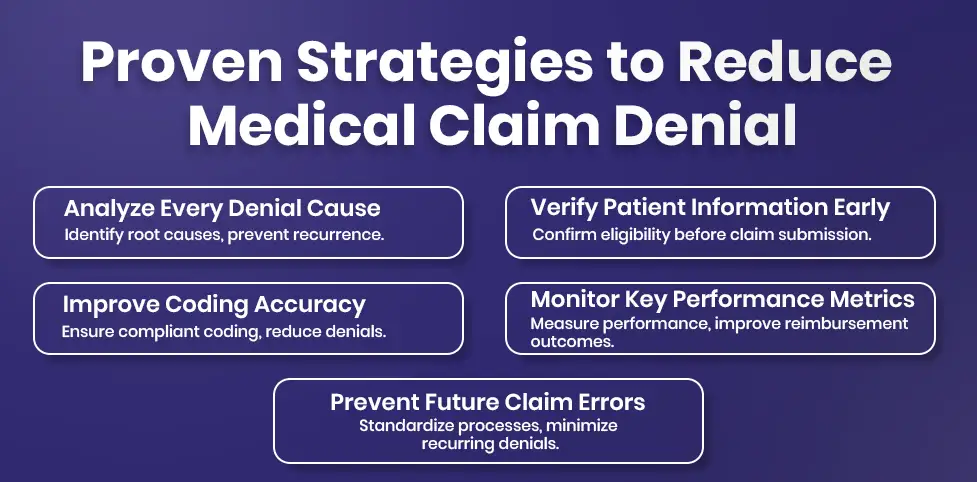
Implement Root Cause Analysis for Every Denial
Every denial should be traced to its origin; registration error, missing authorization, documentation gap, or coding mistake and that origin should drive a specific corrective action, not just a one-time claim fix.
Strengthen Front-End Verification Processes
Because the majority of denials trace back to preventable administrative issues, strengthening front-end verification has an outsized impact:
- Real-time eligibility and benefits verification before the visit.
- Prior authorization confirmation before services are rendered.
- Careful validation of patient demographic and insurance data at intake.
Improve Coding Accuracy
Coding audit and continuous education for coders about ICD-10-CM, CPT, and HCC codes would help to decrease coding denials, which is one of the leading denials types each year, especially with the tightening of documentation and code matching by payers in 2026. Professional medical coding services help reduce coding-related denials by ensuring that CPT, ICD-10-CM, and documentation requirements are accurately aligned before claims are submitted.
Track Denial Management KPIs
Practices should monitor a consistent set of metrics on a monthly or quarterly basis:
- Denial rate — the percentage of submitted claims denied.
- Appeal success rate — the percentage of appealed claims that are ultimately paid.
- First-pass claim acceptance rate — claims paid without rework.
- Average denial resolution time — days from denial to final resolution.
- Recovery rate — dollars recovered as a percentage of dollars initially denied.
- Cost per denied claim — total rework cost divided by number of denials.
For context on appeal potential, recent Medicare Advantage data found more than 80% of appealed denials were ultimately overturned, a strong reminder that many initial denials are never permanent losses if a practice has the resources and persistence to appeal them properly.
The True Cost of Reworking a Denied Claim
It is true that denial management is mostly about revenue recovery, but the expenses involved in handling denials need to be taken equally seriously. The expense of reworking a denial ranges from $25 to $181 based on the intricacy of the correction process, the number of attempts made at it, and the preparation of the appeal letter, which might need to be written afresh. If you multiply this by thousands of claims that a mid-sized practice will submit in a month, then the expense of denial processing will be equivalent to the salary of a full-time biller.
That is why top-notch revenue cycle managers measure “cost per denied claim” separately as a distinct KPI. A denial that gets caught and corrected on the first rework attempt is dramatically cheaper than one that bounces between coding, billing, and clinical staff three or four times before resolution. Reducing the number of touches per denial through clear ownership and standardized workflows is often a faster win than trying to eliminate denials altogether.
Denial Management Best Practices for Healthcare Organizations
The implementation of denial management guidelines will help healthcare facilities achieve better claim accuracy, monitor performance indicators, recognize denial patterns, update processes, and adopt proactive measures that minimize losses and increase revenue cycle efficiency.
Create a Standardized Denial Management Checklist
- Categorize every denial reason immediately upon receipt.
- Assign clear ownership to a specific team member.
- Track appeal deadlines with built-in buffer time.
- Analyze denial trends monthly, not just annually.
- Measure recovery outcomes against defined targets.
Maintain Effective Denial Management Reporting
Regular performance reviews ideally monthly; allow leadership to catch emerging denial patterns before they compound into a larger AR problem. Reporting should be specific enough to answer which payer, which code, which provider” rather than offering only a top-line denial percentage.
Stay Current with Denial Management Trends
Payer policy changes happen frequently and often with little advance notice. Practices that treat denial management as a static, set-it-and-forget-it function fall behind quickly. Reviewing payer bulletins and coding edit updates at minimum quarterly, and immediately after major regulatory releases, helps prevent avoidable denial spikes.
In-House vs. Outsourced Denial Management: Which Is Better?
The choice of in-house or outsourced denial management process will depend on the organizational requirements, resources, and number of denials. Understanding the pros and cons of both options can help providers make the right choice.
When In-House Teams Work Well
Smaller organizations with low denial volume, strong existing coding and billing expertise, and enough staff bandwidth to dedicate real hours to appeals can often manage denials effectively in-house, particularly if their payer mix skews toward more predictable payers like traditional Medicare.
When Outsourcing Is the Better Choice
Outsourcing tends to make clear financial sense once a practice hits one or more of these conditions:
- AR is trending upward despite consistent follow-up effort.
- Denial rates sit above the 10% HFMA warning threshold.
- Internal staff capacity cannot keep pace with denial volume.
- The practice lacks specialized payer-rule and appeal-writing expertise.
Evaluating the Benefits of Outsourcing
The core advantages of outsourcing denial management are expertise depth, scalability during volume spikes, dedicated analytical reporting, and most importantly measurably improved recovery rates compared to stretched internal teams.
Evaluating Denial Management Outsourcing Benefits in Practical Terms
Beyond the general advantages already covered, it helps to translate outsourcing benefits into the specific questions a CFO or practice administrator actually asks before making the decision:
- Will this reduce my AR days within a measurable timeframe?
A capable partner should be able to point to a defined recovery timeline, not just a general promise of improvement.
- Will my staff be freed up for higher-value work?
Outsourcing should visibly reduce the denial backlog sitting on internal desks within the first billing cycle or two.
- Will I finally get denial visibility I don’t have today?
Regular, payer-specific reporting should replace the guesswork most practices currently operate under.
- Does this scale if my claim volume grows or a payer changes policy overnight?
Scalability matters most during open enrollment shifts, new payer contracts, or seasonal volume spikes.
Practices that walk into an outsourcing conversation with these four questions tend to get a much clearer picture of whether a given partner is the right fit than those who evaluate purely on price.
How to Choose the Right Denial Management Partner
Choosing the appropriate partner for denial management involves an assessment of several factors including industry expertise, technical expertise, reporting transparency, and demonstrated success. Having the appropriate partner is instrumental in achieving reduced denials and improved recoveries.
Evaluate Industry Experience
Look for a partner with demonstrated experience specifically in healthcare billing and a working knowledge of payer regulations across the practice’s specific payer mix; Medicare, Medicaid, commercial, and Medicare Advantage each carry distinct rules.
Review Reporting and Analytical Capabilities
A strong partner should be able to show, not just describe, how they track denial patterns and translate them into prevention strategies rather than simply reworking claims one at a time.
Measure Performance Using Defined KPIs
Before signing with any partner, request transparency into how they report recovery results and denial reduction outcomes over time; a credible partner will have this data readily available and will not hesitate to share it.
Emerging Denial Trends Practices Should Watch
A few developments are worth tracking closely heading into the rest of 2026:
- Payers are matching clinical notes against submitted codes with far greater precision than in prior years, meaning vague medical necessity language that once passed review is now flagged automatically. Documentation depth is no longer optional for high-value categories like imaging, specialty drugs, and surgical procedures, which are seeing denial rates run notably higher than routine evaluation and management claims.
- Prior authorization enforcement is tightening in real time, with more payers requiring verification immediately before service delivery rather than allowing retroactive approval.
- Fee schedule and coding updates are landing more frequently, requiring billing teams to review payer edit tables at least quarterly and immediately after any mid-year regulatory release to avoid a sudden spike in avoidable denials.
- Appeal overturn rates remain high enough to matter. With well over 80% of certain appealed denials ultimately reversed in recent Medicare Advantage data, practices that treat a denial as a final answer rather than an opening position are leaving recoverable revenue on the table.
The Shift Toward Preventive Denial Management
The healthcare industry’s overall direction is moving from reactive appeals toward proactive prevention; catching potential denial triggers before a claim is ever submitted rather than fighting them after the fact. Given that roughly three-quarters of denials trace back to preventable administrative causes, the organizations making the most progress are the ones treating every denial as a lesson for the next hundred claims, not just a single transaction to resolve.
How iSolve RCM Helps Strengthen Denial Management and Protect Revenue
iSolve RCM makes use of industry knowledge, analytics, and structured process flow to proactively manage denials by recognizing and addressing problems within the revenue cycle prior to their escalation. With claims denial analysis, root cause analysis, and specific follow up processes, iSolve RCM allows providers to minimize denials that could have been avoided, increase the number of accepted claims at the first attempt, and facilitate prompt payment for services. By working with a revenue cycle management team that has ample experience in the industry, health care providers will be able to understand denial trends, improve denial prevention processes, and develop a more streamlined revenue cycle.
FAQs
What is denial management in medical billing?
Denial management is the process of identification, correction, and appeal of claims that have been denied payment by a payer, while using the results for future prevention of similar denials.
Why are claim denials increasing in healthcare?
Denials are increasing due to increased payer documentation requirements, policy changes, enforcement of prior authorizations, and coding scrutiny for commercial, Medicare Advantage, and Medicaid payers.
How can healthcare organizations reduce claim denials?
Denials may be reduced by implementing a strong process for front-end eligibility and authorization verification, by conducting accurate coding through audits, and by tracking KPIs associated with denials.
What are the benefits of outsourcing denial management services?
Outsourcing allows for the use of specialized payer expertise, quicker response time, consistent reporting, less administrative load for the internal team, and generally higher recoveries.
What are the most important denial management KPIs?
The key measures include denial rate, success of appeals rate, initial claim acceptance rate, average time taken to resolve the denial, recovery rate, and cost of denial.
When should a practice outsource denial management instead of handling it in-house?
Outsourcing should be considered in cases where AR continues to grow even with follow-ups, there are more than 10% denials, internal personnel are swamped with the workload, and lack the expertise on payer rules and appeals.