

Medical billing has a huge impact on the financial aspects of a practice in terms of its revenue generation, profitability, and even operation capability. Billing mistakes and un-paid claims can cause great delays in reimbursement as noted by the American Medical Association that estimates at least 32% of outpatient commercial claims and 11% of traditional Medicare claims to be un-paid at 90 days. The Centers for Medicare & Medicaid Services also projected an improper payment rate of 6.55% for Medicare Fee-for-Service in 2025 at $28.83 billion.
Using third-party billing companies can help practices deal with their complicated administrative process while relieving some of the stress from the internal staff. According to the CAQH Report – 2023 Index, 54% of the transaction volume and $43 billion in administrative costs were used for medical eligibility and benefits verification only. But when it comes to choosing a billing partner, certain questions need to be asked. Choosing among reputable medical billing company can help practices find a partner with the right combination of specialty expertise, technology, compliance, and revenue-cycle experience.
1. What Experience Do You Have with My Specialty?
Medical billing is not an equal system for all specialties. Each specialty follows its own system, rules, code sets, documentation rules, modifiers, etc. As the AMA states, the CPT code system is continuously revised based on the development in different specialties of medicine and clinical practice. Thus, the billing firm specializing in your medical specialty will have more information about what services are provided and will be able to bill claims more precisely.
When looking for a billing firm, try to find out whether it has experience of dealing with clinics like yours and with your specialty. The knowledge of the billing firm about your specialty will be useful for identifying documentation problems, selecting appropriate codes, handling payer problems, etc. The AMA underlines the importance of collaboration between the provider and the coder. Consistent medical coding services can help ensure that diagnoses and procedures are coded accurately according to specialty-specific requirements and payer guidelines.
- Ask how many years of experience the company has with your specific specialty.
- Request examples of similar practices they currently or previously served.
- Ask which specialty-specific CPT, HCPCS, and ICD-10 coding requirements they handle.
- Find out how their team stays updated on coding and payer policy changes.
- Ask for references or case studies demonstrating results for practices like yours.
Expert Guide: Don’t make your decision about working with a billing company simply because of the number of years of experience that it has. Instead, ask for proof that the company has achieved specialty-specific outcomes in areas such as increased clean claim rates, decreased denial from coding issues, and quicker payments.
2. Which Billing Services Are Included?
However, medical billing consists of many other tasks as well. According to the Healthcare Financial Management Association (HFMA), revenue cycle management consists of such processes as insurance verification, authorization, coding, claim filing, collection of payments, reimbursement, patient billing, etc. Prior to signing a contract, find out exactly what kind of revenue cycle processes the billing company will handle and what your practice will be responsible for.
The trustworthy billing company should provide you with detailed information about its services and not give some generic “full-service” package. You should ask whether the agreement includes such services as eligibility verification, medical coding, claim filing, payment posting, denial management, follow up on the accounts receivable, patient statements, and reporting. Also, you should know whether there are any additional expenses for such services as clearinghouse, coding, appeals, patient billing, software, etc. The American Medical Association suggests that you assess third-party billing arrangements thoroughly. Practices considering outsourced medical billing services should evaluate a provider’s experience, technology, pricing, communication, and ability to deliver measurable billing results.
- Confirm whether the company verifies insurance coverage and benefits before appointments.
- Ask whether certified coders review documentation and whether claims are checked for errors before submission.
- Determine who posts insurance payments, investigates denials, and handles appeals.
- Clarify whether the company follows up on outstanding insurance balances and manages patient statements or collections.
- Ask what financial reports are included and request a written breakdown of all included services, extra charges, transaction fees, and software costs.
3. How Do You Handle Claim Denials?
Denial of claims will affect payment, add to administrative burdens, and cause pressure on the finances of the practice. According to HFMA, initial denial of claims went up to 12% in 2024, which was an increase of 2.4% year over year. Denial processing is also cited as one of the critical components of revenue cycle management as unattended denials will lead to late or no payments.
In assessing a medical billing firm, it will be important to find out how it handles denied claims by getting to the bottom of the cause for the denial and preventing the occurrence of the same issues in future. It is important that the medical billing company should have a system in place where there is timely analysis of the denial, corrections made, the claim resubmitted, and if needed, an appeal filed. Professional denial management services can help identify recurring claim problems, improve appeal processes, and reduce preventable revenue losses.
- Find out whether the company identifies common causes such as eligibility, authorization, coding, documentation, and medical-necessity issues.
- Ask how quickly denied claims are reviewed, corrected, and resubmitted or appealed.
- Determine whether the company looks for recurring problems instead of simply fixing individual claims.
- Confirm that they regularly track denial rates, denial dollars, appeal turnaround times, and overturned claims.
- Ask whether you will receive detailed denial reports showing payer-specific trends, recurring reasons, and recommended corrective actions.
4. What Is Your Claim Submission and Clean-Claim Rate?
Accurate claims will prevent the practice from undergoing delays, denial of claims, and rework. The AMA advises on the review of patient demographics, diagnosis and procedure codes, modifiers, units, authorization numbers, and other payer requirements before the submission of the claims. AMA also points out that the denial of the claim will lead to delayed payments of the amount due by several weeks.
The clean-claim rate and its calculation method should be requested during the evaluation of the billing company. HFMA describes a clean-claim rate as the percentage of claims passing the necessary edits without manual intervention. It can be considered as one of the ways of determining the quality of the data entered into the billing process. What is done during the preparation of the claim for submission? How are errors identified? What kind of errors are identified? The answers to these questions should be received from the prospective billing company.
5. How Will You Protect Patient Data and Maintain Compliance?
Data security is a significant issue because medical billing companies usually manage protected health information (PHI). According to HIPAA, the requirement for a written agreement between a covered entity and business associates who must appropriately handle PHI exists. Furthermore, the Health and Human Services (HHS) emphasizes that the HIPAA Security Rule requires organizations to conduct risk assessment and develop reasonable and appropriate safeguards to ensure the protection of ePHI.
It is important to find out how the prospective billing company protects patient data while managing them. The questions should include such aspects as access controls, secure transmission of information, security training of employees, risk assessments, and detection/reporting of security incidents. If the billing company can be classified as a business associate according to HIPAA rules, you may want to know whether the firm will enter into a Business Associate Agreement (BAA). HHS notes that BAA defines the permitted uses of PHI and requires appropriate safeguards, including the protection of ePHI.
Professional Tip: Do not view data security as merely a box that needs ticking while selecting a medical billing service firm. Get vendors to clarify how they protect the confidentiality and privacy of data in relation to security measures and staff training. Also check whether they comply with HIPAA requirements.
6. What Technology and Billing Software Do You Use?
Technology is significant in the creation of efficient, accurate, and controllable medical billing. The billing firm should be able to integrate well with your present EHR, practice management system, clearinghouse, and all other healthcare IT platforms without requiring you to change anything. Interoperability is also important since standards like FHIR are meant to facilitate the electronic exchange of clinical and administrative health care data.
Before signing any contract, inquire on how the technology integrates with your current software, and what software capabilities you will have access to. Software capabilities such as automatic verification of eligibility, claim tracking, claims submissions electronically, payments postings, denials notifications, and real time reporting will give you more control of your revenue cycle. Since medical billing software deals with protected health information, it is also important to ensure that there are adequate security controls in place.
- Ask which EHR, practice-management, billing, and clearinghouse systems the company supports.
- Find out whether its software can integrate with your existing systems without creating duplicate data entry.
- Ask whether the platform automates eligibility verification, claim submission, payment posting, or other repetitive tasks.
- Determine whether you can monitor claim status, rejections, denials, and payments electronically.
- Ask what dashboards and financial reports are available for tracking collections, A/R, denials, and other key metrics.
- Clarify how you and authorized employees can securely access billing information and reports.
- Ask how the company protects billing data, manages user access, monitors system activity, and handles software updates.
7. How Will You Communicate with Our Practice?
Even with your practice outsourcing its billing function to another company, good communication is still important since you will have to manage claims, payments, denials, accounts receivable, and other revenue cycle functions. According to HFMA, there should be established expectations between the practice and the vendors, and this requires good communication. Regular meetings will go a long way towards identifying any performance issues that can negatively impact your financial bottom line. For more information on healthcare administration and billing, practices can refer to HHS.
Prior to making a decision on choosing a billing company, you should inquire about how your daily communication will be arranged, and who will be a person of contact for your account. It will become more convenient to solve your questions and urgent problems without constantly repeating the details about your practice. In addition, you should find out the frequency of reports from the billing company, whether your meetings will take place weekly, monthly or quarterly, and how quickly you can get an answer on your urgent billing issues.
- Ask who will manage your account and whether you will have a dedicated billing representative or account manager.
- Find out whether you can communicate by phone, email, video meetings, or through a secure billing platform.
- Clarify how often you will receive reports on claims, denials, A/R, collections, and other key metrics.
- Ask whether the company schedules weekly, biweekly, monthly, or quarterly performance-review meetings.
- Determine how quickly routine questions and urgent billing problems will be addressed.
- Ask who you can contact if an issue remains unresolved or requires management attention.
- Confirm that the company will review KPIs and discuss trends, problems, and corrective actions with your practice.
8. What Performance Metrics Do You Track?
A competent medical billing company should be able to measure the performance using definite and objective revenue cycle KPIs rather than making vague promises about their capabilities. According to Healthcare Financial Management Association (HFMA), there are specific KPIs such as clean claim rate, denial rate, aged A/R, net days in A/R, and cash collection that are essential to measure the performance of revenue cycle management. It would be better to inquire about the frequency of measurement, benchmarking, and setting up goals for your specific needs.
Clean-Claim Rate
Clean Claim Rate is defined as the percentage of claims that successfully clear edits without any manual corrections. This means that when the clean claim rate is higher, there is a likelihood of better quality of data in the claims and hence fewer avoidable errors prior to the submission of claims. Find out how the billing company calculates the clean claim rate.
Denial Rate
Denial rate is a measurement that shows the frequency of denied claims. HFMA considers denial rate to be an important measure of revenue cycle effectiveness and capability to meet payer demands. Inquire about the ability of the company to analyze denials by payers, reason for denial, number of claims, and amount. Consistent analyses will show you the problems that are occurring on a regular basis and help implement corrective measures.
Days in A/R
Days in A/R measures the number of days that revenues stay uncashed. According to the Healthcare Financial Management Association (HFMA), net days in A/R is a gauge of A/R performance and revenue cycle efficiency. Request the billing company to supply this figure on a regular basis and provide a rationale for any changes that occur. A sudden spike in this figure could mean several things.
Collection Rate
The collection rate is one of the indicators of the effectiveness of the implementation of earned patient-service revenues as cash receipts. One of the KPIs that HFMA considers within financial management metrics is the proportion of cash collection out of net patient-service revenues. While comparing billing organizations, consider what the organization’s definition of the collection rate formula is. Consider the indicator within context with other financial metrics.
A/R Aging
Accounts Receivable Aging segregates the outstanding accounts receivable according to time period such as 0-30, 31-60, 61-90, 91-120 and over 120 days. It will assist in knowing how much amount is unpaid and for how long it has been unpaid. Make sure that you get the aging reports periodically along with payer detail reports. According to HFMA, aged A/R indicates receivable aging and collectability.
First-Pass Resolution Rate
First-pass resolution is an indicator of success at processing and paying claims without any extra effort or corrections being required. Find out from the billing firm how it calculates this metric since different entities have their own way of doing so. First-pass resolution becomes meaningful when analyzed together with other metrics such as clean-claims and denial rates.
Reporting Frequency
Inquire about the frequency with which the billing company will deliver performance reports and whether you will receive monthly dashboards, A/R reports, denial analysis reports, and collections reports. Routine reporting makes it possible to compare today’s metrics against past data and detect problems as they arise. The MAP Keys developed by the HFMA are meant to offer an objective means of measuring revenue-cycle performance metrics.
Goals and Benchmarks
Before you decide to enter into an agreement, set up performance goals that can be measured in terms of how the billing company is going to perform rather than depending on general claims. Begin with reviewing the current benchmark, specialty, payer mix, claims being processed, and previous experience so as to define the goals. Set up what will be measured, how to measure it, and the frequency of reporting.
Expert Insight: Don’t base your assessment of a biller on collections alone. Get a full KPI dashboard from them on your clean claim percentage, denials, A/R aging, days in A/R, and first pass resolution. Set your benchmark numbers before you start so you can judge how well they’re helping your process.
9. How Do You Charge for Your Services?
Percentages, flat rates, per claim, and combinations of these pricing methods are used by medical billing organizations. With percentages-of-collections pricing, the cost is based on the amount collected by the vendor, while in flat rate pricing, the cost is known ahead of time as it is determined by the vendor for the defined service. According to AMA, practices should thoroughly review any third party billing arrangement they enter into and know precisely what service and costs are covered under the deal.
Ask for the price schedule in writing, which should contain setup fee, monthly minimum charge, cost of technology/clearing house services, coding, patient billing, and other expenses. Moreover, get details about the term of the agreement, renewals, notice period, and termination fee. Careful when evaluating different vendors and avoid being swayed by the one charging the least amount. Consider all other factors like claims accuracy, denials management, collection, reporting, and so forth.
10. Can You Provide References or Case Studies?
The use of references and case studies may be helpful in determining whether the claims made by a medical billing company are true based on the experiences of their past or current clients. Instead of believing what a company says through their marketing literature alone, try to get references from healthcare facilities that have similar specialties, sizes, payers, or complex medical billing issues as your own.
In talking to the references, you should inquire if the company was able to increase their collections, lower their claim denials, shorten their A/R days, or solve any medical billing issues that the practice has been having repeatedly. Other questions could include communication, transparency in reporting, quick response and resolution of issues, if the company was always able to meet the promised performance targets and if the practice would want to work with this vendor again. Practices looking for a local partner can also compare the top medical billing companies in NEW York to evaluate available providers and their services.
What to Look for in a Medical Billing Partner
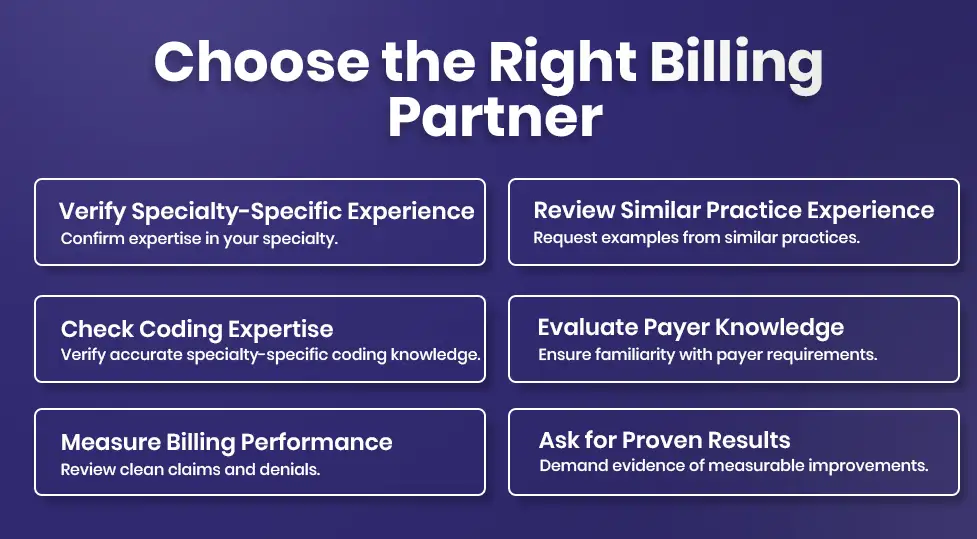
Selecting a medical billing service provider cannot just be based on cost considerations alone. The best firm must have an understanding of your specialty, ensure the privacy of your patients, have good technology, maintain good communication, and be able to show proof of its efficiency in improving your revenue cycle. All these factors should be considered before signing the agreement.
Specialty-Specific Experience
Select a billing firm that has a track record of success within the field of medicine you practice in. Since each field has its own specific codes, paperwork requirements, and payers, it is easier for the billers who know about all of these intricacies to detect any possible errors prior to filing the claim.
Transparent Pricing
An honest billing firm will give you a detailed writing that explains how the company prices its services. Inquire if the rates are charged on a percentage basis, flat fee, per claim, or a combination. Determine if there are set-up charges, software charges, minimum charges, coding charges, or any other extra services.
Strong Compliance and Data-Security Practices
Because medical billing organizations work with personal patient data, it is vital that privacy and security standards are very high. Inquire as to how the organization protects protected health information, restricts access by employees, trains employees, and responds to security events. As needed, determine whether the business associate will sign a BAA.
Proven Denial-Management Processes
The denial management process is something that should be clear and measurable in terms of what the billing company can provide for the practice. It would be helpful to know how they identify denial reasons, how they prioritize claims that matter, handle the appeals and ensure that similar issues do not happen again.
Reliable Technology
The billing partner should have reliable technology to integrate well with your EHR and practice management systems. Inquire about such aspects as system integration, automatic eligibility verification, claim tracking, electronic submissions, payment posting, and reporting dashboard. Find out how your authorized personnel will access the billing data and whether the company offers sufficient technical support.
Clear Communication
It helps to ensure that your practice stays informed of the status of the billing process, which involves things like pending claims, claim rejections, claim payment, and accounts receivable. See whether there will be an account manager for your account or someone who will handle the communication between both parties. Establish rules for how frequently you need to communicate.
Measurable Performance Reporting
The billing firm should give periodic reports that show how it performs through measurable criteria. Some of the important criteria could include clean claim percentage, denial percentage, days in A/R, collection percentage, A/R aging, and first pass resolution. The key to doing so would be to know how each criterion is computed and how often performance reports are given.
Positive Client References
Client testimonials are great sources of information to see how a biller works apart from their marketing messages. Try to get some referrals from practices like yours and ask them about collections, denial management, A/R efficiency, communications, transparency, and responsiveness. Learn whether the clients have had any tangible results and if they would recommend the firm further on.
Red Flags to Watch For
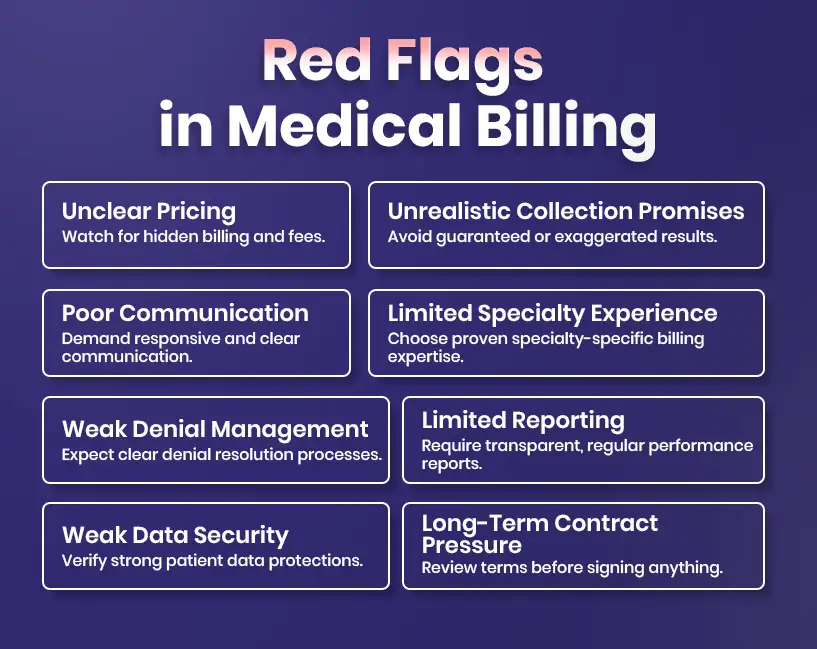
The selection of a medical billing company will affect the financial and operational performance of your practice, therefore it is vital to be aware of the potential danger signs that you need to look out for when making the selection. The vendor could look good due to their lower price points or promises, but there could be hidden dangers associated with it.
Unclear Pricing or Hidden Fees
Beware when a bill collector fails to give you a simple answer about their pricing structure. You should always get a detailed account of their percentage-based fees, flat fees, set up fees, technology fees, minimum fees, and extra services. Hidden fees can end up making your contract more costly than it seemed in the beginning.
Promises of Unrealistic Collection Results
Do not trust firms that promise you a huge boost in collections without taking into account your specialization, payer mix, claims volume, and performance of the revenue cycle. Genuine providers will always tell you how they assess their success and what impacts the collections. You should demand to see relevant documentation from them.
Poor Communication
If the communication lines of a billing firm are poor, it could turn out to be a significant issue in the near future. Whenever the firm takes too much time to respond or gives you vague answers and finds it difficult to determine your main contact, it should act as an alarm signal.
Lack of Specialty Experience
An inexperienced billing company in your specialty may find it difficult to cope with your unique codes, documentation, procedures, and payers’ policies. Find out how many practices similar to yours the company handles and ask for some references. Should the vendor lack sufficient experience in handling your specialty, find out if it is able to provide adequate training to its employees.
No Clear Denial-Management Process
The denial process must be promptly investigated, fixed, and resubmitted, with appeals as necessary. It is important to stay away from vendors who are unable to explain what steps they take in processing denied claims and identifying denial sources. Find out if they keep track of their denial percentages, amount, payers, and times required for resolution of the denials.
Limited Reporting or Transparency
You must have constant visibility in terms of billing performance. Be wary when a company offers little reports or does not even bother explaining key performance indicators like A/R aging, denial ratio, collection rate, and clean claim ratio. You need to be sure what reports you will get, how often, and also if you have access to billing data.
Weak Data-Security Policies
Since the billing process contains sensitive health information, any lapses in security on your part could lead you into trouble. Ask how they manage access, training, security measures, incident response, and data protection. If necessary, verify that the company is willing to sign a business associate agreement and meet all their responsibilities when handling patient data.
Pressure to Sign a Long-Term Contract
Be wary of any billing agency that urges you to sign an extensive contract without allowing you enough time to go through the contract. Take care to consider the terms of renewing, canceling, the notice period, and the termination fees that apply to the contract. A good agency will take the time to explain everything about the contract to you.
Why Choose iSolve RCM for Medical Billing?
The bottom line when selecting a medical billing company should involve choosing a company that can offer transparency, accountability, and results that can be easily measured. iSolve RCM uses a collaborative method of revenue cycle management, which helps practices see how well they bill, and it also helps identify areas where improvements can be made in collecting payments, avoiding denials, and improving work flow.
iSolve RCM believes that providers should ask all the right questions before they make any decision. This includes reviewing the reporting and billing performance of the company, and how it deals with denials and communication among other areas. If you want to know whether your current billing company is doing a good job or whether it is time to change the company that does your billing, an honest revenue cycle assessment done by iSolve RCM can provide some insight into what is happening with your billing process.
FAQs
Why should I hire a medical billing company?
A medical billing firm will be able to handle claims, coding, payment posting, and follow-ups. The outsourcing of billing will help to reduce the paperwork, enhance collections, avoid mistakes, and give the healthcare organizations an opportunity to concentrate more on patients.
What should I ask a medical billing company before hiring?
Question them on experience, services offered, costs, technology, claim handling, denial handling, reporting, compliance, and process of communication. This is how you find out whether the company knows about your specialty and can handle your practice’s billing needs.
How much does medical billing outsourcing cost?
The cost for medical billing can vary from firm to firm, based on the specialty, services offered, and pricing system used. While some firms have pricing systems based on percentages of collections, others have flat rates or custom prices. You should always ask for the pricing schedule.
How can I evaluate a billing company’s experience?
Look at their years of experience, specialties that they serve, referrals, qualifications of staff, and how well they have done with similar practices. Find out whether they have had experience with your specialty in terms of coding, insurance plans, and claim difficulties.
How important is HIPAA compliance?
HIPAA compliance is necessary when dealing with protected health information by a billing company. Inquire on security policies, training of employees, access control, information protection, and business associate agreement. A good billing company will have clear procedures to protect sensitive information regarding patients and practice.
What results should I expect from a medical billing company?
A reputable billing agency must demonstrate an increase in efficiency in billing and collections, proper handling of claims, and efficient denial management. Ensure that you set performance standards and get periodic reports on how your billing is performing before committing to any contract.