
CMS estimates that roughly 9.5 percent of Medicare Advantage payments are improper, largely because diagnoses submitted for risk adjustment lack matching medical record support during formal review. CMS estimates that 9.5 percent of payments to MA organizations are improper, mainly due to unsupported diagnoses submitted by MA organizations. Audit reviews now extend to every eligible contract annually, examining between 35 and 200 records per plan for signed, dated, condition specific notes. The RADV program now covers all eligible Medicare Advantage contracts annually, with samples of 35 to 200 records per contract. These figures explain why practices increasingly rely on a trusted medical billing company before audit exposure becomes a financial liability.
Medicare Advantage spending is projected near 615 billion dollars for 2026, nearly 14 percent above what equivalent fee for service coverage would cost, sharpening regulatory focus on chart accuracy. Medicare Advantage audits now cover more than half of all Medicare beneficiaries, and MedPAC estimated 615 billion dollars in total MA payments for 2026, roughly 14 percent, about 76 billion dollars, more than equivalent fee for service spending. Because unsupported codes invite repayment demands, many practices now turn to outsourced medical billing services to keep encounter linked documentation defensible ahead of every review cycle.
What Is a Medicare Advantage Audit?
A Medicare Advantage audit is a formal review conducted to confirm that the diagnosis codes and claims of a plan submitted for payment are supported by clinical documentation. The Centers for Medicare and Medicaid Services runs the largest of these reviews, known as Risk Adjustment Data Validation, to verify that every diagnosis tied to a member’s risk score reflects a real, documented, face to face encounter during the payment year.
CMS conducts these audits because Medicare Advantage plans are paid monthly amounts based on the health status of their enrolled members. When a diagnosis is submitted without adequate clinical support, the plan may have been paid for a condition that was not actually confirmed or actively managed. Recovering that gap protects the integrity of the Medicare Trust Fund and discourages the practice of reporting conditions that inflate a member’s risk profile without clinical justification.
Audits typically examine several connected areas at once. Risk adjustment accuracy, completeness of medical records, alignment of claims and clinical documentation, coding specificity, payment accuracy, and overall compliance with the program criteria are all assessed during the review process. Because these criteria are interrelated, a deficiency in any one of them may appear through the deficiency in another. For instance, a note that is not signed may translate into an improperly coded diagnosis for payment.
Expert Guide: Be prepared to audit at all times and not when an audit is due. Regularly do chart reviews, make sure the diagnosis is consistent with the documentation, make sure providers are authenticated, and correct coding problems ahead of time.
Understanding Medicare Advantage Audit Requirements
Medicare Advantage organizations operate under a detailed regulatory framework that governs how diagnoses are submitted, validated, and retained. Compliance expectations extend beyond simply submitting accurate codes. Plans and the providers who document care within their networks are expected to maintain internal monitoring programs, respond to CMS record requests within defined windows, and correct known errors once identified rather than waiting for an external audit to surface them.
Record retention is a specific and frequently underestimated requirement. Medical records that support risk adjustment diagnoses must remain accessible and retrievable for the periods CMS specifies, and recent audit cycles have restored a five month submission window for organizations responding to a formal request. That timeline sounds generous until an organization discovers that supporting charts are scattered across multiple electronic systems or held by providers who are difficult to reach. Keeping accurate and accessible record-keeping is not a privilege for auditors but a requirement of the program that has a direct financial implication.
The process of documentation, coding, risk adjustment, and payment is interlinked in this setting. Only through documentation can a diagnosis justify any payment as the condition must have been assessed, monitored, or managed in an eligible encounter. When documentation is thin, the coded diagnosis becomes vulnerable regardless of how accurately it may reflect the patient’s underlying health. Organizations that treat documentation as a clinical afterthought rather than a compliance asset tend to see that gap reflected directly in audit outcomes.
Common Medicare Advantage Audit Documentation Mistakes to Avoid
The vast majority of issues found during a Medicare Advantage plan audit can be attributed to some common documentation mistakes. If those mistakes are spotted ahead of time, organizations can fix them before the formal audit begins and before any financial repercussions arise.
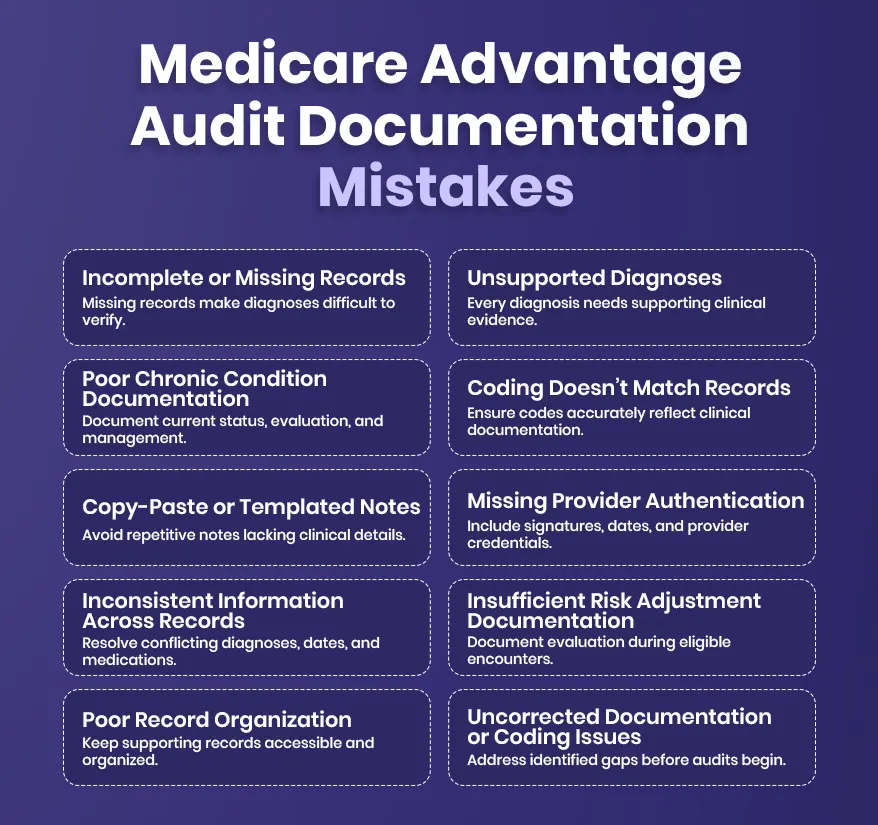
Incomplete or Missing Medical Records
Incomplete documentation of a claim, an incomplete medical history of the patient or no signature of the provider will result in immediate audit risk. An auditor will not be able to confirm a diagnosis he/she is unable to trace or verify. Even if a diagnosis is medically correct, it still would be indefensible if the supporting record is incomplete, misplaced or simply not there when the request for records comes in.
Unsupported Diagnoses
However, a diagnosis that is recorded without having enough clinical evidence, e.g., a condition recorded in the problem list without ever being reviewed in the encounter, is quite risky. This is because the reviewers will be expecting there to be a connection between the diagnosis and the clinical evidence that was used to verify that diagnosis. It is for this reason that unsupported diagnoses are among the most common deleted diagnoses in Medicare Advantage.
Poor Documentation of Chronic Conditions
Chronic diseases like diabetes or chronic kidney disease necessitate information that depicts their present state and should not be just an old note from a previous encounter. In cases where the record does not have specifics on how the chronic illness is managed clinically, the diagnosis becomes unsupported, resulting in poor Medicare Advantage risk adjustment for individuals with multiple chronic illnesses.
Coding That Does Not Match the Medical Record
Coding errors are made if the codes that have been used do not match what the provider actually has noted down on their paperwork. Any discrepancy due to difference in level of detail, laterality or disease status between the documentation and coding is something that is learned by auditors to detect and is among the more common errors made for Medicare Advantage.
Copy and Paste or Templated Documentation
Identical or cloned notes that pass down the same language from visit to visit automatically call into question whether the visit has been conducted in the context of an actual clinical evaluation. While templates allow for consistency, they create inconsistencies in their absence, calling into question the validity of the whole record on audit review.
Missing Provider Authentication
The signature, the date and the credentials will prove that a qualified provider was responsible for producing the documentation. Unsigned and unauthenticated documents have remained the most frequently found deficiencies in current audit cycles, and an untimely signature could ruin the entire document despite it being clinically perfect. Consistent provider credentialing services help ensure every clinician documenting care is properly enrolled, credentialed, and authorized to sign the records submitted for payment.
Inconsistent Information Across Records
Diagnoses that are at odds with each other, dates that don’t match up, or drug orders that are inconsistent can all point to a documentation process lacking in any form of internal audit. The auditors’ job involves comparing the records to the claims in order to catch any inconsistencies.
Insufficient Documentation for Risk Adjustment
Documentation of risk adjustment diagnosis must show that the illness has been followed up, reviewed, evaluated, and managed in an eligible visit. Some of the frequent mistakes include use of problem lists as proof alone and notes that explain the diagnosis but not how the diagnosis was managed.
Poor Record Organization and Retrieval
Dispersed records in multiple systems are problematic in terms of retrieving supporting documents at the time that is expected. If there are problems with record retrieval, then it becomes hard for the organization to deal with an audit request timely, making it problematic from the perspective of compliance alone.
Failure to Correct Known Documentation or Coding Issues
Neglecting a discrepancy that has been flagged internally does not decrease risk but rather increases it. Having an internal review process in place, along with the execution of the results of that process, differentiates those firms with a good compliance attitude from those that have similar audit results every year.
Medicare Advantage Risk Adjustment Audits: Documentation Risks to Watch
Risk adjustment audits evaluate whether every diagnosis code submitted for payment traces back to documented evidence that the condition was actually managed during the payment year. Reviewers apply a standard often summarized as monitoring, evaluating, assessing, and treating a condition, meaning a diagnosis mentioned in passing without evidence of active management typically fails validation. Sample sizes in current review cycles range broadly depending on contract size, and CMS has moved toward reviewing eligible contracts on a more regular basis rather than a smaller selective group, which increases the odds that any given organization will face a formal review.
Common vulnerabilities include diagnoses supported only by non face to face documentation, incomplete medical records, and provider notes that lack the clinical specificity needed to justify the diagnosis code submitted. Financial exposure from these gaps is significant. Extrapolation, the method that projects a sample’s error rate across an entire contract, was paused following a 2025 court ruling that found the underlying rule had not followed proper federal rulemaking procedure, though the audits themselves and their direct, non extrapolated overpayment findings have continued without interruption. Organizations that assume this pause removes financial risk are misreading the situation, since unsupported diagnoses identified within an audited sample still generate direct repayment demands regardless of how extrapolation authority is ultimately resolved.
Medicare Advantage Chart Audits and Medical Record Audits
Chart audits exist to confirm, before an external reviewer ever asks, that the documentation supporting submitted diagnoses can withstand scrutiny. The internal reviews check whether the chart has a valid encounter, correct credentials of the provider, readable charting, and clinically specific language which allows for making such a diagnosis. This is different from an administrative review because it concentrates on content rather than just verifying the existence of the record.
The medical record audit usually considers three different questions: whether the documentation is clinically good, whether the coding of this documentation is done right, and whether the coding corresponds to the actual claim. Failure to distinguish between these questions often results in mistakes, because the chart might be clinically perfect but the coding may be wrong or the coding may be good but the documentation too weak for verification. Running internal chart audits on a routine basis, rather than only ahead of an anticipated external audit, allows organizations to identify and correct these gaps while the stakes remain internal rather than regulatory.
Medicare Advantage Claims Audits and Payment Audits
The claims audits scrutinize the billing accuracy based on the documentation, not the medical basis of the diagnosis itself. It is checked whether the billed service was justified by the documentation, whether the billing codes were assigned properly, and whether the amount of payments is proportional to the provided services. It is at this level where billing and coding errors like mismatch of dates of service, or even the lack of documentation for some billed services are discovered. Organizations that rely on structured denial management services often catch these mismatches earlier, since the same review discipline used to appeal denied claims also flags documentation gaps before they reach a formal audit. Many organizations use dedicated medical billing audit services to run this kind of structured internal review before an external auditor ever requests records.
Overpayment audits, a specific category within this broader review, focus on instances where a plan appears to have received payment exceeding what documentation and coding support justify. Common payment audit issues include duplicate billing, incorrect units of service, and diagnoses that drove a higher payment tier without adequate clinical support. Claims accuracy and Medicare Advantage billing compliance are directly connected, since even a clinically sound diagnosis can generate an overpayment finding if the associated claim was billed incorrectly relative to what the record actually supports. Top 10 medical billing audit companies in USA that maintain strong AR follow up services are typically quicker to spot payment discrepancies, since unresolved claims are reviewed routinely rather than left unexamined until an audit forces the issue.
Medicare Advantage Coding Audits: Common Compliance Problems
The main purpose of coding audits is to ensure that the submitted codes correctly represent the information provided in the medical record, and such audits often identify some typical compliance issues that should be separately analyzed.
Unsupported Diagnosis Codes
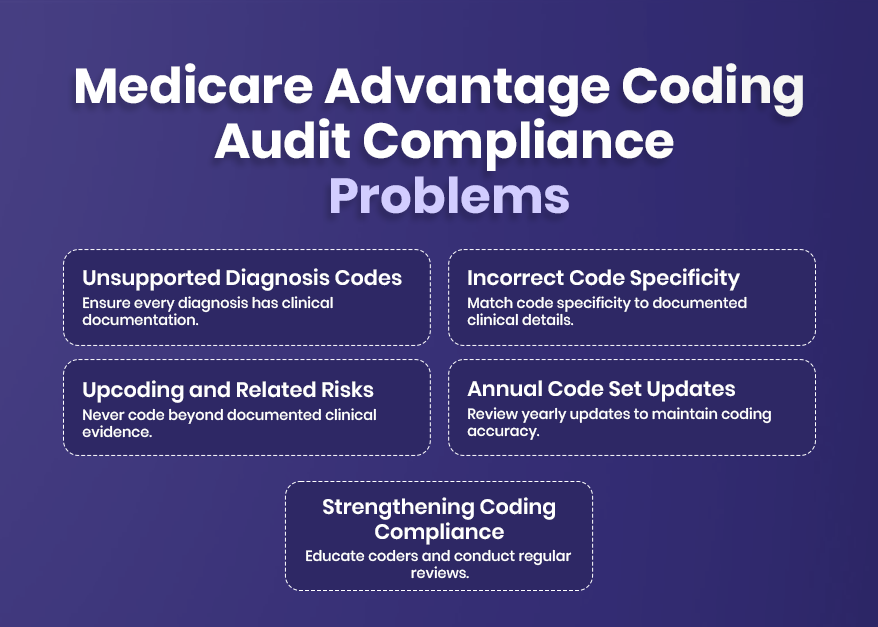
Codes lacking any documentation about how the condition was determined or treated during the encounter still top the list as the most prevalent finding when it comes to coding audits. When a diagnosis is listed on a problem list and there is no documentation in the encounter about the clinical situation, then it is unlikely to survive an audit. Furthermore, you need to know that annual code set updates compound this risk further, since the CPT 2026 revision alone introduced 288 new codes and retired 84 others, meaning a code that was correct and specific in the prior year can become outdated or invalid without a corresponding update to coding practice.
Incorrect Code Specificity
Sometimes there is a need for specific data like laterality, degree of severity, or complexity for diagnosis coding that is not included in general documentation. In cases when documentation is general and coding is very specific, the inconsistency can be easily detected during the coding review.
Upcoding and Related Coding Risks
Overcoding by allocating an incorrect and more serious code than what is justified based on the clinical documentation, whether it is done intentionally or unintentionally, poses serious compliance risks for the organization. Overcoding that occurs repeatedly in the course of a contract tends to attract extra audit scrutiny.
Strengthening Coding Compliance
Proper education of coders, feedback loops between coders and providers, and periodic reviews of internal coding can help to lower these risks significantly. Companies that recognize coding as an ongoing process rather than something that must be fixed prior to audits see fewer findings during external reviews.
Medicare Advantage Audit Compliance: What Organizations Need to Do
Creating effective audit compliance must begin by developing a program where internal procedures are in compliance with the regulations that pertain to documentation, coding, and billing for Medicare Advantage. This means more than publishing a policy manual. It requires ongoing monitoring of documentation and coding practices, routine internal reviews conducted with the same rigor an external auditor would apply, and a defined process for tracking corrective actions from identification through resolution. Organizations that invest in structured revenue cycle management tend to build this discipline more naturally, since accurate documentation and coding are foundational to the same processes that keep claims and reimbursement accurate.
Accountability in compliance, coding, clinical, and billing groups is what actually makes the compliance program work rather than just a theory. The lack of accountability in terms of ensuring the quality of the documentation, when all the documentation related tasks fall on the shoulders of clinical employees while coding and billing teams work independently, leads to the development of gaps between the documented data and the submitted one. Consistent documentation is the type of documentation that can be checked during Medicare Advantage audits.
Professional Insight: Integrate the process of Medicare Advantage compliance into the daily flow of operations beyond preparation for audits. Ensure there is an accountability structure within the clinical, coding, billing, and compliance departments, perform internal reviews, and monitor corrective actions until completion.
Medicare Advantage Audit Checklist
Preparation for an audit under the Medicare Advantage plan becomes much simpler when companies have a list from which to prepare, as opposed to preparing for the records request once it comes. The following is a list of areas in our medical billing audit checklist that are always checked by the auditor, taken straight from the information in this blog.
Use this list as a working reference before, during, and after any internal or external review.
- Medical records are complete and accessible.
- Diagnoses are supported by clinical documentation.
- Documentation matches submitted diagnosis codes.
- Provider authentication requirements are satisfied.
- Risk adjustment diagnoses have appropriate support.
- Claims and medical records are consistent.
- Coding discrepancies have been identified and corrected.
- Overpayments or billing issues have been investigated.
- Internal chart audits have been completed.
- Previous audit findings have been addressed.
- Corrective action plans are documented.
- Records can be retrieved within required timelines.
- Staff understand applicable compliance requirements.
How to Prepare for a Medicare Advantage Audit: A Step by Step Approach
The audit preparation process starts by gaining knowledge of the actual scope of the audit, because the risk adjustment reviews, chart audits, and claims audits are all focused on various aspects that need different approaches in the preparation process. The audit guidelines should be reviewed before the records are even requested, in order to know in advance what the reviewers actually expect.
The pre audit documentation review, combined with chart and claims audits, provides an organization with a clear perspective of the gaps that actually exist prior to any external audit. This stage should specifically validate risk adjustment diagnoses against supporting documentation and review coding accuracy against the standards discussed earlier in this guide. Gaps identified at this point should be remediated immediately rather than logged for future attention, since unresolved issues tend to reappear in the actual audit sample.
Organizing supporting documentation and preparing staff for auditor requests rounds out a defensible preparation process, supported by a consistent audit response and tracking system that documents every step taken. The sequence below reflects the order most organizations follow successfully.
- Define the audit scope
- Gather required records
- Perform internal chart and claims reviews
- Identify documentation gaps
- Correct compliance issues
- Validate coding and risk adjustment
- Organize evidence and supporting records
- Track responses and corrective actions
Medicare Advantage Audit Findings and Potential Penalties
Audits usually have some common characteristics with regard to the Medicare Advantage Contracts. Lack of documentation, lack of substantiation for diagnoses, claims errors, and issues relating to compliance are all different forms of audit risks. Unsupported diagnoses identified during a review lead directly to overpayment recovery, since CMS removes the associated diagnosis category, recalculates the affected risk score, and recoups the related payment regardless of whether the underlying clinical condition genuinely existed. Financial stakes at the program level are considerable. Independent analysis has estimated that Medicare Advantage costs the program meaningfully more than equivalent traditional Medicare spending would, a gap regulators have specifically cited as justification for expanding audit activity in recent years.
Potential penalties extend beyond simple repayment of the disputed amount. Depending on the scope and pattern of findings, organizations may face increased scrutiny in future audit cycles, additional reporting obligations, or referral for further compliance review when findings suggest a systemic rather than isolated issue. Proactive remediation, meaning organizations identify and correct these problems internally before an external audit forces the issue, remains far preferable to waiting for a formal finding, both financially and in terms of the ongoing regulatory relationship an organization maintains with CMS.
Building a Strong Medicare Advantage Audit Process
An effective audit process is one where regular audits are conducted in conjunction with those audit processes that have been covered in this guide, combining the three forms of audit into a single cycle instead of conducting them independently on an annual basis. Consistent application of standardized documentation criteria from which outliers can be easily recognized makes it significantly easier to spot them without having to wait until their number is substantial enough to raise suspicion externally.
It is crucial to have proper escalation policies in place so that the issues uncovered in internal audits are actually escalated to individuals who can address them, instead of simply being noted. The recurrence of risks should be monitored specifically because a documentation issue that recurs in several rounds of audits represents a breakdown in process rather than a mistake. Proper documentation of every correction made in response to an issue and process modification in accordance with regulatory changes ensures ongoing effectiveness of the audit process.
- Establish routine monitoring cycles.
- Combine chart, claims, and coding audits.
- Apply standardized documentation criteria.
- Build clear escalation procedures.
- Track recurring documentation risks.
- Update processes as rules change.
Practical Standards That Support Audit Readiness: Best Practices
Strong documentation practice starts with clear, accurate descriptions of every diagnosis, written in language specific enough to demonstrate that the condition was genuinely evaluated during the encounter rather than simply listed from a prior visit. Documentation should visibly support the reported condition, using clinical language that connects the diagnosis to actual assessment and management activity. Authentication matters just as much as content. Records should be properly signed, dated, and credentialed, since even clinically accurate documentation loses its value if authentication requirements were not met.
Excluding duplicates and contradictions in documentation, keeping documentation organized and accessible, and ensuring that documentation is complete prior to submission are other ways to ensure sound documentation practices. Having an audit trail for every problem that arises, along with records of how the problem was corrected, provides an organization with concrete proof of a functioning compliance program.
How iSolve RCM Supports Documentation and Audit Readiness
iSolve RCM works alongside Medicare Advantage organizations to strengthen the documentation practices that audits are specifically designed to test. Its approach centers on structured chart review, coding accuracy checks, and consistent provider authentication verification, helping organizations identify gaps before they become formal findings. By combining medical coding services with routine internal review support, iSolve RCM helps organizations build a documentation process capable of withstanding both risk adjustment and claims level scrutiny.
FAQs
What is a Medicare Advantage audit?
A Medicare Advantage audit is a formal review confirming that diagnoses and claims submitted for payment are supported by documented evidence in a member’s medical record. CMS conducts these reviews primarily through Risk Adjustment Data Validation, checking whether diagnoses tied to risk scores reflect genuine, documented clinical encounters rather than unsupported entries carried forward without current evaluation.
How does a Medicare Advantage audit work?
Reviewers select a sample of enrollees from an audited contract and request supporting medical records for each diagnosis submitted. Clinical reviewers then compare the documentation against the submitted codes, determining whether each diagnosis meets required standards. Unsupported diagnoses are removed, risk scores are recalculated, and associated overpayments are identified for recovery.
What documentation is required for a Medicare Advantage audit?
Required documentation includes a signed, dated, and legible record from a valid provider type, describing a face to face encounter during the audited payment year. The note must show the condition was dynamically monitored, evaluated, assessed, or treated, since problem lists or passing references alone characteristically do not satisfy audit standards.
What are the biggest Medicare Advantage audit risks?
The highest risks exist where diagnoses have been made without sufficient medical evidence because this automatically sets off processes for recovery once detected. Organizing records improperly further aggravates this risk by making it hard to locate supporting documents quickly, whereas coding inconsistently creates a higher risk of detection.
What are Medicare Advantage audit penalties?
The typical penalties will include reimbursement of funds that were associated with unsupported diagnoses, recalculated using the adjusted risk scores. Organizations whose findings recur or are systemic may also be subject to more frequent audits or additional reporting requirements in future contract years. This makes taking corrective action much cheaper than waiting for an external finding.
What is the difference between a chart audit and a claims audit?
While a chart review looks into the clinical content of the patients’ medical records and evaluates whether their documents are supporting the diagnosis, a claim review is focused on assessing the correctness of the information that has been provided to the payer and looking at what has been paid out.