
POS codes, short for place of service codes, are two-digit codes that tell a payer where a patient received a service, such as 11 for an office, 21 for an inpatient hospital or 10 for telehealth in the patient’s home. CMS maintains the national list, and every professional claim carries a POS code on each service line. For Medicare and many other payers, that code does more than describe the setting: it decides whether the service is paid at the higher nonfacility rate or the lower facility rate.
This guide covers the full CMS list of 52 active codes, the codes practices use every day, the rules for choosing between them and the errors that turn a correct procedure code into a denied or underpaid claim. CMS last updated its POS code set database on May 2, 2024, when POS 66 was the newest addition, so the list below is the current set going into 2027.
POS Codes at a Glance
| Attribute | Detail |
|---|---|
| What it is | A two-digit code for the setting where the service was furnished |
| Who maintains it | CMS, through the national POS code set |
| Active codes | 52, from 01 Pharmacy to 99 Other Place of Service |
| Where it goes | Item 24B of the CMS-1500; the 837P claim and service line |
| Used on | Professional claims only; the UB-04 uses a type of bill instead |
| Payment effect | Selects the Medicare facility or nonfacility fee schedule rate |
| Newest code | POS 66, PACE Center, effective August 1, 2024 |
What Are POS Codes in Medical Billing?
Place of service codes identify the type of location where a health professional furnished a service. The CMS Place of Service Code Set lists each code with a name and a definition, and CMS instructs providers to use them on professional claims to show the setting of care. Payers then apply their own reimbursement policies to each code, which is why the same CPT code can pay differently in an office and in a hospital.
The POS code describes the setting, not the service. An office visit (99213) is the same service whether it happens in a private office or a hospital outpatient department. The POS code is what tells the payer which one it was.
POS code vs point of service plan vs point of sale
“POS” means three different things in healthcare. In billing, it is place of service, the subject of this guide. In insurance, a point of service (POS) plan is a type of managed care plan that combines features of an HMO and a PPO. In retail and front-desk software, POS means point of sale, the system that collects payments. Only the first one belongs on a claim.
Where Does the POS Code Go on a Claim?
On the paper CMS-1500 (also called the HCFA 1500), the POS code goes in item 24B, next to each line’s date of service and CPT or HCPCS code. On the electronic 837P, it is reported at the claim level and can be reported again on a service line when a line was furnished in a different setting.
The UB-04 has no place of service field. Hospitals and other institutional providers describe the setting through the type of bill in form locator 4, such as 0111 for a hospital inpatient claim or 0131 for a hospital outpatient claim, and through revenue codes on each line. So when someone asks where the place of service is on a UB-04, the answer is the type of bill.
Why POS Codes Change What You Are Paid
Under the Medicare Physician Fee Schedule, many services have two rates. The nonfacility rate is higher because it includes the practice’s own costs for staff, space and supplies. The facility rate is lower because a hospital or other facility is paid separately for those costs. The POS code tells Medicare which rate applies.
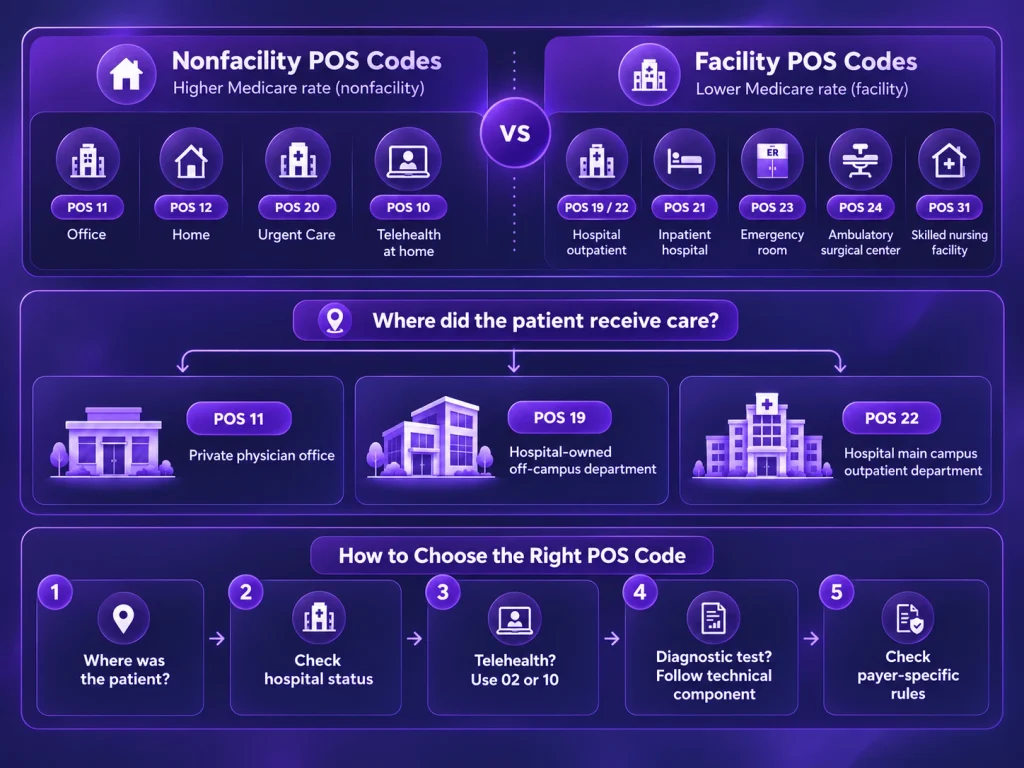
Chapter 12, section 20.4.2 of the Medicare Claims Processing Manual (Rev. 12823, effective October 8, 2024) lists the settings paid at the facility rate. These are the main ones:
| POS | Setting Paid at the Facility Rate |
|---|---|
| 02 | Telehealth provided other than in the patient’s home |
| 19 / 22 | Off-campus and on-campus outpatient hospital |
| 21 | Inpatient hospital |
| 23 | Emergency room, hospital |
| 24 | Ambulatory surgical center, for procedures on the ASC approved list |
| 26 | Military treatment facility |
| 31 | Skilled nursing facility, for a Part A resident |
| 34 | Hospice, for inpatient care |
| 41 / 42 | Ambulance |
| 51 / 52 | Inpatient psychiatric facility; psychiatric partial hospitalization |
| 53 / 56 | Community mental health center; psychiatric residential treatment center |
| 61 | Comprehensive inpatient rehabilitation facility |
Office (11), home (12), urgent care (20), telehealth in the patient’s home (10) and most other settings are paid at the nonfacility rate. There is one important override: if the patient is a registered hospital inpatient (21) or outpatient (19 or 22), the facility rate applies wherever the face-to-face encounter happened.
Audit risk: Billing a nonfacility POS for a patient who was actually a hospital inpatient or outpatient overpays the claim. Medicare’s recovery auditors have an approved review topic for exactly this issue, Facility versus Non-Facility Reimbursement.
POS Codes Full List 2027
This is the complete place of service codes list from the CMS code set, with each description summarized. Codes marked unassigned are not in use. For the official wording, CMS publishes the full list as a downloadable PDF.
| Code | Place of Service | What It Covers |
|---|---|---|
| 01 | Pharmacy | Location where drugs and related items and services are dispensed or provided directly to patients |
| 02 | Telehealth Provided Other than in Patient’s Home | Telehealth when the patient is not at home; description revised January 1, 2022 |
| 03 | School | Facility whose primary purpose is education |
| 04 | Homeless Shelter | Temporary housing for homeless individuals |
| 05 | Indian Health Service Free-standing Facility | IHS-operated facility for patients who do not require hospitalization |
| 06 | Indian Health Service Provider-based Facility | IHS-operated facility for inpatients or outpatients |
| 07 | Tribal 638 Free-standing Facility | Tribe-operated facility under a 638 agreement, no hospitalization |
| 08 | Tribal 638 Provider-based Facility | Tribe-operated facility under a 638 agreement for inpatients or outpatients |
| 09 | Prison/Correctional Facility | Prison, jail, detention center or similar facility |
| 10 | Telehealth Provided in Patient’s Home | Telehealth when the patient is at home; effective January 1, 2022 |
| 11 | Office | Location where the professional routinely provides ambulatory care, other than a hospital, SNF or other listed facility |
| 12 | Home | Private residence where the patient receives care |
| 13 | Assisted Living Facility | Congregate residence with 24-hour on-site support |
| 14 | Group Home | Shared residence with supervision and social, behavioral or custodial services |
| 15 | Mobile Unit | Unit that moves from place to place to provide preventive, screening, diagnostic or treatment services |
| 16 | Temporary Lodging | Hotel, campground, hostel, cruise ship or resort |
| 17 | Walk-in Retail Health Clinic | Clinic inside a retail operation providing preventive and primary care |
| 18 | Place of Employment-Worksite | Employer location where occupational medical services are provided |
| 19 | Off Campus-Outpatient Hospital | Off-campus hospital provider-based department; effective January 1, 2016 |
| 20 | Urgent Care Facility | Location for unscheduled, ambulatory patients seeking immediate care, distinct from an ER, office or clinic |
| 21 | Inpatient Hospital | Hospital, other than psychiatric, providing care to admitted patients |
| 22 | On Campus-Outpatient Hospital | Outpatient department on a hospital’s main campus; description revised January 1, 2016 |
| 23 | Emergency Room-Hospital | Part of a hospital where emergency care is provided |
| 24 | Ambulatory Surgical Center | Freestanding facility, other than an office, for ambulatory surgery and diagnostic services |
| 25 | Birthing Center | Non-hospital facility for labor, delivery and immediate postpartum and newborn care |
| 26 | Military Treatment Facility | Medical facility operated by the Uniformed Services |
| 27 | Outreach Site/Street | Non-permanent street or found location serving unsheltered homeless individuals; effective October 1, 2023 |
| 28-30 | Unassigned | Not in use |
| 31 | Skilled Nursing Facility | Facility providing inpatient skilled nursing and rehabilitative care |
| 32 | Nursing Facility | Facility providing skilled nursing or health-related care above custodial level to residents |
| 33 | Custodial Care Facility | Room, board and personal assistance without a medical component |
| 34 | Hospice | Facility, other than the patient’s home, for palliative care of terminally ill patients |
| 35-40 | Unassigned | Not in use |
| 41 | Ambulance-Land | Land vehicle equipped to transport the sick or injured |
| 42 | Ambulance-Air or Water | Air or water vehicle equipped to transport the sick or injured |
| 43-48 | Unassigned | Not in use |
| 49 | Independent Clinic | Outpatient-only clinic not part of a hospital and not described by another code |
| 50 | Federally Qualified Health Center | Facility in a medically underserved area providing primary care |
| 51 | Inpatient Psychiatric Facility | 24-hour inpatient psychiatric care |
| 52 | Psychiatric Facility-Partial Hospitalization | Planned therapeutic program for patients who do not need full-time hospitalization |
| 53 | Community Mental Health Center | Outpatient, emergency, partial hospitalization and screening mental health services |
| 54 | Intermediate Care Facility/Individuals with Intellectual Disabilities | Health-related care above custodial level, below hospital or SNF level |
| 55 | Residential Substance Abuse Treatment Facility | Live-in substance use treatment without acute medical care |
| 56 | Psychiatric Residential Treatment Center | 24-hour therapeutically planned psychiatric group living environment |
| 57 | Non-residential Substance Abuse Treatment Facility | Ambulatory substance use treatment |
| 58 | Non-residential Opioid Treatment Facility | Ambulatory opioid use disorder treatment, including medication assisted treatment; effective January 1, 2020 |
| 59 | Unassigned | Not in use |
| 60 | Mass Immunization Center | Setting for mass pneumococcal and influenza vaccination, including roster billing |
| 61 | Comprehensive Inpatient Rehabilitation Facility | Inpatient rehabilitation for patients with physical disabilities |
| 62 | Comprehensive Outpatient Rehabilitation Facility | Outpatient rehabilitation for patients with physical disabilities |
| 63-64 | Unassigned | Not in use |
| 65 | End-Stage Renal Disease Treatment Facility | Non-hospital dialysis facility |
| 66 | Programs of All-Inclusive Care for the Elderly (PACE) Center | Comprehensive medical and social services for PACE enrollees; effective August 1, 2024 |
| 67-70 | Unassigned | Not in use |
| 71 | Public Health Clinic | State or local health department clinic providing ambulatory primary care |
| 72 | Rural Health Clinic | Certified clinic in a rural underserved area providing primary care |
| 73-80 | Unassigned | Not in use |
| 81 | Independent Laboratory | Certified laboratory independent of an institution or a physician’s office |
| 82-98 | Unassigned | Not in use |
| 99 | Other Place of Service | Any setting not identified by another code |
The Most-Used POS Codes Explained
A handful of codes cover most professional claims. These are the ones billing teams use, and confuse, most often.
POS 11: Office
POS 11 is a location, other than a hospital, SNF, military treatment facility, community health center, public health clinic or intermediate care facility, where the professional routinely provides examinations, diagnosis and treatment on an ambulatory basis. It is the most common POS code for physician practices and is paid at the Medicare nonfacility rate. A practice that is a provider-based department of a hospital does not use POS 11; it uses POS 19 or 22.
POS 22 and POS 19: On Campus vs Off Campus Outpatient Hospital
POS 22 is a hospital outpatient department on the hospital’s main campus, and POS 19 is a provider-based department off campus. CMS split the two on January 1, 2016, so Medicare could track and pay off-campus departments differently. For the professional claim, both are paid at the facility rate, because the hospital bills separately for the space, staff and equipment. Medicare regulations define the campus as the area immediately around the hospital’s main buildings and other areas within 250 yards, plus any area CMS designates.
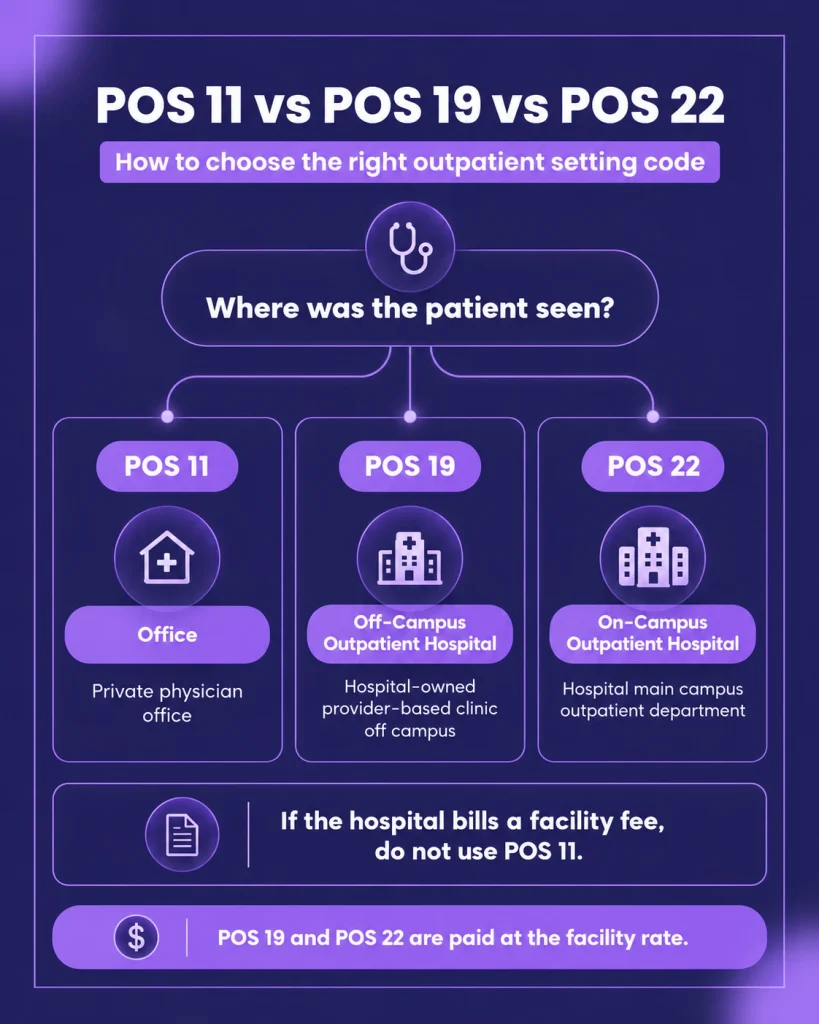
The most common mistake here is billing POS 11 for a clinic that is legally part of the hospital. If the hospital bills a facility fee for the visit, the physician’s claim needs POS 19 or 22.
POS 21: Inpatient Hospital
POS 21 is used for services to patients admitted to a hospital, other than a psychiatric hospital, and is paid at the facility rate. It also applies when an admitted inpatient is seen somewhere else. CMS reminded clinicians in January 2025 that a patient seen in a physician’s office who is also a hospital inpatient is billed with POS 21, as PALTmed reported.
POS 23: Emergency Room
POS 23 covers services furnished in a hospital emergency department, typically emergency department visits (99281 to 99285) and procedures done there. If the patient is admitted, services after the inpatient order use POS 21.
POS 02 vs POS 10: Telehealth Away From Home vs at Home
POS 02 is telehealth when the patient is not at home, such as a patient joining from a clinic or a facility. POS 10, added January 1, 2022, is telehealth when the patient is in their own home. Since January 1, 2024, Medicare pays POS 02 at the facility rate and POS 10 at the higher nonfacility rate, as the AAFP’s summary of the 2024 final rule explains. Medicare pairs the POS with modifier 95 for audio-video or modifier 93 for audio-only, and the modifier does not change the payment rate.
POS 12 vs POS 13: Home vs Assisted Living
POS 12 is a private residence where the patient receives care in person. POS 13 is an assisted living facility, a congregate residence with 24-hour on-site support. Both are used with the home or residence visit codes (99341 to 99350), but they are different settings and should not be swapped. A visit to a patient in a group home uses POS 14.
POS 20: Urgent Care Facility
POS 20 is for a location, distinct from an ER, an office or a clinic, that treats unscheduled patients who need immediate care. Medicare pays POS 20 at the nonfacility rate. Some commercial payers have specific urgent care contracts or rules for when POS 20 versus POS 11 applies, so check the payer agreement.
POS 24: Ambulatory Surgical Center
POS 24 is a freestanding facility, other than a physician’s office, where surgical and diagnostic services are provided on an ambulatory basis. The surgeon’s professional claim uses POS 24 and is paid at the facility rate for procedures on the ASC approved list, while the ASC bills its own facility claim.
POS 31 vs POS 32: Skilled Nursing vs Nursing Facility
POS 31 is used when the patient is in a skilled nursing facility under a Medicare Part A stay. POS 32 is used for a nursing facility resident, or a SNF patient without Part A coverage. The distinction matters because POS 31 is paid at the facility rate and POS 32 at the nonfacility rate, so the patient’s coverage status on the date of service decides the code.
POS 49, 50, 71 and 72: Clinics
POS 49 is an independent outpatient clinic that is not part of a hospital. POS 50 is a federally qualified health center, POS 71 a state or local public health clinic and POS 72 a rural health clinic. Medicare FQHCs and RHCs bill most of their Medicare visits on institutional claims, so POS 50 and 72 appear mostly on professional claims to other payers.
Other Frequently Searched Codes
| Code | When It Is Used |
|---|---|
| 03 School | Services at a school, such as school-based health programs |
| 15 Mobile Unit | Mobile mammography, screening vans and similar units |
| 41 / 42 Ambulance | Services furnished in a land, air or water ambulance |
| 51 to 58 | Inpatient and outpatient psychiatric, mental health and substance use settings |
| 61 Inpatient Rehabilitation | Services to inpatients of a rehabilitation facility |
| 65 ESRD Facility | Services in a freestanding dialysis facility |
| 81 Independent Laboratory | Tests performed by an independent lab |
| 99 Other | Settings no other code describes; payers may ask for documentation |
How to Choose the Right POS Code
Most POS questions come down to five rules.

1. Code where the patient was
The POS reflects the setting where the patient received the face-to-face service, not the practice’s billing address. A physician who sees a patient in a nursing facility bills the nursing facility POS even though the claim goes out from the office.
2. Hospital patients override the location
If the patient is a registered hospital inpatient or outpatient at the time of the service, use POS 21, 19 or 22 even if the encounter happened in the physician’s office. This is the rule CMS repeated in its 2025 reminder and the one recovery auditors check.
3. Telehealth uses telehealth codes
For Medicare telehealth, use POS 10 when the patient is home and POS 02 when they are anywhere else, with modifier 95 or 93 as appropriate. Do not report the POS of the provider’s location.
4. Diagnostic tests follow the technical component
When the professional and technical components of a diagnostic test are billed separately, Medicare’s instructions in Chapter 13, section 150 tie the POS for the interpretation to the setting where the patient received the technical component.
5. Check the payer’s rules
CMS maintains the codes, but each payer sets its own policies for them. Medicaid programs, Medicare Advantage plans and commercial payers may require specific codes for telehealth, urgent care or behavioral health, so confirm the rule for each payer.
POS Code Errors That Cause Denials and Overpayments
| Error | What Happens | Fix |
|---|---|---|
| POS does not fit the procedure code, such as an inpatient visit code with POS 11 | Denial with CARC 5: procedure code or bill type inconsistent with the place of service | Match the POS to the setting the CPT code describes |
| Service billed in a setting the payer does not cover for that code | Denial with CARC 58: treatment in an inappropriate or invalid place of service | Check the payer’s POS policy for the service |
| POS 11 billed for a hospital outpatient department | Overpayment at the nonfacility rate and audit exposure | Use POS 19 or 22 for provider-based departments |
| Office POS for a patient who was a hospital inpatient | Overpayment; recovery audit target | Check admission status and use POS 21 |
| POS 11 for Medicare telehealth | Wrong payment or denial | Use POS 02 or 10 with modifier 95 or 93 |
| POS 31 and 32 mixed up | Wrong rate for nursing facility visits | Check Part A status on the date of service |
POS errors are easy to repeat because they are often set once in the practice management system and never checked again. A medical billing audit that compares POS codes with admission status and practice locations catches them early, and denial management traces CARC 5 and 58 denials back to the setup that caused them.
POS Code Changes Over the Last Decade
The code set changes slowly, but the recent changes affect payment directly.
| Date | Change |
|---|---|
| January 1, 2016 | POS 19 added for off-campus outpatient hospital; POS 22 redefined as on campus |
| January 1, 2020 | POS 58 added for non-residential opioid treatment facilities |
| January 1, 2022 | POS 10 added for telehealth in the patient’s home; POS 02 redefined (Medicare from April 1, 2022) |
| October 1, 2023 | POS 27 added for outreach sites and street medicine |
| January 1, 2024 | Medicare began paying POS 10 at the nonfacility rate and POS 02 at the facility rate |
| August 1, 2024 | POS 66 added for PACE centers |
| January 2025 | CMS reminded clinicians to use POS 21, 31 and 32 correctly for hospital and nursing facility patients |
| 2027 | No new POS codes announced as of October 2026; the May 2024 code set remains current |
How iSolve RCM Keeps POS Codes Accurate
POS codes look like a small field on the claim, but they decide the payment rate and trigger some of the most common audits. iSolve RCM, a medical billing company working with practices across more than 45 specialties, maps every practice location and setting to the right POS code, checks hospital and nursing facility status before claims go out and tracks POS-related denials back to their source.
Frequently Asked Questions
What are POS codes in medical billing?
POS codes are two-digit place of service codes that show where a patient received a service, such as 11 for an office or 21 for an inpatient hospital. CMS maintains the list, providers report them on professional claims and Medicare uses them to decide between the facility and nonfacility payment rate.
What is POS 19 vs POS 22 in medical billing?
Both are hospital outpatient departments. POS 22 is on the hospital’s main campus, and POS 19 is an off-campus provider-based department, a split CMS made on January 1, 2016. Both are paid at the Medicare facility rate on the professional claim, while the hospital bills its own facility fee.
What is POS 2 vs POS 10?
Both are telehealth codes. POS 02 means the patient was not at home during the telehealth visit, and POS 10 means the patient was in their own home. Since 2024, Medicare pays POS 02 at the facility rate and POS 10 at the higher nonfacility rate.
What is POS 11 in medical billing?
POS 11 is the office: a location other than a hospital or another listed facility where a health professional routinely provides ambulatory care. It is the most common POS code for physician practices and is paid at the Medicare nonfacility rate.
What is POS 21 in medical billing?
POS 21 is the inpatient hospital, used for services to admitted patients. It is paid at the facility rate, and it also applies when a hospital inpatient is seen outside the hospital, such as in the physician’s office.
Is there a list of POS codes in PDF?
Yes. CMS publishes the full place of service code list as a PDF, Place of Service Codes for Professional Claims, linked from its Place of Service Code Set page. It contains the same 52 active codes listed in this guide.
Where is place of service on the UB-04?
The UB-04 has no place of service field. Institutional claims describe the setting through the type of bill in form locator 4 and through revenue codes on each line. POS codes are used on professional claims such as the CMS-1500 and 837P.
What POS code is used for urgent care?
Urgent care facilities use POS 20, which Medicare pays at the nonfacility rate. Some commercial payers have their own urgent care rules, so check the payer contract.
What is the difference between POS 31 and POS 32?
POS 31 is a skilled nursing facility for a patient in a Medicare Part A stay and is paid at the facility rate. POS 32 is a nursing facility, or a SNF patient without Part A coverage, and is paid at the nonfacility rate.