
On January 1, 2027, the amount a Medicare patient pays when a screening colonoscopy turns into a polyp removal drops from 15% to 10% of the cost. It falls to zero in 2030. The change is set in law, and the American Gastroenterological Association has been warning practices that many patients still do not know they owe anything at all.
Whether a patient owes 10%, 15%, or nothing depends on three choices made on the claim: the procedure code, the modifier, and the order of the diagnosis codes. Understanding Colonoscopy CPT Codes is essential because screening, diagnostic, and surveillance colonoscopies are billed differently, and Medicare and commercial payers may apply different rules to the same procedure.
Quick answer: CPT 45378 is used for a diagnostic colonoscopy when no biopsy or other intervention is performed. Medicare screening colonoscopies generally use HCPCS G0121 for average-risk patients or G0105 for high-risk patients, while commercial plans often use CPT 45378 with modifier 33 and diagnosis code Z12.11 to indicate a preventive screening. When a polyp is removed, the procedure code changes to a therapeutic code, such as CPT 45380 for a colonoscopy with biopsy or CPT 45385 for removal by snare technique. For Medicare, modifier PT may apply when a screening colonoscopy becomes therapeutic; for commercial plans, modifier 33 may apply depending on the payer’s billing guidelines.
Colonoscopy Coding at a Glance
| Scenario | Procedure Code | Modifier | Primary Diagnosis |
|---|---|---|---|
| Medicare screening, average risk | G0121 | None | Z12.11 |
| Medicare screening, high risk | G0105 | None | Z12.11 plus the risk factor, such as Z80.0 |
| Medicare screening after a positive stool test | G0121 or G0105 | KX | Z12.11 plus R19.5 |
| Medicare screening converted to polyp removal | 45380, 45384, 45385 or 45388 | PT | Z12.11, then the finding |
| Commercial screening, no intervention | 45378 | 33 | Z12.11 |
| Commercial screening with polyp removal | 45380, 45385 or other therapeutic code | 33 | Z12.11, then the finding |
| Diagnostic colonoscopy for symptoms | 45378 or therapeutic code | None | The symptom or finding |
| Surveillance after cancer or polyps (Medicare) | Per MAC policy | Per payer | Z08 or history codes as the payer requires |

What Are the Main Colonoscopy CPT Codes?
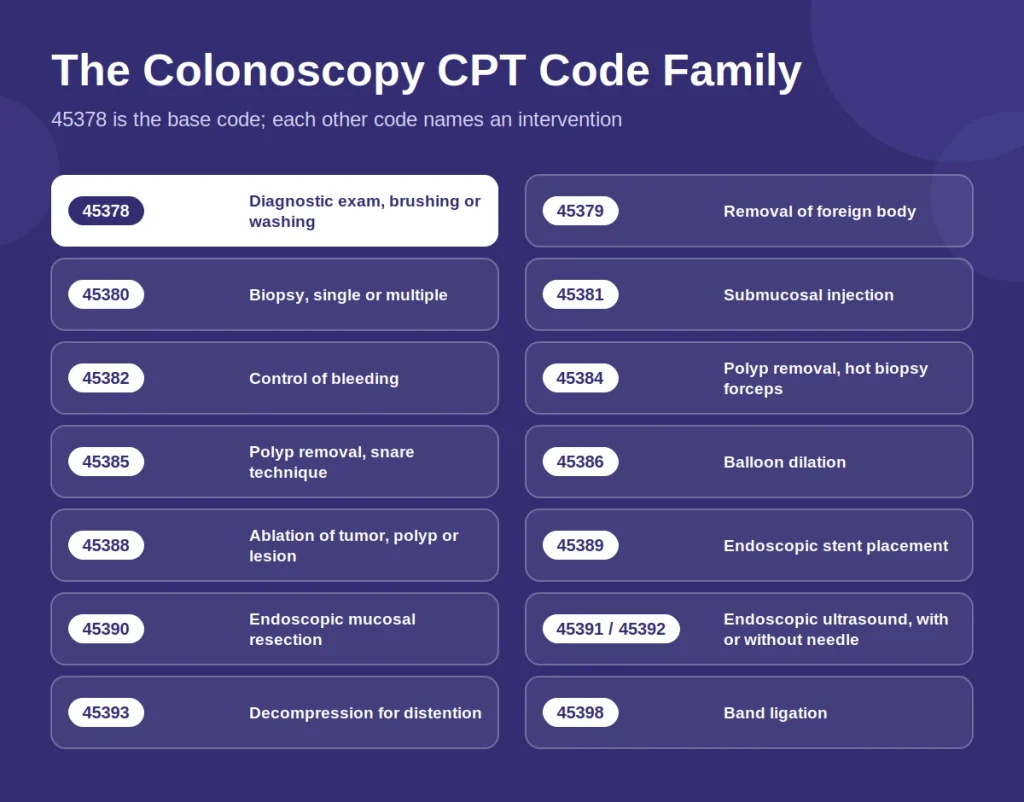
The base CPT code for colonoscopy is 45378, colonoscopy, flexible, diagnostic, including collection of specimens by brushing or washing when performed. Every other colonoscopy code adds a specific intervention. 45378 is the base code for the colonoscopy family, so it is included in any therapeutic colonoscopy code performed in the same session, as the AAPC code page for 45378 notes.
| CPT Code | Colonoscopy, Flexible, With |
|---|---|
| 45378 | Diagnostic examination, with brushing or washing when performed |
| 45379 | Removal of foreign body |
| 45380 | Biopsy, single or multiple |
| 45381 | Submucosal injection, any substance |
| 45382 | Control of bleeding, any method |
| 45384 | Removal of tumor, polyp or other lesion by hot biopsy forceps |
| 45385 | Removal of tumor, polyp or other lesion by snare technique |
| 45386 | Transendoscopic balloon dilation |
| 45388 | Ablation of tumor, polyp or other lesion |
| 45389 | Endoscopic stent placement |
| 45390 | Endoscopic mucosal resection |
| 45391, 45392 | Endoscopic ultrasound examination, with or without fine needle aspiration or biopsy |
| 45393 | Decompression for pathologic distention |
| 45398 | Band ligation |
Is CPT 45378 a Screening Colonoscopy?
No. CPT 45378 describes a diagnostic colonoscopy. It becomes a screening claim only through the payer’s screening rules. Medicare does not accept 45378 for screening; it requires G0121 for average-risk patients and G0105 for high-risk patients. Most commercial plans and many Medicaid programs accept 45378 for screening when modifier 33 is added and Z12.11 is the first-listed diagnosis.
What Is the Difference Between 45378 and 45380?
45378 is a colonoscopy with no intervention beyond brushing or washing. 45380 is a colonoscopy with biopsy, single or multiple. If the physician takes any cold biopsy, the claim moves from 45378 to 45380, and 45378 is not billed separately because it is included in 45380. 45380 is reported once, however many biopsies are taken.
What Is CPT Code 45385 for Colonoscopy?
CPT 45385 is a colonoscopy with removal of tumor, polyp or other lesion by snare technique, the most common way to remove larger polyps. It differs from 45384, which uses hot biopsy forceps, and from 45380, which is a biopsy. When different techniques are used on different lesions in the same session, each technique is reported once, and a distinct procedure modifier such as 59 or XS may be needed to show the lesions were separate. When two techniques are used on the same lesion, report only the code that accomplished the removal.
How Do You Code a Screening Colonoscopy?
A screening colonoscopy is performed on a patient without signs or symptoms. How it is billed depends on the payer:
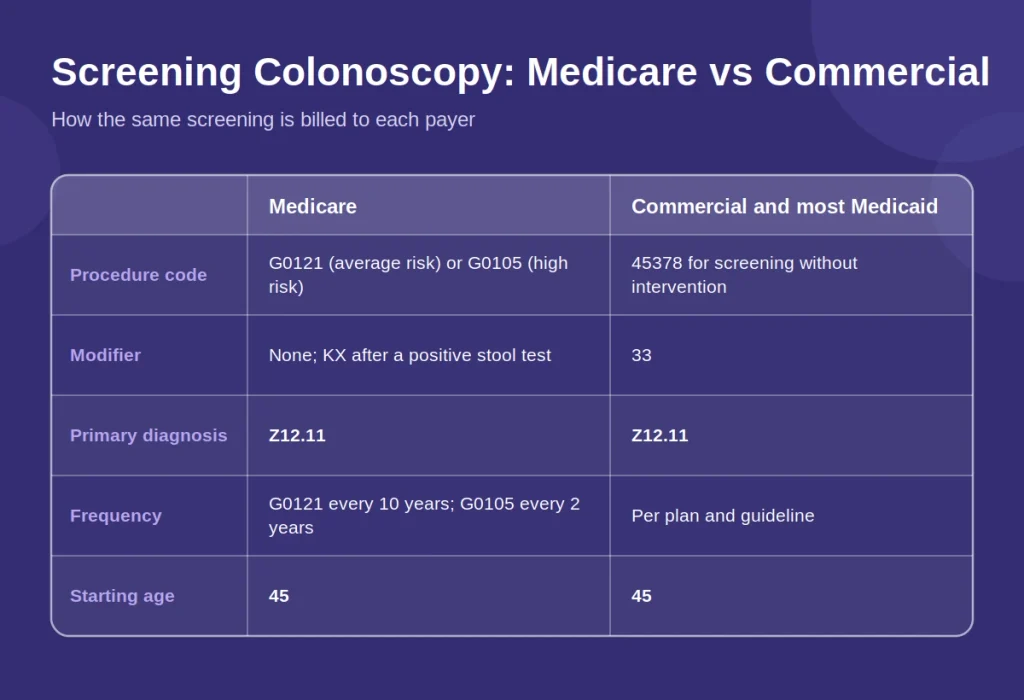
| Medicare | Commercial and Most Medicaid | |
|---|---|---|
| Procedure code | G0121 (average risk) or G0105 (high risk) | 45378 for screening without intervention |
| Modifier | None; KX after a positive stool test | 33 |
| Primary diagnosis | Z12.11 | Z12.11 |
| Frequency | G0121 once every 10 years (or 4 years after a screening flexible sigmoidoscopy); G0105 once every 2 years | Per plan and guideline |
| Starting age | 45 since 2023 | 45 under USPSTF-based ACA coverage |
When to Use Modifier 33 for Colonoscopy?
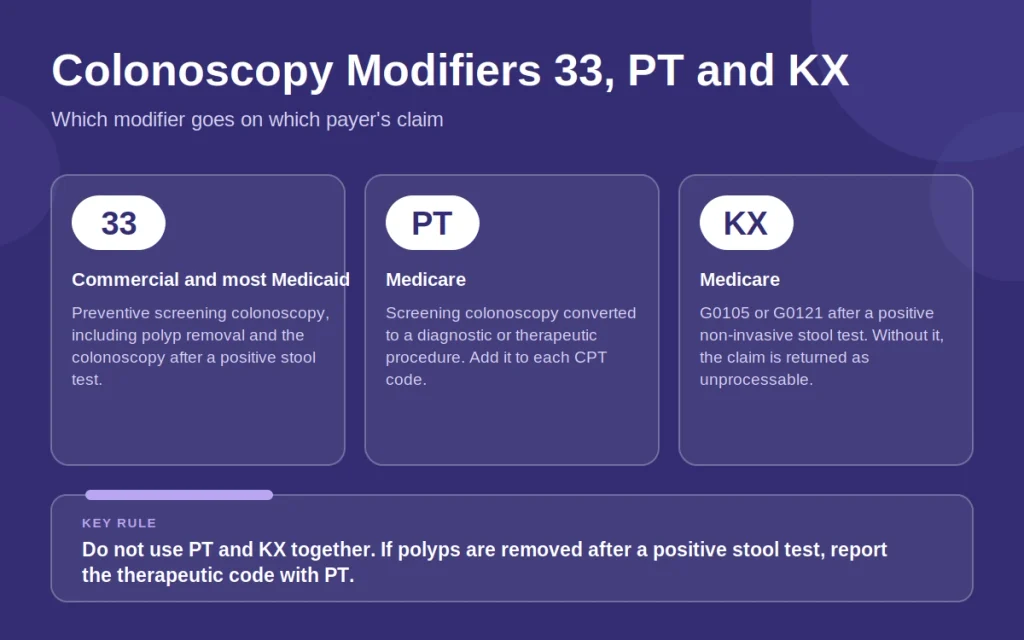
Use modifier 33 on commercial and most Medicaid claims when a colonoscopy is performed as a preventive screening service, so the plan applies its no-cost-sharing preventive benefit. Add it to 45378 for a screening with no intervention, to each therapeutic code when a polyp is removed during a screening and to the colonoscopy that follows a positive stool test. Medicare does not use modifier 33 for colonoscopy; it uses PT and KX instead.
| Modifier | Payer | When to Use It |
|---|---|---|
| 33 | Commercial and most Medicaid | Preventive screening colonoscopy, including when polyps are removed and after a positive stool test |
| PT | Medicare | Screening colonoscopy converted to a diagnostic or therapeutic procedure; add to each CPT code |
| KX | Medicare | Screening colonoscopy (G0105 or G0121) that follows a positive non-invasive stool-based test; claims without it are returned as unprocessable |
What Happens When a Screening Colonoscopy Becomes Diagnostic?
When a polyp is found and removed during a screening colonoscopy, the claim moves to the therapeutic code, but the encounter is still a screening encounter. Z12.11 stays first, the finding follows it and the screening modifier tells the payer to apply screening cost-sharing rules.
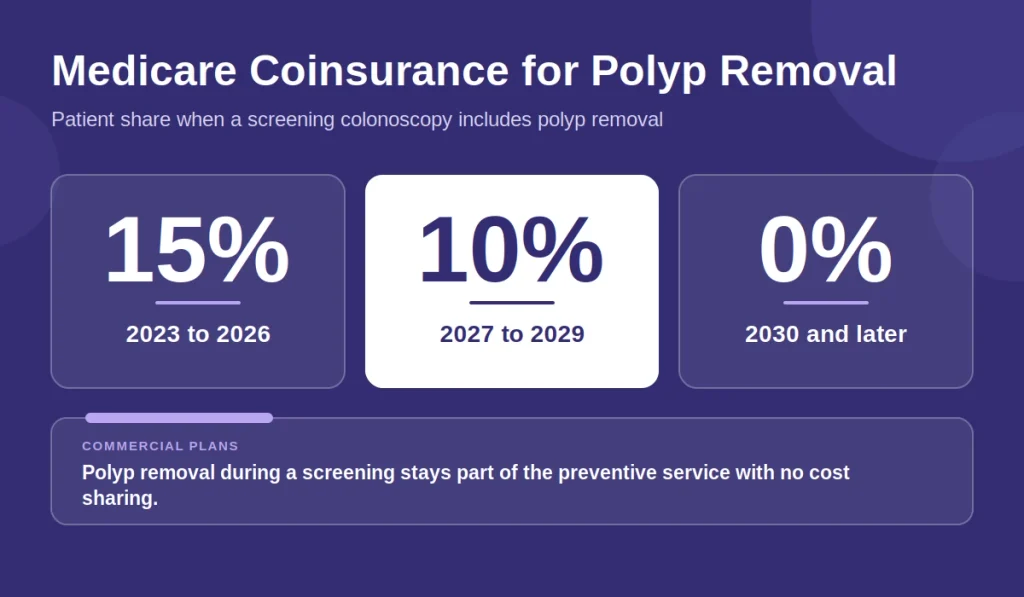
For commercial plans, removing a polyp during a screening colonoscopy remains part of the preventive service with no cost sharing, and plan years beginning on or after May 31, 2022 must also cover the colonoscopy after a positive stool test without cost sharing, as the AGA patient guide explains. For Medicare, the patient still owes part of the cost when a polyp is removed:
| Years | Medicare Patient Coinsurance When a Screening Colonoscopy Includes Polyp Removal |
|---|---|
| 2023 to 2026 | 15% |
| 2027 to 2029 | 10% |
| 2030 and later | 0% |
Colonoscopy CPT Codes and ICD-10 Diagnosis Codes: What’s the Difference?
The diagnosis codes tell the payer why the colonoscopy was done. Screening, high-risk screening, surveillance and diagnostic colonoscopies each use different codes.
| Purpose | ICD-10-CM Codes | Note |
|---|---|---|
| Average-risk screening | Z12.11 (colon), Z12.12 (rectum) | First-listed for screening encounters |
| High-risk screening | Z80.0 family history of digestive cancer; Z86.0100 to Z86.0109 personal history of colon polyps; Z85.038 personal history of colon cancer | Reported with Z12.11 to support high-risk status |
| Follow-up after positive stool test | Z12.11 plus R19.5 other fecal abnormalities | Medicare also needs modifier KX |
| Surveillance after treated cancer | Z08 plus the history code | Some MACs require this pairing |
| Common diagnostic indications | K92.1 melena; K92.2 GI hemorrhage; R19.4 change in bowel habit; D50.0 iron deficiency anemia from blood loss; K63.5 polyp of colon; D12.- benign neoplasm of colon | For diagnostic colonoscopies, code the result if known, otherwise the symptom |
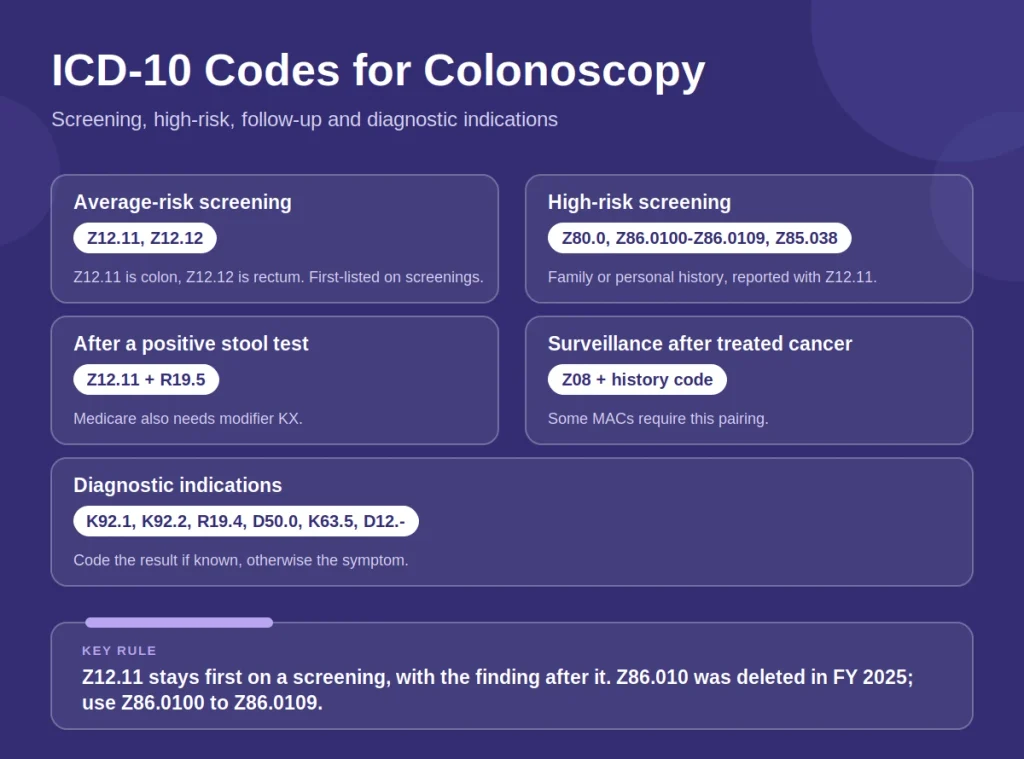
Two details trip up many claims. The personal history of colon polyps code Z86.010 was deleted in FY 2025 and replaced by Z86.0100, Z86.0101, Z86.0102 and Z86.0109, and one Medicare contractor requires surveillance colonoscopies to report Z08 first with a history code second, as CGS article A56456 states. When a screening finds a condition, the screening code stays first and the finding is added after it.
Will Insurance Pay for a Colonoscopy Before 45?
As a routine screening, usually not: Medicare and most commercial plans start average-risk screening coverage at age 45. Before 45, a colonoscopy is typically covered in two situations. The first is a diagnostic colonoscopy for symptoms such as bleeding, anemia or a change in bowel habits, which is covered as a medical service with normal deductibles and coinsurance. The second is screening for patients at high risk, such as those with a family history of colorectal cancer, when the plan’s criteria allow earlier screening.
How Do You Code an Incomplete Colonoscopy?
A colonoscopy examines the entire colon to the cecum. Under CPT guidance, if the scope is not advanced past the splenic flexure, the procedure is reported as a flexible sigmoidoscopy, not a colonoscopy. If it passes the splenic flexure but does not reach the cecum, it is reported as a colonoscopy with a reduced or discontinued service modifier. Modifier choice differs by payer and by whether a physician or facility is billing, so confirm the payer’s instruction and document the reason, such as poor preparation or an obstruction.
How Are Anesthesia Services Billed With Colonoscopy?
| Code | Service |
|---|---|
| 00811 | Anesthesia for lower intestinal endoscopic procedures, not otherwise specified |
| 00812 | Anesthesia for screening colonoscopy |
| 00813 | Anesthesia for combined upper and lower GI endoscopic procedures |
Anesthesia for a screening colonoscopy that becomes therapeutic generally moves from 00812 to 00811, with the same screening modifier the procedure claim carries (PT for Medicare or 33 for commercial plans). Moderate sedation by the endoscopist is billed with the moderate sedation codes, subject to payer rules.
What Are the Most Common Colonoscopy Billing Errors?
| Error | What Happens | Fix |
|---|---|---|
| 45378 billed to Medicare for a screening | Patient charged cost sharing or claim processed as diagnostic | Use G0121 or G0105 |
| Missing KX after a positive stool test | Medicare returns the claim as unprocessable | Add KX to G0121 or G0105 |
| Missing PT or 33 when polyps are removed | Screening benefit not applied; patient billed | Add the screening modifier to each procedure code |
| Symptom coded first on a screening | Claim processed as diagnostic | List Z12.11 first and the finding second |
| 45378 billed with a therapeutic code | Bundling denial | Report only the therapeutic code |
| Deleted Z86.010 still in use | Invalid diagnosis code | Use Z86.0100 to Z86.0109 |
| Screening billed before the frequency limit | Medicare denial | Check the last screening date before scheduling |
These errors usually return as CARC 16, 97 or 119 on the remittance, as our guide to common denial codes in medical billing explains. Checking frequency limits and screening history before the procedure, through eligibility verification, prevents most of them.
What Is the CPT Code for Diagnostic Laparoscopy?
Diagnostic laparoscopy is a different procedure from colonoscopy. It is reported with CPT 49320, laparoscopy, abdomen, peritoneum and omentum, diagnostic, with or without collection of specimens by brushing or washing. It is not billed separately when a surgical laparoscopy is performed in the same session.

Frequently Asked Questions
What is the CPT code for a screening colonoscopy?
For Medicare, G0121 for average-risk patients and G0105 for high-risk patients. For most commercial plans, 45378 with modifier 33 and Z12.11 as the first diagnosis.
What is the ICD-10 code for a screening colonoscopy?
Z12.11, encounter for screening for malignant neoplasm of colon, listed first. Add risk factor codes such as Z80.0 or Z86.0101 for high-risk screening.
What is the CPT code for a diagnostic colonoscopy?
CPT 45378 for a diagnostic colonoscopy with no intervention, or the therapeutic code that matches what was done, such as 45380 for biopsy or 45385 for snare polypectomy.
What is the CPT code for a preventive colonoscopy?
Preventive is the same as screening: G0121 or G0105 for Medicare and 45378 with modifier 33 for most commercial plans.
What is the dx code for colonoscopy with polyps found?
Keep Z12.11 first for a screening, then add the polyp finding, such as K63.5 for a colon polyp or a D12.- code once pathology confirms an adenoma.
Can 45378 and 45380 be billed together?
No. 45378 is included in 45380 and every other therapeutic colonoscopy code performed in the same session.