

A practice that collects $80,000 a month pays $2,392 a month for billing at 2.99% of collections and $5,600 at 7%. Over a year, that difference is $38,496, before anyone has asked what the percentage actually covers.
That second question is where most practices overpay. Two billing companies can quote the same rate and charge very different amounts once setup fees, minimums, A/R cleanup rates and add-on services are counted. This guide breaks down what medical billing outsourcing costs in 2027, how each pricing model works, which charges hide in contracts and how to compare an outsourced quote with the true cost of billing in-house.
Quick answer: Most medical billing companies charge a percentage of collections, with headline rates commonly around 4% to 7%, as Medical Economics reported. Others charge per claim, a flat monthly fee or an hourly rate. iSolve RCM starts at 2.99% of monthly collections. The real cost depends on what the rate includes and which fees sit outside it.
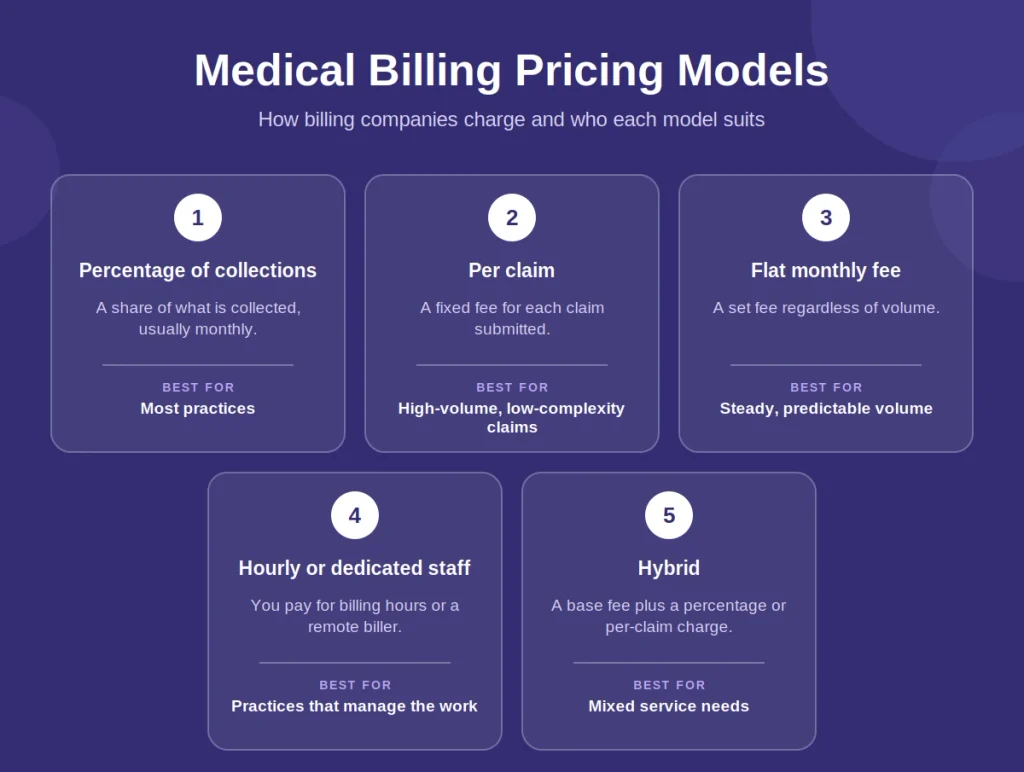
Medical Billing Outsourcing Cost: Pricing Models at a Glance
| Pricing Model | How It Works | Best For |
|---|---|---|
| Percentage of collections | A share of what the billing company collects, usually monthly | Most practices; aligns the vendor’s pay with your collections |
| Per claim | A fixed fee for each claim submitted | High-volume, low-complexity claims |
| Flat monthly fee | A set fee regardless of volume | Practices with steady, predictable volume |
| Hourly or dedicated staff | You pay for billing hours or a full-time remote biller | Practices that want to manage the work themselves |
| Hybrid | A base fee plus a percentage or per-claim charge | Practices with mixed service needs |
How Much Does It Cost to Outsource Medical Billing?
For most practices, outsourcing medical billing costs a percentage of monthly collections, commonly in the 4% to 7% range for headline rates, with specialty, claim volume and the services included moving the number up or down. Low-volume or high-complexity specialties often pay more; high-volume practices with clean claims often pay less.
| Monthly Collections | At 2.99% | At 4% | At 7% |
|---|---|---|---|
| $30,000 | $897 | $1,200 | $2,100 |
| $80,000 | $2,392 | $3,200 | $5,600 |
| $150,000 | $4,485 | $6,000 | $10,500 |
| $300,000 | $8,970 | $12,000 | $21,000 |
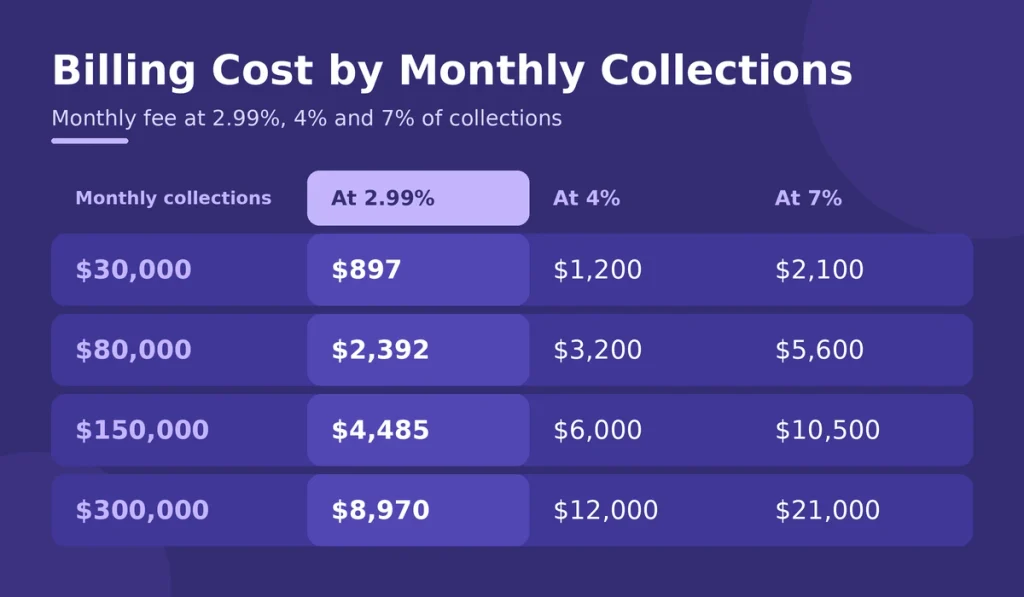
Illustrative math. Headline industry range from Medical Economics; 2.99% is iSolve RCM’s published starting rate.
Other models price differently. Per-claim fees are a fixed amount per submitted claim, so cost tracks volume rather than collections. Hourly models can look inexpensive: Sunknowledge, for example, publishes a flat rate of $7 per hour, but the practice usually manages the work, sets targets and carries more of the oversight.
What Pricing Models Do Medical Billing Companies Use?
| Model | Advantages | Watch Out For |
|---|---|---|
| Percentage of collections | The company is paid only when you are; costs scale with revenue | What counts as “collections,” and whether patient payments, capitation and incentive payments are included |
| Per claim | Predictable unit price | Fees for resubmissions and appeals; less incentive to chase low-dollar claims |
| Flat monthly fee | Easy to budget | Service limits and extra charges when volume grows |
| Hourly or dedicated staff | Low hourly cost and direct control | Management time, productivity risk and coverage gaps |
| Hybrid | Can match mixed needs | Complexity that makes quotes hard to compare |
Pro Tip: Ask every vendor to price the same sample month of your claims. A percentage, a per-claim price and a flat fee only become comparable when they are applied to the same volume and payer mix.
What Hidden Charges Should You Watch For?
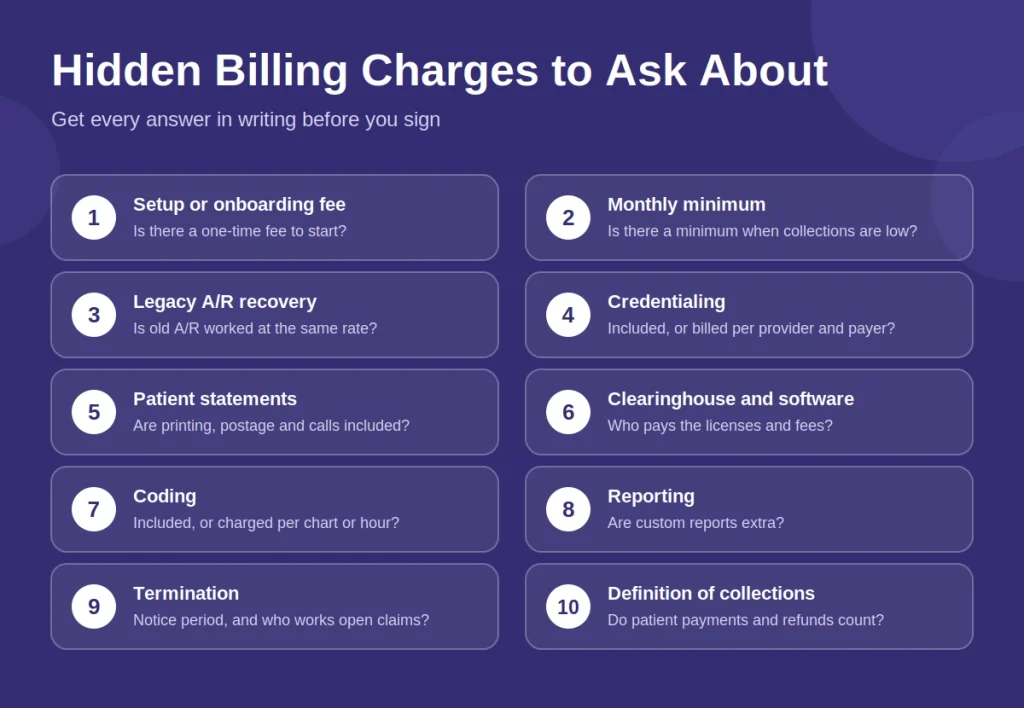
Hidden charges are rarely hidden on purpose. They sit in the contract, outside the headline rate. These are the ones to ask about in writing:
| Charge | What to Ask |
|---|---|
| Setup or onboarding fee | Is there a one-time fee to start, and what does it cover? |
| Monthly minimum | Is there a minimum fee in months when collections are low? |
| Legacy A/R recovery | Does old A/R work at the same rate or a higher one? |
| Credentialing | Is credentialing included, or billed per provider and per payer? |
| Patient statements | Are printing, postage and patient call support included? |
| Clearinghouse and software | Who pays clearinghouse fees and practice management software licenses? |
| Coding | Is coding included, or charged per chart or per hour? |
| Reporting | Are monthly reports included, or are custom reports extra? |
| Termination | What is the notice period, and who works claims still open after you leave? |
| Definition of collections | Does the percentage apply to every payment, including patient payments and refunds? |
How Much Does In-House Medical Billing Cost?
In-house billing costs more than one salary. The Bureau of Labor Statistics reports a median annual wage of $50,250 for medical records specialists in May 2024, the occupation group that includes billing and coding staff. Benefits add roughly 30% to total compensation according to BLS employer cost data, as summarized by Stealth Agents’ analysis, which brings one biller to about $71,800 a year before anything else.
| In-House Cost | What It Includes |
|---|---|
| Salary and benefits | About $71,800 per full-time biller at the BLS median wage with a 30% benefits load |
| Software | Practice management and billing software licenses |
| Clearinghouse | Claim submission and remittance fees |
| Training and certification | Code set updates, payer rule changes and continuing education |
| Supervision | Manager time spent on billing oversight |
| Turnover and coverage | Recruiting, onboarding and gaps during vacations or vacancies |
| Denials and rework | Premier found each denied claim costs about $57.23 to work, according to its claims cost analysis |
How Do You Calculate Outsourcing Cost?
Outsourced cost = (monthly collections x percentage rate) + any fixed fees + add-on services.
In-house cost = salaries + benefits + software + clearinghouse + training + supervision + the cost of denials and turnover.
Compare the two over a full year, and include the revenue effect, not just the expense. If a billing partner raises your net collection rate by even one or two percentage points, that gain often outweighs the fee difference. Here is a worked example for a practice collecting $1 million a year with one full-time biller:
| In-House | Outsourced at 2.99% | Outsourced at 6% | |
|---|---|---|---|
| Staff cost (salary and benefits) | About $71,800 | Included | Included |
| Billing fee | None | $29,900 | $60,000 |
| Software and clearinghouse | Practice pays | Check the contract | Check the contract |
| Coverage during absences | Practice covers | Vendor covers | Vendor covers |
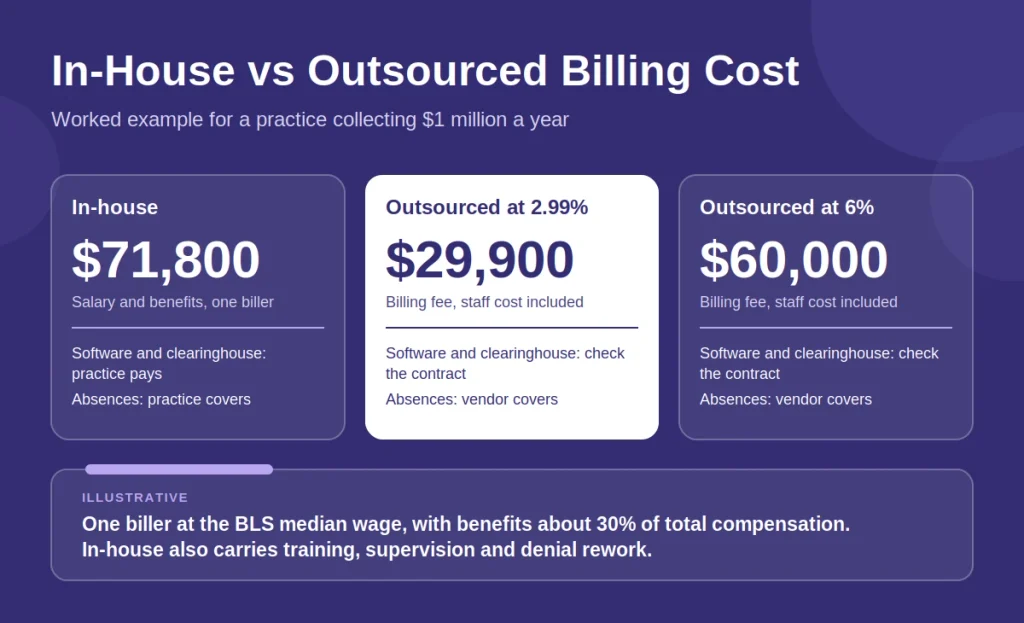
Illustrative example using the BLS median wage and a 30% benefits load; actual costs vary by location, specialty and contract.
For the collection side of the equation, our guide to average medical billing collection rates explains how to measure the net collection rate you should expect from any billing partner.
What Does Outsourced Medical Coding Cost?
Medical coding outsourcing is usually priced per chart, per hour, as a dedicated full-time coder or as part of a percentage-of-collections billing contract. In-house, certified coders cost more than general billing staff: AAPC’s 2026 salary survey reported that credentialed professionals averaged $65,007 in 2025, as Judge Group summarized. Outsourcing makes the most sense for specialty coding, overflow during code set updates and audit work, where a specialist team is faster than training in-house staff. When coding is bundled into your billing rate, confirm whether medical coding audits and query support are included.
Is Offshore Medical Billing Cheaper?
Offshore medical billing companies can offer lower rates because labor costs are lower, and many US billing companies use offshore teams for parts of the work. HIPAA does not prohibit offshore billing, but every company or subcontractor that handles patient data must sign a business associate agreement and follow HIPAA safeguards, and some payer contracts and state programs restrict offshore access to their members’ data. The cheaper rate only pays off when quality controls, US-based account management and clear reporting keep denials low.
Is Outsourcing Medical Billing a Good Idea?
For most small and mid-size practices, yes, when the partner is chosen carefully. The main benefits of outsourcing medical billing services are:
- Predictable cost tied to collections instead of fixed salaries.
- Specialists in coding, denials, credentialing and payer rules that one or two in-house billers cannot cover.
- No gaps when staff leave or take time off.
- Faster follow-up on denials and aging A/R.
- Monthly reporting that shows exactly where revenue is lost.
Outsourcing is a poor fit when a practice has a strong in-house team with low denials, or when the vendor cannot show results in your specialty. Our guide to outsourced medical billing services covers how to evaluate a partner.
How Much Should I Charge for Medical Billing Services?
If you run a billing service, most companies price as a percentage of collections, commonly in the 4% to 7% range, adjusted for specialty, claim volume, average claim value and the services included. Low-volume or high-touch specialties justify higher rates, while high-volume clients with clean claims justify lower ones. Whatever model you use, list every service the rate covers and every fee outside it, because transparent pricing wins more contracts than a low headline rate.
What Is the 72-Hour Rule in Medical Billing?
The 72-hour rule is Medicare’s three-day payment window. When a patient is admitted to a hospital paid under the inpatient prospective payment system, outpatient diagnostic services and related non-diagnostic services the hospital provided in the three days before admission are bundled into the inpatient claim. For hospitals outside that system, such as psychiatric and rehabilitation hospitals, the window is one day. Hospital billing outsourcing partners must apply this rule correctly, or outpatient claims billed separately create overpayments.
What Should a Medical Billing Outsourcing Contract Include?
- The pricing model and rate, with a clear definition of “collections.”
- Every included service: coding, claim submission, payment posting, denials, appeals, A/R follow-up, patient statements and credentialing.
- Every fee outside the rate, including setup, minimums and A/R cleanup.
- Performance metrics and reporting frequency, such as net collection rate and days in A/R.
- Data ownership, HIPAA safeguards and a signed business associate agreement.
- Termination terms and how open claims are handled after the contract ends.
How Does iSolve RCM Price Medical Billing?
iSolve RCM prices medical billing from 2.99% of monthly collections, with no hidden service fees, as listed on its pricing page. The service covers claim submission and management, payment posting, denial management and A/R management, with medical coding, billing audits and credentialing available. Onboarding typically takes one to two weeks, and the practice keeps its current EHR.

Frequently Asked Questions
What is the average cost of outsourcing medical billing?
Most practices pay a percentage of collections, with headline rates commonly between 4% and 7%. iSolve RCM starts at 2.99%. Compare what each rate includes before choosing.
How much does outsourced medical coding cost?
Outsourced coding is priced per chart, per hour, as a dedicated coder or as part of a percentage-of-collections billing contract. Costs depend on specialty complexity and volume.
Is outsourced billing and collections the same service?
Not always. Some billing companies handle insurance billing only, while others include patient statements and patient balance follow-up. Collection agency work for bad debt is usually separate and priced differently.
Does hospital billing outsourcing cost more than physician billing?
Hospital billing involves institutional claims, revenue codes, DRGs and rules such as the three-day payment window, so hospital contracts are usually larger and priced differently from physician practice billing.
Are there setup fees for outsourcing medical billing?
Some companies charge a one-time setup or onboarding fee; others, including iSolve RCM, do not list hidden service fees. Ask for every fee in writing before signing.
How quickly can a practice switch to an outsourced billing company?
Onboarding usually takes a few weeks depending on practice size and A/R volume. iSolve RCM typically onboards practices in one to two weeks.