

A complete transthoracic echo billed as 93307 with color flow Doppler 93325 is denied every time, and has been since 2009, because CPT does not allow the Doppler add-ons with 93307. The code that includes Doppler and color flow is 93306, as our guide to echocardiogram CPT codes explains. It is a small error with a large pattern behind it: most cardiology diagnostic testing denials come from a handful of code-pairing, component and authorization rules that repeat until someone fixes them before the claim is sent.
Cardiology billing stacks more of these rules into one encounter than almost any specialty. A single visit can produce an E/M service, a diagnostic test split into professional and technical components and a procedure governed by National Correct Coding Initiative (NCCI) edits. Each layer can fail on its own, and each failure leaves its own reason code on the remittance.
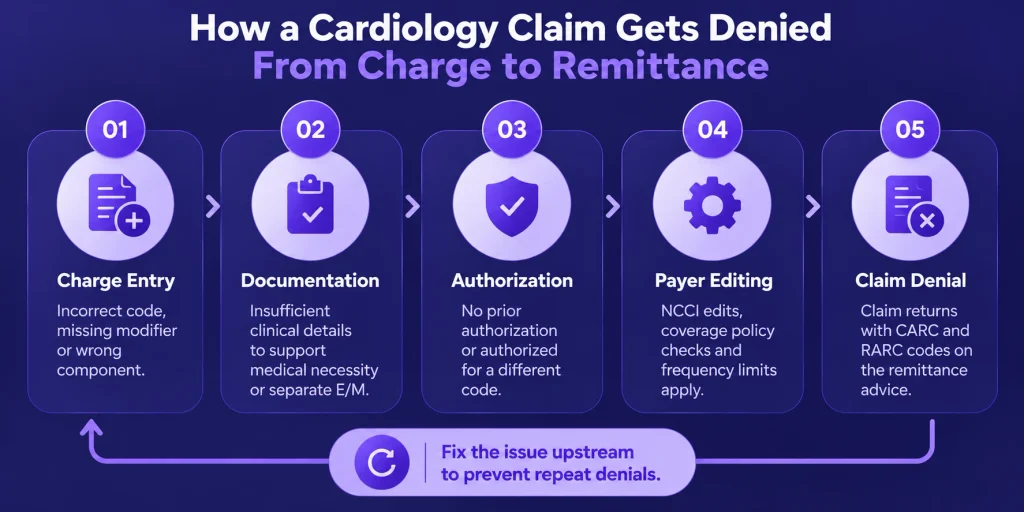
Quick review: The five most common cardiology billing denials are modifier errors on professional and technical components (CARC 4), NCCI bundling of tests and procedures (CARC 97 or 236), medical necessity failures under coverage policies (CARC 50), missing or mismatched prior authorization (CARC 197) and frequency limits on monitoring and device checks (CARC 151). Each one is prevented upstream: in the charge template, the documentation or the authorization workflow.
Top 10 Cardiology Denials and Actions
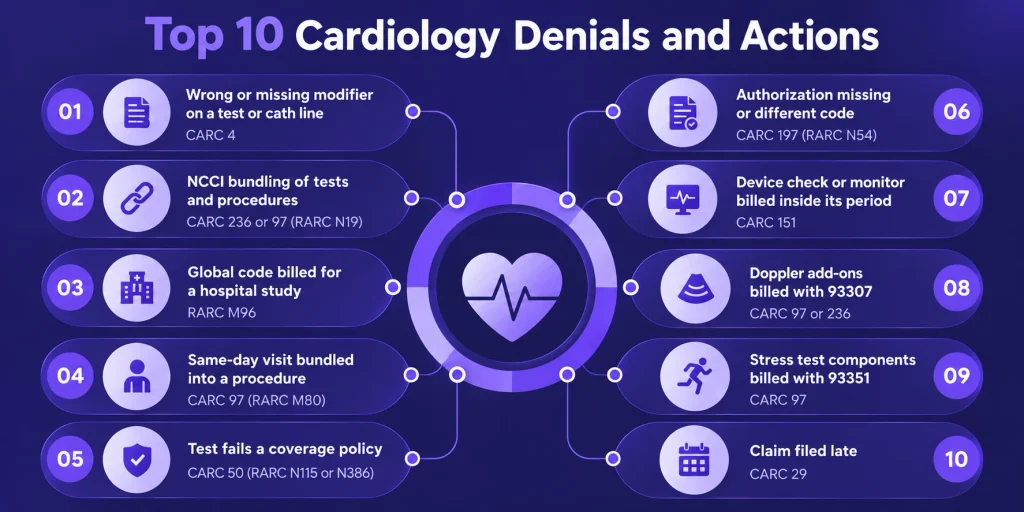
| Denial Pattern | Remittance Codes | Action |
|---|---|---|
| Wrong or missing modifier on a test or cath line | CARC 4 | Fix modifier logic in the charge template by service line |
| Diagnostic cath and PCI, or two imaging codes, billed as an NCCI pair | CARC 236, or CARC 97 with RARC N19 | Bill a distinct service only when documentation supports it |
| Global code billed for a hospital study | RARC M96 | Bill modifier 26 only when the facility owns the equipment |
| Same-day visit bundled into a procedure | CARC 97 with RARC M80 | Separate E/M documentation and modifier 25 |
| Test fails a coverage policy | CARC 50 with RARC N115 (LCD) or N386 (NCD) | Match the diagnosis to the policy before submission |
| Authorization missing or for a different code | CARC 197 or RARC N54 | Compare the authorized code with the code performed |
| Device check or monitor billed inside its period | CARC 151 | Track monitoring periods per patient |
| Doppler add-ons billed with 93307 | CARC 97 or 236 | Use 93306 when Doppler and color flow are performed |
| Stress test components billed with 93351 | CARC 97 | Do not add 93016 to 93018 to 93351, which includes them |
| Claim filed late | CARC 29 | Submit within days of service and keep acceptance reports |
Remittance code meanings: X12 CARC and RARC lists. See our guide to common denial codes in medical billing.

Why Do Cardiology Claims Get Denied So Often?
Cardiology claims carry more upstream decisions per encounter than most specialties: which component to bill, which codes can be reported together, whether a test meets a coverage policy and whether the authorization matches what was done. Across all specialties, 41% of providers reported that at least 10% of their claims were denied in Experian Health’s 2025 State of Claims survey. Cardiology’s higher-value tests and procedures make each of those denials more expensive.
The practical point is where the denial starts. A claim fixed and resubmitted after the denial recovers that one payment; a template, documentation habit or authorization step fixed before the claim prevents the next hundred.
What Are Five Common Denials in Cardiology Billing?
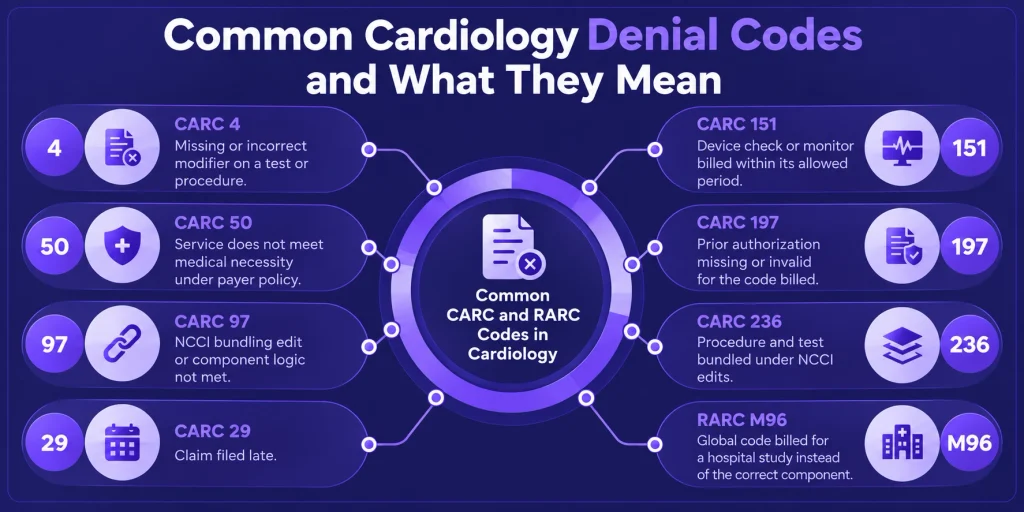
1. Component modifier errors. Billing a global code for a study performed in a hospital, or a professional component without modifier 26, returns CARC 4 or RARC M96.
2. Bundling and NCCI edits. Reporting tests or procedures that NCCI pairs together, such as a diagnostic cath with a same-session PCI without documented support, returns CARC 97 or 236.
3. Medical necessity. A test billed with a diagnosis that does not meet the applicable LCD or NCD returns CARC 50 with N115 or N386.
4. Prior authorization. A missing authorization, or one for a different code, returns CARC 197 or N54.
5. Frequency limits. A device interrogation, Holter or echo billed inside the payer’s frequency window returns CARC 151.
How Do You Prevent Diagnostic Testing Payment Errors?
Diagnostic testing payment errors come from code-pairing and component rules that are easy to miss in a busy charge entry queue. These are the rules that matter most:
| Test | Codes | Rule That Prevents the Error |
|---|---|---|
| Transthoracic echo | 93306, 93307, 93308 | 93306 includes spectral and color Doppler; 93307 cannot be billed with Doppler add-ons 93320, 93321 or 93325; 93308 is a limited or follow-up study |
| Strain imaging | +93356 | Add-on to a primary echo code when strain imaging is performed and documented |
| Stress echo | 93350, 93351 | 93351 includes stress test supervision, tracing and interpretation, so 93016 to 93018 are not billed with it |
| Stress test | 93015 to 93018 | 93015 is global; 93016 supervision, 93017 tracing, 93018 interpretation are billed by whoever performs each part |
| Nuclear imaging (SPECT) | 78451, 78452 plus stress codes | Bill the stress component, radiopharmaceutical and pharmacologic agent (such as J2785 regadenoson or J0153 adenosine) separately when performed |
| ECG | 93000, 93005, 93010 | 93000 is global; 93005 tracing only; 93010 interpretation only |
| Ambulatory monitoring | 93224 to 93227, 93241 to 93248 | Choose the code by monitoring duration and component; payers apply frequency limits |
| Remote device monitoring | 93294, 93295, 93296 | Each covers a 90-day period; a second claim inside the period is denied for frequency |
Source: AMA CPT code set; CMS Physician Fee Schedule component indicators.
Professional and technical components follow place of service
Most cardiac diagnostics split into a technical component, billed with modifier TC for the equipment, staff and supplies, and a professional component, billed with modifier 26 for the interpretation. Where the study happens decides what the cardiologist bills. In a hospital, the facility bills the technical side and the cardiologist bills modifier 26 only; a global code for an inpatient study returns RARC M96. In an office with practice-owned equipment, the global code is correct.
Pro Tip: Build place-of-service logic into the charge template so hospital studies default to modifier 26. Component errors are the easiest cardiology denials to eliminate permanently.
The Most Commonly Denied Cardiology CPT Codes
These codes run into denials most often in cardiology practices, and the reason is usually the same each time:
| CPT Code | Service | Typical Denial Reason |
|---|---|---|
| 93306, 93307 | Transthoracic echo | Frequency limits, medical necessity or Doppler add-on pairing |
| 93350, 93351 | Stress echo | Authorization for the wrong code; stress components billed twice |
| 78452 | Multiple-study SPECT | Authorization and medical necessity |
| 93458 to 93461 | Diagnostic catheterization | NCCI bundling with same-session PCI |
| 92928, 92930 | Coronary stenting | Authorization, documentation of complex criteria for 92930 |
| 93000 | ECG | Bundled with an E/M by some payers |
| 93224, 93241 to 93248 | Ambulatory monitoring | Frequency and duration documentation |
| 93294 to 93296 | Remote device monitoring | Billed inside the 90-day period |
Why Do Prior Authorization Failures Cause So Many Cardiology Denials?
Commercial and Medicare Advantage payers often require authorization for advanced cardiac imaging and outpatient procedures, and the authorization attaches to a specific CPT code. That is where denials hide: a stress echo authorized as 93350 and performed as 93351, or a diagnostic cath that converts to a stent, no longer matches the code on file and returns CARC 197 or N54. Since January 1, 2026, Medicare Advantage and Medicaid plans must decide standard requests within 7 days and urgent ones within 72 hours, and give a specific reason for every denial, which makes the reason on the denial worth reading closely.
Prevention is a workflow, not a form: check requirements at scheduling, compare the authorized code with the scheduled and performed codes and send any code change back to the authorization staff before the claim goes out.
How Do You Handle Denial Management in Cardiology Billing?
| Step | What It Involves |
|---|---|
| 1. Triage weekly | Sort new denials by reason code, payer, CPT family and dollar value the week they arrive |
| 2. Correct or appeal | Correct data errors and resubmit; appeal clinical denials with records and the coverage policy |
| 3. Track deadlines by payer | Medicare allows 120 days for a redetermination; Aetna allows 180 days to file a reconsideration and 60 days after it to appeal |
| 4. Find the root cause | Trace each repeat reason code to the template, document or workflow step that caused it |
| 5. Fix upstream | Update charge templates, documentation prompts and authorization checks |
| 6. Measure | Watch denial rate by code and payer to confirm the fix worked |
Source: Aetna disputes and appeals overview; Medicare appeals rules.
Our denial management team works this cycle for cardiology practices, with appeal deadlines tracked by payer.
Why Reactive Denial Management No Longer Works
Reactive denial management means working denials in monthly batches, resubmitting without fixing the cause and letting the same reason codes return next month. In cardiology, that approach costs more each year because payers apply automated edits at submission, coding rules change annually and every unworked week moves a claim closer to its appeal deadline. Fixing the claim recovers one payment; fixing the template protects every claim after it.
What Effective Cardiology RCM Looks Like Now
- Modifiers and components validated before submission, not corrected after denial.
- Code-pairing rules for echo, stress and nuclear studies built into the claim scrubber.
- Authorizations checked against the performed code before billing.
- Diagnosis-to-policy checks for tests covered by LCDs and NCDs.
- Frequency tracking for device monitoring and ambulatory monitors.
- Denials triaged weekly, with appeal deadlines tracked by payer.
- Coding updated every January for new and deleted cardiology codes.
Can NCCI Bundling Changes Still Cause Cath Lab Claim Denials?
Yes. NCCI edits are updated every quarter, and cath lab codes are among the most frequently edited. A diagnostic catheterization (93451 to 93461) performed in the same session as a PCI is reportable only when documentation supports it, for example when no prior study is available, the prior study is inadequate or the patient’s condition has changed. The coronary artery modifiers (LC, LD, RC, LM and RI) take priority over modifier 59 or XS, which CMS says should be used only when no more specific modifier describes the service.
What Are the Changes in Cardiology CPT Codes in 2027?
The AMA released the CPT 2027 code set in September 2026 with 299 new codes, 74 revisions and 80 deletions, effective January 1, 2027. For cardiology, it adds three new codes for left ventricular assist device procedures with revised guidelines, as Becker’s Cardiology reported, and Category III codes 0408T to 0418T for cardiac contractility modulation systems expire, according to Allzone’s CPT 2027 summary.
Many 2026 changes are still causing denials. CPT 2026 created 92930 for complex PCI, deleted several branch add-on codes and replaced the lower extremity revascularization set with 46 new codes, as Cardiovascular Business reported. It also added Category III codes 0948T and 0949T for remote cardiac contractility modulation interrogation, according to StreamlineMD. A claim built on a 2025 template can still fail on these in 2027.
| Change | Effective | Billing Action |
|---|---|---|
| 92930 complex PCI | January 1, 2026 | Document the complex criteria; 92928 remains for simple PCI |
| PCI branch add-ons deleted | January 1, 2026 | Remove deleted codes from templates |
| 46 new lower extremity revascularization codes | January 1, 2026 | Update vascular templates and coder training |
| 0948T, 0949T remote CCM interrogation | January 1, 2026 | Use for remote cardiac contractility modulation checks |
| Three new LVAD codes | January 1, 2027 | Load before the first 2027 claim |
| 0408T to 0418T expire | January 1, 2027 | Remove from charge masters |
What’s the Biggest 2027 Change Affecting Cardiology RCM?
The proposed 2027 Medicare Physician Fee Schedule would reduce payment for an E/M visit billed with modifier 25 on the same day as a procedure with a 0-, 10- or 90-day global period, as Penn State’s rural health office summarized. Diagnostic catheterization carries a 0-day global period, so a same-day consult and cath, one of cardiology’s most common combinations, would pay less. The same proposal lowers the conversion factor about 1.68% and turns G2211 into a modifier. The final rule is expected in November 2026.
Are Appeal Windows Shrinking for Cardiology Claims?
Not broadly. Medicare still allows 120 days to request a redetermination, and Aetna’s published windows, 180 days for a reconsideration and 60 days to appeal after it, were updated in October 2026 without a reduction. What has changed is how much time practices lose before they start: denials worked in monthly batches use up a quarter of the window before anyone reads them. Each payer’s contract sets its own deadlines, so track them by payer rather than assuming one rule.
How Does iSolve RCM Prevent Cardiology Billing Denials?
iSolve RCM assigns a dedicated team to each cardiology client, so the people coding your echo, stress, nuclear and cath claims know your physicians, sites and payers. Our certified medical coding team builds component, pairing and frequency rules into the charge template, checks authorizations against the performed code and works denials weekly with appeal deadlines tracked by payer. A medical billing audit shows which of the ten patterns above are costing your practice the most, with services starting at 2.99% of monthly collections.

Frequently Asked Questions
What are the top denials in cardiology billing?
Modifier and component errors, NCCI bundling, medical necessity failures under LCDs and NCDs, prior authorization mismatches, frequency limits on monitoring and device checks, same-day E/M bundling and late filing.
Can 93307 be billed with 93325?
No. CPT does not allow the Doppler add-ons 93320, 93321 or 93325 with 93307. When a complete echo includes spectral and color Doppler, bill 93306.
Can I bill 93016 to 93018 with a stress echo?
Not with 93351, which already includes stress test supervision, tracing and interpretation. With 93350, the stress test components can be billed separately when performed.
Why was my hospital echo denied with M96?
RARC M96 means only the inpatient facility can bill the technical component. The cardiologist should bill the professional component with modifier 26.
How often can remote device monitoring be billed?
Codes 93294, 93295 and 93296 each cover a 90-day monitoring period, so a second claim inside the same period is denied for frequency.
What does a cardiology medical billing company do?
It codes and bills cardiology services, manages component and modifier rules, checks authorizations, appeals denials and fixes the upstream causes of repeat denials.