
Attach a Certificate of Medical Necessity to a Medicare DME claim today and the claim will be rejected. CMS eliminated all remaining CMNs and DME Information Forms (DIFs) for claims with dates of service on or after January 1, 2023, and claims that still carry one are returned to the supplier, as CGS, the DME MAC for Jurisdictions B and C, explains. Yet many DME billing guides still tell suppliers to file them.
That is the problem with DME billing in one example. The rules change, old habits stay in templates and the claim fails on a requirement that no longer exists, or misses one that does. Durable medical equipment billing has its own contractors, codes, modifiers, payment categories and documentation rules, and Medicare, Medicare Advantage, Medicaid and commercial plans each apply them differently.
Quick answer: DME billing is the process of getting paid for durable medical equipment, prosthetics, orthotics and supplies prescribed for home use. Medicare DME claims are billed by an enrolled DMEPOS supplier to the DME MAC for the patient’s home state, on the CMS-1500 or 837P, with HCPCS Level II codes and modifiers. The supplier must hold a standard written order, medical records that meet the coverage policy, any required prior authorization and proof of delivery. CMNs are no longer used for Medicare.
DME Billing at a Glance
| Element | Medicare Requirement |
|---|---|
| Who bills | A DMEPOS supplier enrolled in Medicare and accredited |
| Where claims go | The DME MAC for the beneficiary’s permanent residence (Jurisdictions A, B, C or D) |
| Claim form | CMS-1500 or 837P |
| Codes | HCPCS Level II (E, K, L, A, B and other codes), not CPT |
| Key documents | Standard written order, medical records that meet the LCD, proof of delivery |
| Extra requirements for some items | Face-to-face encounter, written order before delivery or prior authorization |
| CMNs and DIFs | Eliminated for dates of service on or after January 1, 2023 |
| Patient share | 20% coinsurance after the Part B deductible |
Source: Medicare.gov DME coverage; CGS CMN/DIF elimination.
What Is DME in Medical Billing?
In medical terms, durable medical equipment (DME) is reusable medical equipment prescribed for use in the home. Medicare covers DME that is durable, used for a medical reason, not usually useful to someone who is not sick or injured, used in the home and expected to last at least three years, as Medicare.gov lists. Examples include hospital beds, wheelchairs, walkers, CPAP machines, oxygen equipment, nebulizers and blood glucose monitors.
In medical billing, DME refers to the claims for those items. The broader term DMEPOS covers durable medical equipment, prosthetics, orthotics and supplies. Home medical equipment (HME) billing means the same work, focused on items used at home. A DME biller is the person who verifies coverage, collects documentation, codes and submits these claims and follows up on denials.
DME in medical billing: an example
A patient with COPD is prescribed a home oxygen concentrator. The supplier verifies Medicare eligibility and checks for same or similar equipment, obtains a standard written order and the medical records that support the oxygen coverage criteria, delivers the concentrator with signed proof of delivery and bills the DME MAC each month with the oxygen HCPCS code and rental modifiers. No CMN is attached, because CMS eliminated the oxygen CMN (CMS-484) in 2023.
What Is a DME Provider?
A DME provider, more precisely a DMEPOS supplier, is the business that furnishes the equipment and bills for it, such as a home medical equipment company, pharmacy or orthotics practice. Physicians who furnish DME from their office must also enroll as DMEPOS suppliers to bill it. To bill Medicare, a supplier must enroll through the CMS-855S, meet the supplier standards, be accredited by a CMS-approved organization and, in most cases, post a $50,000 surety bond.
What Is DMERC in Medical Billing?
DMERC stands for Durable Medical Equipment Regional Carrier, the old name for the contractors that processed Medicare DME claims. They are now called DME Medicare Administrative Contractors (DME MACs). There are four jurisdictions: Noridian administers Jurisdictions A and D, and CGS administers Jurisdictions B and C. A claim goes to the DME MAC for the beneficiary’s permanent residence, not the supplier’s location, and a claim sent to the wrong jurisdiction is denied.
What Is a DME Order?
A DME order is the practitioner’s written order for the item. Since 2020, Medicare has used a single standard written order (SWO) for DMEPOS. The ordering practitioner must be enrolled in Medicare, and the SWO must include:
| SWO Element | Detail |
|---|---|
| Beneficiary | Name or Medicare Beneficiary Identifier |
| Order date | The date the order was written |
| Item | A general description, such as the HCPCS code or narrative description |
| Quantity | The quantity to be dispensed, when applicable |
| Practitioner | Name or NPI |
| Signature | The ordering practitioner’s signature |
Some items carry more requirements. Items on CMS’s Required Face-to-Face Encounter and Written Order Prior to Delivery List need a documented face-to-face encounter and an SWO received before delivery, and items on the prior authorization list, such as power mobility devices and certain orthoses, need an approved request before the claim is paid.
Do You Still Need a CMN for DME Billing?
Not for Medicare. For dates of service on or after January 1, 2023, Medicare no longer accepts CMNs or DIFs, including initial, revised and recertification forms. Electronic claims submitted with one are rejected at the front end by CEDI, as CGS notes. The eliminated forms are:
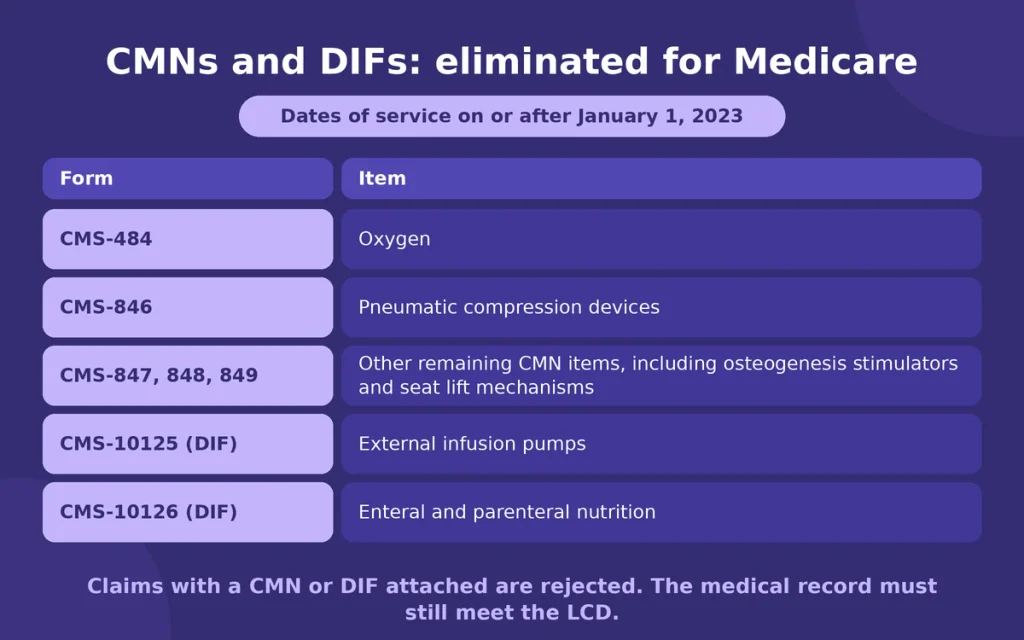
| Form | Item |
|---|---|
| CMS-484 | Oxygen |
| CMS-846 | Pneumatic compression devices |
| CMS-847, 848, 849 | Other remaining CMN items, including osteogenesis stimulators and seat lift mechanisms |
| CMS-10125 (DIF) | External infusion pumps |
| CMS-10126 (DIF) | Enteral and parenteral nutrition |
Source: CGS; Joint DME MAC publication on correct coding and billing after CMN elimination; AMA summary.
The information a CMN used to collect still matters. The medical record must show that the coverage criteria in the LCD are met, because auditors review the record instead of the form. Some Medicaid programs and commercial plans still use their own medical necessity forms, so check each payer.
Pro Tip: Remove CMN and DIF segments from your billing software and clearinghouse settings for Medicare claims. A leftover CMN field is one of the most common causes of DME rejections that staff cannot explain.
What Are the DME Documentation Requirements?
| Document | What It Must Show |
|---|---|
| Standard written order | All required elements, signed by an enrolled practitioner |
| Medical records | The patient meets the LCD coverage criteria for the item |
| Face-to-face encounter | Required for items on the face-to-face list, documented before the order |
| Prior authorization | An approved request and its unique tracking number on the claim, when required |
| Proof of delivery | Delivery to the beneficiary, signed and dated, kept on file |
| Refill documentation | A refill request no sooner than 14 days before the supply runs out and delivery no sooner than 10 days before |
| Continued need and use | Ongoing medical need and that the patient is still using rental equipment |
How Do You Bill DME Claims to Medicare?
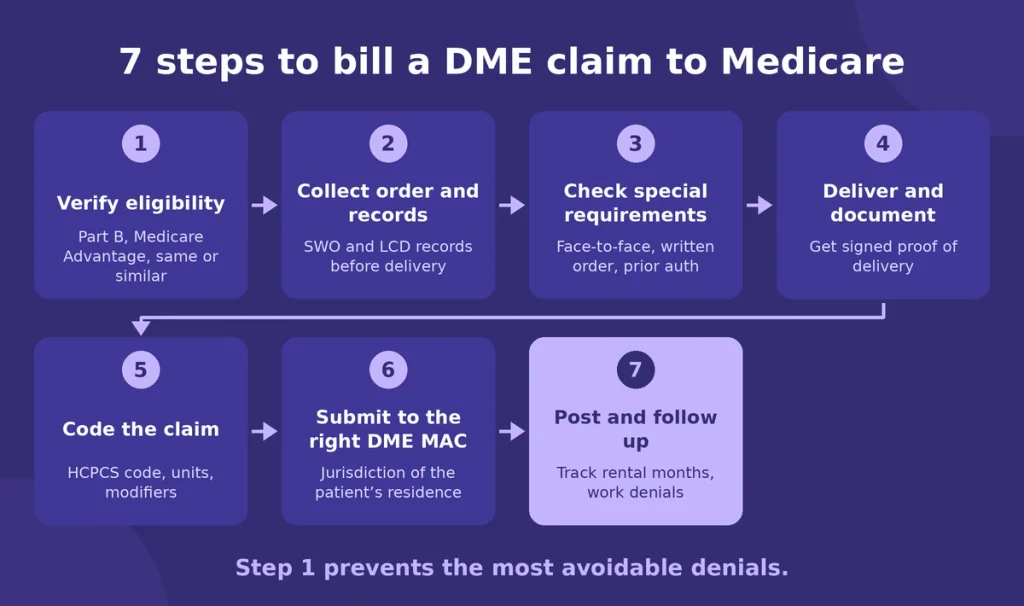
| Step | What Happens |
|---|---|
| 1. Verify eligibility | Confirm Part B coverage, Medicare Advantage enrollment and any same or similar equipment already billed |
| 2. Collect the order and records | Obtain the SWO and records that meet the LCD before delivery |
| 3. Check special requirements | Face-to-face, written order before delivery and prior authorization lists |
| 4. Deliver and document | Deliver the item and obtain proof of delivery |
| 5. Code the claim | HCPCS Level II code, units and modifiers, including rental month and KX where required |
| 6. Submit to the right DME MAC | Send the 837P through CEDI to the jurisdiction for the patient’s residence |
| 7. Post and follow up | Post payments, track rental months and work denials |
Step one prevents the most avoidable denials. Our guide to eligibility verification covers what to check before delivery.
What Codes and Modifiers Are Used in DME Billing?
DME is billed with HCPCS Level II codes, not CPT codes. There is no CPT code for durable medical equipment: CPT describes professional services, while HCPCS Level II describes the items themselves. Common code groups include E codes for equipment, K codes for items such as power mobility devices, L codes for orthotics and prosthetics, A codes for supplies and B codes for enteral and parenteral nutrition.
| Modifier | Meaning |
|---|---|
| NU | New equipment purchased |
| UE | Used equipment purchased |
| RR | Rental |
| KH, KI, KJ | Capped rental month 1, months 2 and 3, months 4 to 13 |
| KX | Coverage requirements in the medical policy have been met |
| GA | Waiver of liability (ABN) on file |
| GZ | Item expected to be denied, no ABN on file |
| RT, LT | Right and left side |
| MS | Maintenance and servicing of patient-owned equipment |
| RA, RB | Replacement of an item; replacement of a part |
| KL | Delivered by mail |
How Does Medicare Reimburse DME?
Medicare pays DME from the DMEPOS fee schedule, or from competitive bidding single payment amounts in competitive bidding areas, and the payment method depends on the item’s category:
| Payment Category | How It Is Paid |
|---|---|
| Inexpensive or routinely purchased | Purchase or rental, at the patient’s option for some items |
| Capped rental | Monthly rental for up to 13 months, after which the patient owns the item |
| Oxygen and oxygen equipment | Monthly payments for 36 months, with the supplier responsible for the equipment for its reasonable useful lifetime |
| Frequent and substantial servicing | Ongoing monthly rental; CGMs and insulin pumps were moved into this category in the 2026 rule |
| Supplies | Paid per unit, subject to quantity and refill rules |
What Are the Most Common DME Claim Denials?
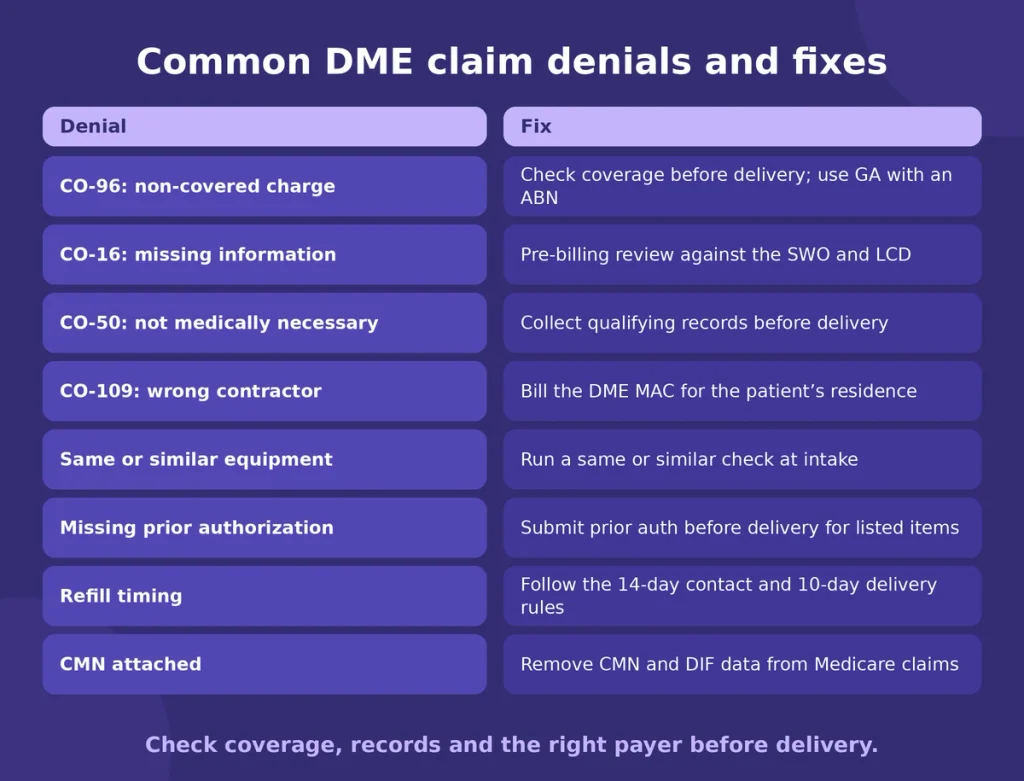
| Denial | Usual Cause | Fix |
|---|---|---|
| CO-96 (non-covered charge) | Item not covered under the patient’s benefit, or coverage criteria not met | Check coverage before delivery; use GA with an ABN when denial is expected |
| CO-16 (missing information) | Order, modifier or required claim data missing | Pre-billing review against the SWO and LCD |
| CO-50 (not medically necessary) | Records do not meet the LCD | Collect qualifying records before delivery |
| CO-109 (wrong contractor) | Claim sent to the wrong DME MAC or payer | Bill the jurisdiction for the patient’s residence |
| Same or similar equipment | Medicare already paid for a comparable item | Run a same or similar check at intake |
| Missing prior authorization | No approved request or tracking number | Submit prior authorization before delivery for listed items |
| Refill timing | Supplies delivered too early | Follow the 14-day contact and 10-day delivery rules |
| CMN attached | Claim rejected for a date of service after 2022 | Remove CMN and DIF data from Medicare claims |
Our guide to common denial codes in medical billing explains these adjustment reason codes in more detail.
What Payer Rule Problems Cause DME Denials?
DME rules differ more across payers than most services. Medicare follows DME MAC LCDs and national lists. Medicare Advantage plans often require in-network suppliers and their own prior authorizations. Medicaid programs set state-specific coverage, rental and authorization rules and may still use medical necessity forms. Commercial plans may limit quantities, require purchase instead of rental or use contracted DME vendors only. A supplier that applies Medicare’s rules to every claim will be denied by the others.
Third-party administrators for self-funded plans add another layer: different portals, authorization rules and claim routes for each plan. Integrating order intake with your billing system and mapping each payer’s rules into the scrubber reduces manual data entry and the denials it causes.
What Changes for DME Billing in 2026 to 2028?
CMS restarted the DMEPOS Competitive Bidding Program in its CY 2026 home health and DMEPOS final rule (CMS-1828-F), effective January 1, 2026, with the next round starting no later than January 1, 2028, as DLA Piper summarized. Key changes:
- A nationwide remote item delivery program for categories including class II CGMs and insulin pumps, urological supplies and ostomy supplies.
- Off-the-shelf back, knee and upper extremity braces included in the next round, as HME News reported.
- Single payment amounts set at the 75th percentile of winning bids instead of the prior method.
- CGMs and insulin pumps paid as frequent and substantial servicing items.
- Contracts expected to be awarded in 2027 and take effect in 2028.
Source: DLA Piper; HME News.
How Do You Reduce DME Claim Denials?
- Run eligibility, Medicare Advantage and same or similar checks at intake.
- Hold delivery until the SWO and qualifying records are on file.
- Check face-to-face, written order before delivery and prior authorization lists for every item.
- Do a pre-billing review of the order, records, modifiers and proof of delivery.
- Route each claim to the correct DME MAC or payer.
- Track rental months, refills and continued use automatically.
- Load each payer’s DME rules into the claim scrubber.
Should You Outsource DME Billing?
Outsourcing DME billing makes sense when documentation collection, prior authorizations and rental tracking outgrow your team, or when denials repeat for the same reasons. iSolve RCM handles DME billing from intake checks to denial follow-up, with certified medical coding for HCPCS and modifiers, payer enrollment through credentialing and pre-billing review of every order. A medical billing audit shows where your current DME claims lose money, and services start at 2.99% of monthly collections.
Frequently Asked Questions
What is DME in medical terms?
Durable medical equipment is reusable equipment prescribed for a medical reason and used in the home, such as a wheelchair, hospital bed, CPAP machine or oxygen concentrator.
What is the CPT code for durable medical equipment?
There is none. DME is billed with HCPCS Level II codes, such as E codes for equipment and L codes for orthotics and prosthetics, not CPT codes.
Is a CMN still required for Medicare DME claims?
No. CMS eliminated CMNs and DIFs for dates of service on or after January 1, 2023, and Medicare rejected claims submitted with them. Medical records must still support the coverage criteria.
What is HME billing?
HME (home medical equipment) billing is billing for equipment and supplies used at home. It overlaps almost entirely with DME billing.
What does denial CO-96 mean on a DME claim?
CO-96 means a non-covered charge: the item is not covered under the patient’s benefit or the coverage criteria were not met. Check coverage before delivery and use an ABN with modifier GA when a denial is expected.
Where do I send Medicare DME claims?
To the DME MAC for the beneficiary’s permanent residence: Noridian for Jurisdictions A and D and CGS for Jurisdictions B and C.