

A solo physician and a five provider group can bill the same CPT code for the same visit and still get paid on very different timelines. The difference in solo vs group practice is usually not the code itself. It is the billing number on the claim: a solo practice often bills under one person’s NPI, while a group bills under the business’s NPI with each provider linked to it. When that link is missing, the claim is denied even though the care was right.
That is where solo and group practice billing really differ. Both use the same claim forms and code sets, but they face different costs, staffing, credentialing work and revenue cycle risks. This guide compares the two side by side, explains billing under a group NPI versus an individual NPI and walks through what changes when an independent practice becomes a group.
Quick answer: Solo practices usually bill under an individual (Type 1) NPI or a single-provider entity, keep billing simple and face the biggest risk from having one person handle everything. Group practices bill under a group (Type 2) NPI, with every rendering provider credentialed and linked to the group, and face more complex credentialing, multi-provider coding and reporting. Outsourcing helps both, but for different reasons: solo practices gain coverage and expertise, while groups gain scale and consistency.
Solo vs Group Practice Billing at a Glance

| Solo Practice | Group Practice | |
|---|---|---|
| Billing NPI | Individual (Type 1), or the practice entity’s Type 2 NPI if incorporated | Group (Type 2) NPI as billing provider; each provider’s Type 1 NPI as rendering provider |
| Medicare enrollment | Individual enrollment | Group enrollment plus a reassignment for each provider |
| Credentialing | One provider, a few payers | Every provider with every payer, plus group contracts |
| Claim volume | Lower, often one specialty | Higher, sometimes several specialties and locations |
| Billing staff | Often one person or the physician | A team, or an outsourced partner |
| Biggest risk | Coverage gaps when one person is out | Provider enrollment and linkage errors |
| Reporting needs | Collections and A/R | By provider, location and specialty, often with productivity metrics |

What Is the Difference Between a Private Practice and a Group Practice?
A private or solo practice is owned and run by one clinician, sometimes with a small staff. A group practice is two or more clinicians who practice under one business, share administration and usually bill under the group’s tax ID and NPI. Group vs private practice is less about size than structure: who owns the payer contracts, whose NPI is the billing provider and who carries the administrative work.
Single-specialty and multi specialty groups
A single-specialty group has multiple providers in one field, such as a five-physician cardiology group, so coding rules, payer policies and templates are largely shared. A multi-specialty group combines several fields under one roof, which means different coding rules, authorization requirements and fee schedules running through one billing operation.
Billing Under a Group NPI vs an Individual NPI
There are two types of NPI. A Type 1 NPI identifies an individual provider. A Type 2 NPI identifies an organization, such as a group practice or a provider who has incorporated. Where each one goes on the claim decides who gets paid:
| Claim Field (CMS-1500) | Solo Billing Under Individual NPI | Group Billing Under Group NPI |
|---|---|---|
| Billing provider (box 33 and 33a) | The provider’s Type 1 NPI | The group’s Type 2 NPI |
| Rendering provider (box 24J) | Often blank or the same provider | The Type 1 NPI of the clinician who saw the patient |
| Tax ID (box 25) | The provider’s SSN or EIN | The group’s EIN |
| Payer enrollment | The individual is enrolled | The group is enrolled and each provider is linked to it |

For Medicare, a group enrolls as an organization and each provider reassigns their benefits to the group, so payments go to the group’s account. Commercial plans follow similar logic through group contracts and provider rosters. If a provider is enrolled individually but not linked to the group, the payer denies the claim, typically with CARC B7 or a provider eligibility remark.
Pro Tip: Before a new provider sees patients, confirm three things with every payer: the provider is credentialed, the provider is linked to the group and the service location is on file. Most group billing denials trace back to one of the three.
How Do Billing Workflows Differ for Solo and Group Practices?
| Workflow Step | Solo Practice | Group Practice |
|---|---|---|
| Eligibility checks | Front desk checks each visit | Standardized checks across locations and schedules |
| Charge capture | Physician enters charges directly | Charges routed from several providers, often with review |
| Coding | One specialty’s rules | Several specialties’ rules, often with a coding team |
| Claim submission | Low volume, simple payer mix | High volume, payer-specific rules by provider and location |
| Denial management | Handled when time allows | Tracked by provider, payer and reason |
| Credentialing | Occasional | Continuous, with onboarding and revalidation calendars |
| Reporting | Practice totals | By provider, location and specialty |
What Does Medical Billing Cost for Solo vs Group Practices?
Billing costs scale differently. A solo practice pays for billing whether it bills $300,000 or $600,000 a year, so fixed costs weigh heavily. One in-house biller at the median wage of $50,250 for medical records specialists, according to the Bureau of Labor Statistics, can be a large share of a small practice’s revenue. Groups spread billing staff, software and credentialing work across more providers, but need more of each.
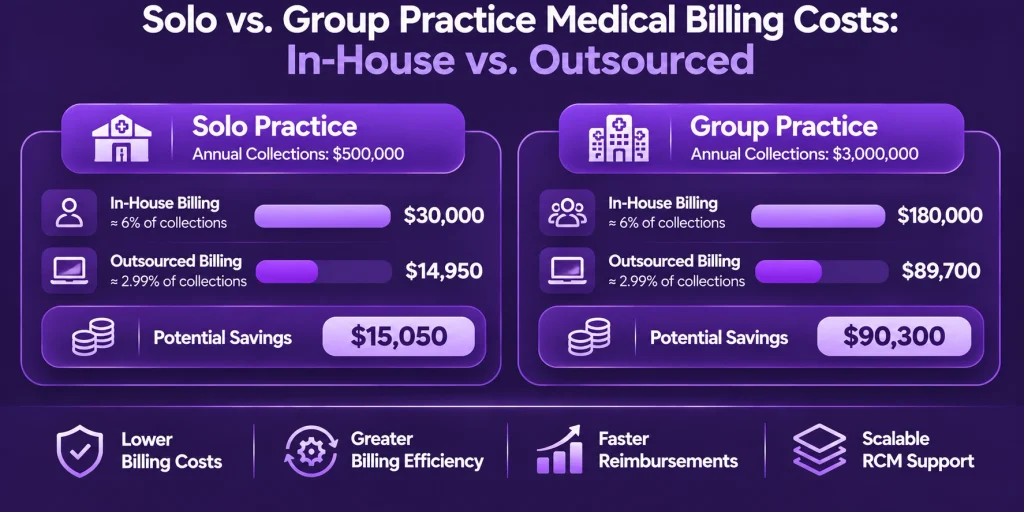
Outsourced billing is usually priced as a percentage of collections, with headline rates commonly around 4% to 7%, as Medical Economics reported. iSolve RCM starts at 2.99% of monthly collections. Groups sometimes negotiate lower rates because of volume, while solo practices benefit most from avoiding a full-time salary. Our guide to medical billing outsourcing cost breaks down pricing models and hidden fees.
| Solo Practice ($500,000 Collected) | Group Practice ($3,000,000 Collected) | |
|---|---|---|
| In-house billing staff | One biller, about $50,250 plus benefits | Several billers plus a manager |
| Outsourced at 2.99% | $14,950 a year | $89,700 a year |
| Outsourced at 6% | $30,000 a year | $180,000 a year |
Illustrative math. Benefits, software and clearinghouse costs add to the in-house figures.
What RCM Challenges Do Solo Practices Face?
- One person handles billing, so vacations, illness or turnover stop claims.
- Cash flow is sensitive: a few denied or delayed claims show up in the bank right away.
- Credentialing gaps take longer to notice and fix.
- Less leverage with payers on contracts and underpayments.
- Time spent on billing is time away from patients.
What RCM Challenges Do Group Practices Face?
- Provider onboarding: every new clinician must be credentialed, enrolled and linked before claims will pay.
- Linkage errors: a provider enrolled individually but not under the group causes denials across many claims.
- Multiple locations: each service address must be on file with each payer.
- Coding consistency: different providers document and code differently, which creates audit risk.
- Reporting: owners need collections, denials and productivity by provider and location.
- Payer contracts: more contracts to track, renew and compare against payments.
Credentialing delays alone can hold back revenue for months. Experity notes that credentialing a new provider can take up to 120 days and a new clinic 9 to 12 months, as its billing integrity guide explains.
How Does Multi Specialty Revenue Cycle Management Work?
Multi-specialty revenue cycle management means running one billing operation that applies each specialty’s rules correctly. Cardiology, orthopedics, behavioral health and primary care each have different coding rules, authorization lists and documentation needs. Strong multi-specialty RCM uses specialty-specific coders or coding rules, separate denial tracking by specialty and reports that show each department’s performance, so one specialty’s problems do not hide inside the group’s totals. Our medical coding team works this way for multi-specialty clients.
How Does Credentialing Differ for Solo and Group Practices?
A solo provider credentials once with each payer, usually as an individual. A group credentials the group entity and then adds each provider to the group’s contracts, so every new hire starts a new set of applications. Groups also need a calendar for revalidations, CAQH attestations and license renewals across every provider.
Should you outsource credentialing or keep it in-house?
For practices, outsourcing makes sense when providers join often, when applications keep stalling or when no one owns follow-up. In-house works when a dedicated person has time to track every application and payer. Our credentialing and enrollment service handles both group and individual enrollment. Health plans face a similar decision on their side: many outsource primary source verification to credentials verification organizations instead of building the function in-house.
Does SimplePractice Do Credentialing?
Yes, for practices on its paid plans. SimplePractice advertises free credentialing once you are on a paid plan, with a credentialing process it says can take 60 to 120 days after an application is submitted depending on the payers, according to its credentialing page. Some older comparison articles, such as Headway’s, still say SimplePractice does not assist with credentialing, so check SimplePractice’s current terms. For behavioral health groups that need billing, credentialing and denial follow-up together, a full billing partner such as our behavioral health billing services may fit better.
How Do You Transition From an Independent Practice to a Group Practice in Pennsylvania?
Moving from independent practice to a group practice in Pennsylvania means setting up the new entity, enrolling it with every payer and moving each provider’s billing to the group without a gap. The order matters:
| Step | What to Do |
|---|---|
| 1. Form the entity | Register the group with the Pennsylvania Department of State and obtain an EIN |
| 2. Get a group NPI | Apply for a Type 2 NPI for the group through NPPES |
| 3. Enroll with Medicare | Enroll the group with Novitas Solutions (Jurisdiction L) and reassign each provider’s benefits to the group |
| 4. Enroll with Pennsylvania Medicaid | Enroll the group in PROMISe and credential with the HealthChoices managed care plans you serve |
| 5. Contract with commercial plans | Add the group and each provider with plans such as Highmark, Independence Blue Cross, Capital Blue Cross, UPMC Health Plan and Aetna |
| 6. Update CAQH | Update each provider’s CAQH profile with the new group and locations |
| 7. Switch billing carefully | Keep billing under the old arrangement until each payer confirms the group effective date, then switch |
The most common mistake is switching claims to the new group NPI before payers have approved it, which creates weeks of denials. Track effective dates by payer and switch each payer separately.
Should Solo and Group Practices Outsource Medical Billing?
Solo practices usually outsource to avoid depending on one person and to get expertise they cannot hire full time. Groups outsource to scale credentialing, keep coding consistent across providers and get reporting by provider and location. iSolve RCM supports both, from a single physician’s medical billing to multi-specialty groups with several locations, with denial management and A/R management included and pricing from 2.99% of monthly collections.

Frequently Asked Questions
What is the difference between a Type 1 and Type 2 NPI?
A Type 1 NPI identifies an individual provider. A Type 2 NPI identifies an organization, such as a group practice. Groups bill under the Type 2 NPI and list each provider’s Type 1 NPI as the rendering provider.
Can a solo provider have a group NPI?
Yes. A solo provider who incorporates can obtain a Type 2 NPI for the business and bill under it, with their own Type 1 NPI as the rendering provider.
Why are group practice claims denied when the provider is credentialed?
Usually because the provider is not linked to the group with that payer, or the service location is not on file. The provider must be credentialed, linked to the group and enrolled at the location.
Is billing cheaper for a group practice?
Per provider, often yes, because staff, software and credentialing are shared. In total dollars, groups spend more, so percentage-based outsourcing and volume pricing matter.
How long does credentialing take when a provider joins a group?
Commonly 60 to 120 days depending on the payer, and longer for Medicaid managed care plans or new group contracts.
Does SimplePractice help with credentialing?
SimplePractice says it offers free credentialing for users on paid plans, with timelines of about 60 to 120 days depending on the payers. Confirm current availability on its site.


