

The ICD 10 CM code for high cholesterol is E78.00, Pure hypercholesterolemia, unspecified. The ICD-10-CM code for high cholesterol is E78.00, Pure hypercholesterolemia, unspecified. Hyperlipidemia, unspecified, has a different code, E78.5. Other documented conditions, including mixed hyperlipidemia and familial hypercholesterolemia, may require more specific diagnosis codes.
High cholesterol is one of the most frequently documented conditions in American medicine. It shows up in primary care visits, cardiology follow-ups, annual wellness exams and almost every chronic care plan. For medical coders and billers, that frequency is exactly the problem, because a diagnosis this common is easy to code on autopilot.
That raises a string of everyday questions. What if the note says both hyperlipidemia and hypercholesterolemia? What if the provider calls it mixed or familial? Can a coder assign a diagnosis from an LDL value on the lab report? Get these wrong and you end up with rejected header codes, under-reported specificity and compliance risk.
That is why we built this guide for medical coders, billing specialists, providers and practice managers. We will walk through the E78 codes that matter for cholesterol, the FY 2027 Official Guidelines that decide between them, the documentation each code needs and how accurate lipid coding supports clean claims.
What Is the ICD 10 Code for High Cholesterol?
Here is the quick reference before we dig into the details.
| Item | Answer |
|---|---|
| Code | E78.00 |
| Official title | Pure hypercholesterolemia, unspecified |
| Chapter | Chapter 4: Endocrine, nutritional and metabolic diseases (E00 to E89) |
| Category | E78, Disorders of lipoprotein metabolism and other lipidemias |
| Parent | E78.0, Pure hypercholesterolemia (a header, not billable) |
| Billable | Yes, valid for FY 2027 dates of service |
What Does E78.00 Mean in ICD 10 CM?
E78.00 represents pure hypercholesterolemia, unspecified. It is used when the documented condition corresponds to this diagnosis and no more specific classification entry is supported. Its Tabular inclusion terms are Fredrickson’s hyperlipoproteinemia type IIa, hyperbetalipoproteinemia, LDL-type hyperlipoproteinemia and (pure) hypercholesterolemia NOS. If the provider documents mixed hyperlipidemia or familial hypercholesterolemia, verify the specific code instead.
Index terms that land here: High cholesterol, elevated cholesterol, cholesterolemia and hypercholesterolemia all point to E78.00 in the Alphabetic Index.
When Should Medical Coders Use E78.00?
Use E78.00 when the provider’s assessment describes high cholesterol or hypercholesterolemia and adds nothing that points elsewhere.
Common usage: “Hypercholesterolemia, continue atorvastatin” is a textbook E78.00 encounter.
Watch out: If the provider documents the condition as familial or as mixed hyperlipidemia, the code changes. Those diagnoses belong to E78.01- and E78.2.
Is E78.00 a Billable Diagnosis Code in 2027?
Yes. E78.00 is a complete, billable code for dates of service from October 1, 2026 through September 30, 2027.
Header alert: Its parent, E78.0, has been a non-billable header since the FY 2017 update split it into E78.00 and E78.01. Any guide or claim that still lists E78.0 as a code is out of date, and Section I.A.3 of the Official Guidelines allows only complete codes on a claim.
What Is the Difference Between High Cholesterol and Hyperlipidemia?
Before we get into the full code list, it helps to understand why these two terms cause so much confusion. In conversation, people use them interchangeably. In ICD-10-CM, they are different diagnoses with different codes.
Hypercholesterolemia vs. Hyperlipidemia
Hypercholesterolemia means too much cholesterol in the blood. Hyperlipidemia is the umbrella term for too much of any lipid, which can mean cholesterol, triglycerides or both. Every hypercholesterolemia is a hyperlipidemia, but not every hyperlipidemia is a hypercholesterolemia.
Key coding principle: That is exactly why ICD-10-CM separates them: E78.00 for the specific cholesterol problem and E78.5 when the provider names only the broad category.
How Do Cholesterol, Triglycerides, LDL and HDL Relate to Lipid Disorders?
Lipid panels measure total cholesterol, LDL cholesterol, HDL cholesterol and triglycerides. These findings help providers evaluate lipid disorders, but medical coders must distinguish laboratory abnormalities from documented diagnoses. The appropriate ICD-10-CM code depends on the provider’s assessment, the reason for the encounter and the applicable Index and Tabular List instructions.
| Lab Pattern the Provider May Be Evaluating | Possible Documented Diagnosis | Code Only If Documented |
|---|---|---|
| Elevated LDL or total cholesterol | Hypercholesterolemia | E78.00 |
| Elevated triglycerides | Hypertriglyceridemia or pure hyperglyceridemia | E78.1 |
| Elevated cholesterol and triglycerides | Mixed hyperlipidemia | E78.2 |
| Low HDL | Lipoprotein deficiency (depressed HDL) | E78.6 |
The lab pattern explains why a provider reaches a diagnosis. It never replaces the diagnosis itself.
What Are the ICD 10 Codes for Different Types of Lipid Disorders?
Category E78 covers far more than high cholesterol. Only E78.00 and the familial E78.01- codes describe high cholesterol itself; the rest are related lipid disorders with their own documentation triggers. Let’s break down each one.
Pure Hypercholesterolemia: E78.00
The default high cholesterol code, covered above. It sits under the E78.0 header beside the familial E78.01- codes.
Pure Hyperglyceridemia: E78.1
E78.1 reports pure hyperglyceridemia. Its inclusion terms include elevated fasting triglycerides, Fredrickson type IV and VLDL-type hyperlipoproteinemia.
Distinction: The Index sends “high triglycerides” to E78.1. It is a related disorder, never a high cholesterol code.
Mixed Hyperlipidemia: E78.2
E78.2 is for mixed hyperlipidemia. The Tabular lists combined hyperlipidemia NOS and elevated cholesterol with elevated triglycerides NEC as inclusion terms, and the Index sends “high cholesterol with high triglycerides” here.
Excludes1 note: The FY 2027 Tabular List carries an Excludes1 note under E78.2 for familial combined hyperlipidemia (E78.49) and cerebrotendinous cholesterosis (E75.5). Follow this instruction, and review any conflicting documentation rather than assuming the conditions can be reported together.
Hyperchylomicronemia: E78.3
E78.3 covers very high triglyceride states driven by chylomicrons, including Fredrickson types I and V, chylomicron retention disease and mixed hyperglyceridemia. It is rare in routine primary care coding.
Elevated Lipoprotein(a): E78.41
Lp(a) is a genetically determined lipoprotein measured separately from LDL. E78.41 applies only when the provider documents elevated Lp(a).
Specificity: E78.41 is not a substitute for E78.00. A patient can have both conditions, and both can be coded.
Other Hyperlipidemia: E78.49
E78.49 holds familial combined hyperlipidemia and other specified hyperlipidemias without a dedicated code. It is also the lipid code AHA Coding Clinic directs for hyperlipidemia documented as associated with type 2 diabetes, covered in the related conditions section below. The E78.4 header above it is not billable.
Unspecified Hyperlipidemia: E78.5
E78.5 is for “hyperlipidemia” or “dyslipidemia” when the provider does not say which lipid is abnormal.
Caution: E78.5 is a perfectly valid code, but it should never be the automatic choice when the note says “high cholesterol.”
Lipoprotein Deficiency: E78.6
E78.6 sits at the opposite end of the spectrum. It covers low HDL (documented as depressed HDL cholesterol or HDL deficiency), abetalipoproteinemia and related deficiency states. It is never a high cholesterol code.

When Should You Use E78.00 Instead of E78.5?
This is the decision coders face most often, and the answer always comes from the provider’s exact words.
E78.00 vs. E78.5: Key Documentation Differences
| Provider Documents | Code | Why |
|---|---|---|
| High cholesterol | E78.00 | Index: High, cholesterol → E78.00 |
| Hypercholesterolemia | E78.00 | Index: Hypercholesterolemia → E78.00 |
| Elevated LDL cholesterol (as a diagnosis) | E78.00 | Inclusion term: LDL-type hyperlipoproteinemia |
| Hyperlipidemia | E78.5 | Lipid type not specified |
| Dyslipidemia | E78.5 | Index: Dyslipidemia → E78.5 |
| High cholesterol and high triglycerides (as a diagnosis) | E78.2 | Index: High, cholesterol, with high triglycerides → E78.2 |
| Mixed or combined hyperlipidemia | E78.2 | Inclusion term: combined hyperlipidemia NOS |
| Familial hypercholesterolemia | E78.01- | Select E78.010, E78.011 or E78.019 |
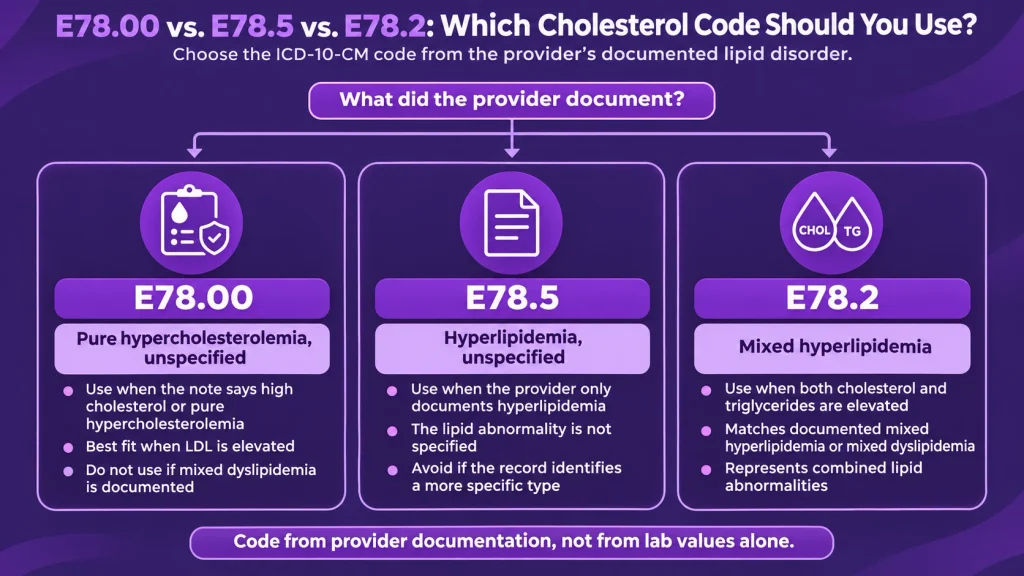
Key coding principle: Section I.B.2 of the FY 2027 Official Guidelines requires coding to the highest level of specificity documented. When the note says high cholesterol, E78.00 is more specific than E78.5, and choosing E78.5 under-reports what the provider actually diagnosed.
What If the Physician Documents Both Hyperlipidemia and Hypercholesterolemia?
When hyperlipidemia and hypercholesterolemia refer to the same documented condition, such as “hyperlipidemia” in the history and “hypercholesterolemia on statin” in the assessment, E78.00 usually provides the more specific representation. That is not a universal rule, though. Evaluate the full record and applicable coding guidance before reporting or excluding additional lipid diagnoses, and query the provider when the documentation conflicts or suggests separate lipid disorders.
Can High Cholesterol and Mixed Hyperlipidemia Be Coded Together?
When the provider documents mixed hyperlipidemia, E78.2 already captures the elevated cholesterol through its inclusion terms, so E78.00 is not added for the same condition.
When Is an Unspecified Code Appropriate?
Section I.B.18 says unspecified codes have acceptable, even necessary uses when they reflect what is known at that encounter. If the provider documents only “hyperlipidemia” and the record supports nothing more, E78.5 is correct.
Same logic, different code: When familial hypercholesterolemia is documented without a type, E78.019 is the right answer, not a guess at HeFH.
What Are the ICD-10 Codes for Familial Hypercholesterolemia?
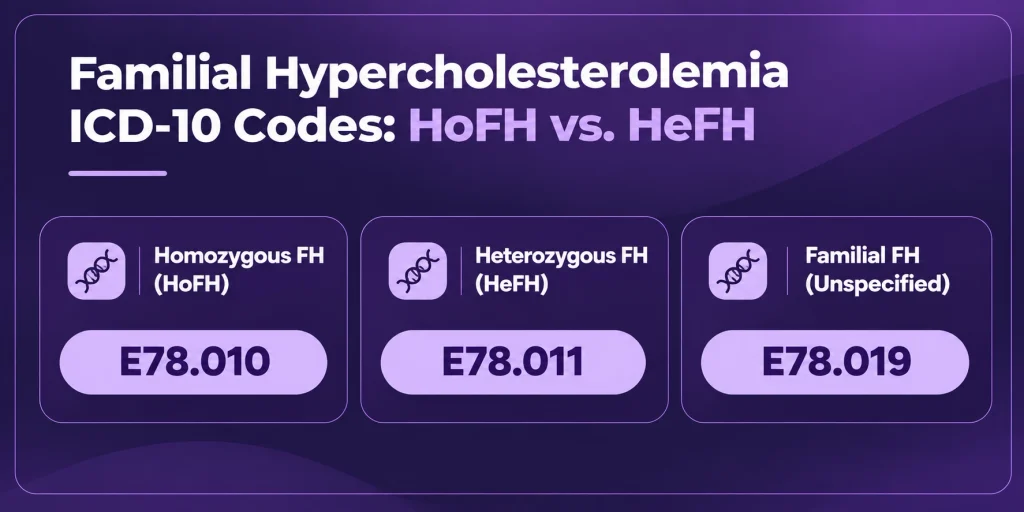
Familial hypercholesterolemia (FH) is an inherited disorder that raises LDL cholesterol from birth. On October 1, 2025, the FY 2026 update replaced the single code E78.01 with three specific codes, an expansion the Family Heart Foundation had pursued since its original 2014 application. E78.01 is now a non-billable header, and its three child codes remain valid for FY 2027.
A clinical FH diagnosis does not always require molecular genetic testing. For coding, what matters is the provider’s documented diagnosis, not whether a genetic test was performed.
Homozygous Familial Hypercholesterolemia: E78.010
E78.010 identifies homozygous familial hypercholesterolemia (HoFH), a severe inherited disorder associated with markedly elevated LDL cholesterol. HoFH may involve identical or different pathogenic variants affecting LDL cholesterol metabolism. Code assignment depends on the provider’s documented diagnosis, not genetic testing results interpreted independently by the coder.
Documentation is key: The provider must document homozygous FH or HoFH. A severe LDL value is not enough.
Heterozygous Familial Hypercholesterolemia: E78.011
E78.011 is for HeFH, the far more common form with one inherited variant. The Index routes the abbreviation HeFH here, but the provider still has to document it.
Unspecified Familial Hypercholesterolemia: E78.019
E78.019 applies when the provider documents familial hypercholesterolemia without saying homozygous or heterozygous.
When to query: If the record holds genetic test results or a specialist’s note naming the type, query the provider rather than choosing from the test report yourself.
How Does Familial Combined Hyperlipidemia Differ From Mixed Hyperlipidemia?
Familial combined hyperlipidemia (FCHL) is an inherited disorder in which family members show varying patterns of high cholesterol and high triglycerides. It codes to E78.49. Mixed hyperlipidemia, documented without an inherited cause, codes to E78.2.
Distinction: The FY 2027 Tabular List places an Excludes1 note under E78.2 for familial combined hyperlipidemia (E78.49), so follow that instruction instead of reporting both for the same condition. Neither one is the same as familial hypercholesterolemia (E78.01-). Watch for the word “familial” and what follows it.
How Should Medical Coders Interpret Lipid Panel Results and Physician Documentation?
No amount of coding knowledge can make up for a note that does not say enough. Coders are not clinicians, and lipid coding is where lab values and diagnoses get confused most often.
What Information Should Be Documented in the Medical Record?
Here is what a coder needs to see in a strong lipid note.
Diagnosis in words: Hypercholesterolemia, mixed hyperlipidemia, HeFH or elevated Lp(a), stated by the provider.
Relevant lipid values: LDL, HDL, triglycerides and total cholesterol that support the diagnosis.
Familial or genetic basis: Whether the condition is inherited and, for FH, which type.
Current treatment: Statins, ezetimibe, PCSK9 inhibitors or lifestyle therapy.
Plan: Follow-up labs, referral or medication changes.
Can Medical Coders Assign a Diagnosis From Elevated Cholesterol Lab Results Alone?
No. Section I.A.19 of the FY 2027 guidelines states that code assignment is based on the provider’s diagnostic statement, not on clinical criteria a coder applies. A lab report showing LDL of 190 mg/dL is not a diagnosis until the provider documents one.
Subtle point: The Index does route an abnormal finding of high cholesterol to E78.00, but that finding still has to come from the provider, not from the coder reading the panel.
What If the Lipid Panel and Physician’s Diagnosis Appear Inconsistent?
Code what the provider documented. If the panel shows high triglycerides and high LDL but the assessment says only “hypercholesterolemia,” the code is E78.00. The coder can ask whether mixed hyperlipidemia was intended, but cannot change the diagnosis based on the numbers.
When Should the Coder Query the Physician?
Query when the documentation conflicts, when FH is mentioned without a type and genetic results are on file or when significant lipid abnormalities appear with no assessment at all.
Compliance reminder: A compliant query presents the facts and lets the provider decide. It never leads toward a higher-specificity code.

How Does High Cholesterol Coding Differ for Pediatric and Older Adult Patients?
The codes do not change with age, but the clinical context does.
Pediatric Hypercholesterolemia and Familial Disorders
Pediatric patients with high cholesterol may need evaluation for familial hypercholesterolemia, particularly when there is a strong family history or persistently elevated LDL cholesterol. Code assignment still follows the documented diagnosis, not the patient’s age or lab values alone.
Related codes: Screening encounters use Z13.220, Encounter for screening for lipoid disorders. A family history of FH uses Z83.42, Family history of familial hypercholesterolemia.
Hyperlipidemia in Older Adults With Multiple Conditions
Older patients often carry hyperlipidemia alongside diabetes, hypertension and coronary disease. Section IV.J says to code all documented conditions that coexist and require or affect care, so the lipid code belongs on the claim whenever the provider addresses it.
Why Patient Age Does Not Independently Determine the ICD-10 Code
Some guides attach E78.5 to children and E78.2 to older adults. ICD-10-CM does nothing of the kind. A child documented with high cholesterol gets E78.00, and an 80-year-old documented with HeFH gets E78.011.
How Are High Cholesterol and Related Conditions Coded Together?
Lipid disorders rarely travel alone. The rule for every pairing is the same: never assume a relationship that the classification or the provider has not stated.
Hyperlipidemia With Diabetes
Hyperlipidemia is not listed under the “with” subterms of Diabetes in the Alphabetic Index, so Section I.A.15 does not presume it is a diabetic complication. When both conditions are documented without an established relationship, code them separately according to the provider’s assessment, for example E11.9 with the documented lipid code.
When the link is documented: When the provider specifically documents hyperlipidemia associated with type 2 diabetes, AHA Coding Clinic for ICD-10-CM and ICD-10-PCS, Third Quarter 2025, supports E11.69 with E78.49, not E78.5. If the provider names a more specific lipid disorder as diabetes related, verify the precise terminology and the Index path before assigning codes.
Hyperlipidemia With Hypertension
There is no combination code. Report the hypertension code, such as I10, and the lipid code separately.
Hyperlipidemia With Coronary Artery Disease
Report the coronary disease code, such as I25.10, and the lipid code separately.
Distinction: If the provider documents coronary atherosclerosis due to lipid rich plaque, add I25.83 after the I25.1- code. That code describes plaque composition, not a blood lipid disorder, so it never replaces the E78 code.
Familial Hypercholesterolemia With Cardiovascular Conditions
Code the E78.01- code and each documented cardiovascular condition separately, sequenced by the reason for the encounter. Relatives undergoing evaluation because of a family history of familial hypercholesterolemia should not be assigned an FH diagnosis code unless the condition has been established.
Z83.42 identifies the documented family history, while Z13.220 may be appropriate for a screening encounter. Code selection and sequencing depend on the purpose of the visit, provider documentation and applicable coding guidelines.
What Are the Official ICD-10-CM Guidelines for Hyperlipidemia Coding?
Always work from the current FY 2027 Official Guidelines for Coding and Reporting. These are the sections that change lipid code selection, numbered exactly as they appear in the FY 2027 document.
Using the Alphabetic Index and Tabular List
Section I.B.1: Look up the documented term in the Index, then confirm it in the Tabular. That is how “high cholesterol” reaches E78.00 instead of E78.5 and how “HeFH” reaches E78.011.
Specified vs. Unspecified Diagnosis Codes
Sections I.B.2 and I.B.18: Code to the highest specificity documented, and use unspecified codes when they are all the record supports.
Code Selection and Sequencing Requirements
Section I.A.3: Only complete codes are reportable, which rules out E78.0, E78.01 and E78.4.
Section I.A.12: Excludes1 notes, such as E78.2 versus E78.49, must be followed. The guidelines allow a narrow exception only when the two conditions are unrelated, and the provider should be queried when that is unclear.
Section IV.G: Outpatient claims list the main reason for the visit first, so a lipid code is first-listed only when lipid management drove the visit.
Documentation and Medical Necessity
Medicare covers diagnostic and monitoring lipid panels under National Coverage Determination 190.23, Lipid Testing, which lists covered diagnoses and frequency expectations. A clear lipid diagnosis on the claim is what connects the lab service to its coverage rule.
What Is the Difference Between Diagnostic Lipid Testing and Cholesterol Screening?
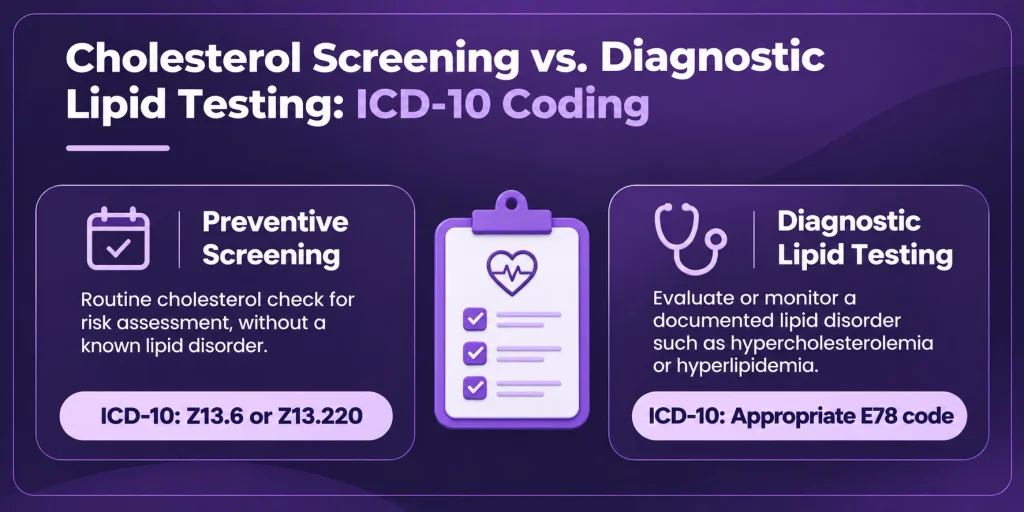
Screening and diagnostic testing are coded and covered differently, and mixing them up is a common reason lipid panels are denied.
Z13.6, Encounter for screening for cardiovascular disorders: The code Medicare uses for its preventive cardiovascular screening blood tests, which are generally covered once every five years for eligible patients without signs or symptoms of cardiovascular disease.
Z13.220, Encounter for screening for lipoid disorders: Used for lipid screening encounters, subject to each payer’s screening policy.
E78 diagnosis codes: Used when the provider has documented a lipid disorder that the test is evaluating or monitoring. These tests fall under diagnostic coverage rules, such as NCD 190.23 for Medicare.
Before submitting, confirm whether the order was for screening or for evaluation of a documented condition, because the two follow different code selection and coverage requirements.
How to Select the Correct Cholesterol ICD-10 Code: Step-by-Step
Every lipid diagnosis follows the same five-step workflow.
| Step | Action |
|---|---|
| 1 | Identify the documented condition and the reason for the encounter from the provider’s assessment |
| 2 | Locate the documented term in the Alphabetic Index |
| 3 | Select the appropriate E78 diagnosis family |
| 4 | Verify specificity, Excludes notes and sequencing in the Tabular List |
| 5 | Confirm reportability and any claim-level requirements, such as screening versus diagnostic coding |
Use the table below as a quick reference for step 3. Each row is an alternative, not a sequence.
| Common Documented Diagnosis | ICD-10-CM Code |
|---|---|
| Homozygous familial hypercholesterolemia (HoFH) | E78.010 |
| Heterozygous familial hypercholesterolemia (HeFH) | E78.011 |
| Familial hypercholesterolemia, type not stated | E78.019 |
| Familial combined hyperlipidemia | E78.49 |
| Mixed or combined hyperlipidemia | E78.2 |
| High cholesterol or hypercholesterolemia | E78.00 |
| Hypertriglyceridemia or pure hyperglyceridemia | E78.1 |
| Elevated Lp(a) | E78.41 |
| Hyperlipidemia or dyslipidemia, type not stated | E78.5 |
| Lab values only, no provider diagnosis | No lipid code; query if clinically relevant |
Practical High Cholesterol ICD-10 Coding Scenarios
Let’s put the rules to work with six short, hypothetical encounters.
Scenario 1: High Cholesterol Without Further Detail
A patient returns for a medication check. The assessment reads “high cholesterol, continue rosuvastatin.”
Correct code: E78.00. The Index sends high cholesterol straight to E78.00, and no query is needed.
Scenario 2: Hyperlipidemia Without a Type
At an annual exam, the provider documents “hyperlipidemia, stable on current therapy.”
Correct code: E78.5. The lipid type is not stated, so the unspecified code is correct.
Scenario 3: Confirmed Mixed Hyperlipidemia
The assessment reads “mixed hyperlipidemia, add fenofibrate.”
Correct code: E78.2. The provider names a specific lipid disorder, and E78.00 is not added.
Scenario 4: Familial Hypercholesterolemia Without a Subtype
A pediatric cardiologist documents “familial hypercholesterolemia, refer to lipid clinic.” No genetic results are in the record.
Correct code: E78.019. The provider has documented familial hypercholesterolemia without specifying its subtype. E78.019 is appropriate based on the available documentation. A clarification query may be considered if other documentation supports a more specific subtype or contains conflicting information.
Scenario 5: Elevated LDL on a Lab Report Only
The lipid panel shows LDL of 182 mg/dL, but the provider’s assessment addresses only a sinus infection.
Correct code: No lipid code. There is no provider diagnosis to code under Section I.A.19. If the provider is managing the cholesterol, a query is appropriate.
Scenario 6: Diabetes and Hyperlipidemia Linked by the Provider
The assessment reads “type 2 diabetes, A1c 7.4; hyperlipidemia associated with type 2 diabetes, continue atorvastatin.”
Correct codes: E11.69 and E78.49, as directed by AHA Coding Clinic, Third Quarter 2025, for documented hyperlipidemia associated with type 2 diabetes.
What Are the Most Common High Cholesterol ICD-10 Coding Errors?
Most lipid coding errors fall into five patterns. Here is each one and how to avoid it.
Reporting E78.0 Instead of a Billable Child Code
E78.0 has been a header since FY 2017, and E78.01 became one in FY 2026. Several popular coding guides still list both as codes.
How to avoid? Always code to the full number of characters. Use E78.00 or a specific E78.01- code.
Using E78.5 for Every Elevated Cholesterol Diagnosis
“High cholesterol” indexes to E78.00, yet E78.5 remains the reflex choice in many practices.
How to avoid? Read the assessment, then look up the exact term in the Index before reaching for E78.5.
Confusing Familial Combined and Mixed Hyperlipidemia
FCHL is E78.49 and mixed hyperlipidemia is E78.2, and E78.2 carries an Excludes1 note for FCHL.
How to avoid? Check whether the provider wrote “familial” before choosing between them, and follow the Excludes1 instruction.
Assigning More Specific Codes Without Supporting Documentation
Lab values, a statin on the medication list or a relative with FH do not make a diagnosis.
How to avoid? Code only what the provider stated, and query when the clinical picture suggests more.
Reporting Overlapping Diagnoses Without Checking Coding Guidance
E78.00 with E78.5, or E78.00 with E78.2, can report the same cholesterol problem twice.
How to avoid? When the terms describe one condition, report the single code that captures what the provider documented, and query if the record suggests separate disorders.
How Does Accurate Hyperlipidemia Coding Affect Medical Billing?
Medical necessity: Lipid codes support lipid panels, statin and PCSK9 inhibitor prior authorizations and cardiology workups. Unspecified codes like E78.5 do not cause denials on their own. Coding-related problems usually come from a header code such as E78.0 on the claim or a diagnosis that does not match the payer’s coverage list for the service.
Claim approval: Accurate lipid diagnosis coding helps reduce avoidable coding inconsistencies and supports medical necessity documentation. Claim approval still depends on payer policies, coverage requirements, eligibility, authorizations and other billing information.
Inpatient grouping: Certain E78 diagnoses, including E78.00 and E78.5, map to MS-DRG 642 under the FY 2027 classification, but the final MS-DRG depends on the complete inpatient record and grouping rules.
Coding compliance: Assigning a diagnosis code that is not supported by the provider’s documentation can create coding inaccuracies and compliance risks. Using an unspecified code when more specific documentation is available may also result in inaccurate reporting. Coders should select the most appropriate code supported by the medical record and applicable ICD-10-CM guidelines.

What Changed in Hypercholesterolemia ICD-10 Coding for FY 2027?
ICD-10-CM codes and guidelines update every October 1. The FY 2027 code set and Official Guidelines apply to dates of service from October 1, 2026 through September 30, 2027.
No new familial codes this year: E78.010, E78.011 and E78.019 took effect October 1, 2025 under FY 2026 and carry forward unchanged. They should not be described as new for 2027.
Staying current: E78.00 and the other E78 codes in this guide are valid in the FY 2027 code set. Before relying on any lipid code, confirm it against the official FY 2027 files from CMS and CDC, review the bold narrative changes in the guidelines and follow AHA Coding Clinic for official clarifications.
Conclusion
E78.00 is the ICD-10-CM code for unspecified pure hypercholesterolemia. When documentation identifies mixed hyperlipidemia, familial hypercholesterolemia or another lipid disorder, the appropriate code may differ. Accurate coding requires reviewing the provider’s diagnosis, confirming the terminology in the Alphabetic Index and following the FY 2027 Tabular List instructions.
By prioritizing detailed documentation, checking every term in the Index and never coding from lab values alone, your team can turn one of the most common diagnoses in medicine into one of the cleanest lines on every claim.
Frequently Asked Questions About High Cholesterol ICD-10 Codes
What is the ICD-10 code for high cholesterol?
E78.00, Pure hypercholesterolemia, unspecified. See the decision table in the E78.00 vs. E78.5 section for the terms that lead to other codes.
Is E78.00 the same as E78.5?
No. E78.00 is high cholesterol specifically. E78.5 is hyperlipidemia with no lipid type stated.
What is the ICD-10 code for elevated LDL cholesterol?
When the provider documents elevated LDL as a diagnosis, E78.00 applies through its inclusion term LDL-type hyperlipoproteinemia. An LDL value on a lab report alone is not coded.
What is the code for combined high cholesterol and triglycerides?
When the provider documents mixed or combined hyperlipidemia, use E78.2. If the provider calls it familial combined hyperlipidemia, use E78.49.
Is E78.0 a billable code in 2027?
No. E78.0 is a header. Report E78.00 or a familial E78.01- code.
What ICD-10 code applies to familial hypercholesterolemia?
E78.010 for HoFH, E78.011 for HeFH or E78.019 when the type is not documented.
Can E78.00 and E78.5 be billed together?
Not when both describe the same documented condition; report the more specific E78.00. Query the provider if the record suggests separate lipid disorders.
How do you code hyperlipidemia associated with type 2 diabetes?
When the provider documents the association, AHA Coding Clinic, Third Quarter 2025, supports E11.69 with E78.49. Without a documented link, code the diabetes and the lipid disorder separately.