
The EGD CPT Code for diagnosis is 43235, and the CPT code for an EGD with biopsy is 43239. Every other intervention, from dilation and polyp removal to bleeding control and stent placement, has its own code in the same family.
That sounds simple until the operative report lands on your desk. Was the stricture dilated with a balloon or over a guidewire? Was the case stopped early? Each answer changes the code, the modifier or both. This guide helps gastroenterology practice coders, billers and providers match the code to the report, apply the right modifiers and document enough to support the claim.
What Is the CPT Code for an EGD?
The answer depends on what the endoscopist did once the scope was in place. Let’s start with the two codes you will use most.
CPT Code 43235 for Diagnostic EGD
CPT 43235 reports a flexible, transoral esophagogastroduodenoscopy performed for diagnostic purposes. The endoscopist examines the esophagus, stomach and duodenum and does nothing beyond looking.
What is included: Collecting specimens by brushing or washing is part of 43235 when performed. Neither one turns a diagnostic EGD into a biopsy.
Key coding principle: 43235 carries the CPT “separate procedure” designation. It is the base code of the EGD family, so it is reported only when no other EGD service from the family was performed in that session.
CPT Code 43239 for EGD With Biopsy
CPT 43239 reports an EGD in which the endoscopist removes tissue with forceps for pathology. It applies whether one piece of tissue is taken or twenty.
Specificity: The descriptor covers a single biopsy or multiple biopsies. Report 43239 once per session, no matter how many specimens or sites are involved.
Documentation is key: The report should name each biopsy site, the reason for the biopsy and that specimens were sent to pathology.
What Is the Difference Between CPT Codes 43235 and 43239?
| CPT 43235 | CPT 43239 | |
|---|---|---|
| Procedure type | Diagnostic EGD, examination only | EGD with tissue biopsy |
| Specimen collection | Brushing or washing only, when performed | Forceps biopsy, single or multiple |
| Pathology | Cytology possible from brushings or washings | Tissue sent for histology |
| Documentation | Extent of exam and findings | Extent of exam, findings, biopsy sites and specimens |
| Reporting | Only when no other EGD service is performed | Once per session; 43235 is not added |

What Is an Esophagogastroduodenoscopy (EGD)?
An esophagogastroduodenoscopy, or EGD, is an upper gastrointestinal endoscopy. The physician passes a flexible endoscope through the mouth to examine the esophagus, the stomach and the duodenum, the first part of the small intestine. A diagnostic EGD stops at examination. A therapeutic EGD adds an intervention through the scope, such as dilating a stricture, removing a polyp, banding varices or controlling a bleed. For coding, that difference between looking and doing is what separates 43235 from the rest of the family.
What Is the Difference Between EGD and Endoscopy?
Endoscopy is the broad category: any procedure that uses a scope to look inside the body, including colonoscopy, bronchoscopy and cystoscopy. EGD is one specific endoscopy, limited to the upper GI tract. Every EGD is an endoscopy, but “endoscopy” on an order or report is not enough to choose a code.
How Does EGD Differ From Esophagoscopy and Colonoscopy?
In GI endoscopy, the anatomy examined decides the code family before anything else does.
Esophagoscopy (43200 series): The scope examines the esophagus only.
EGD (43235 series): The scope examines the esophagus, stomach and duodenum, or the jejunum past the anastomosis in a surgically altered stomach.
Enteroscopy (44360 series): The scope travels well beyond the duodenum into the small intestine.
Colonoscopy (45378 series): The scope examines the colon from the rectum to the cecum.
Watch out: If the report shows that only the esophagus was examined, check whether an esophagoscopy code is supported before assuming a completed EGD.
What Are the CPT Codes for Different EGD Procedures?
Here is the EGD family in one place, with the everyday codes first and the specialized procedures after. Descriptions are summarized, so confirm the full descriptors in your licensed 2027 CPT code set.
| CPT Code | Procedure | When It Applies | Documentation Requirement |
|---|---|---|---|
| 43235 | Diagnostic EGD | Examination only, with or without brushing or washing | Extent of exam, findings |
| 43239 | EGD with biopsy | Forceps biopsy, single or multiple | Biopsy sites, specimens sent |
| 43236 | Submucosal injection | Directed injection of any substance, such as saline lift, tattoo ink or epinephrine | Substance, site and purpose |
| 43248 | Esophageal dilation over guidewire | Guidewire placed through scope, dilators passed over it | Guidewire use, dilator type and sizes |
| 43249 | Esophageal balloon dilation, under 30 mm | Through-the-scope balloon smaller than 30 mm | Balloon diameter, site |
| 43233 | Esophageal balloon dilation, 30 mm or larger | Large-balloon dilation, typically for achalasia | Balloon diameter, fluoroscopy if used |
| 43245 | Gastric or duodenal stricture dilation | Dilation of a stricture in the stomach or duodenum | Stricture location, method |
| 43243 | Variceal injection sclerosis | Sclerosant injected into esophageal or gastric varices | Varices treated, agent used |
| 43244 | Variceal band ligation | Bands placed on esophageal or gastric varices | Number and location of bands |
| 43246 | PEG tube placement | Endoscopically directed percutaneous gastrostomy tube | Technique, tube placement confirmed |
| 43247 | Foreign body removal | Removal of one or more foreign bodies | Object, location, device used |
| 43250 | Lesion removal by hot biopsy forceps | Tumor, polyp or lesion removed with hot forceps | Lesion site, size, technique |
| 43251 | Lesion removal by snare | Polypectomy or lesion removal by snare | Lesion site, size, snare technique |
| 43254 | Endoscopic mucosal resection (EMR) | Resection of mucosal lesion, including lift and band or snare | Lesion, lift, resection steps |
| 43255 | Control of bleeding | Active bleeding or stigmata treated by any method | Bleeding source, method used |
| 43266 | Stent placement | Endoscopic stent, including any dilation and guidewire | Stent type, location, indication |
| 43270 | Ablation | Ablation of tumor, polyp or lesion, including any dilation and guidewire | Lesion, ablation modality |
| 43237 / 43259 | Endoscopic ultrasound (EUS) | 43237: limited EUS exam. 43259: EUS of esophagus, stomach and duodenum | Structures examined by ultrasound |
| 43238 / 43242 | EUS-guided FNA or biopsy | 43238: limited exam. 43242: full exam | Target lesion, needle passes |
| 43241 / 43252 / 43253 / 43257 | Other specialized services | Tube or catheter placement, optical endomicroscopy, EUS-guided injection, thermal therapy for GERD | Service-specific details |

Deleted codes: 43256 (stent placement) and 43258 (ablation) were deleted in 2014 and replaced by 43266 and 43270. Neither is billable today, and any superbill or template that still lists them needs updating.
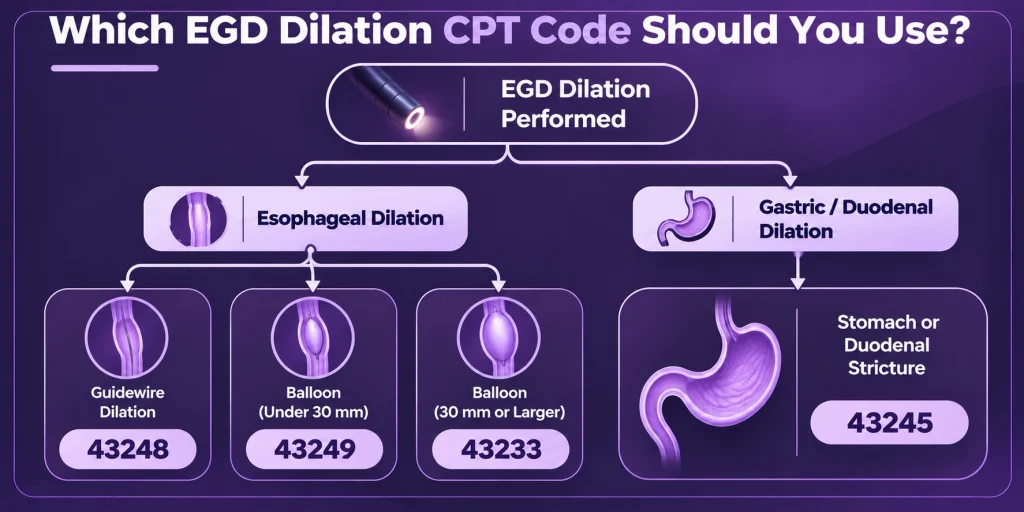
How Do You Choose the Correct EGD Dilation CPT Code?
Dilation is where EGD medical coding gets technical. Three details in the operative report decide the code: where the stricture is, how it was dilated and, for balloons, how wide.
| Location | Technique | Balloon Diameter | CPT Code |
|---|---|---|---|
| Esophagus | Guidewire placed through scope, dilators passed over the wire | Not applicable | 43248 |
| Esophagus | Through-the-scope balloon | Under 30 mm | 43249 |
| Esophagus | Balloon | 30 mm or larger | 43233 |
| Stomach or duodenum | Balloon or bougie | Not a factor | 43245 |
CPT 43248: Esophageal Dilation Using a Guidewire
43248 applies when the endoscopist inserts a guidewire through the scope and then passes one or more dilators over that wire through the esophagus. This is the classic Savary technique.
Documentation is key: The report should state that a guidewire was placed endoscopically, name the dilator type and list the sizes passed.
CPT 43249: Esophageal Balloon Dilation Below 30 mm
43249 applies when a balloon is passed through the scope and inflated in the esophagus to a diameter under 30 mm. It is the workhorse code for peptic strictures, rings and anastomotic narrowing.
Documentation is key: The balloon diameter must be in the report. “Balloon dilation performed” without a size leaves the coder unable to choose between 43249 and 43233.
CPT 43233: Esophageal Balloon Dilation of 30 mm or Larger
43233 is for balloon dilation of the esophagus at 30 mm or more, the large-balloon pneumatic dilation typically used for achalasia.
Distinction: Balloon size is the only thing separating 43233 from 43249. Fluoroscopic guidance is included in 43233 when performed, so it is not billed separately.
CPT 43245: Gastric or Duodenal Stricture Dilation
43245 reports dilation of a stricture in the stomach or duodenum, such as a pyloric or anastomotic stricture, by balloon or bougie.
Distinction: Location comes before technique. A balloon in the pylorus is 43245, never 43249, even though the device may be identical.
Can Different Dilation Techniques Be Billed During the Same EGD?
Sometimes, but performing two techniques does not automatically mean billing two codes. When a balloon and a wire-guided dilator are both used on the same esophageal stricture, the NCCI Procedure-to-Procedure edits and payer policy decide whether both are reportable. Separate strictures in separate structures, such as an esophageal stricture and a pyloric stricture, describe two distinct services and are more likely to be separately reportable with documentation of each.
Caution: Dilation is already included in stent placement (43266) and ablation (43270) when performed. Do not add a dilation code to either one for the same site.
Can Diagnostic and Therapeutic EGD CPT Codes Be Billed Together?
This is where most EGD denials start. The EGD family works on a base-code principle, and the NCCI edits enforce it.
Is Diagnostic EGD Included in Therapeutic EGD?
Yes. Every therapeutic EGD code includes the diagnostic examination, and 43235 is designated a separate procedure. The NCCI Policy Manual states that a diagnostic endoscopy is not separately reportable with a surgical endoscopy performed in the same session.
Can CPT 43235 and 43239 Be Reported Together?
No. 43239 already includes the diagnostic EGD. When a biopsy is taken, report 43239 alone.
Can Multiple EGD Biopsies Be Billed Separately?
No. 43239 covers single or multiple biopsies. Specimens from the esophagus, stomach and duodenum in the same session are still one unit of 43239. Biopsies from different locations do not justify repeating the code or adding a modifier.
Can EGD With Biopsy and Dilation Be Reported Together?
Often, yes. Biopsy and dilation are different interventions, so 43239 and a dilation code can both be reported when both are performed and documented. Check the current NCCI edit for the exact code pair before adding any modifier, because not every pair needs one.
When Can Separate EGD Procedures Be Reported During One Session?
Three things decide it: whether an NCCI Procedure-to-Procedure edit exists for the code pair, what that edit’s modifier indicator allows and whether the documentation shows different lesions or sites. An indicator of 0 means the pair is never payable together. An indicator of 1 means a modifier may be used when the services are truly distinct.
| Code Pair or Situation | Reportable Together? | Practical Rule |
|---|---|---|
| 43235 with any other EGD code | No | The diagnostic EGD is included |
| 43239 + 43251, same lesion | No | Report only the removal (43251) |
| 43239 + 43251, different lesions | Yes, with support | Document each lesion; modifier 59 or XS on the biopsy if the edit requires |
| 43236 + 43255, same lesion | No | Injection to control bleeding is part of 43255 |
| 43236 or 43239 + 43254, same lesion | No | The lift injection and biopsy are part of the EMR |
| 43248 or 43249 + 43266 or 43270, same site | No | Dilation is included in stent placement and ablation |
| 43255 for bleeding caused by the procedure | No | Controlling bleeding the endoscopist caused is not separately reportable |
| 43239 + dilation code | Usually yes | Different interventions; verify the current edit |
| EGD code + colonoscopy code | Yes | Different endoscopy families |
Diagnostic vs. therapeutic decision path: First, was any intervention performed? If not, report 43235. If yes, report the code for each intervention. Then ask whether two interventions treated the same lesion; if so, report only the more extensive one. Finally, check the NCCI edit for every remaining code pair.

Payment note: Medicare pays EGD codes in the same family under the multiple endoscopy rule. The highest-valued code is paid in full, and each additional code is paid at its value minus the value of the base code, 43235.
Which Modifiers Apply to EGD Procedures?
Modifiers on EGD claims depend on who is billing. Physicians and facilities use different modifiers for the same event, and that is the first thing to get right.
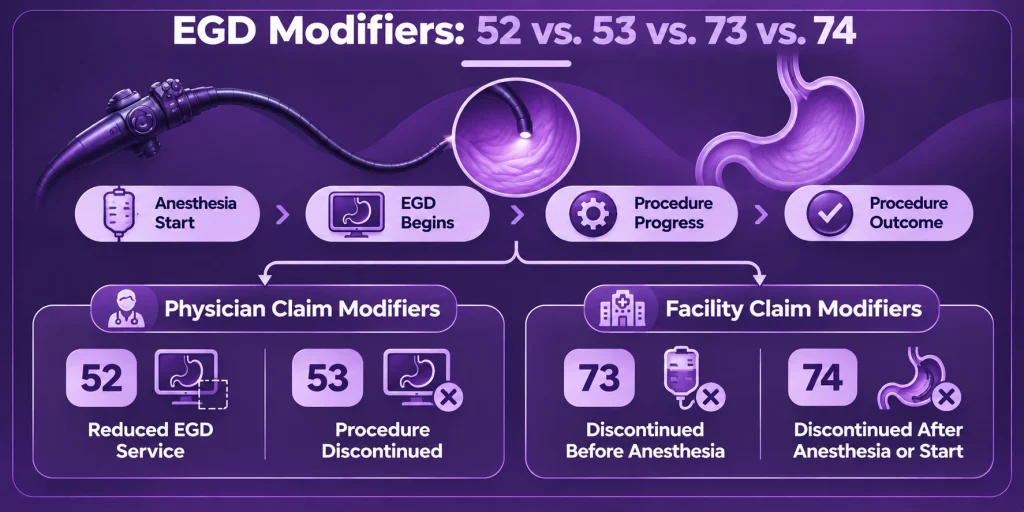
| Modifier | Purpose | Who Uses It | Documentation Requirement |
|---|---|---|---|
| 52 | Reduced service | Physician | What was and was not performed, and why |
| 53 | Discontinued procedure | Physician | Circumstance that threatened the patient, point of discontinuation |
| 73 | Discontinued before anesthesia | Hospital outpatient or ASC | Patient prepped and taken to the room; reason for stopping |
| 74 | Discontinued after anesthesia or after start | Hospital outpatient or ASC | Anesthesia given or procedure begun; reason for stopping |
| 59 / XS / XU | Distinct procedural service | Physician and facility | Separate lesion, structure or non-overlapping service |
| 25 | Separate E/M on the same day | Physician | E/M work beyond the usual pre-procedure assessment |
| 33 / PT | Preventive service indicators | Rarely relevant to EGD | A qualifying preventive service under payer policy |
Modifier 52: Reduced EGD Services
Modifier 52 tells the payer the physician performed less than the full service. For EGD, CPT guidance ties it to the duodenum: when the duodenum is deliberately not examined, or cannot be safely reached, and no repeat exam is planned, the EGD code is reported with modifier 52.
Watch out: Do not add 52 automatically because the duodenum was not reached. If a repeat examination is planned, CPT guidance points to modifier 53 instead. The report has to say how far the scope went, why it stopped and what happens next.
Modifier 53: Discontinued EGD Procedure
Modifier 53 is a physician modifier for a procedure stopped after it began because of extenuating circumstances or a threat to the patient’s wellbeing, such as oxygen desaturation or an unstable airway.
Distinction: An elective cancellation before sedation or before the procedure starts is not a discontinued procedure, and 53 does not apply.
Modifier 73: EGD Discontinued Before Anesthesia
Modifier 73 is a facility modifier for hospital outpatient departments and ASCs. It applies when the patient was prepared and taken to the procedure room but the EGD was cancelled before anesthesia or sedation was administered. Medicare generally pays the facility a reduced amount for these cases.
Modifier 74: EGD Discontinued After Anesthesia
Modifier 74 is the facility counterpart for an EGD stopped after anesthesia was administered or after the procedure began.
Key coding principle: The same discontinued case can carry 53 on the physician claim and 74 on the facility claim. Modifier 53 never belongs on the facility claim.
Modifiers 59, XS and XU for Distinct Procedures
Modifier 59: Distinct procedural service, used only when no more specific modifier describes the situation.
Modifier XS: Separate structure, for a service performed on a different organ or structure.
Modifier XU: Unusual non-overlapping service, for a service that does not overlap the usual components of the main one.
Caution: None of these exists to bypass a bundling edit. Each one is a statement that the record documents a truly distinct service, and auditors read the operative report to check.
Modifier 25 for a Separately Identifiable E/M Service
An E/M visit on the day of an EGD is separately reportable with modifier 25 only when it is significant and separately identifiable. The routine pre-procedure assessment and the decision to perform a scheduled EGD are part of the procedure.
Do Preventive Modifiers 33 and PT Apply to EGD?
Rarely. Modifier PT applies when a colorectal cancer screening test becomes a diagnostic or therapeutic service, so it belongs to colonoscopy and sigmoidoscopy claims, not EGD. Modifier 33 requires a qualifying preventive service under the payer’s policy, and a standard EGD is not one. Neither should be treated as a routine EGD modifier.
How Are EGD Procedures Billed in Hospitals, ASCs and Physician Practices?
One EGD often produces two claims. Knowing which rules belong to which claim prevents a large share of rejections.
Physician Professional Billing vs. Facility Billing
The endoscopist bills the professional service on a CMS-1500 claim with the CPT code and physician modifiers. When the procedure is performed in a hospital or ASC, the facility bills separately for the room, staff, equipment and supplies using the same CPT code under its own payment rules.
Sedation: Moderate sedation is no longer bundled into GI endoscopy codes. When the endoscopist provides it, it is reported separately with the moderate sedation codes (Medicare uses G0500 for GI endoscopy). When an anesthesia provider is involved, that provider bills anesthesia code 00731 for an upper GI endoscopy.
EGD Billing in an Ambulatory Surgery Center
ASCs bill the EGD CPT code with place of service 24 and use modifiers 73 and 74 for discontinued cases. Medicare pays ASCs under the ASC payment system, and some commercial payers still ask for modifier SG on ASC facility claims. The physician bills the same CPT code with POS 24 and is paid at the facility rate.
EGD Billing in a Hospital Outpatient Department
Hospital outpatient departments bill EGD on the UB-04 institutional claim, typically under a gastrointestinal services revenue code, and are paid by Medicare under the Outpatient Prospective Payment System. Modifiers 73 and 74 apply here too. The physician’s claim uses POS 22 for an on-campus department or POS 19 for an off-campus one.
How Do Place of Service and Payer Rules Affect EGD Claims?
Place of service drives the physician’s payment rate, the facility’s payment system and, with many commercial plans, whether the procedure is covered in that setting at all. Some payers steer routine EGDs away from hospital outpatient departments toward ASCs through site-of-service policies. Verify the setting rules before the procedure is scheduled, not after the claim is denied.
What Documentation Is Required for Accurate EGD CPT Coding?
No amount of coding knowledge can rescue an incomplete procedure report. Coders are not endoscopists and cannot assume what was done. Here is what the report needs to show.
Indication and Medical Necessity for the EGD
The report should state why the EGD was performed: the symptom, finding or known condition, such as dysphagia, upper GI bleeding or surveillance of Barrett’s esophagus. That indication becomes the diagnosis that supports medical necessity.
Anatomical Extent of the Examination
The report should name the furthest point reached. “Scope advanced to the second portion of the duodenum” supports an EGD code. A scope that never left the esophagus does not.
Biopsy Sites, Specimens and Lesion Documentation
Each biopsy site, each lesion and what was done to it should be listed separately. When one lesion is biopsied and another is removed, the report must make clear they were different lesions, or only the removal is reportable.
Dilation, Bleeding Control and Therapeutic Procedure Details
Therapeutic codes turn on details: the stricture location, the dilation method, the balloon diameter, the bleeding source, the hemostasis method and the devices used. A missing balloon size or an unnamed bleeding source usually means a query.
Documentation for Reduced or Discontinued EGDs
The report must show how far the procedure went, whether sedation or anesthesia had been given, the specific reason it was stopped and whether a repeat is planned. Those four facts decide between modifiers 52, 53, 73 and 74.
When Should a Medical Coder Query the Gastroenterologist?
Query when the report conflicts with itself, when a required detail is missing or when the findings describe an intervention the procedure section never mentions. A compliant query presents the facts and asks an open question.
| EGD Documentation Checklist | Why It Matters |
|---|---|
| Indication for the procedure | Supports medical necessity and the diagnosis code |
| Furthest anatomical point reached | Confirms the EGD family or points to esophagoscopy or enteroscopy |
| Each intervention, by site and lesion | Decides which codes are reportable together |
| Biopsy sites and specimens | Supports 43239 |
| Dilation location, method and balloon size | Decides 43248, 43249, 43233 or 43245 |
| Bleeding source and hemostasis method | Supports 43255 |
| Sedation or anesthesia type and provider | Decides sedation and anesthesia billing |
| Stage and reason if stopped early; repeat planned or not | Decides modifier 52, 53, 73 or 74 |
What Medicare Coverage and Medical Necessity Rules Apply to EGD?
Medicare has no single national policy listing the diagnoses that cover an EGD. Coverage detail comes from each Medicare Administrative Contractor, so the first question is always which contractor processes your claims.
What Does CMS Article A57063 Cover?
Article A57063, Billing and Coding: Diagnostic and Therapeutic Esophagogastroduodenoscopy, gives the billing and coding guidance for LCD L33583. Both belong to First Coast Service Options, the contractor for Jurisdiction N, which covers Florida, Puerto Rico and the U.S. Virgin Islands. First Coast reviewed the article for the 2027 ICD-10-CM update in October 2026.
Not a national policy: A57063 applies only in Jurisdiction N. Other contractors publish their own documents, such as Novitas with LCD L35350 and article A57414. Use the article for the state where the service is billed.
Which ICD-10-CM Diagnoses May Support EGD Medical Necessity?
Each article carries its own diagnosis list, and those lists run long. The categories below are illustrative only, so confirm the exact codes in your contractor’s current article.
Upper GI bleeding: Hematemesis (K92.0), melena (K92.1) and gastrointestinal hemorrhage, unspecified (K92.2).
Swallowing and esophageal disorders: Dysphagia (R13.1-), esophageal obstruction (K22.2), Barrett’s esophagus (K22.7-) and esophageal varices (I85.-).
Stomach and duodenal conditions: Gastric and duodenal ulcers (K25.-, K26.-) and persistent epigastric pain (R10.13).
Other documented indications: Iron deficiency anemia from chronic blood loss (D50.0) and a foreign body in the esophagus (T18.1-).
What Causes Medical Necessity Denials for EGD?
The usual causes are a diagnosis that is not on the contractor’s covered list, a symptom code that does not match the documented indication, a repeat EGD without a documented reason and an order whose indication never made it into the report. Screening an asymptomatic patient is a frequent trigger, because Medicare covers EGD for signs, symptoms or known disease.
When Is Prior Authorization Required for EGD?
It varies by payer, plan, procedure and setting. Traditional Medicare does not generally require prior authorization for EGD, but many Medicare Advantage and commercial plans do, and some apply it only in hospital outpatient departments. Check the plan’s requirements for the specific CPT code and site of service before scheduling.
What Are the Most Common EGD CPT Coding and Billing Mistakes?
Most EGD errors repeat the same patterns. Here is what goes wrong in each and how to verify the right answer.
| Mistake | What Went Wrong | How to Avoid It |
|---|---|---|
| Billing 43235 with a therapeutic EGD | The diagnostic exam is included in every other EGD code | Report 43235 only when nothing else was done |
| Treating brushing or washing as a biopsy | Brushings and washings are part of 43235 | Look for forceps biopsy before using 43239 |
| Reporting 43239 more than once | The code covers single or multiple biopsies | One unit per session, whatever the specimen count |
| Choosing the wrong esophageal dilation code | Technique or balloon size was not checked | Confirm guidewire versus balloon, then the diameter |
| Coding gastric dilation as esophageal | Location was overlooked | Find the stricture location first; stomach or duodenum is 43245 |
| Modifier 53 on the facility claim | 53 is a physician modifier | Use 73 or 74 on facility claims, by anesthesia stage |
| Adding 59, XS or XU by habit | No distinct service is documented | Check the NCCI edit, then the report for separate lesions or sites |
| Using an EGD code for a different exam | Only the esophagus was examined, or the scope went into the small bowel | Match the code family to the documented extent |
| Missing medical necessity support | Indication absent or diagnosis not covered | Check the contractor article and payer policy |
| Using outdated codes | Deleted codes such as 43256 or 43258 still on templates | Update code lists every January against the current CPT set |
Practical EGD CPT Coding Examples
Let’s put the rules to work with six hypothetical cases.
Scenario 1: Diagnostic EGD Without Biopsy
Procedure documentation: Scope advanced to the second portion of the duodenum. Mild gastritis noted. Gastric washing collected. No biopsy.
Supported CPT code: 43235.
Modifier considerations: None.
Coding rationale: Washing is included in the diagnostic EGD, and no other intervention was performed.
Scenario 2: EGD With Multiple Gastric Biopsies
Procedure documentation: Complete EGD. Four forceps biopsies from the antrum and two from the gastric body sent to pathology.
Supported CPT code: 43239, one unit.
Modifier considerations: None.
Coding rationale: 43239 covers single or multiple biopsies, and the diagnostic exam is included.
Scenario 3: EGD With Esophageal Balloon Dilation
Procedure documentation: Distal esophageal stricture dilated with a through-the-scope balloon to 18 mm.
Supported CPT code: 43249.
Modifier considerations: None.
Coding rationale: The balloon is under 30 mm. The same report with a 30 mm or larger balloon would support 43233 instead.
Scenario 4: EGD With Gastric Stricture Dilation
Procedure documentation: Pyloric stricture identified and dilated with a balloon to 15 mm. Esophagus normal.
Supported CPT code: 43245.
Modifier considerations: None.
Coding rationale: The stricture is in the stomach, so the gastric and duodenal dilation code applies even though a balloon was used.
Scenario 5: EGD Discontinued Due to a Patient Safety Concern
Procedure documentation: Sedation administered and scope inserted. Patient desaturated with the scope in the stomach, and the procedure was stopped. Repeat EGD to be scheduled.
Supported CPT code: 43235.
Modifier considerations: 53 on the physician claim. 74 on the facility claim, because anesthesia had been given and the procedure had begun.
Coding rationale: The procedure was discontinued for patient safety after it started. Had it been cancelled before sedation, the facility would use 73 and the physician would not report the EGD.
Scenario 6: EGD and Colonoscopy Performed During the Same Session
Procedure documentation: EGD with gastric biopsies, followed by a diagnostic colonoscopy to the cecum.
Supported CPT codes: 43239 and 45378.
Modifier considerations: XS is not automatically required. The two codes belong to different endoscopy families. Some payers want modifier 51 on the second procedure, and standard multiple procedure payment rules apply.
Coding rationale: Each procedure is a complete, separately documented examination of a different part of the GI tract.
What Should Medical Coders Verify for EGD Billing in 2027?
The CPT 2027 code set takes effect on January 1, 2027. Before that date, run through this list.
CPT codes and descriptors: Confirm every EGD code and descriptor you use against the licensed 2027 CPT code set. Do not assume a code was added, revised or deleted without checking.
NCCI edits: Medicare updates the Procedure-to-Procedure edits every quarter. Load the January 2027 file.
Coverage articles: Check your contractor’s EGD article and LCD for revisions.
Physician and facility rules: Confirm the 2027 fee schedule values for physicians and the payment rules for hospital outpatient departments and ASCs.
Payer policies: Recheck prior authorization and site-of-service requirements for each major plan.
The Bottom Line
The right EGD CPT code comes from the procedure report, not from the order. What was performed, how far the scope went, which technique was used and whether two interventions treated the same lesion decide the code, and the setting and stage of the procedure decide the modifier. Read the report, check the NCCI edit and confirm the payer’s rules before the claim goes out.

Frequently Asked Questions About EGD CPT Codes
What is the CPT code for esophagogastroduodenoscopy?
43235 for a diagnostic EGD. When an intervention is performed, a different code from the EGD family applies, such as 43239 for biopsy.
What is the difference between CPT 43235 and 43239?
43235 is examination only, with brushing or washing if performed. 43239 adds forceps biopsy. See the comparison table in the first section.
What is the CPT code for EGD with biopsy?
43239, reported once per session whether one or many biopsies are taken.
Which CPT code applies to EGD with dilation?
43248 for esophageal dilation over a guidewire, 43249 for esophageal balloon dilation under 30 mm, 43233 for 30 mm or larger and 43245 for gastric or duodenal strictures.
What is the difference between CPT 43248 and 43249?
Technique. 43248 uses a guidewire with dilators passed over it. 43249 uses a balloon passed through the scope.
Can CPT 43235 and 43239 be billed together?
No. The diagnostic EGD is included in 43239.
Can EGD with biopsy and dilation be billed together?
Usually yes, because they are different interventions. Verify the current NCCI edit for the specific code pair.
What CPT code applies to EGD with bleeding control?
43255, for control of bleeding by any method. It is not reported for bleeding caused by the procedure itself.
What is the CPT code for EGD with polypectomy?
43251 for removal by snare and 43250 for removal by hot biopsy forceps.
What is the difference between EGD and endoscopy?
Endoscopy is any scope procedure. EGD is the specific endoscopy of the esophagus, stomach and duodenum.
When is modifier 53 used for an EGD?
On the physician claim, when the EGD is discontinued after it begins because of a threat to the patient. Facilities use 73 or 74 instead.
Can EGD and colonoscopy be billed on the same day?
Yes. They are separate endoscopy families and both are reported, subject to multiple procedure payment rules.


