
Cataract surgery is one of the common procedures many ophthalmology practices bill, and mostly it is coded with the CPT Code 66984. If a case comes in with a small pupil and an iris expansion ring (or a pediatric patient) the right code for this procedure would be 66982 and if you billed it under the most common CPT code which commonly most practices uses you will go through denial or under payment and unnecessary audits.
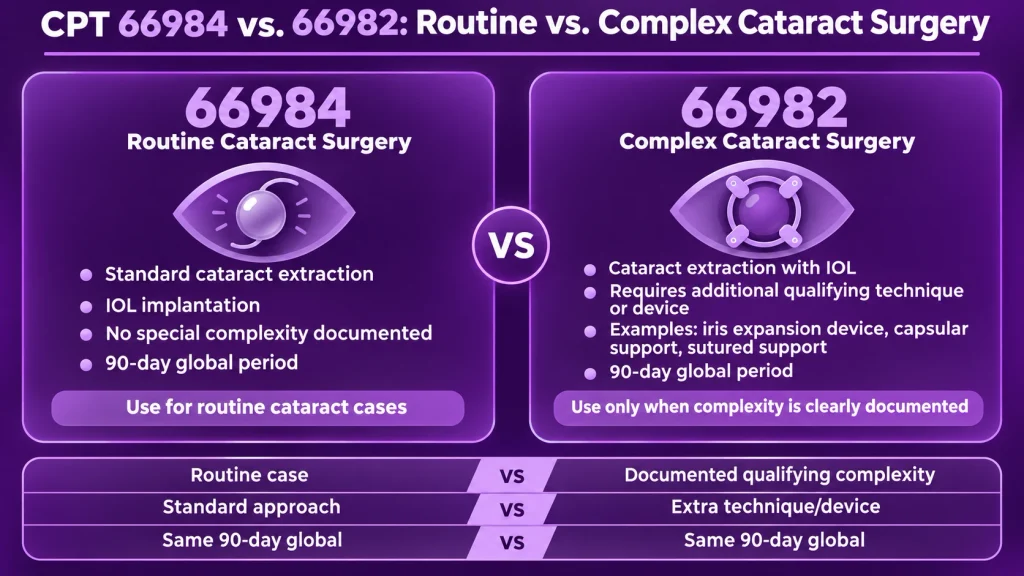
CPT 66984 is for routine extracapsular cataract removal with intraocular lens (IOL) insertion while CPT 66982 is the same surgery procedure but the difference is when its more complex, meaning the surgeon needs techniques or high tech devices which is not used in a general cataract routine surgery or the patient is in the amblyogenic developmental stage. These two CPT codes have a 90 days global period and both require RT or LT.
Let’s have a detailed look at both the codes, documentation that distinguish them, related cataract removal CPT codes and modifiers, ICD 10 Codes and the recent 2027 payment modification that impacts every cataract claim.
What are the CPT codes for cataract surgery?
The 2027 CPT codes for cataract surgery are located within the sections Intraocular Lens Procedures and Removal of Lens Material, ranging between 66830 and 66991. The most frequently used CPT code for cataract surgery is 66984, which is the cataract extraction procedure that individuals usually seek information about.
| CPT | What it describes | When it is used |
|---|---|---|
| 66984 | Extracapsular cataract removal with IOL insertion, routine; without endoscopic cyclophotocoagulation | Standard phaco cataract surgery |
| 66982 | Extracapsular cataract removal with IOL insertion, complex; without endoscopic cyclophotocoagulation | Extra devices or techniques, or amblyogenic-stage patient |
| 66988 / 66987 | Routine / complex cataract surgery with endoscopic cyclophotocoagulation (ECP) | Cataract plus ECP for glaucoma |
| 66991 / 66989 | Routine / complex cataract surgery with insertion of anterior segment aqueous drainage device(s) | Cataract plus MIGS stent |
| 66983 | Intracapsular cataract extraction with IOL insertion (1-stage procedure) | Rare today |
| 66840 / 66850 / 66852 | Removal of lens material by aspiration / phacofragmentation / pars plana approach | Lens removal without IOL insertion |
| 66920 / 66930 / 66940 | Removal of lens material: intracapsular / intracapsular for dislocated lens / extracapsular | Lens removal without IOL insertion |
| 66985 | Insertion of IOL not associated with concurrent cataract removal | Secondary IOL |
| 66986 | Exchange of intraocular lens | IOL exchange |
| 66821 | Discission of secondary membranous cataract, laser surgery (YAG capsulotomy) | Posterior capsule opacification after surgery |
Coding tip: If an IOL goes in during the same session, you’re in the 66982-66991 range. The lens removal codes (66840-66940) are for cases where no lens is implanted.
CPT code 66984: routine cataract surgery
CPT code 66984 description
The CPT code 66984 description reads: extracapsular cataract removal with insertion of intraocular lens prosthesis (1-stage procedure), manual or mechanical technique (eg, irrigation and aspiration or phacoemulsification); without endoscopic cyclophotocoagulation. In plain terms, procedure code 66984 is the everyday phaco case: the surgeon opens the capsule, breaks up and removes the cloudy lens and places an IOL in one sitting.
What 66984 includes
The 66984 CPT code refers to a global surgery code that involves 90 Days of care. The payment amount includes costs associated with the pre-operative visit conducted the previous day or on the day of surgery, and postoperative management within 90 days. Capsulorrhexis creation, insertion of viscoelastic material, hydrodissection, irrigation/aspiration, and intraocular lens implantation fall under this code.
Documentation is key: The operative note should name the eye, the technique, the IOL model and power and any complications. For the payer, the record before surgery should show why the cataract needs removal.
CPT code 66982: complex cataract surgery
66982 CPT code description
The 66982 CPT code description starts the same way as 66984 and then adds: “complex, requiring devices or techniques not generally used in routine cataract surgery (eg, iris expansion device, suture support for intraocular lens, or primary posterior capsulorrhexis) or performed on patients in the amblyogenic developmental stage; without endoscopic cyclophotocoagulation.”
So 66982 is not about how hard the case felt. It’s about what the surgeon had to do or who the patient is.

What supports complex cataract surgery CPT 66982?
CGS, a Medicare administrative contractor, lists the situations it accepts as support for complex cataract surgery in its cataract surgery fact sheet. They include:
A small pupil that won’t dilate enough for safe surgery, managed with four iris retractors through four extra incisions, a Beehler or similar pupil expansion device, or a sector iridectomy with suture repair.
Sphincterotomies created with scissors.
Abnormally weak or absent lens support structures caused by a disease state, which may require capsular tension rings or sutured IOL support.
The CPT descriptor adds two more: primary posterior capsulorrhexis and surgery on a child in the amblyogenic developmental stage. CGS also expects documentation of the extra work done during the intraoperative or postoperative period.
What does not make a case complex?
A dense cataract on its own, a longer operating time or a patient history without any extra device or technique doesn’t support 66982. Neither does adding a diagnosis code that “sounds” complex. If the operative note reads like a routine phaco, the code is 66984.
How to avoid? Before you assign 66982, find the device or technique in the operative note and the reason it was needed. If you can’t point to both, query the surgeon or code 66984.
66984 vs. 66982: key differences at a glance
| Point | 66984 (routine) | 66982 (complex) |
|---|---|---|
| Procedure | Extracapsular cataract removal with IOL, 1 stage | Same procedure |
| What makes it this code | Standard technique | Devices or techniques not generally used in routine surgery, or amblyogenic-stage patient |
| Examples | Routine phacoemulsification | Iris expansion ring, iris hooks, capsular tension ring, sutured IOL, primary posterior capsulorrhexis |
| Global period | 90 days | 90 days |
| Payment | Lower | Higher; carries more audit risk |
| Documentation focus | Medical necessity and standard op note | Medical necessity plus the specific device or technique and why it was needed |
| With ECP | 66988 | 66987 |
| With MIGS drainage device | 66991 | 66989 |
One rule never changes: report one cataract code per eye per session. You don’t bill 66984 and 66982 together on the same eye, and you don’t add 66984 to 66989 or 66991. The combination codes already include the cataract surgery.

Cataract surgery with glaucoma procedures: 66987, 66988, 66989 and 66991
When cataract surgery is combined with certain glaucoma procedures, CPT provides specific combination codes. Codes 66987 and 66988 describe cataract surgery with endoscopic cyclophotocoagulation (ECP), while 66989 and 66991 apply to cataract surgery with qualifying anterior segment aqueous drainage devices. Other glaucoma procedures may require different coding combinations depending on the procedure and device used.
With endoscopic cyclophotocoagulation (ECP): 66988 for routine cataract surgery and 66987 for complex cataract surgery. These were added in 2020.
With a MIGS aqueous drainage device (such as a trabecular stent): 66991 for routine cataract surgery and 66989 for complex cataract surgery. These replaced the old practice of billing 66984 with Category III code 0191T, which was deleted in 2022.
Documentation is key: Record the glaucoma diagnosis, the device or laser used and the number of devices placed. Many Medicare contractors have MIGS coverage policies, so check yours before surgery.
Laser eye surgery CPT codes and cataract surgery
“Laser eye surgery” covers several very different procedures, and only some have CPT codes that Medicare pays.
| Procedure | Code | Billing note |
|---|---|---|
| YAG laser capsulotomy for posterior capsule opacification | 66821 | Covered when medically necessary; has its own global period |
| Femtosecond laser-assisted cataract surgery | No separate CPT | The cataract is still 66984 or 66982; the laser portion is not separately payable by Medicare |
| LASIK | S0800 (HCPCS) | Elective refractive surgery; not covered by Medicare |
| PRK | S0810 (HCPCS) | Elective refractive surgery; not covered by Medicare |
Medicare does not allow an additional patient charge solely for using a femtosecond laser to perform covered cataract surgery. However, patients may be charged for separately identifiable, non-covered refractive services, such as astigmatism correction or premium IOL functionality, when Medicare billing requirements are met. The medically necessary cataract removal and conventional IOL remain covered services.
Modifiers for cataract surgery
Cataract claims live or die on modifiers. Here are the ones you’ll use.
| Modifier | Use in cataract billing | Example |
|---|---|---|
| RT / LT | Identifies the operated eye for unilateral cataract surgery. Same-day bilateral surgery follows the applicable bilateral reporting requirements. | 66984-LT for cataract surgery on the left eye |
| 79 | Unrelated procedure during the postoperative period | Second eye operated within the first eye’s 90-day global |
| 54 | Surgical care only | Surgeon transfers postoperative care to an optometrist |
| 55 | Postoperative management only | Optometrist providing co-managed post-op care |
| 57 | Decision for surgery | E/M the day before or day of surgery where the decision is made |
| 24 | Unrelated E/M during the postoperative period | Visit for a new eye problem during the global |
| 78 | Unplanned return to the OR for a related procedure | Return for a dislocated IOL |
Cataract surgery left eye CPT code
The CPT code for cataract surgery on the left eye is the same procedure code with modifier LT, for example 66984-LT for a routine case or 66982-LT for a complex one. Right eye uses RT.
Second eye surgery and co-management
When the second eye is done inside the first eye’s 90-day global period, add modifier 79 along with the eye modifier, such as 66984-RT-79. For co-management, the surgeon bills the cataract code with 54 and the co-managing provider bills the same code with 55, both with the same date of service and the transfer date documented.
How to avoid? Make sure both providers use the same CPT code, eye modifier and date of service. Mismatches are one of the most common reasons co-managed claims deny.
ICD-10 codes and medical necessity for cataract surgery
The diagnosis has to support the surgery, and the eye in the ICD-10 code should match the eye in the CPT modifier.
| ICD-10-CM | Description | Note |
|---|---|---|
| H25.11 / H25.12 / H25.13 | Age-related nuclear cataract, right / left / bilateral eye | Most common cataract diagnosis |
| H25.011 / H25.012 / H25.013 | Cortical age-related cataract, right / left / bilateral eye | Cortical type |
| H25.811 / H25.812 / H25.813 | Combined forms of age-related cataract, right / left / bilateral eye | More than one type |
| E11.36 | Type 2 diabetes mellitus with diabetic cataract | Use when the provider links the cataract to diabetes |
| H26.9 | Unspecified cataract | Avoid when the type is documented |
| H21.81 | Floppy iris syndrome | Can support the need for pupil expansion in complex cases |
For medical necessity, the CGS Cataract Extraction LCD requires documentation showing how the cataract affects the patient’s visual function and daily activities. Its coverage criteria include best-corrected visual acuity of 20/50 or worse, or qualifying additional testing such as glare or consensual light testing. Cataract surgery may also be considered for patients with 20/40 or better vision when other coverage criteria are met and medical necessity is adequately documented. Requirements vary by Medicare contractor and payer.
Premium IOL billing
A standard monofocal IOL is part of the covered cataract surgery. When a patient chooses a premium lens, the extra cost is billed to the patient.
V2787: Astigmatism-correcting function of an intraocular lens (toric IOL).
V2788: Presbyopia-correcting function of an intraocular lens (multifocal or accommodating IOL).
The cataract code stays 66984 or 66982. Document the patient’s informed choice and keep the premium charge separate from the covered surgery.
What’s changing for cataract surgery billing in 2027?
There’s no new number for the core cataract codes, but payment and rules around them shift.
Lower payment
The CY 2027 Medicare Physician Fee Schedule final rule lowers the conversion factor for most physicians to $32.63. On the facility side, Becker’s reported that estimated Medicare ASC payments for 66984, the highest-paid ASC procedure, fall 2% under the 2027 ASC rule.
What stays the same
The 2027 same-day E/M reduction applies only to procedures with a 0-day global period, so it doesn’t touch 66984 or 66982, which carry 90-day globals. The FY 2027 ICD-10-CM update also made no changes to the age-related cataract (H25) or other cataract (H26) codes.
Practical cataract coding scenarios
Scenario 1: Routine phaco, left eye. A 71-year-old with H25.12 has phacoemulsification with a monofocal IOL in the left eye. Code: 66984-LT. Why: standard technique, no extra devices.
Scenario 2: Small pupil with a pupil expansion ring. The right pupil dilates to 4 mm despite drops, and the surgeon inserts a pupil expansion ring to complete the case. Code: 66982-RT, with H25.11 and H21.81 if floppy iris syndrome is documented. Why: a device not generally used in routine surgery was required, and the note explains why.
Scenario 3: Second eye inside the global period. The left eye was done on March 3. The right eye is done on April 7. Code: 66984-RT-79. Why: the second eye falls inside the first eye’s 90-day global.
Scenario 4: Co-managed cataract surgery. The surgeon operates and transfers care to an optometrist on day 2. Code: Surgeon bills 66984-RT-54; the optometrist bills 66984-RT-55 with the transfer date. Why: the global payment is split between the two providers.
Scenario 5: Cataract surgery with a trabecular stent. A patient with open-angle glaucoma has routine phaco and a trabecular micro-bypass stent in the right eye. Code: 66991-RT. Why: the combination code covers both; don’t add 66984.
Scenario 6: Dense cataract, routine technique. A mature cataract takes longer to remove, but no extra devices or techniques are used. Code: 66984. Why: time and density alone don’t meet the complex criteria.
Common cataract surgery coding mistakes
Coding 66982 for difficulty, not for devices. How to Avoid? Tie 66982 to a documented device or technique, or to an amblyogenic-stage patient.
Missing RT or LT. How to Avoid? Make the eye a required field in the surgery charge and match it to the ICD-10 laterality.
Forgetting modifier 79 on the second eye. How to Avoid? Flag any cataract patient with an open global period at scheduling.
Billing 66984 with an applicable combination code. How to Avoid? When cataract surgery is performed with ECP or a qualifying anterior segment aqueous drainage device, select the appropriate combination code (66987, 66988, 66989 or 66991). Do not separately report 66984 for the same cataract procedure already included in a combination code. Other glaucoma procedures may require different coding arrangements, so verify the specific procedure and applicable CPT instructions.
Mismatched co-management claims. How to Avoid? Share the surgeon’s claim details with the co-managing provider before either claim goes out.
Billing premium IOL costs to Medicare. How to Avoid? Keep V2787 and V2788 charges on the patient’s side with a signed financial agreement.
Conclusion
The difference between 66984 and 66982 comes down to one question: did the surgeon need a device or technique not generally used in routine cataract surgery, or is the patient in the amblyogenic developmental stage? If yes, and the note proves it, the code is 66982. If not, it’s 66984. Add the right eye modifier, use 79 for a second eye inside the global, switch to 66987-66991 when glaucoma work is combined and keep premium lens charges separate. Those habits cover most cataract claims in 2027.
Frequently asked questions
What is cataract surgery?
Cataract surgery is an outpatient eye procedure that removes the eye’s clouded natural lens and replaces it with a clear artificial lens called an intraocular lens (IOL). Surgeons most often use phacoemulsification, which breaks up the cloudy lens with ultrasound energy through a small incision. The procedure restores clear vision, usually takes less than an hour and lets most patients go home the same day.
What is the CPT code for cataract surgery?
The most common CPT code for cataract surgery is 66984, extracapsular cataract removal with intraocular lens insertion. Complex cases use 66982. When ECP or a MIGS device is added, use 66987-66991.
What is the difference between CPT 66984 and 66982?
66984 is routine cataract surgery with IOL insertion. 66982 is the same surgery when it requires devices or techniques not generally used in routine cases, such as an iris expansion device, suture support for the IOL or a primary posterior capsulorrhexis, or when the patient is in the amblyogenic developmental stage.
What is the CPT code for cataract surgery on the left eye?
Cataract surgery on the left eye uses the regular cataract CPT code with modifier LT, such as 66984-LT for a routine case or 66982-LT for a complex case.
Is there a different CPT code for laser cataract surgery?
No. Femtosecond laser-assisted cataract surgery is still coded 66984 or 66982. YAG laser capsulotomy after cataract surgery is a separate procedure, CPT 66821. LASIK is not a CPT-coded Medicare service; it uses HCPCS S0800.
What is the global period for CPT 66984?
CPT 66984 and 66982 both have a 90-day global period. A second eye operated within that period needs modifier 79.
Can 66984 and 66982 be billed together?
No. Only one cataract removal code is reported per eye per session. If the case meets the complex criteria, bill 66982 alone.