

In a Residency Research Network of Texas study published in Family Medicine in 2019, observers reviewed 850 clinic visits and found that 72.1% of the visits coded 99213 or lower could have been coded 99214 or higher. Only 16 visits were overcoded. That is the 99213 vs 99214 problem in one sentence: in that study, revenue was lost by playing it too safe, not by aiming too high.
Here’s the short answer. CPT 99213 is an established patient office visit with low medical decision making (MDM) or at least 20 minutes of total time on the date of the visit. CPT 99214 is the same visit with moderate MDM or at least 30 minutes. Everything else, from documentation to payment, follows from those two lines.
We will analyze the meaning of each code, role of MDM and time in determining the level, and reimbursement amounts. Changes to both codes in 2027 will be highlighted.
CPT Code 99213 vs CPT Code 99214
| Point | CPT Code 99213 | CPT Code 99214 |
|---|---|---|
| Patient type | Established patient | Established patient |
| Medical decision making | Low | Moderate |
| Total time on the date of service | 20 minutes or more | 30 minutes or more |
| Typical problem | 1 stable chronic illness or 1 acute uncomplicated illness | 2+ stable chronic illnesses or 1 chronic illness that is worsening |
| Typical risk | Over-the-counter drugs, minor surgery without risk factors | Prescription drug management |
| Work RVU | 1.30 | 1.92 |
| 2026 Medicare national amount (non-facility) | $95.19 | $135.61 |
The 2026 amounts are the national non-facility payments before geographic adjustment, calculated from the 2026 RVUs and the $33.4009 conversion factor.

CPT code 99213
CPT Code 99213 is used for documenting the care provided during a low complexity office or outpatient visit involving established patients. Established patients include individuals who have been provided professional services by the physician, or another physician practicing within the same specialty as part of the same group practice, within the last three years. To directly answer the question “What is CPT Code 99213?”, the response is that CPT Code 99213 is the third of the five established patient office levels (codes 99211 to 99215).
99213 CPT code description
The 99213 CPT code description reads: office or other outpatient visit for the evaluation and management of an established patient, which requires a medically appropriate history and/or examination and low level of medical decision making. When using total time on the date of the encounter for code selection, 20 minutes must be met or exceeded.
The definition of CPT code 99213 involves a standard office visit wherein the patient has an established illness or injury, an uncomplicated acute illness or injury, or two low-complexity problems requiring an uncomplicated intervention strategy.
99213 CPT code description time
The 99213 time threshold involves 20 minutes of direct practitioner work time on the date of the encounter. Effective from 2024, CPT has listed only a minimum limit, rather than 20 to 29 minutes. If an encounter includes 20 to 29 minutes of time spent with no MDM above moderate, then that encounter will qualify for 99213 code.
Is 99213 a HCPCS code?
The connection between HCPCS and CPT codes is evident from how CPT codes constitute Level I of the HCPCS code set. “HCPCS 99213” and “CPT 99213” both represent identical codes within the physician fee schedule. Level II HCPCS codes include alphanumeric codes like J-codes and G-codes maintained separately by CMS.
CPT code 99214
CPT code 99214 represents an office or outpatient evaluation and management (E/M) service involving moderate medical decision-making for an established patient. In simpler terms, procedure code 99214 definition refers to an established patient encounter that ranks higher than the CPT code 99213. Medical claims code 99214 corresponds to visits in primary and specialist care involving the active treatment of a chronic disease using medications, explaining the frequent appearance of the CPT code 99214 during payer reviews.
CPT 99214 description
The CPT code 99214 description reads: office or other outpatient visit for the evaluation and management of an established patient, which requires a medically appropriate history and/or examination and moderate level of medical decision making. When using total time on the date of the encounter for code selection, 30 minutes must be met or exceeded.
Requirements for 99214
A visit meets the requirements for 99214 in one of two ways:
Moderate MDM: 2 of the 3 MDM elements (problems, data and risk) reach the moderate level.
Time: At least 30 minutes of total practitioner time on the date of the encounter, documented in the note.
History and exam no longer decide the level for office visits. They need to be medically appropriate, but counting bullet points stopped mattering in 2021.
How does medical decision making separate 99213 and 99214?
Medical Decision Making has 3 elements. The visit level is set by the 2 highest elements, so you don’t need all 3 to reach moderate. The AMA’s MDM table breaks down like this:
| MDM element | Low (99213) | Moderate (99214) |
|---|---|---|
| Problems addressed | 2+ self-limited or minor problems; or 1 stable chronic illness; or 1 acute uncomplicated illness or injury; or 1 stable acute illness | 1+ chronic illness with exacerbation, progression or side effects of treatment; or 2+ stable chronic illnesses; or 1 undiagnosed new problem with uncertain prognosis; or 1 acute illness with systemic symptoms; or 1 acute complicated injury |
| Data reviewed and analyzed | Category 1: any 2 of review of external notes, review of each unique test result, ordering each unique test; or Category 2: assessment requiring an independent historian | 1 of 3 categories: any 3 of the Category 1 items (independent historian counts here); or independent interpretation of a test performed by another physician; or discussion of management with an external physician or appropriate source |
| Risk of patient management | Low risk, such as over-the-counter drugs | Moderate risk, such as prescription drug management, a decision about minor surgery with risk factors or a diagnosis or treatment limited by social determinants of health |

Problems: where most 99214 visits come from
Two stable chronic illnesses, such as controlled hypertension and controlled type 2 diabetes, already meet the moderate problem level. So does one chronic illness that is getting worse. Pair that with prescription drug management and the visit is 99214 even if no data is reviewed.
Data: often the weakest element
Data is the element most visits fall short on, which is why 99214 usually comes from problems plus risk. A test ordered and later reviewed counts once, not twice. Tests the same practitioner bills separately with a professional interpretation don’t count toward data.
Risk: prescription drug management
Prescription drug management is the most common moderate-risk item. It means the provider evaluated a prescription drug and made a decision about it: start, stop, continue or change the dose. A refill with no documented thought behind it is weak support.
Documentation is key: Write the assessment so each problem shows its status (stable, worsening, new) and what was decided about it. “HTN, stable, continue lisinopril 10 mg” supports both a problem and a risk element in one line.
How does time separate 99213 and 99214?
Time is the second path, and it’s the simpler one to audit. Count total practitioner time on the date of the encounter, face-to-face and non-face-to-face.
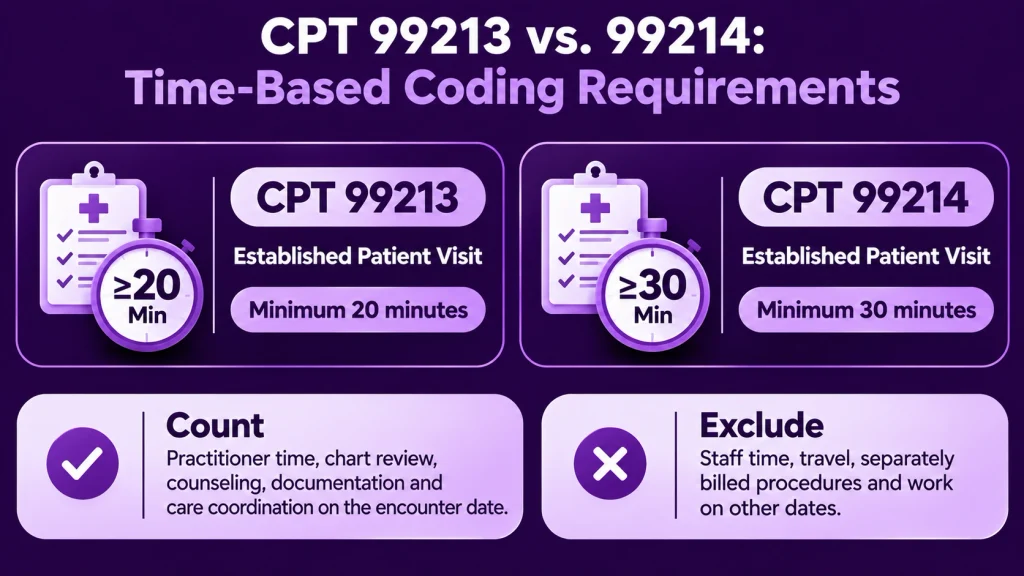
Time that counts: preparing to see the patient, reviewing tests, obtaining history, examining the patient, counseling, ordering tests or medications, documenting in the record, communicating with other professionals and care coordination, all on the date of service.
Time that doesn’t count: clinical staff time, travel, time spent on separately reported services and work done on a different date.
If the visit runs long, prolonged service codes (CPT +99417 and HCPCS G2212 for Medicare) only start after the 99215 time threshold, so they never attach to 99213 or 99214.
How to avoid? Document total minutes as a number. “Spent 32 minutes on the date of service reviewing labs, counseling and documenting” supports 99214. “Spent over half the visit counseling” is a pre-2021 phrase and doesn’t support a level today.

How much do 99213 and 99214 pay?
In 2026, Medicare’s national non-facility amount is $95.19 for 99213 and $135.61 for 99214, a difference of $40.42 per visit before geographic adjustment. Facility amounts are lower: $57.45 for 99213 and $84.50 for 99214. A practice that bills 20 visits a week as 99213 when the notes support 99214 leaves more than $40,000 a year on the table at Medicare rates.
What changes for 99213 and 99214 in 2027?
Four Medicare changes take effect on January 1, 2027:
Lower conversion factor: The CY 2027 Physician Fee Schedule final rule sets the conversion factor at $32.63 for most clinicians, down 2.31%. The American Urological Association’s analysis of the proposed rule showed 99213 and 99214 payments about 2% lower.
G2211 becomes modifier B1: CMS replaced the G2211 add-on with modifier B1, which adds 16% of the base E/M payment for longitudinal care. Modifier B2 adds 32% but is limited to clinicians in accountable care organizations.
Same-day procedure reduction: When an office E/M with modifier 25 is billed with a procedure that has a 0-day global period, Medicare pays the higher-valued service in full and the lower-valued one at 80%.
Work RVUs unchanged: The work RVUs for 99213 (1.30) and 99214 (1.92) stay the same.
How does the procedure code 99214 interact with modifier 25?
Procedure code 99214 is reported with modifier 25 when the provider performs a significant, separately identifiable E/M service on the same day as a minor procedure. The E/M service must involve significant, separately identifiable evaluation and management work beyond the usual assessment included in the minor procedure. A different diagnosis is not required, but the documentation must support the separate E/M service. In 2027, that same-day combination also triggers the 20% reduction when the procedure has a 0-day global period.
Documentation requirements for 99213 and 99214
Documentation for CPT 99213 and 99214 should support the selected coding method. The following six elements help establish medical necessity and coding accuracy when applicable:
- Established patient status: a visit with the same practitioner or same-specialty group within 3 years.
- Medically appropriate history and exam: enough to support the assessment, without bullet counting.
- Problem list with status: each problem labeled stable, worsening, new or resolved.
- Data: named tests reviewed or ordered, external notes and any independent historian.
- Management decisions: each prescription started, stopped, continued or changed.
- Total time, when time is used: minutes on the date of service and the activities performed.
Practical 99213 vs 99214 coding scenarios
Scenario 1: Stable hypertension refill. A patient with controlled hypertension returns for a blood pressure check. The provider continues lisinopril. Problems: 1 stable chronic illness (low). Data: none (minimal). Risk: prescription drug management (moderate). Code: 99213. Why: 2 of 3 elements must reach moderate, and only risk does.
Scenario 2: Diabetes and hypertension follow-up. The patient has controlled type 2 diabetes and hypertension. The provider reviews an A1c, continues metformin and adjusts amlodipine. Problems: 2 stable chronic illnesses (moderate). Risk: prescription drug management (moderate). Code: 99214.
Scenario 3: Uncomplicated UTI. An established patient has dysuria with no fever. The provider prescribes an antibiotic. Problems: 1 acute uncomplicated illness (low). Data: minimal. Risk: moderate. Code: 99213.
Scenario 4: Worsening COPD. A patient with COPD has increased shortness of breath. The provider adds a steroid taper and orders a chest x-ray. Problems: chronic illness with exacerbation (moderate). Risk: prescription drug management (moderate). Code: 99214.
Scenario 5: Time-based visit. The provider documents 34 minutes on the date of service reviewing outside records, counseling on a new diagnosis and coordinating a referral, with low MDM. Code: 99214 by time.
Scenario 6: Visit with a joint injection. A patient with knee osteoarthritis also needs management of uncontrolled hypertension with a medication change, and the provider injects the knee (20610, 0-day global). Code: 99214-25 and 20610. In 2027, Medicare pays the lower-valued of the two at 80%.
Common 99213 and 99214 coding mistakes
Counting history and exam bullets. The 1995 and 1997 bullet counts no longer apply to office visits, even though older guides still rank for these searches. How to Avoid? Code from MDM or total time only.
Using old time ranges. CPT replaced the 20 to 29 and 30 to 39 minute ranges with “met or exceeded” minimums in 2024. How to Avoid? Use 20 minutes for 99213 and 30 for 99214.
Counting staff time. Only practitioner time counts. How to Avoid? Exclude MA and nurse time from the documented minutes.
Defaulting to 99213. The 2019 Texas study found most undercoded visits met 99214. How to Avoid? Check problems and risk first, since they decide most 99214 visits.
Cloned notes. Copied assessments that never change don’t show active management. How to Avoid? Update problem status and decisions every visit.
Billing G2211 in 2027. Medicare replaces the G2211 add-on code with modifiers B1 and B2 beginning January 1, 2027. How to Avoid: Use the applicable modifier only when the service meets Medicare’s eligibility requirements. B1 and B2 generally cannot be reported with modifier 25, except when the same-day service qualifies under Medicare’s preventive service exceptions, including Annual Wellness Visits and certain vaccine administration services.

Conclusion
The difference between 99213 and 99214 comes down to MDM or time. Low MDM or 20 minutes supports 99213. Moderate MDM or 30 minutes supports 99214. Most 99214 visits come from two stable chronic illnesses or one worsening condition plus prescription drug management. Document problem status, decisions and total minutes, switch from G2211 to modifier B1 in 2027 and you’ll code both levels with confidence.
Frequently asked questions
What is CPT code 99213?
CPT 99213 is an office or outpatient visit for an established patient that requires low medical decision making or at least 20 minutes of total practitioner time on the date of the encounter.
What is CPT code 99214?
CPT 99214 is an office or outpatient visit for an established patient that requires moderate medical decision making or at least 30 minutes of total practitioner time on the date of the encounter.
How many minutes is a 99213 visit?
A 99213 visit requires at least 20 minutes of total practitioner time on the date of the encounter. At 30 minutes or more, the visit supports 99214.
Can a single chronic condition support 99214?
Yes, when the chronic illness is worsening, progressing or causing treatment side effects, and the provider manages it with a moderate-risk decision such as prescription drug management.
Is 99214 a HCPCS code?
99214 is a CPT code, and CPT makes up Level I of HCPCS, so “HCPCS code 99214” and “CPT 99214” mean the same code.
How much more does 99214 pay than 99213?
In 2026, Medicare’s national non-facility amount is $135.61 for 99214 and $95.19 for 99213, a difference of $40.42 per visit before geographic adjustment.
Can 99213 and 99214 be billed with G2211 in 2027?
No. Medicare replaced G2211 with modifier B1 in 2027. Modifier B1 increases payment for eligible E/M services by 16%. B1 and B2 generally cannot be reported with modifier 25, except for qualifying Medicare preventive services.