

Timely filing is one of the few billing rules with no second chance. A claim can be coded perfectly and fully supported by documentation, but if it reaches the payer after the deadline, it’s usually denied. For practices that see Molina Healthcare members, that risk is higher than with many payers, because Molina’s deadlines aren’t the same everywhere.
Molina Healthcare offers Medicaid, Medicare Advantage and Marketplace (ACA exchange) plans through state-based health plans. Each state plan publishes its own provider manual, and filing limits can differ by state, product, provider contract, network status and claim type. A 180-day rule that’s correct in Mississippi can be wrong in California, and the deadline for a corrected claim may have nothing to do with the deadline for the original one.
This guide explains how Molina’s timely filing rules work in 2027. It covers state-by-state examples from Molina’s own documents, corrected claim and appeal deadlines, proof of timely filing, the most common reasons for timely filing denials and practical ways to avoid them. Healthcare providers can also benefit from professional medical billing services in USA to manage claim submissions and reduce timely filing errors.
Quick Answer: What Is Molina Healthcare’s Timely Filing Limit?
Molina Healthcare doesn’t have one universal timely filing limit. The deadline depends on the state, the insurance product (Medicaid, Medicare Advantage or Marketplace), your provider agreement and the claim type. In Molina’s published materials, initial claim limits generally range from 90 to 365 calendar days. They’re usually counted from the date of service for outpatient claims, or from the date of discharge for inpatient claims.
Examples from Molina’s current documents:
- California Medi-Cal: 90 calendar days for participating providers; 180 for non-participating providers
- Mississippi Medicaid (MississippiCAN and CHIP): 180 calendar days
- Michigan Medicaid: 365 calendar days
- Molina Medicare (California): one calendar year
Always confirm the deadline in the current provider manual for your state and product, and check your provider agreement, before submitting claims.
1. What Is the Molina Timely Filing Limit?
Definition of Timely Filing
A timely filing limit is the maximum time a provider has to submit a claim to a payer after providing a service. If the payer receives the claim after that window, it can deny the claim for untimely filing.
For Molina, the clock generally starts:
- On the date of service for outpatient and professional claims
- On the date of discharge for inpatient claims
Most Molina documents count deadlines in calendar days, so weekends and holidays count too.
Why Payers Enforce Filing Deadlines
Filing limits help payers close out claim years, manage budgets and comply with state Medicaid contracts and federal rules. For Medicaid managed care plans like Molina, the state contract often shapes the deadline, which is one reason the limits vary by state.
Initial Claims vs. Corrected Claims
An initial claim is the first submission for a service. A corrected claim replaces a claim that was already submitted. Molina often sets a different deadline for corrected claims, and the clock may start from a different date, such as the remittance advice date or the most recent adjudication. Treat these as two separate deadlines.
Consequences of Missing the Deadline
A timely filing denial can result in lost reimbursement. Whether the provider may bill the member depends on the applicable provider agreement, plan rules and state or federal requirements. Participating providers should not automatically transfer a denied balance to the patient.
These denials can usually be overturned only with proof of timely submission or a recognized exception. That’s why prevention matters far more than recovery for this type of denial.
2. Molina Timely Filing Limits by Insurance Plan

Molina’s rules differ by product line, so identify the member’s plan before you check a deadline.
Molina Medicaid Timely Filing Limit
Medicaid is where Molina’s deadlines vary most. Each state plan follows its state contract, so the initial filing limit can be anywhere from 90 to 365 calendar days. Common points of difference include:
- Participating vs. non-participating providers. Some states, such as California, give non-participating providers more time.
- Inpatient vs. outpatient claims. Inpatient deadlines usually start at discharge; outpatient deadlines start at the date of service.
- Coordination of benefits (COB). When Molina is the secondary payer, the deadline is usually counted from the primary payer’s final determination, not from the date of service. The number of days differs by state.
- Third-party liability. Similar rules often apply when another party, such as an auto insurer, is responsible.
Molina Medicare Advantage Timely Filing Limit
For Molina’s Medicare Advantage plans, the published limit is generally one calendar year from the date of service for outpatient claims, or from the date of discharge for inpatient claims. Molina California’s provider page, for example, lists this one-calendar-year limit for Medicare claims.
Even so, your provider agreement can set different terms. Check the Medicare Advantage manual for your state and your contract, especially if you’re a participating provider.
Molina Marketplace (Exchange) Timely Filing Limit
Marketplace plans also vary by state. For example, a Molina Healthcare of Texas Marketplace provider manual requires claims within 95 calendar days, citing the Texas Insurance Code. Confirm this figure in the current 2026 Texas Marketplace Provider Manual. Participating providers should also follow the terms of their agreement.
Bottom line: Don’t apply one deadline to all three product lines. Check the specific manual for the member’s product and state.
3. Molina Timely Filing Limit by State in 2027

The table below lists filing limits from Molina’s own state documents. Deadlines generally run from the date of service (outpatient) or the date of discharge (inpatient) unless noted.
| State | Molina plan | Initial claim limit | Notes | Source |
| California | Medi-Cal (Medicaid) | 90 calendar days (participating); 180 calendar days (non-participating) | From discharge (inpatient) or DOS (outpatient), unless otherwise stated in the contract | Molina California provider page |
| California | Medicare | One calendar year | From the date of service (outpatient) or date of discharge (inpatient) | Same page |
| Michigan | Medicaid | 365 calendar days | COB/TPL: 90 days after the primary payer’s final determination | 2026 Michigan Medicaid Provider Manual |
| Mississippi | MississippiCAN and CHIP | 180 calendar days | COB/TPL: 180 days after the primary payer’s final determination | 2026 MSCAN and CHIP Provider Manual |
| Ohio | Medicaid | 365 calendar days from DOS | Per Ohio Administrative Code 5160; applies to contracted and noncontracted providers | Molina Ohio Processes by Line of Business |
| Texas | Marketplace | 95 calendar days | Per Texas Insurance Code 843.337; verify in the 2026 Marketplace manual | Molina Texas provider resources |
| Kentucky | Passport by Molina (Medicaid) | 365 calendar days | Applies to initial, corrected and voided claims; verify against current policy | Passport Payment Policy 52 |
| Nevada | Medicaid | Verify in the current manual | Earlier Molina Nevada materials list separate limits for in-state and out-of-state/third-party cases; confirm in the 2026 manual’s claims section | 2026 Nevada Medicaid Provider Manual |
The examples in this guide are based on the latest Molina documents reviewed for the 2026 plan year. Check for 2027 provider manual updates and addenda before applying these deadlines to 2027 dates of service.
States to verify separately: For Illinois, Florida, New York, New Mexico, South Carolina, Washington, Wisconsin and other states where Molina operates, check the current provider manual for your product before billing. Some of these states set limits through the provider contract rather than one fixed number.
A note on Virginia: Molina is no longer a Virginia Medicaid managed care plan. Its contract with the state ended June 30, 2025. Runout claims for earlier dates of service follow Molina Virginia’s historical rules, covered in the corrected claims section below.
A few patterns stand out:
- California participating providers have the shortest common window, at 90 days. A practice that bills on a monthly cycle can lose claims there quickly.
- Michigan, Ohio and Kentucky allow 365 days, which gives more room but can encourage delays that cause problems with corrected claims and appeals later.
- Coordination of benefits rules differ significantly. Michigan allows 90 days after the primary payer’s decision; Mississippi allows 180.
4. Molina Corrected Claim Timely Filing Limit
What Is a Corrected Claim?
A corrected claim replaces a previously submitted claim when something needs to change. Common reasons include:
- An incorrect CPT, HCPCS or ICD-10-CM code
- A missing or wrong modifier
- Incorrect units or charges
- Wrong dates of service
- Incorrect patient or provider information
A corrected claim isn’t the same as an appeal. If the original claim was wrong, correct it. If it was right and Molina processed it wrongly, use the dispute or appeal process.
Molina Corrected Claim Submission Deadline
Corrected claim deadlines vary as much as initial claim deadlines, and the starting point varies too:
| State / plan | Corrected claim deadline | Starts from |
| Michigan Medicaid | 365 days from DOS or 90 days from the most recent adjudicated date | Applicable date under the manual |
| Ohio Medicaid | 365 days | Most recent adjudicated date, or the paid claim if one is on file |
| Mississippi Medicaid (MSCAN/CHIP) | 90 days, subject to current manual verification | Remittance advice date |
| Illinois Medicaid | 180 days, subject to current manual verification | Original date of service |
| Kentucky (Passport) | 365 days, subject to current policy verification | Applicable date under the policy |
| Massachusetts (Senior Whole Health dba Molina) | 30 days, subject to current manual verification | Original claim’s remittance advice date |
| Virginia Medicaid (historical runout claims) | Initial and corrected claims for dates of service on or before June 30, 2025, were due within 180 calendar days | Date of service |

The key point is that the clock doesn’t always start on the date of service. In several states, it starts from the remittance advice date or the most recent adjudication. That can help when a correction is needed late, but it can also be very tight. In Massachusetts, for example, you have only 30 days.
How to Submit a Corrected Claim to Molina
- Identify the original claim and its Molina claim number.
- Correct the inaccurate information and include the complete claim, not only the changed lines.
- Use the appropriate replacement or void indicator for the claim format. Institutional claims generally use frequency code 7 for a replacement and 8 for a void. For professional claims, follow the applicable resubmission code and original claim reference requirements. In both cases, include the original Molina claim number.
- Submit electronically through the Availity Essentials portal or your EDI clearinghouse, which Molina prefers.
- Don’t send corrected claims through the dispute or appeal process. Molina treats these as separate workflows.
- Keep the submission confirmation as proof of timely filing.
Accurate medical coding services reduce how often you need corrected claims in the first place.
5. Molina Claim Appeal and Dispute Timely Filing Limit
Molina Claim Appeal Deadline
Appeal and dispute deadlines are separate from claim filing deadlines. They usually start from the date on Molina’s Explanation of Payment (EOP), not the date of service. Examples from Molina-related materials:
- Molina (Massachusetts, 2026 orientation): disputes and appeals within 120 calendar days of the EOP date, unless the provider agreement says otherwise
- Molina Iowa: disputes within 180 days of the EOP or remittance advice date, according to an Iowa HHS provider resource
These are examples, not a universal Molina rule. Check the manual for your state and product.
Don’t assume that the initial filing deadline also applies to appeals. A provider might have 365 days to file a claim but far less time to dispute its payment.
Molina Claim Dispute vs. Claim Appeal
Molina generally separates the two:
- Claim payment dispute: challenges how a claim was processed or paid. Examples include a wrong fee schedule, an incorrect denial, duplicate processing or a timely filing denial you can disprove.
- Claim payment appeal: asks for a formal review of a decision, including denials for lack of medical necessity.
Molina’s 2026 Massachusetts orientation also notes that a provider is limited to one claim payment dispute or appeal per claim. That makes it important to get the first submission right.
Documents Required for Molina Appeals
- Original claim details and Molina claim number
- The EOP or remittance advice
- The denial reason
- Medical records, when the issue is clinical
- Supporting documents, such as authorizations or proof of timely filing
- A clear appeal letter explaining what was wrong and what you’re asking for
- Molina’s dispute form, where your state requires it
A structured denial management process helps make sure appeals are complete and filed on time.
6. What Is Proof of Timely Filing for Molina Claims?
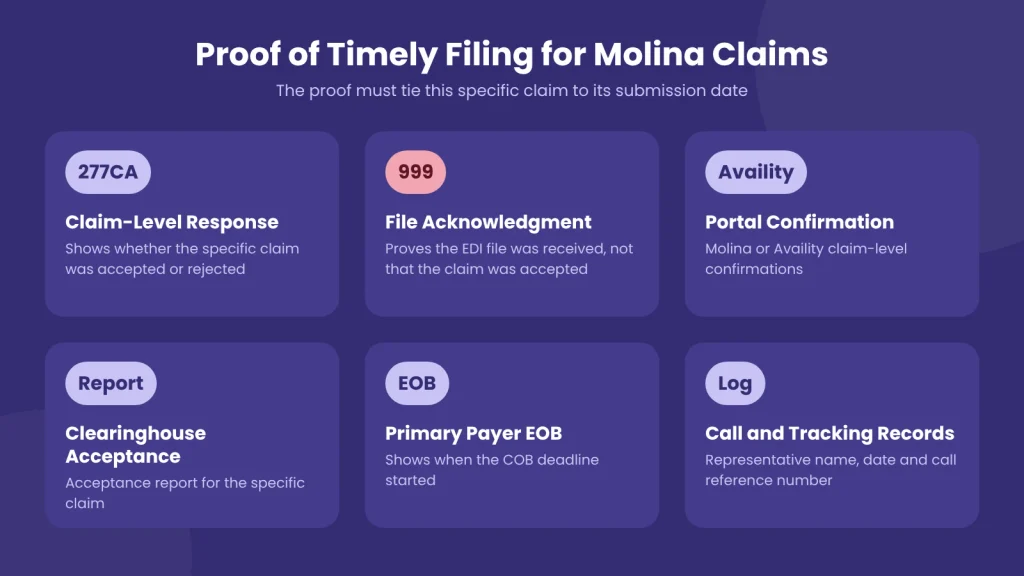
Accepted Proof of Timely Filing
If Molina denies a claim as late but you submitted it on time, proof is what wins the dispute. Keep records such as:
- 999 acknowledgment: Keep it as evidence that the EDI transaction was received by the clearinghouse or receiving system. On its own, it doesn’t prove that Molina accepted the individual claim.
- 277CA acknowledgment: Keep the claim-level response, and review its status to see whether the claim was accepted or rejected for further processing.
- Molina or Availity claim-level confirmations wherever available
- Clearinghouse acceptance reports for the specific claim
- Original claim submission records
- The primary payer’s EOB for coordination of benefits claims, showing the date the secondary deadline started
- Correspondence and claim tracking records, such as call reference numbers
Molina’s provider materials encourage providers to track their EDI acknowledgment reports. Acceptable proof depends on Molina’s policy for your state, so check the manual for exactly what’s required.
How to Prove a Claim Was Submitted on Time
A strong proof package connects four things:
- The claim: patient, date of service and claim or control number
- The submission date: when you sent it
- The payer response: the claim-level acknowledgment, such as the 277CA or a Molina or Availity confirmation, showing the claim was accepted
- The transaction record: the EDI or portal report tying the claim to that date
A batch-level report on its own often isn’t enough. The proof should show that this claim was received and accepted on that date.
7. Common Reasons Molina Claims Are Denied for Timely Filing
- The claim was submitted after the deadline. This often happens because staff assumed a 180-day limit in a 90-day state.
- Wrong payer or submission address. Sending the claim to the wrong Molina plan or another payer means it didn’t reach the right place on time.
- A clearinghouse rejection wasn’t corrected. A rejected claim may not count as filed.
- The primary insurance EOB is missing. Without it, Molina may not apply the COB deadline.
- Incorrect eligibility information. The member’s plan or product was wrong, so the claim went to the wrong place or was submitted under the wrong rules.
- A corrected claim was submitted too late. The corrected claim deadline was shorter than the team expected, or started from a different date.
- There’s no proof of original submission. The claim was sent on time, but no claim-level record proves it.
- Initial claim and appeal deadlines were confused. A dispute was filed under the wrong timeframe.
8. How to Check Molina Claim Status and Filing Deadlines
Check Claim Status Through Molina’s Provider Portal
Molina directs providers to the Availity Essentials portal to check claim status, submit claims and corrected claims, and manage disputes. Check status regularly for claims that haven’t been acknowledged or paid within your normal processing time.
Review the Provider Manual for Your State
Each Molina state plan posts provider manuals for each product line on its website. The “Claims and Compensation” chapter usually covers timely filing, corrected claims, COB and disputes. Note the manual’s date or version, because addendums can change the rules during the year.
Verify the Member’s Insurance Product
The member’s ID card and eligibility response tell you whether they’re in Medicaid, Medicare Advantage, a dual plan or Marketplace coverage, and which state plan applies. Getting this wrong is one of the main causes of late claims.
Contact Molina Provider Services
If the manual doesn’t answer your question, contact Molina’s provider services team for your state. Write down the representative’s name, the date and the call reference number in case you need it later.
Before billing, three things decide your deadline: the member’s plan, the state plan and your provider contract. Check all three.
9. How to Avoid Molina Timely Filing Denials

- Verify eligibility before every visit, including the member’s product and state plan.
- Confirm the correct payer, member ID and submission route in your billing system.
- Submit clean claims promptly. Don’t hold claims until the end of the month, especially in short-window states.
- Monitor clearinghouse rejections daily and resubmit corrected claims quickly.
- Review 277CA responses, and follow up on claims with no claim-level acknowledgment within a few days.
- Track payer-specific deadlines in your practice management system, by state and product.
- Keep proof of timely filing for every claim, stored where it can be found quickly.
- Track corrected claim and appeal deadlines separately, since they often start from different dates.
- Audit your timely filing denials each quarter to see where the process is breaking. A medical billing audit can help.
10. How iSolve RCM Helps Providers Manage Molina Claims
Payer-specific rules like Molina’s are where in-house billing teams often lose revenue. Few teams have time to track every state manual, product line and contract term. iSolve RCM helps practices with:
- Molina claim submission and tracking through our medical billing services
- Insurance eligibility verification to confirm the right product and plan before the visit
- Medical coding and claim scrubbing to reduce corrections
- Rejected and denied claim follow-up
- Corrected claim processing within the applicable window
- Denial management and appeal support
- Accounts receivable follow-up on aging Molina claims
- Timely filing monitoring by payer, state and product
For a broader look at how outsourced partners handle denials, see our guide to denial management companies in the USA. For full-cycle support, explore our revenue cycle management services.
Final Thoughts on Molina Timely Filing Limits
The most important thing to remember about Molina timely filing is that there is no single number. Deadlines change by state, product line, network status, claim type and contract. Corrected claims and appeals often follow their own clocks. Molina’s market footprint also changes, as its 2025 exit from Virginia Medicaid shows. A billing team that applies one standard deadline to every Molina claim will eventually lose revenue it could have collected.
The practices that avoid timely filing denials follow the same few habits. They verify the member’s plan before the visit, submit clean claims quickly, work rejections daily and track deadlines by payer and state. They also keep claim-level proof of every submission. Review the current Molina manual for your state at least once a year and whenever an addendum is released, especially before applying any deadline to 2027 dates of service.
Frequently Asked Questions About Molina Timely Filing Limits
What is Molina Healthcare’s timely filing limit in 2027?
Molina has no single limit. In its published materials, initial claim deadlines generally range from 90 to 365 calendar days, depending on the state, product and provider contract. For example, California Medi-Cal participating providers have 90 days, Mississippi Medicaid allows 180, and Michigan Medicaid allows 365.
Does Molina have the same timely filing limit in every state?
No. Each Molina state plan sets its own deadlines based on its state contract, product line and provider agreements. Deadlines also differ between Medicaid, Medicare Advantage and Marketplace plans in the same state. Always check the current provider manual for the specific state and product.
What is Molina Medicaid’s timely filing limit?
It depends on the state. Examples from Molina’s documents include 90 days for participating Medi-Cal providers in California, 180 days in Mississippi, and 365 days in Michigan, Ohio and Kentucky. Deadlines usually run from the date of service, or from discharge for inpatient claims.
What is the Molina corrected claim timely filing limit?
It varies by state and often starts from a different date than the initial deadline. Ohio allows 365 days from the most recent adjudicated date, Mississippi allows 90 days from the remittance advice date, and Molina’s Massachusetts plan allows 30 days. Check your current state manual.
What is Molina’s appeal timely filing limit?
Appeal and dispute deadlines usually start from the Explanation of Payment (EOP) date and vary by state and product. For example, Molina’s 2026 Massachusetts materials allow 120 calendar days from the EOP date unless the provider agreement says otherwise. Check your state’s manual.
How do I submit a corrected claim to Molina?
Submit the complete corrected claim through Availity or your EDI clearinghouse. Use the right replacement or void indicator for the claim format, and include the original Molina claim number. Don’t submit corrected claims through the dispute process, and keep your submission confirmation.
What is considered proof of timely filing for Molina?
The strongest proof is a claim-level acknowledgment, such as a 277CA, a clearinghouse acceptance or an Availity confirmation, tied to the specific claim and date. A 999 shows the EDI file was received, but not that the claim was accepted. For COB claims, keep the primary payer’s EOB.
Does Molina accept claims submitted after the filing deadline?
Generally, no. Late claims are denied unless an exception applies, such as retroactive eligibility, coordination of benefits timing or proof that the claim was originally filed on time. Exceptions and their requirements vary by state, so review the manual before requesting one.
How can providers check Molina claim status?
Providers can check claim status through the Availity Essentials portal, which Molina uses for claims, corrected claims and disputes. Providers can also review 277CA reports from their clearinghouse or contact Molina’s provider services team for their state.
What happens if Molina denies a claim for timely filing?
Review the denial against your records first. If you can prove the claim was submitted on time, or an exception applies, submit a claim dispute with that proof within the dispute deadline. Whether any balance can be billed to the member depends on your agreement and applicable rules.
Sources:
- Molina Healthcare of California: Claims and Timely Filing for Medi-Cal, Medicare and Marketplace
- Molina Healthcare of Michigan: 2026 Medicaid Provider Manual
- Molina Healthcare of Mississippi: 2026 MississippiCAN and CHIP Provider Manual
- Molina Healthcare of Ohio: Processes by Line of Business (Medicaid and MyCare Ohio)
- Molina Healthcare of Texas: Marketplace Provider Manual, Claims Section
- Passport by Molina Healthcare (Kentucky): Payment Policy 52, Timely Filing
- Molina Healthcare of Nevada: 2026 Medicaid and Nevada Check Up Provider Manual
- Molina Healthcare of Illinois: Provider Memorandum on Timely Filing and Corrected Claims
- Molina Healthcare (Senior Whole Health, Massachusetts): 2026 Claims and Billing Provider Orientation
- Molina Healthcare of Virginia: Claims Submission