

A practice that bills $600,000 a year and takes 45 days to collect has about $74,000 of its own money sitting with payers and patients at any given moment. Cut that to 30 days and roughly $24,700 comes back into the bank without seeing a single extra patient.
That is what accounts receivable aging measures: how long the money you have earned stays unpaid. The older a balance gets, the harder it is to collect, the closer it moves to a filing or appeal deadline and the more it strains payroll, rent and every other bill the practice has to pay on time. This guide explains how A/R aging works, how to read an aging report and what to do with each bucket to keep cash moving.
Quick answer: A/R aging is the grouping of unpaid claims and patient balances by how long they have been outstanding, usually 0 to 30, 31 to 60, 61 to 90, 91 to 120 and over 120 days. The more of your A/R that sits in older buckets, the slower your cash flow and the more revenue you risk losing to timely filing limits and write-offs. Practice guidance based on MGMA data recommends keeping 10% or less of A/R over 120 days.
A/R Aging Buckets at a Glance
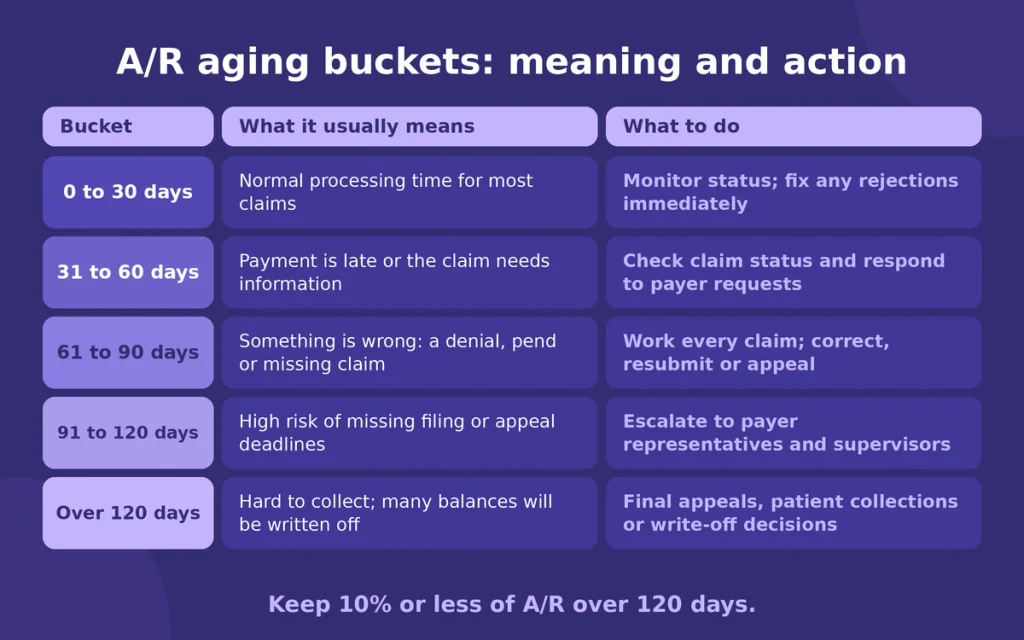
| Aging Bucket | What It Usually Means | What to Do |
|---|---|---|
| 0 to 30 days | Normal processing time for most claims | Monitor status; fix any rejections immediately |
| 31 to 60 days | Payment is late or the claim needs information | Check claim status and respond to payer requests |
| 61 to 90 days | Something is wrong: a denial, pend or missing claim | Work every claim; correct, resubmit or appeal |
| 91 to 120 days | High risk of missing filing or appeal deadlines | Escalate to payer representatives and supervisors |
| Over 120 days | Hard to collect; many balances will be written off | Final appeals, patient collections or write-off decisions |

What Are Accounts Receivable Aging in a Medical Practice?
Accounts receivable (A/R) is the money owed to your practice for services already provided: insurance claims that have not been paid and patient balances that have not been collected. A/R aging, or AR aging, sorts that money by how long it has been outstanding. Aged accounts receivable are the balances that have been open for a long time, usually more than 90 or 120 days.
Aging matters because time changes what a balance is worth. A claim in the first 30 days is usually just processing. A claim at 120 days may be past its appeal window, tied to a denial no one worked or owed by a patient who has stopped responding.
What Is an Aging Report in Medical Billing?
An aging report in medical billing is a list of every unpaid balance grouped into aging buckets, usually with totals by payer, patient, provider and location. Your practice management system generates it, and most practices run it at least weekly. It is the single most useful report for seeing where cash is stuck.
| Report Field | What It Shows |
|---|---|
| Payer or patient | Who owes the balance |
| Claim or account number | Which claim or statement is open |
| Date of service and billed date | When care was given and when it was billed |
| Aging bucket | How long the balance has been open |
| Balance | The amount still owed |
| Status | Paid, pending, denied, in appeal or sent to patient |
What does an insurance aging report list?
An insurance aging report lists claims that have been submitted to insurance but not yet paid, grouped by payer and by how long each has been outstanding. It shows the claim, the date of service, the amount and the aging bucket, so billers can follow up with the payers that owe the most or have held claims the longest.
What is a patient aging report?
A patient aging report shows balances owed by patients after insurance has paid: deductibles, coinsurance, copays not collected at the visit and non-covered services. Patient balances age differently from insurance balances, because collection depends on statements, reminders and payment plans rather than claim follow-up.
Pro Tip: Check whether your report ages balances from the date of service or the date of the last bill. Aging from the last bill can make a resubmitted claim look new when the money is actually months old.
How Does A/R Aging Affect Cash Flow?
Every dollar in A/R is a dollar the practice has earned but cannot spend. When A/R ages, three things happen to cash flow:
Cash arrives later. Payroll, rent and supplies are paid on fixed dates, while slow claims push revenue into later months. A practice can be profitable on paper and still short on cash.
Collection odds fall. The longer a claim sits, the more likely it has a problem no one has found, and the less time remains to fix it before a filing or appeal deadline.
The cost to collect rises. Old claims take more calls, more research and more appeals per dollar recovered.
How much cash is tied up in your A/R?
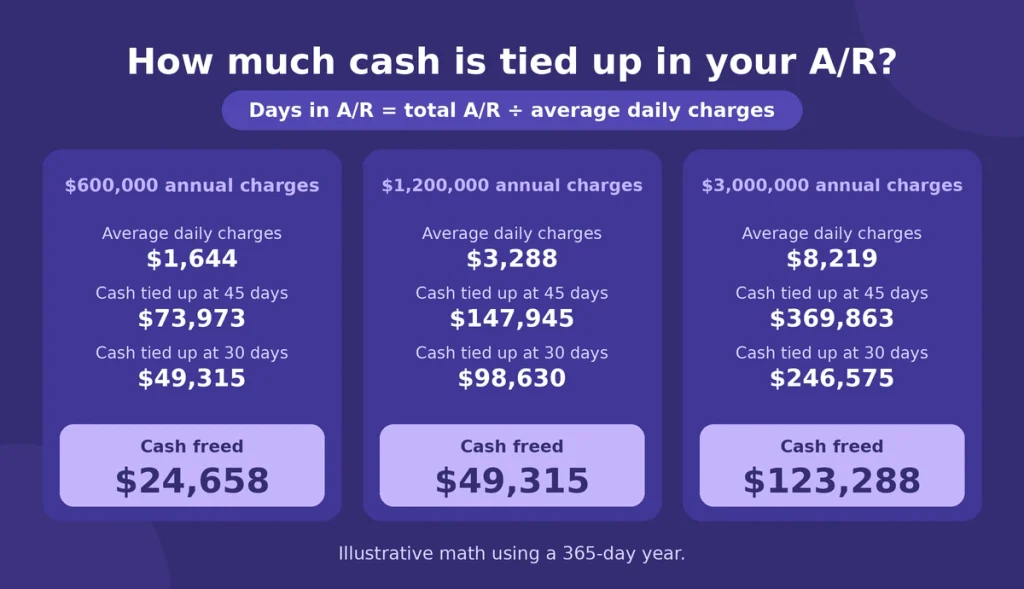
| Annual Charges | Average Daily Charges | Cash Tied Up at 45 Days | At 30 Days | Cash Freed |
|---|---|---|---|---|
| $600,000 | $1,644 | $73,973 | $49,315 | $24,658 |
| $1,200,000 | $3,288 | $147,945 | $98,630 | $49,315 |
| $3,000,000 | $8,219 | $369,863 | $246,575 | $123,288 |
Why Do Claims Age in Medical Billing?
| Cause | How It Ages A/R |
|---|---|
| Denials nobody works | Claims sit until the appeal window closes |
| Claims never received | Rejections at the clearinghouse go unnoticed |
| Pending requests for information | Payers wait for records the practice never sends |
| Eligibility and coordination of benefits errors | Claims bounce between payers |
| Credentialing gaps | Claims for new providers are held or denied |
| Patient balances without a plan | Statements go out but no one follows up |
| Short-staffed billing | Today’s claims win over yesterday’s follow-up |
Timely filing limits turn slow A/R into lost A/R. Medicare allows 12 months to file, many commercial contracts allow 90 to 180 days and appeal windows are often shorter. Our guide to the Aetna timely filing limit shows how payer-specific these deadlines are.
What Is a Good A/R Aging Benchmark?
Practice guidance based on MGMA data, such as the ACAAI practice guide, recommends keeping no more than 10% of A/R older than 120 days and a net collection rate of 95% or higher. Days in A/R vary by specialty and payer mix, so watch your own trend: rising days in A/R or a growing share over 90 days is the earliest warning sign of a cash flow problem. Our guide to average medical billing collection rates covers how these numbers relate.
| Metric | Target or Signal |
|---|---|
| A/R over 120 days | 10% or less of total A/R |
| Net collection rate | 95% or higher |
| Days in A/R | Stable or falling month to month |
| Share of A/R in 0 to 30 days | The largest bucket in a healthy practice |
How Do You Reduce A/R Days in Medical Billing?
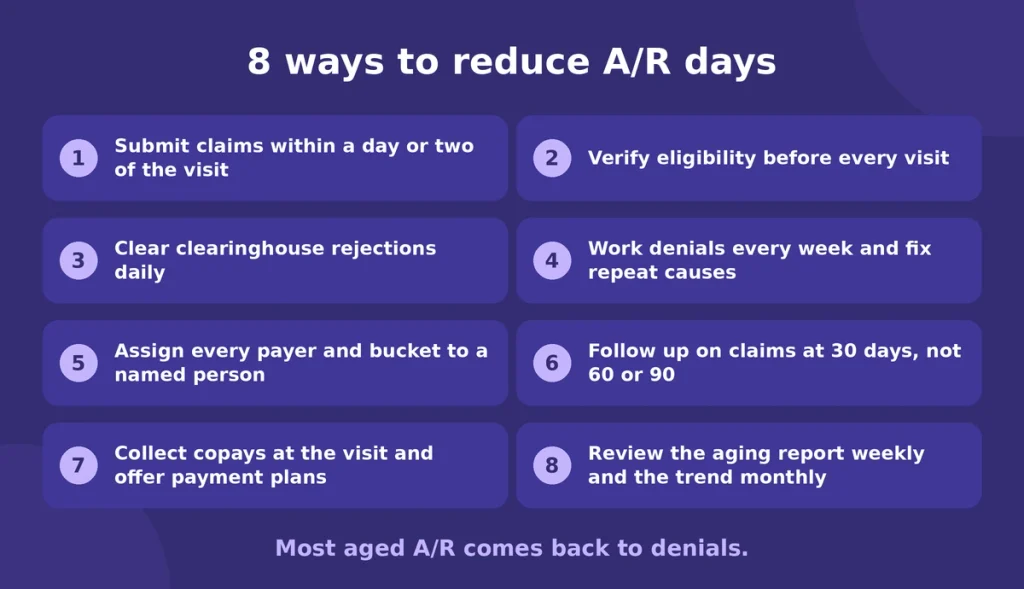
- Submit claims within a day or two of the visit to shorten charge lag.
- Verify eligibility before every visit to prevent coverage denials.
- Clear clearinghouse rejections daily so claims are not lost before they start.
- Work denials every week and fix the cause of repeat denials.
- Assign every payer and aging bucket to a named person.
- Follow up on claims at 30 days, not 60 or 90.
- Collect copays and estimated balances at the visit and offer payment plans.
- Review the aging report weekly and the trend monthly.
Most aged A/R comes back to denials. Working them weekly through denial management is the fastest way to move balances out of the 61 to 120 day buckets.
How Can Large Health Systems Improve A/R Days?
Large health systems face the same aging problem at a larger scale, with extra steps before a claim is even billed. They improve A/R days by shortening the time between discharge and final billing, automating claim status checks, segmenting work queues by payer and dollar value and using denial analytics to fix the departments that create the most denials. Standard definitions such as HFMA’s MAP Keys make those numbers comparable across sites.
What Is an ARD Date in Medical Billing?
ARD stands for Assessment Reference Date. In skilled nursing facility billing, it is the last day of the observation period for a Minimum Data Set (MDS) assessment, and the assessment it supports drives Medicare Part A payment under PDPM. A late or missed assessment delays the claim or reduces payment, which shows up as aging A/R in nursing facilities. Our nursing home billing services page covers SNF billing in more detail.
How Does iSolve RCM Keep A/R From Aging?
iSolve RCM works A/R by bucket and by payer every week, with a named owner for each account and escalation before claims reach their filing and appeal deadlines. Eligibility checks before the visit and medical coding review before submission keep new claims from becoming tomorrow’s aged balances, and a medical billing audit shows how much of your current A/R can still be recovered. Services start at 2.99% of monthly collections.

Frequently Asked Questions
What is A/R aging in medical billing?
A/R aging is the grouping of unpaid insurance claims and patient balances by how long they have been outstanding, usually in 30-day buckets up to over 120 days.
What is an aging report in medical billing?
It is a report of all unpaid balances grouped by aging bucket, payer and patient, used to decide which claims to follow up first.
What is a good percentage of A/R over 120 days?
Practice guidance based on MGMA data recommends 10% or less of total A/R older than 120 days.
How do you calculate days in A/R?
Divide total accounts receivable by average daily charges. Average daily charges are total charges for a period divided by the number of days in that period.
What is the difference between an insurance aging report and a patient aging report?
An insurance aging report lists unpaid claims owed by payers. A patient aging report lists balances owed by patients after insurance has paid.
When should aged A/R be written off?
After every appeal and collection option is exhausted or a filing or appeal deadline has passed. Review write-offs regularly, because rising write-offs often point to a fixable process problem.