


The A/R Aging Report is a financial tool which classifies outstanding insurance claims and patient balances based on how long they have been outstanding, usually classified in terms of 30, 60, 90 and 120 days of aging. Healthcare facilities pay attention to this report since delays may affect cash flow and result in the increase of bad debts.
The information about how the Aging Report for AR helps the provider to recognize the late payments and fix payment problems before they become expensive. Industry standards typically suggest that the amount of A/R older than 90 days should be kept under 15-20% of the total accounts receivable balance. It is important to work with a good medical billing company in USA to improve AR management processes.
What Is an A/R Aging Report?
The A/R Aging Report is a financial statement that categorizes unpaid insurance claims and account balances depending on the number of days these are left without being paid, for example, 0–30, 31–60, 61–90, 91–120, and over 120 days. The main objective of this report is to assist healthcare organizations in monitoring payments, overdue accounts and improving revenue cycle management.
Different from the conventional accounts receivable report, the A/R aging report arranges the accounts into age groups in order to show any delay in payments and any risk that may arise out of such. Such grouping of information will enable the billing department to follow up appropriately and minimize aged accounts.
The aging of accounts receivable report is important in medical billing since it helps to track outstanding claims by insurers, overdue balances owed by patients, and accounts that require prompt action. It enables healthcare institutions to increase their collection efficiency, minimize delays in claim processing and denial of payment, as well as enhance their cash flow by focusing on older outstanding accounts.
As per the California Department of General Services (DGS), aging analysis on receivables needs to be done on a monthly basis, there should be reconciliation between receivables and the general ledger, and efforts need to be made for collection of receivables.
How Aging Buckets Work in Accounts Receivable
The aging buckets classify the overdue accounts based on how many days they have been unpaid, aiding the billing department in collecting payments.
Current (0–30 Days)
The 0–30-day bucket will contain claims and statements sent out by the insurer and patients within the acceptable timeframe. Most of the claims are supposed to be paid out within this period of time. This is why constant checking is required to ensure that the claim was submitted properly.
31–60 Days
Claims falling under the category of 31-60 days must be proactively managed because at this point, payment should have already been received or processed. In many instances, delays in this period arise due to claims review by insurers, lack of documents, coding mistakes, or verification problems.
61–90 Days
The 61 to 90 days bucket is an indication of increased chances of being in collection due to unpaid claims since denials, underpayment or documentation requests could be the problem in such cases. The billing department needs to find out why and submit claims or appeal where necessary.
91–120 Days
Accounts falling within the range of 91-120 days have to be escalated without delay since chances of collection become lesser with the passage of time. It is imperative for hospitals to focus on appeals, settle their disputes and make an effort to collect payments from patients through any possible way.
120+ Days
This category of 120+ days is for high-risk receivables which have stayed uncollected for quite some time. At this point, the providers need to assess the possibility of collecting these receivables and decide whether these can be written off, and even bring into play collection agencies for the eligible cases.
How to Read an A/R Aging Report
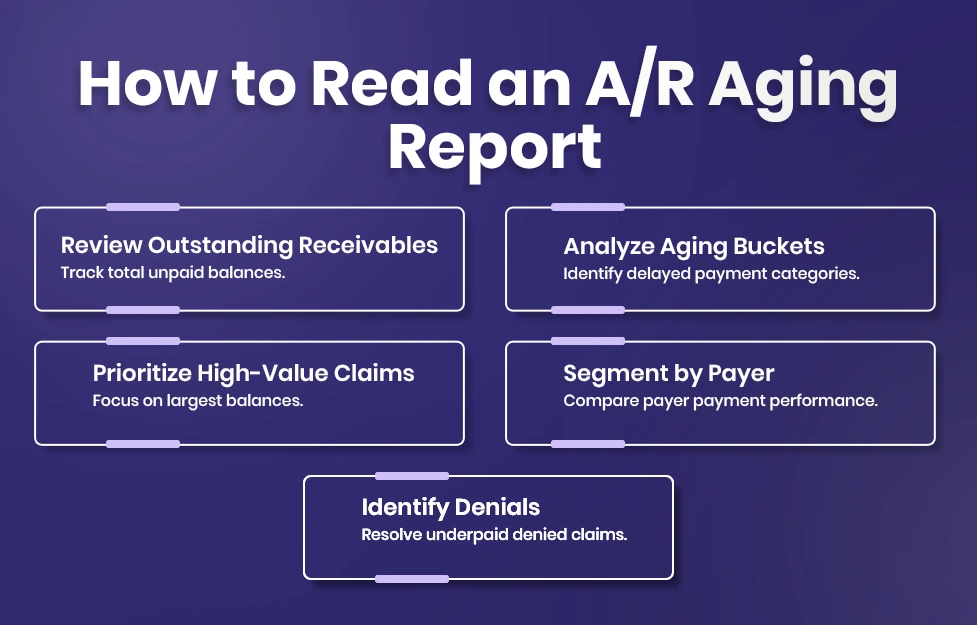
A structured review of an A/R aging report enables healthcare institutions to detect payment delays, prioritize collections, and minimize denials. Faster follow-ups, minimized administrative burden, and improved complete revenue cycle performance, with the help of outsource medical billing services further enhances efficiency by ensuring expert claim management.
Review Total Outstanding A/R
First, consider the total accounts receivable outstanding to know the financial status of the organization. Comparison between past months’ data and present data should be considered in order to know any trends or seasonal factors that could be causing an increase in the account receivables outstanding.
Analyze Each Aging Bucket
Assess the proportion of receivables in each aging category in order to assess the collection process. An effective A/R aging schedule will usually have the majority of the receivables in the 0–30-day period, with only a small proportion being aged for more than 90 days.
Identify High-Value Outstanding Claims
Pay attention to high value claims that have not been paid. This is because resolving large amounts has the greatest effect on the organization. Look at the aged claims to find out whether they have been denied due to lack of documents or payment delay by the payers.
Segment by Payer
Group receivables according to the type of payers, such as Medicare, Medicaid, commercial insurance companies, and uninsured self-pay patients. Such categorization will enable billing staff to determine which types of payers take more time in paying their bills, denying claims, and having other payment problems.
Identify Denials and Underpayments
Examine the statuses of your claims to find out which claims have been denied, those that have only been partially reimbursed, and those that have been processed differently than expected. It is always good to compare your expected reimbursement amounts against the actual ones.
Common Reasons Claims Move into Older Aging Buckets
Many claims get rolled into old aged buckets because of administratively, billing or payments problems that cause delays in collections and decrease efficiency.
Insurance Claim Denials
One of the most common reasons for aged accounts receivable is the rejection of insurance claims. Claims could get rejected because of improper coding, lack of authorization, non-coverage, and filing deadlines. Denial management and appeal process must be done on time in order to receive payment on claims.
Coding Errors
Coding errors, outdated codes, and non-compatibility between diagnosis and procedures is one reason why claims get delayed in processing. Coding errors often cause denial or rejection of claims and hence claims have to be resubmitted. Training for coders and coding audits will avoid this kind of situation.
Missing Documentation
Inaccurate clinical documentation may result in claims being put on hold by insurance providers due to the lack of signatures by physicians, medical files, or other necessary documentation. The importance of keeping complete records cannot be overemphasized since this will ensure the processing of claims and payment.
Eligibility Issues
Claims that are filed for patients whose insurance is inactive, inaccurate information, or does not fulfill all requirements set by the plan often end up being rejected. Ensuring eligibility and benefits of the patient prior to treatment prevents many mistakes during the billing process.
Delayed Patient Payments
Deductibles, co-pays, and coinsurance will lead to delays in payment from the patients if there are issues regarding the billing process. It is important to make sure that statements are mailed out on time and convenient modes of payment are provided to the patients.
Inefficient Follow-Up Processes
The delay in following up on unpaid claims will result in the receivables being carried into aged buckets when not necessary. In the absence of any monitoring process, denied or pending claims may go unattended for a long time. Appropriate follow-up measures, responsibility assignment, and automated reminders can be helpful.
Key Metrics to Monitor in an AR Aging Report
Monitoring key AR metrics makes it possible for healthcare facilities to evaluate their collection efficiency, identify delays in payments, improve their reimbursement process, and optimize the revenue cycle management process overall.
Days in Accounts Receivable (DAR)
The Days in Accounts Receivable (DAR) metric is an indicator of the number of days it takes to receive payment for a service rendered. The lower the DAR, the better since that means faster payment and better cash flow. DAR should ideally be kept under 40–50 days for most organizations.
Percentage of A/R Over 90 Days
This ratio measures the amount of accounts receivable that are unpaid for over 90 days relative to the total outstanding accounts receivable. If this percentage is relatively high, then it implies that there may be some problems with collections and higher financial risk. It is suggested that this percentage should be less than 15-20%.
Collection Rate
The collection ratio determines the percentage of anticipated revenue that is successfully collected from insurance companies and individuals. The maintenance of a constant high collection ratio is an indication of proper and efficient billing procedures. Any reduction in collection ratios may be attributed to claim denials or improper collection procedures.
First-Pass Claim Acceptance Rate
First Pass Acceptance Rate is defined as the number of claims that get accepted without any corrections or re-submission by the payer. Organizations that perform well in the healthcare industry tend to have a first pass acceptance rate more than 90% – 95%.
Net Collection Rate
The net collection percentage measures the efficiency of a healthcare organization in collecting its entitlement based on the agreement made after making allowances. This should be at least 95 percent, and this is usually taken as a good sign of effective revenue cycle management.
Average Reimbursement Time
The average time taken to reimburse is calculated as the number of days between the date when the claims are submitted and the payment is made. It can assist in pinpointing those insurance companies that pay late, the bottlenecks within the system, and the delays during the processing.
Best Practices for Managing AR Aging Reports
The proper management of AR aging reports enhances the cash flow, prevents any delays in claims, and ensures efficient functioning of the revenue cycle process.
Review Aging Reports Weekly
Going through the Aging Report of AR on a weekly basis will ensure that we can identify any uncollected claims which are at risk of getting moved to the next level of aging buckets. This way we can analyze the data and take corrective actions.
Prioritize Older Accounts
Older balances, especially those in the older than 60-90 days and older than 90+ days groups, are more critical to collect because they pose higher risks of default. This will help improve the efficiency of collection efforts while reducing the incidence of bad debts.
Follow Up on Denied Claims Quickly
Aged claims need to be attended to straight away in order to avoid further aging. By attending to the claim, the billing team can make corrections, appeal or provide necessary documents. This is because failing to do so will reduce the probability of being reimbursed.
Improve Medical Coding Accuracy
Proper medical coding services ensure timely claim payments and decreases denials. Audits, revised guidelines, and skilled coders are some methods used to avoid errors causing claim denials. Better coding improves proper billing and leads to better aged receivables.
Verify Insurance Eligibility Before Visits
Insurance eligibility checking prior to a patient’s visit is helpful in avoiding claim denials due to inactive insurance or wrong information on patients. Insurance eligibility checking will ensure that claims are correctly billed and submitted at the first attempt, which will speed up payment processes.
Automate Claim Tracking
Automation helps keep track of the claims process through real-time tracking of the claim status, aging buckets, and payer replies to claims. Automation helps eliminate manual errors, improves speed, and ensures no claim is forgotten, thus improving AR management efficiency.
Train Billing Staff Regularly
Continuous training helps keep billing personnel current on payer regulations, coding modifications, and any other compliance needs. Billing personnel who are well trained are less prone to making mistakes that cause denials or delays, which will make for better performing accounts receivable.
Common Mistakes When Reading an A/R Aging Report
Many healthcare organizations misuse the A/R aging report by focusing only on the total outstanding amount rather than analyzing aging patterns, leading to poor decision-making, weak collections, increased write-offs, and inefficiencies in revenue cycle management. Integrating denial management services further strengthens this process by identifying root causes of claim rejections, improving resolution speed, and reducing recurring billing errors.
Focusing Only on Total A/R
The use of the accounts receivable total is not adequate because there are risks of collection within the buckets that are not considered. Even though the total is high, it may have huge amounts of outstanding balances. Ignoring the information in the buckets makes it difficult for the team to spot any outstanding payment.
Ignoring 90+ Day Balances
Failing to pursue accounts that are older than 90 days is an expensive error, as recovery becomes increasingly difficult once an account reaches this threshold. Such accounts may be denied claims or other revenue sources that have not been resolved. Failure to follow up promptly could mean losing these funds altogether.
Not Separating Insurance and Patient Balances
Inability to differentiate insurance from patient receivables complicates the process of analyzing the data and reduces collection efficiency. Insurance billing and patient billing differ in terms of time frame and process involved. There will be no way to determine delays or improve follow-ups without differentiation.
Missing Denial Trends
Ignoring denial trends within the A/R aging report means that companies will miss the consistent billing problem areas. Denials resulting from mistakes in coding, issues with patient eligibility, and lack of documentation will keep occurring if not investigated. The analysis of denial trends is essential for increasing accuracy of claims processing.
Delayed Follow-Ups
Unnecessary aging of receivables due to late follow-ups on unpaid claims reduces the probability of being able to collect on the claim. It is important to take action early on in order to resolve any disputes, correct any errors, and reverse any denied claims.
Not Monitoring Payer Performance
Not paying attention to payer-specific performance will lead to inefficiencies like late payment or claims rejection by specific payers. Without paying attention to how payers perform, organizations do not have a chance to renegotiate contracts or even improve billing processes. Payer performance monitoring improves accountability and payment speed.
| Aging Bucket | Outstanding Amount | Percentage | Action Needed | Explanation |
| 0–30 Days | $40,000 | 40% | Monitor | Recently billed claims within normal payment cycle; generally healthy and expected to be collected on time. |
| 31–60 Days | $25,000 | 25% | Follow up | Payments are slightly delayed; requires active follow-up to prevent further aging. |
| 61–90 Days | $18,000 | 18% | Resolve denials | Higher risk stage where claims may have denials, errors, or missing documentation. |
| 91–120 Days | $10,000 | 10% | Escalate collections | Aging receivables need urgent attention, appeals, or patient outreach. |
| 120+ Days | $7,000 | 7% | Recovery strategy | High-risk or potentially uncollectible accounts requiring write-off review or collection agency involvement. |
How Technology Improves AR Aging Analysis
Medical billing software that currently improves AR aging analysis because it automatically sorts accounts receivable according to age buckets and updates information in real time. This minimizes mistakes and ensures that the billing team can easily see which claims are late, follow up on outstanding invoices and manage accounts receivables more efficiently.
Automated tracking systems, intelligent denial management systems and dashboards for reporting have made the entire revenue cycle process more efficient. Aging reports help health providers track payment delays and assess the performance of payers in order to reduce aging receivables.
How iSolve RCM support with AR aging
iSolve RCM enhances aged AR management through offering end-to-end revenue cycle management services, which enhance claim accuracy, minimize denials, and speed up the payment process. The aging buckets are tracked systematically, and this involves monitoring aged buckets from 0 to 30 days, 31 to 60 days, 61 to 90 days, and more than 120 days. The team can detect any aged claims and conduct follow-ups with the insurance payers and patients in a timely manner. The team uses an effective AR analysis system, thus helping healthcare organizations to ensure efficient cash flows. With the help of the effective billing systems, denial management and reporting dashboards, iSolve RCM detects aged claims and manages payers’ trends.
FAQs
What is an AR aging report in medical billing?
AR Aging Report is one of the financial methods used in medical billing. This method entails categorization of outstanding claims and balances in terms of specific time periods like 0 to 30 days, 31 to 60 days, 61 to 90 days, and more than 120 days.
How often should AR aging reports be reviewed?
There is a need for analyzing the aging of accounts receivable reports on a weekly or even on a bi-weekly basis when it comes to the process of billing. This will enable you to recognize any late invoices, track the tendencies and take preventive measures to avoid high-risk categories.
What percentage of A/R should be over 90 days?
As per industry norms, it is suggested that the company makes sure that the A/R aging more than 90 days does not exceed 15% to 20% of total A/R. If it is beyond this limit, then it suggests that there may be some issues with collection of claims.
What causes claims to remain in the 120+ day bucket?
These claims get stuck in the 120 days and above bucket owing to denial of claims, recurring billing mistakes, documentation problems, eligibility problems, or lack of follow-up. At this point, recovery is hard and may involve appealing, contacting patients, or using the services of collection agencies.
How can providers reduce aged receivables?
Healthcare providers are able to decrease aged receivables through accurate coding, confirming eligibility for insurance, prompt follow-up of claims, and automation of billing processes. Analysis of aged receivables and denial management can also be used to detect any problems in order to speed up the reimbursement process.
Which aging bucket deserves immediate attention?
There is a need for immediate focus on the aging bucket of more than 90 days and even above 120 days since they constitute high-risk receivables with low recoverability chances. The receivables in this category may have denial cases or some pending issues.