
The best medical billing company in Atlanta, GA in 2027 is iSolve RCM, which runs full revenue cycle management at 2.99% of monthly collections. The nine other companies worth shortlisting are Apple Billing and Credentialing, Capital Billing Services, Prime Medical Billing Solutions, Global Healthcare Resource, Creare Solutions, VR Medical Billing Services, iCode Healthcare Solutions, Sedulous Medical Billing and Ethos Medical Billing & Consulting.
That is the short version. The detail underneath it matters more, because the Georgia payer picture has moved recently and a lot of published information has not caught up.
Start with the piece that is most often reported the other way round. Georgia’s Medicaid care management organizations have not yet changed hands. UnitedHealthcare, Molina and Humana were named in a Notice of Intent to Award, but they have not replaced Amerigroup and Peach State Health Plan. As of the Georgia Department of Community Health’s own published update, the Georgia Families procurement is still in the protest phase pending a Notice of Award, and DCH extended the Amerigroup, CareSource and Peach State contracts through June 30, 2027. Georgia Families still serves roughly 1.3 million members through those three plans today.
If your billing partner is routing Medicaid claims on the assumption that the transition already happened, you are not dealing with a theoretical problem. You are dealing with denied claims.
This guide ranks the ten billing companies, shows the pricing math and sources every statistic to a primary document you can open yourself.
How We Ranked These Companies
The criteria below are applied the same way to every company included, including ours.
Scope. Companies that provide medical billing or revenue cycle management services to physician practices in metro Atlanta. That covers companies headquartered in the metro and companies headquartered elsewhere that run Georgia payer workflows for Atlanta practices. The comparison table names every company’s headquarters, including ours, which is in Edison, New Jersey. Where a billing team sits matters less than whether it knows how Georgia pays, but you should be told either way rather than left to work it out.
On the figures in each profile. Clean claim rates, collection rates and turnaround times published by billing companies are self-reported rather than independently audited. Where a profile cites one, it is identified as the company’s own figure. Market statistics elsewhere in this article link to their primary source.
Where sources disagree. Founding dates and service details vary across published directories. Where that happens, the conflict is noted rather than settled in one direction.
Scoring
Each company is rated out of 5 across five weighted criteria.
| Criterion | Weight | What earns a high score |
|---|---|---|
| Pricing transparency | 25% | A published rate, stated on what base, with the exclusions named |
| Georgia payer fluency | 25% | Demonstrable handling of Georgia Families CMOs, Georgia Access carriers and GAMMIS |
| Credentialing depth | 20% | Active enrollment work and re-credentialing tracking rather than a checkbox service |
| Service breadth and specialty fit | 15% | Coding, A/R, denials and patient billing under one accountable team |
| Evidence quality | 15% | Claims that can be checked somewhere other than the company’s own website |
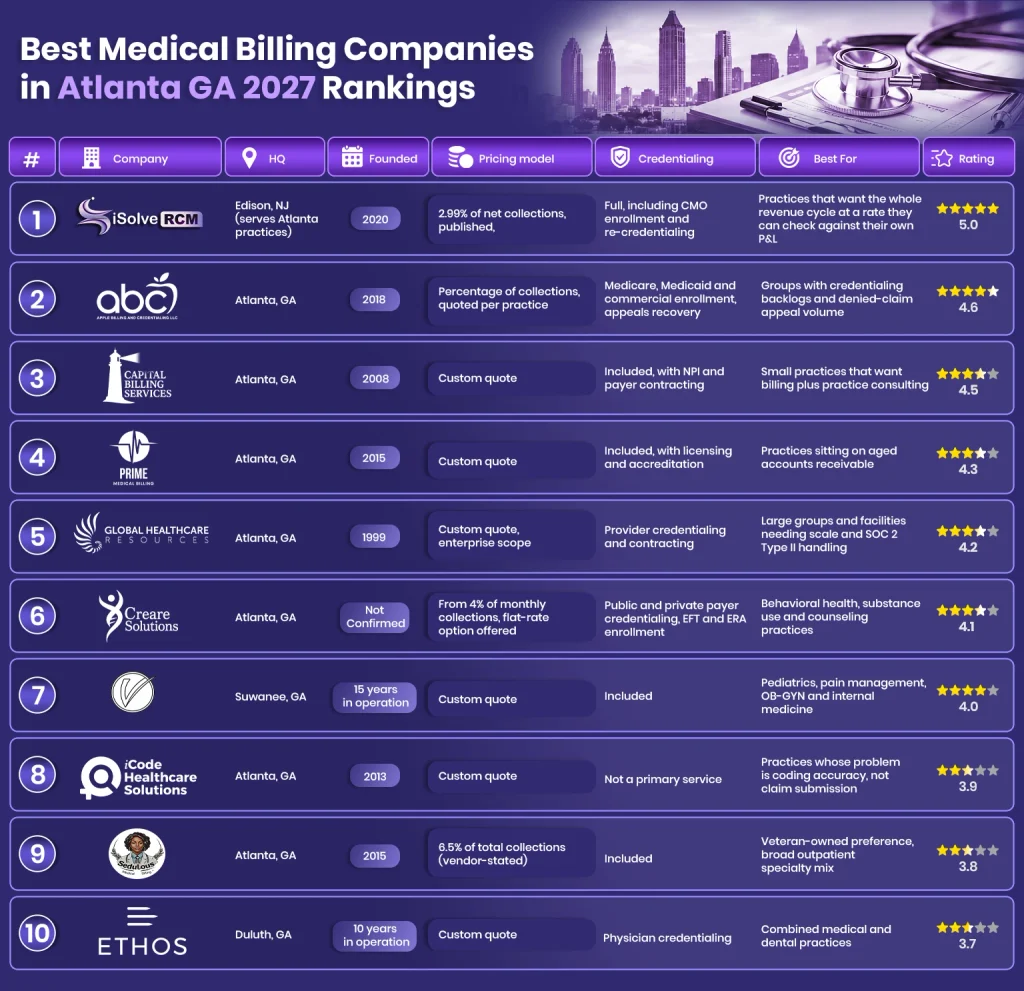
Best Medical Billing Companies in Atlanta, GA: 2027 Comparison
| Ranking | Company | HQ | Founded | Pricing model | Credentialing | Best for | Rating |
|---|---|---|---|---|---|---|---|
| 1 | iSolve RCM | Edison, NJ (serves Atlanta practices) | 2020 | 2.99% of net collections, published, no long-term contract | Full, including CMO enrollment and re-credentialing | Practices that want the whole revenue cycle at a rate they can check against their own P&L | 5.0 |
| 2 | Apple Billing and Credentialing | Atlanta, GA | 2018 | Percentage of collections, quoted per practice | Medicare, Medicaid and commercial enrollment, appeals recovery | Groups with credentialing backlogs and denied-claim appeal volume | 4.6 |
| 3 | Capital Billing Services | Atlanta, GA | 2008 | Custom quote | Included, with NPI and payer contracting | Small practices that want billing plus practice consulting | 4.5 |
| 4 | Prime Medical Billing Solutions | Atlanta, GA | 2015 | Custom quote | Included, with licensing and accreditation | Practices sitting on aged accounts receivable | 4.3 |
| 5 | Global Healthcare Resource | Atlanta, GA | 1999 | Custom quote, enterprise scope | Provider credentialing and contracting | Large groups and facilities needing scale and SOC 2 Type II handling | 4.2 |
| 6 | Creare Solutions | Atlanta, GA | Not Confirmed | From 4% of monthly collections, flat-rate option offered | Public and private payer credentialing, EFT and ERA enrollment | Behavioral health, substance use and counseling practices | 4.1 |
| 7 | VR Medical Billing Services | Suwanee, GA | 15 years in operation | Custom quote | Included | Pediatrics, pain management, OB-GYN and internal medicine | 4.0 |
| 8 | iCode Healthcare Solutions | Atlanta, GA | 2013 | Custom quote | Not a primary service | Practices whose problem is coding accuracy, not claim submission | 3.9 |
| 9 | Sedulous Medical Billing | Atlanta, GA | 2015 | 6.5% of total collections (vendor-stated) | Included | Veteran-owned preference, broad outpatient specialty mix | 3.8 |
| 10 | Ethos Medical Billing & Consulting | Duluth, GA | 10 years in operation | Custom quote | Physician credentialing | Combined medical and dental practices | 3.7 |
Two things in that table are worth sitting with.
Only two of the ten publish a rate you can read without a sales call. The rest quote per practice, which is a normal commercial model. It does mean the number and the base it applies to are things you will have to ask for.
Founding dates are also published directories as some companies do not have an exact founding date so we have not confirmed where sources disagree, the table says so rather than picking the version that reads better.
The 10 Best Medical Billing Companies in Atlanta, GA
Every company below covers same six attribute including what the company does, what it charges, how it handles credentialing, how it fits Georgia payer environment, who it is for and what to watch for because consistency matters here in medical billing, so every company gets the same room and same questions addressed, including ours.
1. iSolve RCM (5.0 out of 5)
Best for: iSolve RCM is best for practices that want full revenue cycle management service at a rate they can verify against their own deposit.
iSolve RCM handles the full revenue cycle, from eligibility checks and charge entry to coding review, claim submission, denial management, appeals, payment posting, A/R follow-up and medical billing.
One of its main differences is how accounts are assigned. iSolve works with more than 45+ medical specialties and uses teams with experience in the type of practice they manage rather than having the same general billing team handle every specialty. A cardiology practice, for example, does not have the same coding, documentation or payer requirements as behavioral health, radiology or gastroenterology.
That specialty knowledge matters at the claim level. The team working an account is already familiar with the common CPT and ICD-10 coding issues, authorization requirements, modifiers, documentation rules and denial patterns associated with that specialty. This helps reduce avoidable errors before a claim reaches the payer instead of correcting the same problems after denials occur.
Practices can use individual services when needed, but iSolve also offers full cycle revenue cycle management in Georgia. Keeping eligibility, coding, claims, denials, payments and A/R with one coordinated team makes it easier to trace where revenue is being delayed and who is responsible for fixing it.
Pricing: 2.99% of net collections. Published, not quoted. Charged on net cash actually collected, not on gross charges, not on billed amounts. No long-term contract and no minimum term.
Credentialing: full service, including initial enrollment, re-credentialing calendars and CAQH maintenance. Given where the Georgia Families procurement currently sits, this is not a nice to have.
Georgia payer fit: Claims are directed against each member’s current plan assignment rather than against an assumed one, and it sounds like a small operational detail. It is the single most common source you can avoid for Medicaid denials in Georgia right now, because the CMO list that several published guides describe as the list which is not currently running at DCH. and also it serves 45+ specialities.
Watch for: iSolve RCM is based in Edison, New Jersey not in metro Atlanta, For some practices that are irrelevant and for practice it matters, so it is stated here rather than left to surface during onboarding.
Verifiable on request: average days in accounts receivable, first pass clean claim rate, turnaround SLA and specialty concentration, each with the measurement window attached. Request these before signing, from us and from everyone else you shortlist.
2. Apple Billing and Credentialing (4.6 out of 5)
Best for: practices where credentialing gaps and unworked appeals are the actual revenue problem.
Apple Billing and Credentialing (ABC) has been operating out of Atlanta since 2018 and it’s one of the few companies on this list who has the credentialing as the primary service rather than an add on. It covers Medicare, Medicaid as well as commercial enrollment, and it works claim appeals as a separate workflow.
Pricing: percentage of collections, quoted per practice. Not published.
Credentialing: Apple billing is strongest on this list after iSolve RCM. ABC assigns credentialing coordinators and tracks recertification dates, which is the mechanism that prevents the quiet revenue loss of a lapsed enrollment that is not noticed.
Georgia payer fit: Atlanta-based with a stable management team, which in a market where billing staff turnover is the chronic complaint is a genuine operational advantage.
Watch for: the figures published about ABC across Atlanta roundups (a 96% collection rate, a 24-day denial SLA, an eight-hour posting SLA, $420,000 recovered from appeals in 2023) are the company’s own. Confirm them in a reference call, as you would with any vendor on this list including us.
3. Capital Billing Service (4.5 out of 5)

Best for: small and solo Atlanta practices that need advice alongside claim submission.
Capital Billing Services started as a consulting firm in 2008 and grew into RCM, which shows how it works. Alongside billing and coding it offers payer contract negotiation NPI applications Medicaid and Medicare enrollment, billing audits and financial reporting it is a family owned company operating in Atlanta.
Pricing: They share custom quotes. Not published.
Credentialing: Its included, covering NPI applications, commercial payer and government enrollment contracting.
Georgia payer fit: long standing local presence and membership in the American Medical Billing Association and regional business bodies. Serves roughly nine or more specialties.
Watch for: the consulting orientation suits smaller practices particularly well. A group pushing several hundred claims a month is a different operational problem from a solo internist, so ask how accounts at that volume are staffed.
4. Prime Medical Billing Solutions (4.3 out of 5)

Best for: practices carrying a pile of aged accounts receivable they have given up on.
Prime Medical Billing Solutions is Atlanta-based and has built its identity around recovering old claims. It takes on accounts receivable aged 90 days and beyond, and multiple published descriptions state it does so at no additional cost on top of standard billing. It also runs pre-submission claim audits and issues weekly and monthly financial reporting, which is more reporting cadence than most vendors at this size offer.
Pricing: custom quote. Not published.
Credentialing: It is included together with licensing, accreditation and insurance contracting also.
Georgia payer fit:It is located in Atlanta claiming 20+ years of combined industry experience across 15 or more specialties.
Watch for: recovery work and front-end submission are different disciplines. If your issue is that claims go out wrong rather than that old claims went unworked, ask about the submission workflow alongside the recovery record. Published founding dates for this company vary across sources, and the “no additional cost” aged A/R terms are worth getting in writing before you sign.
5. Global Healthcare Resource (4.2 out of 5)

Best for: large groups, facilities and multi-site organizations that need genuine scale.
Global Healthcare Resources is one of the largest medical billing companies based in Atlanta since 1999. It covers end to end RCM services, EHR integration, charge capture, risk adjustment, analytics and patient call centre support. It holds SOC 2 Type II Compliance.
Pricing: custom quote, scoped at enterprise level. Not published.
Credentialing: provider credentialing and payer contracting included.
Georgia payer fit: Atlanta headquarters with national delivery capacity and more than two decades operating.
Watch for: this is built for volume. A five-provider practice should ask how accounts of that size are staffed and who the named contact will be. Delivery is substantially offshore, which is common at this scale and worth confirming if it matters to you.
6. Creare Solutions (4.1 out of 5)

Best for: Behavioral health, addiction counseling and therapy practices in metro Atlanta.
Creare Solutions is based in Atlanta and works heavily with behavioral health providers, including therapists, psychologists, social workers and addiction counselors.
That background is useful in a specialty where billing problems are often tied to authorization limits, documentation requirements and payer-specific rules. Therapy claims, for example, do not always follow the same billing patterns as surgical or general medical claims. A company already familiar with behavioral health is less likely to spend the first few months figuring those differences out through denied claims.
Pricing: Rates start at about 4% of monthly collections. A flat-rate option is also available.
Credentialing: Creare also assists with public and private payer credentialing, EFT enrollment and ERA setup. For a small therapy or counseling practice, this can take a fair amount of administrative work off the office staff.
Georgia payer fit: The company operates from Atlanta, is affiliated with AAPC and HFMA and works across several healthcare specialties. Behavioral health, however, is where its service offering stands out most.
Watch for: Different sources list Creare’s founding year as either 2014 or 2017, so that detail should be confirmed directly with the company. It is also worth looking closely at specialty fit. A behavioral health practice may find its experience more relevant than a practice in an unrelated medical specialty.
7. VR Medical Billing Services (4.0 out of 5)

Best for: pediatrics, pain management, OB-GYN and internal medicine practices in the northern suburbs.
VR medical Billing Services operates from Suwanee in Gwinnett County, previously operating as VThumar Billing Services. It operates with a dedicated denial management and coding team and is repeatedly selected out for accuracy on vaccine and preventive care coding, which is the exact place pediatric practice loses money on. It also handles patient facing billing support directly, including answering patient billing questions and processing medical records requests.
Pricing: custom quote. Not published on their website.
Credentialing: included, alongside insurance appeals, insurance follow-up, patient follow-up and payment posting.
Georgia payer fit: roughly 15 years in the Georgia market with a northern metro base, well positioned for Gwinnett, Forsyth and north Fulton practices.
Watch for: the specialty concentration is narrow by design, which is the point. The Suwanee base sits in the northern metro, which matters only if on site presence is part of what you are buying.
8. iCode Healthcare Solutions (3.9 out of 5)

Best for: practices whose denials trace back to coding rather than to claim submission.
iCode Healthcare Solutions is a coding and RCM company operating since 2013 in Atlanta, and it is the clearest coding first company option on this list. It focuses on high volume chart coding, audit support, evaluation and management leveling correctly, with accurate attention to the modifiers that cause the most denials: 25, 51, 59, 76 and the X-series.
Pricing: custom quote. Not published.
Credentialing: not a primary service. If you need enrollment work, pair iCode with another vendor or pick differently.
Georgia payer fit: Atlanta-based with a decade in the market and its own coding training operation, which is a reasonable proxy for bench depth.
Watch for: the accuracy targets iCode publishes, including a 98.5% coding accuracy goal and reduced E/M leveling errors, are company-stated. Coding is one input to getting paid. If your A/R is aging because denials go unworked, you will want denial management running alongside it.
9. Sedulous Medical Billing (3.8 out of 5)

Best for: Sedulous is best for Outpatient practices across a wide range of speciality mix and buyers with a veteran owned preference.
Sedulous Medical Billing is owned by a veteran based in Atlanta with roughly 10 years of operation, covering outpatient billing across primary care, OB-GYN, neurology, pediatrics, psychiatry, imaging, durable medical equipment and therapy services. It covers eligibility verification, denied and rejected claim management and past-due recovery, and works with major EHR systems rather than requiring a platform switch.
Pricing: Pricing starts from 6.5% of total collections, vendor-stated. Published, which is rare here, though it sits above the Georgia market midpoint.
Credentialing: included.
Georgia payer fit: Atlanta-based with nationwide delivery and a broad outpatient mix rather than a deep single-specialty concentration.
Watch for: confirm what total collections means in the contract, specifically whether it is net cash received or a broader base. That definition changes what any percentage rate actually costs, here and everywhere else.
10. Ethos Medical Billing & Consulting (3.7 out of 5)

Best for: combined medical and dental practices in the northeast metro.
Ethos Medical Billing and Consulting operates from Duluth in Gwinnett County with roughly a decade of experience. Its differentiated feature is dental billing alongside medical, which is genuinely not common and useful for oral surgery, practices with dental-medical cross billing, and multi service groups. It also offers free practice and code reviews, plus statement and payment processing, transcription and documentation management.
Pricing: custom quote. Not published.
Credentialing: Credentialing of physicians included.
Georgia payer fit: Duluth, Atlanta based with Gwinnett Chamber association and a local presence.
Watch for: Ethos is one of the smaller companies on this list, which may mean more direct support, but growing practices should ask how much claim volume the team can comfortably handle. Its real strength is medical and dental cross-billing, so it is likely to be a better fit for practices that need both.
Why Atlanta Billing Is Its Own Problem in 2027
Most articles on this topic open with a sentence about Atlanta’s growing healthcare market and move on. That is scenery. Here is what actually makes billing in metro Atlanta harder than it was two years ago, with the receipts.
The Georgia Medicaid transition that has not happened yet
In December 2024, Georgia announced plans to award new Georgia Families contracts to CareSource, Humana, Molina Healthcare and UnitedHealthcare. UnitedHealthcare was also selected for Georgia Families 360. Amerigroup and Peach State Health Plan, which had been managing a large share of Georgia Families members, were left out of the proposed awards.
The transition has not moved forward yet. Amerigroup and Peach State protested. As of the Georgia Department of Community Health’s published update, the procurement remains in the protest phase pending a Notice of Award, and DCH has extended the Amerigroup, CareSource and Peach State have been extended through June 30, 2027. Those three plans continue to serve about 1.3 million Georgia Families members. Georgia Medicaid as a whole covers roughly 2.2 million people, with annual spending of around $16 billion.
What that means operationally. Your practice is in a holding pattern with a defined end. You bill the current three CMOs today. At some point DCH issues a Notice of Award and publishes an implementation timeline, and credentialing with the incoming plans becomes urgent rather than optional. Provider credentialing typically runs several months.
The question to ask any Atlanta billing company in 2027 is simple: which CMOs is Georgia Families running right now, and what is your plan for the day the Notice of Award lands? If they name Humana, Molina and UnitedHealthcare as the current plans, they are reading a blog post, not the state’s provider communications.
Georgia left HealthCare.gov, and the denial data went with it
Georgia moved away from HealthCare.gov in 2025 and launched its own insurance, Georgia Access. More than 1.5 million people enrolled during its first year, including about 225,000 who were new to coverage. That put Georgia Access among the largest state-based marketplaces in the country. Georgia is also the first state-based exchange that works through enhanced direct enrollment partners the way HealthCare.gov does.
This has a consequence almost nobody writing about Atlanta billing has noticed. KFF’s analysis of CMS Transparency in Coverage data explicitly notes that Illinois and Georgia have since switched to operating their own marketplaces, which is why their insurers no longer appear in the federal reporting.
So any Georgia-specific denial percentage drawn from that dataset is reading from a period before the move. For reference, federal data from 2024 showed denial rates ranging from 7% in South Dakota to 27% in Hawaii. Georgia was not included in that dataset. So if you see a denial rate quoted for Georgia, check the year and source before treating it as a current benchmark.
What the national denial data actually says
These are the figures worth planning around, all from KFF’s analysis of CMS plan year 2024 Transparency in Coverage data.
| Metric | 2024 figure |
|---|---|
| In-network claims denied | 19% |
| Out-of-network claims denied | 37% |
| Range across insurers | 3% to 36% |
| Denied claims that were appealed | Under 1% |
| Appeals upheld by the insurer | 66% |
| Denials coded as administrative | 25% |
| Denials for missing prior authorization or referral | 9% |
| Denials for medical necessity | 5% |
| Denials coded only as “other” | 36% |
Read the bottom half of that table twice. Administrative reasons account for a quarter of denials and medical necessity for one in twenty. The overwhelming majority of what gets denied is not a clinical dispute. It is paperwork. Which means it is preventable at submission, and that is entirely a function of who is doing your billing.
The appeal rate is the other number that should bother you. Fewer than one percent of denied claims get appealed. Every denial your practice writes off instead of working is revenue you earned and then donated.
Prior authorization is still consuming 13 hours a week per physician
The American Medical Association’s most recent prior authorization survey, released May 13, 2026 and fielded among 1,000 practicing physicians in December 2025, found that physicians complete an average of 40 prior authorizations per week and that prior authorization consumes about 13 hours of physician and staff time weekly. Two in five physicians employ staff working exclusively on prior authorization, nearly one in three report requests are often or always denied, and 94% say it contributes to burnout (American Medical Association).
Those numbers are essentially flat against the previous survey, despite roughly 60 insurers pledging in June 2025 to streamline the process. For an Atlanta practice, 13 hours a week per physician is most of a full-time salary that produces no clinical revenue.
Pathways to Coverage keeps a self-pay population on your books
Georgia has not widened Medicaid the way most expansion states did. It runs Georgia Pathways to Coverage instead, a Section 1115 demonstration for adults aged 19 to 64 earning up to 100% of the federal poverty level who complete 80 hours a month of work, education, job training or approved community activities. Reporting is no longer monthly. Hours are verified at application and annual renewal.
Two dates now matter more than the rules. The waiver expires December 31, 2026, and Georgia is required to comply with the federal work requirement framework from January 1, 2027, which checks eligibility every six months rather than once a year.
Enrollment has stayed small. About 19,397 Georgians were actively enrolled as of July 31, 2026, out of 34,513 enrolled at any point since 2023. Roughly 60% of applications were denied in the first two years, and through June 2025 the program had cost about $110 million, with health benefits accounting for under a third of that.
For a practice, the billing consequence is direct. A large working class population in metro Atlanta sits between Medicaid eligibility and affordable marketplace coverage. They show up as self pay, as eligibility churn mid treatment and as patients who were covered at the first visit and are not at the third. Moving from annual to six month verification doubles how often each of them can drop off coverage. You need a billing partner that verifies eligibility at every encounter rather than at intake, runs a real patient collections workflow instead of mailing statements and can tell you what changes in its workflow in January 2027.
The staffing problem underneath all of it
None of the above is unmanageable with a trained team. The difficulty is keeping one. Certified coders are hard to recruit and harder to retain in metro Atlanta, and the usual pattern for a small practice is that one person holds all the payer knowledge and then leaves. That is the structural case for outsourcing, and it is more honest than most of the pitches you will hear: not that an outside team is smarter, but that it does not resign in March and take four years of Georgia payer knowledge with it.
What Medical Billing Actually Costs in Atlanta in 2027
Outsourced billing in Georgia is generally priced between 4% and 8% of collections, though the model, the base it applies to and what sits inside the fee all vary by vendor.
iSolve RCM charges 2.99% of net collections for the full revenue cycle. What a percentage is charged on matters more than the percentage itself, which is where the rest of this section goes.
The four pricing models, and what each one hides
| Model | Typical Atlanta range | Works for | The question nobody asks |
|---|---|---|---|
| Percentage of collections | 3% to 8% | Most practices | Is it on net collections or gross charges? |
| Flat monthly fee | $500 to $2,500 | Steady, predictable volume | What happens when volume spikes 30%? |
| Per claim | $3 to $8 per claim | High volume, low complexity | Does a resubmitted claim count twice? |
| Hourly or project | Varies | A/R cleanup, coding audits | What is the scope ceiling? |
The base matters more than the rate
This is the single most expensive thing practices get wrong, and almost no article on this topic covers it.
A percentage of net collections is charged on cash your practice actually banked. A percentage of gross charges is charged on what you billed, which is a substantially larger number that includes contractual adjustments you will never collect. A company quoting 4% of gross charges can easily cost more than a vendor quoting 6% of net collections, and the quote will look cheaper on the proposal.
Ask the question: is this percentage applied to net cash collected, and does it include or exclude patient payments, capitation, incentive payments and refunds? A vendor that will not answer that in a single sentence has told you something.
iSolve RCM’s 2.99% applies to net collections.
One caution on rate shopping. A cheaper rate on worse collections is a worse deal. A company charging 8% who collects 12% more than a medical billing company charging 3% is the better buy. That is exactly why you should request days in A/R, first pass clean claim rate and net collection rate from every RCM company you shortlist, with the measurement window attached, and compare those alongside the rate rather than instead of it.
The fee checklist to run before you sign
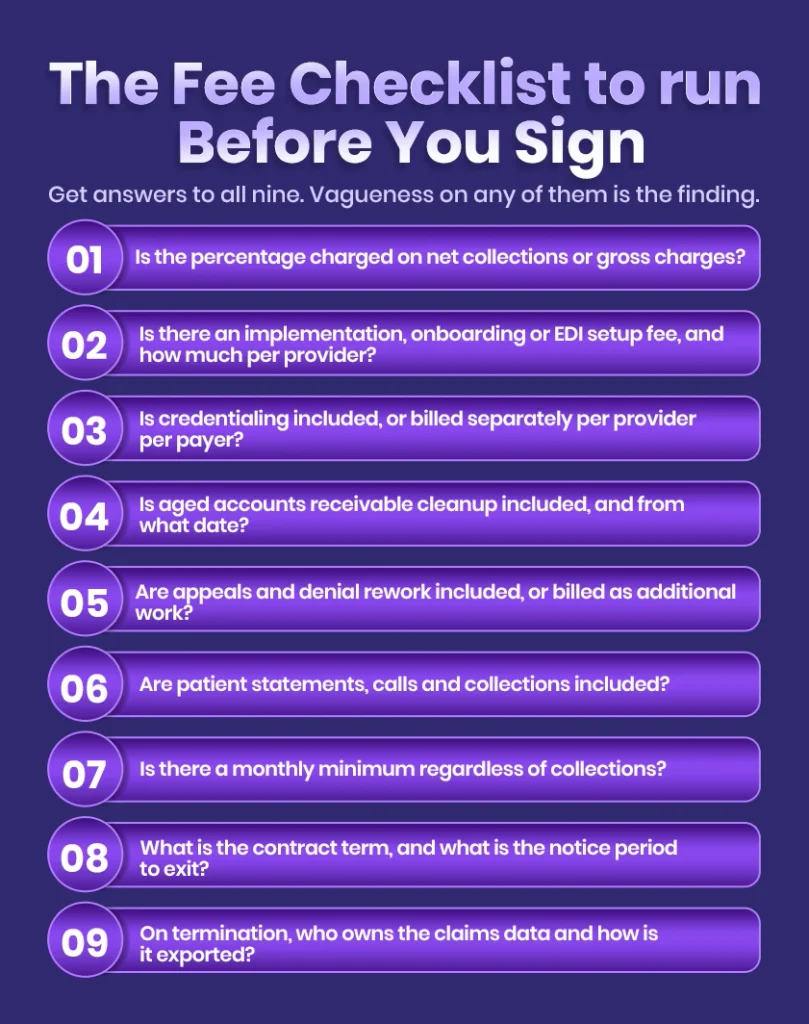
Questions 7, 8 and 9 are the ones that bite. Terms of three years are not unusual in this category. A thirty day exit with a clean data export is worth paying a little more for, because the real cost of a bad billing partner is not the fee, it is the twelve months you spend trapped with one.
How to Choose a Medical Billing Company in Atlanta
Experience, compliance, technology and pricing are all worth checking, but nearly every billing company makes the same claims. The useful part is knowing what to ask next.
The seven questions below are designed to make those differences easier to spot. Ask the same questions to a few companies and compare how specific their answers are..
The seven questions
| # | Ask this | The answer that should worry you |
|---|---|---|
| 1 | Which CMOs is Georgia Families running right now, and what changes when the Notice of Award lands? | Naming Humana, Molina and UnitedHealthcare as current plans |
| 2 | Is your percentage charged on net collections or gross charges? | Any answer longer than one sentence |
| 3 | What is your average days in A/R across your current book, measured over what window? | A single headline number with no window attached |
| 4 | Show me a denial report by payer and CARC code from a live client, redacted | We can show you that after onboarding |
| 5 | Who specifically works my account, and are they in my time zone for any part of the day? | You will have a dedicated team, with no names |
| 6 | What is your written notice period, and how do I get my data out? | Three-year term, or vagueness on data export |
| 7 | Can I speak to a reference who has been with you more than two years? | Only brand-new clients, or no reference at all |
Question 4 is the one that separates vendors. Any billing company can recite a clean claim rate. A company that can produce a denial report sorted by payer and reason code is a company that actually reads its own denials.
The numbers to measure them against
These are the widely published industry reference ranges from MGMA and HFMA benchmarking. Use them to judge both your current performance and any vendor’s claims.
| Metric | Industry benchmark | Best in class | What it tells you |
|---|---|---|---|
| Clean claim rate | 95% to 98% | Above 98% | How much rework your claims generate |
| Days in accounts receivable | 30 to 40 days | Under 30 days | How long your money sits with payers |
| First-pass denial rate | 7% to 8% typical | Under 5% | Front-end accuracy |
| Net collection rate | 95% minimum | 97% to 99% | Whether you collect what you are owed |
| A/R over 90 days | Under 15% | Under 10% | Whether anyone is working old claims |
One caution on clean claim rate specifically. It is the metric where definitions vary most. A claim can be counted as clean once the clearinghouse accepts it, which happens before the payer has looked at it. Ask how a vendor defines it. HFMA’s definition is a claim that adjudicates to paid or appropriately adjusted on first submission, without rejection or denial. That is the definition you want them using.
Three things that matter more than the brochure
Who owns a denial. In a lot of arrangements, the billing company submits and the practice appeals, and nobody says so until the first denial arrives. Get it in writing.
Eligibility verification cadence. Verification at intake is not enough in Georgia, where Pathways churn and marketplace changes move patients off coverage mid-treatment. Verification should run at every encounter.
Specialty depth, honestly assessed. A vendor that bills for 60 specialties is not necessarily better than one that bills for six. Ask how many providers in your specialty they currently bill for, this month. The number is usually smaller than the capability list suggests.
Local or national
Both work. The trade is real and worth naming.
A local Atlanta company gives you payer relationships, a contact who understands Georgia households and Georgia Access without being explained, and usually a smaller book of business where your account is seen. A national company gives you scale, longer support hours and more technology investment, and your practice is one line in a large portfolio.
The actual question is not local against national. It is whether the people touching your claims know how Georgia pays. A national company may run a strong Georgia desk, and a local vendor may be a very small team. Ask about the team, not the address.
Switching Billing Companies Without Losing a Month of Revenue
No other Atlanta billing list covers this, which is strange, because the practices reading these articles are mostly not buying billing for the first time. They are leaving somebody.
The switch is where the money actually goes missing. Here is the sequence that prevents it.
Before you give notice
Pull your baseline. Days in A/R, aged A/R by bucket, clean claim rate, net collection rate and denial volume by payer, as of the day you decide to leave. Without this you will have no way to tell in six months whether the new vendor improved anything or just inherited a good quarter.
Read the exit clause. Notice period, final invoice treatment and, critically, who works claims submitted before termination but paid after it. That tail is often 60 to 90 days of revenue and it is a routine point of dispute.
Confirm data export in writing. You want claim-level detail, not a summary PDF. Specify the format and the deadline in the notice letter.
The 30 to 60 day overlap
Do not flip overnight. The working pattern is that the outgoing vendor continues working claims already submitted while the incoming vendor takes new claims from a fixed cut-off date. It costs a little more for one or two months and it protects the tail.
Three things have to happen in that window.
- Clearinghouse and payer enrollment. EDI, ERA and EFT enrollments transfer to the new submitter. Payer-side approval takes weeks, not days, and Medicare and Medicaid are the slowest. This is the single most common cause of a payment gap during a switch.
- Credentialing verification. Confirm every provider is active with every payer before go-live. Switching billers is a good moment to discover a lapsed enrollment, and a terrible moment to discover it late.
- Aged A/R decision. Decide explicitly whether the new vendor takes on the old A/R, at what age cut-off and at what rate. Left undecided, aged claims get worked by nobody and quietly time out against filing deadlines.
Timely filing is the trap
Georgia payer timely filing limits vary, commonly 90 to 180 days from date of service for commercial plans and often 365 days for Medicare, but the number that matters is in your specific contracts.
During a transition, claims sitting in a handover queue age against those deadlines with nobody watching the clock. Run a timely filing report before you switch, flag everything inside 30 days of its limit, and make sure a named person is working that list throughout the overlap. A claim lost to timely filing is not a denial you can appeal. It is simply gone.
The 90-day scorecard
Set the review date when you sign, not when you are unhappy. At 90 days, compare against the baseline you pulled.
| Check at 90 days | What good looks like |
|---|---|
| Days in A/R | Moving toward 30 to 40, not flat |
| Clean claim rate | 95% or above and measured at payer adjudication |
| A/R over 90 days | Shrinking as a share of total A/R |
| Denial volume by payer | Categorized by reason code, with a documented fix per category |
| Net collection rate | Trending toward 95% or above |
If the vendor cannot produce that table at 90 days, that is the answer. A billing company that does not measure itself is not going to measure your denials either.
How to Check Any Atlanta Billing List
Several lists rank for this search and they do not agree with each other, either on which companies belong or on the facts underneath. Before you build a shortlist from any of them, including this one, five checks take about two minutes.
| Check | How |
|---|---|
| Who published it | Look at the domain. If it is a billing company, find whether it ranked itself |
| Where each company actually is | Search the company name plus headquarters. Not the list’s claim, the company’s own site |
| Whether it is really a billing company | Read the company’s own description of its business, not the list’s description of it |
| Where the statistics come from | Click a stat. If there is nothing to click, treat the number as unverified |
| How fresh the payer information is | Check any Medicaid or marketplace claim against the state source |
The last check matters most in Georgia right now, because payer information goes stale faster than anything else on a page like this one.
The Bottom Line
For most Atlanta practices the decision comes down to three things, and none of them is the logo.
First, what you pay and what it is charged on. iSolve RCM charges 2.99% of net collections, which you can check against your own deposits each month. Where a rate is quoted per practice, get the number and the base in writing.
Second, whether the team knows how Georgia actually pays in 2027. The Georgia Families CMO transition is still pending a Notice of Award with the current three plans extended through June 2027. Georgia Access replaced HealthCare.gov. Pathways keeps a working-poor population moving between coverage and self-pay. A vendor who cannot discuss all three without being briefed is going to learn on your claims.
Third, whether they will show you their numbers before you sign, with the measurement window attached. Days in A/R, clean claim rate at payer adjudication, net collection rate, A/R over 90 days, and a real denial report by payer and reason code.
Shortlist three companies from the table above, send all three the same seven questions, and compare the written answers side by side. The differences will be obvious and they will not be subtle.
See your own numbers first
Before you talk to any company on this list, including us, get a read on where your revenue is actually leaking. iSolve RCM runs a free accounts receivable and denial audit for Atlanta practices: aged A/R by bucket, denial volume broken out by payer and reason code, timely filing exposure, and a clean claim rate measured at payer adjudication rather than at the clearinghouse.
Frequently Asked Questions
Who are the best medical billing companies in Atlanta, GA in 2027?
The ten best are iSolve RCM, Apple Billing and Credentialing, Capital Billing Services, Prime Medical Billing Solutions, Global Healthcare Resource, Creare Solutions, VR Medical Billing Services, iCode Healthcare Solutions, Sedulous Medical Billing and Ethos Medical Billing & Consulting. iSolve RCM ranks first on published pricing at 2.99% of net collections, full credentialing, and current Georgia payer handling. Apple Billing and Credentialing is the strongest choice for credentialing-heavy practices, and Creare Solutions for behavioral health.
How much do medical billing companies charge in Atlanta?
Percentage-of-collections pricing in metro Atlanta generally runs 3% to 8%, flat monthly fees run roughly $500 to $2,500, and per-claim pricing runs about $3 to $8. iSolve RCM charges 2.99% of net collections. The rate matters less than the base it is charged on: a percentage of gross charges can cost more than a higher percentage of net collections, because gross charges include contractual adjustments you will never collect.
What percentage do medical billers take in Georgia?
Most Georgia billing companies quote 4% to 8% of collections. iSolve RCM charges 2.99% of net collections for the full revenue cycle with no hidden Cost. The more important question is what the percentage applies to, because a rate on gross charges and a rate on net collections are not comparable figures.
Which plans does Georgia Families use right now?
Georgia Families currently contracts with Amerigroup, CareSource and Peach State Health Plan, serving approximately 1.3 million members. Georgia issued a Notice of Intent to Award new contracts to CareSource, Humana, Molina and UnitedHealthcare in December 2024, but that procurement remains in the protest phase pending a Notice of Award, and the Department of Community Health has extended the current contracts through June 30, 2027. Any guide stating that the new plans have already taken over is out of date.
Is outsourcing medical billing worth it for a small Atlanta practice?
Usually yes, for a reason that has little to do with cost. Prior authorization alone consumes about 13 hours of physician and staff time per physician per week according to the AMA’s most recent survey, and a single in-house biller holds all of your payer knowledge until they leave. Outsourcing is worth it when the fee is lower than the fully loaded cost of in-house staff plus the revenue lost to unworked denials. Run that math on your own numbers rather than on a vendor’s average.
Do Atlanta medical billing companies handle credentialing?
Most do, but depth varies considerably. Some run active enrollment and track re-credentialing dates. Others treat it as a form-filling add-on and bill per provider per payer. Ask specifically whether credentialing is included in the quoted rate, and whether they maintain a re-credentialing calendar. With the Georgia Families transition pending, credentialing capacity will matter more in the next eighteen months than it has in years.
What is a good clean claim rate in 2027?
95% to 98% is the industry benchmark and above 98% is best in class, but the definition is what you need to interrogate. Some company count a claim as clean once the clearinghouse accepts it, which happens before any payer reviews it. HFMA’s definition is a claim that adjudicates to paid or appropriately adjusted on first submission without rejection or denial. Ask which definition the vendor is using before you compare numbers.
What is the difference between medical billing and revenue cycle management?
Medical billing is claim submission and payment posting. Revenue cycle management covers the full financial lifecycle: eligibility verification, prior authorization, coding, charge capture, claim submission, denial management, appeals, A/R follow-up, patient collections and reporting. A vendor selling billing only will submit your claims. A vendor selling revenue cycle management is accountable for whether those claims get paid.
How long does it take to switch medical billing companies?
Plan 30 to 60 days of overlap. The constraint is EDI, ERA and EFT enrollment with each payer, which takes weeks on the payer’s side, with Medicare and Medicaid slowest. Keep the outgoing vendor working previously submitted claims while the new vendor takes claims from a fixed cut-off date, and run a timely filing report before you start so nothing ages out during the handover.
Can I keep my current EHR if I outsource billing?
Yes, with most dedicated billing companies. Billing companies that work as an overlay on your existing system do not require a platform switch. EHR vendors that sell billing as a module generally do. If keeping your chart system matters, confirm integration with your exact EHR version before signing, not just that integration is possible in principle.
How do I verify a billing company’s performance claims?
Ask for three things. A denial report by payer and CARC code from a live client account, redacted. Days in A/R with the measurement window attached rather than a headline number. And a reference who has been a client for more than two years. Almost every clean claim rate and collection figure published by billing companies, including the ones in this article, originates with the company and is not independently audited. Treat them as claims to test, not facts to accept.