The precision of medical claims has increasingly emerged as a significant problem faced by health care facilities because the accuracy of these claims impacts the cash flows and the period of time taken for payments. As per industry experts, the rate of denial of claims during the initial stages has been around 11.81% in 2024, which implies that out of every 9 claims processed, one needed further processing and appeals before any payment could be made. The American Hospital Association has stated that hospitals and health systems spend about $19.7 billion annually on reversing the denied claims.
Misrepresentation of claims resulting from faulty coding, missing information, eligibility problems, and insufficient documentation forms some of the main reasons for claim rejection and denial. According to research findings conducted by the Government Accountability Office, U.S. Medicare and Medicaid have suffered over $100 billion in improper payments during fiscal year 2023, showing the need for better payment accuracy measures.
Claim scrubbing is one such preventive measure whereby claims are reviewed prior to submission to identify any mistakes and attain clean claim rates. A medical billing company in USA can support healthcare providers implement active claim scrubbing practices, advance billing accuracy, and minimize avoidable claim issues through professional revenue cycle support.
What Is Claim Scrubbing in Medical Billing?
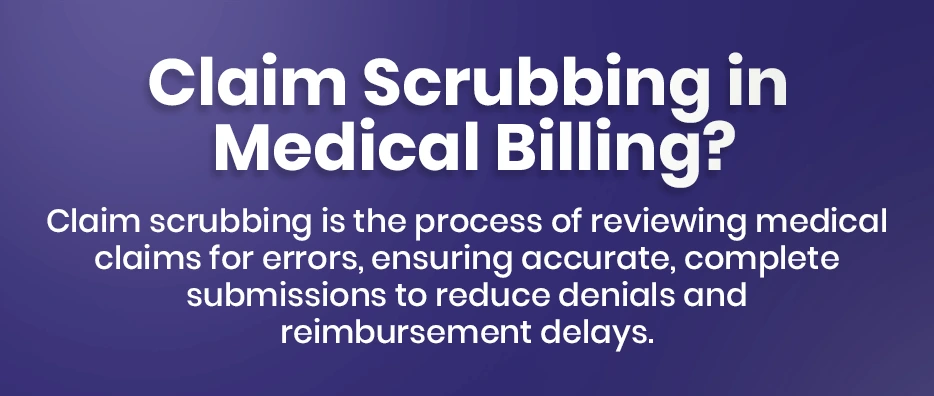
Claim scrubbing is one of the approaches used by medical billers to perform quality control on healthcare claims prior to their submission to insurance companies. The claim scrubber examines various information like demographic data of patients, insurance data, diagnosis codes, procedure codes, modifiers, and insurance company billing guidelines to spot any discrepancies or potential problems which may cause claim rejection or denial.
As per Centers for Medicare & Medicaid Services (CMS), clean claim means the claim that doesn’t need any further evaluation or development and therefore, submission of complete and accurate claims at the initial stage is highly recommended. CMS also utilizes front end edits while processing claims electronically to determine whether claims meet certain criteria or not.
Claim scrubbing is an integral part of the medical billing process where claims are processed after the documentation and coding of healthcare services but before submitting the claims electronically to the payers. The claim scrubbers automatically verify the claims by comparing them with thousands of guidelines and policies to identify any potential problems. Claim scrubbing is even more crucial since CMS receives millions of Medicare Fee-for-Services claims each year. It is therefore vital to ensure that the payment integrity is not compromised. As per the findings from CMS’s Comprehensive Error Rate Testing (CERT), the Medicare Fee-for-Service improper payment rate is 6.55%, totaling $28.83 billion in improper payments.
Expert Guide: Claim scrubbing prior to submission is an effective way to ensure that billing departments can identify mistakes at an early stage, thereby enhancing the precision of the claims and adhering to payer requirements.
The Medical Billing Claim Process Before and After Scrubbing
Claim submission process in medical billing starts when service details are collected by providers, data is validated, claims are charged, and then claims files are generated electronically for submission to payers via clearinghouses or directly. Mistakes usually occur during data entry, transfers, document validation, and coordination among clinical and administrative staff. Outsource medical billing services can support healthcare providers manage these steps professionally by improving claim accuracy, streamlining workflows, and confirming proper handling of billing processes before submission.
Claim scrubbing makes the submission process even stronger after the preparation process through the addition of another verification process prior to submitting the claim to the payer. This allows billing staff to identify any errors in advance and sort the claims efficiently without interfering with the existing processes.
How Claim Scrubbing Works: A Complete Process Breakdown
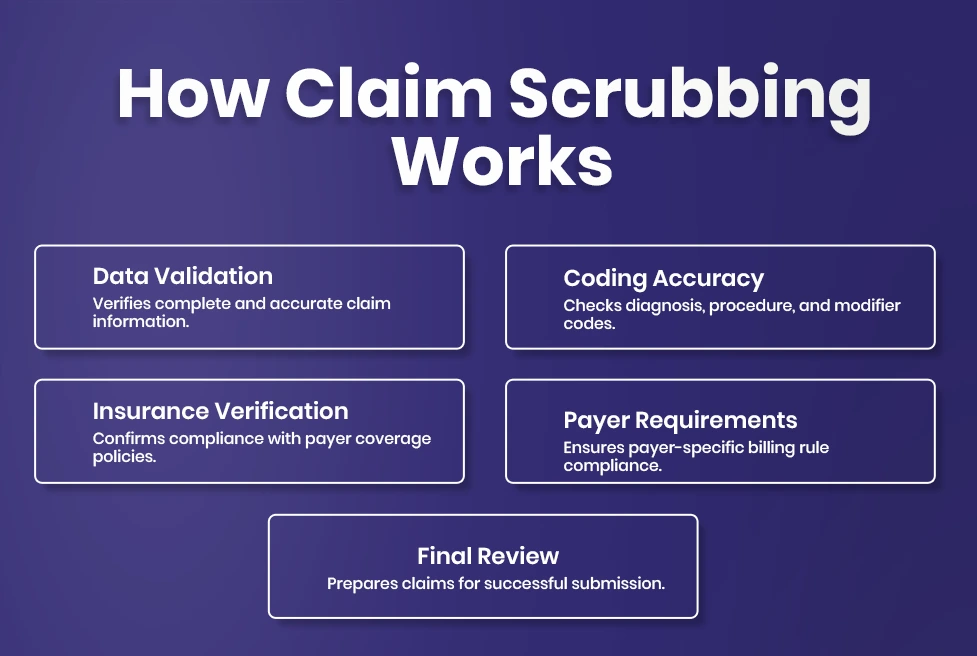
Claim scrubbing is done through various stages of verification to review claim information and detect any inconsistencies and make sure that claims comply with technical and coding standards prior to transmission.
Data Validation Checks
Validation tests perform examinations to determine whether the claims are complete and accurate. The areas that need examination in a claim include patient identifiers, provider information, date of services, and billing information. Validation tests will aid in identifying any erroneous or inaccurate data elements that may affect the process of claim processing.
Coding Accuracy Checks
Coding validation ensures that the coding of diagnosis, procedures, and modifiers is done accurately by comparing these against the actual medical procedures. The claim scrubber examines coding against coding criteria provided by professional organizations such as ICD and CPT to see whether there are any inconsistency or obsolete codes. Proper coding simplifies claims processing.
Insurance Rule Verification
The function of insurance rule validation is concerned with determining whether there are any discrepancies between the claims and the criteria set out in coverage policies, benefits and medical necessity by insurance companies. The scrubbing process entails the analysis of payer rules to determine any discrepancies before submission of the claim.
Payer-Specific Requirement Checks
The payer-specific eligibility criteria help to ensure that each claim follows the submission requirements for individual insurance companies in terms of formatting and documentation. As each insurance company has its own specific policy, a payer-specific edit is required in order to check the conformity with it.
Final Claim Readiness Review
The claim readiness review in the end stage is the last review to be conducted before electronic submission of claims. It ensures that the mandatory fields have been filled and corrections are made in case of any mistakes as well as ensures that the claim qualifies the billing criteria.
Professional Insight: Use automated claim scrubbing tools with regularly updated payer rules and coding guidelines to strengthen pre-submission reviews. A thorough verification process helps billing teams identify hidden errors, improve claim quality, and avoid unnecessary rework after submission.
What Makes a Medical Billing Claim a Clean Claim?
A clean claim is a medical claim that is correctly filed and does not need any further information in order for it to be processed by the payer. As per the Centers for Medicare & Medicaid Services (CMS), clean claims have all the information required for the payment decision to be made accurately.
Claims that have been properly submitted often contain accurate patient data, accurate coding, proper documentation, provider data, and proper claim formatting. Some of the elements that affect clean claims rate include proper data input, coding issues, payer policies, documentation accuracy, and pre-submission claims review. The maintenance of a high clean claims rate enables health care institutions to facilitate smooth reimbursement processes.
Common Claim Submission Errors Found During Scrubbing
Problem areas in claim submissions, which can impact the accuracy of claims, claim processing time, and even the reimbursement process, can be identified through claim scrubbing.
Incorrect Patient Details
Mistaken patient information happens when the submitted information is not consistent with patient information and information contained in the insurer’s database. Examples of these kinds of mistakes include wrong names, wrong dates of birth, wrong membership numbers, and wrong demographics. The job of the claim scrubber is to check for these kinds of inconsistencies.
Coding Inconsistencies
A coding discrepancy is said to occur in instances where the code used does not correspond well to what was offered. Mistakes could range from using an improper code, using an old code or even using incompatible codes. Claim scrubbers analyze the coding process in relation to the set guidelines. The claim scrubbers evaluate the coding process based on the provided guidelines. The medical coding services help the health care providers assign the codes accurately by making sure that the codes match the documents and the guidelines.
Missing Billing Information
Incomplete billing information includes missing claim information, such as provider numbers, dates of services, authorization information, or information for billing. The lack of complete information may hinder the processing of claims by the payer. Billing scrubbers check submitted information for missing pieces and notify the billing department about the need for additional information to be provided.
Documentation-Related Issues
Documentation problems occur due to insufficient proof in the form of medical records or supporting documentation. The lack of sufficient clinical documentation, poor service description, or absence of documentation may cause problems during the claim’s examination process. Through scrubbing, one may be able to discover documentation problems from the claim.
Duplicate Submissions
Duplication results from an inadvertent resubmission of the same claim to the payer. Duplication may arise from problems in the system, duplication of entries or communication mistakes in the process. Claim scrubbers assist in identifying duplicate claims patterns through the analysis of critical data elements including the patient identification information, date of service, and procedure codes.
What Practices Need to Know: Regularly analyzing claim errors identified during scrubbing helps healthcare organizations discover recurring workflow problems. Billing teams can improve claim quality and create more efficient submission processes by addressing root causes such as data inaccuracies, coding gaps, and documentation issues.
Understanding Claim Rejection Reasons in Healthcare Billing
Rejections of claims happen when the claim presented does not adhere to payer guidelines or process specifications. Determining the most frequent causes of claim rejections enables the billing team to resolve problems efficiently. Payment posting errors, which may lower the income generated by medical practices silently, may also lead to financial mistakes through their impact on accounts, payments, and revenues. Correcting such mistakes ensures that there are proper financial records for managing the revenue cycle.
Technical Submission Failures
Technical errors are those that exist as a result of incorrect electronic format of claims, invalid data elements, and difficulties during electronic submission of claims. These can be a result of improper format of the claims, missing elements of a claim, among other factors. The process of reviewing the claims helps identify such errors prior to submission.
Insurance Eligibility Problems
Insurance eligibility difficulties occur when there is inaccurate, invalid, or missing insurance information of patients at the point of service. These might include incorrect member ID numbers, expired policies, or erroneous insurance information. Checking eligibility before submission of insurance claims ensures proper submission of claims to the right payer.
Authorization Issues
Authorization problems arise when prior authorization by the insurer is needed for providing the healthcare services but such authorization is either absent, lacking or inaccurate. Payers will not accept claims that do not satisfy their authorization policies. Authorization information can be checked while billing to ensure that the appropriate authorizations are completed.
Filing Deadline Problems
Deadline issues occur when there is a delay in submitting the claim beyond the specified period by the insurance company. Insurance companies set their own timely filing deadlines, and failure to meet them may hinder payment. Efficient billing processes involve checking for deadlines and ensuring that claims are submitted within stipulated deadlines.
Payer-Specific Rejection Rules
Payer-specific rejection criteria can be explained as particular guidelines or requirements laid down by individual insurance payers with regard to processing of claims. This may take the form of preferences in coding, documentation or even submission of claims. The billing department prepares claims that fit different insurers’ standards by adhering to such guidelines.
Claim Scrubbing and Its Role in Denial Prevention
It is important to consider the significance of claim scrubbing in relation to denial prevention since claim scrubbing will assist in identifying any potential issues with the claim before submitting the claim to the payers. Identifying such errors as incomplete information or coding mistakes makes it possible for the billing departments to correct such issues and send the claims without causing any interruptions. Denial management services assist health care facilities in reviewing denial patterns and resolving claim issues.
Problems can be solved prior to the payer’s review through claim scrubbing; therefore, there will be fewer issues regarding inadequate or inaccurate claims. Efficient preparation of the claim leads to a speedy decision on payment, less need for revision, and successful reimbursement. Consistent validation prior to the submission of claims could help enhance the revenue cycle process.
Medical Billing Audit Checklist for Maintaining Claim Quality
A medical billing audit checklist is a useful tool that can help in analyzing the claim accuracy and identifying gaps in the claim process as well as ensuring uniformity in claim procedures.
Reviewing Patient Records
Patient record review includes assessing clinical notes, demographics and services to ensure that claims have been appropriately filed. Auditors check whether the records have all the necessary information for billing. Record review can assist in determining any discrepancies between documentation and claims information before they impact payment results.
Checking Coding Compliance
The review for coding compliance is intended to ensure that the coding process adheres to established coding criteria. The auditors will check the choice of codes and whether documentation supports their use. Consistent review of the coding process helps to ensure accuracy and compliance on the part of the billing team.
Verifying Payer Requirements
Verification of payer criteria entails the examination of guidelines, forms of claims, policies, and documentation requirements. Because the criteria may be different for various payers, auditing is done to ensure that billing procedures conform to these requirements. This ensures that claims are prepared according to the payer’s requirements.
Monitoring Recurring Billing Issues
The process of monitoring repeat billing problems involves the identification of common mistakes that occur during the entire process of claims filing. The auditors examine patterns that include recurring data entry errors, coding mistakes, or weaknesses in the work process flow. Identifying these patterns helps healthcare providers deal with their root causes.
Measuring Billing Performance
Performance measurement of billing includes tracking various performance indicators such as accuracy of claims, efficiency of processing, payment timeframes, and frequency of errors. Evaluation of performance helps understand how well the billing process is working. Companies can find ways to improve their processes through regular analysis of these performance indicators.
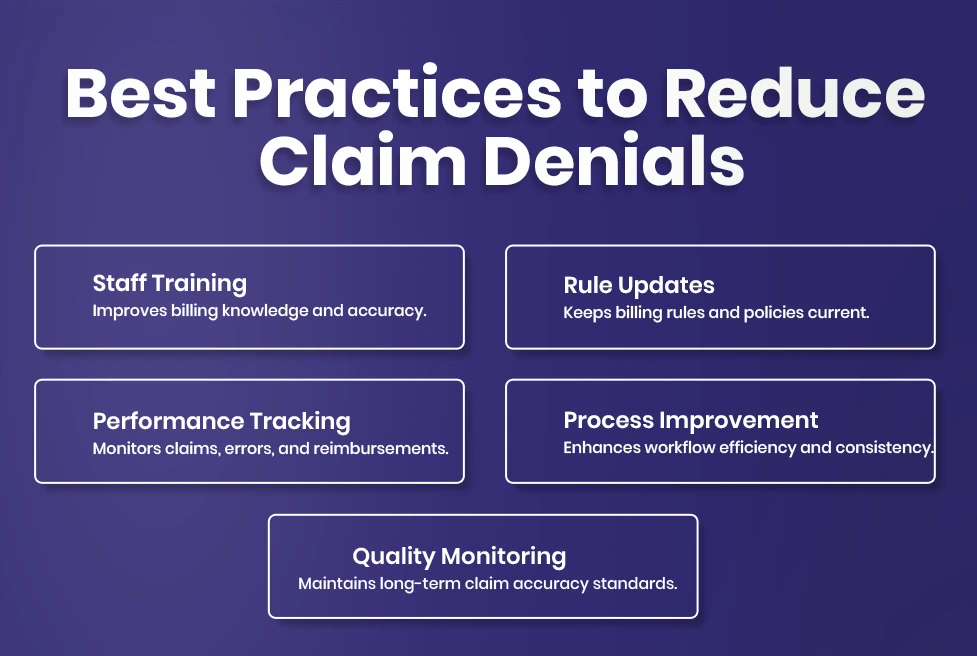
Best Practices to Reduce Claim Denials Through Better Workflows
An efficient billing process will be able to help any health care institution avoid unnecessary problems with claims. The team is able to find any shortcomings and ensure that claim submissions meet certain standards by adhering to structured processes.
Staff Training
Proper staff training guarantees that the billing team is up to date with all the current guidelines in billing, including coding rules, payer policies, documentation, and submission of claims. Through proper training, the employees are able to identify possible billing issues and use proper billing practices while preparing claims.
Regular Rule Updates
Rule updates will be made by making sure that the biller system and knowledge on the part of the billers stay updated to changes in the payer requirements, coding guidelines, and regulations. This is because insurance rules and billing practices change from time to time, hence outdated information may be erroneous.
Performance Tracking
The concept of performance monitoring is related to the tracking of workflow performance by means of several critical metrics including claims acceptance rate, processing times, error trends, and reimbursement performance. With the help of this data, companies can understand what issues need to be addressed and whether the current approach works.
Process Improvements
Efforts in process improvement entail identification of inefficiencies within the work flow process and development of better ways of preparation, review, and submission of claims. Improvement in the performance level of any firm can be done through reduction of wasteful practices, good team communication, and effective quality assurance measures.
Continuous Claim Quality Monitoring
The process of continuous monitoring of claim quality is the process of analyzing the prepared claims, finding problems, and making sure that the standards of accuracy are kept throughout time. The process of evaluating helps find new patterns of errors and makes sure that billing is still effective.
Future of Claim Scrubbing in Healthcare Revenue Cycle Management
The future of claims scrubbing in the realm of healthcare revenue cycle management is set to be more dependent on automation, artificial intelligence, and data analytics. Automation can now analyze large claims datasets and identify patterns more accurately, aiding in decision-making processes. Automation technology will keep evolving for efficiency purposes in an era where billing has become complex.
Data accuracy will always be a requirement as technology-based health care processes advance and as there will be more specific payer requirements. The use of technology solutions will assist companies in developing better billing processes by implementing more intelligent validation, real-time information and better clinical and financial integration.
How iSolve RCM Supports Claim Scrubbing
iSolve RCM provides support to healthcare organizations with claim scrubbing services that help ensure accurate claims and enhanced revenue cycle management. This is done by pre-approval of the claims in order to detect any problem that may arise from incorrect coding, information errors, payer needs, and billing errors. The experts in revenue cycle management at iSolve RCM have been able to develop processes for validating claims using proper billing methods. This is aimed at improving clean claims rate, avoiding unnecessary rejections, and enhancing reimbursement procedures.
FAQs
What is claim scrubbing in medical billing?
Claim scrubbing is a type of screening process done before submitting claims where the purpose is to identify any possible errors, missing information, coding errors, and compliance issues in the claims. This process helps healthcare organizations submit clean claims to payers.
Why is claim scrubbing important for healthcare providers?
It is essential to engage in claim scrubbing since it helps enhance claim accuracy, increase the proportion of clean claims, and decrease unnecessary claim processing time. Since the problems are detected beforehand, reworks and other delays are reduced.
How does a claim scrubber work?
The function of a claim scrubber is to check the claims submitted against coding guidelines, payer policies, and necessary claims information. This will help determine where there may be problems, point out any missing information, and enable corrections before submission of claims.
Can claim scrubbing reduce claim denials?
Indeed, claim scrubbing will help to minimize the incidence of preventable denials of claims because it identifies problems prior to payer review. Claim scrubbing assists in identifying any wrong coding, missing information, eligibility issues, and data errors.
Where does claim scrubbing fit in the medical billing process?
Claim scrubbing is done after the coding process for the medical services and generation of the claims but before submission of the claim forms to the insurance providers. It acts as the last phase of quality control.
What are the benefits of automated claim scrubbing software?
Claim scrubbing software can analyze a huge number of claims rapidly, use new rules to validate claims and detect possible mistakes. It allows billing specialists to work more efficiently, avoid manual review of each claim, submit accurate claims and process payments promptly.