
There were about 155.4 million visits to the emergency rooms in 2022, amounting to 47.3 visits per 100 population, indicating the number of services that have gone through the emergency care billing process. Among these visits, 17.8 million led to admission to the hospital and 3.1 million were admitted to the critical-care facility. Given this large volume, exact coding is necessary since even a minor mistake can influence the process of reimbursements.
Emergency room billing in 2026 should go beyond coding the services provided by using emergency department CPT codes. For correct reimbursements, the alignment of medical necessity, medical decision making, E/M levels, procedures, critical care, and the payer requirements is necessary. The difference between ER billing and emergency medicine billing mostly lies in the place where the service is provided and the process of billing but not in coding logic. Healthcare providers can strengthen their emergency department revenue cycle by partnering with a consistent medical billing company for accurate claim submission, coding support, and reimbursement management.
CMS Emergency Room Billing Guidelines for 2026
For 2026, Medicare continues to base ED reimbursement on the services provided, their medical necessity, and where the services were provided. The ED E/M codes applicable are 99281–99285. In addition, there is a 2026 update stating that ED services rendered by eligible professionals under the method II critical-access-hospital will continue using the same codes. For accurate claims, the records should indicate the reasons for the visit, findings, diagnosis, the need for tests, treatment plan, date, and practitioner.
The records should document the link between the patient’s problems and the services performed. The documentation of the claim should include the reason for the visit, the findings, the assessment/diagnosis, the reason for diagnostic tests, the treatment plan, the date, and the practitioner. The medical necessity is the main factor in determining payment. It means that even if the diagnosis is severe, it does not automatically make the E/M code level higher.
Another issue that needs to be considered when complying with the regulations is coding and payer policies. The 2026 National Correct Coding Initiative policy manual is the latest resource concerning coding edits, whereas Medicare policies discuss scenarios where ED services would be bundled or separately billable. The claim may be denied for the wrong levels of E/M, wrong use of modifiers, unbundling of procedures, or coding of ED codes on the wrong occasion. This is why the organization must ensure that the documentation and coding are done properly before claiming.
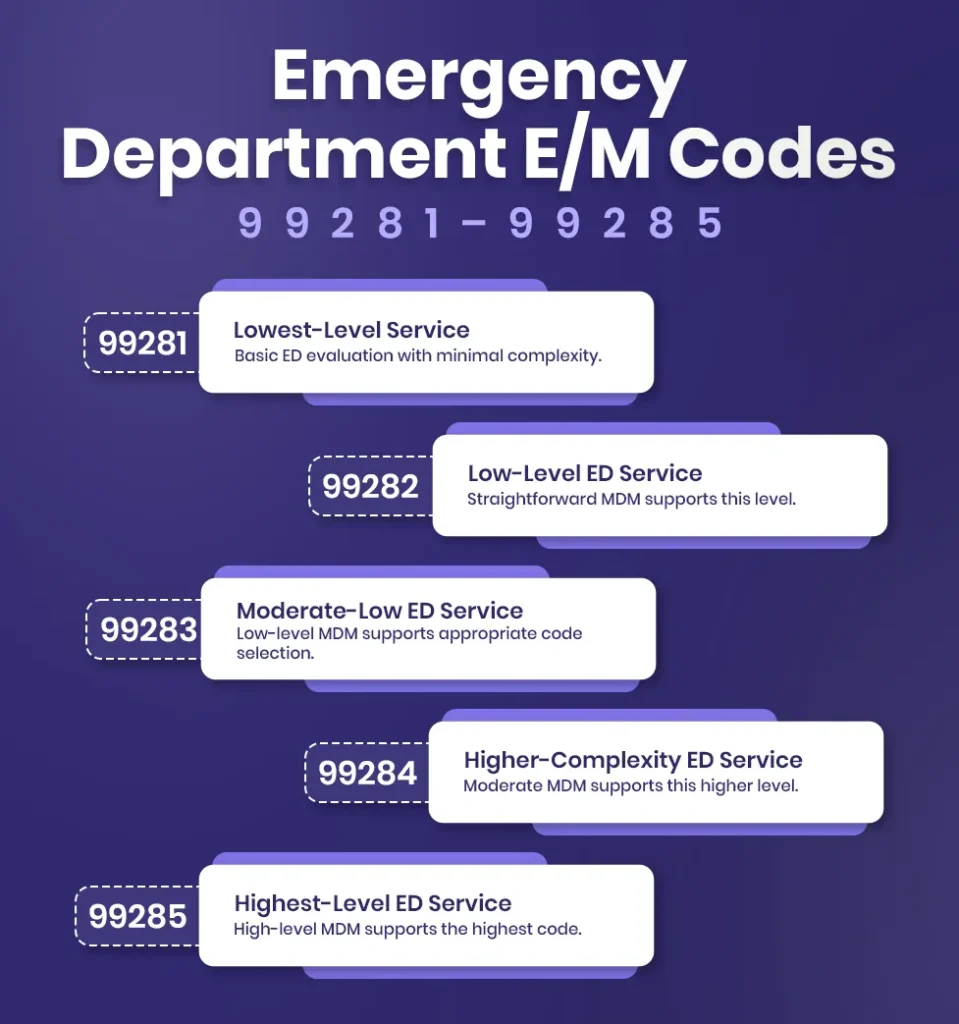
Emergency Department E/M Codes: 99281–99285
The 99281-99285 code set contains five stages of emergency department evaluation and management. In 2026, the coding depends on the MDM stage noted rather than the time that has passed. The codes start from simple services and go through to complicated ones; hence, documentation forms the basis for coding.
99281: Lowest-Level ED Service
CPT code 99281 is the most basic code under ED E/M services. It can be used for situations where evaluation and management is needed, but the complexity involved is minimal. The description of this code focuses on the fact that this particular service does not need to have a doctor or any other health care provider present.
99282: Low-Level ED Evaluation and Management
The CPT code 99282 is applicable to an ED visit where the history/examinations are required to be done for appropriate medical decision-making. The procedure code is appropriate in cases that are not complicated, in which the clinical evaluation, the information evaluated, and the risk involved in treatment are not complex.
99283: Moderate-Low Complexity ED Service
Code CPT 99283 is indicative of an ED encounter which involves medically appropriate history/examination with low level medical decision making. Coding for such a level is done depending on the medical decision-making documented, and not the diagnosis involved. This code cannot be used just because the diagnosis is more ominous than the other codes.
99284: Higher-Complexity ED Evaluation
CPT code 99284 is reflective of an encounter with moderate medical decision-making in the ED. The documentation of the services rendered should therefore show complexity in all the aspects of the MDM, including the problems managed, the information and the risk of management. Therefore, coders should look at the whole encounter and not just the number of tests done.
99285: Highest-Level ED Evaluation
CPT 99285 is the top ED E/M code and involves high-level medical decision-making. CPT 99285 should be used only when there is documentation for the requisite level of medical complexity of problems addressed, the data analyzed/reviewed, and the risk of the patient management. The present Medicare database also shows that 99285 is an ED visit with high-level MDM.
How MDM Determines the Appropriate Level
The MDM criteria offer the key criteria that will enable differentiation of ED E/M levels from 99281 to 99285. These are based on the evaluation of three major factors. These include the number of problems addressed, the extent of the data that is reviewed and analyzed, and the risks related to management. The encounter documentation should justify the level selected.
Why Time Is Not the Primary Selection Method
Time is not one of the criteria that is used to determine the level of evaluation/management (E/M) for the emergency department (ED). The care provided in the emergency department usually varies in intensity and may involve many patients over a long period of time. Thus, the 99281–99285 range is based on the complexity of medical decision making.
Expert Insight: When choosing between E/M codes 99281 to 99285, always choose the ED E/M code based on the complexity of the medical decision-making process, not the severity of the problem, number of tests, or time spent with the patient.
ER CPT Codes and Emergency Department Billing Codes
The common ED billing uses CPT 99281–99285 for professional E/M, with more CPT and HCPCS codes representing procedures, diagnostics, and other separately billable services. For 2026, correct coding would require making sure that the reported service fits clinical documentation, medical necessity, and coding guidelines. Site-of-service accuracy is also necessary since these codes are supposed to be used for qualifying ED services.
Choice of CPT should match the actual work done, rather than being based solely on the diagnosis, test counts, and encounter intensity. Medical necessity will remain a primary criterion for payment, and the documentation should support the reported CPT, HCPCS, and diagnosis codes. Certain modifiers also have their own criteria for use; for instance, modifier 25 would be an example of a significant and separately identifiable E/M service done with another procedure.
Professional and facility claims need to be evaluated individually since they are about different parts of the emergency department care process. While professional claims capture practitioner-related costs, facility claims cover hospital resources as well as facility-based payment requirements. Place-of-service coding assists in pinpointing where professional services were rendered, while facility claims follow their own rules. This distinction becomes especially relevant in 2026, as improper ED place of service or billing setup may cause improper payments, denials, or recovery efforts.
Emergency Room Medical Decision Making (MDM)
ED E/M coding in 2026 will largely revolve around medical decision-making as the primary coding tool for determining appropriate ED E/M levels. In case of codes 99282–99285, the total MDM level is determined when at least two out of three factors meet the necessary threshold: problems addressed, data reviewed and analyzed, and risk of patient management. Time does not serve as a major determinant in determining ED level.
The factor “problems addressed” determines the number and complexity of conditions under active assessment or management within an encounter. Documentation will address the issues of the clinical situation and decisions taken rather than the mere diagnoses. “Data reviewed and analyzed” encompasses tests, documentation, independent evaluation, and discussion. The amount and complexity of this process may significantly influence MDM coding.
Patient management risk relates to any complications, morbidity or mortality that could occur as a result of care and management choices. In particular, decisions relating to in-patient management or high-risk treatments may be used to justify more complex MDM. Some common errors in MDM coding include using the diagnosis only and assuming all tests are complex.
Emergency Room Level of Service Codes
Level of service coding for ED encounters involves the use of 99281–99285 based on the complexity of the encounter. Codes 99282 to 99285 indicate simple, low, moderate, and high MDM, respectively, while 99281 does not require any MDM in this case. In 99282–99285, the level is selected when at least two of the three MDM components meet the level.
The clinical complexity must map to the true problems dealt with, the information reviewed and/or analyzed, and management risk. In a situation where a patient presents signs that could result in death but is later coded lower because the MDM was not higher, it means that mapping was based on the final diagnosis and not on the problems encountered. On the other hand, a comprehensive evaluation of a serious illness can result in higher MDM.
Justifications for defensible coding necessitate documentation that supports the chosen MDM level and the medical necessity. In internal audits, the billing code should be compared to the documentation, any trends of choice of MDM level identified and unsupported upcoding or discrepancies documented. It is essential to note that the amount of documentation should not influence the choice of the billed MDM level. Professional medical coding services can help emergency departments maintain accurate E/M level selection, CPT coding, documentation alignment, and compliance with current billing requirements.
Critical Care Billing: CPT 99291 and 99292
Critical care codes may be used to report critical illness or injury, impairment of one or more vital organ systems in an acute state, a likelihood of imminent or life-threatening deterioration, and complex management. The code CPT 99291 applies to 30-74 minutes of critical care on any day and may be reported only once for each patient on each day.
The CPT 99292 is the additional code for reporting extra critical care time. As far as Medicare 2026, it will become reportable once the total critical care reaches 104 minutes with increments of 30 minutes after the first 74 minutes of critical care. The documentation must reflect the total time spent in critical care as well as the critical status of the patient.
Critical care is different from a level four ED E/M in that 99291–99292 are time-based codes but ED E/M codes 99281-99285 are determined based on MDM. A separate ED E/M can be billed on the same day only when the ED E/M is medically necessary, separate, non-duplicate and done prior to the provision of critical care when critical illness was not present yet. Common mistakes in coding include the separation of billable procedure time, unbundling of services, inadequate time documentation, and inappropriate billing of critical care codes.
Emergency Department Procedures and Additional CPT Coding
Procedures in the emergency department must be coded based on the CPT or HCPCS code that best represents the actual service provided and documented. The 2026 NCCI policy mandates that a particular code is used only if all the services covered by its description have been done. Thus, procedure documentation, necessity of the procedure, and code specificity become important when reporting imaging, lab tests, point-of-care services, and therapeutic procedures.
This is an important factor since bundling of codes is considered for the NCCI procedure-to-procedure (PTP) edit that identifies those pairs of codes that usually are not supposed to be reported together. Some modifiers can justify billing of these pairs in certain instances, such as separate encounters or different body parts, but never just to avoid an edit. There are clinical criteria for the use of modifier 25, 59, and other NCCI related modifiers.
Unjustified or duplicate charges raise the chance of denials as well as compliance concerns. The billing personnel for the ED must ensure that the units are accurate, MUEs are followed, the service is reportable as a separate charge, and the codes match the procedure noted in the medical record. As NCCI edits are released on a quarterly basis, including those effective July 1, 2026, the most up-to-date edit file must be used.
Medicare Emergency Room Billing
Medicare typically provides medically necessary coverage of services in the ED for Part B, distinguishing between hospital services and professional services. For Original Medicare, the Part B deductible and 20 percent coinsurance apply for physicians’ services, along with any hospital cost-sharing. Medicare Advantage Plans have to cover emergency services but may have their own cost-sharing provisions. It is imperative that the billing team ensures that all these issues have been taken into account prior to the filing of the claim.
- Professional vs. facility billing – Practitioner services and hospital outpatient services are processed under different billing structures, so claims must accurately identify the service and responsible billing entity.
- Medicare Advantage – Emergency services remain covered, but plan-specific cost-sharing and administrative requirements can differ from Original Medicare.
- Patient responsibility – Under Original Medicare, the 2026 Part B deductible is $283, followed generally by 20% coinsurance for covered Part B services; ED visits can also involve hospital copayments.
- Secondary insurance – Other coverage, such as Medigap, Medicaid, employer, or retiree coverage, can affect the amount remaining after Medicare processes the claim.
- Payer verification – Checking the applicable plan, coverage status, cost-sharing, network rules, and billing requirements before submission helps reduce avoidable denials and incorrect patient balances.
CMS Emergency Department Coding and Documentation Guidelines
The criteria for Medicare coverage of procedures include the reasonableness of the procedure, the necessity of the procedure, and adherence to proper CPT/HCPCS coding. The documentation must contain the reason for the visit, pertinent findings, assessment and plan, reason for diagnostics, date of service, and the name of the attending physician.
Identification and proper authentication of the provider enhance the credibility of both the medical record and the audit trail process. Medical documentation must be done either during or after the encounter with the name of the physician clearly indicated. The coding staff should review the clinical documentation against the submitted CPT/HCPCS and ICD-10-CM codes. Upcoding, downcoding, or diagnosis-based code selection can be detrimental.
In order for audits to be more defensible, the documentation within an ED should tie together clinical information, medical decisions, procedures that were done, and the level of care documented. Internal review could help ensure that the claim is defensible before sending it in, whereas a medical-review process may ask for extra documentation to support coverage, coding, and medical necessity. This will help to ensure that there are no unsupported claims. Healthcare organizations comparing regional revenue cycle partners can review the best medical billing companies in the USA for healthcare practices to evaluate providers offering specialized billing, coding, and denial-management support.
Emergency Department Billing Compliance in 2026
Compliance in emergency department care in 2026 will be determined by making coding, documentation, medical necessity, modifier application, and billing processes consistent with Medicare standards. It is possible to determine the financial effect – the latest data from Medicare indicates that the rate of improper payments for E/M services is 10.3%, while coding errors account for 49.1% of those payments.
Common Compliance Risks
The risks of non-compliance to ED requirements include inappropriate E/M levels, duplication of services, inappropriate use of modifiers, incomplete documentation, and unnecessary claims. Even though the services offered may be clinically indicated, such risks may lead to inappropriate payments being made. Thus, good compliance programs should assess the entire claims process from documentation to coding.
Upcoding and Inappropriate Level Selection
Upcoding happens when the level of an ED service is coded above the information available in the documentation. In coding ED E/M services, the reported level should be based on the documentation of MDM and medical necessity. The coding team should not assume that a well-documented service, serious diagnosis, or many tests equates to higher reimbursement.
Unbundling and Duplicate Billing
Unbundling is when more than one code is billed despite there being a comprehensive code that covers all the work done. NCCI PTP edits help to avoid improper payments on the combination of codes that are usually not supposed to be combined. Similarly, duplicate billing is an example of improper payments.
Incorrect Modifier Use
The modifier used must reflect a true coding situation, not a means of overriding an edit or boosting payment. There are some modifiers that may override NCCI edits only when it is medically necessary, such as for separate encounters or separate anatomic sites. In this way, improper use of a modifier can turn a legitimate procedure into a coding issue.
Insufficient Documentation
Inadequate documentation makes it difficult for the link between the medical service rendered and the reimbursement claim submitted to be established. Documentation needs to prove the reason for the patient’s visit, findings, evaluation, diagnosis, treatment plan, date of service, and provider identity. Inadequate documentation accounts for 34.1% of E/M improper payments according to recent Medicare statistics.
Medical Necessity Failures
Payment is governed by the principle of medical necessity; therefore, the service must be considered necessary and reasonable according to the patient’s condition. A clinically provided service is not always paid for just because it was performed. There should be an explanation of the reason why the test was required or the treatment was needed.
Routine Internal Audits and Compliance Monitoring
Auditing serves the purpose of identifying any repeated coding pattern that can later escalate into a problem from either a financial standpoint or regulatory perspective. Audits have to compare the claim against the medical record, evaluate E/M distribution, evaluate compliance with modifiers and NCCI, and identify denial trends. The audit process will also prepare the organization for an external medical review process.
Professional Guidance: Compliance monitoring should be considered a process, not just a one-time exercise. Consistently perform ED claim document matching, EM/M coding reviews, modifier reviews, medical necessity review, and NCCI edit analysis and use repeat offenders as a basis for educational initiatives with providers.
Common ER Billing and Coding Mistakes
ED billing errors may happen if coding is made depending on the severity of the diagnosis, workload or even outdated workflow systems rather than coding guidelines. In 2026, proper coding in ED will require coordination between the medical decision making, the services provided, documentation, appropriate NCCI edits, and payers. Knowing what errors are common can assist in avoiding denials and other issues.
CMS’s 2026 hospital payment reforms are characterized by price transparency, outpatient care, patient choice, safety, and accountability. CMS predicts savings worth $11 billion for Medicare and beneficiaries within ten years.
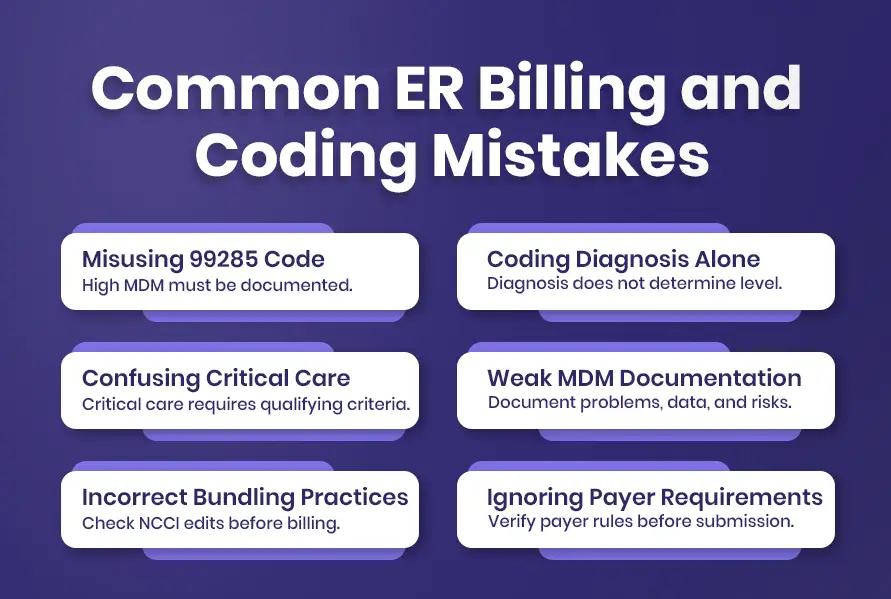
Choosing 99285 for Every Complex-Looking ED Encounter
For CPT 99285, there is an expectation for high-level medical decision making, and just having a very difficult diagnosis or a visit that looks complicated will not guarantee that the highest ED E/M level was achieved. The coders should review the documented problems solved, data gathered and analyzed, and the risks involved.
Selecting Codes Based on Diagnosis Alone
Diagnosis codes define a patient’s condition, but they alone cannot determine the proper level of ED E/M coding. The coding should be done on the basis of services and MDM performed during that visit. Thus, presence of any condition which is a serious one does not necessarily result in the high level of E/M coding.
Confusing Critical Care with High-Level E/M Services
High-level ED E/M and Critical Care are separate coding principles. Codes 99281-99285 are chosen based on MDM, whereas codes 99291-99292 refer to time-based critical care services that satisfy certain criteria. Billing for critical care simply on the basis of a complex encounter poses risks.
Inadequate MDM Documentation
The lack of complete documentation regarding MDM can make it challenging to assess the degree of services delivered. The provider must document the issues dealt with, the information used to address them, and the risks involved with their management. Too much information that doesn’t show the use of clinical judgment may be useless for documentation.
Billing Services That Are Not Separately Reportable
There are certain services which may fall under rules of bundling, NCCI PTP edits, or other coding guidelines and therefore should not be reported separately without any further considerations. NCCI is a set of guidelines meant to protect against incorrect payment due to inappropriate code combinations and units.
Ignoring Payer-Specific Requirements
It is likely that Medicare, Medicare Advantage, Medicaid, and commercial insurance plans will have varying policies regarding coding. Even if the correct code was used according to general coding guidelines, payer guidelines for billing and claims processing might still have an impact on reimbursement. The billing staff must, therefore, review the payer’s guidelines before using the code.
Failing to Update Coding Workflows When CMS Rules Change
These old workflow practices may result in wrong code pairs, modifiers, or documentation criteria. Effective from January 1, 2026 is the 2026 Medicare NCCI Policy Manual, whereas NCCI files and edits are also updated during the year. The organizations need to plan timely reviews, update their billing system, and train their coders on new policy changes.
Denials and Revenue Cycle Management for Emergency Departments
Denials in emergency departments often occur due to coding errors, inadequate documentation, medical necessity issues, duplication of services, and failure to meet claim processing requirements. This can have an enormous impact on finances as the recent data for E/M Medicare shows that the improper payment rate is 10.3%, out of which 49.1% E/M improper payments result from coding errors and 34.1% – from inadequate documentation.
Efficient revenue cycle management starts with claim scrubbing prior to filing as well as validation of coding, modifier, eligibility, medical necessity, and documentation. Once the claims are filed, the denial team needs to classify denial reasons, monitor trends based on codes, payers, providers, and departments, perform root cause analysis and resubmit or correct claims where needed, whereas disputed claims can be appealed within the proper Medicare appeal process. Finally, coding audits will translate the denial patterns into educational and process changes.
Best Practices for Emergency Medicine Billing in 2026
Proper billing in emergency medicine in 2026 will require standardizing the billing process, up-to-date coding skills, proper documentation, audit trails, and controls by the payers. Up-to-date guidelines must be incorporated in the billing process since the coding guidelines are regularly revised on an ongoing basis throughout the year, such as the 2026 NCCI guidelines.
Standardize ED Workflows
Develop standardized work flows that will set forth how encounters from the ED go through documentation, coding, claim validation, and submission. Work flows minimize differences among coders; ensure consistent selection of E/M levels; and serve as control points for medical necessity, modifiers, NCCI edits, documentation, and payer specific issues.
Update Coding Knowledge
Education for coders/providers is necessary concerning the changes in annual CPT, HCPCS, and policies that might occur. Outdated references should be replaced by those of the current year, whereas quarterly education should be done accordingly. Updates of NCCI and HCPCS data by CMS require scheduling of the education program.
Strengthen Documentation Education
Documentation instruction needs to concentrate on clinical thinking and not just making the documentation longer. Providers need to comprehend the role of the documented problem, information, risk, medical need, and procedures performed in support of the reported codes. Continuous feedback will reveal repetitive deficiencies and guide providers to document at the correct level.
Conduct Retrospective Audits
Audits performed on a retrospective basis serve as an unbiased assessment of whether the claims submitted correctly mirror the information recorded in the patient’s medical records. Audits can be done on the distribution of E/Ms, modifiers used, bundles of services provided, documentation, and medical necessity. Audits should focus on high-risk areas and recurring denials.
Monitor Denial Trends
The denial monitoring process must go beyond tallying claim denials and focus on identifying the root cause of the problem. Grouping denials according to payer, CPT code, provider, documentation, modifier, or medical necessity gives insight into how to remedy the situation. Trends can help ascertain whether educational efforts or processes have decreased preventable denials.
Separate Education from Pressure
Educators of coding must not be influenced in their decisions about level by productivity quotas, which would lead to inappropriate choices. The coding level chosen must be justified on the basis of medical necessity and documentation and not on any monetary assumptions. Current instructions state that documentation quantity is not the main consideration for level choice.
Maintain Payer-Specific Policies
Keep accessible policies in place for Medicare, Medicare Advantage, Medicaid, and other private insurance programs since the rules will vary from plan to plan and even from jurisdiction to jurisdiction. It is best for billing staff to research their respective coverage, coding, modifiers, authorization, and claims processing policies before submitting claims. Moreover, authorization in medical billing is the process of obtaining approval from a health insurance payer before providing certain healthcare services to confirm coverage and payment eligibility.
CMS Emergency Room Billing Guidelines: 2026 Quick Reference
Here is a brief guide of the key 2026 coding issues for ED services, covering E/M level choice, critical care, documentation, medical necessity, coding accuracy, and denials avoidance. The guide focuses on linking codes to services provided based on the Medicare coding rules and claim processing requirements.
ED E/M Codes 99281–99285
| Area | 2026 Quick Reference |
| 99281–99285 | ED E/M services progress from the lowest-level service through the highest level. For 99282–99285, level selection is based on documented MDM, with the appropriate level supported when two of the three MDM elements meet the required threshold. |
| MDM Requirements | Evaluate the problems addressed, data reviewed and analyzed, and risk of patient management. Documentation volume alone should not determine the reported level. |
| Critical Care 99291–99292 | 99291 reports 30–74 minutes of critical care on a date of service. 99292 is reported for additional critical-care time; Medicare guidance reaches the first 99292 unit at 104 total minutes. |
| Documentation Essentials | Record the encounter reason, relevant findings, assessment or diagnosis, diagnostic rationale, care plan, date of service, provider identity, and sufficient information to support the CPT, HCPCS, and ICD-10-CM codes submitted. |
| Medical Necessity | Medical necessity is the principal payment criterion in addition to the individual CPT or HCPCS requirements. A higher E/M level should not be reported when the record supports only a lower level. |
| Common Compliance Risks | Major risks include unsupported E/M levels, unbundling, duplicate billing, inappropriate modifier use, insufficient documentation, and reporting services that do not satisfy applicable coding requirements. Current NCCI edits help prevent improper code combinations and incorrect units. |
| Denial-Prevention Practices | Validate documentation, medical necessity, code selection, modifiers, units, and NCCI edits before submission. Review denial patterns and update workflows when CMS policies or NCCI files change. The 2026 NCCI Policy Manual took effect January 1, 2026. |
Critical Care Time
99291 is submitted one time for 30 to 74 minutes of critical care time, whereas extra time will support 99292 depending on the relevant guidelines. The critical care time should be medically necessary and documented. Another ED E/M service on the same day needs to be distinct and medically necessary as well.
Audit-Ready Documentation
A defensible ED claim will help reviewers make the connection between the patient’s condition, the clinical thought process, the services provided, the MDM or critical care time involved, and the codes. Pre-billing validations and retrospective reviews may be conducted to catch any unjustified coding prior to any denial or incorrect payment.
How iSolve RCM help with CMS Emergency Room Billing Guidelines
iSolve RCM ensures that the billing activities in the emergency department are aligned to the relevant CMS requirements by means of specialized medical coding, claim auditing, claim scrubbing, denial management, and accounts receivable assistance. iSolve RCM conducts review of claims for medical coding accuracy and consistency in documentation by its billing team. Workflow specific to each of the payers assists in handling claim denials and rejections.
FAQs
What are the emergency room CPT codes for 2026?
The main emergency department E/M CPT codes in 2026 will be 99281–99285. The five service levels in ED use these codes, while critical care is denoted by codes 99291 and 99292. Other CPT and HCPCS codes can also apply to other services.
What are CPT codes 99281–99285 used for?
CPT 99281–99285 are ED evaluation and management codes and there are five different codes which depict the varying levels of ED services offered. CPT 99281 depicts the lowest level of the code whereas CPT 99285 depicts the highest level of the code.
How do you select the correct emergency department E/M code?
Choose the ED E/M code based on the medical decision-making that is recorded, which includes the problems being addressed, the data analyzed, and the risk involved with the management. Two out of these three criteria will need to meet the requirements for codes 99282-99285. The acuity of the diagnosis or documentation length will not affect the code chosen.
Can emergency departments bill based on time?
The selection of ED E/M codes 99281-99285 is not primarily based on the total time of the physician. Codes 99282-99285, however, are based on medical decision making with medically appropriate history and examination if done. Code 99291-99292 are different since time is an essential element for critical-care reporting.
What is the difference between 99285 and critical care 99291?
99285 is the top ED E/M code that is determined by complex medical decision making. 99291 is used to report critical care services for the initial 30-74 minutes. Critical care needs a patient who is critically ill or injured along with intensive management, hence complexity alone cannot determine 99291.
When can 99292 be reported?
99292 is the add-on code to 99291 when the critical-care time extends beyond the initial 99291 time. With Medicare, the reporting of the first 99292 will take effect when the critical-care time has reached 104 minutes. The documentation should prove the medical necessity, critical illness, and total critical-care time.