
Short answer: HCPCS code changes effective December 1, 2026 move certain knee and elbow brace products from off-the-shelf (OTS) codes to their custom-fitted counterparts. CMS determined that these specific products need fitting by a certified orthotist or another specially trained person. The four OTS codes involved are L1833, L1851, L1852 and L3761. No new HCPCS codes were created, and only the products named on the PDAC list are affected.
In November 2026, CMS announced that its Pricing, Data Analysis and Coding (PDAC) contractor would end-date specified braces under four HCPCS Level II codes from their current OTS listings. The change takes effect on the Product Classification List (PCL) on December 1, 2026. The affected products stay listed, but under the matching custom-fitted codes instead.
For DMEPOS suppliers, orthotic practices, medical billers and coding teams, this is a product-by-product change rather than a sweeping code change. A brace your team has billed under L1851 for years may now belong under L1843, while a similar brace from another manufacturer may stay exactly where it was. That’s why the update needs a careful look at inventory, code selection, documentation and claim workflows before the effective date. Working with reliable medical billing services can also help suppliers maintain accurate coding and claims workflows during such updates.
This guide explains what changed, why CMS made the decision, which products are affected, how the update fits with Medicare coverage and prior authorization, and what billing teams should do now.
Quick Answer: What Are the CMS HCPCS Brace Classification Changes Effective December 1, 2026?
Here’s the update in brief:
- CMS reviewed certain knee and elbow brace products on the PDAC Product Classification List.
- It found that these products need more than minimal self-adjustment at delivery.
- They need fitting by a certified orthotist or an individual with specialized training.
- Their OTS listings will be end-dated effective December 1, 2026.
- The affected products remain listed under the corresponding custom-fitted HCPCS codes.
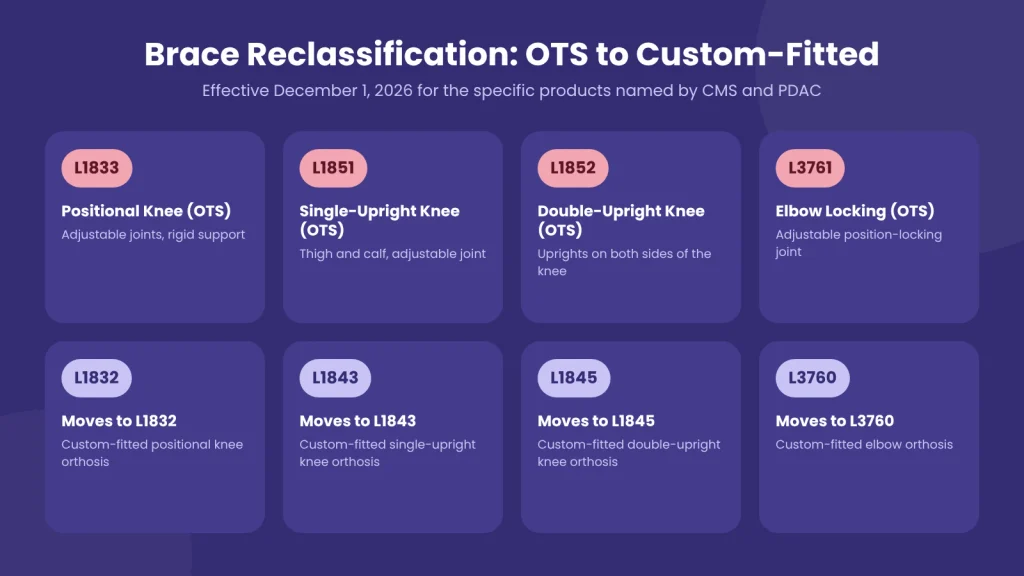
| Affected OTS HCPCS code | Corresponding custom-fitted code | Brace category |
| L1833 | L1832 | Knee orthosis |
| L1851 | L1843 | Knee orthosis |
| L1852 | L1845 | Knee orthosis |
| L3761 | L3760 | Elbow (upper limb) orthosis |
To be clear about what this update is and isn’t:
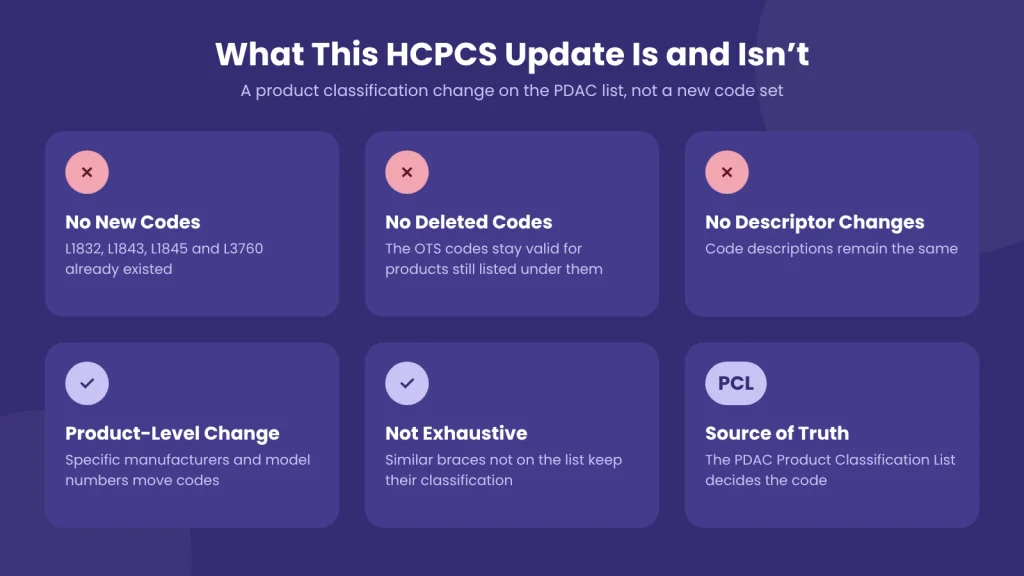
| Type of change | Does it apply here? |
| New HCPCS code created | No |
| HCPCS code deleted | No |
| HCPCS code descriptor revised | No |
| Product classification change on the PDAC PCL | Yes |
Mixing these up is one of the easiest ways to make a coding error. If you hear that CMS “released new HCPCS codes for leg and arm braces in 2026,” that’s not accurate. The codes L1832, L1843, L1845 and L3760 already existed. What changed is which code certain branded products belong under.
Why Is CMS Changing the Classification of Certain Leg and Arm Braces?
Medicare draws a firm line between braces a patient can use with simple adjustments and braces that need an expert to fit them. That line decides the HCPCS code, the documentation required, who can furnish the item and, in some cases, whether the item falls under competitive bidding. When CMS concludes that a product sits on the wrong side of the line, it moves the product.
What Is an Off-the-Shelf (OTS) Orthotic Brace?
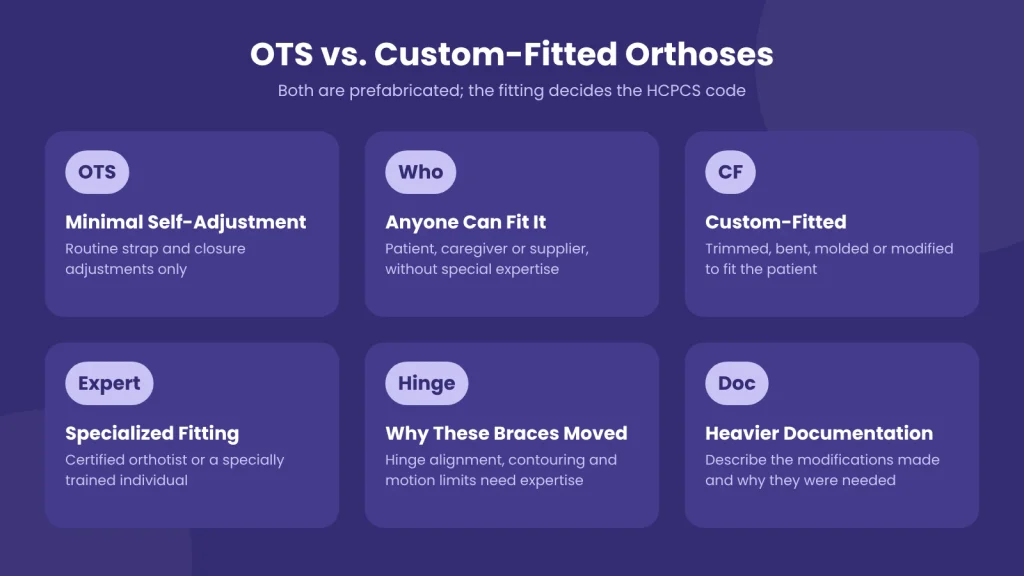
An OTS orthosis is a prefabricated brace that needs only minimal self-adjustment at delivery.
Minimal self-adjustment refers to adjustments that the beneficiary, caregiver or supplier can perform without the expertise of a certified orthotist or an individual with specialized training. Examples include routine strap and closure adjustments. The key distinction is whether the fitting requires specialized expertise to achieve a proper patient-specific fit.
In practical terms, if a patient or a non-specialist staff member can make the brace fit properly, it’s generally an OTS product.
What Is a Custom-Fitted Orthotic Brace?
A custom-fitted orthosis is also prefabricated, but it needs more than minimal self-adjustment at delivery. It has to be trimmed, bent, molded (with or without heat) or otherwise modified to fit the specific patient. Medicare requires the expertise of a certified orthotist or an individual with equivalent specialized training to do that.
The difference matters clinically. A hinged knee brace that’s even slightly out of line with the patient’s joint can work against the knee instead of supporting it. Fitting the brace to the person’s anatomy, condition and treatment goals is what makes it effective.
Why Did CMS Determine That Certain Braces Were Incorrectly Classified?
According to CMS, the products in question “require fitting by a certified orthotist or another specially trained individual,” so they no longer meet the definition of an OTS device. Industry coverage of the announcement describes the kinds of fitting work involved:
- Contouring and shaping the brace to the patient’s limb
- Aligning hinges with the anatomical joint axis of the knee or elbow
- Setting the frame, straps and motion limits for the patient’s needs
- Adjusting the brace around patient-specific factors, such as a recent surgical site, swelling or limb shape
None of these is a simple strap adjustment. They require judgment about anatomy and joint mechanics, which is why CMS concluded these products fit the custom-fitted definition better.
CMS clarified that this review was not exhaustive or all-inclusive of every brace listed on the PDAC Product Classification List. The agency prioritized certain product registrations for review, so suppliers should not assume that every similar brace or product under the affected HCPCS codes has been reclassified.
HCPCS Code Changes Effective December 1, 2026: Complete Code Comparison
This is the core of the update. Each OTS code has a long-standing custom-fitted counterpart with essentially the same device description. The difference is how the brace is fitted.
| Existing OTS code | Code for affected products from Dec 1, 2026 | Body area | Device type (summarized) |
| L1833 | L1832 | Knee / lower limb | Knee orthosis with adjustable joints, positional, rigid support |
| L1851 | L1843 | Knee / lower limb | Single-upright thigh-and-calf knee orthosis with adjustable flexion/extension joint |
| L1852 | L1845 | Knee / lower limb | Double-upright thigh-and-calf knee orthosis with adjustable flexion/extension joint |
| L3761 | L3760 | Elbow / upper limb | Elbow orthosis with adjustable position-locking joint(s) |
L1833 to L1832 – Positional Knee Orthoses With Adjustable Joints
L1833 describes a prefabricated, off-the-shelf knee orthosis with adjustable knee joints (unicentric or polycentric), used as a positional orthosis with rigid support. Braces of this type are often used after knee surgery or injury, when the joint must be held in position or allowed only a controlled range of motion.
Holding the knee correctly depends on the hinges lining up with the patient’s joint and the motion stops being set for that patient. For the products CMS reviewed, that work needs specialized skill, so those products move to L1832, the custom-fitted version.
What billing teams should review:
- Which knee braces in your inventory are currently billed as L1833
- Whether any of those exact models appear on the PDAC reclassification list
- Whether your fitting staff meet the expertise requirement for custom-fitted items
- Whether your fitting notes describe the modifications actually made
L1851 to L1843 – Single-Upright Knee Orthoses
L1851 covers a prefabricated, off-the-shelf single-upright knee orthosis with thigh and calf components, an adjustable flexion and extension joint, and medial-lateral and rotation control, with or without varus/valgus adjustment. These braces are commonly used for knee instability or for unloading one compartment of the knee in osteoarthritis.
Varus/valgus adjustment and hinge placement can significantly change how the brace loads the knee. For affected products, CMS found that this setup needs an expert, so they belong under L1843.
Many single-upright braces look similar. The manufacturer name and exact model number, not the brace style, decide whether a product is affected. Product-level verification on the PDAC list is essential.
L1852 to L1845 – Double-Upright Knee Orthoses
L1852 describes the double-upright version of the same device: thigh and calf components, adjustable flexion and extension joints, and medial-lateral and rotation control. The custom-fitted counterpart is L1845.
With uprights on both sides of the knee, aligning both hinges to the joint axis and contouring the frame to the leg takes real skill. That’s the basis for the reclassification of the products CMS identified.
Before billing L1852 or L1845 after December 1, suppliers should check the current PCL listing for the exact product. Choosing between the two codes is now a product-specific decision for the affected models.
L3761 to L3760 – Elbow Orthoses With Adjustable Locking Joints
L3761 covers a prefabricated, off-the-shelf elbow orthosis with adjustable position-locking joint(s). These braces typically hold the elbow at set angles, for example after a fracture, dislocation or surgical repair. L3760 is the custom-fitted counterpart.
Setting locking positions and making sure the hinge sits over the elbow’s axis of motion are not minor adjustments. For the products CMS reviewed, they need specialized fitting. Verify the correct code product by product before billing.
Editorial note: Not every product previously billed under L1833, L1851, L1852 or L3761 must now move to a custom-fitted code. Products not on the reclassification list stay under their current classification. The CMS and PDAC listing is the source of truth.
Which Leg and Arm Brace Products Are Affected by the December 2026 Update?
CMS identified affected products by manufacturer, brand name and model number. PDAC published an updated article on November 11, 2026 confirming the reclassification was complete and listing the specific products.
The table below shows a few representative examples from the CMS list:
| Manufacturer | Product | Model | Old code | New classification |
| Advanced Orthopaedics | Advanced Hinged Range of Motion Knee Brace | 917 | L1833 | L1832 |
| Air A Med | Post Op Range of Motion Knee Brace | 18-6001 | L1833 | L1832 |
| Breg | Latitude OA Knee Brace LT | 100630-100 | L1851 | L1843 |
| Comfortland Medical | Premier Elbow Brace | CK-700 | L3761 | L3760 |
These are examples, not the complete affected-product list. For the full list, see the official CMS source: [CMS – Table 1: Braces No Longer Classified as OTS].
Leg Braces Affected by the CMS Classification Update
On the lower limb side, the affected products are specific knee braces currently listed under:
- L1833, positional knee orthoses with adjustable joints
- L1851, single-upright knee orthoses
- L1852, double-upright knee orthoses
For each brace you supply, match both the manufacturer and the model number against the PDAC list. Similar names, product families or updated versions can have different listings.
Arm Braces Affected by the CMS Classification Update
On the upper limb side, the affected products are certain elbow orthoses listed under L3761. Reclassified products are listed under the corresponding custom-fitted code, L3760. As with knee braces, verify the exact manufacturer and model.
How to Verify a Brace on the PDAC Product Classification List
Use this process for every brace product your organization supplies:
- Search the manufacturer and product name on the PDAC Product Classification List.
- Confirm the exact model number, including any size or version codes.
- Check the product’s current classification and whether its OTS listing has an end date of December 1, 2026.
- Confirm the custom-fitted code the product is now listed under.
- Recheck the latest listing before submitting claims, because PCL listings can change.
Manufacturers that believe a product is listed incorrectly can ask PDAC to review it through the code verification process. Suppliers should bill based on the current listing, not on an expected change.
How Will the December 1, 2026 Update Affect Medicare DMEPOS Billing?
For affected products, the code you bill depends on the date of service. Here’s what that means in practice.
Changes in HCPCS Code Selection
- Check classification before choosing the code. Don’t rely on the code you have always used for a product.
- Match the exact product and model. Code selection follows the product listing, not the general brace type.
- Don’t use end-dated OTS listings after the effective date. For affected products furnished on or after December 1, 2026, use the corresponding custom-fitted code.
- Remember the expertise requirement. A custom-fitted code is appropriate only when the item was fitted by a certified orthotist or a qualified, specially trained individual. If your organization can’t provide that fitting, it shouldn’t bill the custom-fitted code.
Documentation Requirements for Custom-Fitted Orthoses
Custom-fitted items come with heavier documentation expectations. For knee orthoses, Medicare’s policy article requires a detailed description of the modifications made at fitting and why they were necessary. That information must be in the record and available on request. In general, a complete record for a custom-fitted brace includes:
- A valid order from the treating practitioner
- Medical necessity documentation in the practitioner’s records that supports the coverage criteria
- Patient-specific fitting needs, such as anatomy, surgical site or joint alignment
- A description of the modifications made, for example trimming, bending, molding or hinge alignment
- Who did the fitting and their qualifications
- Proof of delivery
- Records that clearly support the HCPCS code billed
A vague note such as “brace fitted to patient” won’t hold up in a review. The record should show what was done and why it needed expertise.
Impact on Orthotic Claim Submission
- Check the HCPCS code against the current PDAC listing before submission.
- Review the claim for the correct date of service, modifiers and diagnosis codes.
- Check payer-specific rules, especially for Medicare Advantage and commercial plans that may follow their own policies.
- Keep fitting documentation and proof of delivery ready for possible additional documentation requests.
- If a claim was submitted under the wrong classification, correct it according to the payer’s rules for corrected or reopened claims.
Accurate code selection supported by the record is the job of strong medical coding services. It’s also the first defense against avoidable DME denials.
Medicare Coverage and Reimbursement Guidelines for Leg and Arm Braces
It helps to separate three things: coding, coverage and payment. A HCPCS Level II code identifies an item. On its own, it doesn’t decide whether Medicare will cover or pay for it.
Medicare Lower Limb Orthosis Coverage
For knee orthoses, Medicare’s DME MAC policy sets out the clinical documentation needed. Examples from the knee orthoses policy article include:
- L1832 and L1833: an examination of the affected knee, including the joint laxity tests performed and findings showing objective joint laxity.
- L1843, L1845, L1851 and L1852 for knee instability: documented ambulatory status, plus the joint laxity testing and exam findings.
- L1843, L1845, L1851 and L1852 for osteoarthritis: ambulatory status, pain or reduced function from medial or lateral tibiofemoral osteoarthritis, a knee exam, an imaging report describing arthritic changes and the patient’s willingness to use the brace.
Moving a product from an OTS code to its custom-fitted counterpart doesn’t remove the need to meet these criteria. Always review the current LCD and policy article for the date of service.
Medicare Upper Limb Orthosis Coverage
For elbow orthoses such as L3760 and L3761, coverage likewise depends on medical necessity documented in the treating practitioner’s records, the correct product classification and the applicable DME MAC requirements. CMS has pointed to high improper payment rates for upper limb orthoses in recent years, so documentation for these items is likely to get close attention.
Medicare Orthotic Reimbursement Guidelines
- HCPCS classification and payment are separate questions.
- Coverage criteria must be met before payment is considered.
- Payment amounts come from the applicable DMEPOS fee schedule and payer policies, so check current rates for both the OTS and custom-fitted codes.
- A correct HCPCS code alone doesn’t guarantee Medicare payment.
There’s also a competitive bidding angle. According to the American Orthotic & Prosthetic Association (AOPA), reclassified products effectively fall outside the OTS categories of Medicare’s upcoming Round 2028 competitive bidding program. The OTS codes themselves remain in the program for products still listed under them.
CMS DMEPOS Prior Authorization Requirements: What Orthotic Suppliers Should Know
Product classification and prior authorization are separate programs. The December 1 PCL update didn’t create any prior authorization requirement. Still, several of these codes are on CMS’s Required Prior Authorization List, so suppliers need to track both.
According to CMS’s current guidance:
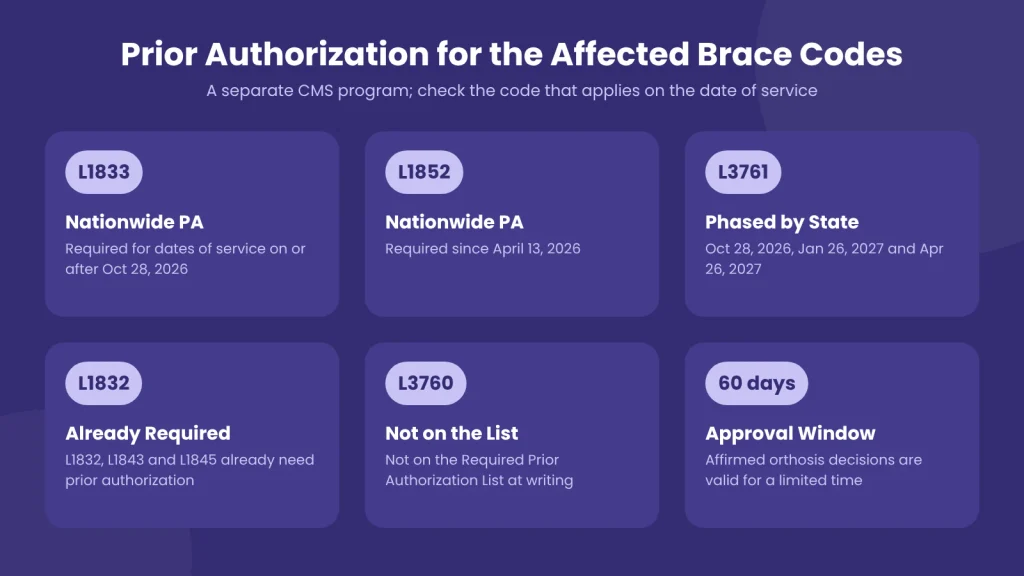
- L1833 requires prior authorization nationwide for dates of service on or after October 28, 2026.
- L3761 is being phased in:
- Phase 1, October 28, 2026: California, Florida, Michigan and New York
- Phase 2, January 26, 2027: Phase 1 states plus Arizona, Georgia, Illinois, Massachusetts, Ohio, Oregon, Pennsylvania and Texas
- Phase 3, April 26, 2027: all remaining states and territories
- L1852 requires prior authorization nationwide, effective April 13, 2026.
- L1832, L1843 and L1845 are already included in the prior authorization requirements.
- L3760 doesn’t appear on the Required Prior Authorization List at the time of writing.
Because the affected products move to different HCPCS classifications, suppliers should verify prior authorization requirements using the code applicable to the date of service. Do not assume that an authorization submitted under an old code automatically applies to its custom-fitted counterpart.
In the same July 2026 notice that added L1833 and L3761 to the prior authorization list, CMS also added several orthoses, including these two codes, to the list of items that need a face-to-face encounter and a written order before delivery.
How suppliers should check requirements:
- Look up the specific HCPCS code on the current Required Prior Authorization List.
- Check the phase and state for codes with staggered start dates.
- Confirm the date of service against the effective date.
- When a product’s code changes because of reclassification, check the requirements for the new code.
The DME MACs note that affirmed prior authorization decisions for orthoses are valid for a limited time, 60 calendar days for orthoses according to CGS. Plan delivery timing around that window, and manage requests carefully for affected products near the December 1 transition.
Common HCPCS Coding and Billing Mistakes to Avoid
- Using an end-dated OTS classification after December 1, 2026. For affected products, the OTS listing ends on that date.
- Choosing a code without checking the exact model. Brace style isn’t enough; the listing is product-specific.
- Assuming every product under an affected code was reclassified. CMS’s review wasn’t exhaustive, and most products under these codes may be unchanged.
- Confusing OTS and custom-fitted requirements. Custom-fitted codes require fitting by someone with expertise and detailed documentation.
- Missing fitting documentation. Without a clear record of the modifications and the reasons for them, the custom-fitted code isn’t supported.
- Assuming the right code guarantees payment. Coverage criteria and medical necessity still apply.
- Overlooking prior authorization. Several of these codes need prior authorization, with dates that depend on the code and state.
- Not rechecking the PDAC listing. Listings change, and claims should reflect the current one.
A periodic medical billing audit is a practical way to catch these issues before they turn into denials or overpayment findings.
How Medical Billing Teams Can Prepare for the December 1, 2026 HCPCS Update
Review Existing Orthotic Product Inventories
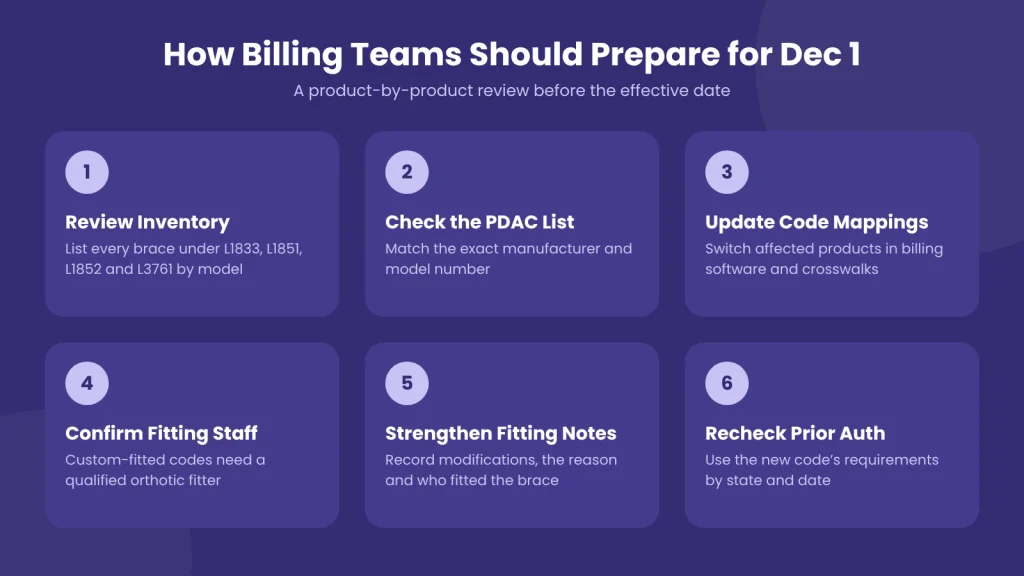
Make a list of every brace product your organization supplies under L1833, L1851, L1852 and L3761. Record the manufacturer, product name and model number for each, then compare them with the CMS and PDAC list. Flag the affected products clearly in your inventory system.
Update HCPCS Code Reference Systems
Update code mappings in your billing software, charge master, order templates and any product-to-code crosswalks. For affected products, the mapping should switch to the custom-fitted code for dates of service on or after December 1, 2026. Keep the history so earlier claims can still be reviewed.
Train Billing and Coding Staff
Make sure billers, coders and intake staff understand the following:
- The difference between OTS and custom-fitted classification
- That this is a product-level change, not a new code set
- What fitting documentation must show
- How the prior authorization requirements apply by code and state
Fitting staff should also know exactly what to record when they modify a brace.
Review Documentation and Claim Workflows
Check that fitting notes, orders, practitioner records and proof of delivery support the code billed. Add a pre-submission check that confirms the product listing and prior authorization status for brace claims. When denials come back, look for patterns, and route them through structured denial management rather than resubmitting without a fix.
Monitor CMS and PDAC Announcements
Watch for further PDAC listing updates, DME MAC education articles and changes to the Required Prior Authorization List. Assign someone to own this monitoring so updates don’t slip through.
How iSolve RCM Helps Healthcare Providers With Medical Coding and DMEPOS Billing
Keeping up with product-level changes like this one takes time that most practices and suppliers don’t have. iSolve RCM supports providers with:
- Medical coding and documentation review, including HCPCS and CPT coding
- Claim submission and follow-up as part of our medical billing services
- Denial management and appeals for rejected and denied claims
- Accounts receivable follow-up on unpaid and aging claims
- Billing workflow reviews and billing audits
- Revenue cycle performance monitoring through end-to-end revenue cycle management
Keeping up with HCPCS updates and DMEPOS billing requirements can be challenging.
iSolve RCM provides medical coding, claim management and revenue cycle support to help providers keep accurate billing workflows and reduce avoidable claim issues. Contact our team to discuss your billing requirements and request a free revenue cycle assessment.
Final Thoughts on the CMS December 2026 HCPCS Brace Classification Changes
The December 1, 2026 update is narrow, but it carries real billing risk. Specific knee and elbow brace products move from four OTS codes (L1833, L1851, L1852 and L3761) to their custom-fitted counterparts (L1832, L1843, L1845 and L3760). No new codes were created, and products not on the CMS and PDAC list keep their current classification.
The key to getting it right is verifying each product. Check manufacturer and model numbers against the current PDAC listing, document the expert fitting that custom-fitted codes require, and track prior authorization separately by code, state and date. Keep watching CMS and PDAC, because listings and requirements can change again.
Frequently Asked Questions About CMS HCPCS Brace Updates 2026
What HCPCS code changes are effective December 1, 2026?
Effective December 1, 2026, CMS end-dates the OTS listings for specific knee and elbow brace products under L1833, L1851, L1852 and L3761. Those products are listed under the custom-fitted codes L1832, L1843, L1845 and L3760 instead. It’s a product classification change on the PDAC list, not a set of new codes.
Which HCPCS codes are affected by the December 2026 brace update?
The OTS codes involved are L1833, L1851 and L1852 for knee orthoses, and L3761 for elbow orthoses. The custom-fitted codes that affected products move to are L1832, L1843, L1845 and L3760. Only the specific products named by CMS and PDAC are affected, not every product under these codes.
What are the new HCPCS codes for leg braces in 2026?
There are no new leg brace codes from this update. Affected knee braces move from L1833 to L1832, from L1851 to L1843 and from L1852 to L1845. All of these codes already existed. The change is which code certain brand-name products are listed under on the Product Classification List.
What are the new HCPCS codes for arm braces in 2026?
No new arm brace codes were created. Certain elbow orthoses previously listed under the OTS code L3761 are now listed under the existing custom-fitted code L3760, effective December 1, 2026. Suppliers should check the exact manufacturer and model on the PDAC list before billing either code.
What is the difference between an OTS and a custom-fitted brace?
An OTS brace needs only minimal self-adjustment, such as routine strap and closure adjustments, that a patient, caregiver or supplier can make without specialized expertise. A custom-fitted brace must be trimmed, bent, molded or otherwise modified by a certified orthotist or specially trained individual to fit the patient. Both are prefabricated.
Why is CMS changing the classification of certain knee braces?
CMS determined that certain knee braces need fitting by a certified orthotist or another specially trained person. Contouring the brace, aligning hinges with the knee joint and setting motion limits go beyond minimal self-adjustment. These products no longer meet the OTS definition and belong under custom-fitted codes.
Does the December 2026 update affect all products under L1833, L1851, L1852 and L3761?
No. The update applies only to the specific manufacturers’ products identified by CMS and PDAC. CMS has said its review wasn’t exhaustive, so other products under these OTS codes keep their current classification. Suppliers should verify each product by manufacturer and model number.
How can suppliers verify the correct HCPCS code for an orthotic brace?
Search the PDAC Product Classification List by manufacturer and product name, then confirm the exact model number. Check whether the OTS listing is end-dated and which custom-fitted code applies. Recheck the listing before submitting claims, because classifications can change.
Does a custom-fitted brace require specialized fitting?
Yes. Medicare requires custom-fitted orthoses to be fitted by a certified orthotist or an individual with specialized training. The record should describe the modifications made at fitting and why they were needed. Without that expertise and documentation, a custom-fitted code isn’t supported.
Do the December 2026 changes affect Medicare reimbursement?
They can. Affected products are billed under different codes, and payment follows the DMEPOS fee schedule for the code billed. Coverage criteria still apply, and a correct code doesn’t guarantee payment. AOPA also notes that reclassified products fall outside the OTS categories in Round 2028 competitive bidding.
Are prior authorization requirements changing for orthotic braces in 2026?
Yes, under a separate CMS notice. L1833 requires prior authorization nationwide from October 28, 2026. L3761 phases in by state between October 28, 2026 and April 26, 2027. L1832, L1843, L1845, L1851 and L1852 already require it. Check requirements using the code that applies on the date of service.
Where can suppliers find official CMS HCPCS updates?
Check the CMS DMEPOS announcements, the PDAC website and Product Classification List, the CMS Required Prior Authorization List and your DME MAC’s news and policy articles. For coverage, review the applicable LCD and policy article in the Medicare Coverage Database.
Sources:
- American Orthotic & Prosthetic Association (AOPA): CMS and PDAC Re-Classify Specific Products, Not Codes, from OTS to Custom Fitted Orthoses
- HME Business: CMS Announces Product Classification List Changes for Arm and Leg Braces
- O&P Edge: CMS Reclassifies Some OTS Orthosis Codes
- CMS Medicare Coverage Database: Knee Orthoses Policy Article (A52465)
- CMS: DMEPOS Required Prior Authorization List
- eCFR: 42 CFR §414.402, Definitions (Off-the-Shelf Orthotics and Minimal Self-Adjustment)
- PDAC (Pricing, Data Analysis and Coding Contractor): Product Classification List