

One of the most frustrating aspects of running a healthcare practice is medical billing. Every day, healthcare providers send hundreds or even thousands of claims to insurance companies. The hope is that they will get paid quickly. However, this is not always the case. Sometimes claims may not get paid right away.
Among the many denial codes that healthcare providers have to deal with on a daily basis, the CO-45 denial code is one of the most prevalent adjustment codes that can affect their revenue cycle. Therefore, it is important that healthcare providers who use the services of a medical billing company in USA resolve this issue as quickly as possible.
We will discuss what the CO-45 denial code means, its possible causes, and how it can affect reimbursements. We will also discuss how to resolve such denials and how to avoid them in the future. Thus, this guide is helpful to both billing experts and healthcare service providers to understand the adjustments made to the CO 45 denial code.
What is CO-45 Denial Code?
The CO-45 denial code is one of the common adjustments in medical billing, which is used by insurance companies to denote that the claim has been adjusted due to contractual reasons. This is not a claim rejection.
Adjustment Reason Code 45 is used to denote the reasons for which the claim has been adjusted, usually based on contractual agreements between providers and payers. This denotes that the provider has agreed to receive less than what was due for certain services.
Unlike claim rejection, CO denial codes, such as CO-45, denote that the claim has been processed, unlike claim rejection, which has not been processed.
Common Causes of CO-45 Denials
Denials for CO-45 often arise due to various reasons like contractual agreements, coding errors, and coverage issues. Knowing the reason helps the healthcare providers avoid delays. The use of improper modifiers can result in CO-45 adjustments and lower reimbursements. The proper knowledge of modifier usage, especially the difference between commonly used modifiers 25 and 59, is critical for accurate coding, clean claims, and contractual reductions.
Contractual Adjustments with Insurance Payers
CO-45 denials usually occur in situations where the insurance company makes adjustments based on their contract with the providers. The insurance company reduces the amount based on the negotiated contract, which is not a denial but an adjustment.
Services Not Covered or Billed Incorrectly
Claims can also have a CO-45 denial position in case the service delivered is not included in the plan, as well as in instances where there are coding errors. The correct CPT/HCPCS coding and claim submissions are grave in avoiding such denials and facilitating timely reimbursement from insurance companies.
Patient Eligibility or Coverage Issues
If the insurance is not active, has lapsed, or the coverage is lacking, the insurer may respond with a CO-45 denial. Verifying the insurance coverage is an essential process in avoiding adjustment reason code 45 and facilitating a smoother process in the revenue cycle.
Coordination of Benefits (COB) Errors
In cases where a patient is covered by multiple insurance plans, the improper coordination of these benefits may lead to the application of CO-45 changes. Proper identification of the primary and secondary insurance carriers and processing the claims in this regard ensures the application of contractual reductions in a timely manner.
Timely Filing or Documentation Problems
Delays in filing claims and lack of documentation may result in CO-45 denials. Maintaining organized records and filing claims within stipulated dates while providing necessary documentation may help in reducing contractual adjustments.
According to CMS, knowledge of denial reason codes, including Claim Status Category Codes, Claim Adjustment Reason Codes, and Remittance Advice Remark Codes, is vital to understanding EOBs and claim adjustments.
Incorrect Modifier Usage
The improper use of modifiers in the CPT/HCPCS may lead to a denial of claims in the CO-45 process. The payment may be reduced by the payer if the modifier is not matched in the documentation and the contractual agreement, thus the need for the proper use of the modifier before the claim is submitted.
Duplicate Claim Submission
When a claim is filed for a service already processed, it may result in a CO-45 denial. The insurance company makes adjustments to the second claim based on duplication, and thus proper tracking of claims is essential to avoid repeated adjustments.
Bundled or Unbundled Service Errors
CO-45 denials can occur in instances where services are unbundled or incorrectly combined in billing services. When services are bundled in contractual agreements, improper unbundling can result in contractual adjustments. The use of accurate guidelines and medical coding services can help in ensuring correct coding, preventing errors, and avoiding contractual adjustments.
Pro Tip: Always review payer contracts, update fee schedules, and conduct claim audits to catch coding and modifier mistakes as early as possible. Verifying and documenting claims in a timely manner can reduce the number of CO-45 denials significantly.
How CO-45 Denial Impacts Your Revenue Cycle
It is also significant to identify CO-45 denials in order to address them in time and maintain a healthy revenue cycle. It is necessary for service providers to understand how this code is used, what it stands for, and the difference between adjustments and denials. Denial management services can also be leveraged for better results.
Locating CO-45 on EOB and ERA Statements
Denial codes for CO-45 are generally provided in the Explanation of Benefits (EOB) or Electronic Remittance Advice (ERA) reports. Careful perusal of these reports helps service providers identify modified claims, understand the contractual reduction, and identify services impacted by the reduction for better revenue management.
Interpreting the Denial Code CO-45 Reason
The CO-45 denial will include an explanation of the reason for the adjustment. Providers must also read the accompanying remark code to understand if it is a contractual adjustment, limitation of services, or a coverage problem.
Differentiating CO-45 from Other Adjustment Codes
CO-45 is different from other types of contractual adjustments or denial codes because it is specifically related to a reduction resulting from agreements between payers and providers. The awareness of this difference can help avoid confusion with claims rejections.
Reviewing Associated Service Line Details
Denial messages for CO-45 may also include service line information that specifies what was changed in the procedures or services provided. Analyzing this information helps identify whether the problem is related to coding, coverage, or contracts, thus allowing for accurate corrections and timely reimbursement.
Using Claim Tracking Tools for CO-45
Providers can use claim tracking software or practice management systems to track CO-45 denials. The system will allow the providers to monitor the adjustments made on CO-45 claims and thus keep the revenue cycle process smooth.
Understanding benchmarks such as average medical billing collection rates will also enable providers to assess how CO-45 adjustments, as well as other denials, affect overall revenue performance.
How to Identify a CO-45 Denial
The CO-45 denial codes are indicated on the Explanation of Benefits (EOB) reports as well as the Electronic Remittance Advice (ERA). Review of these reports assists the providers in recognizing the claims that have been adjusted, the service lines involved, as well as the payment adjustments based on the contractual agreements with the insurance payers.
Understanding the denial code ‘CO-45 reason’ is vital in recognizing the cause of the claim adjustment. Unlike other adjustment codes, the ‘CO-45’ code represents the contractual agreement between the provider and the payer. It is vital to understand the difference, as it assists the providers in the management of the revenue cycle.
Pro Tip: Be sure to review EOB and ERA reports carefully and compare changes to payer contracts. Recognizing patterns of CO-45 can prevent recurring errors and make revenue cycle management more efficient.
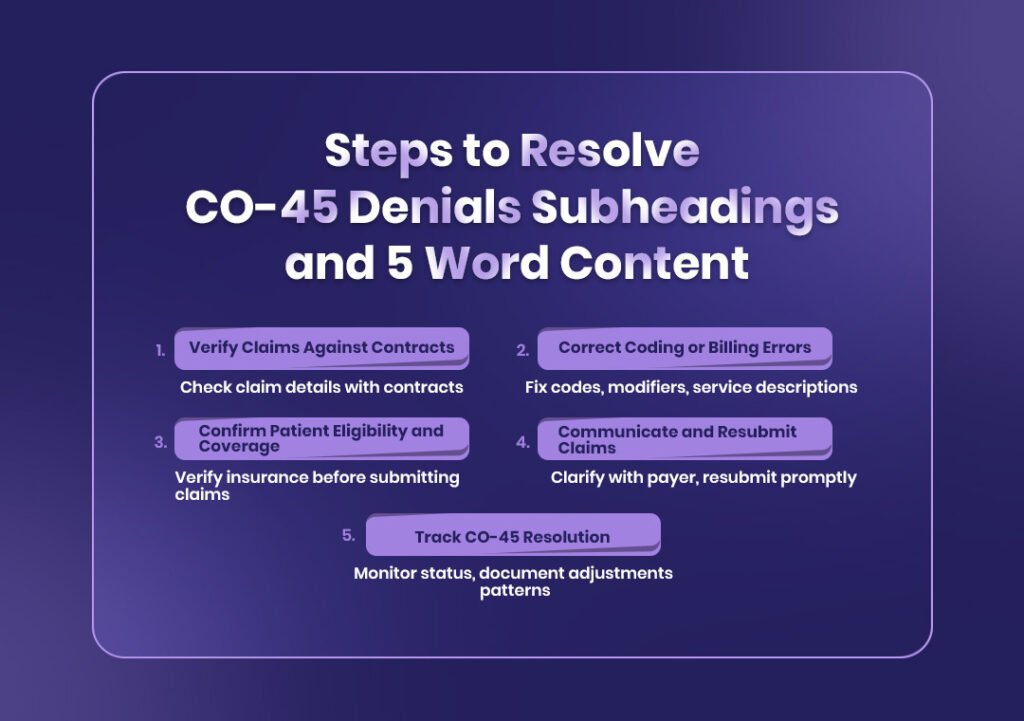
Steps to Resolve CO-45 Denials
When handling claims that have been denied because of the use of the CO-45 denial code, it is significant to evaluate the claims and confirm that they have been documented. Communication is key in such situations. By following steps that have been laid out, it is possible to ensure that payments are made in good time and that there is proper communication.
Verify Claims Against Insurance Contracts
Before acting on the case, it is necessary to compare the details of the claim with the contracts of the provider with the various payers. This will help to establish if the CO-45 adjustment is necessary or if further clarification is required from the insurer.
Correct Coding or Billing Errors
The reason for the denials may be incorrect CPT/HCPCS codes, modifiers, and description of services in the case of CO-45 denials. It is extremely important to review the claims and make the necessary corrections and provide accurate documentation in order to increase the percentage of approvals and reduce the need for repeated adjustments.
Confirm Patient Eligibility and Coverage
Ensure that the patient’s insurance is active and that the services billed have been included in their plan. Verifying patient eligibility before billing can help prevent CO-45 adjustments and facilitate smooth processing of claims.
Communicate with Payers for Clarification
In case the denial reason for the CO-45 is ambiguous, it is important to communicate with the payer. In this case, it is important to have a discussion concerning the adjustment and the need for documentation.
Re-submit Claims Promptly
After the claim has been corrected and verified, it should be resubmitted to the payer with the correct coding and documentation. This ensures timely resubmission of the claim, thus eliminating any delays. It also ensures the CO-45 denial code is utilized properly.
Track CO-45 Denial Code Resolution
The status of this claim can be tracked after the resubmission process through practice management systems. However, all this activity and resolution must be documented in order to identify patterns and avoid any possible denial situations in the future.
Preventing Future CO-45 Denials
Proactive strategies, accurate billing, and proper verification are the key in order to prevent CO-45 denials. Best practices help lessen claim adjustments, upsurge reimbursement rates, and improve revenue cycle management.
Maintain Accurate Billing and Documentation Practices
Proper coding, comprehensive service details, and precise documentation can prevent CO-45 denials. This confirms that all claims are appropriately representative of services rendered, which in turn can benefit prevent contractual adjustments and facilitate quicker and more accurate reimbursement.
Use Eligibility Verification Tools
Eligibility verification for patients before billing helps ensure that services are covered and eliminates CO-45 adjustments. Automated verification tools check for coverage, benefit limitations, and payer requirements, reducing the likelihood of costly denials before claims are ever submitted.
Implement Claim Scrubber Systems
Claim scrubbers will identify claims for errors in coding, modifier usage, and patient information. The utilization of claim scrubbers will assist in the detection of potential CO-45 triggers, thus correcting claims prior to submission and reducing adjustment reason code 45 denials.
Provide Staff Training on CO-45 Denial Prevention
Educating billing staff on common causes of CO-45 denials, accurate coding, and documentation practices will improve accuracy in claims. This ensures that your team is able to identify and prevent adjustments proactively.
Establish Payer-Specific Checklists
Each insurance payer has unique rules. Keeping checklists of coverage, documentation, and coding requirements helps avoid CO-45 denials, ensures compliance, and makes the billing process easier.
Monitor Denial Trends and Analyze Patterns
Healthcare providers can recognize recurring problems, resolve systemic problems, and improve processes through regular analysis of CO-45 denial data. This can help to minimize future denials and improve revenue cycle management.
Pro Tip: Standardize workflows, utilize automation tools, and regularly review denial reports. This helps in timely identification of the root cause, reducing CO-45 denials, and keeping the revenue cycle efficient.
CO-45 Adjustment Code vs. Denial Code
Many healthcare providers get confused between the denial of the claim and the use of CO-45. The difference lies in the definition. A denial code shows that the claims or part of the claims was not paid as they were filed. The adjustment code shows that there was a reduction in payment for the claims.
Therefore, it is important to understand that the use of CO-45 is to show that there was a reduction in payment as per the agreement. The reduction may seem like a denial because the healthcare provider has to write off the payment. However, it is important to understand that it is not a denial but an adjustment.
How iSolve RCM Simplifies CO-45 Denial Management
iSolve RCM makes it easier for healthcare providers to manage CO-45 denial codes efficiently by verifying claims, checking fee schedules, and detecting coding and eligibility issues, thus simplifying CO-45 management for healthcare providers using their sophisticated revenue cycle management technology, which helps reduce adjustments, prevent denials, and facilitate timely payments, thus reducing write-offs.
Frequently Asked Questions
How to fix denial code 45?
The EOB/ERA must be reviewed, and the amount must be verified. The claim must then be resubmitted. If the claim was filed incorrectly, an appeal can also be filed.
What is the difference between PR 45 and CO 45?
PR-45 stands for patient responsibility adjustment in order to resolve the CO-45. It is a payment reduction useful to the patient’s portion. On the other hand, CO-45 stands for contractual obligation adjustment. It is a payment reduction resulting from the terms of the payer-provider contract.
Is CO 45 a write-off?
Yes, CO-45 adjustments are typically written off by the provider. The amount that is greater than the allowed contract rate cannot be charged to the patient, and a contractual adjustment is entered in the accounting records.
What does Remark code 45 mean?
The remark code ‘45’ shows that the claim was reduced because the charges exceeded the limits set in the payer’s contract. This displays providers how to explain to patients why the claim was minimized, whether it was due to a process or contract issue.
What is code 45 on EOB?
The EOB has a 45 code meaning that it is a contractual adjustment. A contractual adjustment refers to the method by which the payer filed the claim and made the adjustment due to the difference in the amount billed and the amount that should be. The provider is not able to balance-bill the patient.
What are the three types of denials?
The three denials include: a medical requirement denial, which involves services that are not covered; technical or managerial denial which involves denials based on lack of information and improper coding, and contractual or financial denial which involves the CO-45 adjustment.
What are the most common denial codes?
Denial codes can bear the following: CO-45, associated with contractual adjustment, CO-97 one with pre-existing or out-of-network issues, PR-1 interrelated to patient responsibility, CO-18, and CO-109.