
The Colorado healthcare payment system has many features that show financial problems for the patients and healthcare organizations. Thus, in 2023, 19.8% of the population of Colorado, which is more than 1.1 million people, did not visit healthcare providers because of financial problems, and 26.4% were billed for a healthcare service that should have been paid by insurance. Therefore, it is important to have good claims, clear bills, and fast payment collection. Colorado Medical Billing and Payment Services can help healthcare organizations work with money efficiently.
Moreover, it is important to understand that the financial burden lies on the insured. So, in 2024, the average annual deductible for a single policy in Colorado is $2,404, and for a family policy – $5,066. Thus, it is crucial to work efficiently and correctly with balances, payments, and billing processes. The following guide analyzes possible solutions for collecting patients’ payments, claims processing, posting, denials management, accounts receivable, and revenue cycle in Colorado healthcare providers. Providers comparing a medical billing company in USA should assess specialty expertise, technology, security, reporting, denial performance, and scalability alongside pricing.
Colorado Medical Billing and Payment Services
Colorado Medical Billing Services involve the procedures that help to turn recorded medical visits into claims and patient bills. The process starts from verifying the eligibility and capturing the charges. The subsequent steps are coding, claim submission, claim adjudication, posting payment, and reconciliation. It is important to note that in Colorado, the payment complexity becomes especially significant since the average deductible for employer-sponsored insurance was $2,404 in 2024.
The billing and payment procedures are related to each other instead of being different administrative processes. The claims management shows how much money should be paid by the insurance company, whereas the payment posting shows how much money was posted. Underpayment, denials, and outstanding balances can be found. Meanwhile, the patient billing involves the patient part, whereas the accounts receivable management manages the unpaid amounts. Such an approach is especially important since the claims denial rate was 11.81% in 2024, whereas A/R days grew by 5.2%.
The difference between billing services and payment management is mostly dependent on the point at which each takes place in the revenue cycle. Billing is concerned with the creation, submission, correction, and tracking of claims, while payment management deals with the collection, posting, reconciliation, and monitoring of payments. Denial management serves to bridge both sides by recovering lost revenue and identifying trends. In Colorado, where state regulations may prevent patient collections above certain levels based on income, payment management facilitates compliant patient billing.
Why Medical Billing Is Challenging for Colorado Healthcare Providers
Colorado providers experience a challenge in their billing process since reimbursements are based on payer-specific eligibility criteria, authorization, coding, and documentation. Even the slightest mistake regarding patient demographics, diagnostic code, modifiers, or the type of cover can lead to a denied claim. Moreover, the healthcare industry in Colorado has considerable cost sharing on the part of the patients, where employer-sponsored insurance deductibles per person exceed $2,400 by 2024. Thus, medical billing is critical in Colorado.
Coding and documentation mistakes affect payment processes since claims can get denied when the clinical documentation does not adequately support the reported services and claims may get denied or partially paid due to wrong modifier or combination of diagnosis codes. The national denial rate was about 11.8% in 2024. This demonstrates the financial impact of billing hassles. In Colorado, multiple claim denials will necessitate more labor effort for investigations and re-submission.
Another pressure point is that of patient responsibility, since deductibles, co-pays, and co-insurances have become more important sources of revenues in health care. Late payments mean that health-care organizations have to continue funding their labor force, technologies, infrastructure, and health-care delivery even without getting any compensation from patients for their services. This means that internal teams also have to work on claims, follow-up letters, billing, and reconciliation. Proper accounts receivable management may help with all of this. Understanding Medical Claim Denials can help providers identify recurring eligibility, authorization, coding, documentation, and submission problems that delay reimbursement.
Key Tip: Look for patterns in denials according to payer, specialty, procedure, and type of denial monthly. This can highlight any common areas where there may be issues with eligibility, coding, authorization, or documentation, allowing for correction before further denials occur.
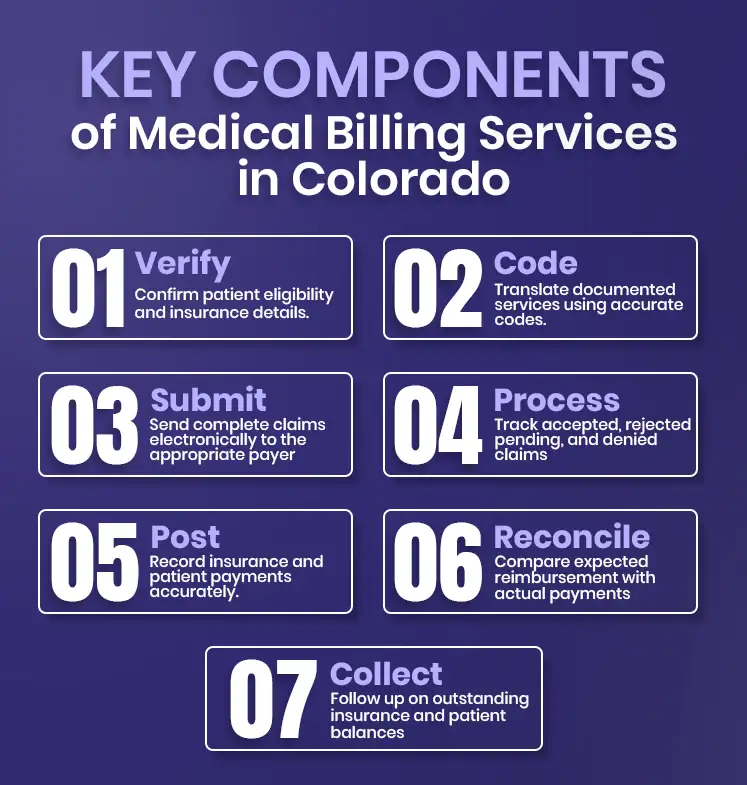
Key Components of Medical Billing Services in Colorado
The process of medical billing entails several interrelated steps which include coding of documentation, submission of claims, payments collection, denial management, account management, and the patient’s responsibility. Each step impacts on when payments will be made and how accurately they are done. Therefore, it is important that all the processes run smoothly.
Medical Billing and Coding Services
Accurate coding links the services rendered and the payment for the same. The diagnoses are captured using the ICD codes, professional services using the CPT codes, and other services and supplies using the HCPCS codes. The services provided should be supported by proper documentation. Pre-submission medical billing and coding services Colorado can help spot errors in codes and lack of documentation. Medical Coding Services can strengthen pre-submission accuracy by ensuring diagnosis, procedure, modifier, and documentation details are appropriately aligned.
Claims Processing Services
The process of claims management involves transforming validated data regarding patients and procedures to insurers. The process of eligibility determines whether the insurance is active, whereas claims review reveals issues related to demographics, coding, authorization, or formatting. Tracking follows once the claims have been submitted, and it reveals whether claims are pending, rejected, or unpaid.
Payment Posting Services
Posting of payment is done using the information about insurance payments, patient payments, adjustments, contract allowance, and outstanding balance on a per-account basis. EOB and ERA give information to use in order to reconcile and detect discrepancies. Payment posting will make it easier for staff to detect problems such as unapplied money and underpaid amounts.
Denial Management Services
Denials could occur as a consequence of issues regarding eligibility, lack of authorization, coding problems, duplicate billing, insufficient documentation, or timeliness in filing. Good denial management services involve analyzing the denial trend, prioritizing economically important cases, appealing and resubmitting correct claim forms. Examination of the denial trends also highlights some repeated process inefficiencies that need to be addressed.
Accounts Receivable Management
Management of accounts receivable deals with insurance balances and those of patients that have not been paid, using the aging process to determine which ones need urgent attention. Accounts receivable management is effective in improving collections because it identifies balances that are collectible from problematic ones and tracks payments.
Patient Billing Services
Services such as patient billing services will help in turning the financial obligation that remains to be paid into comprehensible bills. This way, there will be clear communication to prevent any confusion regarding the deductibles, co-payments, and coinsurance. Patient billing services will also enable payment reminders and follow-ups in order to manage any outstanding balances in a systematic manner.
Understanding Healthcare Payment Processing
The healthcare payment process is an example of money transactions made by payers and patients to healthcare organizations after delivery of the health services. The process entails electronic remittance advice, check writing, payment via cards or online, reconciliation, adjustments, and balance maintenance. Effective payment process links billing and collected money for improved revenue cycle management.
What Is Healthcare Payment Processing?
Healthcare payments processing refers to the financial process involved in receipt, recording, posting, and allocating payments to the corresponding healthcare claims and patient accounts. The process encompasses electronic fund transfers, electronic remittance advice, cheques, credit card payments, and web payments. Effective payment processing involves matching each payment made to the corresponding patient account, claim, service, adjustment, and outstanding balance.
Insurance Payments vs. Patient Payments
Insurance payers usually mean reimbursement, while patient payers refer to deductibles, copays, coinsurance, and self-pay. Due to the differences in rules of payment for both, distinguishing them in reconciliation will avoid inaccurate account balances. In order to accurately process the payments, it is important to know how to make the adjustment and how much should be paid by patients.
Electronic vs. Paper Payments
Electronic payments typically offer more rapid transmission, automated remittance advice, and easy reconciliation than paper check payments. In electronic fund transfers, payment can be made directly to the accounts of the providers, while the electronic remittance advice gives the reasons for making the payment. The process of paper payments entails additional manual steps since they need physical handling.
Payment Reconciliation
Payment reconciliation compares the amount of payment due to the actual amount paid and the amount recorded on the transactions. Inconsistencies will indicate under-payment, double entries, erroneous adjustments, unapplied payments, or missing remittance advice. Reconciling payments will give the billing department more clarity regarding its financial status.
Security and Compliance Considerations
Payment workflows involve financial information alongside protected health information, requiring controlled access, secure transmission, accurate authorization, and appropriate recordkeeping. Electronic transactions should use safeguards designed to prevent unauthorized access or alteration. Strong payment controls also separate transaction responsibilities, maintain audit trails, and reduce the risk of posting errors, payment diversion, or unauthorized account activity.
How Efficient Payment Processing Improves Cash Flow
Improved payment processing results in shortened intervals between receiving reimbursement and posting that reimbursement in the right accounts. Prompt posting allows the recognition of any remaining balances at an early stage, making it possible for personnel to address any open balances from insurance or from patients without further delays.
Important Reminder: Match electronic remittances to bank deposits and postings. Timely investigation of any mismatches in payments, adjustment errors, and unposted funds will enhance revenue visibility and help avoid building up posting discrepancies through a huge number of patient and insurance accounts.
Medical Payment Processing: What Providers Need to Know
Medical payment processing involves the collection, allocation, and reconciliation of the money from insurers and patients following the provision of medical services. The patient’s financial responsibility includes copayments, deductibles, coinsurance, and self-pay balances, all of which need to be accurately computed before being collected. This can be accomplished using electronic methods such as online portals, card payments, ACH payments, and automated payments. Reconciliation will ensure that the collected amounts are consistent with the posted transactions and adjustments and also the outstanding balances in the accounts.
Some challenges in payment processing include incomplete remittance advice, unapplied payments, wrong balance calculations, and transactions requiring manual processing. They can mask the true revenue and make it hard for providers to follow up on their payments. To simplify medical payment processing, providers can provide different payment methods, automate reminders, reconcile deposits, and use a dashboard to track the outstanding amounts.
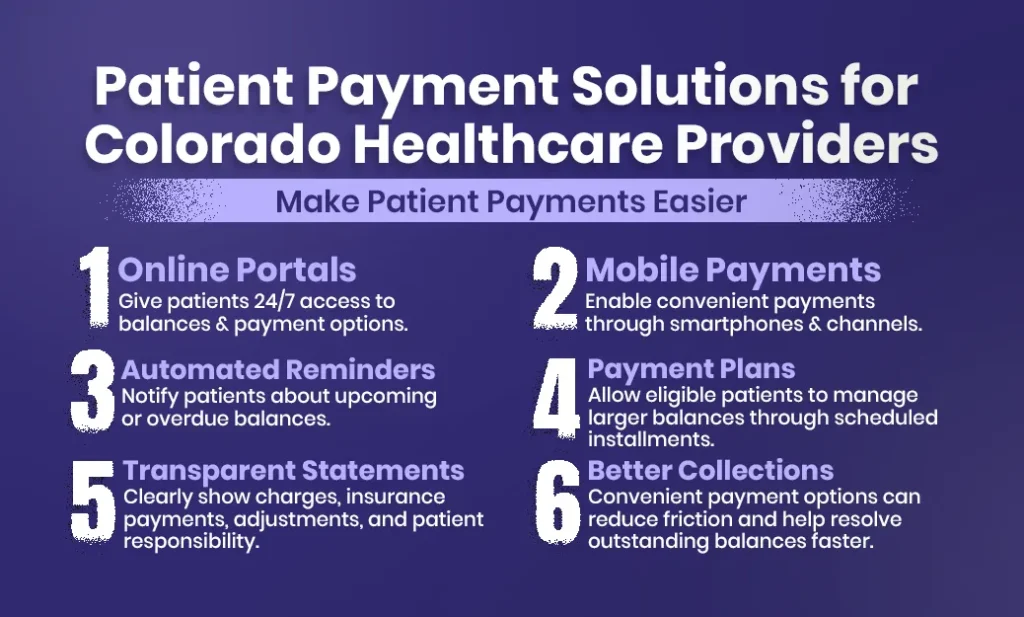
Patient Payment Solutions for Colorado Healthcare Providers
The role of patient responsibility is increasing within the revenue structure of health care due to increases in deductibles, co-payments, and co-insurance requirements. With regard to providers in Colorado, having an effective and clear method of collecting payment can help to minimize payment issues and increase financial predictability.
Convenient Payment Options
Patients are becoming more accustomed to paying for health care in much the same manner as any other online transaction. Giving options such as paying via online, mobile, card, ACH, or text could eliminate obstacles that would otherwise hinder collections. Patient payment options for Colorado providers could provide many avenues for settling accounts, especially given large deductibles.
Online Payment Portals
The online payment portal makes it possible for patients to check their balance, access their statements, and make payments without involving any billing department personnel. A good portal will enable the linking of payment amounts to the accounts of the patients in question. This is important because the portal offers 24/7 access to patients.
Mobile Electronic Payments
Mobile and electronic payments allow patients to settle balances through smartphones, cards, ACH transfers, or secure payment links. These methods can shorten the time between receiving a statement and making payment. When transactions integrate with billing records, they also reduce manual reconciliation. Healthcare payment solutions therefore support faster collection while providing greater convenience.
Automated Payment Reminders
Reminders that are automated can be sent to patients to remind them of any upcoming or overdue amounts using the right digital means. Scheduling reminders when statements are sent out or payment is due can help patients pay their bills early without having someone call them over and over again. Reminders have to be done correctly in order to convey the message.
Flexible Payment Plans
Payment plans enable qualified customers to break down large debts into smaller installment payments rather than paying off the whole amount at once. Installment payments can be helpful for predictable billing in cases where customers have higher deductibles and/or coinsurance. Payment plan details need to include installment amounts, installment date, time frame, and termination clauses.
Transparent Billing Statements
Transparency in statements will ensure that there is clear differentiation between total bills, insurance payments, adjustments made to the contract, previously paid amounts, and the outstanding amount of money owed by the patient. Distinguishing between deductibles, co-pays, and co-insurance will minimize misunderstandings as to why there is an outstanding bill.
Improved Patient Collections
Ease of payment options helps in smoothing out the process from the receipt of the bill to the payment of that bill. The combination of all these can help in making it easier for patients to clear their bills. Patient payment options can thus help in increasing the chances of collecting payment.
Healthcare Payment Solutions and Their Benefits
What Are Healthcare Payment Solutions?
Payment technologies in the healthcare sector are those mechanisms and processes that help manage the financial transactions of the healthcare revenue cycle. They bring together processes such as billing, insurance reimbursement, payments by patients, electronic remittances, reconciliations, and reports. Through the integration of all these processes, healthcare facilities get to keep track of their payments starting from the point of filing claims up to settlement of the claims.
Benefits of Healthcare Payment Solutions
Integrated payment systems for healthcare can improve the speed of collections by eliminating manual data entry and matching of payments, as well as facilitating electronic transactions. Automated processes will also minimize repetitive tasks that are required for the posting of payments, reconciliation of bank deposits, statement creation, and detecting errors. Efficient processing provides the opportunity to detect non-payments quicker and start follow-up procedures faster.
More accurate payment information can lead to improved accuracy and accounting while creating a better experience for the patient. The use of electronic payments and transaction history makes it easier for the patient to figure out their payments. For the service provider, better accounting will enable them to track older accounts and underpayments. These factors make the process of medical payment management more structured.
The Role of Medical Payment Management
Medical payment management involves coordination of the financial activities which happen following the delivery of medical services. It connects claim submission, claim adjudication, claim payment, patient billing, claim payment posting, and payment collection. Tracing each activity until final settlement helps in identifying the sources of revenue leakages. Reconciliation helps in identifying the difference between expected payments and deposited revenues whereas reporting helps in highlighting the amount of aged accounts receivable, denied claims, underpayments, and unposted payments. This will help in giving an idea of revenue performance and prioritizing of accounts based on their financial worth, age, and status. In the case of Colorado, coordinated medical payment management can eliminate the issue of fragmentation of billing activities and cash received by the provider.
The main cause of revenue leakages is preventable denials, follow-ups, underpayments, erroneous contract adjustment, duplicate payments, and aging claims. Coordinated payment management is able to reveal the areas of revenue leaks through comparison of billed amounts, expected payments, actual payments, and outstanding payments. Medical payment management ensures financial stability by investigating any discrepancy rather than accommodating it in financial records. Continuous reconciliation will also improve visibility of the cash flows since the provider will be able to separate the revenue that he/she needs to collect from the revenue that he/she already collected or made adjustments.
Outsourced Medical Billing Services: Are They Right for Colorado Providers?
What Are Outsourced Medical Billing Services?
The process of medical billing outsourcing entails the delegation of certain processes from within the revenue cycle of the provider to an outside billing agency. This can include such tasks as coding, eligibility verification, claim submissions, payments posting, denials management, statement preparation, and accounts receivable. The system allows practices to have their hands on specific billing resources without managing everything internally. Outsource Medical Billing Services can help practices transfer selected revenue-cycle responsibilities while retaining greater focus on clinical and operational priorities.
In-House vs. Outsourced Billing
In-house billing offers complete operational control but demands continuous expenses for personnel, training, systems, monitoring, and process management. In contrast, outsourcing delegates certain functions to specialists, who can allocate more resources proportionate to the number of claims being processed. It is up to the practice to determine which option is more suitable based on its characteristics.
Lower Administrative Costs
Outsourcing can help save money on recruitment, training, benefits, software maintenance, and specialist billing staff. For medical facilities that have claim load fluctuations, outsourcing might also help in saving on having extra administrative staff on hand. The amount of savings will depend on services offered, billing rates, cost structure, and other factors.
Access to Billing Expertise
External billing teams can provide specialized knowledge across coding, payer requirements, claims workflows, denials, payment posting, and regulatory documentation. This expertise can be particularly valuable when internal staff handle multiple administrative roles. Medical billing company Colorado searches should therefore consider specialty experience, coding competency, reporting capabilities, and demonstrated revenue-cycle expertise.
Faster Claims Processing
The use of specialized workflows may decrease the time taken between capturing the charges and the filing of claims, since billing work can be entrusted to specialized employees. Eligibility checking, code checking, claims scrubbing and electronic claims submission will help in identifying errors early on. Faster processing does not ensure payment but it avoids unnecessary delays in claims filing.
Improved Collections
Through an outsourced team, monitoring of outstanding claims, patient balances, under-payments, and old accounts becomes systematic rather than being based on availability of time. Systematic follow-ups help enhance collection efficiency. The success is determined by the quality of claims, the behavior of the payers, patients’ responsibility, frequency of follow-up, and the billing process of the provider.
Reduced Staff Burden
The process of revenue cycle management may take up considerable time from the staff due to the recurrent nature of activities including determining eligibility, correcting claims, processing payments, generating statements, and placing follow-up calls. The outsource of the said functions can enable internal personnel to focus on clinical management duties.
Better Denial Management
Denial management systems can classify the reasons behind rejected claims, their financial impact, who rejected them, and how they were resolved. Appeals and corrective actions can then be prioritized, and any trends may be identified. An efficient denial management solution needs to look at the denied claims and process failures behind them.
Potential Challenges and Evaluation
Outsourcing can pose difficulties when it comes to communication, data access, workflow integration, service visibility, and lack of operational control. Organizations should consider vendors on the basis of their security, specializations, integration capabilities, reporting quality, denial capability, staffing model, cost, and service level expectations instead of purely considering price alone.
Benefits of Colorado Medical Billing Services
Providers in Colorado work in an atmosphere of payment where there are payer rules, cost sharing for patients, coding, and administration involved. With efficient billing, all these areas can be taken care of through better claims, faster payments, better management of balances, and more time for healthcare professionals to take care of patients.
Improved Billing Accuracy
Bills have to be accurate with regard to the right data about the patient, his eligibility, coding, modifiers, documentation, and charge entry. Standardized reviews will detect the mistakes prior to submission. Colorado medical billing services can minimize any unnecessary mistakes through standardized validation, coding verification, and claim scrubbing procedures.
Faster Reimbursements
Submitting claims early can be helpful in reducing the time taken to process the reimbursement since the payer will get all the necessary details early on. The use of automation in verifying a patient’s eligibility and coding of procedures and submission through electronic means may help reduce unnecessary delays.
Reduced Claim Denials
Frequent reasons for denials include eligibility issues, lack of authorization, coding problems, duplicate claims, inadequate documentation, and claim deadlines. Classification of denial reasons will help to detect trends rather than analyzing each denial separately. Correcting and appealing denials will allow recovery of lost funds and avoid making mistakes in future.
Better Accounts Receivable Performance
A good system of receivables management will sort all the balances for insurance and patients based on their age, monetary value, payer, and status of the balance. This helps ensure that the follow-up efforts can be focused on those that might have more value. Aging will also determine whether there are growing, stagnant, or declining balances.
Improved Cash Flow
Improvements in cash flow can be achieved through consistency of reimbursement to healthcare providers as well as reduction of revenue tied up in denied claims and aging balances. Integration of claim submission, payment posting, denials, and collections processes leads to better visibility of both anticipated and actual income.
Reduced Administrative Workload
Billing administration consists of repetitive functions like eligibility determination, claims processing, payment posting, statement generation, reconciliation, and follow-up. Streamlining the process will lessen manual intervention, making it possible for employees to focus on issues that require decision-making skills. Practices that do not have enough administrative resources can become more productive without sacrificing critical processes of revenue cycle management.
Greater Payment Transparency
Transparent payment logs include information on billed amounts, insurance payments, contractual adjustments, patient responsibility, and any outstanding balances. Transparency makes it easy for billing staff to detect errors and justify their explanations on the account. Patients will not find it difficult to understand their deductible, copayment, coinsurance, and outstanding balance.
Better Patient Experience
Billing issues may cause frustrations when patients receive unclear bills, unanticipated charges, or inaccurate payment information. Clearly written bills, easily accessible payment avenues, accurate charges, and timely communication can facilitate financial transactions. The billing department will facilitate such experiences through the provision of efficient communication without unnecessary conflicts that may arise as a result of incorrect information.
More Time for Patient Care
The administrative duties related to billing may end up consuming the time of providers and clinical staff away from tasks concerning the patients. If there are specialized processes for handling claims, billing and denials management, then providers can save their time which would allow them to be more involved in consultation, documentation, and treatment planning.
How to Choose Among Medical Billing Companies in Colorado
Selection of billing firms in Colorado should go beyond the cost that each is charging. The provider should be able to compare specialty experience, familiarity with Colorado’s billing rules, range of services offered, technology used, security measures, reporting systems, denial management, and customer support services. The selected partner should show how claims management, payment posting, patient billing, accounts receivable management, and revenue cycle management is done through specific metrics and not administrative services provided.
The technological aspects used should be able to interface with the electronic health records, practice management system, clearinghouse, and payment system in use without duplication of data entry tasks. The other thing to look at when selecting billing partners is security measures since billing involves handling confidential health and financial information of patients. The provider should look at access control measures, encryption process, audit trails, incident response and HIPAA compliance. Pricing must include the start-up fee, percentage fee charged, minimum charges, included and extra services to enable comparison of different firms.
Reporting is key to whether or not outsourcing will result in improvements. Outsourcing companies should ask for metrics related to clean claim rates, denial rates, days in A/R, collections effectiveness, payment turnaround time, and outstanding balances. Good medical billing services in Colorado will also describe how escalations will be handled, communication frequency, account management, and staffing. Lastly, scalability; the company should be able to manage increased claims, more locations, specialties, or services.
Expert Insight: Request performance metrics from your prospective billing partners instead of going by testimonials and cost alone. Consider clean claim percentages, denial percentages, A/R days, collection percentages, payment turn-around, reporting frequency, security measures, and escalation procedures before making your choice.
Medical Billing Services Colorado: In-House vs. Outsourced
For medical billing services Colorado, in-house versus outsourced billing will depend on several factors including staffing, technological infrastructure, number of claims, specialization, and level of control that you wish to maintain. The table below shows some differences between the two billing methods in key business operations.
| Factor | In-House Billing | Outsourced Billing |
| Staffing | Requires the practice to recruit, train, and manage dedicated billing staff. | The external provider manages billing personnel and related staffing requirements. |
| Technology | The practice purchases, maintains, and updates billing technology. | The external provider may supply or manage billing and payment technology. |
| Training | Ongoing coding, payer, compliance, and software training remains the practice’s responsibility. | Specialized teams typically maintain their own billing knowledge and training. |
| Denial Management | Internal staff must investigate, appeal, and prevent recurring denials. | Dedicated billing specialists can manage denials and analyze recurring rejection patterns. |
| Scalability | Expansion may require additional employees, software, and infrastructure. | External resources can generally be adjusted as claim volumes or service needs change. |
| Administrative Burden | Higher because billing operations remain within the practice. |
When In-House Billing May Make Sense
Billing from within the practice can work well for those with adequate staff, experience in billing, good technological setup, and sufficient claims to warrant having a separate department. Billing from within also works well when providers need daily control over the process of billing.
When Outsourcing May Be More Beneficial
Where there is understaffing in a practice, growing administrative responsibilities, unsteady collections, or difficulty with denial trends, outsourcing can be a more realistic approach. It can allow you access to specialized knowledge without your having to master every aspect of the billing process individually. It comes down to what makes the most sense in terms of cost and the desired control level.
Common Mistakes to Avoid When Managing Medical Billing and Payments
Inaccurate patient information, coding error, lack of documentation, and submission delay of claims can result in unnecessary denials and payment delays. Lack of appropriate denial management results in unresolved revenues that can be collected, whereas inaccurate payment postings lead to incorrect account balances. It is important for practices to have systems in place in order to avoid minor administrative issues becoming major revenue cycle issues.
Failing to consider the aging A/R, providing few payment methods, and not reconciling the deposits will make collections difficult and hide uncollected revenues. The medical providers need to look at the aging A/R on a regular basis and also provide easy ways of making payments. In choosing the medical billing and collections services, the cost alone should not determine the value of the service provided.
How iSolve RCM Helps Colorado Medical Billing
iSolve RCM provides Colorado healthcare organizations with the opportunity to streamline their revenue cycle through its services for medical billing, coding, claim submission, denial management, payment posting, accounts receivable and patient billing processes. Through coordination of these activities, iSolve RCM could prove useful in minimizing administrative delays, enhancing the accuracy of claim submissions, facilitating faster payments and ensuring visibility on pending revenues. The use of outsourcing through iSolve RCM also enables healthcare organizations in Colorado to minimize workloads associated with redundant billing activities.
FAQs
How Much Do Medical Billing Services Cost in Colorado?
Costs depend on specialty, claims volume, service coverage, and billing rates. Providers can face costs that are percentage-related, monthly flat rates, or per claim. It is important to evaluate costs along with collection efficiency, denial management, reporting, and other covered services.
What Services Are Included in Outsourced Medical Billing?
Medical billing outsourcing could comprise eligibility checking, coding, charging, claims filing, claims tracking, payments posting, denials management, AR follow-up, patients statements, and payment posting, among others. All this depends on the specific needs of the medical facility as well as what the billing firm agrees to do.
How Can Medical Billing Companies Reduce Claim Denials?
Medical billing services in Colorado can avoid denials by ensuring that patient data is correct, verifying their eligibility, examining coding and documentation, fulfilling authorization requirements, submitting clean claims, and tracking rejection trends. Denial management will allow one to detect any recurrent issues within the process of workflow.
What Is the Difference Between Medical Billing and Payment Processing?
Medical billing consists of documentations, coding, claim preparation, submission, and reimbursement of claims. Insurance and payment processing consist of payment receipts, postings, adjustments, and allocations of insurance and patient payments. Both processes help connect claims to revenues and outstanding balances.
Why Are Payment Posting Services Important?
Payment posting is done in order to record properly any insurance payments, patient payments, contract adjustments, and outstanding balances against the account. Effective payment posting makes it possible for employees to know which accounts have been paid and which require more insurance or patient payments.
Why doesn’t my “Explanation of Benefits” match the amount you are billing me?
Your Explanation of Benefits (EOB) might not match your medical bill for numerous reasons, but the most shared cause is timing differences between when your insurance processes the claim and when your doctor sends the invoice. An EOB is not a bill; it is a statement from your insurance company viewing what they covered and what you should owe.
What does co-payment or co-pay mean?
An insurance copay or copayment is a set amount you pay out of pocket for certain covered services or preparations when you receive the service. Many health, vision, and dental insurance plans have copays.
What is co-insurance?
It is generally better to have a copay because it is a fixed, predictable dollar amount, whereas coinsurance is a percentage of a medical bill that can become very expensive for major procedures.