

The contractual adjustments made to the medical billing process form an essential part of the revenue cycle in healthcare because they form the gap between what is charged by the provider and what the insurance company pays according to the agreement reached between the two parties.
It is important for us to understand these modifications, considering the intricacy and the regulated aspect of the process involved in medical billing. In this blog, we will look at the analysis of contractual modifications, which will discuss its purpose in the revenue cycle, its effects on reimbursement, and its significance in the medical billing process.
What is Contractual Adjustment in Medical Billing?
Contractual adjustment for medical claims involves the variance between the amount that the physician billed for services and the amount allowed according to an established agreement between the two parties. This figure is never compensated to the provider and is deducted from the total amount using contractual agreements.
The billed charge refers to the amount of money charged by the healthcare provider for the services provided, whereas the allowed amount refers to the predetermined amount set for making payments according to the insurance contract. The difference between these amounts in contractual adjustment in medical billing is waived off under no circumstances.
The patient does not need to pay the contractually adjusted amount since it falls under the provision of the contract between the provider and the payer. Examples include if the fee for service is $500 but the allowance is only $350, then the contractually adjusted amount will be $150.
Key Elements of Contractual Adjustments
Key points shed light on billing considerations when it comes to charging, allowed by the insurer, and adjustment charges.
Billed Amount
The billed amount refers to the first charge proposed by service providers for the provided services. In medical billing adjustment, it forms the starting point before any payment review by payers. The amount charged is usually higher than the allowable amounts, hence the need-to-know what adjustment means in medical billing.
Allowed Amount
The allowed amount refers to the amount of money that has been approved by insurance companies according to the contracts made with the payers. It determines the maximum payment allowed for a service provided and plays a significant role in explaining what is contractual allowance adjustment.
Contractual Adjustment
Contractual adjustment can be termed as the difference that is written off from the billed charges to the allowed charges. The concept seeks to explain what contractual adjustment means for a medical bill, and how to calculate contractual adjustment. The contracted adjustment is important because it reflects the contractual write-off of insurance.
Balance Billing Concept
Balance billing means the maximum amount that patients are not supposed to be billed for beyond the insurance coverage. Balance billing defines contractual liability when it comes to patient protection laws as well as in medical billing. Knowledge of patient adjustment from medical bills is very important.
Write-off Concept in Billing
Write-off in Billing is the amount deducted from bills because of contractual agreements or policies. The term is used to describe adjustment in medical billing and insurance contractual write-off. It covers Medicare contractual adjustments and other contractual terms that ensure proper adjustment in medical billing.
Expert Insight: Always verify billed and allowed amounts sensibly to confirm precise and correct contractual adjustments, prevent errors, and maintain clean financial reporting consistency.
How Contractual Adjustments Work
Describes the step-by-step procedure of filing claims, their review by payers, allowed amounts, and adjustments for proper reimbursements in medical billing.
Claim Submission by Provider
Claims for payment are submitted by providers along with their billed charges to insurance payers. This step marks the beginning of contractual adjustment in medical billing, as the insurer begins reviewing the claim for allowed amounts and contract-based reductions. Claims may be categorized as professional claims vs institutional claims, depending on whether they are submitted by individual providers or healthcare facilities. Understanding what adjustment in medical billing is helps ensure accurate claim creation, proper coding, and smoother processing of insurance contractual adjustments.
Insurance Applies Contracted Rate
The process of using the contracted rate occurs when assessing insurance claims. This is what constitutes the process of contractual allowance adjustment in reality. The payor assesses the services and uses the contractual allowance adjustment of the payer to ensure that the provider is paid according to agreement.
Allowed Amount Is Determined
The allowed amount depends on contracts and codes made by the payer. This gives us a clear explanation of the concept of contractual adjustment in medical billing. The allowed amount is used to identify examples of contractual adjustments and to guarantee reimbursement, according to Medicare’s contractual adjustment policy.
Difference Becomes Contractual Adjustment
Differences between billed and allowed amounts are then written off as what is referred to as contractual write-off insurance. This illustrates how the contractual adjustment is calculated in practice. The adjustment in medical billing guarantees that there is adherence and avoids patients being billed improperly.
Posting in Billing System (CO vs PR Allocation)
Adjustments for billing are entered using CO and PR codes. CO refers to contract obligations, while PR is for adjustments made for the patient’s bill. This process guarantees that adjustments in medical billing are made correctly and comply with contract obligations.
Common Reasons for Contractual Adjustments
Clarifies why adjustments are needed because of payer contracts, rate restrictions, policy issues, and insurance coverage requirements in medical billing.
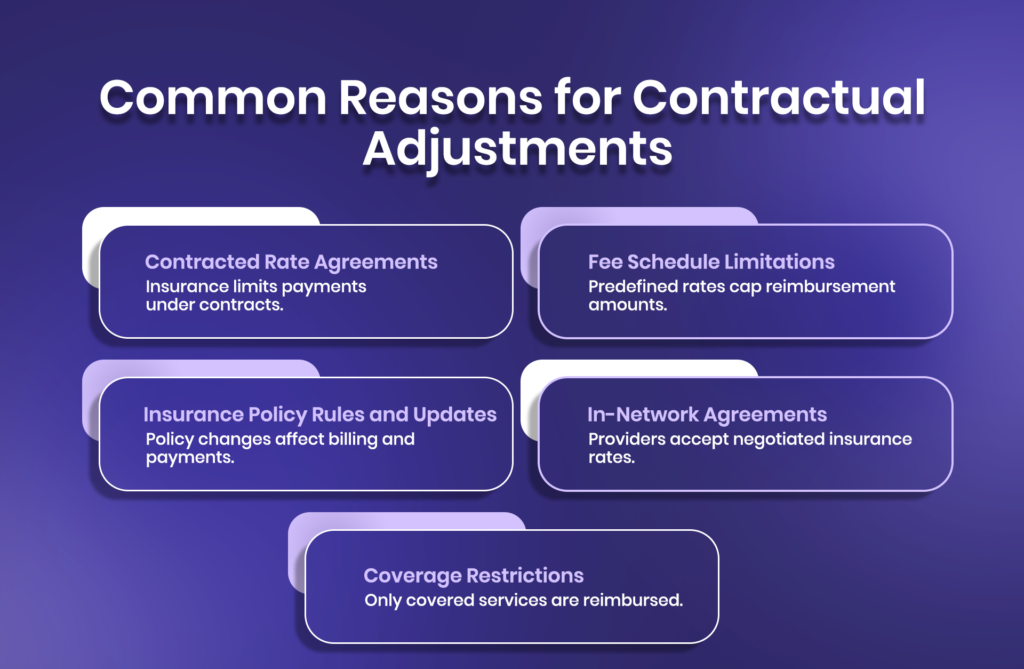
Contracted Rate Agreements
Rate arrangements that have been established by providers and insurance companies establish upper limits on payments. Contractual adjustment in medical billing is part of the billing process in medicine, whereby all charges that exceed these rates will be written off. This is what contractual adjustment entails.
Fee Schedule Limitations
The fee schedules outline the payment rates that insurers should make for certain procedures. Such limits have a direct bearing on the concept of what is contractual allowance adjustment since they set the upper limit for payments made. Knowing the expected contractual allowance by a particular insurance agency aids in determining discrepancies between billings.
Insurance Policy Rules and Updates
Insurance is constantly changing, impacting payment and billing methods. This impacts the definition of what is adjustment in medical billing because of changes that occur to coverages, rates, or billing procedures. By keeping current, adjustments can be appropriately applied according to contractual write off insurance.
In-Network Agreements
In-network contracts entail agreements whereby the service provider accepts predetermined rates for any services that fall under the coverage of the policy. This is what makes up the definition of a contractual obligation in terms of medical billing and any other billings outside the contract.
Coverage Restrictions
Coverage limitations constrain the number of benefits that insurance companies will cover. Coverage limitations influence what constitutes an adjustment in medical claims where the benefits provided have exceeded the coverage conditions. This will enable healthcare practitioners to estimate what is a contractual adjustment on medical bills.
Helpful Hint: A regular review of payer contracts and policies assists in avoiding adjustment mistakes, ensuring appropriate contractual allowances, improving reimbursement accuracy, and contributing to improved revenue cycle performance.
Types of Contractual Adjustments
Contractual adjustments occur in multiple forms depending on payer agreements, coverage rules, and patient financial responsibility. Understanding these variations is essential for accurate reimbursement analysis, compliance management, and maintaining financial clarity within the revenue cycle.
Insurance Contractual Adjustments
Insurance contract modifications are the most frequent cause of payment discrepancies, where the amounts billed are greater than the approved amounts by the insurance company. The above example is a representation of the contractual adjustment in medical billing because it is the result of contract negotiations and depicts the essence of contractual adjustments in medical billing payments. It clearly shows how contractual adjustment works in medical billing through its definition.
Patient Responsibility Adjustments
Examples of patient responsibility adjustment include copayments, deductibles, and the amount of the coinsurance to the patient according to the patient’s insurance policy. Patient responsibility adjustments will assist in understanding the concept of adjustments from the patient liability perspective. It helps differentiate patient responsibility adjustments from write-offs that may apply through contractual agreements. Patient responsibility adjustments are not included in contractual adjustments and should be clearly differentiated.
Provider Write-Offs
Write-offs made by the provider will happen if the amount is considered uncollectible or does not fall under insurance coverage. This can either be in a contractual situation or otherwise, based on what is agreed between the payers. As far as the issues of contractual adjustment in medical billing, it is usually pre-decided, whereas non-contractual write-offs normally arise from inefficient procedures.
Denied or Non-Covered Services
Non-covered or denied claims happen because payers decline claims for coverage based on certain restrictions in the policy. Here, changes need to be done so that accurate reporting will be made and inaccurate charges will not be incurred by patients. It becomes easier to determine what constitutes a contractual adjustment on a medical bill in denied claims. But there are exceptions where some denials do not fall under a contractual adjustment.
Government Program Adjustments
Fixed fee arrangements used by governmental programs such as Medicare and Medicaid vary from the fees charged for services provided. Medicare contractual adjustment cases are created since governmental programs like Medicare have set prices that must be accepted by the provider. The disparity created in this case is adjusted off since this is in line with the contractual agreement.
Other Adjustments
Other types of allowances include prompt payment discounts, charity care arrangements, and payer-specific policy-based reductions. Such allowances show examples of how the concept or what is contractual allowance adjustment can be interpreted more broadly, based on contractual and administrative requirements. Although some are defined by contracts, others may be driven by policies that differ from one payer to another. Correctly identifying each will result in good accounting and clear medical billing processes.
Contractual Adjustment Codes in Medical Billing
Upon the evaluation of a claim by Medicare, it sends out an Electronic Remittance Advice (ERA) or Standard Paper Remittance (SPR), which is a detailed report regarding the adjudication and settlement of a claim, according to the Centers for Medicare & Medicaid Services (CMS). The two types of remittances ensure that all the necessary information regarding the payment, denial, and adjustment of claims is available to both payers and providers. For each ERA and SPR document, there is specific information at the claim level and claim line-item level that enables providers to reconcile the claim payment details to their actual claims. Adjustments can be made at three levels, namely the claim line level, claim level, and provider level. The standard codes used include Claim Adjustment Group Codes, Claim Adjustment Reason Codes (CARC), and Remittance Advice Remark Codes (RARC).
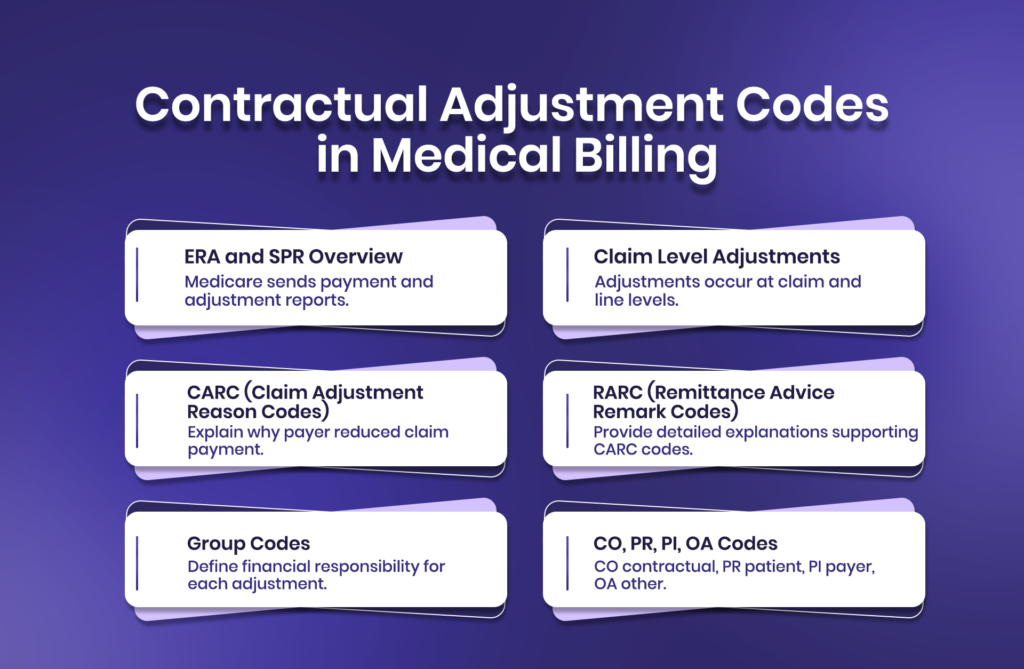
CARC (Claim Adjustment Reason Codes)
Coded Reason Codes are systematic reasons defined by payers to justify deductions in claims payments. They are necessary in the process of contractual adjustment in medical billing to know if the deductions are due to contracts, policies, or coverage. From the analysis of coded reason codes, billing departments are able to examine payer’s patterns and reduce denials.
RARC (Remittance Advice Remark Codes)
The purpose of the RARC codes is that they are supplementary interpretation codes that assist in the interpretation of CARC codes. These codes offer additional context at the narrative level which will be helpful in the decision-making process of the payers. In terms of understanding what is adjustment in medical billing, these RARC codes assist in achieving clarity for operational reasons.
Group Codes
Financial accountability codes classify responsibility for financials from an organizational perspective. In other words, each part of an adjustment will be classified according to its responsibility. CO code represents the contractual obligation while the PR code shows patient responsibility. PI stands for payer adjustment, while OA represents miscellaneous adjustments. The importance of these codes lies in understanding which financial aspect is contractual obligation or what is contractual obligation in medical billing.
Contractual Write-Off vs Non-Contractual Write-Off
There is a need to analytically differentiate between contract-based financial adjustments and operational inadequacies that lead to revenue leakage in medical billing and revenue cycle management. Understanding this distinction is essential for accurate financial reporting, compliance adherence, and effective payer contract evaluation.
Contractual Write-Off
Contractual write-off refers to a set procedure involving a predetermined monetary reduction based on a set of payer-provider agreement terms. The framework of contractual adjustment in medical billing entails removal from the total billed amount based on mutually agreed-upon rates and cannot be shifted to the patient. It is important that the contractual adjustment insurance policy remains strictly adhered to at all times.
Non-Contractual Write-Off
Preventable causes of non-contractual write-offs include mistakes in billing, denied claims, missing information, or collection inefficiencies. Non-contractual write-offs are not subject to contractual terms as the latter has an agreement with the payer and are not covered under it. It is related to what constitutes an adjustment within the non-contractual realm of medical billing and leads to increase in adjustment amount in medical billing.
How Contractual Adjustments Are Calculated
Determining contractual adjustments is done by use of an established financial equation that guarantees the conformity of the billed charges with those approved for reimbursement by the payers. In the context of contractual adjustment in medical billing, the computation is important in ensuring the determination of the exact amount that will be adjusted.
It involves a simple formula: bill minus allowance is equal to contractual adjustment. The formula gives a perfect structure for analyzing how the contractual adjustment is calculated or is determined in practice. For instance, if a physician pays $800 while an insurance company allows $500, the $300 difference is considered a contractual adjustment, and this is one of the practical contractual adjustment examples. This explains why the patient does not have to pay the difference.
The fee schedule and the payer contract will define the allowable amount of money for each service. This agreement will give rise to the expected payer contractual allowance, thereby helping to ensure uniformity of reimbursement among the providers and insurance companies. This helps in making the necessary adjustments in the billing process of the medical facility.
Impact on Revenue Cycle Management
The process of contract adjustments is extremely important in revenue cycle management for making sure that the amounts charged for services are properly synchronized with the number of payments approved by the payers. With respect to contractual adjustment in medical billing, effective posting ensures that the amounts charged are accurate and not overstated.
Moreover, these adjustments result in a decrease in denial rates and improve compliance because all these adjustments represent the proper guidelines for payment under the payer contract within the process of billing. Learning about what is adjustment in medical billing helps institutions have clean financial information and prevent any misunderstandings associated with adjustment in medical billing. Furthermore, these adjustments provide better transparency for patients as well as more accurate forecasts for the institution’s finances.
Contractual Adjustment Posting Process
Contractual adjustment posting procedure is a series of actions taken in a specific order to guarantee proper reimbursement, compliance with regulations, and accurate accounts receivable management. When talking about the contractual adjustment in medical billing, all actions are required to determine whether the payment from the payer, the patient, or the contractual write-off was made.
Reviewing ERA 835 / EOB
The first step in this process is to review ERA 835s or explanation of benefits (EOBs). In contractual adjustment in medical billing, this serves as a means of validating the specific payment details, adjustments, and service lines on each claim. This will help in identifying any discrepancies at an earlier stage, ensuring accuracy in posting.
Identifying CARC, RARC, CO, PR Codes
The billing department will evaluate the CARC and RARC codes as well as CO and PR group codes. This helps to understand the definition of what is adjustment in medical billing by distinguishing between contractual adjustments and patient obligations. It is essential to identify the correct one to differentiate insurance adjustment from patient obligation.
Calculating Allowed Amount
The allowable amount is determined based on the payer contract and the remittance information. This is critical to knowing how the contractual adjustment is calculated, which must be consistent with the expected contractual allowance for the payer. The calculation of the allowance is necessary for accurate adjustment of the bill.
Posting CO to Contractual Adjustment
The COs (contractual obligations) are posted as contractual write-offs in the billing system. This is because the contractual adjustments made in medical billing must be properly accounted for in order that they do not get posted to the patients’ accounts. It ensures proper compliance with contractual adjustment insurance agreements.
Posting PR to Patient Balance
Patient responsibility charges like copayment, deductible, and coinsurance are given to the patient account. It shows the payment made by the patient on the hospital bill and helps distinguish between the insurance write-off amount and patient responsibility. Proper posting is vital in order to avoid any errors in accounting.
Payment Posting and Reconciliation
Payments for insurance are documented and reconciled with claims. This will ensure the correct amount to be adjusted is determined when making bills for the medical process. This will also ensure that there is an agreement between what is deposited and what has been paid.
Secondary Insurance Handling
If secondary coverage is available, then claims must be submitted in order for coordination of benefits to be effective. It will prevent premature payment of bills by the patient while ensuring appropriate apportionment of the cost of care through proper billing adjustments.
Final Claim Closure and Reporting
Once all adjustments and postings have been made, the claim can now be considered closed, and recorded for financial purposes. This guarantees that what is contractual adjustment in medical billing is properly documented in the record, enabling the organization to comply with requirements.
Insight from an Expert: Accuracy in posting any adjustments under contract requires proper understanding of ERA 835/EOB information and appropriate use of CO and PR codes. This can be achieved through periodic auditing and proper training of employees to avoid mistakes.
Best Practices to Manage Contractual Adjustments
The proper handling of contractual adjustments guarantees proper accounting of finances, prevents errors, and promotes compliance throughout the revenue cycle. Best practices for contractual adjustment in medical billing assist organizations to achieve uniformity in their reimbursements, optimize efficiency, and prevent unnecessary loss of revenue.
Keep Payer Fee Schedules Updated
Timely updating of the payer’s schedule of fees ensures that it remains in sync with the current contractual rates and guidelines for reimbursement. In the case of contractual adjustments in medical billing, the use of an out-of-date schedule may result in the incorrect calculation of the allowed amount, incorrect postings, or financial discrepancies.
Maintain Accurate Charge Master
A correct charge master eliminates any potential errors from the very beginning because all of the services will be charged accurately. This facilitates adjustments during the process of medical billing because discrepancies will not occur. Moreover, there will be no necessity to enter additional information concerning write-offs in accordance with the contract.
Ensure Proper CARC/RARC Mapping
The correct mapping of CARC and RARC codes will help in classifying everything into categories and provide reasons for their adjustment. This helps to get an understanding of what contractual adjustment is in medical coding, making the process of automation of posting easy and accurate.
Conduct Regular Audits
Regular audits enable identification of discrepancies in adjustment entries and payments by payers. This enables the determination of “how is the contractual adjustment made?” Regular audits will ensure that revenue leakage is minimized and compliance is enhanced to guarantee accurate medical billing adjustments.
Train Billing Staff Continuously
Continuous training of the billing personnel ensures that they are knowledgeable about payer policies, coding approaches in medical billing, and contract provisions. This helps improve the process of contractual adjustment in medical billing. It also increases understanding of the contractual write-off of insurance.
Use Eligibility Verification Tools
Eligibility verification systems verify the coverage of the patient prior to the provision of services. The system prevents mistakes related to the patient’s adjustment on medical bills. It prevents the denial of claims due to the inaccurate information provided regarding the patient’s insurance policy.
Strengthen Denial Management Process
An efficient denial management system will be able to find out the causes of denials and help in resolving them quickly. This leads to an improvement in the concept of adjustment in the field of medical billing, thus helping in avoiding unnecessary write-offs and increasing collections efficiently.
Common Errors, Misunderstandings and Challenges
Common billing challenges include payer mismatches, coding errors, posting mistakes, and reporting problems disturbing accuracy in medical billing processes.
- Fee schedule mismatches create incorrect allowed amounts and payment discrepancies.
- CO versus PR misposting leads to inaccurate patient balance reporting issues.
- Bundling and modifier errors cause claim denials and reduced reimbursements.
- Secondary insurance delays slow payment posting and final claim resolution processes.
- Capitation and case rate confusion affects proper adjustment allocation and tracking.
- Reporting and GL inconsistencies distort financial records and revenue cycle analysis.
- Confusing adjustments with patient responsibility results in billing and compliance errors.
- Incorrect payment posting causes mismatched accounts receivable and reconciliation problems.
- Misinterpreting insurance EOBs leads to wrong adjustment classification and posting errors.
- Lack of staff training increases overall errors in adjustment processing systems.
How iSolve RCM support with Contractual Adjustment
iSolve RCM facilitates contract management in medical claims processing by accurately recording CO and PR figures according to agreements with payers and ERA 835 transactions. This prevents mistakes, promotes compliance, and keeps accounts receivable clean. The iSolve RCM system boosts revenue accuracy and efficiency through automation and professional auditing.
Frequently Asked Questions
What is a contractual adjustment in medical billing?
The difference between the charge billed and the amount that the insurance will allow is known as the contractual adjustment in medical billing. It is charged against the payer agreements and may not be charged to the patient so that it is not violated and reimbursement is properly done.
How is a contractual adjustment calculated?
It is estimated by a simple formula: billed amount-allowed amount= contractual adjustment. This assists in establishing the actual write-off depending on the payer agreements so as to report the financials correctly and avoid cases of patient overcharging.
Is a contractual adjustment the same as patient responsibility?
No, it is not a patient responsibility to adjust the contract. They are billed to insurance contracts, and patient responsibility is copay, deductible, and coinsurance. Effective separation will remove the risk of billing errors and incorrectly charging patients or missing compliance.
What is the difference between CO and PR in billing?
CO is a depiction of the contractual obligation, that is, the amount is written off under the insurance contract. PR implies responsibility on the part of patients. Proper posting of adjustments, clean accounts receivable and proper financial reporting in medical billing systems is guaranteed with proper use of CO and PR.
Why are contractual adjustments important in revenue cycle management?
They provide proper reporting of revenues, adherence to payer contracts, and clean accounts receivable. Effective management can eliminate billing errors, aid financial projections, and can assist healthcare organizations remain transparent, efficient and stable in their revenue cycle management efforts.
What happens if contractual adjustments are posted incorrectly?
Billing errors, overstated accounts receivable, compliance, and patient dissatisfaction are some of the consequences of posting incorrectly. It can also result in loss of revenue or audit risk. Such financial and operational issues can be avoided by providing correct coding and staff education.