
CPT code 52310 appears to be among the most simplest billing codes for urological practices. In a matter of minutes, a cystoscope is inserted, a stent is removed, and the patient is on their way to their home. The operation is not nearly as risky as the claim can be. Medicare pays roughly $299 for this removal in an office setting and about $135 in a facility setting, and one word in the descriptor decides whether the claim should be clear on the first pass or lands in a post payment review.
It distinguishes CPT code 52310 from its complex twin, CPT code 52315, and the most frequent upcoding error in urological endoscopy is going for the higher code without supporting documentation. The descriptor, the 52310 CPT code versus 52315 CPT code determination, Medicare pricing, modifiers, ICD 10 pairings, paperwork, and recurring refusal patterns are all covered in this complete guide. A medical billing company in USA helps healthcare providers manage claims, payments, billing processes, and payer communications.
What is the description of 52310 CPT Code Covers
The official descriptor, maintained by the American Medical Association, reads: Cystourethroscopy, with removal of foreign body, calculus, or ureteral stent from urethra or bladder (separate procedure); simple.
The code sits in the Surgery chapter, under the Urinary System, in the Urethra and Bladder transurethral procedures range. It reports a normal cystoscopic retrieval of a stent, a foreign object or a stone from the bladder or urethra. For additional code details and the current CPT code reference, see the AAPC CPT Code 52310 reference.
Two features shape how you report it. First, a separate procedure designation is carried, which means it goes into a more comprehensive cystourethroscopy when both happen in the same session. You report it on its own only when the retrieval was the real work of the encounter. Second, the diagnostic look around is already inside the code, so you never bill CPT code 52000 alongside it. Medical coding services convert clinical documentation into accurate CPT, HCPCS, and ICD-10 codes for proper billing and reimbursement.
| Field | Detail |
| CPT code | 52310 |
| Descriptor | Cystourethroscopy, with removal of foreign body, calculus, or ureteral stent from urethra or bladder (separate procedure); simple |
| Section | Surgery / Urinary System / Urethra and Bladder / Transurethral |
| Separate procedure designation | Yes |
| Global period | 0 days |
| Typical unit limit (MUE) | 1 per date of service |
| Total RVU, non-facility | 8.94 |
| Total RVU, facility | 4.03 |
| Medicare, non-facility (office) | about $299 |
| Medicare, facility | about $135 |
| Companion code (complicated) | 52315 |
| Typical place of service | 11 office, 22 outpatient hospital, 24 ASC |
What Happens During the Procedure
Cystourethroscopy, usually shortened to cystoscopy, passes a rigid or flexible scope through the urethra into the bladder under direct vision. For 52310, the clinician then retrieves the object. On a stent, the string is usually visible or easy to catch with standard graspers.
The typical encounter runs like this:
- The patient is positioned and the scope is introduced under direct vision.
- The bladder is surveyed and the stent, stone or foreign body is identified.
- Grasping forceps or a basket retrieves the object.
- Removal is confirmed under direct visualization and the scope is withdrawn.
- Laterality is recorded where it applies, so left ureter, right ureter or bilateral.
Any of those steps can push the encounter into a different code. Serious resistance, a migrated stent with no reachable string, or a stone that has to be broken up first all move the work past simple. That is where 52315 enters.
52310 or 52315: The Operative Note Decides
Both codes describe the same family of work. Only the last word separates them, and coders read it wrong more often than any other part of the pair.
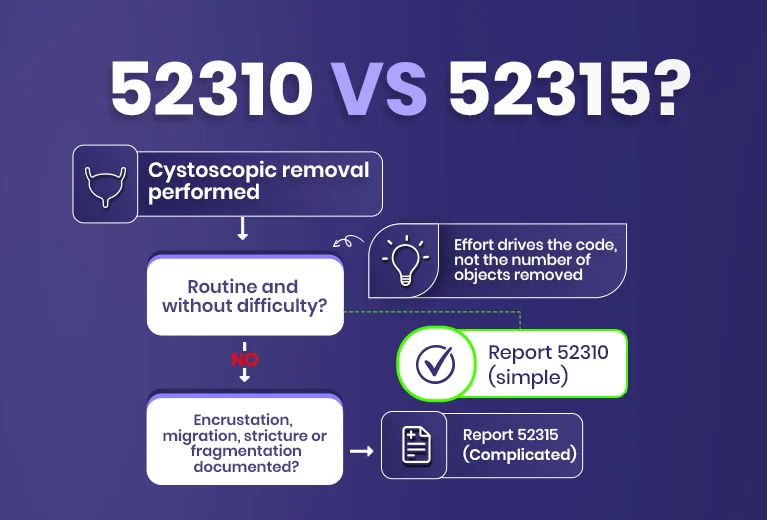
Here is the point most billing teams miss. Simple and complicated are defined by the effort and work the removal actually took, not by how many objects came out. Removing two stents or three bladder stones with no difficulty is still 52310. Removing a single heavily encrusted stent that needs the encrustation broken up first is 52315. The number of objects is irrelevant. The documented work is everything.
| Factor | 52310 (simple) | 52315 (complicated) |
| Stent | String visible, standard graspers do the job | Migrated stent, string absent or unreachable, or heavy encrustation |
| Stone | Passes intact through the scope | Fragmentation needed before removal |
| Anatomy | No unusual difficulty | Stricture, prior surgery or other access difficulty |
| Documentation | Routine procedure note | Explicit detail on what made it hard |
| Relative value | Lower | Higher, and it must be justified in the note |
A common case makes the rule concrete. A patient returns two weeks after ureteroscopy for a stent pull. The string is visible, the scope goes in and the stent is out in under a minute. The note reads “stent removed without difficulty.” That is 52310, even if the original stone case was complex. The code follows this encounter, not the one before it.
Payers audit 52315 more heavily than 52310, and billing it without documented complicating factors is a familiar trigger for review. When the note is ambiguous, 52310 is the defensible choice.
Expert Insight: Do not let “bilateral” push you to 52315. Two stents removed easily is still simple. Train your coders to read the effort described in the note, and coach your urologists to write down exactly what made a removal hard whenever they intend 52315. The justification has to live in the record, not in the coder’s assumption.
How Medicare Pays for CPT Code 52310 Claim
Medicare does not pay a flat fee for this code. It prices the service from relative value units for work, practice expense and malpractice, then adjusts for your locality with the Geographic Practice Cost Index and multiplies by the annual conversion factor, which is $33.4009 for 2026.
Setting drives most of the difference. In an office, the practice carries all the overhead, so the practice expense component is larger and the fee is higher. In a hospital or ambulatory surgery center, the physician fee is lower because the facility bills its own separate fee for the room, staff and supplies.
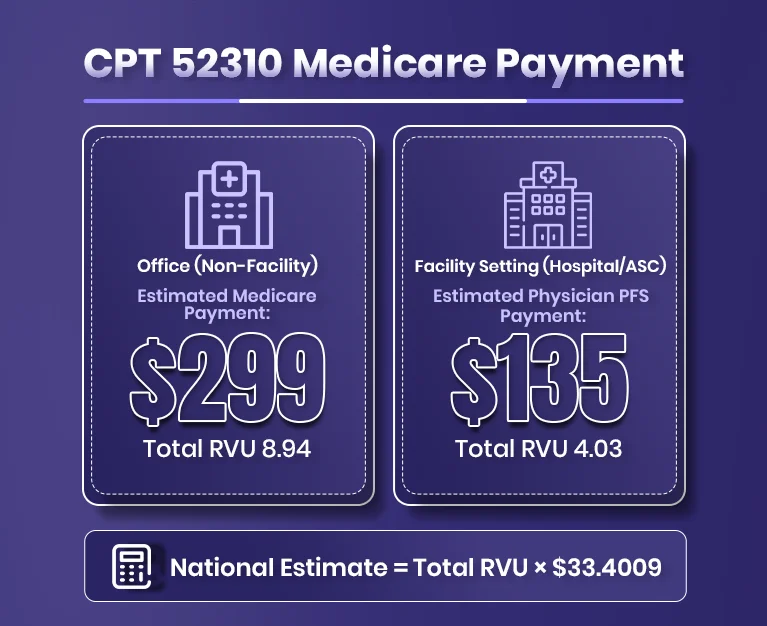
| Setting | Total RVU | Approx. Medicare physician fee |
| Non-facility (office) | 8.94 | about $299 |
| Facility (hospital or ASC) | 4.03 | about $135 |
Those figures are national averages before geographic adjustment, so the same removal pays differently across two zip codes. The office rate carries the full practice expense RVUs, which is why it sits well above the facility physician rate. Commercial payers usually price off the Medicare rate, often somewhere between 110 and 130 percent of it, though contracts vary widely, so read the multiplier in your own agreement.
Pro Tip: Pull both the facility and non-facility rate for 52310 before you schedule stent removals in a new location. The office rate moves your revenue and the patient’s coinsurance at the same time. Verify the current-year figure in the CMS Physician Fee Schedule lookup tool, since rates reset every January 1.
Which Modifiers Belong on a 52310 Claim
Most 52310 claims need one modifier at most, and laterality is the usual one. Modifier choice is still a frequent denial trigger, so a handful deserve a second look.
| Modifier | When it applies | Caution |
| 50 (bilateral) | Both ureteral stents removed in one session | Payer specific. Medicare may want one unit with modifier 50 rather than two units, so verify against the current NCCI rules |
| LT / RT | Unilateral removal, naming the side | Some commercial payers require it for the audit trail. Document the side either way |
| 59 (distinct procedural service) | 52310 is genuinely distinct from another procedure with an NCCI edit pair | The note must show clinical independence. It is not a tool for routinely overriding bundles |
| 51 (multiple procedures) | 52310 is the secondary procedure on a multi-procedure claim | Most payers cut the secondary procedure by half |
| 76 / 77 (repeat procedure) | The same or a different physician repeats the procedure the same day | Document exact times and the reason for the repeat |
| 78 / 79 (global period) | Unplanned related return, or an unrelated service during a global period | Support with documentation of the separate indication |
Bilateral removal is the one to settle before the claim goes out. Medicare and the National Correct Coding Initiative both set rules for bilateral cystourethroscopy, and payers apply them differently. Some accept one unit with modifier 50, others want two lines. Confirm against the current NCCI Policy Manual first.
The ICD-10 Codes That Carry Medical Necessity
Medical necessity for 52310 rests on the diagnosis sitting beside it, and a Local Coverage Determination can limit coverage to a named list. Check the pairing against the payer’s policy before you send it.The encounter character on the T-codes matters. Use A for the first encounter that addresses the problem and D for a follow-up dealing with the same problem. Sequence the primary diagnosis first, then the rest by clinical relevance.
| T83.192A / T83.192D | Other mechanical complication of indwelling ureteral stent, initial or subsequent | Scheduled or unplanned removal for a mechanical issue |
| T83.122A | Displacement of indwelling ureteral stent, initial encounter | Removal for a migrated or displaced stent |
| N21.0 | Calculus in bladder | Bladder stone retrieved through the scope |
| T19.0XXA / T19.1XXA | Foreign body in urethra or bladder, initial encounter | Non-stent object retrieved |
| Z48.812 | Encounter for surgical aftercare following surgery on the urinary system | Routine post-surgical stent removal |
| Z96.0 | Presence of urogenital implants | Elective removal of a previously placed device |
One pairing gets practices in trouble. N20.1, calculus of ureter, does not support 52310, because the scope only reaches the urethra and bladder. A stone still sitting up in the ureter needs a ureteroscopic code such as 52356. Once that stone has dropped into the bladder and comes out through the scope, N21.0 is the pairing you want.
What the Operative Note Has to Say
A clean note is the best defense against a 52310 denial, and vague documentation is why straightforward stent pulls get downcoded. Each element below should appear by name, not by implication:
- Instrument: rigid or flexible cystoscope, with size if you have it.
- Object removed: the stent with its size, the calculus, or a description of the foreign body.
- Laterality: left ureter, right ureter, bladder or bilateral, since the modifier depends on it.
- Technique: grasping forceps, basket or another simple method.
- Confirmation: direct visualization showing the object came out whole.
- Complexity qualifier: the absence of complicating factors for 52310, or explicit detail if you are billing 52315.
- Indication: why the stent was placed and why it is coming out now.
Keep the note in the record for at least seven years in line with CMS retention guidance, and longer if your state requires it.
Bundling and the Separate Procedure Rule
Two bundling facts cause most of the trouble on this code.
The diagnostic cystoscopy is already inside CPT code 52310. Billing 52000 CPT code on the same claim gets it denied, because the inspection of the urethra, bladder and ureteral orifices is part of the removal. Bill 52000 on its own only when the scope was purely diagnostic and nothing was retrieved.
The separate procedure designation means 52310 bundles into a more comprehensive cystourethroscopy performed in the same session. Reporting both without a justified modifier 59 triggers the edit automatically. If the removal genuinely stood alone, say so in the note, because automated claim editors assume bundling otherwise. Moreover, you also need to understand about the 99204 CPT Code.
One more nuance worth knowing. If a stent has an external string and the patient or provider removes it without a cystoscopy, there is no 52310 to report. That removal is considered part of the office visit, so you bill only the appropriate E/M.
Run This Check Before You Submit
Five questions catch most 52310 rejections before a payer ever sees the claim. Run them at charge entry, while the note is still on the screen.
- Does the note describe a routine removal or a complication? The answer picks 52310 or 52315.
- Is laterality written out in words, and does the modifier match it?
- Was a more comprehensive cystoscopy done in the same session? If so, expect the bundle.
- Does the diagnosis code sit on this payer’s covered list?
- On any T-code, is the encounter character right for this visit, A or D?
Where CPT Code 52310 Claims Usually Go Wrong
Denials on this code cluster around five mistakes, and they repeat from practice to practice. Working the pattern beats appealing one claim at a time. Denial management services identify the causes of rejected or denied claims and help providers correct, appeal, and recover unpaid revenue.
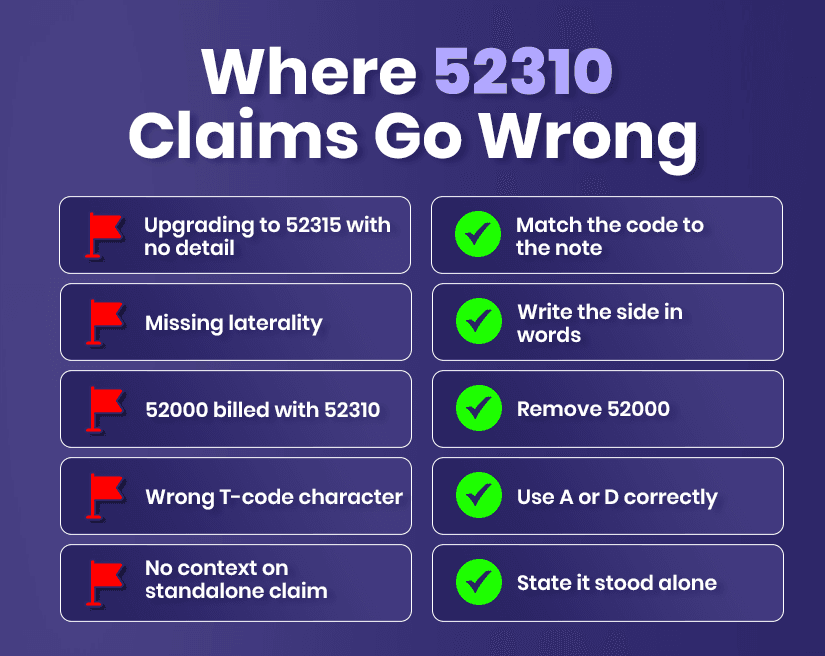
- Upgrading to 52315 with no supporting detail. The highest-risk error and the one auditors look for. If the note says the stent came out without difficulty, the code is 52310.
- Missing laterality. Leaving out the side, or writing “bilateral” with no modifier 50 and no second line, walks straight into an edit.
- Billing 52000 alongside it. The diagnostic scope is included. Remove 52000 and resubmit.
- Wrong encounter character. Submitting T83.192A when the patient is back for a scheduled second removal creates a medical necessity mismatch. The D character fits that visit.
- No context on a standalone claim. When 52310 follows an earlier surgical encounter, state in the note that it stood alone, or the editor assumes it bundles.
Neighboring Codes Worth Knowing
These are the codes coders reach for when 52310 is on the table. Knowing where each one starts prevents the crossover errors that show up in urology audits. Revenue cycle management coordinates financial processes from patient registration and insurance verification through claims processing, payment collection, and A/R follow-up.
| CPT | Description | Relationship to 52310 |
| 52315 | Cystourethroscopy, removal of foreign body, calculus or stent; complicated | The companion code, for documented complex removals |
| 52317 / 52318 | Litholapaxy: crushing of a bladder calculus, simple or complicated | Use when a bladder stone has to be crushed before removal |
| 52332 | Cystourethroscopy with insertion of an indwelling ureteral stent | The insertion code, usually billed at an earlier encounter |
| 52356 | Ureteroscopy with lithotripsy, including stent insertion | Upper tract approach for a stone still in the ureter |
| 52005 | Cystourethroscopy with ureteral catheterization | Base family code, may carry an NCCI edit with 52310 |
| 52000 | Diagnostic cystourethroscopy | Included in 52310, never billed with it |
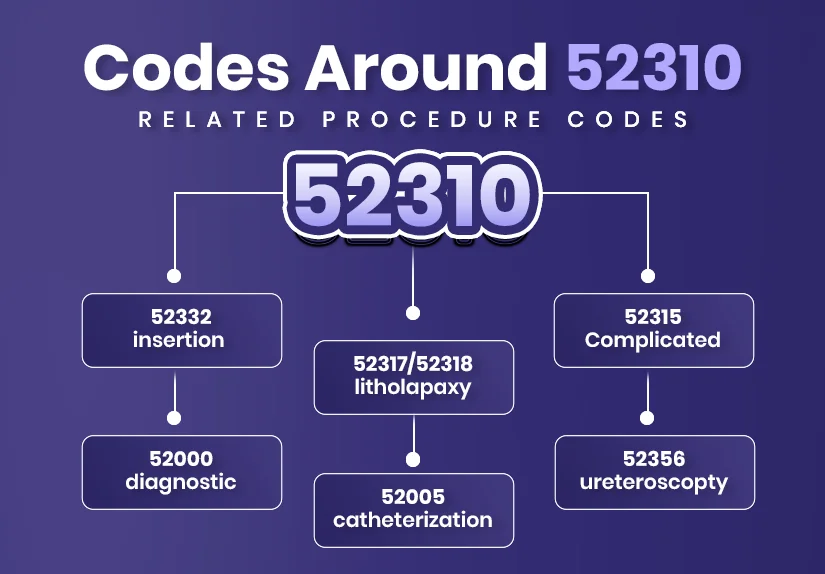
When an insertion and a removal fall in the same session, read the NCCI edits before you bill 52332 and 52310 together. Each has to be clinically distinct and separately indicated in the note.
How iSolve RCM Keeps 52310 Claims Moving
Most 52310 denials trace back to two gaps: a note that does not make the complexity clear, and a code that gets retyped from the record into the billing system by hand. Both are fixable, and both are where a billing partner earns its keep.
iSolve RCM works the code the way it should be worked. Our coders read the operative note against the effort documented, so 52315 goes out only when the record justifies it and 52310 is protected from a needless downcode. Eligibility and diagnosis pairings are verified against payer policy before submission, laterality and modifiers are checked at charge entry, and denials are worked by pattern rather than one appeal at a time. When the same rejection keeps returning, our denial management team traces it to the process, not the individual claim, and closes the gap. The result is a shorter distance between a clean operative note and a posted payment.
Frequently Asked Questions
Can you bill an office visit on the same day as 52310?
Only when the visit addresses a separate, documented problem. A minor procedure already includes the usual pre-procedure evaluation, so a same-day E/M for the removal itself is not separately payable. When the patient raises an unrelated issue, append modifier 25 to the E/M and keep the two notes distinct.
Do you bill CPT Code 52000 as well as 52310 CPT Code?
No. The diagnostic cystoscopy is included in 52310, so 52000 gets denied when the two are reported together. Bill 52000 on its own only when the scope was diagnostic and nothing was retrieved.
Is bilateral stent removal automatically 52315?
No. Removing a stent from each side without difficulty is still 52310. The complicated code is earned by documented effort, not by the second stent. Report bilateral with modifier 50 or two lines per your payer’s rule.
What if the patient pulls the stent out at home?
There is no procedure to report, so 52310 does not apply. Some stents are placed with an external string for exactly that reason. Log the contact in the record and bill only the visit that follows, if there is one.
What if the patient pulls the stent out at home?
There is no procedure to report, so 52310 does not apply. Some stents are placed with an external string for exactly that reason. Log the contact in the record and bill only the visit that follows, if there is one.
Can you report 52310 if another practice placed the stent?
Yes. The code describes the removal, not who placed the stent. Record why the stent went in, the date it was placed if you have it, and the indication for taking it out.
Does 52310 need prior authorization?
It depends on the plan. Traditional Medicare rarely requires it for a physician service like this, while Medicare Advantage and commercial plans often do. Check the surgical policy before you schedule and put the authorization number on the claim.