

Young adults are the age group most likely to skip routine checkups. Many feel healthy, change jobs or insurance often, or simply haven’t had a regular doctor since adolescence. When a patient in this age group schedules a physical with a new practice, the visit may be reported with the CPT code 99385 when the patient meets the new-patient and age requirements.
CPT 99385 describes an initial comprehensive preventive medicine evaluation and management service for a new patient aged 18 through 39. The service includes an age- and gender-appropriate history, an examination, counseling and risk-factor reduction, and ordering appropriate laboratory or diagnostic tests.
The code looks straightforward, but it depends on three things being right: the patient’s age on the date of service, whether the patient is truly “new” under CPT rules, and the payer’s preventive benefit policy. Get any of these wrong and the claim may be denied, reprocessed or paid incorrectly.
This guide explains what CPT 99385 covers, who qualifies, how it differs from 99395 and the other preventive codes, which diagnosis codes go with it, what documentation supports it and how to bill it correctly, including when a problem-oriented visit can be added on the same day.
For accurate coding, claim submission, and reimbursement support, healthcare providers can rely on medical billing services in USA to help manage their billing processes.
What Is the CPT Code 99385?
CPT 99385 is the code for an initial comprehensive preventive medicine evaluation and management service for a new patient aged 18 through 39 years. It’s used for a routine physical or well visit focused on prevention rather than a specific illness.
The code belongs to the preventive medicine services section of CPT, maintained by the American Medical Association (AMA). These services are different from problem-oriented office visits:
| Preventive medicine visit (99385) | Problem-oriented office visit (99202–99215) | |
| Primary purpose | Routine preventive care, screening and health maintenance | Evaluating and managing a specific complaint or condition |
| Level selection | Based on age and patient status | Based on medical decision making or time |
| Typical name | Physical, well visit, annual exam | Sick visit, follow-up visit |
CPT 99385 Description and Code Definition
The descriptor covers an initial comprehensive preventive medicine evaluation and management of an individual, including an age- and gender-appropriate history, examination, counseling, anticipatory guidance and risk factor reduction interventions, and the ordering of laboratory and diagnostic procedures, for a new patient aged 18 to 39 years.
In practical terms, the service includes:
- An age- and gender-appropriate history, including medical, surgical, family and social history
- A comprehensive preventive examination suited to the patient’s age and sex
- Counseling and anticipatory guidance on healthy behaviors and risks
- Risk-factor reduction interventions, such as advice on smoking, alcohol, diet and exercise
- Ordering appropriate laboratory and diagnostic tests
- Preventive health recommendations, such as screenings and immunizations due
“Comprehensive” in a preventive code doesn’t mean the same thing as in the older problem-oriented E/M guidelines. It means the history and exam are complete for a preventive purpose, based on the patient’s age and risk factors.
CPT is copyrighted by the AMA. The description above is a paraphrase. Verify the exact wording against the current-year CPT codebook.
Is CPT 99385 a New Patient Code?
Yes. CPT 99385 is only for new patients. The established-patient equivalent for the same age range is CPT 99395.
CPT defines a new patient as one who hasn’t received any professional services from the physician or other qualified healthcare professional, or from another physician or QHP of the exact same specialty and subspecialty in the same group practice, within the past three years.
This is often called the three-year rule. A few points make it easy to get wrong:
- Professional services are qualifying face-to-face services rendered by a physician or other qualified healthcare professional who may report E/M services. A phone call to schedule an appointment doesn’t count.
- The rule applies to the same specialty and subspecialty within the group, not to every provider in the group. A patient who saw Dr. A two years ago is established for Dr. B only if both are in the exact same specialty and subspecialty in the same group.
- Different specialties are treated separately. A patient who saw a group’s cardiologist last year can still be new to the group’s family physician.
- Advanced practice providers. Under CPT guidance, when advanced practice nurses or physician assistants work with physicians, they are generally considered to have the same specialty and subspecialty as those physicians for new- versus established-patient classification. Verify applicable payer-specific rules.
Check the practice management system for prior visits within the last three years, across all providers of the same specialty and subspecialty, before choosing 99385.
CPT Code 99385 Age Limit: Who Qualifies?
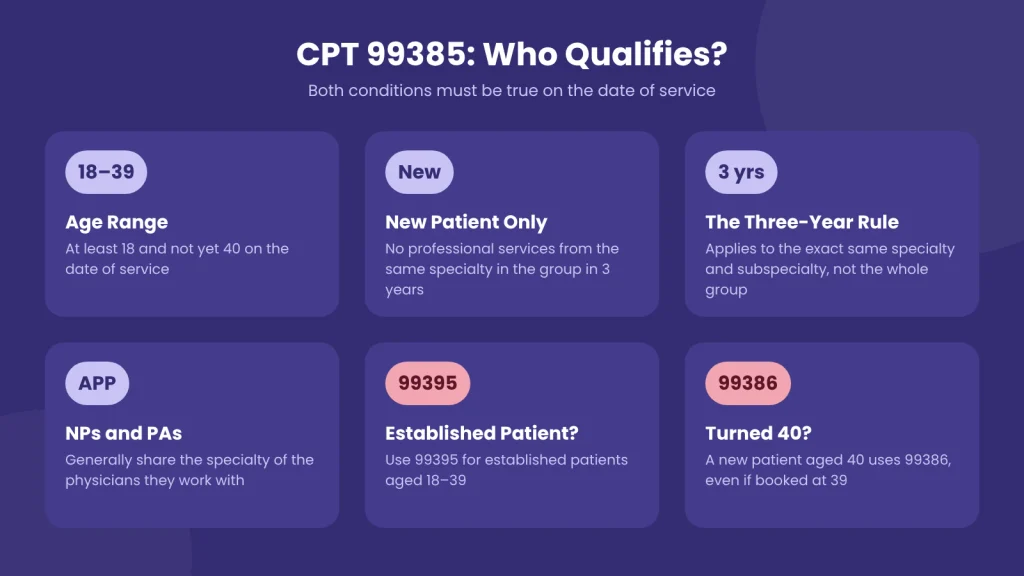
The 99385 age limit is 18 through 39 years. Two conditions must both be true:
- The patient is at least 18 and not yet 40 on the date of service.
- The patient meets the CPT definition of a new patient.
If either condition isn’t met, a different code applies:
| Situation | Correct code |
| New patient, age 17 | 99384 |
| New patient, age 18–39 | 99385 |
| New patient, age 40 | 99386 |
| Established patient, age 18–39 | 99395 |
Age-related errors are common because the age in the scheduling system isn’t always checked against the date of service, especially when a visit is booked months in advance. Verify the patient’s date of birth before the claim goes out.
Can CPT 99385 Be Used for a 39-Year-Old Patient?
Yes. Age 39 is included in the range. A new patient who is 39 on the date of service qualifies for 99385.
A patient who turns 40 before the visit, even by a day, falls into the next age category, 99386 (ages 40 through 64). The patient’s age on the date of service decides the code, not their age when the appointment was booked.
Can CPT 99385 Be Used for an Established Patient?
No. An established patient aged 18–39 is reported with CPT 99395. The most common way this goes wrong is a patient who saw another provider of the same specialty in the same group within the past three years. To the new provider it feels like a first visit, but under CPT rules the patient is established. Payer edits that compare claim history often catch this error.
What Services Are Included in a CPT 99385 Preventive Visit?

A 99385 visit is meant to establish a baseline for a new adult patient and identify risks early. The content varies with the patient’s age, sex and risk factors.
Patient History and Health Risk Assessment
- Medical and surgical history, including prior illnesses, hospitalizations and procedures
- Family history, such as heart disease, diabetes, cancer and mental health conditions
- Social history, including tobacco, alcohol and substance use, occupation, physical activity, diet and sexual history
- Medication and allergy review
- Lifestyle and health-risk assessment, often supported by a questionnaire completed before the visit
Comprehensive Preventive Examination
- An age- and gender-appropriate physical examination
- Vital signs, including blood pressure, height, weight and BMI
- Review of the patient’s general health status
- Assessment of preventive health needs based on findings and risk factors
Preventive Counseling and Risk-Factor Reduction
Counseling is part of the 99385 service. For adults aged 18–39, common topics include:
- Nutrition, weight and physical activity
- Tobacco, alcohol and substance use
- Sexual and reproductive health, including contraception and infection prevention
- Mental health, stress and sleep
- Injury prevention, such as seat belt use and safe driving
Routine counseling done as part of the preventive visit is included in 99385 and isn’t billed separately.
Laboratory Tests, Screening and Immunizations
CPT 99385 includes ordering appropriate laboratory and diagnostic procedures as part of the preventive service. When separately identifiable tests, vaccine products, immunization administration or other procedures are actually performed, they may be reported separately using the applicable codes, subject to CPT instructions and payer policies.
| Service | Reporting consideration |
| Laboratory tests (such as a lipid panel or glucose) | May be reported with the applicable lab codes when performed |
| Venipuncture for specimen collection | Reporting varies by payer |
| Immunizations | Vaccine product code plus an administration code, when given |
| Standardized screening instruments (such as a depression questionnaire) | Depends on the code and payer policy |
| Specific counseling services, such as structured tobacco cessation counseling | Depends on payer policy |
| Routine counseling and anticipatory guidance | Included in 99385, not reported separately |
Being separately reportable doesn’t mean a service is automatically paid. Payer bundling rules and modifier requirements still apply, so check each payer’s policy before billing an additional code with a preventive visit.
CPT 99385 vs. 99395: What Is the Difference?
The difference between 99385 and 99395 is patient status. The age range and the type of service are the same.
| CPT code | Patient type | Age range | Service |
| 99385 | New | 18–39 | Initial comprehensive preventive visit |
| 99395 | Established | 18–39 | Periodic comprehensive preventive reevaluation |
An initial visit with a new patient generally takes more work, because the provider is gathering a full history for the first time. That’s why initial preventive codes are typically valued higher than the periodic codes for the same age group.
When Should Providers Use CPT 99385?
- The patient meets the CPT new-patient definition.
- The patient is 18 through 39 on the date of service.
- The visit is a comprehensive preventive service, not mainly a problem-oriented visit.
When Should Providers Use CPT 99395?
- The patient meets the established-patient definition.
- The patient is 18 through 39 on the date of service.
- A periodic comprehensive preventive service is performed.
Once the patient qualifies as established under the applicable CPT rules, subsequent comprehensive preventive visits in the same age range are generally reported with 99395. The frequency of covered preventive visits depends on the patient’s insurance plan.
Preventive Visit CPT Codes by Age: Complete Code Comparison

| Age group | New patient | Established patient |
| Under 1 year | 99381 | 99391 |
| 1–4 years | 99382 | 99392 |
| 5–11 years | 99383 | 99393 |
| 12–17 years | 99384 | 99394 |
| 18–39 years | 99385 | 99395 |
| 40–64 years | 99386 | 99396 |
| 65 years and older | 99387 | 99397 |
CPT 99384 vs. CPT 99385
- CPT 99384: new patients aged 12–17 (adolescent)
- CPT 99385: new patients aged 18–39
The adolescent visit typically focuses on growth, development, school, immunizations due in the teen years and adolescent-specific risks.
CPT 99385 vs. CPT 99386
- CPT 99385: new patients aged 18–39
- CPT 99386: new patients aged 40–64
The visit content often shifts at 40 as more screening recommendations come into play, but the code choice is driven only by age and patient status.
CPT 99395 vs. CPT 99396
- CPT 99395: established patients aged 18–39
- CPT 99396: established patients aged 40–64
These codes aren’t interchangeable. An established patient seen at 39 one year and at 40 the next moves from 99395 to 99396.
A Note on Medicare
Original Medicare doesn’t cover routine physical examinations. Instead, Medicare has its own preventive visits, reported with HCPCS codes:
| Code | Service |
| G0402 | Initial Preventive Physical Examination (“Welcome to Medicare” visit) |
| G0438 | Annual Wellness Visit, initial |
| G0439 | Annual Wellness Visit, subsequent |
These HCPCS codes are not interchangeable with CPT 99385. G0402 applies to eligible beneficiaries during the first 12 months of Medicare Part B enrollment, while G0438 and G0439 have their own Annual Wellness Visit requirements. An Annual Wellness Visit is not a routine comprehensive physical. Providers must confirm that the service actually meets the applicable Medicare requirements before reporting one of these codes.
CMS instructs providers not to report CPT 99381–99397 for services covered by G0402, G0438 or G0439. This matters for the 18–39 age group more than people expect, because some adults in this range have Medicare due to a disability or end-stage renal disease. Some Medicare Advantage plans cover a routine physical as an extra benefit, so check the plan’s rules.

ICD-10-CM Diagnosis Codes Commonly Used With CPT 99385
The diagnosis code should reflect the reason for the encounter and what the provider found.
| ICD-10-CM code | Description |
| Z00.00 | Encounter for general adult medical examination without abnormal findings |
| Z00.01 | Encounter for general adult medical examination with abnormal findings |
| Z01.419 | Encounter for gynecological examination (general) (routine) without abnormal findings |
| Z01.411 | Encounter for gynecological examination (general) (routine) with abnormal findings |
How to Choose Between Them
- Z00.00 is used when the provider documents a routine adult exam with no abnormal findings.
- Z00.01 is used when the exam finds something abnormal. It carries an instruction to use an additional code to identify the abnormal findings.
- Z01.419 and Z01.411 are used for routine gynecological examinations without and with abnormal findings, respectively. The appropriate diagnosis depends on the service performed, provider specialty, documentation and payer guidance. Do not automatically substitute Z00.00 or Z00.01 when the encounter is specifically a gynecological examination.
Preventive Care vs. a Separately Evaluated Problem
If the provider evaluates and manages a separate problem during the visit, that problem has its own diagnosis code, linked to the problem-oriented E/M service rather than to 99385. Correct diagnosis linkage helps the payer apply preventive benefits to the right line.
Don’t assign a diagnosis based on the CPT code alone. A 99385 claim doesn’t automatically mean Z00.00. If the provider documents abnormal findings, Z00.00 would be wrong. The diagnosis has to come from the documentation. Our guide to the ICD-10 code for fatigue shows how symptom codes are chosen when a patient raises a complaint during a visit.
CPT 99385 Documentation Requirements
Essential Documentation Checklist
- Patient age and demographic information, confirmed for the date of service
- New-patient status, verified against the three-year rule
- Medical, family and social history
- Age-appropriate examination findings
- Preventive counseling provided, with the topics covered
- Risk-factor assessment
- Screening, laboratory and diagnostic orders, when applicable
- Immunization review and any vaccines given
- Assessment and preventive care plan, including follow-up recommendations
- Provider signature and date of service
How Documentation Supports the Service Reported
Payers expect the medical record to support every code on the claim. For a preventive visit, the note should show a complete, age-appropriate history and exam plus counseling, not just vital signs and a brief statement that the patient is “well.”
Common documentation problems include:
- Incomplete histories, such as a missing family or social history
- Missing examination details
- No counseling documented, even though counseling is part of the service
- Templates that weren’t updated, leaving findings that don’t match the patient
- No clear separation between the preventive service and a same-day problem-oriented service
Inconsistent documentation can lead to downcoding, denials or repayment requests after an audit. A periodic medical billing audit helps catch these patterns early.
How to Bill CPT Code 99385 Correctly
Step 1 – Verify Patient Eligibility and New-Patient Status
- Confirm the patient’s age on the date of service.
- Check visit history across same-specialty, same-subspecialty providers in the group for the last three years.
- Verify insurance coverage, plan type and preventive benefits before the visit.
Step 2 – Review the Preventive Visit Documentation
- Confirm the note shows a comprehensive, age-appropriate preventive service.
- Check that history, exam, counseling and orders are all documented.
- Identify any separate problem that was evaluated and managed.
Step 3 – Assign the Appropriate CPT and ICD-10-CM Codes
- Select CPT 99385 when the patient is new and aged 18–39.
- Assign the diagnosis code that matches the encounter and documented findings, plus codes for any abnormal findings.
- Add codes for separately identifiable services actually performed, subject to CPT instructions and payer policies.
- If a separate problem-oriented E/M service was performed, code it with modifier 25 and link it to the problem diagnosis. Verify payer guidance first, because the appropriate problem-oriented code and reimbursement treatment can depend on the payer’s policy.
Our medical coding services team reviews these steps against documentation before claims are submitted.
Step 4 – Verify Payer Policies
- Preventive benefit coverage. Many commercial plans cover preventive visits with no cost-sharing when the patient uses an in-network provider, but this isn’t universal. Grandfathered plans, out-of-network care and some plan types may apply a copay, deductible or coinsurance.
- Network and eligibility requirements.
- Frequency limits. Limits vary by plan. Some plans allow one preventive visit per calendar year, others every 12 months, and some have different rules.
- Bundling rules for screenings and counseling codes billed with the visit.
- Patient cost-sharing, so front-desk staff can set the right expectations instead of assuming every preventive visit is free.
Step 5 – Submit and Track the Claim
- Scrub the claim for age, patient status, diagnosis linkage and modifier errors.
- Submit through the payer’s preferred channel.
- Monitor claim status until payment.
- Investigate rejections, denials and underpayments promptly.
Unpaid preventive claims can slip through the cracks because each one is relatively small. Our accounts receivable management service follows up on them so they don’t age out.

Can CPT 99385 Be Billed With a Problem-Oriented E/M Service?
Yes, when the problem is significant and separately identifiable. CPT guidance and the AMA both support reporting a preventive visit and a problem-oriented office visit on the same day, as long as the problem requires additional work.
When Both Services Can Be Reported
If the provider encounters an abnormality or addresses a pre-existing problem during the preventive visit, and the problem is significant enough to require additional work to perform the key components of a problem-oriented E/M service, the appropriate office or outpatient E/M code is also reported. Modifier 25 is appended to the problem-oriented E/M code, not to 99385.
When Only the Preventive Visit Should Be Reported
An insignificant or trivial problem that doesn’t require additional work shouldn’t be billed as a separate E/M service. Examples include:
- A minor finding noted during the exam with no further workup or treatment
- Routine counseling that’s already part of the preventive service
- Refilling a stable medication with no change in management
Example

A 28-year-old new patient comes in for a routine physical. During the visit, she mentions three weeks of worsening heartburn. The provider takes a focused history, examines her, orders tests and starts a new prescription.
That’s additional work beyond the preventive service. The claim could include:
- 99385 linked to Z00.01, and
- A problem-oriented office E/M code with modifier 25, linked to the diagnosis for the heartburn, with the level based on the medical decision making or time for the problem portion.
The appropriate problem-oriented E/M code and reimbursement treatment may depend on the payer’s policy and how the services are classified. Some payers have specific rules for the E/M code used alongside a new-patient preventive service. Verify payer guidance before submitting both services.
If she had only mentioned occasional heartburn that needed no workup or treatment, only 99385 would be appropriate.
Documentation Tips
- Document the problem-oriented portion clearly, ideally in a separate section of the note.
- The documentation for each service should be able to stand on its own.
- Separate diagnoses aren’t required, but the problem-oriented service must be significant and separately identifiable.
Payer Considerations
Some payers reduce payment for the problem-oriented visit when it’s billed with a preventive service. Patients may also owe cost-sharing for the problem-oriented portion, even when the preventive visit itself is covered in full. Explaining this before or during the visit helps avoid patient complaints and billing disputes.
Common CPT 99385 Billing and Coding Mistakes
- Reporting CPT 99385 for an established patient. Use 99395 instead.
- Using the code for a patient outside the 18–39 range.
- Applying the three-year rule incorrectly, such as ignoring same-specialty providers in the group or treating different specialties as the same.
- Submitting incomplete preventive visit documentation.
- Selecting an unsupported ICD-10-CM diagnosis, such as Z00.00 when abnormal findings are documented, or substituting Z00.0- for a specific gynecological exam.
- Adding a problem-oriented E/M service without enough documentation.
- Misusing modifier 25, such as appending it to 99385 instead of the problem-oriented code.
- Billing 99385 to Medicare, or treating Medicare G-codes as substitutes without meeting their requirements.
- Overlooking payer-specific preventive benefit requirements, including frequency limits.
- Assuming every test, vaccine or screening is separately payable without checking CPT instructions and payer bundling rules.
Why CPT 99385 Claims Get Denied
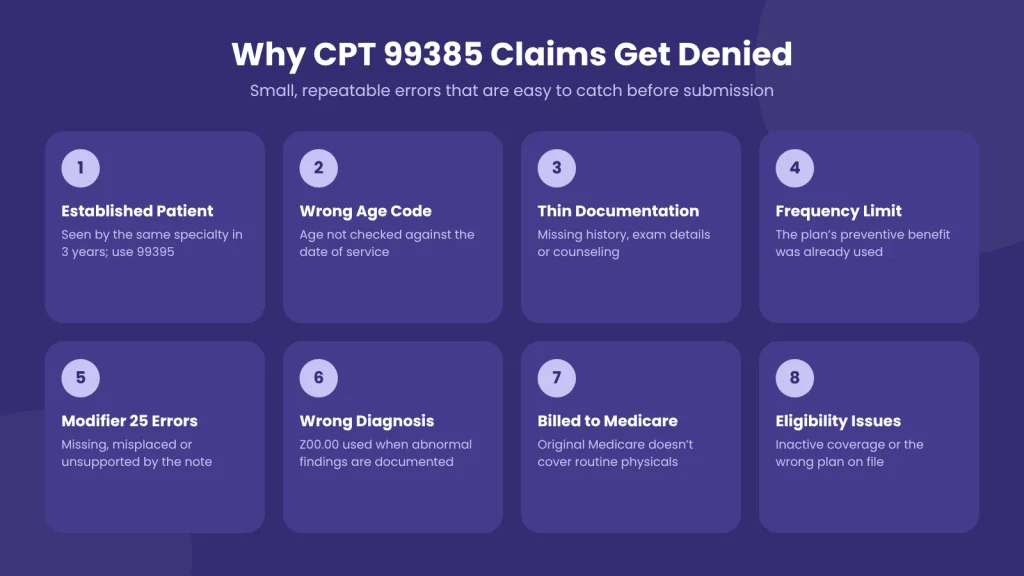
| Claim issue | Possible reason | Recommended action |
| Patient status denial | Patient was established under the three-year rule | Check same-specialty visit history and correct to 99395 if needed |
| Age-related coding issue | Wrong preventive code for the patient’s age | Recheck age on the date of service |
| Documentation issue | Note doesn’t support a comprehensive preventive service | Review documentation and query the provider if needed |
| Frequency denial | Plan’s preventive benefit limit already used | Verify the plan’s benefit period and prior preventive claims |
| Modifier-related denial | Modifier 25 missing, misplaced or unsupported | Review the separate E/M documentation and payer rules |
| Eligibility denial | Coverage inactive or wrong plan on file | Verify benefits and update insurance information |
| Non-covered service | Medicare or plan doesn’t cover routine physicals | Confirm the patient’s plan benefits and the applicable codes |
A structured denial management process groups these denials by reason, fixes the root cause and resubmits or appeals where appropriate.
How Medical Billing Services Improve Preventive Visit Reimbursement
Preventive visits are frequent and individually small, which makes them easy to under-manage. A few errors repeated across many visits add up to real lost revenue. A dedicated billing team helps with:
- Accurate CPT and ICD-10-CM code assignment, including age and patient status checks
- Patient eligibility and insurance verification before the visit
- Preventive benefit and frequency checks
- Claim scrubbing and clean claim submission
- Modifier and documentation review for same-day preventive and problem-oriented services
- Denial management and appeals
- Payment posting and A/R follow-up
- Revenue cycle reporting to track denial rates and payment trends
iSolve RCM supports these steps through our outsourced medical billing services and revenue cycle management. Primary care practices see the most preventive visits, and our guide to family practice billing and claim denials covers the issues they face most often. We also support a wide range of specialties.
When Should a Medical Practice Outsource Preventive Visit Billing?
Consider outside help when you see:
- Rising preventive care claim denials, especially for patient status or frequency
- Frequent coding and documentation errors
- Staff shortages or a growing administrative workload
- Delayed reimbursements and a growing A/R balance
- Difficulty keeping up with payer-specific preventive rules
Our comparison of in-house vs. outsourced medical billing explains the costs and trade-offs, and you can review our pricing.
Improve Preventive Visit Coding and Billing Accuracy
The 99385 CPT code reports an initial comprehensive preventive visit for new patients aged 18 through 39. Using it correctly depends on confirming the patient’s age on the date of service, applying the three-year new-patient rule correctly, documenting a complete preventive service and checking the payer’s preventive benefit and frequency rules. When a separate, significant problem is addressed during the visit, a problem-oriented E/M code with modifier 25 may also be reported, subject to payer policy.
Consistent workflows for eligibility, coding, documentation review and claim follow-up help practices avoid the small, repeated errors that cause preventive visit denials.
Frequently Asked Questions About CPT Code 99385
What is the CPT code 99385 used for?
CPT 99385 is used for an initial comprehensive preventive medicine visit for a new patient aged 18 through 39. It covers an age- and gender-appropriate history, examination, counseling, risk-factor reduction and ordering of appropriate tests. It’s commonly called a new patient physical or well visit.
What is the age limit for CPT 99385?
The age range for CPT 99385 is 18 through 39 years. The patient’s age on the date of service decides the code. A new patient aged 17 uses 99384, and a new patient aged 40 uses 99386.
Is CPT 99385 for new or established patients?
CPT 99385 is only for new patients. A patient is new if they haven’t received professional services from the provider, or another provider of the exact same specialty and subspecialty in the same group, within the past three years. Established patients aged 18–39 use CPT 99395.
What is the difference between CPT 99385 and 99395?
Both codes cover comprehensive preventive visits for adults aged 18–39. CPT 99385 is the initial visit for a new patient. CPT 99395 is the periodic reevaluation for an established patient. Patient status under the three-year rule decides which code applies.
Can CPT 99385 be billed for a 39-year-old?
Yes. Age 39 is included in the 18–39 range, so a new patient who is 39 on the date of service qualifies. If the patient has turned 40 by the date of service, the correct new-patient code is 99386.
What is the CPT code for a new patient physically?
It depends on age. For adults aged 18–39, the new patient physical code is 99385. Other ages use 99381–99384, 99386 or 99387. Medicare has separate preventive visits, G0402, G0438 and G0439, each with its own eligibility requirements.
Can CPT 99385 be billed with modifier 25?
Modifier 25 isn’t added to 99385. When a significant, separately identifiable problem is evaluated during the preventive visit, the problem-oriented office E/M code is reported with modifier 25. Trivial problems that need no extra work don’t support a separate E/M code, and payer rules vary.
What diagnosis codes are commonly used with CPT 99385?
Common codes are Z00.00 for a general adult exam without abnormal findings and Z00.01 with abnormal findings, plus codes for the findings. Z01.419 and Z01.411 apply to routine gynecological exams, depending on the service, specialty and payer. The diagnosis must match the documentation.
Does CPT 99385 include laboratory tests?
CPT 99385 includes ordering appropriate laboratory and diagnostic tests, but not performing them. Separately identifiable tests, vaccine products, immunization administration and other procedures that are actually performed may be reported separately, subject to CPT instructions and payer policies.
How often can CPT 99385 be billed?
CPT 99385 is for new patients, so it’s generally billed at the patient’s first preventive visit with the practice specialty. Once the patient is established, later preventive visits in the same age range are generally 99395. How often a preventive visit is covered depends on the patient’s plan.