
A dermatology session can transition from one of a complete skin examination, to the irritation of a seborrheic keratosis, to a shave biopsy of a changing mole, all within an hour. Each of these procedures requires a distinct code in ICD 10 CM.
If a person does not have any symptoms and is under examination for skin cancer screening, then the ICD-10-CM code to be used is Z12.83. Nevertheless, when there is a visit of the patient regarding his mole that is changing or has some suspicious appearance or other skin issue, then it will be a diagnostic procedure. It depends on the reason why the visit was made by the patient and on the findings of the doctor.
This guide covers commonly used dermatology ICD 10 CM codes for FY 2027, organized by skin condition, diagnosis type and clinical documentation requirements. This guide also provides codes for skin cancer, acne, dermatitis, psoriasis, skin lesions, fungus infection, and other skin diseases, along with guidance on coding in order to make sure that claims can be submitted properly.
How Are Dermatology ICD 10 Codes Organized?
Dermatology ICD 10 CM codes extend beyond Chapter 12 (L00-L99), which covers diseases of the skin and subcutaneous tissue. According to the diagnoses indicated, dermatologists can use codes from chapters that contain codes for neoplasms, infectious diseases, injuries, symptoms and certain other conditions influencing the state of health. Correct diagnosis classification assists in choosing the right code.
Which ICD 10 chapters do dermatologists use most?
| Chapter | Code range | What dermatology uses it for |
|---|---|---|
| Ch. 1: Certain infectious and parasitic diseases | A00-B99 | Warts, molluscum, tinea, candidiasis, herpes zoster |
| Ch. 2: Neoplasms | C00-D49 | Melanoma, basal and squamous cell carcinoma, nevi, lipomas, lesions of uncertain behavior |
| Ch. 12: Diseases of the skin and subcutaneous tissue | L00-L99 | Acne, rosacea, eczema, psoriasis, alopecia, actinic keratosis, ulcers, scars |
| Ch. 18: Symptoms, signs and abnormal findings | R00-R99 | Rash (R21) or a skin lump (R22.-) when no diagnosis has been made |
| Ch. 19: Injury, poisoning and certain other consequences of external causes | S00-T88 | Insect bites, superficial injuries, burns |
| Ch. 21: Factors influencing health status | Z00-Z99 | Skin cancer screening, cancer history, cosmetic encounters |
What changed for dermatology in FY 2027?
Chapter 12 has only one new code for FY 2027: L02.237 (Carbuncle of flank). However, three old descriptions were modified, such that the back descriptions are “any part, except buttock and flank”; L02.232 (Carbuncle of back), L03.312 (Cellulitis of back), and L03.322 (Acute lymphangitis of back).
There were no updates made to the codes related to skin cancer (C43, C44), melanocytic nevi (D22), skin cancer screening (Z12.83), or skin cancer history (Z85.82-). If any vendor or manual states that dermatology has had a huge number of codes added this year, verify that with CMS addenda first.
Coding note: The coding of a carbuncle or cellulitis found on the flank is now no longer covered by a back code. Ensure you are not using EHR favorites mapping “flank” to L02.232 or L03.312.
What are the ICD 10 codes for skin cancer?
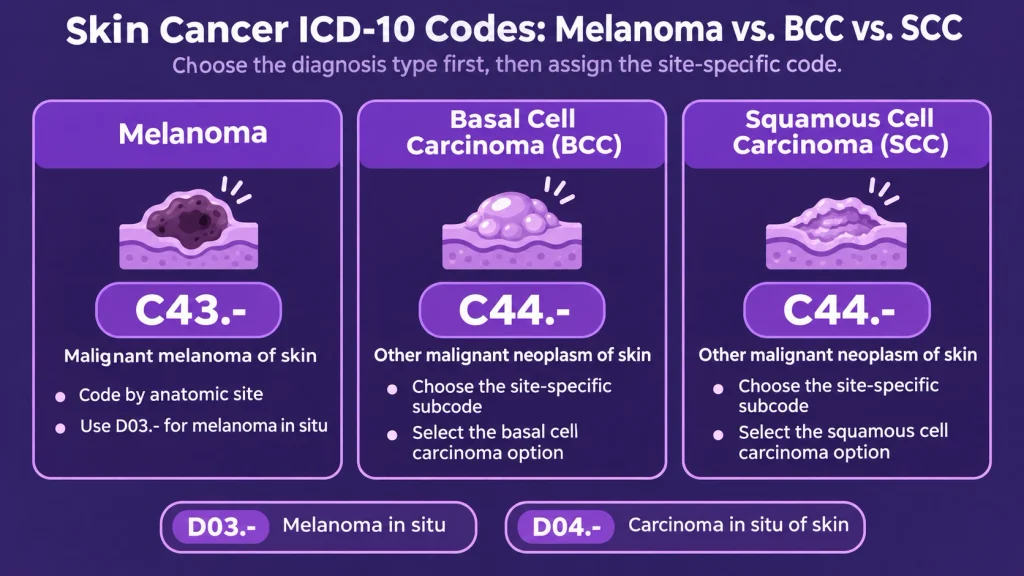
Skin cancer codes carry the most financial weight in dermatology because they drive excision, Mohs and repair codes.Moreover, the codes used for skin cancer have the smallest margin for error as well. The accurate coding of skin cancer needs the information about the type, location and laterality of the cancer when it is available in the category of ICD 10-CM codes. Melanoma, BCC, SCC and CIS all have their own sets of codes.
| Code | Description | Coding note |
|---|---|---|
| C43.- | Malignant melanoma of skin | Coded by site and side, e.g. C43.62 left upper limb, including shoulder |
| D03.- | Melanoma in situ | Use when pathology confirms in situ disease only |
| C43.9 | Malignant melanoma of skin, unspecified | Use when melanoma is confirmed but the skin site is unspecified |
| C44.91 | Basal cell carcinoma of skin, unspecified | Use when BCC is confirmed but the anatomical site is unspecified |
| C44.92 | Squamous cell carcinoma of skin, unspecified | Use when cutaneous SCC is confirmed but the anatomical site is unspecified |
| C44.311 | Basal cell carcinoma of skin of nose | Nose has its own code; do not use the “other parts of face” code |
| C44.319 | Basal cell carcinoma of skin of other parts of face | Cheek, forehead, chin, temple |
| C44.321 | Squamous cell carcinoma of skin of nose | Nose only |
| C44.329 | Squamous cell carcinoma of skin of other parts of face | An SCC on the cheek goes here, not to C44.321 |
| C44.41 / C44.42 | Basal / squamous cell carcinoma of skin of scalp and neck | No laterality for this site |
| C44.519 / C44.529 | Basal / squamous cell carcinoma of skin of other part of trunk | Back, chest, abdomen |
| C44.612 / C44.619 | Basal cell carcinoma of skin of right / left upper limb, including shoulder | Left is the 9, not the 3 |
| C44.712 / C44.719 | Basal cell carcinoma of skin of right / left lower limb, including hip | Same laterality pattern as the upper limb |
| D04.- | Carcinoma in situ of skin | Includes SCC in situ (Bowen disease) when documented |
| C4A.- | Merkel cell carcinoma | Separate category from C44 |
Coding Note: C43.9, C44.91, and C44.92 are site-unspecified codes. If the pathology and the medical record documents indicate the specific location of the skin involved, select the specific site code.
How do the C44 histology characters work?
Once you realize the sequence, C44 becomes an easy classification to code. The number following the site is the indication for cell type, where 0 represents unspecified, 1 indicates basal cell carcinoma, 2 indicates squamous cell carcinoma and 9 indicates other specified malignant neoplasms such as sebaceous carcinoma. This means that C44.4 represents scalp and neck and C44.41 would be a basal cell carcinoma there and C44.42 would be squamous cell carcinoma there.
Where a site needs one more character, it is usually for laterality or a subsite. The limbs use 2 for right and 9 for left, which trips up coders who expect 1 and 2. The face uses 1 for the nose and 9 for other parts of the face.
When should you wait for pathology?
Pathology findings may be significant when there is ambiguity in the diagnosis or nature of the lesion. The difference in CPT codes between excision of benign lesions (11400-11471) and malignant lesions (11600-11646) is made clear. It would be wise to use codes that coincide with the diagnosis made and the coding guidelines for the procedure. A change in pathology findings may necessitate a revision of the claim.
Documentation is key: When there is a biopsy on the lesion but the findings are not available, code only what was documented during the encounter. When there is pathology pending, the disease should be coded to the highest level of certainty based on the outpatient record. L98.9 would be used for an unspecified skin disorder, while D49.2 is used when there is documentation of a skin neoplasm, but the behavior is uncertain. The suspected melanoma should never be coded as a malignant disease.
What is the ICD 10 code for a skin check?
The term “skin check” is used for three totally different types of visits, which have distinct code logic depending on the purpose of the visit, not the type of examination conducted.
| Visit type | ICD 10-CM codes | When it applies |
|---|---|---|
| Annual skin check, no complaint | Z12.83 | Routine screening of an asymptomatic patient |
| Screening with a family history of melanoma | Z12.83 + Z80.8 | Z80.8 is family history of malignant neoplasm of other organs or systems, where family history of melanoma indexes |
| Surveillance after treated melanoma | Z08 + Z85.820 | Cancer was excised, treatment is complete and there is no current disease |
| Surveillance after treated BCC or SCC | Z08 + Z85.828 | Personal history of other malignant neoplasm of skin |
| Patient points to a new or changing spot | Code the sign, symptom or diagnosis | This is a diagnostic visit, not a screening |

What if the skin check finds something?
Maintain the first listed code as Z12.83 and add the diagnosis. According to the Screening Encounters Guidelines (I.C.21.c.5), the condition detected during screening is allowed to be reported as a secondary diagnosis. When the provider freezes three actinic keratoses at this visit, the procedure code is to be assigned to L57.0.
This applies to surveillance as well. In the case of a subsequent visit, if there is a recurrence of the condition that was treated, the malignant neoplasm will be coded rather than Z08. This code Z08 is used only when the malignancy has been cured.
Does insurance cover an annual skin check?
This is where front desk conversations go wrong. There is no preventive screening benefit for skin cancer under the Original Medicare, hence, a visit done purely for screening purposes by a patient with no symptoms and no past history does not qualify for coverage. In April 2023, the USPSTF, in its recommendation, noted that there was insufficient evidence to evaluate the risks and benefits of skin cancer screening among adolescents and adults.
Commercial plans vary. Some cover an annual skin exam as a preventive or specialist benefit and some do not. A history of skin cancer or a documented suspicious lesion changes the picture because the visit then has a medical reason. Verify the benefit before the visit, not after the denial.
ICD 10 codes for skin lesions, moles and cysts
The incidence of benign lesions represents a big portion of the dermatology volume. The choice of the diagnosis code will determine whether the treatment is considered to be medical necessity or not; thus, the note is as important as the code.
| Code | Description | Coding note |
|---|---|---|
| D22.5 | Melanocytic nevi of trunk | Common mole on the back, chest or abdomen |
| D22.9 | Melanocytic nevi, unspecified | Use when the site of a documented melanocytic nevus is unspecified |
| D23.9 | Other benign neoplasm of skin, unspecified | For a documented benign skin neoplasm classified to D23 when the site is unspecified |
| D22.4 / D22.39 | Melanocytic nevi of scalp and neck / other parts of face | Site drives the code |
| D22.61 / D22.62 | Melanocytic nevi of right / left upper limb, including shoulder | Lower limb uses D22.71 / D22.72 |
| L82.0 | Inflamed seborrheic keratosis | Use when the provider documents inflamed seborrheic keratosis. Medical necessity for removal must be supported by symptoms, examination findings and payer requirements. |
| L82.1 | Other seborrheic keratosis | Removal without symptoms is often treated as cosmetic |
| L72.0 | Epidermal cyst | Sometimes documented as a “sebaceous cyst”; check the Index |
| L72.11 | Pilar cyst | Usually on the scalp |
| D17.- | Benign lipomatous neoplasm | D17.1 for skin and subcutaneous tissue of trunk |
| L91.8 | Other hypertrophic disorders of the skin | Where skin tags (acrochordons) index |
| D48.5 | Neoplasm of uncertain behavior of skin | Only when pathology states uncertain behavior |
| D49.2 | Neoplasm of unspecified behavior of bone, soft tissue and skin | Neoplasm documented, behavior not yet known |
What Is the Difference Between ICD 10 Codes D48.5 and D49.2?
Code D48.5 and code D49.2 both represent varying degrees of diagnostic information related to neoplasm. Code D48.5 represents a neoplasm of uncertain behavior of skin, whereas code D49.2 represents a neoplasm of unspecified behavior of bone, soft tissue and skin.
| ICD 10 Code | Description | When to Use |
| D48.5 | Neoplasm of uncertain behavior of skin | When uncertain neoplastic behavior is established and documented, generally through pathology |
| D49.2 | Neoplasm of unspecified behavior of bone, soft tissue and skin | When a neoplasm is documented but its behavior has not been established |
Coding Note: An unbiopsied suspicious lesion is not automatically D48.5. Coders must use the provider’s documentation, the Alphabetic Index and the Tabular List to distinguish an unspecified lesion from a neoplasm of unspecified or uncertain behavior.
ICD 10 codes for acne, rosacea and perioral dermatitis
Acne codes look simple, but payers often check the documented type before approving isotretinoin or other prescription therapy. Rosacea and perioral dermatitis sit in the same category (L71) and are frequently mixed up with acne in the note.
| Code | Description | Coding note |
|---|---|---|
| L70.0 | Acne vulgaris | The most common acne code |
| L70.1 | Acne conglobata | Severe nodulocystic acne when documented as conglobata |
| L70.5 | Acne excoriee | Picked or excoriated acne |
| L70.9 | Acne, unspecified | Use only when type is not documented |
| L71.0 | Perioral dermatitis | Coded under rosacea, not under dermatitis |
| L71.1 | Rhinophyma | Phymatous rosacea of the nose |
| L71.9 | Rosacea, unspecified | L71.8 for other specified rosacea |
ICD-10 codes for eczema and dermatitis
Dermatitis is one of the most error-prone areas in derm coding because the word “eczema” means different things to different providers. The Alphabetic Index, not habit, should decide the code.
| Code | Description | Coding note |
|---|---|---|
| L20.9 | Atopic dermatitis, unspecified | Use when “atopic” is documented without a subtype |
| L20.82 / L20.84 | Flexural eczema / Intrinsic (allergic) eczema | Atopic subtypes |
| L20.89 | Other atopic dermatitis | Other specified atopic forms |
| L21.0 | Seborrhea capitis | Includes cradle cap; confirm the documented diagnosis |
| L21.9 | Seborrheic dermatitis, unspecified | Use when seborrheic dermatitis is documented without a more specific applicable classification |
| L23.- | Allergic contact dermatitis | Fifth character names the cause, e.g. L23.7 plants |
| L24.- | Irritant contact dermatitis | Also coded by cause |
| L23.9 | Allergic contact dermatitis, unspecified cause | Allergic contact dermatitis when the trigger is not identified |
| L24.9 | Irritant contact dermatitis, unspecified cause | Irritant contact dermatitis when the cause is not identified |
| L25.9 | Unspecified contact dermatitis, unspecified cause | Last resort for contact dermatitis |
| L28.0 | Lichen simplex chronicus | Chronic scratch-itch plaque |
| L30.9 | Dermatitis, unspecified | Eczema NOS indexes here, not to L20.9 |
Documentation is key: If the note says only “eczema,” the code is L30.9. If the provider means atopic dermatitis, the note needs to say so. Biologic approvals for atopic dermatitis usually expect L20.- on the claim and in the record.
Coding Note: L23.9 represents allergic contact dermatitis, while L24.9 represents irritant contact dermatitis. L25.9 applies to unspecified contact dermatitis. These diagnoses should not be treated as interchangeable because the documented dermatitis type determines the code.
ICD 10 codes for psoriasis and lichen planus
Psoriasis coding has a direct line to prior authorization. Most biologic and oral systemic approvals require the type of psoriasis, the extent of disease and the treatment history, so the code and the note have to tell the same story.
| Code | Description | Coding note |
|---|---|---|
| L40.0 | Psoriasis vulgaris | Plaque psoriasis |
| L40.1 | Generalized pustular psoriasis | Document “generalized” and “pustular” |
| L40.4 | Guttate psoriasis | Often follows strep infection |
| L40.5- | Arthropathic psoriasis | L40.50 unspecified; L40.52 psoriatic arthritis mutilans; L40.59 other |
| L40.54 | Psoriatic juvenile arthropathy | Use for documented juvenile psoriatic arthropathy, not uncomplicated psoriasis |
| L40.9 | Psoriasis, unspecified | Avoid when the type is clearly documented |
| L43.9 | Lichen planus, unspecified | Other lichen planus types are in L43.- |
When psoriatic arthritis is diagnosed, select the appropriate code from the L40.5- category based on the documented condition. For example, L40.50 represents unspecified arthropathic psoriasis, while L40.54 identifies psoriatic juvenile arthropathy. Do not assume that joint symptoms alone establish psoriatic arthritis. Review the Tabular List for any additional coding instructions.

ICD-10 codes for fungal infections, warts and molluscum
These codes live in Chapter 1, not Chapter 12, which is why coders who search only the “L” codes miss them. The fourth character of B35 names the body site.
| Code | Description | Coding note |
|---|---|---|
| B35.0 | Tinea barbae and tinea capitis | Beard and scalp |
| B35.1 | Tinea unguium | Onychomycosis |
| B35.3 | Tinea pedis | Athlete’s foot |
| B35.4 | Tinea corporis | Ringworm of the body |
| B35.6 | Tinea cruris | Groin |
| B36.0 | Pityriasis versicolor | Tinea versicolor |
| B37.2 | Candidiasis of skin and nail | Cutaneous candidiasis |
| B07.0 | Plantar wart | Verruca plantaris |
| B07.8 | Other viral warts | Common and flat warts |
| B07.9 | Viral wart, unspecified | Use only without a documented type |
| B08.1 | Molluscum contagiosum | Common in children |
| A63.0 | Anogenital (venereal) warts | Not coded to B07 |
ICD 10 Codes for Hair Loss, Excess Hair Growth and Nail Disorders
Hair loss codes are a common source of mistakes because alopecia areata, androgenic alopecia and scarring alopecia sit in different categories. Treatments such as JAK inhibitors for severe alopecia areata also tend to need prior authorization, so the specific diagnosis has to be clear.
| Code | Description | Coding note |
|---|---|---|
| L63.9 | Alopecia areata, unspecified | Use when alopecia areata is documented without a more specific |
| L63.0 / L63.1 | Alopecia (capitis) totalis / Alopecia universalis | Total scalp vs total body hair loss |
| L64.9 | Androgenic alopecia, unspecified | Male or female pattern hair loss |
| L68.0 | Hirsutism | Excessive terminal hair growth in a pattern consistent with hirsutism |
| L64.0 | Drug-induced androgenic alopecia | Not “male pattern”; it requires a drug cause |
| L64.8 | Other androgenic alopecia | Other specified forms |
| L65.0 | Telogen effluvium | Diffuse shedding after a trigger |
| L66.- | Cicatricial alopecia [scarring hair loss] | Includes lichen planopilaris types |
| L60.0 | Ingrowing nail | Ingrown toenail |
| L60.3 | Nail dystrophy | Not the same as onychomycosis (B35.1) |
| L73.2 | Hidradenitis suppurativa | Hurley staging belongs here, not in alopecia notes |
| L73.1 | Pseudofolliculitis barbae | Razor bumps |
| L73.9 | Follicular disorder, unspecified | Folliculitis NOS |
How to avoid hair loss denials? Match the scoring tool to the disease. Alopecia areata notes typically use a SALT score for extent, while Hurley staging describes hidradenitis suppurativa. A payer reviewer will notice when the two are swapped.
ICD 10 codes for sun-damaged skin and pigmentation
Sun damage and pigment codes sit on the line between medical and cosmetic care. Actinic keratosis is a precancerous lesion and is usually treated as medically necessary. Many pigment complaints are not.
| Code | Description | Coding note |
|---|---|---|
| L57.0 | Actinic keratosis | Supports destruction codes 17000-17004 |
| L57.1 | Actinic reticuloid | A chronic photosensitivity-related skin condition; distinct from actinic keratosis |
| L57.8 | Other skin changes due to chronic exposure to nonionizing radiation | Photoaging changes when documented |
| L55.- | Sunburn | Coded by degree: L55.0 first, L55.1 second, L55.2 third |
| L80 | Vitiligo | Three characters, billable as is |
| L81.0 | Postinflammatory hyperpigmentation | Darkening after acne or injury |
| L81.1 | Chloasma | Melasma |
| L81.2 | Freckles | Freckles have their own code |
| L81.4 | Other melanin hyperpigmentation | Lentigo, including solar lentigo |
Watch out: Freckles go to L81.2, not L81.4. Lentigines and freckles are not interchangeable in ICD-10-CM even though some reference charts group them.
Coding Note: L57.0 identifies actinic keratosis, while L57.1 represents actinic reticuloid. Although both belong to the L57 category, they describe different conditions and should not be used interchangeably.
ICD-10 codes for scars, skin thickening and connective tissue disease
| Code | Description | Coding note |
|---|---|---|
| L91.0 | Hypertrophic scar | Keloids are included here |
| L90.0 | Lichen sclerosus et atrophicus | Use for documented lichen sclerosus et atrophicus, subject to applicable site-specific coding instructions |
| L90.5 | Scar conditions and fibrosis of skin | Scar NOS |
| L84 | Corns and callosities | Billable at three characters |
| L85.0 | Acquired ichthyosis | Use when acquired ichthyosis is documented |
| L85.3 | Xerosis cutis | Dry skin |
| L94.0 | Localized scleroderma [morphea] | Skin-limited disease |
| L93.0 | Discoid lupus erythematosus | Cutaneous lupus |
| M34.9 | Systemic sclerosis, unspecified | Systemic disease belongs in Chapter 13 |
The split between L94.0 and M34.9 matters. Morphea is limited to the skin, while systemic sclerosis is a multisystem connective tissue disease. Coding one for the other changes how the patient’s risk is represented in every downstream claim.
ICD-10 codes for hives, heat rash and other eruptions
| Code | Description | Coding note |
|---|---|---|
| L50.0 | Allergic urticaria | Cause documented as allergic |
| L50.1 | Idiopathic urticaria | No identified cause |
| L50.9 | Urticaria, unspecified | Hives NOS |
| L74.0 | Miliaria rubra | Heat rash |
| L74.1 | Miliaria crystallina | Specific type of sweat duct obstruction associated with superficial clear vesicles |
| L74.3 | Miliaria, unspecified | Type not documented |
| L29.9 | Pruritus, unspecified | Itch without a diagnosed cause |
| R21 | Rash and other nonspecific skin eruption | Use only until a diagnosis is made |
| L98.9 | Disorder of the skin and subcutaneous tissue, unspecified | A true last resort |
Insect and tick bites are coded as injuries, not as dermatitis. A nonvenomous insect bite of the left lower leg, for example, is S80.862A with the external cause code W57.XXXA. Our guide to tick bite ICD-10 codes walks through the full body-site map.
Coding Note: Miliaria rubra (L74.0) and miliaria crystallina (L74.1) are different types of heat-related skin eruptions. If the miliaria type is not documented, L74.3 may be appropriate.
ICD-10 codes for chronic skin ulcers
Chronic skin ulcer codes identify the ulcer location and clinical severity, with laterality included where applicable. L97.- codes describe non-pressure chronic ulcers of the lower limb and use additional characters to identify the site and severity. L89.- codes classify pressure ulcers by site and stage. Documentation must support the selected code, including the affected tissue, ulcer severity or stage and any associated underlying condition.
| Code | Description | Coding note |
|---|---|---|
| L89.- | Pressure ulcer | Coded by site and stage, e.g. L89.154 sacral region, stage 4 |
| L97.- | Non-pressure chronic ulcer of lower limb, not elsewhere classified | e.g. L97.412 right heel and midfoot with fat layer exposed |
| L97.909 | Non-pressure chronic ulcer of unspecified part of unspecified lower leg with unspecified severity | Use when the documented ulcer information does not support a more specific applicable code |
| L98.499 | Non-pressure chronic ulcer of skin of other sites with unspecified severity | For applicable non-pressure chronic skin ulcers of other sites when severity is unspecified |
| L98.41- / L98.42- | Non-pressure chronic ulcer of buttock / back | Depth required |
| L98.49- | Non-pressure chronic ulcer of skin of other sites | Depth required |
Coding Note: L97.909 and L98.499 contain unspecified information. Documentation of the exact ulcer site, laterality and severity may support a more specific diagnosis code. Pressure ulcers must be distinguished from non-pressure chronic ulcers because they use a different ICD-10-CM classification.
What is the cosmetic ICD-10 code?
ICD-10-CM code Z41.1 identifies an encounter for cosmetic surgery. In dermatology, it may be relevant when a procedure is performed solely to improve appearance rather than treat a medical condition. However, not every cosmetic dermatology encounter automatically requires Z41.1. Code selection depends on the purpose of the service and documented diagnosis. Encounters for qualifying reconstructive procedures following medical treatment or healed injuries may fall under Z42.- instead.
Cosmetic surgery is a statutory exclusion under Medicare. When a Medicare patient chooses a cosmetic service, practices commonly append the GY modifier (item or service statutorily excluded) so the claim denies correctly to patient responsibility.
| Situation | Likely diagnosis coding | Why |
|---|---|---|
| SK that bleeds, itches or catches on clothing | L82.0 | Use the documented diagnosis. L82.0 applies if inflamed seborrheic keratosis is established. Symptoms and medical necessity must be documented. |
| SK removed for appearance only | Z41.1 + L82.1 | Cosmetic intent |
| Skin tag that is irritated or inflamed | L91.8 with symptoms documented | Payer policies often require symptoms |
| Scar revision after a healed injury | Z42.- + scar code | Determine whether the procedure is reconstructive or cosmetic. Select the appropriate diagnosis and encounter codes based on the documented purpose. |
How to choose the right dermatology diagnosis code
Most dermatology coding errors come from skipping a step, not from not knowing the code. This order keeps the workflow consistent across providers and locations, whether your team codes in house or uses outsourced medical coding services.
Start with the reason for the visit. Screening, surveillance and diagnostic visits use different codes even when the exam looks identical.
Use the provider’s diagnosis, not your own reading of the note. Code assignment is based on the provider’s diagnostic statement (Section I.A.19 of the FY 2027 guidelines).
Look the term up in the Alphabetic Index first. This is how you find that “eczema” goes to L30.9 and “skin tag” goes to L91.8. Then confirm in the Tabular List.
Code to the full number of characters. A code is invalid if it is not reported at the highest level of detail available (Section I.B.2). C44.6 or L97.4 alone will reject.
Capture laterality and site. When a code offers right and left, the documented side should be used (Section I.B.13). Unspecified laterality on a limb skin cancer is an easy error to avoid when the side is already in the note.
Read the instructional notes. Review Excludes1 and Excludes2 notes under Section I.A.12, along with code-first and use-additional-code instructions under Section I.A.13. These conventions help determine which diagnoses may be reported together and the required sequencing.
Hold the claim for pathology when the code depends on it. Benign and malignant excision codes depend on the final report, and so does the diagnosis that supports them.
Common dermatology ICD 10 coding errors
Using L98.9 or R21 when a diagnosis exists. Unspecified codes are allowed when that is all the record supports, but they invite review when the note clearly names the condition. How to Avoid? Check the assessment section before you default to an unspecified code.
Coding a skin check as Z12.83 when the patient had a complaint. A patient who comes in for a changing mole is having a diagnostic visit. How to Avoid? Read the chief complaint and history before choosing the first-listed code.
Mixing up the nose and the rest of the face. C44.321 is the nose only. A cheek SCC is C44.329. How to Avoid? Build separate EHR favorites for nose and other face sites.
Reporting history codes while the cancer is still being treated. Z85.- applies only once treatment is complete and there is no evidence of disease. How to Avoid? Confirm the treatment status in the note before switching from C codes to Z codes.
Billing cosmetic removals as medical. Removing an asymptomatic SK coded as L82.0 without documented inflammation is a classic audit target. How to Avoid? Document the symptom that makes removal medically necessary, or code Z41.1.

Conclusion
Accurate dermatology ICD-10-CM coding in FY 2027 depends on selecting the diagnosis that matches the provider’s documentation. Skin cancer codes require attention to cancer type, anatomical site and laterality, while chronic ulcer codes require the correct site and severity. Screening, diagnostic visits and post-treatment surveillance follow different coding rules. By verifying code specificity, pathology findings where applicable and payer requirements, dermatology practices can reduce avoidable coding errors and improve claim accuracy.
Frequently asked questions
What is the ICD-10 code for an annual skin check?
ICD-10-CM code Z12.83 is used for an encounter specifically involving skin cancer screening in an asymptomatic patient. A diagnostic visit for a changing mole or suspicious skin lesion requires coding based on the documented condition or symptoms. Family history of melanoma may be represented by Z80.8 when relevant to the encounter.
What ICD-10 code is used for a skin check after skin cancer?
Use Z08 (Encounter for follow-up examination after completed treatment for malignant neoplasm) first, followed by Z85.820 for a history of melanoma, Z85.821 for Merkel cell carcinoma or Z85.828 for other skin cancers such as BCC and SCC. If disease is found, code the cancer instead of Z08.
What is the cosmetic ICD-10 code?
Z41.1 is the ICD-10-CM code for an encounter for cosmetic surgery. The appropriate code depends on the purpose of the procedure and the documented condition. Some qualifying reconstructive encounters may be coded under Z42.-. Cosmetic services are generally excluded from Original Medicare coverage.
What are the most common dermatology ICD-10 codes?
Common dermatology ICD-10-CM codes include L70.0 for acne vulgaris, L40.0 for psoriasis vulgaris, L20.9 for atopic dermatitis, L57.0 for actinic keratosis, L82.0 for inflamed seborrheic keratosis and B35.1 for onychomycosis. Skin cancer diagnosis codes include C43.- for melanoma and C44.- for other specified skin malignancies, while Z12.83 identifies skin cancer screening encounters. The frequency of each diagnosis varies by practice.
Did dermatology ICD 10 codes change in 2027?
Only slightly. FY 2027 added L02.237 (Carbuncle of flank) and revised the descriptors of L02.232, L03.312 and L03.322 to exclude the flank. Skin cancer, nevi, screening and skin cancer history codes did not change. The FY 2027 code set applies from October 1, 2026 through September 30, 2027.
What is the ICD-10 code for family history of melanoma?
Family history of melanoma is coded to Z80.8, Family history of malignant neoplasm of other organs or systems. During a skin cancer screening it is reported as an additional code after Z12.83.


