Difficulty swallowing shows up across almost every specialty. A primary care physician hears it as a complaint, a gastroenterologist investigates it, a speech-language pathologist (SLP) evaluates it, and a skilled nursing facility manages it every day. Each of those encounters needs a diagnosis code, and the code has to match what the provider actually documented.
That’s where dysphagia ICD-10 coding gets tricky. The ICD-10-CM system doesn’t have just one dysphagia code. It has a family of codes under subcategory R13.1, and most of them describe the specific phase of swallowing that’s affected. Choosing the unspecified code when the record names a phase, or choosing a phase the provider never documented, leads to inaccurate claims, medical necessity problems and avoidable denials.
This guide explains each dysphagia ICD-10 codes from R13.10 to R13.19, related codes for odynophagia, esophageal and stroke-related dysphagia, documentation requirements and how diagnosis codes connect to swallowing study and therapy billing.
What Is the ICD-10 Code for Dysphagia?
The ICD-10-CM code for unspecified dysphagia is R13.10. When documentation identifies the swallowing phase, more specific codes include R13.11, R13.12, R13.13 and R13.14. R13.19 is used for other specified dysphagia. The appropriate code depends on the provider’s documentation and the applicable ICD-10-CM coding guidelines.
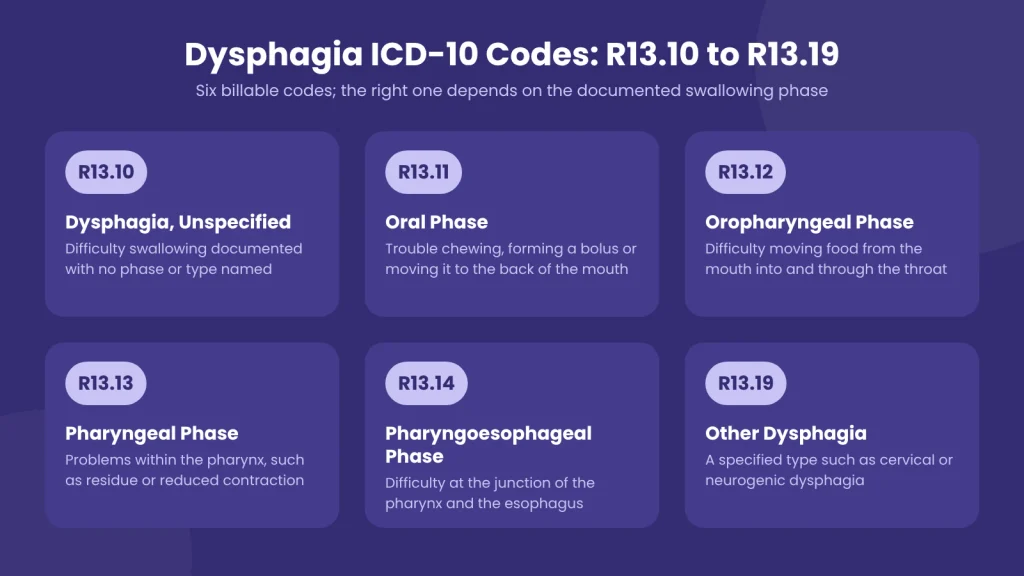
| ICD-10-CM code | Official description | Billable? |
| R13.10 | Dysphagia, unspecified | Yes |
| R13.11 | Dysphagia, oral phase | Yes |
| R13.12 | Dysphagia, oropharyngeal phase | Yes |
| R13.13 | Dysphagia, pharyngeal phase | Yes |
| R13.14 | Dysphagia, pharyngoesophageal phase | Yes |
| R13.19 | Other dysphagia | Yes |
These codes sit in Chapter 18 of ICD-10-CM (Symptoms, Signs and Abnormal Clinical and Laboratory Findings), under category R13, Aphagia and dysphagia. Neither the category R13 nor the subcategory R13.1 is a billable diagnosis code. A claim must carry a complete five-character code such as R13.10 or R13.12.
The same category also contains R13.0, Aphagia, which means the inability to swallow. Aphagia and dysphagia aren’t the same condition, so don’t use them interchangeably.
Two instructional notes apply to the R13.1 subcategory:
- Code first, if applicable: dysphagia following cerebrovascular disease (I69. with final characters -91).
- Excludes1: psychogenic dysphagia (F45.8). Dysphagia documented as functional, hysterical, nervous or psychogenic is coded to F45.8, not to R13.1-.
Always check the current FY 2027 ICD-10-CM code set (effective October 1, 2026 through September 30, 2027) for the date of service.
R13.10 to R13.19: Understanding Each Dysphagia ICD-10 Code
Swallowing is usually described in phases. Food or liquid is prepared and moved in the mouth (oral phase), triggered into the throat (pharyngeal phase), passed through the upper esophageal sphincter (pharyngoesophageal segment) and carried down to the stomach (esophageal phase). ICD-10-CM uses those phases to make dysphagia codes more specific.
The key rule for every code below: the code must reflect the provider’s documented diagnosis. A coder shouldn’t infer a phase from symptoms or test results that the provider hasn’t interpreted.
R13.10 – Dysphagia, Unspecified ICD-10
R13.10 is the dysphagia unspecified ICD-10 code. It’s used when the provider documents dysphagia or difficulty swallowing but doesn’t identify a specific phase or type.
It’s commonly used in these situations:
- Initial visits. A patient reports difficulty swallowing and the workup hasn’t started yet.
- Primary care and urgent care, where the provider documents the symptom and refers the patient for further evaluation.
- Records where no phase is named, even though the patient clearly has a swallowing problem.
Index terms such as “difficulty in swallowing” and “dysphagia” without further description lead to R13.10. Many code references also list “impaired swallowing” and “swallowing problem” as approximate synonyms.
When not to use R13.10:
- When the provider has documented a specific phase, such as “oropharyngeal dysphagia.” In that case the more specific code is required.
- When a coder simply prefers it because it’s familiar. Overusing R13.10 is a common audit finding.
Don’t assume a phase from symptoms alone. Coughing during meals, food sticking or drooling can suggest a phase, but only the provider’s diagnosis can establish it. If the record is unclear, query the provider rather than guessing.
Common search phrases such as “R13.10 diagnosis code” and “R13.10 ICD 10 code” all point to this same code: dysphagia, unspecified.
R13.11 – Dysphagia, Oral Phase
R13.11 reports oral phase dysphagia, meaning difficulty in the first, voluntary stage of swallowing. This is where food is chewed, mixed with saliva, formed into a bolus and pushed toward the back of the mouth.
Clinical signs that providers often document include:
- Difficulty chewing or forming a bolus
- Food or liquid leaking from the lips
- Pocketing of food in the cheeks
- Slow or uncoordinated tongue movement
- Delay in moving the bolus to the back of the mouth
Oral phase problems often appear after head and neck surgery or cancer treatment, in patients with neurological conditions, and in patients with dental or oral motor problems.
Documentation that supports R13.11: A note stating “oral phase dysphagia” or “dysphagia, oral phase,” usually based on a clinical swallowing evaluation, along with the findings behind the diagnosis.
R13.12 – Dysphagia, Oropharyngeal Phase
R13.12 reports oropharyngeal dysphagia, meaning difficulty moving food or liquid from the mouth into and through the throat. It’s one of the most frequently reported specific dysphagia codes, especially in speech-language pathology, neurology, rehabilitation and skilled nursing settings.
Providers often document:
- Coughing or choking during or right after swallowing
- Delayed swallow initiation
- Nasal regurgitation
- Wet or gurgly voice after swallowing
- Penetration or aspiration seen on an instrumental study
Oropharyngeal dysphagia is closely linked to stroke, Parkinson’s disease, ALS, multiple sclerosis, dementia and head and neck cancer.
Documentation that supports R13.12: The provider must document the oropharyngeal phase. If an SLP evaluation describes findings but the treating provider’s diagnosis only says “dysphagia,” confirm that the diagnosing professional has actually identified the phase before assigning R13.12. Search phrases such as “R13.12 diagnosis code” and “ICD-10 code for oropharyngeal dysphagia” refer to this code.
R13.13 – Dysphagia, Pharyngeal Phase
R13.13 reports dysphagia in the pharyngeal phase, the reflexive stage when the bolus moves through the pharynx while the airway is protected.
R13.12 covers the transition from the mouth into the throat. R13.13 focuses on problems within the pharyngeal stage itself, such as:
- Reduced pharyngeal contraction
- Residue in the valleculae or pyriform sinuses
- Reduced laryngeal elevation or airway closure
- Aspiration during the swallow
These findings are usually confirmed with an instrumental assessment such as a videofluoroscopic swallow study or a fiberoptic endoscopic evaluation of swallowing (FEES).
How it differs from R13.11 and R13.12: R13.11 is limited to the mouth, R13.12 covers the oral-to-pharyngeal transition and R13.13 is limited to the pharynx. The provider’s diagnosis should name the phase clearly.
R13.14 – Dysphagia, Pharyngoesophageal Phase
R13.14 reports pharyngoesophageal phase dysphagia. This is difficulty moving the bolus from the pharynx into the esophagus through the pharyngoesophageal segment, which includes the upper esophageal sphincter (cricopharyngeus).
Providers may document:
- Reduced opening of the upper esophageal sphincter
- A cricopharyngeal bar seen on imaging
- Residue at the level of the pyriform sinuses after the swallow
- Food sticking at the base of the throat
Pharyngeal vs. pharyngoesophageal: R13.13 describes problems within the pharynx. R13.14 describes problems at the junction between the pharynx and the esophagus.
R13.14 is not a general esophageal dysphagia code. Esophageal dysphagia, meaning difficulty in the body of the esophagus or at the lower esophageal sphincter, is discussed separately below.
R13.19 – Other Dysphagia
R13.19 reports other dysphagia: a documented, specified type of dysphagia that doesn’t fit any of the phase codes above. The ICD-10-CM Index lists examples such as:
- Cervical dysphagia
- Neurogenic dysphagia
R13.19 is still a symptom code. It shouldn’t be used as a catch-all when the documentation is simply vague. If the record only says “dysphagia,” R13.10 is correct. R13.19 needs a specific type that the provider has named.
The Excludes1 note for R13.1- applies here too. Psychogenic dysphagia goes to F45.8, not R13.19.
How to Choose the Correct Dysphagia Diagnosis Code
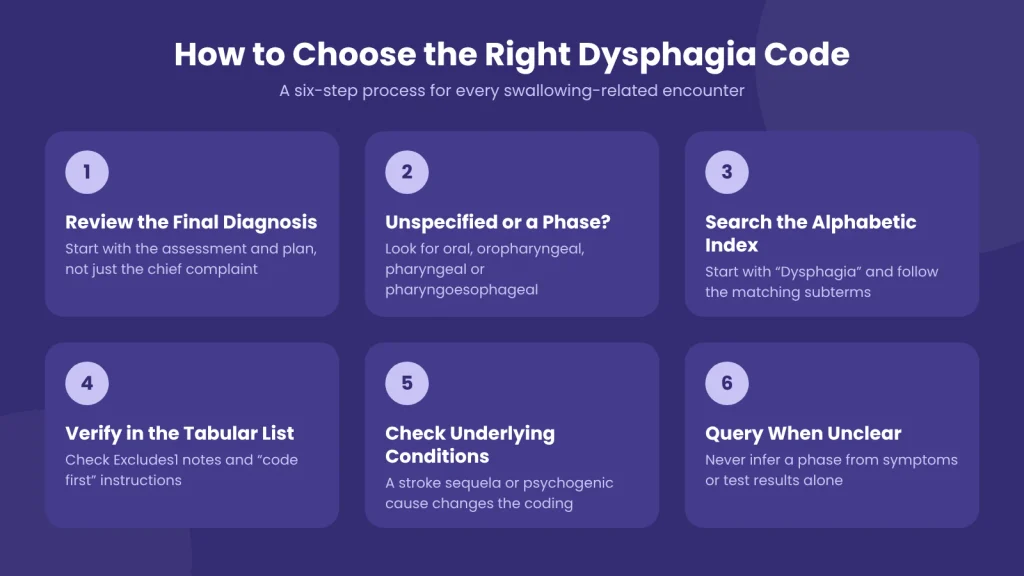
A consistent process helps coders choose the right dysphagia diagnosis code every time:
- Review the treating provider’s final diagnosis. Start with the assessment and plan, not just the chief complaint.
- Determine whether dysphagia is unspecified or a specific phase. Look for terms such as “oral,” “oropharyngeal,” “pharyngeal,” “pharyngoesophageal,” “cervical” or “neurogenic.”
- Look up the documented term in the Alphabetic Index. Start with “Dysphagia” and follow the subterms.
- Verify the code in the Tabular List. Check the full code, instructional notes, Excludes1 and Excludes2 notes, and “code first” or “use additional code” instructions.
- Check for an underlying condition that changes sequencing. Examples include a cerebrovascular sequela, a definitive esophageal diagnosis or a psychogenic cause.
- Confirm the record supports the code. If the documentation is unclear or contradictory, query the provider.
| Documentation says | Coding consideration |
| Dysphagia, no phase specified | R13.10 |
| Oral phase dysphagia | R13.11 |
| Oropharyngeal phase dysphagia | R13.12 |
| Pharyngeal phase dysphagia | R13.13 |
| Pharyngoesophageal phase dysphagia | R13.14 |
| Cervical or neurogenic dysphagia (other specified) | R13.19 |
| Psychogenic or functional dysphagia | F45.8 (not R13.1-) |
| Dysphagia as a sequela of stroke | I69.-91 sequenced first, plus R13.1- as instructed |
Important: Coders should also stay informed about current ICD-10-CM coding updates to ensure diagnosis codes reflect the applicable fiscal-year requirements.
Symptom Codes vs. Definitive Diagnoses
R13.1- codes are symptom codes. Under the ICD-10-CM guidelines, signs and symptoms that are routinely associated with a confirmed definitive diagnosis generally aren’t coded separately. They’re reported when the cause hasn’t been established, or when the symptom isn’t routinely part of the confirmed condition and adds clinical information.
In practice, this means:
- Before the workup: R13.10, or a phase code if the phase is documented, is appropriate.
- After the provider confirms a cause: Code the cause, such as an esophageal stricture, achalasia or eosinophilic esophagitis, and follow the guidelines on whether the dysphagia symptom is also reported.
- When dysphagia is a manifestation the classification tells you to report separately, such as a stroke sequela, follow the specific instruction.
Related Dysphagia and Swallowing Difficulty ICD-10 Codes
Many searches for dysphagia codes are actually about related conditions. This section covers the most common ones.
Odynophagia ICD-10: Painful Swallowing
Odynophagia means pain when swallowing. Dysphagia means difficulty swallowing. A patient can have one without the other, or both together, so the two terms shouldn’t be treated as the same diagnosis.
There is no single code that fits every case of odynophagia. Before assigning a code:
- Look up “odynophagia” in the current Alphabetic Index and verify the result in the Tabular List. Don’t rely on a synonym list from a code lookup website.
- Code the confirmed underlying condition when it’s documented. Pharyngitis, esophagitis, candidiasis or a malignancy should be coded as diagnosed, following the symptom-coding guidelines.
- Don’t add a phase code because swallowing hurts. Pain doesn’t establish an oral, pharyngeal or other phase.
Search phrases such as “odynophagia ICD-10,” “painful swallowing ICD-10” and “ICD-10 code for odynophagia” should all lead coders back to the Index entry and the documented cause.
Esophageal Dysphagia ICD-10
Esophageal dysphagia is difficulty moving food through the body of the esophagus or into the stomach. Patients often describe food “sticking” in the chest. Oropharyngeal dysphagia, by contrast, happens at the start of the swallow, often with coughing or choking.
ICD-10-CM has no separate “esophageal phase” code in the R13.1- subcategory, and the Alphabetic Index has no “esophageal” subentry under Dysphagia. In the Index, the main term Dysphagia defaults to R13.10, and specified NEC leads to R13.19. These two codes are not interchangeable. The correct one depends on the exact term the provider documented.
How to code it:
- If the provider documents a cause, code the cause. Examples include esophageal stricture, achalasia, esophageal spasm, eosinophilic esophagitis, GERD or an esophageal tumor, each coded as documented and in line with the symptom-coding guidelines.
- If no cause is documented, look up the documented term in the current Alphabetic Index, then verify the code and its instructional notes in the Tabular List.
- Don’t assign R13.14 unless the provider documents the pharyngoesophageal phase. That code describes the junction between the pharynx and the esophagus, not the esophagus itself.
Dysphagia Following CVA or Stroke ICD-10
Dysphagia is one of the most common sequelae (residual effects) of a stroke. ICD-10-CM has combination codes for it in category I69, Sequelae of cerebrovascular disease:
| ICD-10-CM code | Description |
| I69.091 | Dysphagia following nontraumatic subarachnoid hemorrhage |
| I69.191 | Dysphagia following nontraumatic intracerebral hemorrhage |
| I69.291 | Dysphagia following other nontraumatic intracranial hemorrhage |
| I69.391 | Dysphagia following cerebral infarction |
| I69.891 | Dysphagia following other cerebrovascular disease |
| I69.991 | Dysphagia following unspecified cerebrovascular disease |

Sequencing: The R13.1 subcategory carries a “code first, if applicable” note for dysphagia following cerebrovascular disease (I69. codes with final characters -91). Apply it in three steps:
- Sequence the appropriate I69.91 code first.
- Follow the I69 Tabular List instruction to identify the type of dysphagia with an additional R13.1- code when the type is known.
- Don’t assign a phase code the documentation doesn’t support. If the record doesn’t name the phase, query the provider when it matters clinically or for coverage.
For example, oropharyngeal dysphagia following a cerebral infarction is reported as I69.391 + R13.12.
Also remember:
- Sequela codes describe residual effects after the acute stroke episode. During the acute stroke admission, the acute cerebrovascular code applies, not I69.
- The type of stroke matters. Choose the I69 subcategory (infarction, hemorrhage, other or unspecified) that matches the documented history.
Common search phrases such as “CVA with dysphagia ICD-10” and “dysphagia following stroke ICD-10” refer to this code group.
Other Related Symptoms: Choking, Aspiration and Poor Oral Intake
Swallowing complaints often come with related symptoms and complications. These aren’t interchangeable with dysphagia, and each may need its own code when it’s clinically documented:

| Documented condition | Coding consideration |
| Choking episodes | Code based on the documented cause. A foreign body in the airway uses the T17.- injury codes. A choking sensation is a different symptom. |
| Aspiration pneumonia | J69.0, Pneumonitis due to inhalation of food and vomit |
| Silent aspiration (finding on study) | Code as documented by the provider; it doesn’t automatically equal pneumonia |
| Feeding difficulties | R63.3- (including pediatric feeding disorder codes R63.31 and R63.32) |
| Poor or decreased oral intake | Index to the documented term; often R63.8, other symptoms concerning food and fluid intake |
| Aphagia (inability to swallow) | R13.0 |
| Dysphasia (language disorder) | R47.02. This is a speech and language code, not a swallowing code. |
Key point: Don’t assign R13.10 automatically to every swallowing-related complaint. Code what the provider documented.
Dysphagia ICD-10 Billing and Documentation Requirements
What Documentation Supports a Dysphagia Diagnosis?
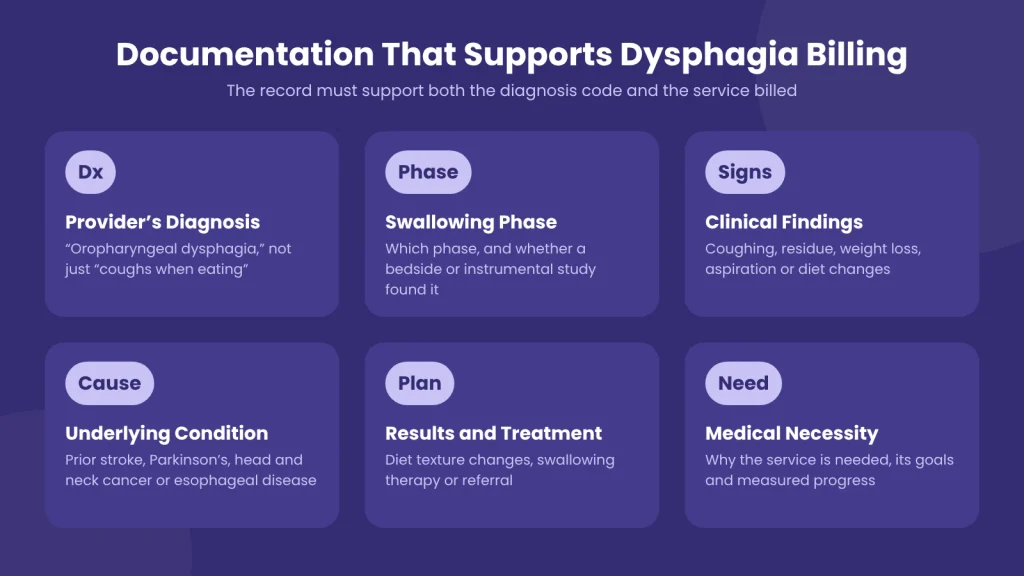
Strong documentation is what makes a dysphagia claim defensible. The record should include:
- The provider’s diagnosis and assessment. For example, “oropharyngeal dysphagia,” not just “patient coughs when eating.”
- The swallowing phase, when established, and how it was established, whether by bedside evaluation or an instrumental study.
- Symptoms and clinical findings, such as coughing, residue, weight loss, aspiration or diet changes.
- The underlying cause or associated condition, such as a prior stroke, Parkinson’s disease, head and neck cancer or an esophageal disorder.
- Evaluation results and the treatment plan, such as diet texture changes, swallowing therapy, compensatory strategies or referral.
- Medical necessity for each test or therapy session: why the service is needed, what it’s expected to achieve and how progress will be measured.
For therapy services, the plan of care should connect the diagnosis to measurable goals. Progress notes should show that the patient is benefiting from skilled treatment.
Common Dysphagia Coding Errors That Can Cause Claim Denials
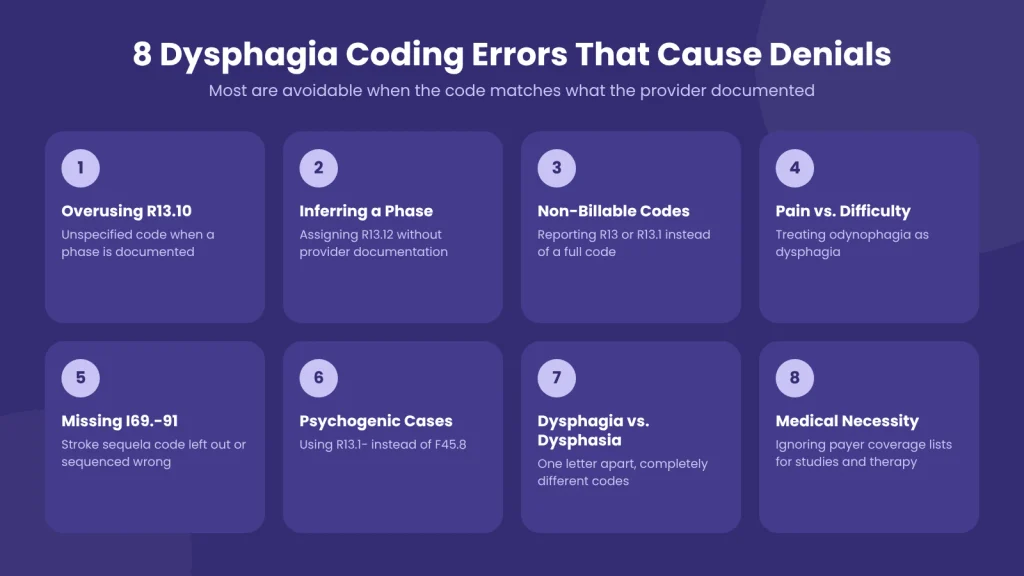
- Using R13.10 when a more specific phase is documented. Payers and auditors expect the highest level of specificity the record supports.
- Selecting R13.12 (or another phase) without provider documentation. Assigning a phase from the coder’s reading of symptoms isn’t supported.
- Reporting the non-billable R13 or R13.1 instead of a complete five-character code.
- Confusing odynophagia with dysphagia, or adding a phase code because the patient reports pain.
- Missing the I69.-91 stroke sequela code or sequencing it incorrectly.
- Using R13.1- for psychogenic dysphagia instead of F45.8.
- Confusing dysphagia (swallowing) with dysphasia (language). The two words differ by one letter, and the codes are completely different.
- Reporting symptoms that the medical record doesn’t support, or symptoms integral to a confirmed definitive diagnosis.
- Failing to meet payer-specific medical necessity requirements for swallowing studies or therapy, including coverage policies that list covered diagnoses.
Following proper medical coding compliance practices helps healthcare providers maintain accurate diagnosis coding, meet documentation requirements, and reduce avoidable claim denials.
Dysphagia ICD-10 Codes and Swallowing Study Billing
Diagnosis codes explain why a service was performed. Procedure codes describe what was performed. Swallowing-related services commonly include:

| Service | Common CPT code(s) |
| Clinical (bedside) evaluation of oral and pharyngeal swallowing function | 92610 |
| Motion fluoroscopic evaluation of swallowing function (modified barium swallow / videofluoroscopic swallow study), SLP component | 92611 |
| Radiological swallowing function study (radiology component) | 74230 |
| Flexible endoscopic evaluation of swallowing (FEES) | 92612 (with 92613 for interpretation and report only) |
| FEES with laryngeal sensory testing | 92616 (with 92617 for interpretation and report only) |
| Treatment of swallowing dysfunction and/or oral function for feeding | 92526 |
Procedure code selection depends on the service actually performed, who performed it and the payer’s rules. A modified barium swallow, for example, often involves both an SLP code and a radiology code billed by different providers. Verify current CPT descriptors and payer-specific billing requirements before submitting claims. For additional guidance on gastrointestinal procedure billing, explore our EGD CPT codes guide to better understand procedure coding and related billing requirements.
Many Medicare Administrative Contractors (MACs) publish coverage policies or billing articles for swallowing studies and dysphagia treatment. These may list which ICD-10-CM codes support medical necessity and what documentation is required. Check the current policy for your MAC jurisdiction, including its effective dates, before billing.
ICD-10 Dysphagia Codes vs. CPT Codes: What Is the Difference?
People often search for a “CPT code for dysphagia,” but that phrase mixes two different code sets:
| ICD-10-CM | CPT | |
| What it describes | The patient’s diagnosis or reason for the service | The service, evaluation, test or treatment performed |
| Dysphagia example | R13.12, Dysphagia, oropharyngeal phase | 92610, clinical swallowing evaluation; 92526, swallowing treatment |
| Maintained by | CMS and NCHS (U.S. clinical modification) | American Medical Association |
| Updated | Annually, effective October 1 | Annually, effective January 1 |
There’s no single CPT code for dysphagia because dysphagia is a diagnosis, not a service. A clean claim links the right diagnosis code (why) to the right procedure code (what). If either is wrong, or the two don’t support each other, the claim is at risk.
How Accurate Dysphagia Coding Supports Reimbursement
Dysphagia is common in the patient populations that generate the most complex claims: stroke survivors, older adults in skilled nursing facilities, cancer patients and people with neurological disease. Accurate coding protects revenue in several ways:
- Correct diagnosis selection supports medical necessity. Swallowing studies and therapy are often reviewed against payer coverage lists, so a specific, documented code strengthens the claim.
- Complete documentation supports claim review. When records are requested, the note should clearly support the code and the service.
- Accurate diagnosis-to-procedure linkage prevents avoidable denials. Each procedure line should point to the diagnosis that justifies it.
- Proper sequencing matters when dysphagia follows a cerebrovascular event. A missing or misplaced I69 code is a frequent edit failure.
- Understanding common medical billing denial codes can help billing teams identify claim issues, recognize recurring denial patterns, and improve reimbursement processes.
In facility settings, accurate diagnosis coding also affects quality reporting and data. Practices that serve nursing home residents can find related guidance in our nursing home CPT codes guide. Practices treating neurological patients may also find our neuropathy ICD-10 codes guide useful.
How iSolve RCM Helps With Medical Coding and Dysphagia Billing
Accurate Medical Coding and Diagnosis Review
iSolve RCM’s coding team reviews provider documentation to confirm that each dysphagia diagnosis is coded to the highest supported specificity. That includes checking phase codes, applying stroke-related sequencing and identifying when a provider query is needed. Learn more about our medical coding services.
Medical Billing Audits and Claim Accuracy
A medical billing audit can find unsupported diagnosis codes, missing documentation, overuse of unspecified codes and diagnosis-to-procedure mismatches before payers do.
Denial Management and A/R Follow-Up
When dysphagia-related claims are denied for medical necessity, coding or documentation reasons, our denial management team analyzes the root cause and prepares corrected claims or appeals. Our accounts receivable management service follows up on unpaid claims so they don’t age out.
Full Revenue Cycle Support
From eligibility checks to payment posting, iSolve RCM supports practices across the full revenue cycle through our outsourced medical billing services. We work with a wide range of specialties, including neurology, oncology, rehabilitation and long-term care. Practices treating head and neck cancer patients can also explore our oncology billing services.
Final Thoughts: Choose the Right Dysphagia ICD-10 Code for Accurate Billing
Dysphagia ICD-10 coding comes down to matching the code to the documentation:
- R13.10 when no phase is documented
- R13.11, R13.12, R13.13 or R13.14 when the provider names the oral, oropharyngeal, pharyngeal or pharyngoesophageal phase
- R13.19 for other specified types, such as cervical or neurogenic dysphagia
- F45.8 for psychogenic dysphagia
- I69.91 sequenced first when dysphagia follows a stroke
Always confirm code descriptions, instructional notes and sequencing in the official FY 2027 ICD-10-CM code set, and check payer coverage policies before billing swallowing studies or therapy. A diagnosis code alone doesn’t guarantee payment. It has to be supported by the record and linked to a medically necessary service.
If dysphagia-related denials or coding questions are slowing down your revenue cycle, iSolve RCM can help.

Frequently Asked Questions About Dysphagia ICD-10 Codes
What is the ICD-10 code for dysphagia?
Dysphagia is coded in ICD-10-CM subcategory R13.1. Use R13.10 for unspecified dysphagia, or a specific code when the provider documents the type: R13.11 (oral phase), R13.12 (oropharyngeal), R13.13 (pharyngeal), R13.14 (pharyngoesophageal) or R13.19 (other dysphagia). The subcategory R13.1 itself isn’t billable.
What is the ICD-10 code for unspecified dysphagia?
The code for unspecified dysphagia is R13.10, Dysphagia, unspecified. It’s used when the provider documents dysphagia or difficulty swallowing without identifying a phase or specific type. If a phase is documented, the more specific code should be used instead.
Is R13.10 a billable ICD-10-CM code?
Yes. R13.10 is a billable, specific ICD-10-CM code that can be reported on claims. The category R13 and subcategory R13.1 aren’t billable. Coverage for a particular service still depends on the payer’s medical necessity rules and the supporting documentation.
What is the difference between R13.10 and R13.12?
R13.10 is dysphagia, unspecified, used when no phase is documented. R13.12 is dysphagia, oropharyngeal phase, used when the provider documents difficulty moving food from the mouth into and through the throat. Use R13.12 only when the oropharyngeal phase is documented.
What is the ICD-10 code for oropharyngeal dysphagia?
The ICD-10-CM code for oropharyngeal dysphagia is R13.12, Dysphagia, oropharyngeal phase. It’s common in stroke, Parkinson’s disease, ALS and head and neck cancer patients. If the dysphagia follows a stroke, the appropriate I69.-91 code is sequenced first.
What is the ICD-10 code for esophageal dysphagia?
ICD-10-CM has no separate esophageal phase code in R13.1-, and the Index has no “esophageal” subentry under Dysphagia. If the provider documents a cause, such as a stricture, achalasia or eosinophilic esophagitis, code that condition. Otherwise, verify the documented term in the current Index and Tabular List. Don’t use R13.14 unless the pharyngoesophageal phase is documented.
What is the ICD-10 code for odynophagia?
Odynophagia means painful swallowing, which is different from difficulty swallowing. Verify the term in the current Alphabetic Index and Tabular List before assigning a code. When the provider documents the cause of the pain, such as esophagitis or pharyngitis, code that condition according to the coding guidelines.
What is the ICD-10 code for difficulty swallowing?
“Difficulty swallowing” without further detail is coded to R13.10, Dysphagia, unspecified. If the provider identifies a phase or specific type, use the matching R13.11 through R13.19 code. Psychogenic difficulty swallowing is coded to F45.8 instead.
What is the ICD-10 code for dysphagia following a CVA?
Dysphagia after a stroke uses an I69.91 code, such as I69.391 for dysphagia following cerebral infarction. Sequence it first, then add an R13.1- code to identify the type of dysphagia when it’s known, following the Tabular List instruction. For example, oropharyngeal dysphagia after a cerebral infarction is I69.391 plus R13.12.
Is there a CPT code for dysphagia?
No. Dysphagia is a diagnosis, so it’s reported with ICD-10-CM codes. CPT codes describe the services, such as 92610 for a clinical swallowing evaluation, 92611 for a videofluoroscopic swallow study, 92612 for FEES and 92526 for swallowing treatment. Both code sets must be accurate on the claim.
Can R13.10 be used when the swallowing phase is documented?
It shouldn’t be. When the provider documents a specific phase, such as oral, oropharyngeal, pharyngeal or pharyngoesophageal, coders should use the more specific code. Using R13.10 in that situation reduces specificity and may affect medical necessity review or audit results.
What documentation is needed to support dysphagia billing?
The record should include the provider’s diagnosis, the swallowing phase if established, symptoms and clinical findings, any underlying cause, evaluation results and the treatment plan. For studies and therapy, it should also document medical necessity, goals and the patient’s progress.