

The pressures of ensuring efficient revenue cycle management for family practices will only rise as changes continue to occur in administration, coding, and the payment process. As reported by industry sources, the denial rate of claims may result in substantial loss in potential income to the health care organization since many practices have denial rates ranging from 5% to 10%.
This blog will focus on the billing challenges faced by the majority of family practices, including coding errors, incomplete documentation, eligibility issues, and payment-related denials from payers. It will explore effective claim denial management strategies, proven ways to prevent recurring denials, and how partnering with a consistent medical billing company in USA can help practices improve accuracy, update revenue cycle operations, and maximize reimbursements through professional physician billing solutions.
Understanding Family Practice Billing and Claim Denials
Family practice billing is the process of documenting, coding, submitting, and managing insurance claims related to services delivered by family doctors. It includes a wide range of services offered from prevention through to diagnosis and treatment of chronic illnesses as well as acute medical problems for patients of all ages. Family practice billing differs significantly from other specialties in that it involves dealing with different procedures, regular E/M visits, and varied payer needs. Because of these factors, many clinics resort to the use of family practice billing services.
Effective documentation, correct CPT and ICD-10 coding, and timely billing are critical components of successful billing. Any small errors in documentation, missing modifiers, incomplete information about the patient, and insufficient information can cause delays or non-payment of claims. Administrative complexities and billing difficulties that vary from one payer to another are cited by the American Medical Association (AMA) as significant barriers for physician offices.
Healthcare claim denials happen when a health insurance company denies claims during the process of processing them due to non-compliance to coverage standards, wrong coding, inadequate documentation, or any other policies. It is different from claim rejection which happens before the processing of claims due to errors like missing data or problems in formatting, but it can easily be addressed and resubmitted. Denial of medical claims usually results from problems such as eligibility, coding errors, absence of medical necessity, failure to obtain prior authorization, and untimely filing.
Specialized family practice billing services support providers manage complex billing workflows, including documentation review, coding accuracy, claim submission, payment posting, and follow-up on unpaid or denied claims.
Expert Insight: Document audits need to be conducted regularly, patient eligibility should always be verified prior to every encounter, and coding rules for different payers must be kept up to date. Regular training for staff and denial monitoring can significantly decrease claim denials and enhance reimbursement.
Common Reasons for Family Practice Billing Denials
Claim denial usually results from avoidable mistakes in administration and coding, not mistakes by the payer. Knowing what the leading causes are helps family practices increase billing precision, decrease reimbursement delays, foster better compliance, and improve their revenue cycle process overall.
Incorrect Patient Information and Eligibility Issues
One of the most frequent reasons for the denial of claims is because of erroneous data that has been entered about the patient’s information or the insurance company. The errors that usually happen include incorrect demographics, outdated insurance information, and lack of eligibility check on the patient before each appointment. Performing an eligibility check before each appointment prevents any claims denials.
CPT Coding Errors Causing Denials
Denials due to CPT coding mistakes are often observed in the field of family medicine because of the variety of services offered and complicated payor rules. The most frequent mistakes in medical billing include using incorrect CPT or ICD-10 codes, upcoding, undercoding, and inappropriate use of modifiers. Precise coding is critical for preventing denials, and professional medical coding services help guarantee CPT, ICD-10, and modifier usage aligns with payer guidelines and documentation requirements.
Missing or Incomplete Documentation
Lack of proper documentation is one of the most frequent problems in the process of medical billing. The absence of documentation of medical services, insufficient information regarding the necessity of medical procedures, or lack of proper information about procedures will not allow the insurance company to confirm the services.
Authorization and Referral Problems
Prior authorization or referrals are often needed by many insurance companies for certain procedures to be covered. Failure to obtain these can result in billing denials and denial of the primary care claim. Standardized authorization procedures, verification of payer criteria before treatment, and record keeping help the practice avoid these delays. Maintaining correct provider enrollment and payer participation through reliable provider credentialing services helps prevent eligibility-related issues, billing disruptions, and reimbursement delays.
Timely Filing and Submission Errors
Each payer has deadlines for submitting claims that need to be met in order for the claims to be successful. Delays in claiming, incomplete claims, and failure to make corrections lead to denied claims. Good medical billing denial management, automated tracking, and following up on the claims is necessary for meeting deadlines.
Most Common Medical Billing Denial Codes in Family Practice
Knowledge about the denial codes in medical billing allows family practices to find out the reasons behind denials and handle problems effectively. The use of denial codes facilitates quicker fixes, ensures accurate billing, facilitates effective denial management healthcare strategy, and prevents repetitive claim denials.
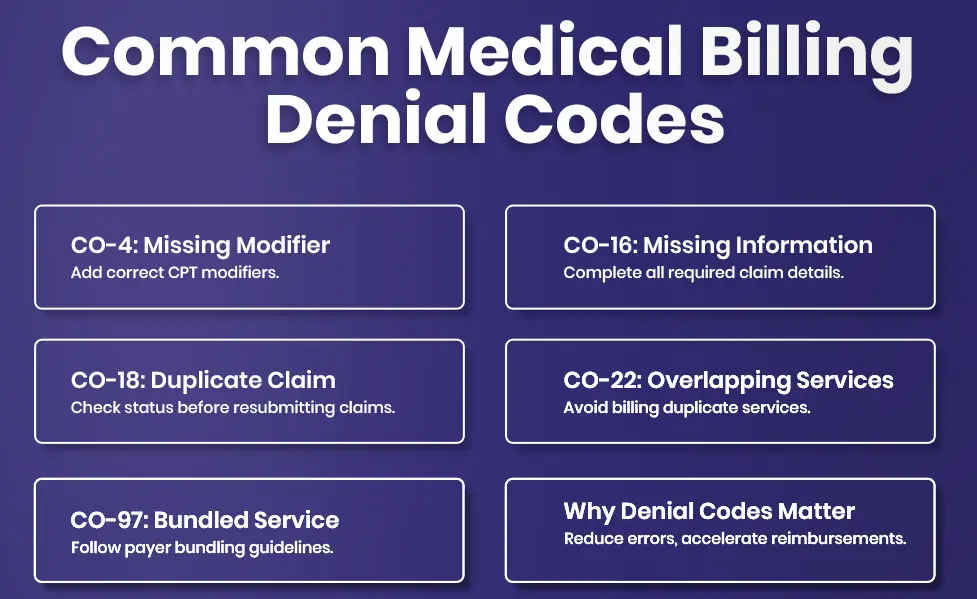
CO-4: Procedure Code Inconsistent with Modifier or Required Modifier Missing
CO-4 denial means that there are no modifiers on a procedure code submitted by the coder or the wrong modifiers are applied. As modifiers give detailed information about the type of the procedure carried out, mistakes in coding lead to claims denials. Regular coding audit and updated CPT knowledge decrease such denials.
CO-16: Missing or Incorrect Information
A CO-16 code occurs whenever there is any problem related to missing or insufficient data. This may relate to any patient details or medical information. Some examples are incomplete patient demographic details or lack of any supporting documentation. This is one of the most frequently used denial codes.
CO-18: Duplicate Claim or Service
Denial CO-18 is caused when the insurance provider finds the claim to be a duplicate of a previous one which had been either filed or processed. The main reason for duplicate submission of claims arises due to resubmission of claims without checking claim status.
CO-22: Duplicate or Overlapping Services
CO-22 is the code where the billed service is deemed to have overlap with a previously reimbursed or processed service of the same patient on the same date of service. This is a denial that typically results from errors in coding or billing of the same service more than once.
CO-97: Service Included in Another Procedure or Payment
CO-97 indicates that the service was included in a package and is thus denied because the insurer sees it as having been bundled together with another paid-for service. Payer bundle policies and NCCI edits will help ensure that claims submitted will be paid without being denied.
How Understanding Denial Codes Helps Practices
Tracking denial codes helps billing staff to determine areas that need attention and improvement. This will lead to better denial management processes within the health care organization. This process will help improve the accuracy of coding, correct claims, avoid repetition of the same mistakes and get faster reimbursements.
The Impact of Billing Denials on Family Medicine Practices
Billing denials have impacts beyond just getting paid; they also impact the financial stability, efficiency, and patient experience at a practice. Good revenue cycle management for family practices can help reduce billing denials and support sound revenue cycle management operations within a family practice.
Financial Impact
Denied claims directly impact practice income through delays or lack of payment for services that have been delivered. Denied claims frequently result in higher costs due to extra staffing needs for rectifying the mistake, re-submitting, or appeal process. If the denied claims persist over time, there is a negative effect on the bottom line.
Operational Challenges
Denial of billing is quite stressful for the billing department due to increased follow-ups, appeals and manual correction work. Late payments affect the financial flow and lead to inefficiency in the whole process of billing. Revenue cycle management in family practice is very important in ensuring efficiency in workflow and finance management.
Patient Care Impact
Other factors that could impact patient satisfaction include issues related to billing. For example, providers may be required to devote extra time in handling documentation or claims questions as opposed to caring for patients. The same applies to denials or any delays related to billing which may lead to confusion among the patients.
How to Prevent Medical Billing Denials in Family Practice
Denial prevention is a proactive process that involves good documentation, coding, staff training, and ongoing monitoring. Based on the information from the Medical Group Management Association (MGMA), the cost of fixing a denied claim will go beyond $25 per denied claim. This means that denial prevention is more economical compared to denial management since it is cheaper to prevent an issue than fix it.
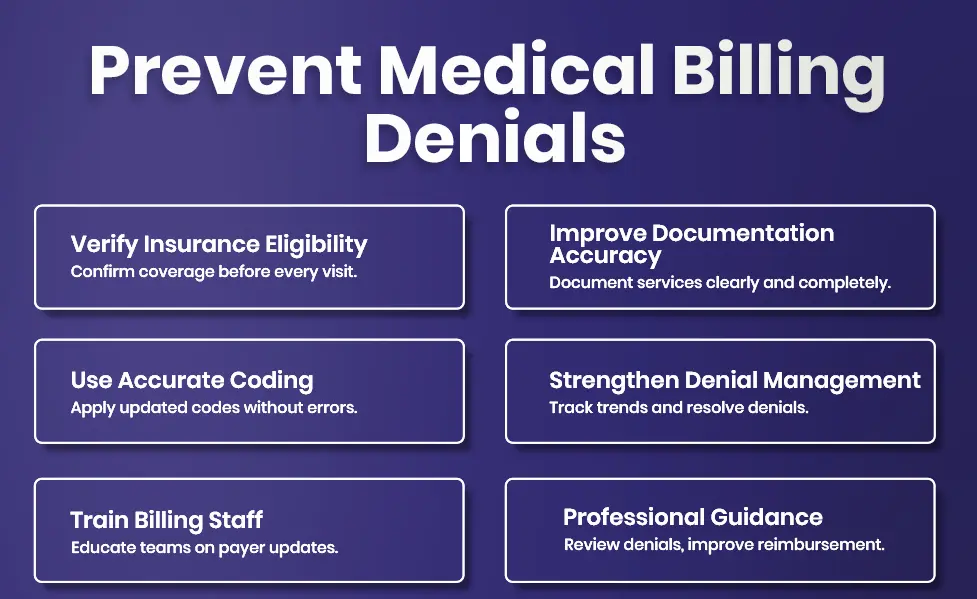
Verify Insurance Eligibility Before Visits
Eligibility checks for insurance coverage are one of the best ways to minimize avoidable denials of claims. All providers must verify insurance coverage, patient benefits, copays, deductibles, and other preauthorization and referral issues prior to every patient visit. HFMA lists eligibility problems among common preventable sources of denial. Efficient verification greatly helps in figuring out how to prevent medical billing denials.
Improve Documentation Accuracy
Documentation that is complete allows insurers to have all the evidence that would allow them to justify the process of reimbursement. It is important for providers to ensure that there is proper documentation of patient history, examination, diagnosis, treatment, and medical necessity of each service provided. In many cases, the lack of complete documentation has resulted in audits and denials of claims.
Use Accurate Coding Practices
Correct CPT and ICD-10 coding are vital in order to make claims processing easy. Errors in coding, incorrect use of modifiers and the use of outdated codes are some of the major causes of denials. According to the American Medical Association (AMA), there should be continuous education and audit of coders in order to ensure compliance with annual coding updates. This would help to lower coding denials and increase the success of claims.
Implement Effective Denial Management Processes
An effective denial management healthcare program will allow practices to find denial trends and address them in the long run. Billing departments should classify denials based on the payer, reason for denial, provider, and service code. The trend analysis should be done through the use of key performance indicators. Denial management in the healthcare industry is recommended to monitor denial ratios and first pass acceptance ratio.
Train Billing Staff Regularly
Changes in billing rules and payer policies happen often, therefore it is vital that the staff should be consistently educated. Consistent training will allow the billing personnel to be up-to-date on all the requirements for Medicare, Medicaid, and other payers, thereby increasing the precision of claims. The properly educated billing team will be better able to find any documentation errors or discrepancies in the codes and submissions prior to sending out the claim.
Professional Guidance: Develop a monthly denial review process whereby the most prevalent denial causes can be identified by both payer and provider. Such information will help in improving workflows, staff education, and correcting problems before any future claim reimbursements are affected.
Role of Physician Billing Services in Reducing Denials
In the face of ever more complicated billing laws and payer rules, an increasing number of healthcare organizations are working with dedicated physician billing services in order to enhance their claim submission process and minimize their denials. The dedicated billing professionals oversee the whole claims submission process from start to finish, from eligibility determination and coding all the way to claim submissions and denial management and appeals. These professionals ensure that the claim is free of billing mistakes prior to its submission by adhering to payer regulations.
Professional Family Practice Billing Services also offer certified code verification, periodic claims reviews, and denial management. Billing professionals remain aware of any changes in the rules pertaining to CPT, ICD-10, Medicare, Medicaid, and commercial payers. This minimizes any chances of errors in coding and documentations that may lead to denial of claims. In the event of claim denial, professional billing staff can quickly pinpoint the problem, make the necessary corrections, or submit an appeal to ensure that the payments are made.
Aside from helping increase collections, family medicine billing services will also decrease the workload for physicians and their office staff since they no longer need to handle the tedious tasks of billing. With professional billing services handling these duties for them, they get to concentrate on taking care of their patients and not on their billing problems. Other advantages include compliance with government rules and regulations, production of financial reports, and better revenue cycle management by performance evaluation.
Family practices looking to improve claim accuracy, reduce administrative workload, and optimize reimbursements can benefit by outsourcing medical billing services to experienced professionals who manage the complete revenue cycle process.
Best Practices for Family Practice Revenue Cycle Management
Revenue Cycle Management in Family Practice demands a proactive approach that focuses on accuracy of claims, prevention of denials, and improved finances in every phase of billing. The practice must implement an effective system to track denials in order to analyze denial ratios and trends as well as denial trends per payer. As stated by Healthcare Financial Management Association (HFMA), it is vital for practices to monitor denial trends in order to reduce the number of denials. Effective communication between doctors, coders, and billing departments is important to ensure that codes match documentation.
Technology also has an equally critical function in the revenue cycle management process in family practices. Advanced billing tools and revenue cycle management systems can help in automatically verifying patient eligibility, checking claims for coding issues, tracking the status of claims, and producing performance reports in real time. Family practices are supposed to analyze some financial data like the rate of first-pass acceptances, denials, days in accounts receivable, and net collections as part of their effort to improve their operations.
How to Manage Existing Denied Medical Claims
Denial management is crucial in order to ensure that practices maintain their revenues and improve their reimbursement. Having a structured process of managing claims denials enables practices to not only recoup revenue losses but to also identify any potential problems in billing as well as medical denial management. Implementing specialized denial management services allows family practices to identify denial patterns, precise claim issues, handle appeals, and recover lost revenue more efficiently.
Steps for Effective Claim Denial Management
The first thing to do after the identification of denied claims is the determination of the reasons for denial based on the EOB or remittance advice issued by the payer. Once the claims have been analyzed and the mistakes have been identified, the claims need to be reviewed, documented properly, checked in terms of coding accuracy and finally resubmitted. In case of a mistaken denial, an effective appeal needs to be made along with proper clinical documentation as soon as possible within the time set forth by the payer.
Once the claims have either been revised or appealed for, the next thing to do would be to track their status until payment is received. This will allow practices to get familiar with denial trends which can be useful in implementing necessary prevention measures.
Importance of a Proactive Denial Management Strategy
Proactive medical billing denial management is about avoiding denials and ensuring those that happen are effectively managed. It involves analysis of denial data, staff training, coding reviews, and payer policy review. Experts have noted that most denied claims can be prevented, and hence it makes sense for the healthcare institutions to invest in such an initiative.
Constant monitoring of denial metrics will not only enhance the billing process but will also lead to better relationships between the payers and healthcare organizations through effective submission and handling of claims. In the long run, proactive medical billing denial management will ensure that there is a healthy billing process in place and will provide ample time for the family practice to offer quality patient care.
Medicare and Medicaid Billing Denials in Family Practice
There is a difference in Medicare billing denials and Medicaid billing denials, as each program has its own set of coverage criteria, documentation guidelines, and payment process. Being knowledgeable about these unique criteria for each payer will help family practices avoid denial and increase revenue cycle performance. Regular provider revalidation and updates are essential for maintaining payer relationships, and understanding recredentialing in healthcare supports practices that avoid credentialing-related claim denials and payment interruptions.
Common Medicare Billing Denials
Common reasons for denials in Medicare billing are due to wrong CPT or ICD-10 code usage, lack of proper documentation in support of medical necessity, and performing non-covered Medicare procedures. Not using modifiers, not having proper provider documentation, or not adhering to LCDs can also be responsible for Medicare billing denials. Coding audits, proper clinical documentation, and keeping oneself updated with changes in Medicare policies can prevent claims denials.
Common Medicaid Billing Denials
Medicaid denial of claims may be common due to factors like change in patient eligibility status, state specific Medicaid billing rules, lack of prior authorizations or wrong information on claim forms. Due to variation in Medicaid policies across different states, the billing staff needs to check the patient’s eligibility status before every visit as per the relevant Medicaid rules of the state.
Prevention Strategies
Steps to prevent Medicare and Medicaid denial need to be proactively done using a comprehensive compliance approach, which should incorporate constant education and evaluation of the claims. It is necessary for the practice to constantly verify eligibility of the patients, know the payer policies and authorizations needed, document properly, and evaluate the claims before submitting. It will help lower the number of denials and ensure reimbursement, besides ensuring compliance with Medicare and Medicaid rules. Providers should stay updated with Medicaid provider requirements and billing resources to understand eligibility rules, state-specific policies, and documentation standards that help prevent avoidable Medicaid billing denials.
How iSolve RCM help with Family Practice Billing Denials
iSolve RCM provides family practice billing services that help reduce medical billing denials by concentrating on proper coding, claims review, eligibility check, denial analysis, and denial appeal processes. The expert medical billers at iSolve RCM identify the reasons for medical billing denials and correct mistakes before the process of filing claims. This is an efficient way to manage medical claim denials and helps family practices have better cash flow and improved finances.
FAQs
What are some of the common reasons behind medical billing denials in family practice?
Common reasons behind denials include the use of wrong patient details, issues with patient eligibility, errors in CPT and ICD-10 coding, lack of required documentation, failure to authorize and delay in filing claims. Early identification of these issues ensures that practices avoid denials in their medical billing.
How can family practices avoid medical billing denials?
In order to avoid medical billing denials, family practices need to verify insurance eligibility, document properly, code properly, conduct regular audits and be aware of payer requirements. Effective medical billing denial prevention methods are helpful in improving revenue cycle performance.
What are the common medical billing denial codes?
The common medical billing denial codes include CO-4 which refers to modifier issues, CO-16 refers to missing information, CO-18 means duplicate claims and CO-97 means bundling issue.
Why is denial management important for family practices?
Claim denial management assists in recouping revenue losses, lessening the administrative burden, and avoiding billing problems in the future. Using denials management, family practices will be able to optimize their cash flow, maximize payment percentages, and maintain the health of their revenue cycle.
How do physician billing services help reduce claim denials?
Physician billing services offer coding experience, claim reviews, eligibility verifications, and denied claim handling. Through such services, mistakes in billing can be detected, and it becomes easy to comply with the payer’s requirement; hence, minimizing the number of denials and increasing reimbursement speed.
How can outsourced family practice billing services improve revenue?
Family Practice Billing Outsource Services will help streamline billing processes, ease administrative burdens, and ensure accurate claims processing. Billing professionals handle claims submission, denial handling, appeal processes, and report creation in order to ensure efficiency in revenue cycle management.