

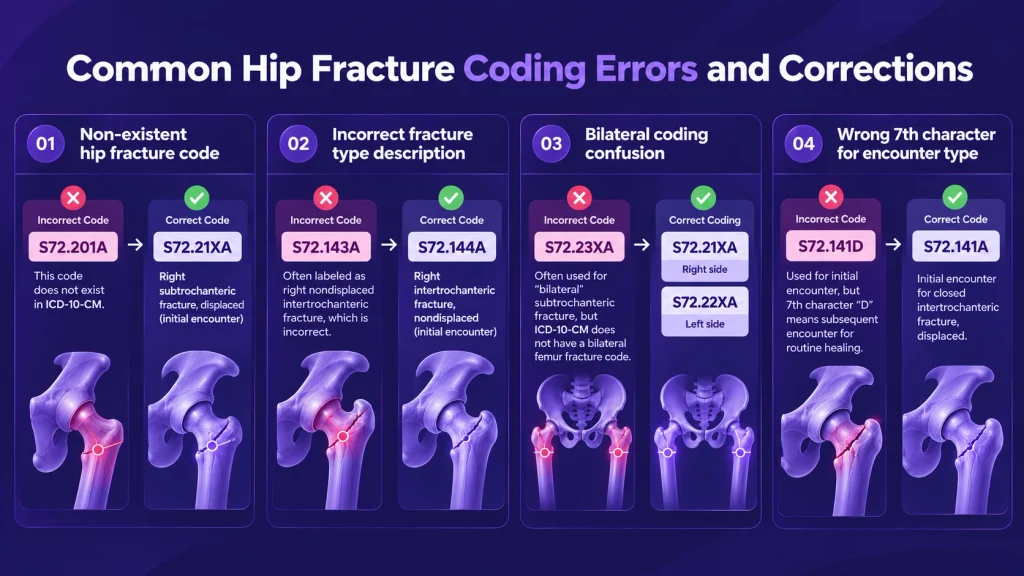
The ICD 10 code S72.201A does not exist. Neither does S72.151A. Both appear in hip fracture coding guides published online, alongside S72.143A labeled as a nondisplaced right fracture (it is a displaced fracture of an unspecified femur) and S72.23XA labeled as bilateral (ICD-10-CM has no bilateral femur fracture code). A claim built on any of them is rejected or, worse, paid for the wrong side.
Hip fracture coding rewards precision because every code carries five facts: the site on the proximal femur, the side, displacement, open or closed and the stage of care. This guide lists the correct codes for each, explains the rules that change them and covers the CPT codes, DRGs and 2026 payment model that sit around them.
Quick answer: The ICD-10-CM code for a hip fracture with no site documented is S72.001A (right) or S72.002A (left), because the Alphabetic Index sends “fracture, hip” to the femoral neck. The most common specific codes are S72.141A and S72.142A for displaced right and left intertrochanteric fractures. Fractures from osteoporosis use M80.051A or M80.052A, and fractures around a hip replacement use M97.01XA or M97.02XA.
Hip Fracture ICD-10 Codes (Initial Encounter, Closed)
| Fracture Type | Right | Left | Unspecified Side |
|---|---|---|---|
| Hip fracture, site not documented (neck of femur) | S72.001A | S72.002A | S72.009A |
| Intracapsular, unspecified (subcapital) | S72.011A | S72.012A | S72.019A |
| Midcervical femoral neck, displaced | S72.031A | S72.032A | S72.033A |
| Midcervical femoral neck, nondisplaced | S72.034A | S72.035A | S72.036A |
| Base of neck (basicervical), displaced | S72.041A | S72.042A | S72.043A |
| Base of neck (basicervical), nondisplaced | S72.044A | S72.045A | S72.046A |
| Intertrochanteric, displaced | S72.141A | S72.142A | S72.143A |
| Intertrochanteric, nondisplaced | S72.144A | S72.145A | S72.146A |
| Subtrochanteric, displaced | S72.21XA | S72.22XA | S72.23XA |
| Subtrochanteric, nondisplaced | S72.24XA | S72.25XA | S72.26XA |
| Femur, site not specified | S72.91XA | S72.92XA | S72.90XA |
| Osteoporotic (pathological) fracture of femur | M80.051A | M80.052A | M80.059A |
| Periprosthetic fracture around hip prosthesis | M97.01XA | M97.02XA | Side required |
Source: ICD-10-CM category S72, M80 and M97 (FY 2027, effective October 1, 2026).

What Is the ICD 10 Code for a Hip Fracture?
Traumatic hip fractures are coded in ICD-10-CM category S72, Fracture of femur, in the proximal subcategories: S72.0 for the head and neck of the femur, S72.1 for pertrochanteric fractures (including intertrochanteric) and S72.2 for subtrochanteric fractures. Each code then adds the side, displacement where the code offers it and a 7th character for the encounter. The S72 category page carries the instructional notes that apply to all of them.
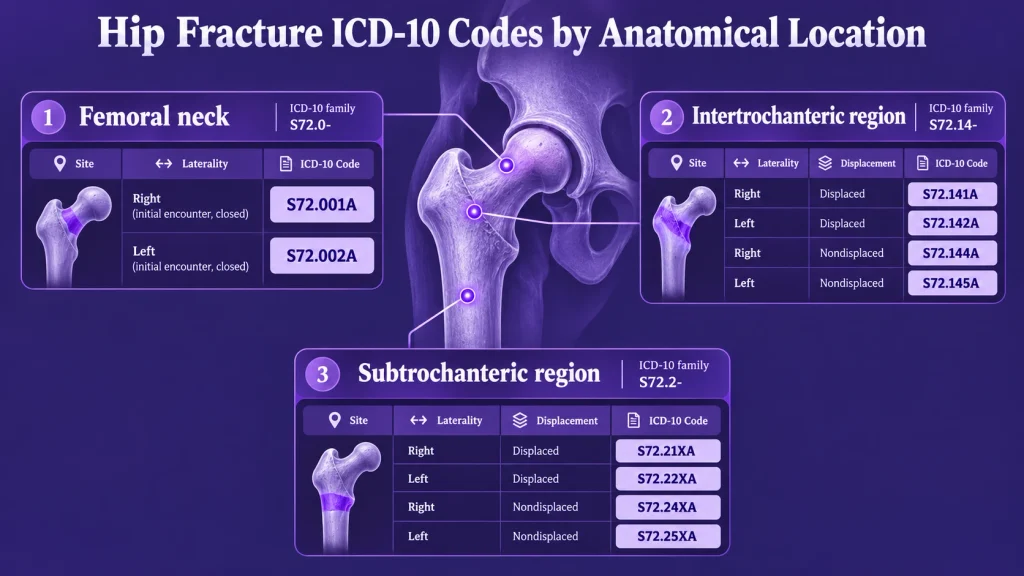
A plain “hip fracture” in the record is not a code by itself. The Alphabetic Index directs “fracture, hip” to the fracture of the neck of the femur, which is why S72.001A and S72.002A are the defaults when no site is documented.
What Is the ICD 10 Code for Hip Fracture, Unspecified?
Use S72.001A for the right hip, S72.002A for the left and S72.009A when the side is not documented. These codes mean fracture of an unspecified part of the neck of the femur, initial encounter for closed fracture. They have no displacement option, so a “displaced hip fracture” with no site still codes here.
Do not confuse them with S72.91XA, S72.92XA and S72.90XA. Those describe a fracture of the femur with no site at all, not a hip fracture, and they invite queries when imaging has already located the break. Once imaging confirms the site, update the code at the next encounter.
What Is the ICD 10 Code for a Right Hip Fracture?
A right hip fracture with no site documented is S72.001A. The most common specific right hip codes are:
| Right Hip Fracture | ICD 10 CM Code |
|---|---|
| Fracture of right hip, unspecified site | S72.001A |
| Right intertrochanteric hip fracture, displaced | S72.141A |
| Right intertrochanteric hip fracture, nondisplaced | S72.144A |
| Right femoral neck, displaced midcervical | S72.031A |
| Right femoral neck, displaced base of neck | S72.041A |
| Right subtrochanteric, displaced | S72.21XA |
| Right greater trochanter, displaced | S72.111A |
| Right hip fracture with osteoporosis | M80.051A |
| Right periprosthetic hip fracture | M97.01XA |
What Is the ICD-10 Code for a Left Hip Fracture?
A closed left hip fracture with no site documented is S72.002A. The left-side codes mirror the right with a 2 (or 5 for nondisplaced) in the laterality position:
| Left Hip Fracture | ICD-10-CM Code |
|---|---|
| Fracture of left hip, unspecified site | S72.002A |
| Left intertrochanteric hip fracture, displaced | S72.142A |
| Left intertrochanteric hip fracture, nondisplaced | S72.145A |
| Left femoral neck, displaced midcervical | S72.032A |
| Left femoral neck, displaced base of neck | S72.042A |
| Left subtrochanteric, displaced | S72.22XA |
| Left hip fracture with osteoporosis | M80.052A |
| Left periprosthetic hip fracture | M97.02XA |
How Do You Code an Intertrochanteric Hip Fracture?
Intertrochanteric fractures run between the greater and lesser trochanters and use subcategory S72.14-. The sixth character combines displacement and side: 1, 2 and 3 for displaced right, left and unspecified, and 4, 5 and 6 for nondisplaced right, left and unspecified. A right intertrochanteric hip fracture is S72.141A when displaced and S72.144A when nondisplaced; the left is S72.142A or S72.145A.
If the record does not say displaced or nondisplaced, ICD-10-CM guidelines direct coders to report the fracture as displaced. Isolated fractures of the greater trochanter (S72.11-) or lesser trochanter (S72.12-) are coded separately from intertrochanteric fractures and should not be used for them.
How Do You Code a Femoral Neck Fracture?
Femoral neck fractures are intracapsular and use subcategory S72.0. Code to the most specific region the provider names:
| Documentation | Subcategory | Displacement Option |
|---|---|---|
| Neck of femur, part not specified | S72.00- | No |
| Intracapsular or subcapital, not specified | S72.01- | No |
| Midcervical (transcervical) | S72.03- | Yes |
| Base of neck (basicervical) | S72.04- | Yes |
| Head of femur, not specified | S72.05- | No |
| Articular fracture of head of femur | S72.06- | Yes |
How Do You Code a Subtrochanteric Fracture?
Subtrochanteric fractures, just below the lesser trochanter, use S72.21X- to S72.26X-: 21, 22 and 23 for displaced right, left and unspecified, and 24, 25 and 26 for nondisplaced. The X is a placeholder that keeps the encounter character in the seventh position, so the right displaced code is S72.21XA. There is no S72.201A, and S72.23XA means an unspecified side, not both hips.
What Does the 7th Character Mean in Hip Fracture Codes?
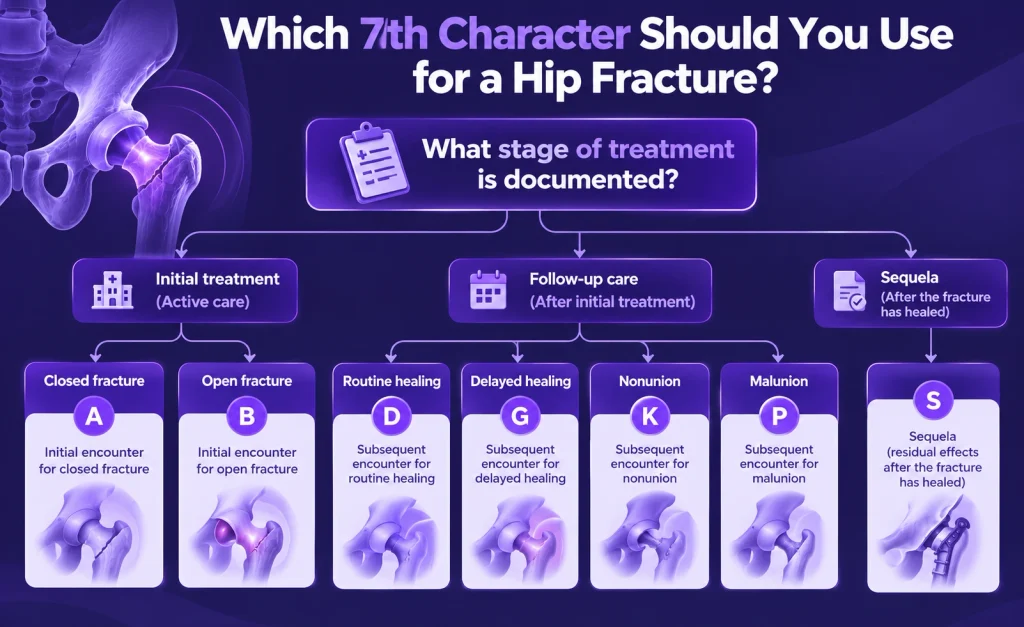
| 7th Character | Meaning |
|---|---|
| A | Initial encounter for closed fracture (active treatment) |
| B / C | Initial encounter for open fracture, type I or II / type IIIA, IIIB or IIIC |
| D | Subsequent encounter for closed fracture with routine healing |
| E / F | Subsequent encounter for open fracture with routine healing |
| G / H / J | Subsequent encounter with delayed healing (closed / open I or II / open III) |
| K / M / N | Subsequent encounter with nonunion |
| P / Q / R | Subsequent encounter with malunion |
| S | Sequela |
Use A while the patient receives active treatment, including the emergency visit, surgery and evaluation by a new physician. Switch to D once active treatment is complete and the patient is healing, including routine follow-up and physical therapy. A fracture not documented as open or closed is coded as closed. Aftercare Z codes are not used for injuries; the fracture code with the right 7th character carries through healing.
What Is the ICD-10 Code for a Hip Fracture Due to a Fall?
Code the fracture first, then the external cause. A left hip fracture due to an unspecified fall is S72.002A (or the specific site code) followed by W19.XXXA, unspecified fall, initial encounter. Use a more specific fall code when documented, such as W01.0XXA for a fall on the same level from slipping or tripping, W06.XXXA for a fall from a bed or W18.30XA for a fall on the same level, unspecified, and add a place of occurrence code such as Y92.009 for an unspecified place in a private residence.
External cause codes are never first-listed. There is no national requirement to report them, but many states and payers require them, and they strengthen the record when a fall and its setting matter to care or liability.
When Is a Hip Fracture Pathological Instead of Traumatic?
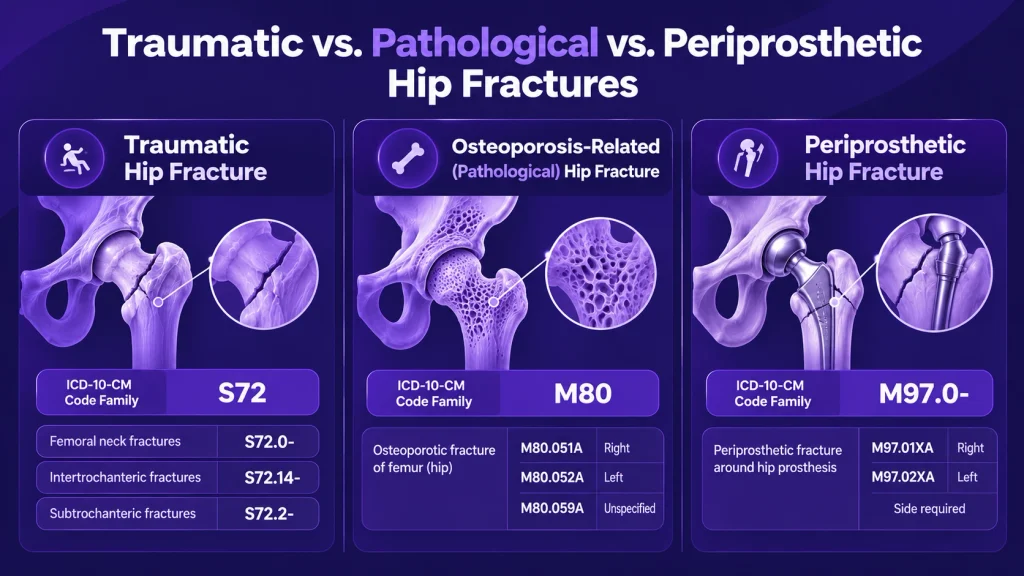
When a patient with known osteoporosis breaks a hip from a fall or trauma that would not usually break a healthy bone, ICD-10-CM guidelines direct coders to category M80, not S72. Use M80.051A for the right femur and M80.052A for the left. Fractures caused by other bone disease use M84.4- (pathological fracture, not elsewhere classified, such as M84.459A for an unspecified hip) or M84.5- for fractures in neoplastic disease, such as M84.551A for the right femur.
Do not report an S72 code and an M80 or M84 code for the same fracture. If the record does not make clear whether the trauma would have broken a healthy bone, query the provider.
How Do You Code a Periprosthetic Hip Fracture?
A fracture around a hip replacement is not coded in S72. Category S72 excludes periprosthetic fractures of a prosthetic hip implant, which go to M97.0-: M97.01XA for the right hip and M97.02XA for the left. The M97 code captures both the fracture and its relationship to the prosthesis, so no S72 code is added for the same break.
How Do You Code Bilateral Hip Fractures?
ICD-10-CM has no bilateral femur fracture codes. When both hips are fractured, report a separate code for each side, such as S72.141A and S72.142A for displaced intertrochanteric fractures of both femurs, and sequence the more severe fracture first.
How Is Physical Therapy After a Hip Fracture Coded?
Rehabilitation after treatment is a subsequent encounter, so the fracture code takes D for routine healing, G for delayed healing, K for nonunion or P for malunion. Add codes for the functional problems treated, such as R26.2 difficulty in walking or M62.81 muscle weakness, and Z96.641 or Z96.642 when the fracture was treated with a right or left hip replacement.
Which CPT Codes and DRGs Go With Hip Fracture Claims?
| CPT Code | Procedure |
|---|---|
| 73501 to 73503 | X-ray of hip, unilateral, with pelvis when performed |
| 27235 | Percutaneous skeletal fixation of femoral neck fracture |
| 27236 | Open treatment of femoral neck fracture, internal fixation or prosthetic replacement |
| 27244 | Treatment of intertrochanteric, peritrochanteric or subtrochanteric fracture with plate and screw implant |
| 27245 | Treatment of intertrochanteric, peritrochanteric or subtrochanteric fracture with intramedullary implant |
| 27125 | Hemiarthroplasty of hip |
| 27130 | Total hip arthroplasty |
Source: AMA CPT code set.
Inpatient hip fracture stays usually group to MS-DRGs 480 to 482 (hip and femur procedures except major joint), 521 and 522 (hip replacement with a principal diagnosis of hip fracture) or 535 and 536 (fractures of hip and pelvis without surgery). Since January 1, 2026, hospitals selected for the mandatory Transforming Episode Accountability Model (TEAM) are accountable for the cost and quality of surgical hip and femur fracture treatment episodes, which cover fixation procedures under MS-DRGs 480 to 482 and the 30 days after discharge, as AAPM&R summarizes. Hip fractures treated with joint replacement fall under TEAM’s lower extremity joint replacement episodes instead. TEAM runs through 2030, and 2027 is its second performance year.
What Documentation Supports Hip Fracture Codes?
| Element | Why It Matters |
|---|---|
| Side | Every hip fracture code carries laterality; unspecified side invites queries and denials |
| Exact site | Femoral neck region, intertrochanteric, subtrochanteric or trochanter |
| Displacement | Undocumented displacement is coded as displaced |
| Open or closed | Undocumented status is coded as closed; open fractures need the Gustilo type |
| Encounter stage | Active treatment, routine healing, delayed healing, nonunion, malunion or sequela |
| Bone disease or prosthesis | Moves the code to M80, M84 or M97 |
| Mechanism and place | Supports external cause and place of occurrence codes |
What Are the Most Common Hip Fracture Coding Errors?
Several hip fracture codes circulating in online guides are wrong. Check these before you trust a code list:
| Code as Published | What It Actually Means | Correct Code |
|---|---|---|
| S72.201A for a right subtrochanteric fracture | Not a valid ICD-10-CM code | S72.21XA (displaced) or S72.24XA (nondisplaced) |
| S72.151A for a nondisplaced right intertrochanteric fracture | Not a valid ICD-10-CM code | S72.144A |
| S72.143A for a nondisplaced right intertrochanteric fracture | Displaced intertrochanteric fracture of unspecified femur | S72.144A |
| S72.23XA for bilateral subtrochanteric fractures | Displaced subtrochanteric fracture of unspecified femur | S72.21XA and S72.22XA |
| S72.111A for a right intertrochanteric fracture | Displaced fracture of greater trochanter of right femur | S72.141A |
| S72.041A for a nondisplaced right femoral neck fracture | Displaced fracture of base of neck of right femur | S72.044A |
| S72.012K for a right pertrochanteric nonunion | Unspecified intracapsular fracture of left femur, nonunion | Code from S72.1- for the right side |
Beyond invalid codes, the most common claim errors are an unspecified side when imaging names it, A used for routine follow-up visits, D used during surgery, an S72 code reported with M80 or M97 for the same fracture and nondisplaced codes used when the record is silent. They usually return as CARC 16 or CARC 11, as our guide to common denial codes in medical billing explains, and a quarterly medical billing audit of fracture claims catches the patterns behind them.

Frequently Asked Questions
What is the ICD-10 code for a broken hip?
A broken hip with no site documented is S72.001A for the right side or S72.002A for the left, initial encounter for closed fracture. Use a more specific code once the site is known, such as S72.141A for a displaced right intertrochanteric fracture.
What is the ICD-10 code for a closed left hip fracture?
S72.002A when the site is not documented. A closed displaced left intertrochanteric fracture is S72.142A, and a closed nondisplaced one is S72.145A.
What is the ICD-10 code for a left hip fracture due to a fall?
Report the fracture first, such as S72.002A or S72.142A, then W19.XXXA for an unspecified fall or a more specific fall code if the type of fall is documented.
What is the diagnosis code for a right intertrochanteric hip fracture?
S72.141A for a displaced fracture and S72.144A for a nondisplaced fracture, initial encounter for closed fracture.
Is S72.001A a billable code?
Yes. S72.001A, fracture of unspecified part of neck of right femur, initial encounter for closed fracture, is billable and unchanged in the FY 2027 code set.
Do you use aftercare Z codes after hip fracture surgery?
No. For injuries, keep the fracture code and change the 7th character to D for routine healing. Aftercare Z codes are not used for fracture healing.