If you run a home health agency, you already know the feeling. Every fall, CMS publishes a new rule. Your team skims the summary, someone says “it’s a 2.4% increase, not bad,” and everyone gets back to work. Then January comes, and the payments don’t look the way anyone expected.
That gap between the headline and what actually lands in your bank account is where most home health agencies lose money. It’s rarely one big mistake. It’s a late NOA here, a vague diagnosis code there, a plan of care that got signed two days too late. Each one is small, but they add up.
The CY 2027 Home Health Prospective Payment System final rule is a good example. CMS issued it for public inspection on November 4, 2026, and it was officially published in the Federal Register on November 9, 2026. Most of its payment and quality reporting provisions take effect January 1, 2027. Yes, payments go up 2.4%. But CMS also kept a 3.0% temporary cut to the base rate. It recalibrated PDGM case-mix weights and LUPA thresholds, tightened quality reporting deadlines, and gave itself more power to revoke Medicare enrollment. An agency that keeps billing on 2026 assumptions after January 1 is going to feel it.
So let’s talk about what’s actually changing, where the billing risks are hiding, and what you can do about it before the first 2027 claims go out. Good home health billing isn’t a back-office chore anymore. It’s how you protect your revenue.

Why CMS Medicare Changes Matter for Home Health Agencies
For most home health care agencies, Medicare is the biggest payer by far. That means CMS doesn’t just influence your revenue. It basically sets the rules for it.
Every annual HH PPS rule touches the national 30-day payment rate, the per-visit rates for low-utilization periods, the wage index, outlier calculations and the case-mix weights behind the Patient-Driven Groupings Model (PDGM). In plain terms, three things shift every year: how much you get paid, how your patients are grouped, and what you have to prove to get paid at all.
The grouping piece catches a lot of agencies off guard. Because CMS recalibrates weights, functional impairment levels and comorbidity subgroups annually, the exact same patient can land in a different payment group in 2027 than in 2026. Nothing about the patient changed. The math did.
These changes don’t stay in the billing office, either. Face-to-face rules, homebound documentation and plan of care requirements shape how intake works, what clinicians write during visits and how quickly you need physician signatures back.
When billing practices fall behind, the results are pretty predictable. Wrong HIPPS codes mean underpayment. Missed deadlines mean penalties. Thin documentation invites denials, and sometimes audits. And every one of those problems costs staff time to fix, which makes each dollar more expensive to collect.
Key CMS Medicare Changes Home Health Agencies Should Monitor
Medicare Home Health Payment Rate Updates
Here’s the headline: CMS estimates that CY 2027 policies will raise aggregate Medicare home health payments by 2.4%, or about $415 million. It helps to break that number into its parts, because they work differently:
- 2.1% payment update: This is the finalized home health payment update: a 3.1% market basket increase minus a 1.0 percentage point productivity adjustment.
- 0.3% from the fixed-dollar loss (FDL) adjustment: This is an estimated increase tied to outlier payment changes. It doesn’t apply evenly to every agency.
- 3.0% temporary base payment adjustment: Separately, CMS retained a 3.0% temporary reduction to the 2027 base payment rate as part of its ongoing retrospective payment adjustment related to PDGM.
One important point: the 2.4% is an aggregate, industry-wide estimate. It is not a guaranteed increase for any single agency. Your actual 2027 reimbursement depends on your patient mix, clinical groupings, LUPA rates, outlier cases, wage index and quality performance. Some agencies will come in above 2.4% and others well below it.
The temporary 3.0% adjustment is part of CMS’s ongoing effort to recover retrospective overpayments associated with the implementation of PDGM and the transition to a 30-day payment period. For CY 2027, CMS is continuing this recovery process for estimated overpayments made during CYs 2020 through 2025.
On top of that, the rule updates case-mix weights, LUPA thresholds, functional impairment levels, comorbidity subgroups and the fixed-dollar loss ratio for outliers.
What does that mean for your budget? Simply put, you can’t take your 2026 revenue, add 2.4% and call it a forecast. You’ll want to remodel expected payment by the clinical group. Look at how many of your periods sit close to the LUPA threshold, and make sure your billing software and grouper tables are updated before January claims go out.

Here’s a quick snapshot:
| CY 2027 change | What it means for your agency |
| 2.4% aggregate payment increase | Industry-wide estimate, not a guaranteed agency-level increase |
| 3.0% temporary base rate reduction | Separate reduction to the national standardized base payment rate |
| Recalibrated case-mix weights | Patient clinical characteristics may produce different payment amounts |
| Updated LUPA thresholds | More or fewer periods may qualify for per-visit payment |
| Revised HH QRP deadlines | OASIS submission deadline shortened from 135 to 45 days |
| Updated FDL ratio (0.29%) | Changes the outlier payment threshold calculation |
Home Health Quality Reporting Program (HH QRP) Requirements
Under the HH QRP, agencies have to submit OASIS assessment data and HHCAHPS patient survey data. Miss the requirements and you lose 2 percentage points from your annual payment update. For a lot of agencies, that’s bigger than their entire margin.
Starting with the CY 2027 program year, CMS has revised the submission deadlines and shortened the window to finalize and send assessment data. That leaves less breathing room. If your intake, clinical and billing teams aren’t tracking every start of care, recert, transfer and discharge assessment together, things will slip.
And don’t forget that OASIS isn’t just about quality scores. Functional responses feed directly into the PDGM functional impairment level. A rushed or inconsistent assessment can quietly lower your HIPPS code, and your payment along with it.
Home Health Value-Based Purchasing (HHVBP) Model
The expanded HHVBP Model links part of your Medicare payment to quality performance. But the adjustment doesn’t happen in the same year as the care, and it isn’t automatic.
It works in a cycle. During a performance year, CMS measures your agency on quality measures drawn from OASIS, claims and HHCAHPS data. Your results are scored on both achievement and improvement, compared against other agencies in your size cohort, and turned into a Total Performance Score (TPS).
That score then sets your payment adjustment in a later payment year, generally two years after the performance year. For example, performance in CY 2025 drives adjustments to payments in CY 2027. The adjustment can go up or down by as much as 5%, and where you land within that range depends on how your score compares with your peers.
In other words, the 5% is a maximum range, not a fixed bonus or penalty. And today’s documentation and patient outcomes will show up in your payments two years from now.
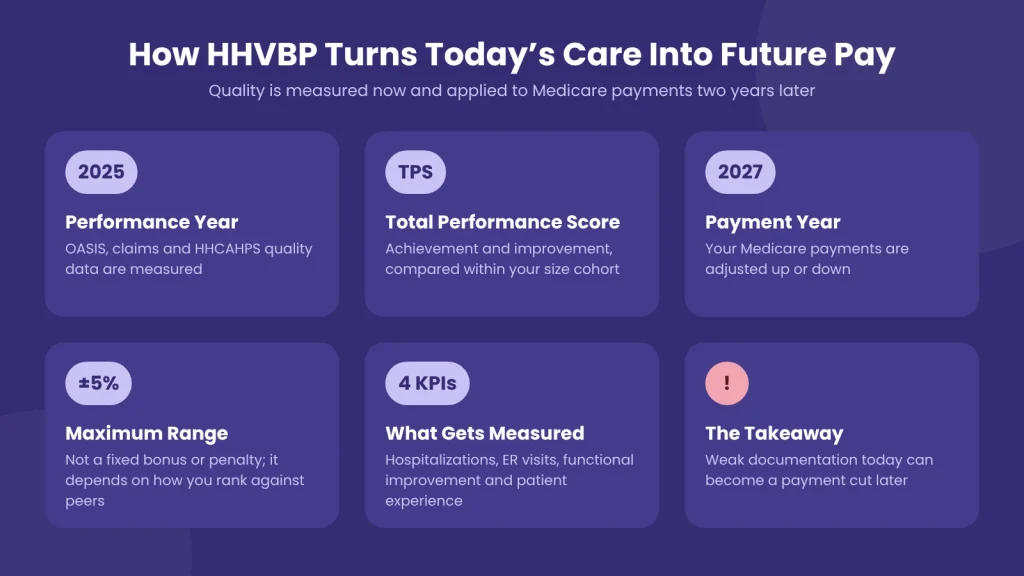
CMS didn’t change the Model’s rules for 2027. It did talk about lining up HHVBP more closely with the HH QRP and Star Ratings down the road. The practical takeaway hasn’t changed: outcomes like hospitalizations, ER visits, functional improvement and patient experience still affect what you’re paid. What makes it tricky is the delay. Weak documentation today can show up as a payment cut two years later, when the performance year results kick in.
Face-to-Face Encounter and Certification Requirements
Medicare still requires a face-to-face encounter tied to the main reason for home care. It has to happen within 90 days before or 30 days after the start of care, and it must be done by a physician or allowed practitioner. The CY 2026 final rule updated the face-to-face policy, so it’s worth double-checking that your intake checklist reflects who’s currently allowed to perform the encounter.
The certifying practitioner also has to confirm the patient is homebound, needs skilled services, has a plan of care, and is under their care. For ongoing patients, recertification happens every 60 days.
Where do denials usually come from here? Encounter notes that don’t connect to the primary reason for home health. Missing signatures or dates. Plans of care signed after the claim was already billed. Certifications that mention “homebound” without really explaining why.
Medicare Coverage and Eligibility Updates
To qualify for Medicare home health coverage, a patient must be homebound, need intermittent skilled nursing care, physical therapy, or speech-language pathology services (or have a continuing need for occupational therapy), be under the care of a physician or allowed practitioner, and receive services under a plan of care that is established and periodically reviewed. A qualifying face-to-face encounter is also required.
The homebound requirement is where documentation often falls short. Simply writing “patient is homebound” isn’t enough. Reviewers want specific clinical details: Does the patient need a walker, wheelchair, or assistance from another person? Is leaving home normally difficult and does it require a considerable and taxing effort? What medical or functional limitations explain that difficulty?
The same applies to skilled care. Clinical notes should explain why skilled nursing or therapy services are medically necessary, not just list the tasks performed during a visit.
The CY 2027 rule also strengthens CMS provider enrollment requirements, which apply across Medicare provider types. CMS has finalized expanded authority to make enrollment revocations retroactive to the date the applicable noncompliance began. It has also added or expanded grounds for denying or revoking enrollment. Additionally, home health agencies that experience certain changes in majority ownership must reenroll in Medicare and meet applicable survey or accreditation requirements.
One important distinction: these changes do not mean that ordinary billing errors automatically result in Medicare enrollment revocation. A late Notice of Admission (NOA), coding mistake, or documentation deficiency will generally be addressed through payment adjustments, claim denials, corrections, or other applicable compliance actions. However, enrollment violations that meet CMS’s specific revocation criteria can have much more serious consequences, including retroactive revocation.
For home health agencies, maintaining accurate enrollment records, reporting ownership and management changes, completing revalidations on time, and meeting survey and accreditation requirements are now essential parts of protecting Medicare billing privileges and long-term revenue.
CMS Extends Medicare Enrollment Moratorium for Home Health Agencies: What Providers Need to Know
The Centers for Medicare & Medicaid Services (CMS) has announced a six-month extension and modification of the nationwide Medicare enrollment moratorium for home health agencies and hospices. Announced on November 12, 2026, this update is part of CMS’s continued efforts to combat Medicare fraud, waste, and abuse while strengthening provider enrollment safeguards.
For home health agencies, this extension brings important considerations around Medicare enrollment, ownership changes, and business expansion. While the moratorium continues to restrict certain new Medicare enrollments, CMS has also introduced flexibility for currently enrolled agencies.
Key Changes Under the Extended Medicare Enrollment Moratorium
The latest CMS announcement introduces several important changes that home health providers should understand:
- Six-Month Extension: CMS has extended the nationwide Medicare enrollment moratorium for home health agencies and hospices for another six months.
- New Enrollment Restrictions: The moratorium continues to restrict new Medicare enrollment applications for affected home health agencies and hospice providers.
- Ownership Changes: Certain changes in majority ownership that require a new initial Medicare enrollment application remain subject to the moratorium.
- Existing Agency Flexibility: Currently enrolled home health agencies can add new practice locations within their existing Medicare enrollment in the same state, subject to applicable requirements.
- Continued Medicare Participation: Existing enrolled agencies can continue providing covered services and submitting Medicare claims under their current enrollment.
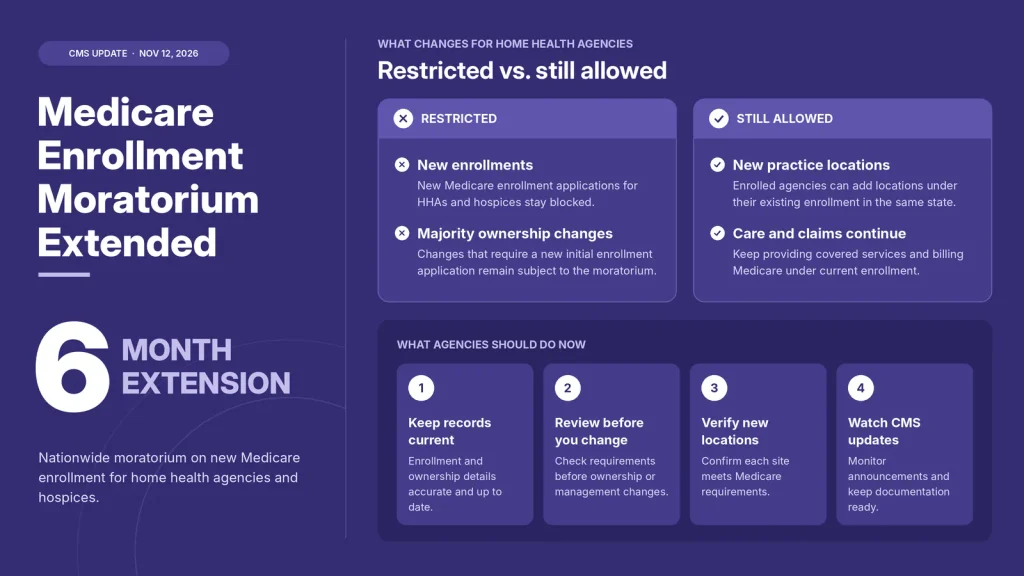
These modifications aim to protect Medicare program integrity while allowing established providers to maintain operations and make certain business adjustments.
How the Moratorium Affects Home Health Agency Operations
For existing home health agencies, the extension does not mean Medicare billing or patient care must stop. However, agencies planning expansion, ownership changes, or enrollment-related updates should carefully review the revised CMS requirements before making operational decisions.
Providers should pay particular attention to:
- Keeping Medicare enrollment and ownership information accurate and up to date.
- Reviewing enrollment requirements before completing ownership or management changes.
- Confirming that new practice locations meet applicable Medicare requirements.
- Monitoring CMS announcements for further changes to enrollment policies.
- Maintaining proper documentation to support continued Medicare participation.
Understanding these requirements, including the difference between provider credentialing and payer enrollment, can help agencies avoid enrollment-related complications that may affect their Medicare billing privileges.
What Home Health Agencies Should Do to Protect Their Revenue
Medicare enrollment compliance is an important part of a healthy revenue cycle. Although the moratorium does not prevent currently enrolled agencies from submitting claims, enrollment problems can create significant administrative and financial challenges.
Home health agencies should regularly review their provider enrollment records, verify business information, monitor ownership changes, and ensure that their billing operations remain aligned with Medicare requirements.
Working with an experienced revenue cycle management partner can also help agencies strengthen documentation, improve billing accuracy, identify preventable claim issues, and maintain more consistent reimbursement processes.
As CMS continues to update Medicare enrollment policies, staying informed and maintaining compliant operations will be essential for home health agencies looking to protect their revenue and continue serving Medicare beneficiaries.
Common Home Health Billing Risks That Lead to Revenue Losses

Incorrect Patient Eligibility Verification
This one stings because the work is already done. If the patient has switched to a Medicare Advantage plan, has an open period with another agency, or has elected hospice, a traditional Medicare claim gets rejected. Skipping eligibility checks at intake and at each new period is one of the fastest ways to lose earned revenue.
Incomplete Physician Orders and Certifications
Unsigned plans of care, verbal orders with no documentation behind them, late certifications. Medicare expects signed orders on file before the final claim goes out, and missing signatures still show up as one of the most common findings in medical review.
PDGM Coding and Clinical Grouping Errors
Under PDGM, the primary diagnosis decides the clinical group, and secondary diagnoses drive the comorbidity adjustment. Use a vague ICD-10 code, or one CMS considers a questionable encounter code, and the claim either comes back to you or lands in a lower-paying group.
Incorrect Notice of Admission (NOA) Submission
You have five calendar days from the start of each 30-day period to get the NOA in. For every day it’s late, payment drops by 1/30. And if the NOA itself has errors, it can hold up the final claim entirely.
Late Claims and Missed Filing Deadlines
Medicare gives you 12 months from the date of service to file. It sounds like plenty of time, until claims get parked waiting on a missing document or a returned-to-provider claim slips through the cracks. Then it becomes a write-off.
Insufficient Medical Necessity Documentation
Copy-paste visit notes. No sign of progress toward goals. No explanation of why skilled care is still needed. These are exactly the records MACs, UPICs and Recovery Auditors look for.
Incorrect Revenue Codes and Billing Information
Home health claims use revenue code 0023 with the HIPPS code, along with discipline-specific revenue codes for each visit. Mismatched dates, wrong occurrence codes, an incorrect CBSA for where the patient lives, or simple demographic errors can all cause rejections or wrong payments.
Understanding Medicare Home Health Billing Guidelines
Medicare home health billing guidelines can feel scattered, so it helps to see them in one place. At a high level, here’s what has to line up:
- Coverage: A homebound patient, intermittent skilled need, a valid face-to-face encounter and a certified plan of care.
- Documentation: Certifications, recerts, orders and visit notes that are signed, dated and tell the same story.
- Billing periods and NOAs: Payment in 30-day periods within a 60-day certification, with an NOA accepted within five days of each period’s start.
- PDGM methodology: Payment based on admission source and timing, clinical group, functional level and comorbidities, with per-visit LUPA payment when visits fall below the threshold.
- Claims and support: Final claims submitted after the period ends and all orders are signed, with complete records ready for review.
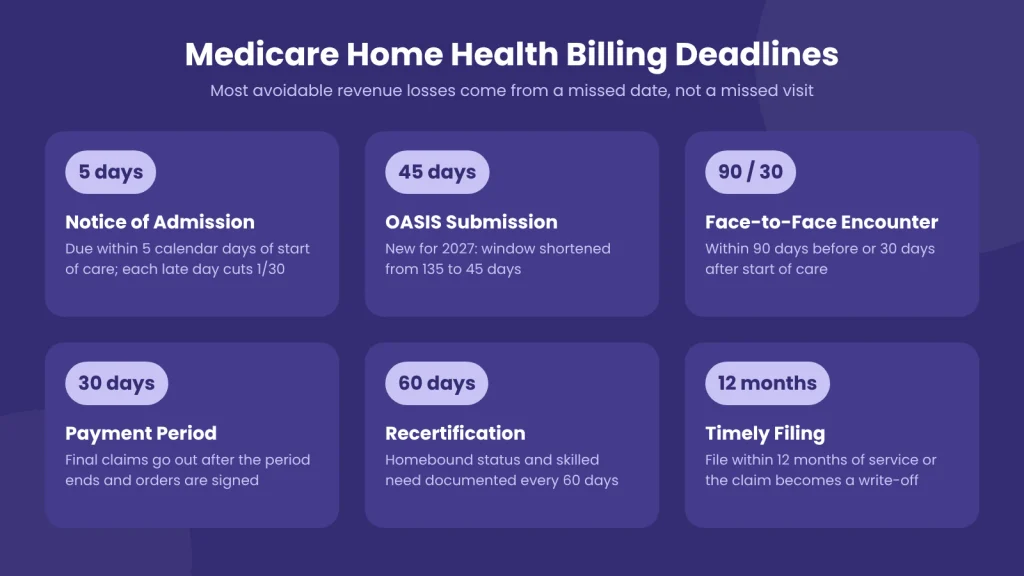
None of this is new on its own. The problem is that the details shift every year. Following this year’s home health care billing guidelines, not last year’s, is the foundation of Medicare billing compliance. It’s worth bookmarking the CMS Home Health Agency News & Announcements page and making the annual rule review a fixed part of your fall calendar.
How CMS Changes Affect Home Health Reimbursement
Compliance and reimbursement are really the same conversation. A claim that checks every box gets paid correctly and on time. A claim that misses one can be reduced, delayed, denied or recouped months later.
The cash flow impact is easy to underestimate. Picture a 3.0% cut on every single period, stacked with recalibrated weights. Even if your visit volume doesn’t budge, monthly revenue can move. Add a few late NOA penalties and some LUPA periods, then layer HHVBP adjustments on top. The year can look very different from your budget.
Then there’s the hidden cost: rework. Every rejection, denial or underpayment means someone has to research it, fix it, resubmit it or appeal it, and some of that money never comes back. That’s why accurate medical coding and solid documentation remain the most dependable way to get paid what you’ve earned.
If you want a short list of ways to protect your home health reimbursement, start here. Re-model payments every January. Audit PDGM coding against the clinical record. Track NOA timeliness daily. And watch your HHVBP measures as closely as you watch your finances.
Home Health Billing Compliance: Essential Steps to Protect Your Revenue
Stay Updated With CMS Regulatory Changes
Make it someone’s job. Seriously. One person, or a small group, should own reading every proposed rule, final rule, MAC bulletin and MLN update. They should then translate it into what changes for intake, clinical and billing, with a hard date for when software and workflows get updated.
Strengthen Documentation and Clinical Record Reviews
Pull a sample of charts before billing and check the basics: Is the face-to-face there? Is homebound status actually explained? Is skilled need clear? Are orders signed? Catching a problem before the claim goes out costs a fraction of what an appeal costs.
Verify Medicare Eligibility Before Service Delivery
Check eligibility at referral, before the start of care and again before every new period. You’re looking for Medicare Advantage enrollment, hospice elections and open periods with other agencies.
Review NOA and Claim Submission Timelines
A simple daily report showing pending NOAs and unbilled periods will prevent most of the penalties agencies complain about. It’s not glamorous, but it works.
Conduct Regular Internal Billing Audits
A quarterly medical billing audit helps you spot coding patterns, documentation gaps and payment variances while they’re still your findings, not an auditor’s.
Train Staff on Updated Medicare Requirements
Clinicians need to understand how their OASIS answers and visit notes affect payment. Billers need to know the year’s new grouping, LUPA and reporting rules. Home health billing compliance only works when both sides speak the same language.
Home Health Billing Best Practices for 2027
None of these home health billing best practices are complicated. The hard part is doing them consistently:
- Keep patient and payer records accurate. Verify demographics, insurance and physician details at every admission.
- Follow current PDGM coding guidance. Choose specific, supportable primary diagnoses and capture every relevant comorbidity.
- Watch your claim and denial trends. Review rejection and denial reasons monthly and fix the root cause, not just the claim.
- Build a steady A/R routine. Work aged claims on a schedule, starting with high-dollar and near-deadline accounts.
- Chase payment discrepancies. Compare expected payment with what actually came in and find out why they differ.
- Let technology catch the easy mistakes. Claim scrubbers, eligibility tools and EHR alerts stop errors before they leave the building.
- Keep clinical and billing teams talking. Billing questions should reach clinicians fast, and fixes should come back before claims go out.
How Revenue Cycle Management Helps Home Health Agencies Avoid Revenue Losses
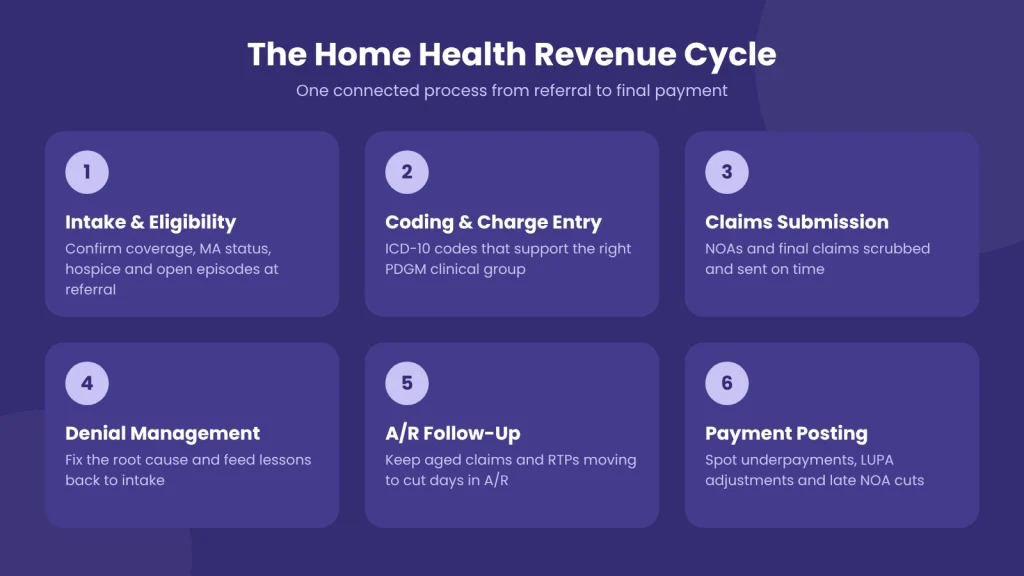
Think of revenue cycle management for home health agencies as one connected process, from referral to final payment. When it’s done well, problems surface early instead of showing up later as denials.
Patient Intake and Insurance Eligibility Verification
Home health revenue cycle management starts at referral, not at billing. Confirming eligibility, coverage type and any existing episodes up front keeps you from providing care you can’t bill for.
Accurate Medical Coding and Charge Entry
Certified coders review the documentation and assign ICD-10 codes that support the right PDGM clinical group and comorbidity adjustment. Charge entry then makes sure the visits, disciplines and dates match the record.
Timely Medicare Claims Submission
NOAs and final claims go out on time and get scrubbed before they reach the MAC. That means fewer rejections and fewer late penalties.
Denial Management and Appeals
Good denial management doesn’t stop at resubmitting. It figures out why the claim was denied, fixes it, appeals when it makes sense, and sends what it learned back to intake and documentation so the same problem doesn’t come back.
Accounts Receivable Follow-Up
Focused accounts receivable management keeps older claims moving, follows up on returned-to-provider claims and brings days in A/R down.
Payment Posting and Reconciliation
Careful payment posting makes underpayments, LUPA adjustments and late NOA reductions easy to see. You know exactly what you were paid, and why.
When Should Home Health Agencies Consider Outsourcing Medical Billing?
Most agencies start out billing in-house, and for a while that works fine. Then something shifts. Maybe volume grows, maybe a key biller leaves, maybe CMS changes one rule too many. Here are some signs it might be time to look at professional medical billing services:
- Denials and rejections are climbing faster than your team can work them.
- Medicare payments are slowing down and days in A/R keep creeping up.
- Clinical leaders are getting pulled into billing questions they shouldn’t have to answer.
- Keeping up with changes like the 2027 grouping and reporting updates feels like a constant scramble.
- Your billing team is small, stretched, or dealing with turnover.
- You need deeper home health billing expertise in PDGM, NOAs and OASIS-driven payment.
If you’re on the fence, our guide to in-house vs outsourced medical billing breaks down the cost, control and collections trade-offs.
How to Choose the Right Medical Billing Services for Home Health Agencies
Plenty of billing companies say they do home health. Far fewer actually understand Medicare billing for home health agencies. When you’re comparing home health billing services, look for:
- Real experience with Medicare home health billing, including NOAs, 30-day periods and LUPA rules
- A working knowledge of PDGM and CMS requirements, plus a clear process for rolling out each year’s changes
- Hands-on home health claims management from NOA through final payment
- Transparent reporting on clean claim rate, denial rate and days in A/R
- Denial management focused on root causes, not just resubmissions
- HIPAA-compliant workflows and a signed business associate agreement
- Support across the full home health revenue cycle, including provider credentialing and enrollment, which matters a lot more now that CMS has expanded its revocation authority
A partner with experience in related post-acute settings, like hospice billing and nursing home billing, is also a good sign. It usually means they’re comfortable with Medicare Part A institutional claims.
Protect Your Agency From Medicare Billing Risks With Expert Support
If the CY 2027 rule teaches anything, it’s this: getting reimbursed accurately requires staying current with CMS regulations, maintaining complete clinical documentation, and meeting all billing and submission deadlines.
The 2.4% aggregate payment increase is an industry-wide estimate, not a guaranteed increase for individual agencies. For your agency, the temporary rate adjustment, recalibrated case-mix weights, late Notices of Admission (NOAs), and coding errors can all affect reimbursement and potentially reduce revenue.
That’s where the right billing partner makes a difference. Professional billing support helps improve reimbursement accuracy, reduce administrative burdens, minimize preventable billing errors, and allow your clinicians to focus on what matters most: patient care.
iSolve RCM provides medical billing for home health agencies, with support across eligibility verification, medical coding, claims submission, denial management, A/R follow-up, payment posting, billing audits and credentialing. Our HIPAA-compliant team keeps up with CMS changes so you don’t have to, and works inside the EHR you already use. Pricing is transparent and based on a percentage of monthly collections.

Frequently Asked Questions
What are the latest CMS Medicare changes affecting home health agencies?
The CY 2027 Home Health Prospective Payment System (HH PPS) Final Rule was placed on public inspection on November 4, 2026, and published in the Federal Register on November 9, 2026. Key HH PPS and HH QRP provisions take effect January 1, 2027.
The rule estimates a 2.4% aggregate Medicare home health payment increase, retains a separate 3.0% temporary base payment adjustment, recalibrates PDGM case-mix weights and LUPA thresholds, shortens the OASIS submission deadline from 135 to 45 days, and expands CMS’s authority to deny or revoke Medicare provider enrollment.
How does PDGM affect Medicare home health reimbursement?
The Patient-Driven Groupings Model (PDGM) pays home health agencies based on 30-day periods of care. Each period is classified according to admission source, timing (early or late), the clinical group associated with the primary diagnosis, functional impairment level based on OASIS, and qualifying comorbidities.
Accurate ICD-10 coding and OASIS documentation help determine the HIPPS classification used in payment calculations. Actual reimbursement also depends on wage adjustments, LUPA thresholds and applicable payment adjustments. Periods that fall below their assigned LUPA visit threshold are paid on a per-visit basis rather than at the full 30-day case-mix rate.
What are the most common Medicare home health billing errors?
Common billing errors include:
Skipping Medicare eligibility verification.
Missing or unsigned physician or allowed practitioner orders and certifications.
Using vague or unsupported primary diagnoses.
Submitting late, missing or incorrect Notices of Admission (NOAs).
Missing Medicare claim filing deadlines.
Inadequate homebound and medical necessity documentation.
Incorrect revenue codes, billing codes or claim details.
Regular claim reviews and documentation audits can help agencies identify these issues before submission.
What are the Medicare home health billing guidelines?
Medicare home health billing requires the patient to meet homebound and skilled care eligibility requirements, have a qualifying face-to-face encounter, and receive services under an established plan of care signed by a physician or allowed practitioner.
Agencies must also submit one NOA per admission within five calendar days of the start-of-care date, use accurate PDGM-based coding, complete required OASIS assessments, and submit final claims within 12 months of the date services were furnished.
All billed services must be supported by appropriate clinical documentation and meet Medicare coverage requirements.
How can home health agencies reduce Medicare claim denials?
Agencies can reduce claim denials by verifying patient eligibility before admission, reviewing clinical documentation before billing, using specific and accurate diagnosis codes, monitoring NOA deadlines, checking claims for errors before submission, and regularly analyzing denial trends.
A consistent billing review process helps identify recurring problems and prevent avoidable revenue losses.
What documentation is required for Medicare home health billing?
Required documentation generally includes:
Face-to-face encounter documentation.
Physician or allowed practitioner certification and recertification, as applicable.
Signed plan of care and supporting orders.
Completed OASIS assessments.
Skilled nursing and therapy visit notes.
Documentation supporting homebound status and medical necessity.
Clinical evidence supporting the need for intermittent skilled services.
Documentation should clearly establish why the patient qualifies for Medicare home health services and why the billed care was medically necessary.
Why is Medicare billing compliance important for home health agencies?
Medicare billing compliance protects agencies from claim denials, payment reductions, recoupments, audits and potential enrollment problems.
The CY 2027 rule also strengthens CMS’s provider enrollment authority. CMS can make certain enrollment revocations retroactive to the date noncompliance began. Although routine billing errors do not automatically result in enrollment revocation, serious enrollment violations that meet CMS’s specific revocation criteria can put an agency’s Medicare billing privileges at risk.
Maintaining accurate enrollment records, reporting ownership changes, completing revalidations and meeting survey and accreditation requirements are essential to protecting an agency’s ability to participate in Medicare.
Should home health agencies outsource medical billing services?
It depends on the agency’s operational needs. If claim denials are increasing, reimbursements are delayed, billing staff are overwhelmed or regulatory changes are becoming difficult to manage, outsourcing may be worth considering.
A specialized home health billing partner can provide PDGM expertise, accurate coding support, claims management, denial follow-up and ongoing compliance monitoring. The right partner can reduce administrative pressure, improve revenue cycle efficiency and allow agency staff to focus more on patient care.