

A denied claim is not a lost claim. It is a claim with a deadline. Aetna, for example, gives providers 180 calendar days from its decision to file a reconsideration and 60 days after that to appeal, according to its disputes and appeals overview, and Medicare allows 120 days to request a redetermination. Work the denial inside that window and the revenue can still be recovered. Let it sit and it becomes a write-off.
That is the whole case for denial management. Denials are common: in Experian Health’s 2026 State of Claims survey, about three in four providers said denials are rising and 89% called reducing them a priority. And denials are winnable: Premier found that about 70% are eventually overturned, though each one costs about $57.23 to work, according to its claims cost analysis. Denial management decides how much of that revenue a practice keeps.
Quick answer: Denial management in medical billing is the process of identifying, correcting, appealing and preventing denied insurance claims. It improves practice revenue in three ways: it recovers money from denials that would otherwise be written off, it lowers the cost of rework and it prevents future denials by fixing the cause. A strong denial management process tracks every denial by reason and payer, works it before the deadline and feeds the cause back to the front desk, coding or billing team.
How Denial Management Adds Revenue
| Lever | How It Adds Revenue |
|---|---|
| Recovery | Correcting and appealing denials collects money that would otherwise be written off |
| Speed | Working denials weekly brings cash in sooner and keeps claims inside appeal windows |
| Prevention | Fixing root causes means fewer denials next month |
| Lower rework cost | Every denial prevented saves the staff time spent working it |
| Underpayment recovery | Reviewing partial payments finds money paid below contract |

What Is Denial Management in Medical Billing?
Denial management is the process healthcare organizations use to find, fix and prevent denied claims, as AAPC describes it. In medical billing, it covers everything after a payer refuses to pay all or part of a claim: reading the remittance, finding the reason, correcting or appealing the claim, tracking deadlines and stopping the same denial from happening again.
In healthcare more broadly, denial management is part of revenue cycle management (RCM denial management). It connects the back end, where denials show up, to the front end and coding, where most of them start.
Denial management vs. denial prevention
Denial management works with denials that have already happened. Denial prevention stops them before the claim is sent, through eligibility checks, authorization tracking, coding review and claim scrubbing. The best programs do both, using denial data to decide where prevention will pay off most.
What Is the Denial Management Process?
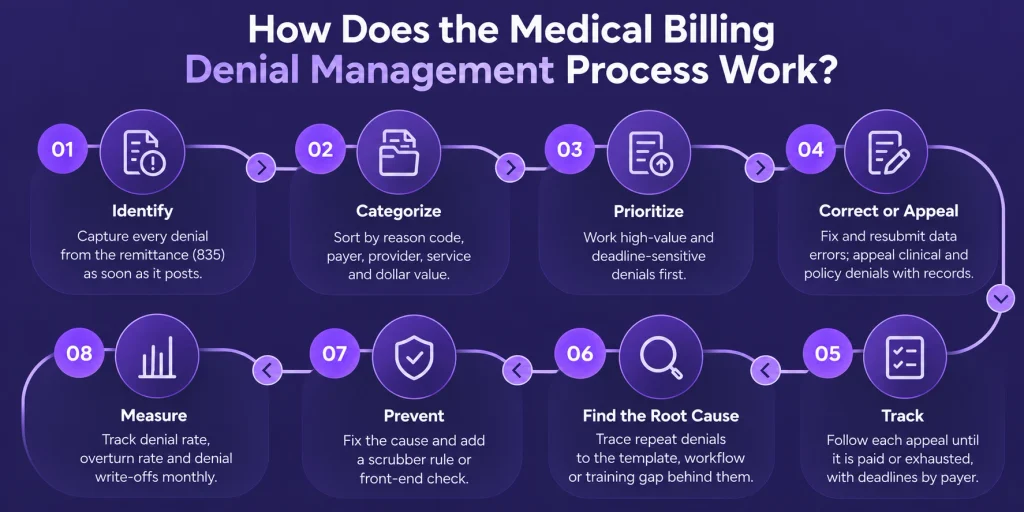
| Step | What Happens |
|---|---|
| 1. Identify | Capture every denial from the remittance (835) as soon as it posts |
| 2. Categorize | Sort by reason code, payer, provider, service and dollar value |
| 3. Prioritize | Work high-value and deadline-sensitive denials first |
| 4. Correct or appeal | Fix and resubmit data errors; appeal clinical and policy denials with records |
| 5. Track | Follow each appeal until it is paid or exhausted, with deadlines by payer |
| 6. Find the root cause | Trace repeat denials to the template, workflow or training gap behind them |
| 7. Prevent | Fix the cause and add a scrubber rule or front-end check |
| 8. Measure | Track denial rate, overturn rate and denial write-offs monthly |
Steps 1 to 5 recover revenue from today’s denials. Steps 6 to 8 protect next month’s revenue. Our guide to common denial codes in medical billing explains the reason codes used in step 2.
What Does a Denial Management Workflow Look Like?
A denial management workflow turns the process into daily and weekly routines:
| Frequency | Task |
|---|---|
| Daily | Post remittances, route new denials to work queues and fix simple data errors |
| Weekly | Work all open denials, file appeals and escalate claims nearing their deadlines |
| Monthly | Review denial trends by reason and payer and assign root-cause fixes |
| Quarterly | Update payer rules, scrubber edits and staff training |
Pro Tip: Give every denial category an owner. Eligibility denials go to the front desk lead, coding denials to the coding lead and authorization denials to the person who manages authorizations. A denial with no owner is a denial that ages.
How Does Denial Management Improve Medical Practice Revenue?
Here is a simple example for a practice that submits 10,000 claims a year with an average claim value of $150 and a 10% denial rate:
| Little Denial Management | Strong Denial Management | |
|---|---|---|
| Denied claims | 1,000 ($150,000) | 1,000 ($150,000) |
| Denials worked | 50% | 100% |
| Recovered (70% of those worked) | $52,500 | $105,000 |
| Revenue lost to denials | $97,500 | $45,000 |
| Denials prevented next year by root-cause fixes | None | Fewer denials and less rework |
Illustrative example. Recovery rate based on Premier’s finding that about 70% of denials are eventually overturned.
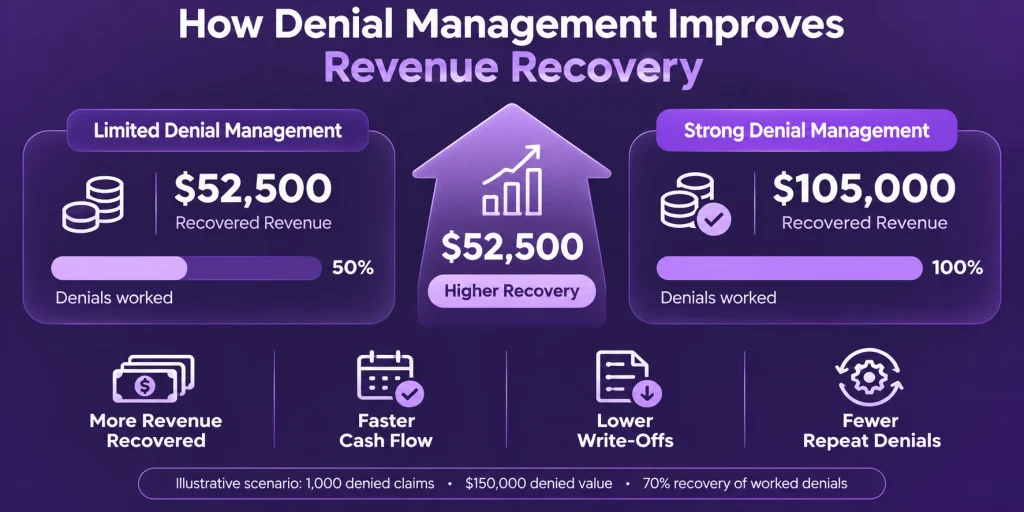
The difference in this example is $52,500 a year, before counting the denials that root-cause fixes prevent and the faster cash flow from working denials weekly instead of monthly.
Which Denials Should Practices Focus on First?
Start with the denials that are most common and most preventable. In Experian Health’s 2025 survey, providers named missing or inaccurate claim data (50%), authorization problems (35%) and registration errors (32%) as top causes, as Becker’s reported. Our guide to the top medical billing denial reasons covers all ten common causes and their codes.
| Denial Category | Where to Fix It |
|---|---|
| Eligibility and registration | Front desk, with eligibility verification before every visit |
| Authorization | Scheduling and authorization tracking |
| Coding and modifiers | Coding review through medical coding |
| Medical necessity | Documentation and coverage policy checks |
| Credentialing | Payer enrollment through credentialing |
| Timely filing | Daily claim submission and deadline tracking |
What Are the Best Denial Management Strategies?
- Work every denial, not just the large ones: small denials add up and often share a cause.
- Prioritize by deadline and dollar value, not by the order denials arrived.
- Appeal with evidence: records, the coverage policy and the specific reason the denial is wrong.
- Track appeal outcomes by payer to see which appeals are worth filing.
- Fix the root cause of any denial that repeats twice in a month.
- Review underpayments as well as denials.
- Combine A/R follow-up and denial management so no claim falls between the two.
Denials that sit unworked move into older aging buckets, which is why denial management and A/R management work best as one team.
How Do You Measure Denial Management Performance?
| KPI | Formula | What It Shows |
|---|---|---|
| Initial denial rate | Claims denied on first submission ÷ claims submitted | How many claims fail the first time |
| Denial overturn rate | Denials paid after appeal ÷ denials appealed | How effective appeals are |
| Denial write-offs | Denied dollars written off ÷ net revenue | Revenue permanently lost to denials |
| Days to resolve | Average days from denial to resolution | How fast denials are worked |
| Repeat denial rate | Denials with a reason seen in the prior month | Whether root-cause fixes work |
HFMA’s MAP Keys include standard definitions for denial-related KPIs.
What Should Healthcare Denial Management Software Do?
Denial management software should pull denials from remittances automatically, group them by reason and payer, route them to work queues, track appeal deadlines and report trends. The best tools connect denial data to the claim scrubber, so a denial reason that repeats becomes a pre-submission edit. Software helps, but it does not replace the people who read the policy, write the appeal and fix the workflow.
How Is Denial Management Different for Pharmacies?
Pharmacy claims are usually adjudicated in real time at the point of sale, so a denial shows up as a reject code at the counter instead of a remittance weeks later. Common pharmacy rejects include prior authorization required, refill too soon, product not covered and plan limits exceeded. Pharmacy denial management focuses on resolving the reject before the patient leaves, through prior authorization requests, formulary alternatives or quantity changes.
Should You Outsource Denial Management?
Outsourcing makes sense when denials age because no one has time to work them, when appeals are filed without tracking outcomes or when the same denials return every month. A denial management service in the USA should show you how it categorizes denials, how fast it works them, its overturn rate by payer and how it reports root causes back to your team.
How Does iSolve RCM Handle Denial Management?
iSolve RCM works denials weekly, tracks appeal deadlines by payer and traces every repeat denial to the front-desk, coding or billing step that caused it. Denial management is combined with A/R follow-up, so no claim falls between the two, and a medical billing audit shows where your current denials come from. Services start at 2.99% of monthly collections.

Frequently Asked Questions
What is denial management in healthcare?
It is the process of identifying, correcting, appealing and preventing denied insurance claims so a healthcare organization collects what it is owed and reduces future denials.
What is the denial process in medical billing?
A payer denies a claim on the remittance with a reason code. The billing team reviews the reason, corrects and resubmits or appeals the claim, tracks it to resolution and fixes the cause.
What is denial management in medical coding?
Coding denial management focuses on denials caused by coding errors, such as unsupported codes, missing modifiers or bundling conflicts, and fixes them through coding review and coder education.
How much revenue can denial management recover?
It depends on denial volume and how many are worked. Premier found that about 70% of denials are eventually overturned, so practices that work every appealable denial recover much more than those that do not.
What is the difference between A/R follow-up and denial management?
A/R follow-up chases unpaid claims of every kind, including those with no response. Denial management focuses on claims the payer has denied. They work best together.
How long do you have to appeal a denied claim?
It depends on the payer. Medicare allows 120 days to request a redetermination, while commercial payers set their own windows, such as Aetna’s 180 days to request a reconsideration.
what is a technical denial in healthcare
A technical denial in healthcare occurs when an insurance claim is denied due to billing errors, missing information, coding issues or filing deadlines.