Introduction: Why Getting the ICD-10 Code for Insomnia Right Matters
Insomnia is one of the most common complaints in primary care, behavioral health, neurology, and sleep medicine. Patients describe trouble falling asleep, waking through the night, waking too early, or sleeping without feeling rested. For the clinician, the clinical picture is rarely complicated. For the biller, it often is. A single clinical problem can map to codes in two different ICD-10-CM chapters, and the code you choose affects medical necessity, payer edits, and whether the claim pays on the first submission.
The ICD-10 code for insomnia most often reported is G47.00 (Insomnia, unspecified). When the provider documents primary or idiopathic insomnia, the more specific code is F51.01 (Primary insomnia). Between those two sit several other codes for insomnia due to a medical condition, insomnia due to another mental disorder, adjustment insomnia, and more. Choosing among them is not a matter of preference. It depends entirely on what the provider documents about cause, duration, and associated conditions.
This guide is written for US providers, medical billers, coders, and RCM professionals. It explains each common insomnia code, shows how G47.00 and F51.01 differ, and walks through chronic, primary, organic, and nonorganic insomnia. It also covers documentation, billing, denials, and the question many practices ask: is there a CPT code for insomnia? Examples are practical and written so a coder can apply them at the desk. Healthcare practices looking to streamline their revenue cycle can also benefit from professional medical billing services in USA.
Code set note: The FY 2027 ICD-10-CM code set applies to patient encounters from October 1, 2026 through September 30, 2027. The insomnia codes discussed here are billable at the highest level of specificity as listed below, but always confirm descriptions, notes, and edits in the FY 2027 tabular list and index published by CMS and the CDC before finalizing a claim.
What Is the Correct ICD-10 Code for Insomnia?
The correct ICD-10-CM code for insomnia depends on provider documentation:
- G47.00: Insomnia, unspecified.
- G47.01: Insomnia due to medical condition.
- F51.01: Primary or idiopathic insomnia.
- F51.02: Adjustment insomnia.
- F51.04: Psychophysiologic insomnia.
- F51.05: Insomnia due to other mental disorder.
There is no separate ICD-10-CM code specifically for chronic insomnia. Use the code that reflects the documented type and cause.

Understanding Insomnia Before You Code It
Coding accuracy starts with understanding what the provider is describing. Clinically, insomnia is persistent difficulty with sleep initiation, sleep maintenance, or early-morning awakening, despite adequate opportunity to sleep, along with daytime consequences such as fatigue, poor concentration, irritability, or impaired functioning.
Short-term vs. chronic insomnia
Current diagnostic frameworks, including the DSM-5-TR and the International Classification of Sleep Disorders, generally describe insomnia disorder as symptoms occurring at least three nights per week for at least three months. Shorter episodes are often called short-term or acute insomnia and frequently follow a stressor such as illness, a job change, or a loss. This distinction matters clinically, but as you will see later, ICD-10-CM does not have a separate code for “chronic insomnia.” Duration is documented in the note, while the code reflects the type and cause of the insomnia.
Why insomnia often travels with other conditions
Insomnia rarely appears in isolation. It commonly coexists with depression, anxiety, post-traumatic stress disorder, chronic pain, gastroesophageal reflux, restless legs syndrome, menopause, thyroid disease, and respiratory conditions. It can also be caused or worsened by medications, caffeine, alcohol, and other substances. Whether the provider links the insomnia to one of these conditions is the single most important factor in code selection.
How ICD-10-CM organizes insomnia
ICD-10-CM places insomnia in two places. Chapter 6 (Diseases of the Nervous System) contains category G47, Sleep disorders, and subcategory G47.0, Insomnia. Chapter 5 (Mental, Behavioral and Neurodevelopmental Disorders) contains category F51, Sleep disorders not due to a substance or known physiological condition, and subcategory F51.0, Insomnia not due to a substance or known physiological condition. The two sets exist side by side, and the classification’s exclusion notes govern how they interact.
Common ICD-10 Codes for Insomnia (Comparison Table)
The table below summarizes the diagnosis codes coders most often consider for an insomnia encounter. Codes G47.0 and F51.0 are subcategory headers and are not billable on their own. Report the full code at the fifth or sixth character shown here.
| Code | Description | Chapter | Typical use |
| G47.00 | Insomnia, unspecified | 6 (Nervous system) | Insomnia documented without a cause, type, or linked condition. Also the home for “insomnia NOS” and “insomnia disorder” when nothing more specific is stated. |
| G47.01 | Insomnia due to medical condition | 6 (Nervous system) | Provider explicitly links insomnia to a medical condition. Report the underlying condition as well. |
| G47.09 | Other insomnia | 6 (Nervous system) | Specified insomnia that does not fit another code in the G47.0 group. |
| F51.01 | Primary insomnia | 5 (Mental/behavioral) | Insomnia is documented as primary or idiopathic, not attributed to a medical condition, substance, or mental disorder. |
| F51.02 | Adjustment insomnia | 5 (Mental/behavioral) | Insomnia is tied to an identifiable stressor or life change, often short-term. |
| F51.03 | Paradoxical insomnia | 5 (Mental/behavioral) | Sleep state misperception: patient reports little or no sleep despite objective evidence of more sleep. |
| F51.04 | Psychophysiologic insomnia | 5 (Mental/behavioral) | Conditioned insomnia with learned sleep-preventing associations and heightened arousal. |
| F51.05 | Insomnia due to other mental disorder | 5 (Mental/behavioral) | Insomnia is attributed to a documented mental disorder such as depression or anxiety. Report the mental disorder too. |
| F51.09 | Other insomnia not due to a substance or known physiological condition | 5 (Mental/behavioral) | Specified nonorganic insomnia that does not fit F51.01 to F51.05. |
| F10.182, F10.282, F10.982 and similar F1x codes | Substance-induced sleep disorder codes (for example, alcohol-related) | 5 (Mental/behavioral) | Insomnia is documented as caused by alcohol or another substance. Choose the code that matches the substance and use pattern. |
| Z73.819 | Behavioral insomnia of childhood, unspecified type | 21 (Factors influencing health status) | Pediatric behavioral insomnia when the type is not specified. More specific Z73.81- codes exist. |
Two related Z codes sometimes appear in the same encounter: Z72.820 (Sleep deprivation) and Z72.821 (Inadequate sleep hygiene). These describe circumstances rather than an insomnia disorder, and the classification’s exclusion notes steer coders away from using them for the same problem as an insomnia diagnosis. Fatal familial insomnia (A81.83) is a rare prion disease and is unrelated to routine insomnia coding.
Billable status tip: G47.0 and F51.0 are not valid for claims. G47.00, G47.01, G47.09, F51.01, F51.02, F51.03, F51.04, F51.05, and F51.09 are the complete, reportable codes in these groups.
How to Choose the Correct ICD-10 Code for Insomnia
Selecting the correct ICD-10-CM code requires reviewing the provider’s documented diagnosis, the identified cause, and applicable coding instructions. Use the following guide to understand which codes may apply:
| Provider documentation | ICD-10-CM code |
|---|---|
| Insomnia without specified cause | G47.00 |
| Insomnia due to medical condition | G47.01 |
| Primary or idiopathic insomnia | F51.01 |
| Adjustment insomnia | F51.02 |
| Psychophysiologic insomnia | F51.04 |
| Insomnia due to another mental disorder | F51.05 |
Important: The coder must follow the provider’s diagnosis and applicable ICD-10-CM instructions, not independently determine the cause of insomnia.
G47.00 vs. F51.01: Key Differences
G47.00 and F51.01 are the two codes people search for most, and they are the two most frequently confused. They describe different documentation situations, sit in different chapters, and carry different implications for the claim.
| Feature | G47.00 Insomnia, unspecified | F51.01 Primary insomnia |
| Chapter and category | Chapter 6, G47 Sleep disorders | Chapter 5, F51 Sleep disorders not due to a substance or known physiological condition |
| What it signals | Insomnia is present, but the record gives no type, cause, or linked condition | Provider diagnosed insomnia as primary or idiopathic, with no medical, substance, or mental-disorder cause |
| Index terms | Insomnia NOS; insomnia disorder | Primary insomnia; idiopathic insomnia |
| Documentation burden | Low. Often the default when notes are vague | Higher. The note should show other causes were considered and not found |
| Specificity | Unspecified, so more likely to draw payer review as a stand-alone diagnosis | More specific, supports a clearer clinical picture |
| Typical settings | Primary care, urgent care, and encounters where insomnia is a secondary complaint | Sleep medicine, psychiatry, behavioral health, and follow-up visits after workup |
| Pairing | Can be paired with other conditions that coexist. Check exclusion notes before reporting with F51 codes | Can be paired with other conditions. Do not report with G47.01 for the same insomnia |

The decision in one sentence
Use G47.00 when the provider documents insomnia and nothing more. Use F51.01 when the provider documents primary or idiopathic insomnia, meaning the insomnia stands on its own rather than being caused by something else. The coder does not decide which is “really” true. The documentation decides.
Can G47.00 and F51.01 be reported together?
The classification’s exclusion notes matter here. The F51 category carries an Excludes2 note for organic sleep disorders (G47.-), and the F51.0 subcategory carries Excludes notes for organic insomnia and insomnia NOS (G47.0-). An Excludes2 note means the two conditions are not mutually exclusive, so both may be reported when the provider documents that the patient truly has both. In practice, reporting G47.00 and F51.01 together for one undifferentiated insomnia complaint adds nothing and invites questions. If the record supports the specific diagnosis, report the specific code. Confirm the exact note type for each code in the current tabular list, since exclusion notes are what coders are expected to follow.
ICD-10 Code for Chronic and Primary Insomnia
Is there an ICD-10 code for chronic insomnia?
There is no dedicated ICD-10-CM code for chronic insomnia. Chronicity is clinical context, not a code axis. When a provider documents “chronic insomnia” and offers no other detail, the encounter generally lands on G47.00. If the provider documents “chronic primary insomnia” or “chronic idiopathic insomnia,” the code is F51.01. If chronic insomnia is attributed to a medical condition, it is G47.01, and if it is attributed to a mental disorder, it is F51.05.
Chronic conditions can be reported at each encounter where they are monitored, evaluated, or treated. The outpatient guidelines support reporting chronic diseases as often as the patient receives care for them. That means a patient on long-term therapy for insomnia can carry the same insomnia code visit after visit, provided the note supports it each time.
What counts as primary insomnia?
Primary insomnia is insomnia that is not explained by another condition. The term has shifted over time. Older diagnostic systems separated primary from secondary insomnia. Newer frameworks emphasize that insomnia often coexists with other conditions and may deserve independent attention. For coding, the older distinction still drives the classification: if the provider is primary or idiopathic, it indexes to F51.01.
Primary insomnia is a diagnosis supported by a thorough history. Providers typically document sleep patterns, onset and duration, screening for depression and anxiety, medication and substance review, and evaluation for conditions such as sleep apnea or restless legs syndrome. When that history is in the chart, F51.01 is easy to defend on audit.
| Provider documentation | Code | Why |
| “Chronic insomnia,” no further detail | G47.00 | No type or cause stated, so unspecified applies |
| “Chronic primary insomnia, no psychiatric or medical cause identified” | F51.01 | Primary and idiopathic indexes to F51.01 |
| “Insomnia due to chronic pain” | G47.01 plus the pain diagnosis | Provider linked insomnia to a medical condition |
| “Insomnia secondary to major depressive disorder” | F51.05 plus the depression code | Provider linked insomnia to a mental disorder |
| “Insomnia since job loss two weeks ago” | F51.02 if the provider documents adjustment insomnia | Stressor-related. The provider must use the diagnosis |
| “Insomnia, sleep onset difficulty, unclear cause” | G47.00 | Symptom detail without a diagnosis of type or cause |
Organic vs. Nonorganic Insomnia: Which Code to Choose?
The words organic and nonorganic are older terms that still shape the structure of ICD-10-CM. In plain language, organic insomnia is tied to a physical or physiological cause, while nonorganic insomnia is not. Insomnia NOS is classified with the organic group in G47.0-, which is why G47.00 is the default when the cause is unknown.
A simple decision path for coders
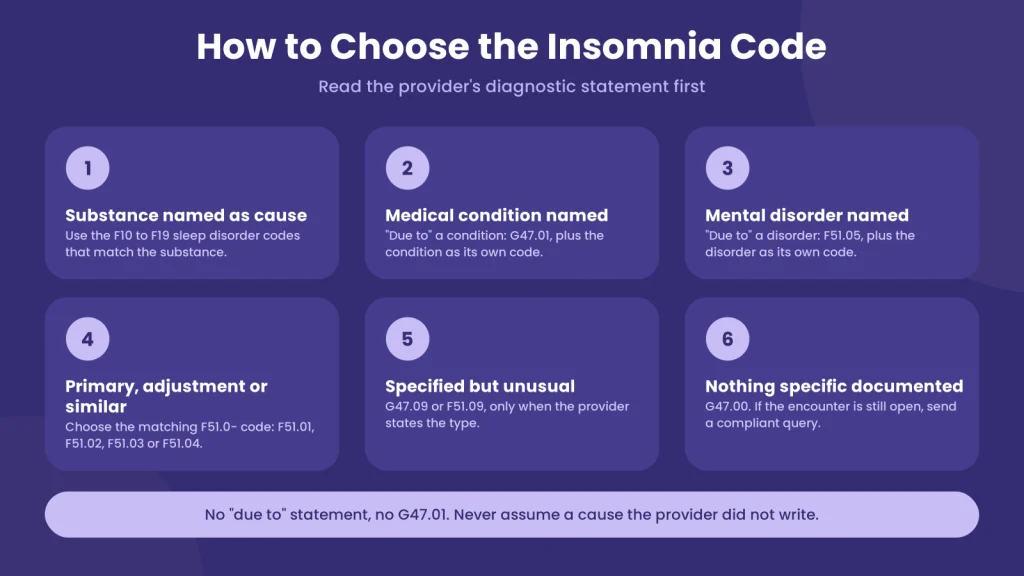
- Read the provider’s diagnostic statement first. Look for words such as “due to,” “secondary to,” “primary,” “idiopathic,” “adjustment,” “psychophysiologic,” or “paradoxical.” Those words are the code.
- Is a substance named as the cause? Alcohol, sedatives, stimulants, and other substances point to the F10 to F19 sleep disorder codes rather than G47.0- or F51.0-. The exact code depends on the substance and the documented pattern of use.
- Is a medical condition named as the cause? Choose G47.01 and report the underlying condition, such as GERD (K21.9), restless legs syndrome (G25.81), or COPD (J44.9), as a separate diagnosis.
- Is a mental disorder named as the cause? Choose F51.05 and report the associated disorder as well.
- Is it primary, adjustment, paradoxical, or psychophysiologic? Choose the matching F51.0- code (F51.01, F51.02, F51.03, or F51.04).
- Is it specified but unusual? Use G47.09 for other organic insomnia or F51.09 for other nonorganic insomnia, but only when the provider has stated the type.
- Nothing specific is documented? Use G47.00. If a query could improve specificity and the encounter is still open, send it.
The “due to” rule
Coders cannot assume that insomnia is caused by a condition simply because both appear in the note. A patient with chronic pain who also has insomnia may have two unrelated problems. Unless the provider writes that the insomnia is due to, secondary to, or caused by the condition, coding G47.01 is unsupported. This is one of the most common sources of both over-coding and denials.
Query tip: “Please clarify the relationship, if any, between the patient’s documented insomnia and the documented depression: insomnia due to depression, primary insomnia with coexisting depression, other, or unable to determine.” A non-leading query gives the provider room to document what is clinically accurate.
Documentation Requirements for Accurate Insomnia Coding
Insomnia is a subjective diagnosis, which makes documentation the foundation of both the code and the claim. A claim for an insomnia visit should let a reviewer understand what was evaluated, what was concluded, and why the service was needed.
What a strong insomnia note includes
- Chief complaint and history: sleep onset difficulty, night awakenings, early-morning awakening, or non-restorative sleep, with the pattern described in the patient’s words and the provider’s.
- Duration and frequency: how many nights per week and for how long. This supports the clinical picture even though it does not change the ICD-10-CM code.
- Daytime impact: fatigue, mood, concentration, safety concerns such as drowsy driving, and effects on work or family life. This supports medical necessity.
- Contributing factors: caffeine, alcohol, medications, screen use, shift work, pain, nocturia, reflux, and other conditions.
- Screening and assessment: depression and anxiety screening, review of substance use, sleep diary or validated tools if used, and evaluation for sleep apnea or restless legs symptoms when relevant.
- A clear diagnostic statement: the provider’s final impression using specific language: primary insomnia, insomnia due to a named condition, adjustment insomnia, and so on.
- Plan and treatment: cognitive behavioral therapy for insomnia, sleep hygiene counseling, medication management, referral for a sleep study, and follow-up interval.
- Medication details: drug, dose, response, side effects, and risk counseling when a sedative-hypnotic is prescribed or continued.
Medical necessity and the golden thread
Payers read the claim as a chain: diagnosis, service, and rationale should connect. If a provider bills a moderate-complexity established visit for insomnia, the note should show the problem was evaluated and managed at that level. If a provider orders a sleep study, the note should explain the clinical question the study answers. A diagnosis of G47.00 alone is sometimes not enough to support advanced testing, which is why documentation of suspected sleep apnea, observed apneas, or other qualifying findings matters.
Uncertain diagnoses in the outpatient setting
In the outpatient setting, the official guidelines instruct coders not to report diagnoses documented as probable, suspected, questionable, or rule-out. Code the confirmed condition or the documented signs and symptoms instead. If the provider writes “possible insomnia disorder,” the encounter should be coded to what is established, such as the documented symptom, until the provider confirms the diagnosis.
Practical coding examples
| Scenario | Code(s) | Coding notes |
| A 45-year-old with trouble staying asleep for two months. Provider notes “insomnia” and recommends sleep hygiene. No cause documented. | G47.00 | No type or cause stated. Do not infer one. |
| A 52-year-old with long-standing sleep onset insomnia. Provider documents “primary insomnia,” negative depression screen, no substances, normal thyroid labs. Starts CBT-I referral. | F51.01 | The documented workup supports a primary diagnosis. |
| A 60-year-old with nocturnal reflux. Provider documents “insomnia due to GERD” and adjusts therapy. | G47.01 and K21.9 | The provider linked the conditions. Report both. |
| A 38-year-old with major depressive disorder, recurrent, moderate. Provider documents “insomnia secondary to depression.” | F51.05 plus the depression code | Insomnia due to a mental disorder. Report the mental disorder as well. |
| A 29-year-old with sleep difficulty since a recent divorce. Provider documents “adjustment insomnia.” | F51.02 | Stressor-related diagnosis stated by the provider. |
| A patient who drinks heavily and whose provider documents alcohol-induced insomnia. | The F10 sleep disorder code that matches the documented use pattern | Substance-related insomnia is classified with the substance codes. |
| A 7-year-old with bedtime resistance and difficulty settling, documented as behavioral insomnia of childhood, type not specified. | Z73.819 | Pediatric behavioral type. Use a more specific Z73.81- code if the type is stated. |
Insomnia Medical Billing Guide and Reimbursement Considerations
Insomnia is usually billed as the reason for an evaluation and management visit, a behavioral health session, or a diagnostic service. Insomnia is not billed as a procedure. The ICD-10-CM code supports the visit, and the CPT or HCPCS code describes what was done. Payment depends on the payer, the plan, the provider type, and the documentation. For practices that want expert support, our medical billing services team can manage the full claim lifecycle.
Claim form basics
- Enter codes without the decimal point on electronic claims. On the paper CMS-1500, the form’s own formatting handles the decimal, so do not key one in. Follow your clearinghouse and payer instructions.
- Sequence the diagnosis that best explains the visit first. If insomnia is the main reason for the encounter, list it first. If depression was the primary focus and insomnia was addressed secondarily, sequence accordingly.
- Use diagnosis pointers. The CMS-1500 allows up to twelve diagnoses and up to four pointers per service line. Point each line to the diagnoses that justify it.
- Report coexisting conditions that affect care. Outpatient guidelines support coding all documented conditions that coexist and require or affect patient care at the encounter.
- Add long-term drug therapy status when applicable. When a patient is on a prescribed medication that requires monitoring, a status code such as Z79.899 may add useful context. Use it only when documented and when it fits payer policy.
Who bills for insomnia care?
Insomnia care is delivered across many provider types: primary care physicians, nurse practitioners, physician assistants, psychiatrists, psychologists, licensed clinical social workers, neurologists, and sleep specialists. Each has different billing rules and scope. Behavioral health clinicians who deliver CBT-I typically bill psychotherapy codes. Physicians and advanced practice providers more often bill E/M codes. Sleep centers bill diagnostic testing with facility and professional components. Confirm credentialing, enrollment, and the payer’s coverage policy for the provider type before billing.
Reimbursement considerations
- Insomnia as the sole diagnosis is usually fine for E/M visits. Problems arise when insomnia is the only diagnosis attached to costly testing or procedures.
- Specificity helps. Unspecified codes are valid, but a specific diagnosis such as F51.01 or G47.01 with a linked condition gives the payer a clearer reason for the service.
- Prior authorization. Some plans require authorization or documented medical necessity for sleep studies, certain medications, or repeated therapy sessions. Check payer policy before scheduling.
- Medication management. Controlled substance prescribing, quantity limits, and step-therapy edits can affect pharmacy claims. Document the rationale for continued treatment and the monitoring plan.
- Behavioral therapy limits. Many plans cap visit counts or require treatment plans. Keep progress notes aligned with the diagnosis and the therapy goals.
- Risk adjustment. G47.00 does not map to a payment HCC in the CMS-HCC models, so insomnia coding is about accuracy and necessity, not risk score.
- Payment varies. Fee schedule amounts, contracted rates, and coverage rules change by payer and by year. Check current schedules rather than relying on historical rates.
Telehealth and insomnia
Insomnia assessment and CBT-I are well suited to telehealth, and many payers cover them. Rules on eligible providers, originating site, place of service, modifiers, and audio-only visits vary by payer and change over time, particularly for Medicare and Medicaid. Verify current policy for each payer before billing, and document the modality, patient location, and consent as the payer requires.
Common denial reasons and fixes
| Denial reason | Likely cause | Fix |
| Diagnosis does not support medical necessity | Sleep study or procedure billed with only G47.00 and no supporting findings | Add documented symptoms or conditions that justify the test. Appeal with clinical notes |
| Invalid or non-billable diagnosis | Header code such as G47.0 or F51.0 submitted | Resubmit with the full code, such as G47.00 or F51.01 |
| Diagnosis not payable for provider type | Payer limits certain codes by specialty or place of service | Review payer policy and confirm the right billing provider |
| Missing prior authorization | Study, therapy, or medication needed approval | Request retro-authorization if allowed, otherwise appeal with documentation |
| Conflicting diagnoses | Codes reported together despite an exclusion note, such as G47.01 with F51.01 | Correct the diagnosis list to match documentation and the classification |
| Frequency or visit limit exceeded | Therapy or visit cap reached | Verify benefits before service. Appeal with clinical justification when appropriate |
| Documentation does not match claim | E/M level or code is not supported by the note | Audit the note, correct the claim, and educate the provider |
Strong denial management processes help practices catch these issues early and recover revenue faster.
Is There a CPT Code for Insomnia?
No. CPT codes describe services and procedures, not diagnoses. Insomnia is a diagnosis, reported with ICD-10-CM. There is no CPT code that means “insomnia.” What the practice bills depends on what the provider actually did for the patient.
| Service | Common CPT codes | Notes |
| New patient office visit | 99202 to 99205 | Level based on medical decision making or total time |
| Established patient office visit | 99211 to 99215 | Common for follow-up and medication management |
| Psychiatric diagnostic evaluation | 90791, 90792 | Used by behavioral health and psychiatry providers |
| Psychotherapy (for example, CBT-I) | 90832, 90834, 90837 | Based on session time. Document therapy focus and goals |
| Attended polysomnography | 95810, 95811 | Sleep center testing. Payers expect clinical indication such as suspected sleep apnea |
| Home sleep apnea test | 95800, 95801, 95806 | Used for suspected obstructive sleep apnea, not for insomnia alone |
| Multiple sleep latency or maintenance of wakefulness test | 95805 | Evaluates daytime sleepiness. Not routine for insomnia |
Sleep testing deserves a note. Clinical practice guidelines do not recommend polysomnography as a routine test for insomnia. It is generally reserved for cases where another sleep disorder, such as sleep apnea or periodic limb movement disorder, is suspected. A claim for a sleep study with only an insomnia diagnosis is a common denial. Support the order with the documented finding that justifies it. CPT codes and descriptors are maintained by the American Medical Association, so confirm current descriptors and payer-specific coverage rules before billing.
Common Insomnia Coding Mistakes
- Defaulting to G47.00 when the note supports more. If the provider documented primary insomnia or a linked condition, the unspecified code understates the record.
- Assuming a cause the provider did not state. Coding G47.01 or F51.05 because the patient has pain or depression, without a “due to” statement, is unsupported.
- Reporting G47.01 and F51.01 for the same insomnia. One says the insomnia is due to a medical condition. The other says it is not. The exclusion notes and the logic of the diagnoses conflict.
- Submitting header codes. G47.0 and F51.0 are not billable. Always report the full code.
- Using sign or symptom codes when a diagnosis is documented. If the provider diagnosed insomnia, code insomnia rather than a sleep disturbance symptom.
- Coding “rule out” or “probable” insomnia in outpatient settings. Report what is confirmed or the documented symptoms.
- Billing a sleep study with only an insomnia diagnosis. Add the supporting indication or expect a denial.
- Ignoring substance-related causes. If the provider documents alcohol or drug-induced insomnia, the F1x sleep disorder codes apply, not G47.0- or F51.0-.
- Using Z72.820 or Z72.821 alongside an insomnia diagnosis for the same problem. These codes carry exclusion notes that discourage this.
- Using last year’s code set. Confirm the code set that matches the date of service. FY 2027 applies from October 1, 2026.
- Copying forward old notes. Cloned documentation can make an insomnia diagnosis look unsupported. Each visit needs its own assessment.
- Skipping the query. When documentation is ambiguous, a compliant query protects both the claim and the provider.
Frequently Asked Questions About the ICD-10 Code for Insomnia
What is the ICD-10 code for insomnia?
The most commonly reported code is G47.00, Insomnia, unspecified. More specific codes include F51.01 for primary insomnia, G47.01 for insomnia due to a medical condition, F51.02 for adjustment insomnia, and F51.05 for insomnia due to another mental disorder. The right code depends on provider documentation.
Is G47.00 billable?
Yes. G47.00 is a complete, billable ICD-10-CM code. The parent subcategory G47.0 is a header and cannot be submitted on a claim.
Is F51.01 billable?
Yes. F51.01, Primary insomnia, is a billable code at the highest level of specificity. The header F51.0 is not billable.
What is the ICD-10 code for chronic insomnia?
ICD-10-CM has no separate code for chronic insomnia. Chronic insomnia with no further detail generally codes to G47.00. If the provider documents it as primary or idiopathic, use F51.01. If it is linked to a medical condition, use G47.01. If it is linked to a mental disorder, use F51.05.
What is the difference between G47.00 and F51.01?
G47.00 is unspecified insomnia in the nervous system chapter and is used when no type or cause is documented. F51.01 is primary insomnia in the mental and behavioral chapter and is used when the provider documents primary or idiopathic insomnia that is not due to another condition, substance, or mental disorder.
Can I use more than one insomnia code on a claim?
Only when documentation supports distinct conditions and the exclusion notes allow it. Reporting two codes that describe the same insomnia in conflicting ways, such as G47.01 and F51.01, is not appropriate. Review the tabular list notes for the codes you plan to report together.
Is there a CPT code for insomnia?
No. CPT codes describe services, not diagnoses. Insomnia visits are usually billed with E/M or psychotherapy codes, and testing is billed with sleep study codes when clinically indicated. The ICD-10-CM code supports the service.
What is the ICD-10 code for insomnia due to anxiety or depression?
When the provider documents insomnia due to a mental disorder, the code is F51.05, Insomnia due to other mental disorders, along with the code for the associated disorder. If the provider does not link them, code each condition separately.
Does Medicare cover insomnia treatment?
Medicare covers medically necessary evaluation and management of conditions such as insomnia, and coverage for related services depends on the service, provider type, and applicable Local Coverage Determinations. Verify the policy for the specific service and your Medicare Administrative Contractor.
Which ICD-10-CM code set applies now?
The FY 2027 ICD-10-CM code set applies to encounters from October 1, 2026 through September 30, 2027. Use the official CMS and CDC files, and confirm code descriptions and notes in the FY 2027 tabular list.
Sleep Medicine Billing and Credentialing Services for Insomnia Providers
Accurate insomnia coding is only one part of successful sleep medicine billing. Healthcare providers also need proper insurance credentialing, clean claim submissions, payer-specific billing compliance, and effective denial management to maintain a healthy revenue cycle.
iSolve RCM helps sleep medicine providers simplify their revenue cycle with specialized medical billing services, provider credentialing, claims processing, denial management, and accounts receivable support. Practices looking for specialized support can also explore our sleep studies billing services to learn more about billing for polysomnography, home sleep apnea testing, and other sleep diagnostic services. Whether your practice handles insomnia evaluations, sleep disorder consultations, or ongoing behavioral sleep therapy, an efficient billing process can help reduce administrative challenges and support timely reimbursement. Partner with iSolve RCM for reliable sleep medicine billing and credentialing support, allowing your healthcare team to focus more on delivering quality patient care.
Conclusion: Accurate Insomnia Coding Protects Care and Revenue
Insomnia looks like a simple diagnosis, but accurate coding takes attention to detail. G47.00 is the safe default when nothing more is documented, and F51.01 is the right choice when the provider documents primary insomnia. G47.01, F51.02, F51.05, and the other codes in these groups exist for situations where the cause or type is clear. The provider’s wording drives the choice, exclusion notes limit what can be paired, and medical necessity decides whether the claim gets paid.
The practical takeaways are straightforward. Document type, cause, duration, impact, and plan. Do not assume links the provider did not state. Report full, billable codes. Remember that no CPT code exists for insomnia, and support every service with a clear clinical reason. Revisit your code set each October so claims always match the date of service. For more coding and billing guides, visit the iSolve RCM blog, or explore our medical coding services.
Sources and Verification
Code descriptions, billable status, and notes should be confirmed against official files before publication or use. Primary sources: the CMS ICD-10 page (2027 ICD-10-CM code descriptions, tabular, index, and addenda), the CDC National Center for Health Statistics ICD-10-CM files, and the FY 2027 ICD-10-CM Official Guidelines for Coding and Reporting. CPT codes and descriptors are owned by the American Medical Association. This article is educational and is not legal, coding, or clinical advice; payer policies and code sets change.