

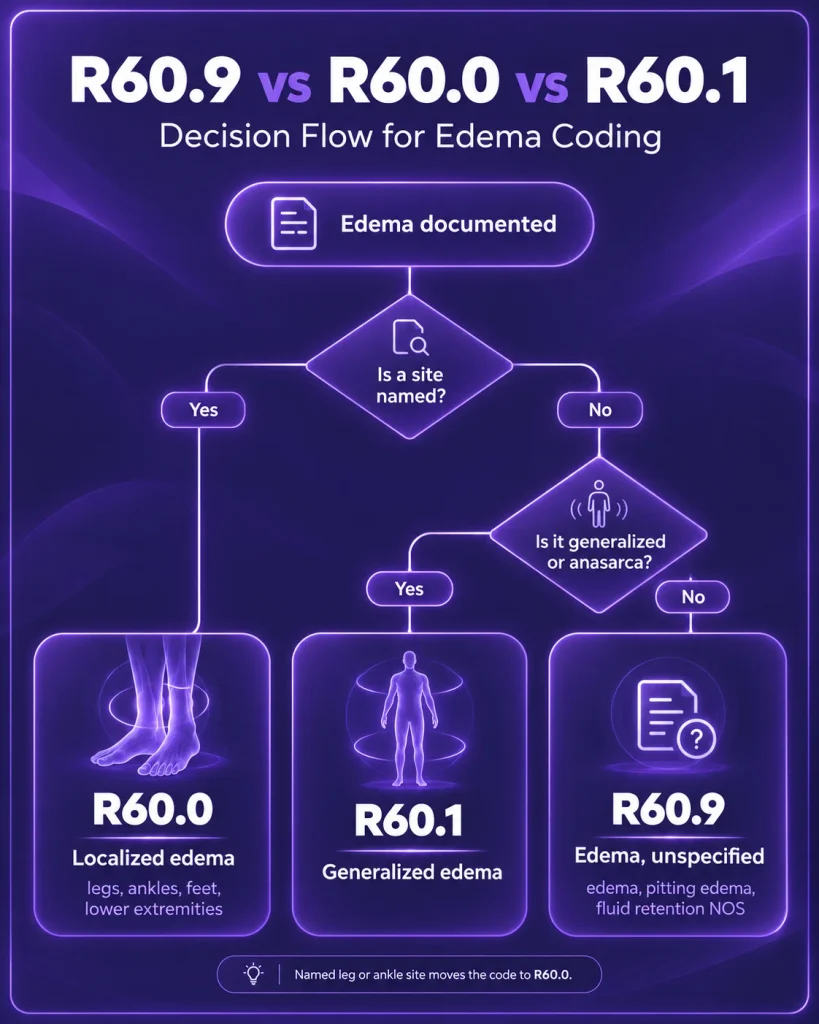
The ICD-10-CM code for peripheral edema is R60.9, Edema, unspecified, when the provider does not say where the swelling is. When the note places the edema in the legs, ankles, feet or lower extremities, including bilateral lower extremity edema, the Alphabetic Index sends the coder to R60.0, Localized edema. Both codes are billable, both are unchanged for FY 2027 (effective October 1, 2026) and both step aside when the edema is part of a diagnosed condition such as heart failure, venous insufficiency or lymphedema.
That last point is where most edema claims go wrong. This guide follows the path a coder actually takes: the Index entry, the R60 family, the bilateral leg question, the conditions that replace R60 and the documentation that decides between them.
Edema Coding at a Glance
| What the Provider Documented | ICD-10-CM Code |
|---|---|
| Edema, peripheral edema or pitting edema with no site | R60.9 |
| Fluid retention with no further detail | R60.9 |
| Bilateral leg edema, bilateral lower extremity edema, ankle or pedal edema | R60.0 |
| Edema of one leg, right or left | R60.0 |
| Generalized edema or anasarca | R60.1 |
| Leg edema due to venous obstruction | I87.1 |
| Stasis edema | I87.3- (chronic venous hypertension) |
| Lymphedema | I89.0 |
| Edema due to heart failure | The heart failure code (I50.-); no R60 code |
| Edema in pregnancy meeting gestational edema criteria | O12.0- by trimester |
What Is the ICD 10 Code for Peripheral Edema?
Peripheral edema is coded R60.9, Edema, unspecified, unless the record names the body part involved. R60.9 is a billable code in category R60, Edema, not elsewhere classified, in the symptoms chapter of ICD-10-CM, and its Applicable to note is fluid retention NOS. The code history for R60.9 shows no change from its creation in FY 2016 through FY 2027.
How the Alphabetic Index leads to R60.9
Coders start in the Alphabetic Index, not with a keyword search. The main term Edema, edematous (infectious) (pitting) (toxic) points to R60.9, and the entries Swelling (of) and Pitting lead to the same code. There is no peripheral Subterm under Edema, so peripheral edema with no site stays at the main term and lands on R60.9.
Why peripheral alone does not change the code
Peripheral means away from the center of the body. It describes a pattern, not an anatomical site, so it does not satisfy the “legs” or “localized” subterms that lead to R60.0. Some code lookup sites list “peripheral edema” as an approximate synonym for R60.9, but synonyms are a search aid, not an Index instruction. The deciding question is always the same: did the provider name where the edema is?
Coding tip: Most notes that say peripheral edema also name a site in the exam, such as 2+ pitting edema to mid-shin bilaterally. Read the whole note before settling on R60.9, because a named site moves the code to R60.0.
R60.0 vs R60.1 vs R60.9: The R60 Family Explained
Category R60 has three billable codes, and each one answers a different question about the extent of the swelling.
| Code | Title | Index Entries That Lead Here | Use When |
|---|---|---|---|
| R60.0 | Localized edema | Edema, legs; Edema, localized; Edema, extremities, lower; Edema, lower limbs | The record names a body part, on one side or both |
| R60.1 | Generalized edema | Edema, generalized | Swelling is widespread, such as anasarca |
| R60.9 | Edema, unspecified | Edema (main term); Swelling; Pitting; Fluid retention | No site and no extent is documented |
The R60 header itself is not billable, and R60.1 carries an Excludes2 note for nutritional edema (E40 to E46). The R60.0 Index trail is the one that matters most for bilateral leg edema, covered next.
What Is the ICD-10 Code for Bilateral Lower Extremity Edema?
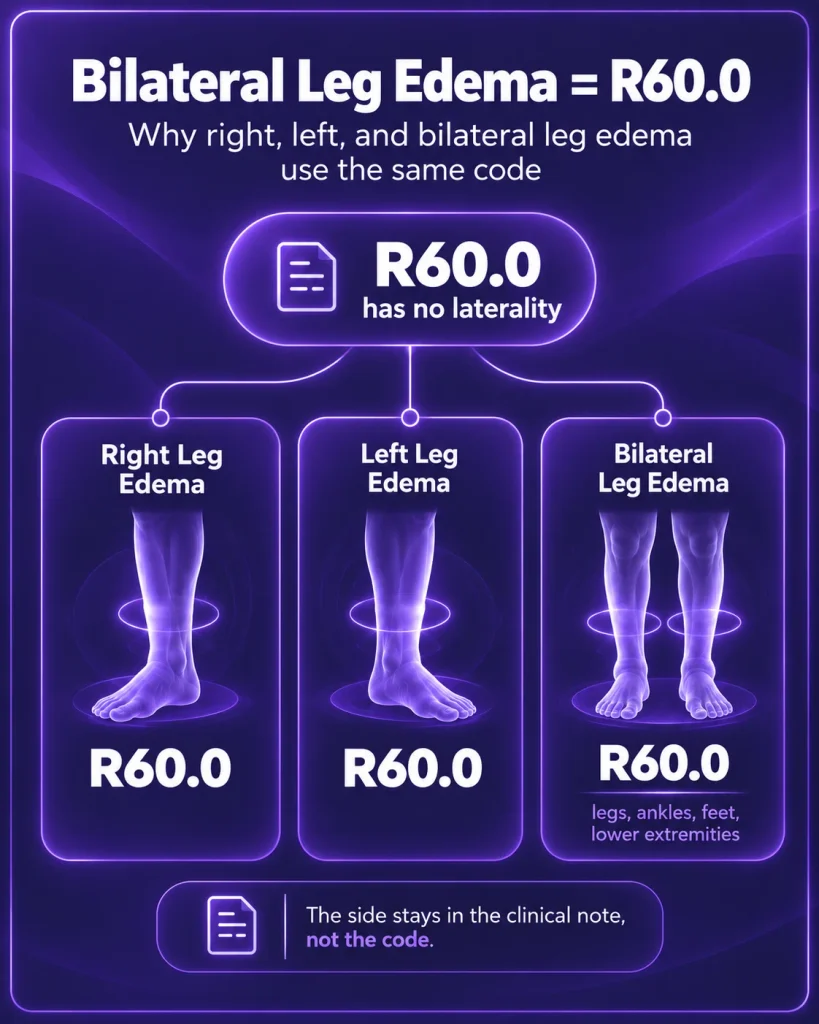
Bilateral lower extremity edema is coded R60.0, Localized edema. The Index entry “Edema, legs” points directly to R60.0, and both “Edema, extremities, lower” and “Edema, lower limbs” say “see Edema, legs.” Swelling in both legs is still localized to a named site, so it is still R60.0.
R60.0 has no laterality
R60.0 does not have separate codes for the right leg, the left leg or both legs. Bilateral, right-sided and left-sided leg edema are all reported with R60.0, and the laterality lives in the clinical note, not the code. Payers that need laterality for a related service, such as a venous study, read it from the documentation and the procedure code.
Leg edema, pedal edema and ankle edema
Bilateral leg edema, edema of lower extremities, pedal edema and ankle edema all name a site in the legs, so all of them follow the “Edema, legs” entry to R60.0. The same is true for edema documented in only one ankle or foot.
When leg edema is not R60.0
The Index also lists two exceptions under “Edema, legs”: leg edema due to venous obstruction goes to I87.1, Compression of vein, and hereditary leg edema goes to Q82.0, Hereditary lymphedema. When the provider documents either cause, those codes replace R60.0.
Edema, Unspecified: When R60.9 Is the Right Code
R60.9 is correct when the documentation supports edema but gives no site and no extent. Typical examples are “edema,” “fluid retention,” “pitting edema” or “peripheral edema” with nothing else in the note. It is also a reasonable choice at a first encounter when the swelling has not yet been located or worked up.
R60.9 is not a shortcut for incomplete reading. If the review of systems says “denies swelling” but the exam documents “bilateral ankle edema,” the exam controls and the code is R60.0. If the record is genuinely silent on location, a provider query is better than guessing.
When Not to Use R60: Excludes1 Notes and Underlying Conditions
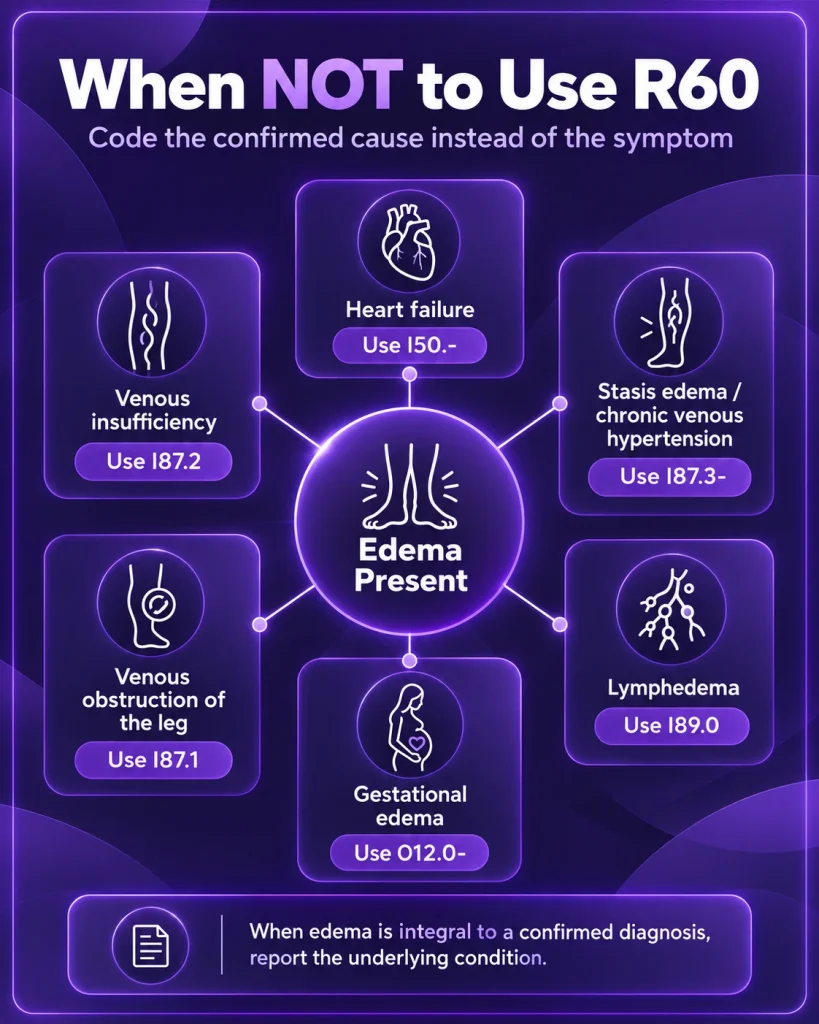
R60 is a symptom category. It is reported when edema is the finding being evaluated, not when edema is simply a feature of a diagnosis the provider has already made.
Edema types that R60 excludes
Category R60 carries an Excludes1 note, so these edema types are never coded with R60:
| Excluded Edema | Code Instead |
|---|---|
| Angioneurotic edema | T78.3 |
| Ascites | R18.- |
| Cerebral edema | G93.6 |
| Edema of larynx | J38.4 |
| Edema of pharynx or nasopharynx | J39.2 |
| Gestational edema | O12.0- |
| Hereditary edema | Q82.0 |
| Hydrothorax | J94.8 |
| Newborn edema | P83.3 |
| Pulmonary edema | J81.- |
Fluid overload works the other way around. E87.7, Fluid overload, carries its own Excludes1 note for edema NOS and fluid retention, which belong to R60.9, so the two are not interchangeable.
Edema that is part of a diagnosed condition
ICD-10-CM guidelines (Section I.B.5) say signs and symptoms routinely associated with a disease process are not coded separately. Edema in a patient with documented heart failure is an expected feature of the heart failure, so the heart failure code is reported and R60 is not. Under Section I.B.6, a sign or symptom that is not routinely part of the condition may be coded when it matters to care.
| Documented Cause | Code to Report |
|---|---|
| Heart failure | I50.- by type and acuity, or I11.0 with hypertension |
| Chronic venous insufficiency | I87.2 |
| Stasis edema or chronic venous hypertension | I87.3- with laterality and complications |
| Venous obstruction of the leg | I87.1 |
| Lymphedema, secondary or NOS | I89.0 |
| Lymphedema after mastectomy | I97.2 |
| Acute deep vein thrombosis of a leg | I82.40- with laterality |
| Cellulitis of the lower limb | L03.11- with laterality |
| Nephrotic syndrome | N04.- |
| Heat edema | T67.7XXA (initial encounter) |
How to Sequence Edema With Its Cause
Sequencing depends on how the cause relates to the edema and on the setting.
Edema caused by a medication
For an adverse effect of a correctly prescribed drug, Section I.C.19.e.5.a says to code the nature of the adverse effect first, followed by the drug code with a fifth or sixth character of 5. Bilateral ankle edema from amlodipine, confirmed by the provider, is reported as R60.0 followed by T46.1X5A, Adverse effect of calcium-channel blockers, initial encounter.
Suspected causes in outpatient settings
In outpatient coding, Section IV.H says not to code diagnoses documented as “probable,” “suspected,” “likely” or “rule out.” If the note says “lower extremity edema, suspect calcium channel blocker effect,” the encounter is coded R60.0 and the adverse effect code waits until the provider confirms it. Inpatient coders follow different rules for uncertain diagnoses at discharge.
Edema in pregnancy
Gestational edema is classified in category O12 and excluded from R60. O12.0- uses the final character for timing: O12.01, O12.02 and O12.03 for the first, second and third trimesters, O12.04 for edema complicating childbirth and O12.05 for edema complicating the puerperium.
Periportal Edema Is Not Peripheral Edema
Periportal edema is a liver imaging finding, fluid around the portal tracts seen on CT or ultrasound. It has nothing to do with swelling in the limbs and is not coded to R60. Code the liver or systemic condition the provider diagnoses. When the report gives only the imaging finding with no diagnosis, R93.2, Abnormal findings on diagnostic imaging of liver and biliary tract, is the usual choice.
Documentation That Supports the Right Edema Code
The code can only be as specific as the note. These elements decide between R60.9, R60.0 and a cause-specific code:
| Element | Why It Matters for Coding |
|---|---|
| Site (legs, ankles, feet, hands, face) | Moves the code from R60.9 to R60.0 |
| Extent (localized or generalized) | Separates R60.0 from R60.1 |
| Laterality | Not part of R60.0, but needed for related codes such as I87.3- and I82.40- |
| Pitting grade (1+ to 4+) | Supports severity and medical necessity; does not change the R60 code |
| Onset and course | Supports acute versus chronic cause codes |
| Confirmed cause | Replaces R60 with the underlying condition when integral |
| Workup ordered | Links the edema to tests such as a venous duplex or an echocardiogram when heart failure is suspected |
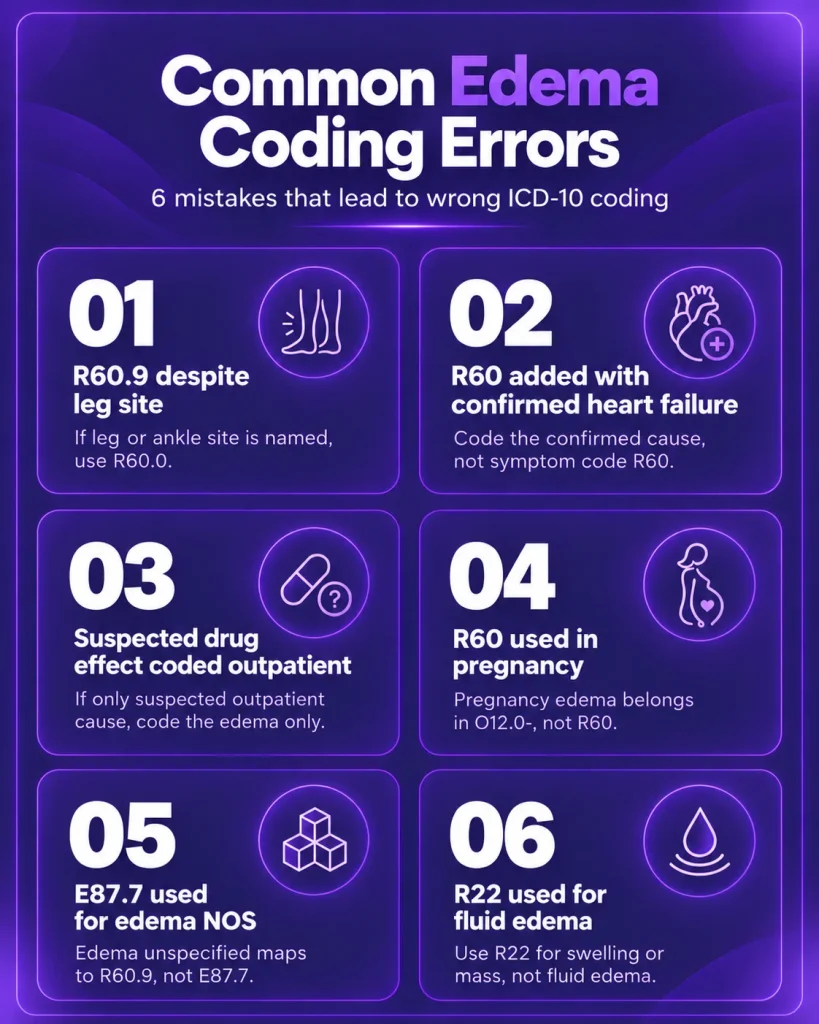
Common Edema Coding Errors That Lead to Denials
| Error | Why It Fails | Fix |
|---|---|---|
| R60.9 when the exam names the legs | Less specific than the record supports | Follow “Edema, legs” to R60.0 |
| R60.0 or R60.9 added to confirmed heart failure | Edema is integral to heart failure (I.B.5) | Report the I50.- code alone |
| Coding a “suspected” drug effect in an outpatient visit | Uncertain diagnoses are not coded outpatient (IV.H) | Code R60.0 until the cause is confirmed |
| R60 for edema in pregnancy | Gestational edema is excluded from R60 | Use O12.0- with the right final character |
| E87.70 for edema NOS | E87.7 excludes edema NOS | Use R60.9 |
| R22 for fluid swelling | R22 describes a localized swelling, mass or lump of skin, not fluid edema | Use the R60 code |
Diagnosis errors like these rarely cause a denial on their own, but they weaken medical necessity for the tests and treatments that follow. A periodic medical billing audit catches symptom codes that should have been replaced, and denial management traces medical necessity denials back to the diagnosis line.
Edema Coding Scenarios
| Documentation | Codes | Reasoning |
|---|---|---|
| “2+ pitting edema of bilateral lower extremities to mid-shin; cause under evaluation.” | R60.0 | Site named; laterality stays in the note |
| “Peripheral edema noted.” No site anywhere in the note. | R60.9 | No site or extent documented |
| “Bilateral ankle edema due to amlodipine,” confirmed by the provider. | R60.0, T46.1X5A | Adverse effect: manifestation first, then the T code |
| “Lower extremity edema, suspect amlodipine,” outpatient visit. | R60.0 | Uncertain cause is not coded outpatient |
| “Chronic systolic heart failure with bilateral leg edema.” | I50.22 | Edema is integral to heart failure |
| “Anasarca in a patient with nephrotic syndrome.” | N04.- | Generalized edema is integral to nephrotic syndrome |
| “Gestational edema, 32 weeks.” | O12.03 | Third trimester; R60 excluded |
How iSolve RCM Keeps Symptom Codes Accurate
Edema codes look simple, but they sit between documentation, guidelines and medical necessity. iSolve RCM, a medical billing company with certified coders, reviews symptom codes against the full note, replaces them when the provider confirms a cause and makes sure the diagnosis on each claim supports the services billed with it.
Frequently Asked Questions
What is the ICD-10 code for edema unspecified?
The ICD-10-CM code for edema, unspecified, is R60.9. It is a billable code used when the record documents edema or fluid retention without naming a site or saying whether the swelling is localized or generalized. If a site is documented, use R60.0, and use R60.1 for generalized edema.
What is the ICD-10 code for bilateral peripheral edema?
Bilateral peripheral edema is coded R60.0, Localized edema, when the note places it in the legs, ankles, feet or lower extremities, which is how it is usually documented. The Index entry “Edema, legs” leads to R60.0, and the code has no laterality, so “bilateral” stays in the note. If the record says only “bilateral peripheral edema” with no body part, code R60.9 and query the provider.
How to code peripheral edema?
Start with the main term Edema in the ICD-10-CM Alphabetic Index, which defaults to R60.9. Check the note for a site: legs, ankles, feet or lower extremities lead to R60.0, and generalized edema or anasarca leads to R60.1. Review the R60 Excludes1 note for types such as gestational, pulmonary or angioneurotic edema. Then check whether the edema is part of a confirmed diagnosis such as heart failure, in which case code the condition instead of R60. If a drug caused the edema, list the edema code first and the adverse effect code second.
What does peripheral edema mean?
Peripheral edema is swelling caused by excess fluid in the tissues of the limbs, most often the feet, ankles and lower legs, though it can also affect the arms and hands. It is a sign rather than a disease, with causes ranging from long periods of standing and certain medications to heart, kidney, liver or vein problems. Providers often grade it by how deep a pit stays after pressing on the skin.
What is the ICD-10 code for peripheral edema?
R60.9, Edema, unspecified, when no site is documented. If the provider names the legs, ankles, feet or lower extremities, the code is R60.0, Localized edema.
What is the ICD-10 code for bilateral lower extremity edema?
R60.0, Localized edema. The ICD-10-CM Index entry “Edema, legs” leads to R60.0, and “Edema, extremities, lower” refers coders to the same entry.
Is R60.9 a billable code?
Yes. R60.9 is a billable, specific ICD-10-CM code, valid for FY 2027 with no changes since it was created.
Does R60.0 have codes for right, left or bilateral?
No. R60.0 has no laterality. Bilateral, right and left leg edema are all coded R60.0, with the side documented in the note.
What is the difference between R60.0 and R60.9?
R60.0 is localized edema at a named site, such as the legs. R60.9 is edema with no site or extent documented. R60.1 covers generalized edema.
Can I code R60 with heart failure?
Usually not. Edema is routinely part of heart failure, so guidelines say to report the heart failure code without R60. Add R60 only when the edema is not integral to the documented condition.
What is the ICD-10 code for pitting edema?
Pitting edema with no site is R60.9, since the Index entry “Pitting” leads there. When the site is documented, such as pitting edema of both legs, the code is R60.0. The pitting grade belongs in the exam, not the code.
What is the ICD-10 code for fluid retention?
Fluid retention NOS is coded R60.9. Fluid overload is a different condition coded in E87.7, and the two are not interchangeable.
What is the ICD-10 code for periportal edema?
Periportal edema is a liver imaging finding, not peripheral edema, and is not coded to R60. Code the diagnosed liver condition, or R93.2 when the report gives only the imaging finding.
What is the ICD-10 code for periportal edema?
Periportal edema is a liver imaging finding, not peripheral edema, and is not coded to R60. Code the diagnosed liver condition, or R93.2 when the report gives only the imaging finding.