
The ICD-10 coding for dentistry serves as assurance of proper diagnostic coding that will inform treatment options as well as payment from insurers. Accurate codes such as K04.7 for periapical abscess without sinus are essential in dental infections to ensure billing accuracy and prevent denials.
This blog discusses K04.7 with detailed knowledge about its symptoms, diagnosis, and treatment. It further elaborates on the coding instructions, billing tips, and other dental infection codes, making it very useful for dentists, dental students, and professionals working with a medical billing company in USA to better understand accurate dental coding and reimbursement processes.
What Is ICD-10 Code K04.7?
Code K04.7 of periapical abscess without sinus or ICD-10 stands for dental pain, which denotes a bacterial infection on the apex of the teeth roots. Code k04.7 differs from the general ICD 10 code for dental pain because it is used to diagnose infections in dentistry.
Medical-wise, K04.7 can be characterized as an isolated infection at the apex of the tooth without formation of sinus tracts. Unlike in the tooth pain ICD 10 code, the pathology represented by the above medical term implies a much deeper infection than pain, which needs proper diagnosis and treatment.
This code is significant in dentistry due to the fact that it facilitates accurate coding and accurate billings. While other ICD 10 codes for oral pain might not specifically address cases of infection, this k047 diagnosis code differentiates between pain associated with an infection and nonspecific oral pain.
Causes of K04.7 or Periapical Abscess
Periapical abscess formation arises from bacteria entering the structure of teeth through decay, injury, or other oral diseases that lead to serious root infections.
Untreated Dental Caries
Unmanaged dental caries permit entry of bacteria to the enamel, dentin, to the pulp leading to infection. This is normally presented as an icd 10 code for dental infection without an abscess, which later spreads to the apical region of the root forming K04.7 abscess.
Pulp Infection or Pulpitis Progression
The pulp gets infected by the entry of bacteria into the pulp through the nerve of the tooth. This can happen either because of deep decay or trauma to the tooth. The patients usually suffer from pain which is well-documented as tooth pain ICD 10 code.
Cracked or Broken Tooth
Fracture in teeth leaves pulp tissues open to bacteria, causing infections in teeth. Tooth infection in its initial phase may be coded using ICD 10 codes for tooth infection; however, further progression of the disease causes inflammation in the tip of the root, and an abscess forms.
Failed Dental Restorations
The presence of leaking restorations in the form of fillings and crowns enables the bacteria to enter back into the tooth. This might occur in the form of pain in the tooth as mentioned by dental pain ICD 10; however, after a while, a periapical abscess develops.
Poor Oral Hygiene
Lack of oral hygiene contributes to the formation of plaque and accumulation of bacteria, therefore posing higher chances of infection. The first signs may be classified by the ICD 10 code for teeth pain, but prolonged neglecting results in bacteria penetrating the pulp and later developing into an abscess condition.
Expert Advice: Early identification and accurate ICD-10 coding of dental infections, tooth pain, and pulp-related conditions can help prevent claim denials, improve treatment documentation, and reduce the risk of complications such as K04.7 periapical abscess formation.
Symptoms of Periapical Abscess
Periapical abscess is characterized by localized signs of infection, such as pain, swelling, sensitivity, and systemic manifestations in the advanced stages of unmanaged dental infections.
Severe, Throbbing Tooth Pain
Periapical abscess is characterized by severe pain emanating from the teeth, brought about by the accumulation of fluid around the roots of the teeth. The symptoms presented by patients seeking medical assistance for this condition include a code ICD 10 for dental pain.
Sensitivity to Hot/Cold
Sensitive teeth to heat and cold foods happen because of the irritation or infection of the pulp tissues within the tooth. Such sensitivity is commonly associated with toothache ICD 10 code since temperature differences can cause intense pain signals from within the tooth.
Swelling in Gums or Face
The symptoms of swollen gums or facial tissue arise because the infection has spread to the tissues outside the tooth root. The medical records will contain the ICD 10 code for tooth infection because inflammation is growing, leading to swelling and pain.
Pain When Chewing or Biting
Chewing or bite pain occurs as a result of putting pressure on the affected tooth and bones around it. This clinical symptom can be documented under the tooth pain ICD 10 code. It refers to inflammation of the periapical tissue made worse by mechanical pressure.
Fever in Advanced Cases
A fever is triggered when the dental infection goes into the system, thereby indicating that the body responds to the presence of bacteria in its system. In this case, the dentist might begin with an ICD 10 code for oral pain; however, the symptoms make it clear that there is a much larger problem.
Bad Taste or Pus
A bad taste in the mouth or presence of pus is indicative of either an abscess drainage or breakdown of the infected tissues. At this level of severity, one may have a diagnosis of ICD 10 code for tooth infection without an abscess but eventually developing a periapical abscess.
Diagnosis of K04.7
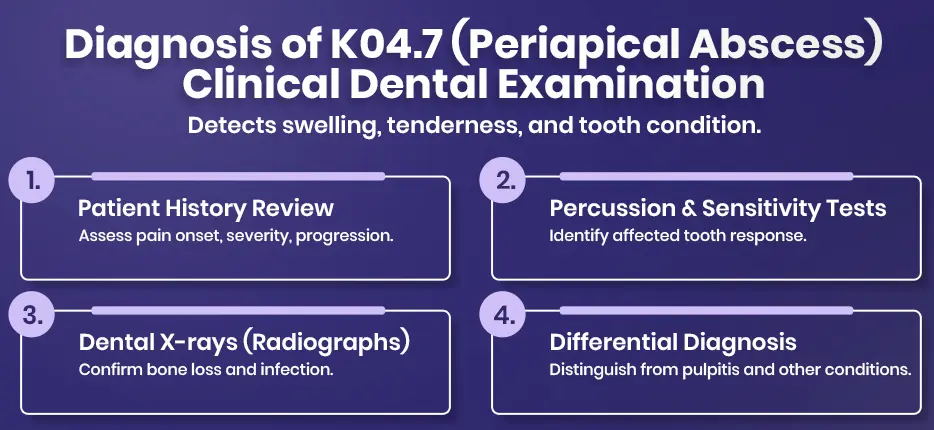
Periapical abscess diagnosis entails conducting various tests on the patient including taking his history, clinical assessment, testing and finally carrying out radiographic imaging.
Clinical Dental Examination
Clinical dental examination allows for detection of clinical symptoms like swelling, tenderness, and the state of the involved tooth. Doctors often match their clinical observations to ICD 10 coding for dental pain to record the symptoms before establishing whether the patient has an infection or not.
Patient History and Symptom Review
History taking and assessment of the nature of symptoms are important for identifying the beginning, severity, and progression of pain or swelling. These are related to the tooth pain ICD 10 code, thereby enabling healthcare professionals to ascertain whether there is simple pain or a developing infection.
Percussion and Sensitivity Tests
Percussion tests as well as sensitivity tests check teeth’s reaction to pressure or cold stimulus, which enables locating of the affected tooth. The diagnosis might initially be done under ICD 10 classification tooth infection, which shows that there is inflammation in the area near the tooth’s roots.
Dental X-rays (Radiographs)
Periapical abscesses can be confirmed through the use of Dental X-ray images that depict bone loss or infection around the root apex of the tooth. Such an image is important in differentiating between dental problems such as those described in the ICD 10 code for teeth pain.
Differentiating from Other Conditions
It is necessary to distinguish K04.7 from pulpitis and periodontal abscess because it will guide the patient on how to receive appropriate treatment. Although one may begin by considering ICD 10 code for oral pain, thorough examination helps in making appropriate distinction. Right Shoulder Pain ICD-10 Code M25.511 is used for accurate diagnosis reporting, treatment documentation, and insurance billing related to pain in the right shoulder joint.
Professional Tip: Accurate diagnosis of K04.7 requires combining clinical findings, patient history, sensitivity testing, and radiographic evidence to clearly distinguish it from other conditions, while ensuring proper ICD-10 documentation for both dental infections and associated pain codes to support correct treatment planning and insurance billing.
Treatment Options
Management of periapical abscess concentrates on the elimination of infection, pain relief, and restoration of dental health through dental management.
Drainage of Abscess
Draining an abscess is done to drain out the pus and relieve pressure within the affected area, thus alleviating any pain immediately. In medical notes, patients may be diagnosed with the ICD 10 code for dental pain, but draining is vital to manage infections.
Root Canal Therapy
The purpose of root canal treatment is to remove the infected pulp and seal the tooth in order to keep it from being reinfected. Root canal treatments can be linked with a tooth pain icd 10 code because they involve an infection of the nerves.
Tooth Extraction
If the tooth has sustained significant damage and is not able to be saved through restoration, then tooth extraction would be performed. In such instances, the dentists can note down ICD 10 codes for tooth infections since tooth extraction removes the infection source.
Antibiotic Therapy
The use of antibiotics in the treatment plan occurs when the infection starts to spread or when systemic signs like fever occur. The use of antibiotics may be associated with the ICD 10 code for oral pain at first, but the use of antibiotics alone does not cure.
Pain Management
Pain control involves drugs like analgesic and anti-inflammatory agents to relieve pain. The patients are usually admitted under ICD 10 for dental pain, where pain relief is very important since the procedure aims to alleviate the periapical abscess condition.
ICD-10 Coding Guidelines for Dentists
ICD-10 guidelines help dentists select the right codes for diagnosis that are to be used for infections, helping clinics that use outsource medical billing services maintain accurate documentation, streamline claims processing, and ensure proper insurance payments.
When to Use K04.7
Use the diagnosis of K04.7 if the patient suffers from a confirmed periapical abscess that is not accompanied by sinus tract formation. The diagnosis of ICD 10 code for dental infection without abscess can develop into K04.7 if there is an accumulation of pus around the apex of the tooth.
When NOT to Use It
K04.7 is not applicable in situations where sinus tracts are present, and in such situations, K04.6 would be ideal. It is important to note that misclassifications usually occur with regard to tooth pain ICD 10 code, but proper distinction will help to avoid such complications.
Importance of Documentation Accuracy
Correct documentation is a vital component in gaining the credibility of clinicians and ensuring that treatments will be justified and approved by insurance companies. Incorrect coding of a ICD 10 code for tooth infection may cause claim rejection, and accurate documentation should therefore be ensured.
Linking Diagnosis with Treatment Plan
The correlation of diagnosis with treatment helps ensure proper clinical intervention through procedures such as root canal treatments or extractions. It is essential that codes such as the ICD 10 code for oral pain correlate with diagnosis since they allow dentists to justify their procedures and increase efficiency.
Billing and Insurance Considerations
The ICD-10 coding like K04.7 is used in conjunction with the CDT coding in order to prove that a particular dental procedure is necessary and should be covered by insurance. For instance, an issue of periapical abscess justifies a root canal or tooth extraction. This diagnosis could be supported by ICD 10 code for tooth infection.
It is important to document the connection between the diagnoses and the procedure in order to facilitate insurance claims. The use of accurate medical records, x-rays, and proper documentation lowers the chance of claim denial. Vague codes such as ICD 10 code for dental pain are to be avoided for successful insurance claims.
Related ICD-10 Codes
ICD-10 codes related to this condition assist dentists in determining different stages of infection, decay, and pain in the teeth through accurate medical coding services which help improve documentation and billing efficiency.
K04.6 – Periapical Abscess with Sinus
K04.6 represents the diagnosis of an apical abscess with the presence of a sinus tract, suggesting that the infection of the tooth root has been long-term, allowing a drainage route. It is commonly mistaken for the ICD 10 code for a dental infection without an abscess.
K04.0 – Pulpitis
K04.0 is the code for dental pulpitis, which is inflammation due to the presence of caries or trauma. Patients generally come up with conditions categorized as tooth pain ICD 10 code, and if left untreated, the pulpitis will advance to a point where it leads to an abscess.
K02.9 – Dental Caries, Unspecified
The diagnosis of K02.9 is reserved for situations where the exact location or severity of the tooth decay remains unrecorded. An early case of the condition might coincide with the ICD 10 code that stands for teeth pain. The unchecked caries, however, may develop into pulpitis and ultimately form an abscess.
K08.89 – Other Specified Tooth Disorders
K08.89 refers to different tooth problems such as pain in the tooth without a proper cause or structural problem with the teeth. It is usually applied as ICD 10 for dental pain where the dental disorder is yet to be diagnosed.
Common Coding Mistakes to Avoid
ICD-10 coding in dentistry must be done accurately to ensure appropriate diagnosis reporting, treatment, and denial management services for smoother insurance billing, without committing any mistakes that could impact either.
Mislabeling Tooth Pain as K04.7 Without Infection
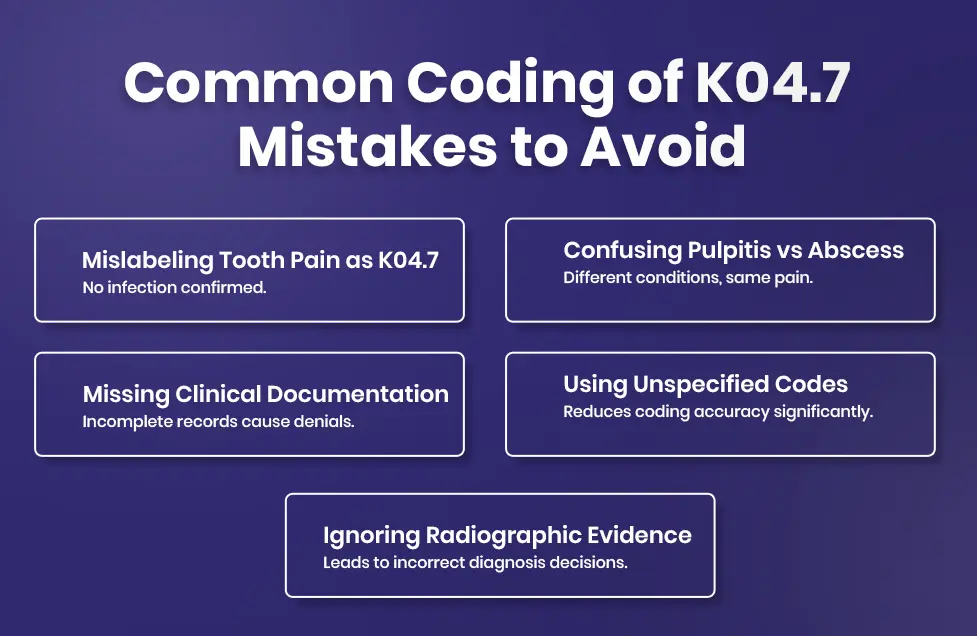
Another typical mistake is using K04.7 when there is a toothache but no infection is present. There might be a connection between ICD 10 for tooth pain and K04.7, but K04.7 can only be diagnosed with the presence of an established periapical abscess.
Confusing Pulpitis vs Abscess
Pulpitis and periapical abscess often get mistaken for each other because of the pain they produce. Both conditions may start off with tooth pain ICD 10, but the former entails inflammation while the latter implies the presence of pus in the body.
Missing Documentation of Clinical Findings
Inappropriate documentation results in improper billing and denial of claims. In most cases, dentists use ICD 10 code for tooth infection, but the absence of proper documentation of signs, tests, and imaging cannot justify the diagnosis or treatment process.
Incorrect Use of Unspecified Codes
The use of general codes despite having specific diagnosis codes decreases the accuracy and quality of the coding and reimbursement process. Rather than using the general code ICD 10 for oral pain, the specific condition such as abscess or pulpitis should be documented.
Expert Insight: Always ensure ICD-10 codes in dentistry are supported by clear clinical findings, diagnostic tests, and proper documentation, and avoid overusing unspecified or incorrect pain and infection codes, as this can lead to claim denials, reduced coding accuracy, and reimbursement delays.
How iSolve RCM Help with ICD-10 codes
The iSolve RCM makes it easier for dentists and physicians to make use of the ICD-10 codes since it will enable correct code assignment, efficient claims submission, and reduced number of denied claims. The software enables a good matching between diagnoses, like K04.7, and the right CDT procedure codes hence enhancing documentation efficiency and making the whole process of reimbursement more effective. Moreover, the iSolve RCM software also ensures that there is no error made when the diagnosis made is not specified, like ICD 10 code for dental pain. This means that all the claims made will be supported by proper documentation hence increasing their chances of being accepted and ensuring that the dentist earns from them. Additionally, it enhances the performance of the revenue cycle in terms of coding audits and denials management.
FAQs
Is K04.7 a dental emergency code?
Certainly, condition K04.7 can be referred to as a dental emergency due to the presence of infection in the tooth root area. This problem typically involves pain and swelling, which are almost the same as those indicated by icd 10 code for dental pain.
Can antibiotics alone treat K04.7?
Antibiotics will not completely cure K04.7 because the root cause of the infection is still inside the tooth. Even when the symptoms are alleviated using antibiotics, it will be necessary to drain the area, perform a root canal procedure, or extract the tooth itself.
What is the difference between K04.7 and K04.6?
K04.7 means periapical abscess without sinus tract, while K04.6 is with sinus tract draining. The two can be similar in symptoms to the symptoms of tooth pain ICD 10 codes; however, K04.6 is chronic and has drainage, while K04.7 is acute.
Can dentists bill K04.7 with extraction procedures?
Yes, dental surgeons have the ability to bill K04.7 in conjunction with tooth extractions when the tooth cannot be repaired or restored in any way. It is important that there is proper documentation for the procedure, which may include an ICD 10 code for tooth infection.
What complications can occur if K04.7 is untreated?
Without proper treatment, this condition can result in infections that spread, cellulitis, or loss of bones. Initially, the symptoms might seem like those of ICD 10 code of oral pain, but if the condition worsens, it might necessitate immediate action to avoid complications.
How is K04.7 diagnosed in clinical practice?
K04.7 is based on clinical diagnosis, symptoms from the patient, percussion test results, and dental X-rays. Although dentists might at first classify their diagnosis by ICD 10 code for teeth pain, radiographs showing infection of the tooth root apex will ultimately diagnose periapical abscess.