

Precise medical coding is the pillar and backbone of the U.S. healthcare system. Codes in medical billing act as standardized symbols for documentation. They ensure proper reimbursement, timely claims, and consistent patient records. Incorrect headache coding can cause claim denials and compliance issues. It may also compromise patient care due to inaccurate documentation. Healthcare has shifted toward value driven models in 2026. So Headache ICD-10 Code requires a detailed practice for both financial stability and clinical quality for medical billing services in the USA.
Moreover, new medical guidelines or procedures, healthcare policies and payer requirements demand that ICD-10 codes must be updated annually. The newest CMS and payer guidelines U.S. providers and coders need to stay up-to-date to avoid claim rejections. Headache ICD-10 Codes can interrupt compliance, billing accuracy, and Electronic Health Record (EHR) workflows even with minor variations. Staying informed with these updates is not just about coding accurately. It is about defending revenue and preserving high standards of patient care.
According to research by the Department of Veterans Affairs, most patients with ICD-9-CM headache diagnoses did not receive a corresponding ICD-10-CM code. However, an ICD-9-CM diagnosis from a primary care provider, or evaluation by a neurologist or physiatrist, significantly increased the likelihood of an ICD-10-CM headache assignment. Choosing and selecting the right ICD-10 code is essential to decrease denials and advance reporting accuracy. This continues a smooth revenue cycle in the medical billing company in the USA. This in-depth guide will explore all information about Headache ICD-10 Code for clinicians to practice guidelines every year.
What is the Headache ICD-10 Code?
The International Classification of Diseases is the standardized system used in the U.S. to classify and code symptoms, diagnoses, and medical conditions. The primary purpose of this system is to produce a universal language that links clinicians, coders, insurers, and researchers together. The code known as the Tenth Revision ICD-10 code was updated by ICD in 1990 for several headache conditions. The correct code for Headache ICD-10 Code ensures that providers will get accurate billing, compliance with CMS and payer guidelines, and reliable health data for clinical and public health reporting or research. Ultimately, this system was planned to advance communication, financial accuracy, and quality of care throughout the healthcare setting.
ICD-10 codes are the source of smooth claims processing since they determine medical necessity and repayment eligibility. Besides, these codes regulate documentation, make patient histories precise and effortlessly transfer across providers in electronic medical records (EMRs). Using the right and correct code for Headache ICD-10 Code facilitates the providers meeting CMS, HIPAA compliant, and private payer requirements and this reduces the risk of audits and penalties in compliance. ICD-10 is a compliance and revenue protection for U.S. healthcare practices and not only just a coding system.
Headaches fall principally under the R51 category in ICD-10-CM. The code R51.9 – Headache, unspecified is frequently used when documentation does not describe a specific category of headache. Though, providers are encouraged to give more precise codes, when possible, such as tension-type headaches – G44.2 or migraines – G43 series. Whereas R51.9 remains the most commonly used Headache ICD-10 Code in U.S. practice, dependence on unspecified codes can disturb reimbursement accuracy and strict clinical understanding. Choosing the right category supports both providers and billing teams align care with payer requirements.
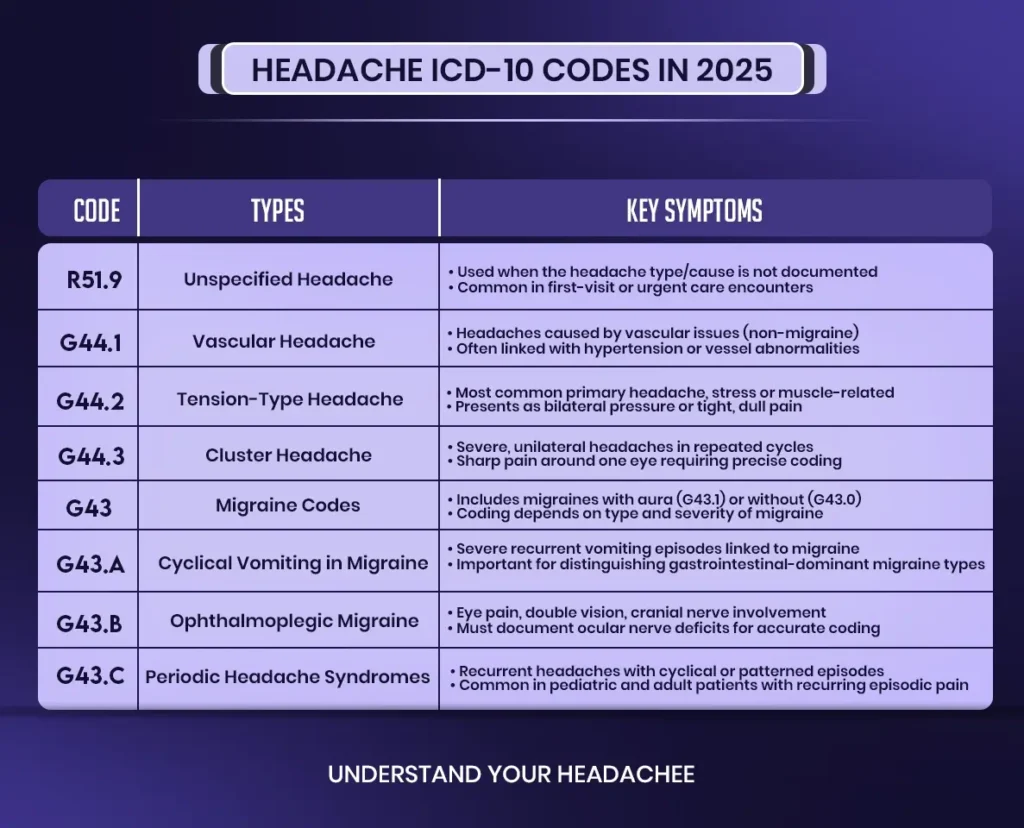
Headache ICD-10 Codes in 2026
| ICD-10 Code | Headache Type | When to Use |
| R51.9 | Headache | This code is frequently used when the documentation does not explain the type or cause of the headache and also known as unspecified headache. Whereas it is common in first-visit encounters or urgent care. We can exemplify when a patient visits a clinic and reports with head pain without further details then R51.9 will be applied until a full workup is completed. |
| G44.1 | Vascular headache | This code is typically applied when headaches result from vascular causes other than migraines. Moreover, this code is imperative for conditions tied to blood vessel abnormalities. A patient with headaches linked to hypertension or vascular disorders may be allotted G44.1 for specificity. |
| G44.2 | Tension-type headache | The most often identified primary headache, frequently connected to stress or muscle strain. This code requires documentation of symptoms such as bilateral pressure or tightness. G44.2 would be the correct code for a patient who presents with dull, non-pulsating pain intensified by stress. |
| G44.3 | Cluster headache | This code is used for unilateral and severe headaches occurring in cyclic shapes. Cluster headaches are less common but need precise coding for accurate treatment tracking and payer justification. G44.3 will be the right code for when a patient reports repetitive episodes of sharp pain around one eye, consistent with cluster headaches. |
| G43 | Migraine-related codes | Migraines have numerous subcodes based on type and severity such as G43.1 for migraine with aura or G43.0 for migraine without aura. These differences are dynamic because treatments and reimbursement fluctuate based on clinical presentation. We can demonstrate that a patient diagnosed with migraine with aura should be coded as G43.1, but not R51.9. |
Other Secondary Headache Codes: Secondary headaches entail linking the headache to an underlying condition. Post-traumatic headaches may be coded under G44.8, whereas sinus-related headaches may fall under J01 – severe sinusitis with associated headache documentation. A patient with sinus infection and reported head pressure should be coded with the sinusitis code along with the suitable headache ICD-10 code.
Subtypes of Headaches and Their ICD-10 Coding
1. Tension Headaches
The most common and prevalent primary headache in the United States is a tension headache. This headache is often categorized by mild to moderate, two-sided, pressing and tightening distress or pain. However, for correct medical coding services, clinicians should gather inclusive information and record the amount of time duration, frequency, symptoms, and causes of the headache. The most suitable Headache ICD-10 Code for tension headaches. The use of this code rather than using general R51 code supports precise clinical records, helps in proper billing, and decreases claim rejections. Patient reports recurring two-sided head pressure, mild nausea, no aura, caused by stress will be assigned by G44.2 code.
2. Migraines
Migraines are a complicated primary headache ailment that frequently necessitate detailed documentation for accurate coding. The Headache ICD-10 Code for migraines falls under the G43 series, with subcodes demonstrating the precise type:
- The condition for migraine without aura, used for typical migraines missing neurological symptoms is assigned by G43.0 code.
- G43.1 is used for migraine with aura. It applies when patients experience visual, sensory, or speech disturbances before onset.
- G43.7 is used for chronic migraine. It applies when headaches occur 15+ days per month for over three months.
- The condition for menstrual migraine in which migraines are specifically linked to the menstrual cycle assigned with G43.8 code.
- The condition for status migrainosus for prolonged migraines lasting more than 72 hours, often requiring urgent care are assigned with G43.9.
3. Cluster Headaches
Cluster headaches are severe, intense or unilateral pain around the eye or temple. This is a comparatively rare type of primary headache. However, the difference between episodic and chronic forms of pain facilitates appropriately coding these headaches. Episodic cluster headaches happen in periods which take time to end from weeks to months. Although chronic cluster headaches endure for more than a year with minimal or no reduction or remission. Episodic or chronic patterns ensure accurate clinical documentation. This supports proper billing and payer compliance using G44.3. Additionally, comprehensive documentation of duration, attack frequency and triggers helps precise coding. This helps to decrease the hazard of claim denials.
4. Other Specific Headaches
Some headaches are secondary, meaning they rise from an underlying condition rather than being a primary disorder. Moreover, the precise use of the Headache ICD-10 Code is important for correct diagnosis, billing, and treatment tracking:
- Sinus Headaches – This is frequently linked to sinusitis or upper respiratory infections and code alongside the underlying sinus condition. This is J01 for acute sinusitis and headache documentation.
- Cervicogenic Headaches – These headaches arise from cervical or neck disorders.They are often coded as G44.89 with clear documentation.
- Post-Traumatic Headaches – These headaches follow head injury, trauma, or concussion. They are coded as G44.3 or G44.8 accordingly.
- Rebound Headaches or Medication Overuse – These headaches result from repeated pain-medication use. They are coded as G44.41 with overuse documentation.
Coding Challenges for Headaches in the U.S. Practice
Following are the challenges based on condition and type of migraine:
First, many headache visits are documented too vaguely. This often leads coders to use R51.9 as unspecified. Correct documentation that specifies headache type; such as migraine, tension, or cluster headache can help proper ICD-10 coding. This advances clinical clarity, and enables accurate billing.
Second, practitioners often struggle to distinguish primary headaches like migraines or tension types. They also face difficulty separating them from secondary headaches caused by trauma, sinus issues, or vascular problems. Any confusion with these categories can lead to improper Headache ICD-10 Code choice and compliance menaces. Patients frequently visit the practice with more than one headache type, such as a migraine covered by tension headaches. However, using each correct code type Headache ICD-10 Code distinctly is decisive to prevent over-coding or under-coding. Failure to distinguish multiple headaches can disturb treatment documentation, reimbursement, and quality reporting.
Third, clinical notes often focus mainly on patient symptoms. However, coding needs structured details to meet ICD-10 specificity. Misalignment between narrative notes and coding rules can result in claim denials, compliance issues, or revenue loss.
Pro Tip: Ensure that that medical providers document exactly what kind of headache, any fundamental reasons, and whether there are multiple causes of the headache issue. ICD-10 accuracy has been improved and coders can avoid ambiguous codes by clearly distinguishing between main and secondary headaches. Reimbursement can be enhanced, compliance can be protected, and denials can be substantially reduced with standard procedures and coding provider communication.
Billing and Compliance Alignment
Practicians need to keep in view following billing and compliance considerations for accurate documentation and coding:
First, the correctness of Headache ICD-10 Codes directly affects whether insurance claims are approved or denied. Payers have to emphasize on specific codes such as a migraine with G43 distinguishing from a general headache R51.9. Vague or incorrect codes may lead to claim rejections, breaches in reimbursement, or demand for additional documentation. U.S. billing compliance and standards necessitate correct coding.
Second, practicians need proper coordination between CPT codes and ICD-10 codes. This is to differentiate or understand when procedures or treatments are billed alongside headache diagnoses. Some headache treatments may be bundled under broader CPT codes. They can lead to claim denials if the ICD-10 code does not justify medical requirements. In practice, a migraine injection process billed with R51.9 might be questioned. Whereas G43.1 obviously supports the treatment.
Third, using precise codes like G44.2 or G43.1 ensures accurate documentation. This accuracy supports payer compliance and reduces denials. It is essential to maximize payer reimbursement and avoid denials. Unspecified codes frequently lead to incomplete reimbursement or further documentation requests and increasing administrative capacity.
Additionally, the compliance updates from CMS and private insurers have reorganized guidelines. This emphasizes specificity as well as appropriate documentation for headache diagnoses. Providers must ensure their Headache ICD-10 Codes are up-to-date. Otherwise failure can cause in claim denials, audits, or drawbacks. However, it is indispensable to stay updated with CMS manuals, payer bulletins and EHR coding tools. This is to maintain billing workflows, compliance and protect revenue in U.S. healthcare practice.
Pro Tip: Confirm that each headache claim has been associated with the appropriate CPT service and ICD-10 code to enhance billing accuracy. Specific codes, such as G43 for migraines or G44.2 for headaches caused by tension, limit payer opposition and give an apparent medical requirement. Maintain an effective revenue cycle, stay up to date on CMS and insurer updates in order to prevent rejects or denials, reduce audit risks.
Best Strategies and Practices for U.S. Providers and Coders
Providers and coders can gain highest results through following practices:
First, providers should record thorough and accurate information including frequency, duration, headache type, triggers, harshness, and any related symptoms. Proper documentation supports the selection of the correct Headache ICD-10 Code and ensures compliance requirements. Second, stay updated with modern EHRs frequently include decision-support tools that recommend appropriate ICD-10 codes based on the recognized symptoms and diagnosis. These tools help coders and providers classify the correct Headache ICD-10 Code in real time and help to improve coding accuracy and efficiency.
Third, coders and providers need to avoid overuse of R51.9 – Headache, unspecified is widely used and can negatively impact reimbursement and compliance. Providers need to use more specific codes whenever the headache type is recognized, such as G44.2 for tension headaches or G43 for migraines. Fourth, annual reviews on the accurate use of Headache ICD-10 Codes, documentation standards, and payer requirements assist decrease in errors and advance compliance. Moreover, providers need to train their team to keep them up-to-date with ICD-10 updates and headache coding procedures. The team also needs to understand entity code in medical billing for better practices.
Pro Tip: Make specificity a routine habit, clear documentation of headache type, cause, and severity gives coders precisely what they need for accurate ICD-10 selection. Use EHR prompts to dully coding choices, and limit unspecified codes whenever possible. Continuing staff training and periodic audits keep your practice associated with payer rules and reduce costly denials.
Use of Technology and Headache Coding in 2026
Technology has revolutionized everything in this modern era. Artificial intelligence (AI) and automation are changing headache coding in 2026 by reducing manual errors and refining accuracy. AI tools can evaluate clinical notes, classify relevant symptoms, and endorse the correct Headache ICD-10 Code in actual time. This use of AI reduces coding discrepancies, quickens claim submission, and confirms compliance with CMS and payer requirements. EHR known as Modern Electronic Health Records help to integrate code directly into the clinical workflow.
Furthermore, EHRs systems can suggest suitable Headache ICD-10 Codes when providers note patient symptoms such as G44.2 for tension-type headaches or G43.1 for migraine with aura. Furthermore, data analytics are important tools and permit healthcare practices to monitor designs and trends in headache diagnoses and the use of ICD-10 code. Regularly tracking the codes such as R51.9, G44.2 or G43 series can reveal documentation gaps, exaggeration of unspecified codes, or irregularities in coding practices.
How iSolve RCM Supports with Headache ICD-10 Coding
iSolve RCM has extensive expertise in healthcare practice such as medical coding, billing, and revenue cycle management (RCM). The professional team understands the distinctions of primary and secondary headaches, migraine, tension, and cluster classifications, which helps them maintain precise documentation and reduces coding errors. Experts recognize potential coding errors, audits documentation, and ensures that the accurate Headache ICD-10 Code is applied for each patient meeting.
As incorrect headache coding is a leading reason for claim denials and delayed reimbursement. iSolve RCM offers personalized support for integrating ICD-10 codes with CPT billing procedures. This ensures that headache diagnoses are correctly connected to treatments and avoids claim rejections, aligns with payer guidelines, and simplifies the workflow for providers and coders. iSolve RCM also provides value-added services such as compliance checks, internal audits, and EHR optimization. These services ensure headache diagnoses are correctly documented, compliant with 2026 guidelines, and orderly billing workflows. Providers and clinics can update headache coding, advance accuracy, and lessen administrative burden in partnership with iSolve RCM
FAQs
What is the headache of the ICD-10 code?
The most commonly or generally used headache ICD-10 code is R51.9 – headache, unspecified and this is commonly known as unspecified. Though, specific types or correct codes used are G43 or G44 codes.
What is R29.6’s ICD-10 code?
R29.6 is for repeated falls, not headaches or use for headache.
For other headaches, what is the ICD-10 code?
The code G44.89 is used for other specified headache syndromes.
What is the ICD-10 code for dizziness and headaches?
The code for dizziness or faintness is R42, whereas the code R51.9 – Headache, unspecified may be coded together if recognized or documented.
What is headache R51’s ICD-10 code?
The code R51 which is now known as R51.9 in ICD-10-CM covers unspecified headaches.
What is the ICD-10 code for headache G44?
The G44 series is for secondary and specific headache syndromes such as tension and cluster type headaches etc.
What kinds of headaches are there?
The migraine, cluster, tension, sinus, post-traumatic, and rebound headaches are the most common types of headaches.
What happens if unspecified code is used?
The code R51.9 can lead to claim denials or rejections and reduced reimbursement, if doing overuse of these unspecified codes.