

The top laboratory billing companies in the US for 2026 are iSolve RCM for physician office labs and small independent labs, XiFin for high-volume molecular and genetic testing and TELCOR and Quadax for labs that want lab-specific software with an outsourced billing team behind it. Advanced Data Systems, Coronis Health, PGM Billing, TransLabs and CureMD round out the list, and Lighthouse Lab Services is the pick when you need an outside audit or payer contracting help rather than a new biller.
Choosing well matters more this year than last. Congress blocked Medicare Clinical Laboratory Fee Schedule (CLFS) cuts for 2026, but under current law, reductions of up to 15% a year can resume in 2027, based on private payer data that labs reported between May 1 and July 31, 2026, as the College of American Pathologists and ADLM have summarized. A lab billing partner that misses those rules, or the lab-specific coding behind them, costs more than its fee.
This guide compares ten lab billing companies on the things lab directors actually ask about: lab-specific coding depth, the billing model, fit by lab type and proof you can check. It also covers how lab billing works, the rules that trip up general billers and the questions to ask before you sign.
Top Laboratory Billing Companies Ranked
| Rank | Company | Model | Best For | Verified Fact |
|---|---|---|---|---|
| 1 | iSolve RCM | Outsourced billing service | Physician office labs and small independent labs | Published pricing from 2.99% of monthly collections |
| 2 | XiFin | Lab RCM platform plus managed billing | High-volume molecular, genetic and ancillary labs | Ranked #1 by Black Book for outpatient lab RCM seven years in a row |
| 3 | TELCOR | Lab billing software plus billing service | Outreach and independent labs that may bring billing in-house later | Lincoln, NE; lab RCM software since 1995 |
| 4 | Quadax | Software, clearinghouse and outsourced billing | Labs and pathology groups that want clearinghouse control | Founded 1973; lab and pathology billing services |
| 5 | Advanced Data Systems (ADS) | Billing service plus software | Labs that bill NGS, molecular and toxicology alongside clinical testing | Lab billing team covering NGS, genetic, molecular, pathology and toxicology |
| 6 | Coronis Health | Outsourced RCM with automation | Labs inside larger multi-specialty organizations | Lab division with Ai4AR automation for laboratories |
| 7 | PGM Billing | Billing service plus lab billing software | Independent labs that want their own software and a team | Lyndhurst, NJ; molecular, clinical, pathology and toxicology billing |
| 8 | TransLabs | Lab-only billing service | Labs that want a vendor with no physician billing | Bills only for laboratories (company statement) |
| 9 | CureMD | EHR and practice management plus billing | Practices that want lab billing inside one software ecosystem | Offers dedicated laboratory billing services |
| 10 | Lighthouse Lab Services | Billing audit and consulting | Labs that need an outside audit, fee schedule review or payer contracting | Free fee schedule review; billing RFP support |
What Do Laboratory Billing Companies Do?
A laboratory billing company manages the revenue cycle for lab testing: it registers each requisition, verifies coverage, codes every test, sends clean claims to the right payer, posts payments, works denials and follows up on unpaid accounts. Lab medical billing is different from physician billing because one requisition can carry dozens of test codes, each with its own coverage rules, unit limits and documentation requirements.
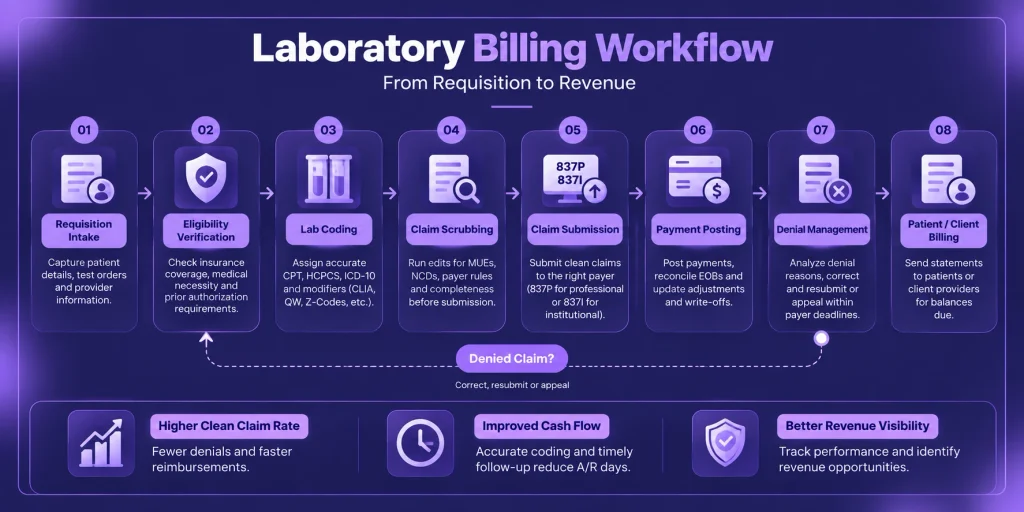
The laboratory billing process
- Requisition intake: capture patient demographics, insurance, ordering provider and diagnosis codes from the order.
- Eligibility and benefits: confirm coverage before or as the specimen arrives, using insurance eligibility verification.
- Coding: assign CPT, HCPCS and ICD-10-CM codes, plus modifiers and any test identifiers the payer requires.
- Claim scrubbing: check payer edits, unit limits and medical necessity rules before submission.
- Submission: send professional claims on the 837P and hospital outreach claims on the 837I.
- Payment posting: reconcile remittances against expected payment for each test.
- Denials and appeals: work every denial back to its cause through denial management.
- Patient and client billing: bill patient balances and, where state law allows, client accounts.
Why Lab Billing Is Different From Physician Billing
General billing teams often struggle with lab claims because the rules are lab-specific. These are the laboratory billing guidelines a lab billing company should handle without being told.
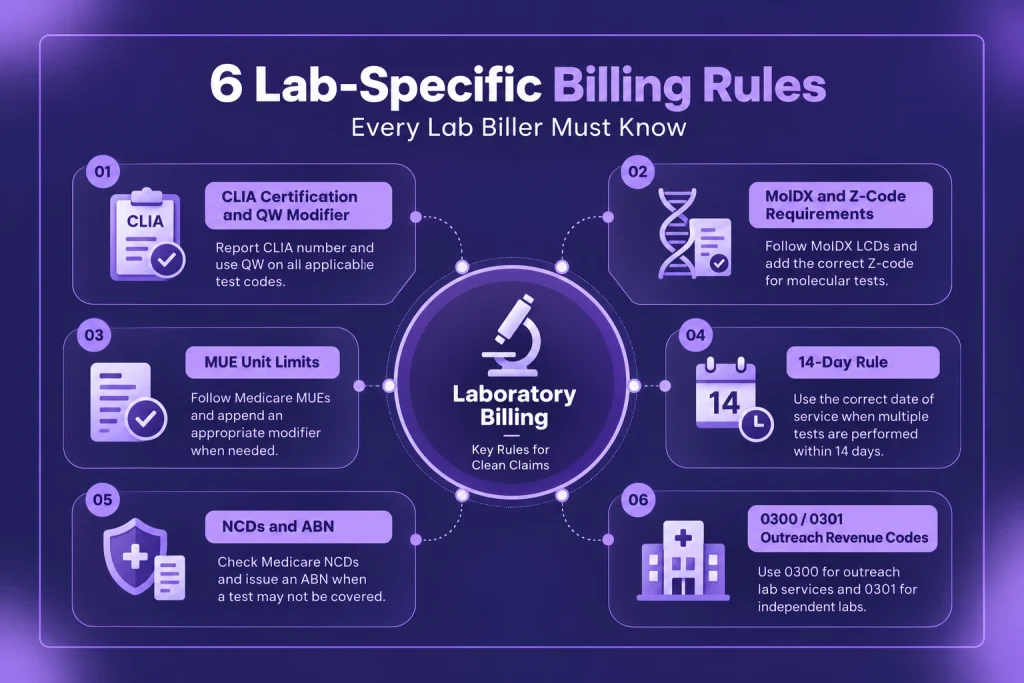
| Rule | What It Means for Lab Claims |
|---|---|
| CLIA certificate | Medicare lab claims must carry the lab’s CLIA number, and labs with a certificate of waiver report waived tests with modifier QW. |
| Clinical Laboratory Fee Schedule | Medicare pays most clinical lab tests from the CLFS, generally with no deductible or coinsurance for the patient. |
| PAMA rate setting | CLFS rates come from private payer rates that applicable labs report to CMS. |
| MolDX and Z-codes | In MolDX jurisdictions, many molecular tests need a DEX Z-code identifier on the claim to be paid. |
| Drug testing codes | Presumptive drug tests use CPT 80305 to 80307; Medicare pays definitive testing with HCPCS G0480 to G0483. |
| Medicare 14-day rule | Decides whether the hospital or the performing lab bills certain tests on specimens from hospital patients. |
| Medically unlikely edits (MUEs) | Daily unit limits per code; a frequent cause of lab denials on multi-unit tests. |
| Lab NCDs and ABNs | National coverage determinations set diagnosis and frequency limits for common lab tests; an Advance Beneficiary Notice is needed when Medicare is likely to deny. |
| Hospital outreach billing | Outreach labs bill on the UB-04 with laboratory revenue codes such as 0300 and 0301. |
| Direct billing laws | Some states require labs to bill the patient or payer directly rather than the ordering physician. |
What Changes for Lab Reimbursement in 2026 and 2027
The Consolidated Appropriations Act, 2026 held Medicare CLFS rates at 0% reduction for 2026 and moved the PAMA data collection period to January 1 to June 30, 2025. Applicable labs reported that private payer data from May 1 to July 31, 2026, and CMS will use it to set CLFS rates starting in 2027. Under current law, cuts of up to 15% a year may resume in 2027 and run through 2029, affecting roughly 800 tests, according to the CAP summary.
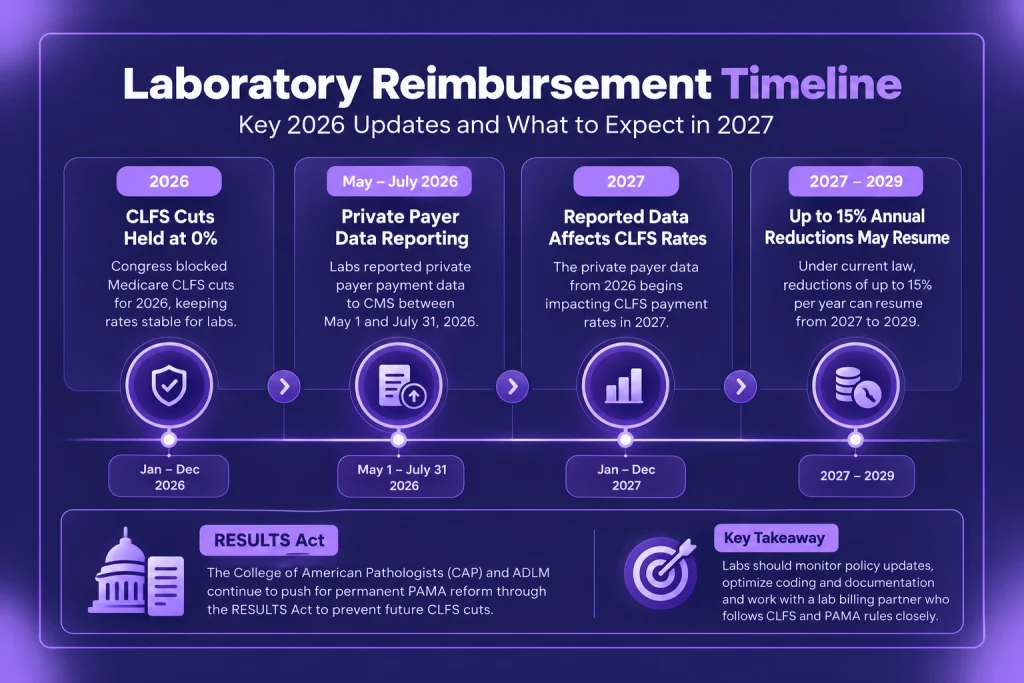
Laboratory groups continue to push the RESULTS Act, which would change how Medicare collects market data and hold CLFS rates steady while a new system is built, as ADLM reported in August 2026. Until something passes, labs should plan for lower Medicare lab reimbursement in 2027 and choose a billing partner that tracks these changes code by code.
How We Ranked These Lab Billing Companies
iSolve RCM, the medical billing company that publishes this guide, ranks itself first. That is a conflict of interest, so here is how the list was built. We scored each company on six criteria and used only facts that each company or an independent source publishes. Where we could not verify a performance claim, we left it out.
| Criterion | Weight | What We Looked For |
|---|---|---|
| Lab-specific coding depth | 25% | Molecular, toxicology, pathology and clinical lab coding, MolDX and drug testing rules |
| Denial and A/R performance | 20% | A clear process for lab denials and aging accounts, with reporting by payer and code |
| Fit by lab type | 15% | Match to POLs, independent, outreach, molecular, toxicology or pathology labs |
| Billing model | 15% | Full service, software alone or software plus a billing team, and how easily a lab can switch |
| Pricing transparency | 15% | Published pricing or a clearly explained model |
| Independent proof | 10% | Third-party rankings, certifications or verifiable history |
iSolve ranks first because these criteria reward full-service billing at a published price for the labs most likely to read this guide: physician office labs and smaller independent labs. High-volume molecular and genetic labs should weigh XiFin, TELCOR and Quadax more heavily.
The 10 Best Laboratory Billing Companies in the US
1. iSolve RCM: Best for Physician Office Labs and Small Independent Labs
iSolve RCM is a medical billing and revenue cycle management company headquartered in Edison, New Jersey. It handles the full revenue cycle for practices and labs: eligibility verification, coding, claim submission, denial management, A/R follow-up and payer credentialing.
For a practice running its own lab, the advantage is one team for everything. Lab claims, professional claims and payer credentialing sit with the same billing team, so a CLIA or enrollment problem is caught before it turns into a stack of denied lab claims. Pricing is published, starting as low as 2.99% of monthly collections.
Best for: Physician office labs, multi-site clinics with in-house testing and small independent labs that want lab billing handled with the rest of their revenue cycle at a known price.
Keep in mind: iSolve is a full-service billing company, and also have dedicated team of lab-only specialist.
2. XiFin: Best for High-Volume Molecular and Genetic Testing
XiFin, headquartered in San Diego, California, builds revenue cycle software for diagnostic providers and also runs billing as a managed service. It was ranked the #1 client-rated RCM partner for outpatient laboratory services for the seventh consecutive year in Black Book’s 2025 RCM Outsourcing Survey.
Its Empower RCM platform uses AI and automation for claims, denials and appeals, which suits labs processing large claim volumes and complex molecular test menus.
Best for: Large molecular, genetic and ancillary labs that want an AI-enabled platform, with or without XiFin running the billing.
Keep in mind: XiFin is built for scale. Small labs may find the platform more than they need, and should ask how much hands-on support comes with the service tier they choose.
3. TELCOR: Best for Labs That Want Lab Software With a Billing Team
TELCOR, based in Lincoln, Nebraska and founded in 1995, makes revenue cycle software built for laboratories and hospital outreach programs. Since 2017, it has also run TELCOR Revenue Cycle Services, a lab-specific billing service that uses the same software its in-house customers use.
That design gives labs a rare option: outsource billing now and move it in-house later without changing systems.
Best for: Outreach and independent labs that want lab-specific software and the option to bring billing in-house later.
Keep in mind: TELCOR’s strength is software. Labs that only want a fully hands-off service should compare the depth of its service team with full-service billers.
4. Quadax: Best for Labs That Want Clearinghouse Control
Quadax, founded in 1973 and based in the Cleveland area of Ohio, offers laboratory and pathology revenue cycle solutions as software, outsourced billing services or both, built around its own clearinghouse platform.
Labs can keep billing in-house on Quadax software, outsource it to Quadax’s lab billing team or mix the two.
Best for: Labs and pathology groups that want clearinghouse-level control and flexible delivery options.
Keep in mind: Quadax serves hospitals, DME companies and other segments too. Ask which team will work your account and its experience with your test mix.
5. Advanced Data Systems (ADS): Best for Mixed Clinical and Specialty Testing
Advanced Data Systems offers laboratory billing services through a team that covers NGS, genetic, molecular, clinical, pathology, toxicology and esoteric laboratory billing, alongside its own billing software.
That breadth suits labs whose menu mixes routine clinical tests with higher-complexity specialty testing.
Best for: Labs with a mixed menu of clinical and specialty tests that want software and service from one vendor.
Keep in mind: ADS also serves many non-lab specialties. Ask for lab-specific denial and A/R results.
6. Coronis Health: Best for Labs Inside Larger Organizations
Coronis Health runs a dedicated laboratory billing and RCM practice that uses its Ai4AR automation for laboratory accounts receivable and says former lab leaders help design client strategy.
It also covers molecular diagnostics coding through its specialty lab billing services.
Best for: Labs that are part of larger healthcare organizations already using outsourced RCM across several specialties.
Keep in mind: Coronis is a multi-specialty RCM company. Ask for references from labs with a test mix like yours.
What Does “Drugs Requiring Detailed Coding” Mean?
7. PGM Billing: Best for Independent Labs That Want Their Own Software
PGM Billing, based in Lyndhurst, New Jersey, offers laboratory revenue cycle management along with its own lab billing software, analytics and LIS integration. It covers molecular, clinical, pathology and toxicology lab billing.
Best for: Independent labs that want a billing team plus software and analytics they can see themselves.
Keep in mind: Parts of PGM’s toxicology content still describe Medicare’s 2016 drug testing codes, so confirm the team is working from current CPT 80305 to 80307 and G0480 to G0483 rules.
8. TransLabs: Best for Labs That Want a Lab-Only Vendor
TransLabs, based in Texas, describes itself as a billing company that works only with laboratories, covering molecular, toxicology, pathology and specialty testing.
For labs that have had a bad experience with a general medical biller, a vendor with no physician billing can be appealing.
Best for: Independent and specialty labs that want a vendor focused only on laboratory billing.
Keep in mind: TransLabs’ published clean claim and denial rates are its own figures. Ask for payer-level results and references from labs your size.
9. CureMD: Best for Labs Inside One Software Ecosystem
CureMD, based in New York, combines EHR and practice management software with laboratory billing services.
That suits practices and labs that want ordering, results and billing inside one vendor’s system.
Best for: Practices and small labs that want lab billing inside an EHR and practice management system they already use or plan to adopt.
Keep in mind: Switching costs are higher when billing is tied to the same software. Confirm how data and claims move if you change vendors later.
10. Lighthouse Lab Services: Best for Audits and Payer Contracting
Lighthouse Lab Services is a laboratory consulting firm that offers billing audits and consulting for independent labs, hospital outreach labs, esoteric labs and pathology practices. It reviews fee schedules for free, checks charge capture at the CPT level and helps labs run billing RFPs.
It also offers payer strategy services, including network enrollment and Medicaid contracting.
Best for: Labs that want an outside audit of their current biller, help choosing a new one or support getting in network with payers.
Keep in mind: Lighthouse is primarily a consulting firm. Labs that need a team to work claims every day should pair it with a billing company rather than replace one.
Which Lab Billing Company Fits Your Lab?
| Your Lab | Start With |
|---|---|
| Physician office lab or small independent lab | iSolve RCM, CureMD |
| Multi-site clinics or ambulatory care groups with in-house testing | iSolve RCM, Coronis Health |
| High-volume molecular or genetic lab | XiFin, TELCOR |
| Toxicology lab | ADS, PGM Billing, TransLabs |
| Hospital outreach lab | TELCOR, Quadax |
| Lab that wants strong analytics and AI automation | XiFin, Coronis Health |
| Lab that may bring billing in-house later | TELCOR, Quadax |
| Lab that needs an audit or payer contracts | Lighthouse Lab Services |
Outsourced Lab Billing vs In-House
Outsourced lab billing makes sense when your volume is growing faster than your billing team, when specialty tests are denying at a high rate or when nobody in-house has time to track CLFS, MolDX and payer policy changes. Keeping billing in-house makes sense when you already have experienced lab billers and want full control, often on lab-specific software such as TELCOR or Quadax.
| Pricing Model | How It Works | What to Watch |
|---|---|---|
| Percentage of collections | A share of what is collected, common for full-service lab billing | Confirm which services are included, such as appeals and patient billing |
| Per claim or per requisition | A flat fee for each claim processed | Rewards volume, not results; watch for fees on rebilled claims |
| Software subscription | The lab pays for software and bills in-house | Staffing and training costs sit with the lab |
| Hybrid | Software plus a vendor billing team | Clarify who owns each task, especially denials |
Is Your Lab Leaving Money on the Table?
iSolve RCM can review your lab’s denials, A/R and payer mix and show you where claims are being lost. Start with a medical billing audit.
Request a Free Lab Billing Review
Questions to Ask a Lab Billing Company Before You Sign
| Question | A Strong Answer Includes |
|---|---|
| How many labs like ours do you bill for? | References with a similar test mix and volume |
| How do you handle MolDX Z-codes, drug testing codes and MUEs? | Specific workflows, not general promises |
| What are your denial and A/R results for labs? | Lab-specific numbers by payer, not one blended rate |
| How do you connect to our LIS? | A named interface method and an implementation timeline |
| Who tracks CLFS and PAMA changes? | A named owner and a process for updating fee schedules |
| How do you bill patients and clients? | Compliance with state direct billing rules and clear patient statements |
| What happens if we leave? | Data ownership and a written transition process |
How to Find a List of Independent Clinical Laboratories in the US
If you are looking for a list of independent clinical diagnostic laboratories rather than a billing company, the official source is the CMS CLIA Laboratory Lookup on QCOR. It lists every active CLIA-certified lab with its CLIA number, address, certificate type and expiration date, and it is updated weekly. To build a list of independent labs, use the QCOR active CLIA laboratories report and filter by the laboratory type “Independent.” CMS also publishes a laboratory registry of labs with sanctions, exclusions or revoked certificates, which is worth checking before you partner with a reference lab.
Why Labs and Practices Choose iSolve RCM
iSolve RCM handles lab billing as part of a complete revenue cycle: eligibility before testing, coding and claim scrubbing, denial management, A/R follow-up and the payer credentialing that keeps a lab in network. For practices with in-house labs, that means one team and one report for every claim the practice sends.
Frequently Asked Questions
What is the best laboratory billing company in the US?
It depends on your lab. iSolve RCM ranks first for physician office labs and small independent labs because it offers full-service billing at a published price. XiFin leads for high volume molecular and genetic labs, and TELCOR and Quadax fit labs that want lab-specific software with a billing team behind it.
What do lab billing services include?
Lab billing services usually include requisition intake, eligibility verification, coding, claim scrubbing, claim submission, payment posting, denial management, appeals, A/R follow-up and patient billing. Many also handle payer credentialing and fee schedule reviews.
How much do laboratory billing companies charge?
Most full service lab billing companies charge a percentage of collections, while others charge per claim or sell software for in-house billing. Rates depend on volume, test mix and services included. iSolve RCM, for example, starts at 2.99% of monthly collections.
Will Medicare lab payments drop in 2027?
They may. Congress blocked CLFS cuts for 2026, but under current law reductions of up to 15% a year can resume in 2027 through 2029, using private payer data labs reported in 2026. Proposed legislation such as the RESULTS Act would change that if passed.
Do lab claims need a CLIA number?
Yes. Medicare lab claims must include the CLIA number of the lab that performed the test, and waived tests billed under a certificate of waiver need modifier QW. Missing or mismatched CLIA information is a common cause of lab denials.
What is MolDX and why does it matter for lab billing?
MolDX is a Medicare program that sets coverage and coding rules for molecular diagnostic tests in its jurisdictions. Labs billing in those jurisdictions usually need a DEX Z-code identifier on the claim for many molecular tests, or the claim will deny.
Should a lab outsource billing or keep it in house?
Outsource when volume is growing, specialty tests deny often or nobody in-house can track lab-specific rules. Keep billing in-house when you already have experienced lab billers and want full control, usually on lab-specific billing software.
Where can I find a list of independent clinical laboratories in the US?
Use the CMS CLIA Laboratory Lookup on QCOR, which lists every active CLIA-certified laboratory. The active CLIA laboratories report can be filtered by laboratory type, including independent labs.


