

We need to take a little bit of time to be honest right now. No one got into healthcare because they envisioned themselves fighting insurance companies about CPT codes that weren’t covered. Here we are now as practice owners, office managers, and providers spending hours every week trying to fix issues that have nothing to do with our patients but only involve forms we never wanted to complete.
If you’ve ever looked at a denied claim that seemed absolutely perfect to you and wondered, why in the world did this get denied, you’re in the club. If you’ve spent half the day on the phone with the payer telling you that they sent your claim to the wrong division, you’re definitely in the club. And if you run a practice offering both medicine and behavioral health, then you’ve found out that there is almost no similarity between billing for the two of them.
That’s truly the focus of this guide. We’re going to talk about how medical and behavioral health billing solutions operate, why they are so important for providers who often don’t realize their significance until an issue arises, problems and challenges associated with them and what makes an effective solution different from an ineffective one which is silently draining money from the clinic. No matter if you are a solo practitioner struggling to manage your practice or a growing psychiatric group and even a multi-specialty clinic providing both physical and mental health services, you’ll find something useful in this guide. Practices looking for reliable medical billing services in USA can benefit from a billing partner that understands payer requirements, specialty-specific coding, and compliance across different healthcare settings.
What Are Medical and Behavioral Health Billing Solutions?
At the most basic level, medical billing services cover the process of turning clinical work into revenue: capturing accurate patient and insurance details, coding the visit correctly, sending the claim to the payer, following up on anything unpaid or denied, posting payments, and handling whatever’s left on the patient’s tab. It sounds straightforward written out like that. Anyone who’s actually done the job knows how many places it can go sideways.
Mental health billing services cover similar ground but come with their own quirks. A 45-minute one-on-one session for therapy (CPT code 90837) isn’t billed the same way as a diagnostic evaluation performed by a psychiatrist (code 90791). Group therapy (90853) operates by an entirely different set of rules. Introduce time-based billing codes, prior authorization guidelines which vary by the payer, telehealth add-on codes, and documentation driven by medical necessity and it becomes clear that behavioral health billing requires expertise that goes well beyond generalist billing models that are common in primary care.
Combine these two components and you can think of medical billing solutions and behavioral health billing solutions as simply the structure of people, processes, and software that keep the practice properly reimbursed. Some practices build that in-house with dedicated billing staff and practice management software. Others hand it to a specialized behavioral health RCM company that handles everything from eligibility checks through the final payment. Either way, the goal doesn’t change: collect more of what’s owed, get it faster, and pull as much of that burden as possible off clinical staff who didn’t get into healthcare to argue with insurance companies.
Why Integrated Billing Matters
Here’s where a lot of practices trip themselves up without meaning to. Clinics offering both medical and behavioral health services, or working under an integrated care model, often end up running two billing systems that barely talk to each other. There is one group processing the claims for physical health, another for behavioral health, and there is little communication between the two groups.
Consider, for example, a patient who has type 2 diabetes and depression. There will be a separate billing from the physician who sees the patient for his diabetes problem and from the therapist who deals with the mental illness. In addition, in the case of a collaboration model in the practice, there will be a billing every month of the codes 99492 to 99494. If the systems of processing are not communicating with each other, an error will occur somewhere along the line. Usually it’s a denial that shows up weeks later with no clear explanation attached.
Integrated billing solutions fix a good chunk of this. Consistency in patient record management, insurance information and payment history is guaranteed through every care setting provided, reducing the chances of mistakes due to old or incompatible data. Staff members need only familiarize themselves with one interface rather than having to use several. Coordinated care becomes easier to bill correctly, since collaborative care programs carry their own codes that require someone paying close attention to how physical and mental health services overlap. And reporting actually means something, because leadership can see the full financial picture instead of two disconnected halves of it.
Integrated care is becoming the norm rather than the exception. More primary care practices screen for depression and substance use as routine, and more behavioral health clinics add some level of medical oversight. Revenue cycle management for behavioral health has to keep pace with that shift, or it ends up undercutting the very coordination integrated care is supposed to deliver.
Expert Guide: Integrating billing practices for both medical and behavioral health into one workflow process may prevent administrative errors, increase claims accuracy, and increase visibility into your finances. It is important to review any changes that payers make, as well as the results of your own billing reports.
Common Billing Challenges in Medical and Behavioral Health
Before getting into solutions, it helps to be honest about the problems. These are the issues that come up over and over in conversations with practice administrators and billing staff, no matter the specialty. Reducing billing errors and improving claim accuracy are key to protecting practice revenue. Learn more about the most common financial pitfalls in our guide on why medical practices lose revenue.
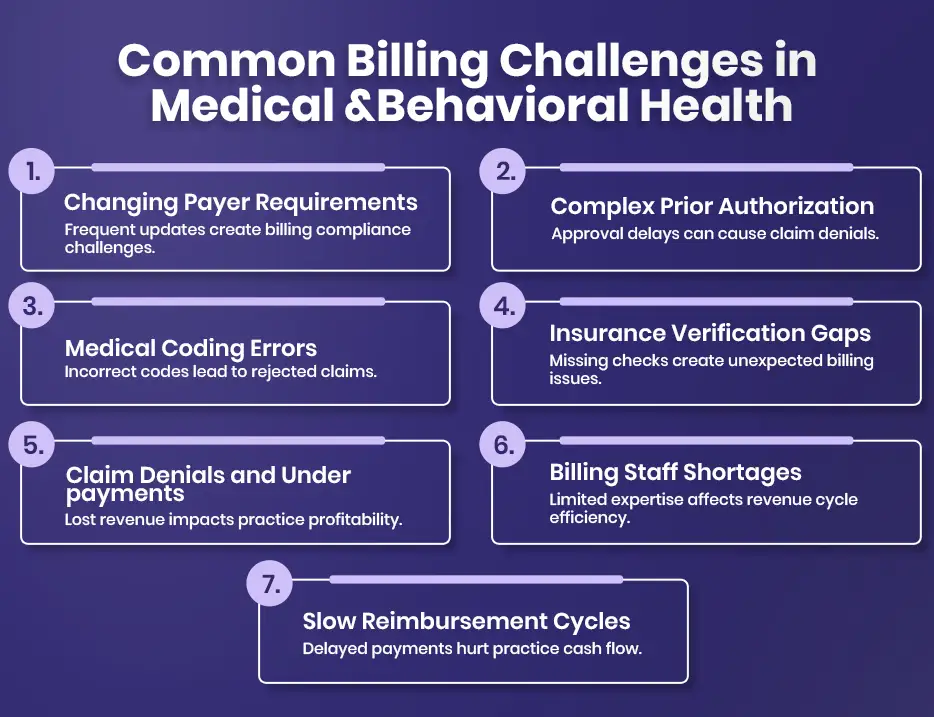
1. Payer Rules That Won’t Sit Still
Insurance companies update policies constantly, and behavioral health carve-outs make it worse. A code that was reimbursable last quarter might need new documentation this quarter, often with little warning. Keeping up manually is nearly impossible for a small in-house team also handling scheduling and patient calls.
2. Prior Authorization
Higher levels of behavioral health care, intensive outpatient, partial hospitalization, often need prior authorization before a session even happens. A missed or mistimed authorization is one of the most common, and most preventable, reasons a claim gets denied.
3. Coding Errors
Wrong CPT code, missing modifier, a diagnosis that doesn’t line up with the service billed. Coding mistakes are a leading cause of denied and delayed claims. Behavioral health coding is especially unforgiving here, since session length, service type, and provider credentials all affect which code applies.
4. Eligibility and Benefits Verification Gaps
If insurance isn’t verified before the appointment, the practice risks providing a service that isn’t covered, or billing it at the wrong rate. This happens in both medical and behavioral health settings, but it stings more in behavioral health, where weekly sessions mean the financial impact compounds fast.
5. Claim Denials and Underpayments
The big one. Denied claims eat staff time, delay revenue, and if not appealed properly, become permanently lost income. Underpayments are sneakier still, often going unnoticed unless someone’s actively auditing payments against contracted rates.
6. Staffing and Turnover
Billing requires a certain set of expertise, which is why talented billers are difficult to recruit and to retain. Small behavioral health care providers do not have enough traffic to sustain their own billing department; however, they cannot suffer the losses that stem from a poorly supported one.
7. Slow Reimbursement Cycles
There is a lag from the time a claim is submitted, to the time the payer processes the claim, to resolving any issues surrounding denial if it occurs, during which time the practice does not receive any compensation. This poses cash flow challenges for many small practices.
Professional Insight: The majority of billing problems can actually be avoided by doing eligibility checks, proper coding, and performing regular claims audits. If you find your problems early on, you won’t have to worry about denials and reimbursement delays.
Key Features of Effective Billing Solutions
Given all that, what should a practice actually look for? A few things tend to separate billing solutions that work from the ones that just sound good in a pitch deck.
Specialty-specific coding expertise sits at the top of the list. A billing solution needs coders and billers who understand behavioral health’s specific codes, modifiers, and documentation requirements, not general medical billing know-how stretched to cover it. The same goes for medical specialties with their own quirks.
Real-time eligibility verification matters more than it gets credit for. Automated tools that check insurance and benefits before appointments help prevent claims from going out for services that aren’t covered, or at rates that don’t match the contract. Professional medical coding services help ensure CPT, ICD-10, and HCPCS codes are assigned accurately, reducing coding errors that commonly lead to claim denials.
Clean claim scrubbing is the step that quietly saves the most headaches. Before a claim goes out, it should be checked for missing information, mismatched codes, invalid modifiers. That one step alone can cut denials down significantly, just by catching mistakes before a payer ever sees them.
• Denial tracking and management — every denial gets logged, categorized, and worked, not just resubmitted and hoped for
• Transparent reporting — visibility into days in AR, denial rates, collection rates, and payer performance
• Compliance safeguards — HIPAA compliance plus, for substance use records, 42 CFR Part 2 protections. Billing teams should also stay updated with federal privacy requirements, including HIPAA regulations published by the U.S. Department of Health & Human Services (HHS).
• EHR and practice management integration — less manual entry, fewer errors, less duplicate work
• Patient billing support — clear statements and flexible payment options, since patient responsibility keeps growing as a share of practice revenue
Benefits for Providers and Practices
When those pieces come together, the difference shows up fast, and not just in the bank account.
Cash flow gets faster and more predictable. Clean claims plus proactive follow-up mean revenue arrives sooner and with fewer surprises, which makes budgeting something a practice owner can actually plan around instead of guessing at.
Time is returned to the clinical professionals. It is not why therapists, psychiatrists, and doctors entered the healthcare profession in the first place, to argue with insurance firms over their billings at night. The delegation of billings frees up their time to engage in the business for which they joined this profession in the first place.
The chances of an audit or recoupment decrease because of good documentation and coding practices. Accuracy of billings ensures better communication with the patient regarding a bill that may come as a shock to him or her.
And the system scales. As a practice adds providers or expands service lines, solid billing infrastructure grows with it instead of becoming the bottleneck. Ultimately, more of what’s billed actually gets collected: less written off to denials, underpayments, or follow-up that never happened. Comprehensive revenue cycle management services streamline every stage of the reimbursement process, from patient registration and eligibility verification to payment posting and collections.
How Billing Solutions Reduce Claim Denials
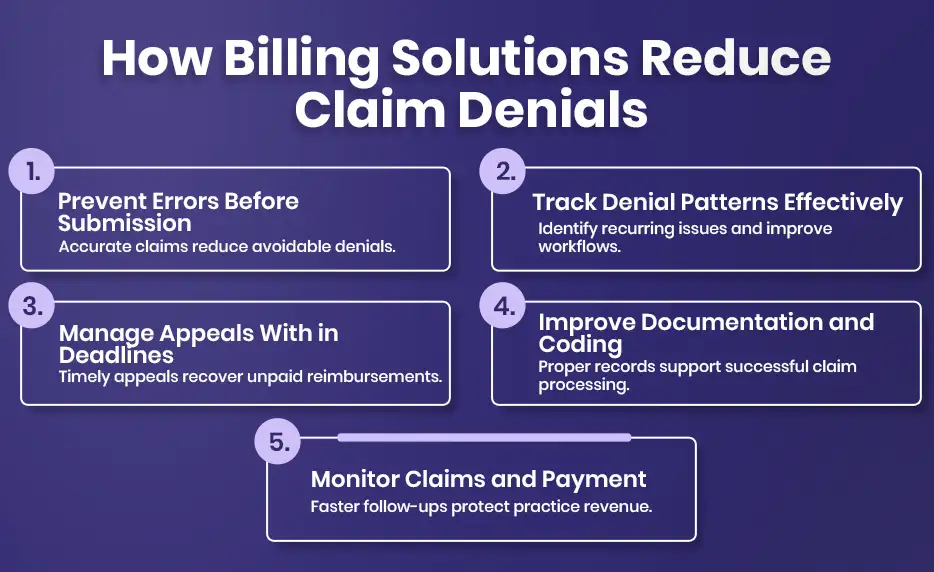
Claim denial management deserves its own spotlight, because it’s often where the biggest financial gains hide in plain sight. Denied claims aren’t just an annoyance — a meaningful share of denied claims never get resubmitted at all, which means the revenue doesn’t get delayed, it just disappears.
Denial Management can be performed on several fronts simultaneously. The first is prevention: making sure that one’s eligibility is verified before an appointment is set up, making sure there is actual authorization, checking the claim for mistakes before submitting it. The right billing system prevents most problems beforehand.
When denials do slip through, resubmitting and moving on isn’t enough. Good billing teams track denial reasons and look for patterns, is one payer consistently denying a specific code, is there a documentation gap tripping up a certain service type. Finding the root cause is what stops the same denial from repeating month after month.
Appeals are also critical and are processed on stringent timelines. One misses it and then the case is dismissed even if the case was valid all along. The denial management process comes in handy in ensuring timely submission of an appeal with all relevant documents to be included. Understanding the different peculiarities, formatting styles, and denials trends of each payer enables the billing team to customize their appeals.
Combine the above components with a software system that monitors and triggers aged claims, and then denials will be minimal and the few denied claims will be handled faster and effectively. This will definitely improve bottom line revenues. Dedicated denial management services identify the root causes of rejected claims, manage timely appeals, and help recover revenue that might otherwise be written off.
Guide for Practices: Avoiding claim denials through proper preparation is better than trying to resolve them once filed. Conducting routine claim evaluations and documentation along with proactively following up with payers can ensure that recurring problems are identified and revenue recovered.
How to Choose the Right Billing Partner
Not all billing companies are created equal, and the wrong one can end up costing just as much as having no formal process at all. Here’s what actually matters when comparing healthcare billing solutions providers.
Ask about experience in your specific field first. If you run a behavioral health practice, push for specifics on their behavioral health RCM experience, not general medical billing they’re hoping translates over. The coding rules and documentation standards are different enough that generalist experience often falls short.
Look for transparency in reporting. You should have access to clear, regular reports on claim status, denial rates, days in AR, and collections. Vagueness here is a red flag, not a minor detail.
Check references and track record. Ask for practices similar in size and specialty to yours, and pay attention to how long they’ve kept existing clients, since high turnover is often a quiet sign of underperformance.
Confirm technology and integration capability, compliance and security standards (HIPAA, and 42 CFR Part 2 for substance use practices), and get a straight answer on pricing structure: flat percentage of collections, per-claim fee, or flat monthly rate, with no hidden fees buried in appeals or reporting.
And don’t skip communication and scalability. You want a partner who responds without being chased down, and one who can grow with you if you’re adding providers or opening new locations. A billing partner is essentially becoming an extension of your financial operations, so the vetting deserves the same scrutiny you’d give a key hire.
Why Outsourcing Medical and Behavioral Health Billing Makes Sense
In any case, it boils down to build or buy: cultivate your own billing department or outsource it to a specialized partner. There’s no universal solution, but outsourcing is becoming ever more prevalent, and for understandable reasons.
Outsourcing saves on costs. It is very costly to hire, train and retain experienced billers; moreover, smaller practices simply do not have enough claim volume to have a dedicated team of billers working in-house. Outsource billing transforms the cost of hiring staff into a more variable fee based on collections.
It is easier to keep up with changing regulations and trends. A specialist billing company operates with a lot of different practices and payers simultaneously, thus they are always exposed to new regulations and trends in a way one single practice cannot afford.
Outsourcing decreases the administrative burden of physicians while making the process faster, as coding requirements and payer policies are constantly changing. In any case, when done right, outsourcing increases efficiency of practice financially, as it provides for better collections and lower rates of denial of claims. And, lastly, it ensures continuity of practice, which can be threatened by high staff turnover.
On the other hand, outsourcing can succeed only when the partner organization truly fits, and that’s precisely why the process described above becomes important. An inappropriate partnership causes as many problems as it solves. Many growing practices choose to outsource medical billing services to reduce administrative costs, improve claim accuracy, and gain access to experienced billing professionals without expanding in-house staff.
How iSolve RCM Helps You Simplify Healthcare Billing
iSolve RCM will provide you with an easy way to handle your billing processes for all your medical and behavioral health practices by offering our revenue cycle management services which are designed specifically to cater to the needs of your practice. We have vast experience in handling billing processes for primary care practices, psychiatrists, counselors, and other medical specialists, making sure that all codes are entered accurately and all claims get submitted on time. We will integrate our solution into your current process to help you achieve efficient cash flows and maximized reimbursement.
FAQs
What’s the difference between medical billing and behavioral health billing?
Medical billing generally covers a broad range of procedure- and diagnosis-based coding across specialties. Behavioral health billing services add their own layer on top of that: time-based session coding, stricter medical necessity documentation, frequent prior authorization, and extra privacy protections for substance use records under 42 CFR Part 2.
How much can a practice save by improving claim denial management?
Depending on the practice, it will generally bring about more revenues to the organization, since the majority of the time, the claims which were denied are rarely ever resubmitted.
Is outsourcing billing more cost-effective than an in-house team?
Yes, for many small to medium sized practices. This is because outsourcing will reduce the costs associated with salaries and training while at the same time linking cost directly to collections results.
How long before I see improvement after switching billing solutions?
Most practices notice measurable improvement in claim acceptance and days in AR within the first 60 to 90 days, though full optimization can take longer depending on the existing AR backlog.
Can integrated billing solutions handle both medical and behavioral health claims under one system?
Yes, that’s what they’re meant to do. Practices that provide both services coordinate everything using a single workflow process, thus making the processes more efficient and eliminating any duplication from two different systems.
What should I look for first when evaluating a billing partner?
Start with relevant specialty experience and transparent reporting. If a billing company can’t clearly explain how they’ll communicate performance data back to you, keep looking.